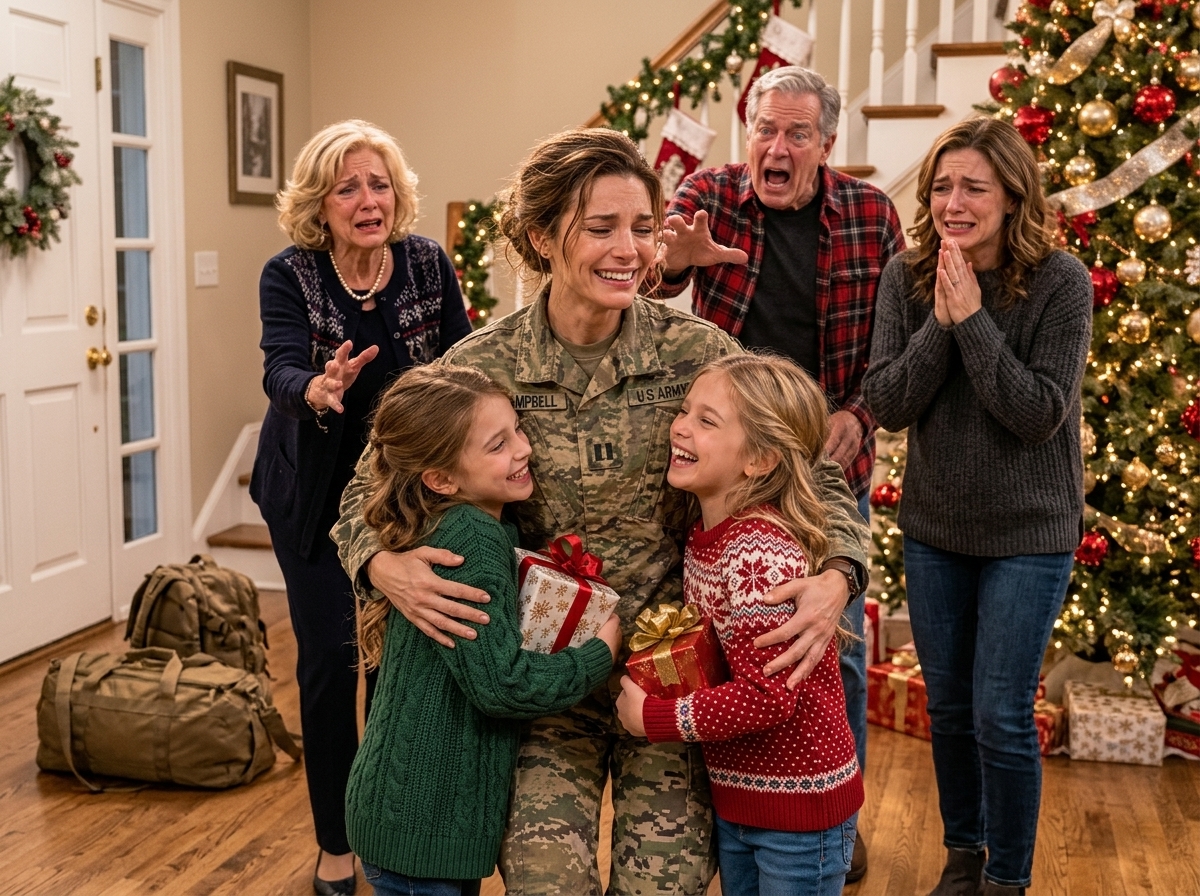
My mom took the last present from my 7-year-old’s hands and gave it to her cousin. “She deserves it more.” My daughter just stared at the empty tree. I didn’t argue. I packed our coats and left. Two hours later, Dad called shouting, “What did you cancel?”
The Line We Do Not Cross
By Captain Amanda Campbell, U.S. Army (Ret.)
Chapter 1: The Ambush at the Hearth
In the military, they teach you that an ambush rarely announces itself with a bugle call. It begins with an unnatural stillness—the sudden absence of birdsong in a tree line, a shadow falling across a gravel road where no tree stands, a whisper of cordite on an otherwise clean wind. You learn to read the terrain not for what is painted on its surface, but for what is being concealed beneath it.
I spent seven years as a logistics officer in the United States Army, coordinating supply convoys through the jagged passes of eastern Afghanistan and managing multi-million-dollar supply depots under mortar fire before receiving my honorable discharge as a captain. I knew how to read terrain. I knew how to secure a perimeter.
What I did not know, until that freezing December afternoon in the affluent suburbs of Upper Arlington, Ohio, was that the most devastating tactical ambushes are not executed by insurgent cells in foreign valleys. They are planned over porcelain teacups in living rooms that smell of spiced cider and pine needles, executed by the very people who gave you your name.
The grandfather clock in the foyer of Brenda and George Campbell’s four-bedroom colonial chimed four times. Wrapping paper—heavy, metallic foil printed with silver bells and crimson ribbons—lay strewn across the Persian rug like spent brass after a firefight. Bing Crosby was crooning through the Bose speakers recessed into the crown molding. On the sofa, my seven-year-old daughter, Riley , sat cross-legged in her green velvet holiday dress, her small fingers gently working beneath the satin bow of a square box wrapped in midnight-blue paper.
It was the final parcel on her side of the Christmas tree. Every other gift bearing her name had already been methodically shifted, opened by others, or whisked away into the back den under the guise of “sorting.”
My mother, Brenda Campbell , moved with the quiet, practiced grace of a seasoned diplomat who had long ago mastered the art of polite theft. She did not snatch. She did not raise her voice. She simply leaned down, slid her manicured fingers under the midnight-blue ribbon, lifted the box out of Riley’s hands, and pivoted toward my younger sister, Taylor , and her eight-year-old daughter, Harper .
“She deserves it more,” Brenda said softly, placing the heavy parcel directly into Harper’s lap.
Riley’s small hands remained suspended in the empty air, her fingers curved as though the box were still there. She did not cry. That was the detail that drove a cold bayonet through my ribs. Riley was an Army brat for the first four years of her life; she had learned early to observe before reacting. Her hazel eyes, wide and luminous, flicked down to her empty palms, then up to the bare carpet beneath the tree where twenty boxes had been stacked two hours earlier, and finally toward me.
Beneath the new adhesive gift label on the blue box—a tag that read To Harper, Love Nana —the corner of an older, neatly handwritten card was visibly trapped under the tape. My eyes, trained to catch discrepancies in supply manifests and cargo seals, locked onto that exposed sliver of paper. The handwriting was unmistakable. It was slanted, elegant, written in blue fountain-pen ink: For Riley, with love from Aunt Carol.
The room did not erupt into chaos. That was the genius of my family’s particular brand of cruelty: they made betrayal feel like etiquette. Taylor was sitting on the floor beside Harper, surrounded by three towering gift bags and an avalanche of torn tissue paper. My father, George Campbell , stood anchored by the brick hearth, one hand wrapped around a ceramic mug of black coffee, his expression entirely unreadable, like a commanding officer watching an unpalatable order being carried out from a safe distance.
“Mom,” I said. My voice was low, level, calibrated to the exact tone I used when a supply sergeant tried to tell me twenty crates of body armor had simply vanished from a shipping manifest. “That belongs to Riley.”
Brenda turned to me, offering the patient, pitying smile she reserved for those she deemed emotionally defective. It was the same smile she had given me when I came home from Fort Lee with calluses on my palms instead of an engagement ring.
“Amanda, please,” Brenda murmured, smoothing her tailored woolen slacks. “We talked about this. Harper has had an excruciating year. With the separation, the move, the adjustment… we all agreed Christmas needed to be about her this time. Don’t make this uncomfortable.”
I stood up from the wingback chair. My posture straightened automatically—shoulders back, spine locked, hands loose at my sides. “We never spoke about this, Mom. And I never authorized anyone to reassign my daughter’s gifts.”
A tiny, suffocating hush dropped over the living room. Across the rug, my aunt Denise slowly lowered a gingerbread cookie halfway to her mouth. My cousin Mark paused with his drink suspended in the air.
“Wait,” Mark frowned, looking between Brenda and me. “Aunt Brenda, you told us Amanda specifically called you to set this up because Riley already had too much at home.”
Brenda’s porcelain smile fractured at the corners, her jaw tightening just enough to betray the hitch in her script. “Amanda is simply feeling overwhelmed, Mark. Let’s not turn family charity into a spectacle in front of the little girls.”
“This isn’t charity,” I said, stepping between the coffee table and the couch, placing myself directly between Brenda and Riley. “Charity requires the consent of the giver. Taking something with a child’s name on it and handing it to someone else because you’ve decided she matters less is theft. Plain and simple.”
Taylor leaned forward, her voice trembling with that practiced, fragile outrage she had weaponized since childhood. “Amanda, how can you say that? Harper has been through hell! She lost her house! Her father walked out! Riley has a two-story home, private swimming lessons, and both of her parents under one roof! Are you really going to begrudge an eight-year-old a little happiness just to be petty?”
Beside her, little Harper looked down at the midnight-blue box in her lap. She wasn’t smiling. She looked anxious, her shoulders hunched, glancing between her mother and the adults around her like a fawn caught in crossfire. I had never held any malice toward Harper; she was a casualty of her mother’s perpetual helplessness and my parents’ bottomless appetite for drama.
My father cleared his throat, setting his coffee mug on the oak mantel with a sharp, definitive click. “That’s enough, Amanda. Riley has plenty. You make a handsome living with your logistics company. You can replace whatever she wants on your own dime. Stop making a mountain out of a molehill on Christmas Day.”
You can replace whatever she wants.
He said it with the casual arrogance of a civilian who believed that supply lines grew on trees, that labor cost nothing, and that another person’s property became communal the moment a louder emotional claim was staked.
A small tug pulled at the hem of my sweater. I looked down. Riley was staring up at me, her lower lip trembling slightly, her eyes brimming with a silence that was far more damning than a tantrum.
“Mommy,” she whispered, her voice barely carrying over the crackle of the fireplace. “Did I do something bad? Did Santa change his mind about me?”
The air left my lungs. Every logistical calculation, every rational argument, every thread of familial patience that had kept me tethered to this family for thirty-two years burned away to cinders. I knelt on the rug, took Riley’s cold, small hands into mine, and looked directly into her eyes.
“No, sweetheart,” I said, my voice perfectly clear, audible to every person in that suffocating room. “You did nothing wrong. Not one single thing.”
I stood up, reached for her woolen winter coat, and zipped her into it. I grabbed my purse from the side table.
Brenda stepped forward, her voice rising an octave, abandoning the sweetness. “Amanda, if you walk out that door right now, you are ruining Christmas for the entire family! You are being entirely dramatic!”
“Don’t cause a scene, Amanda!” George barked from the hearth. “Show some discipline!”
“You’re making Harper feel like garbage!” Taylor shouted from the floor.
I didn’t utter another syllable. I did not raise my voice, slam my fists, or knock over their glittering porcelain nativity set. In the Army, when an outpost becomes fully compromised by hostile command, you do not engage in a futile shouting match across the barbed wire. You execute a tactical withdrawal, consolidate your forces, and prepare the battlefield on ground of your own choosing.
I took Riley by the hand, walked out into the biting Ohio winter, and pulled the heavy oak front door shut behind us with a solid, echoing click.
As I buckled Riley into the back seat of my SUV, the vehicle’s interior mirror reflected the warm glow of my parents’ front porch lantern. My phone buzzed in my coat pocket. It was a text from an unknown number, but the voice behind it was clear as glass:
You should have stayed seated, Amanda. Some things are already in motion that you cannot stop.
Chapter 2: The Tactical Withdrawal
The drive from Upper Arlington to my four-bedroom home in Dublin, Ohio , was thirty-two minutes of gray, frozen silence. The wiper blades scraped a steady, rhythmic cadence against the windshield, clearing away the wet slush falling from a bruised winter sky.
In the rearview mirror, Riley sat rigidly upright in her booster seat. She wasn’t crying; she was simply watching the holiday lights flicker past the darkened glass—red, green, gold, reflecting off suburban lawns like distant warning flares.
When we stepped through our front door, the warm, clean scent of cedar and vanilla enveloped us. Our home was quiet, orderly, structurally sound. I had built this life brick by brick after separating from the military. My husband was away on a scheduled offshore engineering rotation until New Year’s Eve, leaving me as the sole guardian of our perimeter.
I took Riley’s coat, knelt down, and pulled off her little leather boots. I boiled milk, stirred in Dutch cocoa, and topped it with miniature marshmallows. Then, I walked into the study, unlocked the cedar cabinet where I had hidden the one present I hadn’t transported to Brenda’s house three days prior: a modest, hand-painted wooden music box from Germany that played a traditional lullaby.
I brought the box into the family room and placed it on the coffee table beside her steaming mug. Riley looked at the box, her hands tucked securely beneath her thighs.
“Can I keep this one?” she asked, her voice impossibly small. “Or does Harper need this one, too?”
A white-hot spike drove through my temples, but I maintained my command face. I sat beside her, smoothed her dark hair behind her ear, and looked her square in the eyes.
“This is yours, Riley,” I told her, making every word an iron rivet. “Nobody in this world has the right to take what is yours and hand it to someone else without your permission. Not your grandmother. Not your grandfather. Not your aunt. If you ever choose to give something away, that will be your decision. But until you decide to give it, it is yours. Do you understand me?”
She nodded slowly, the tension finally unspooling from her small shoulders as she pulled the box toward her chest and pressed her face into the cold wood.
While Riley watched an animated holiday feature on the television, I walked into my home office and closed the French doors. The discipline of command does not leave you when you take off the uniform. When an operation goes sideways, you do not waste time wallowing in indignation; you review your inventory, assess supply lines, and determine your liabilities.
My commercial enterprise, Vanguard Logistics & Event Solutions , was a mid-sized operation based out of the Columbus industrial corridor. Over the past four years, I had grown the company from two surplus flatbed trailers into an enterprise commanding forty staff members, a fleet of refrigerated and dry transport vehicles, and an extensive warehouse of high-end staging, architectural lighting, and corporate event infrastructure.
Because my parents were active volunteers in local civic circles, I had routinely allowed Vanguard to provide pro-bono logistics, decor rigging, and event staging for various civic fundraisers they supported. I had viewed it as an act of community service and quiet family loyalty.
One of those events was scheduled for two weeks away: the Mid-Ohio Community Outreach Annual Volunteer Appreciation Gala , held in the grand ballroom of the Greater Columbus Convention Center . It was the crown jewel of the local nonprofit calendar, attended by city council members, corporate executives, and civic benefactors.
Vanguard had committed an elite in-kind sponsorship package valued at just over thirty-eight thousand dollars: custom pipe-and-drape fabrication, computerized truss lighting, an eight-piece velvet lounge perimeter, transport, rigging crews, and ten off-duty staff members for teardown on a Sunday morning.
My parents had spent six months talking about this gala. My father, George, sat on the coordinating advisory sub-committee. Brenda was a perennial committee chairwoman.
I sat down at my mahogany desk, booted up my laptop, and navigated through my secure enterprise portal. I pulled up the commercial agreement Vanguard had executed with the Mid-Ohio Outreach Board back in September.
I scrolled directly to Section 14: Termination and Modification of Voluntary Corporate Sponsorship.
The clause, drafted by my firm’s corporate counsel, was crystal clear: Vanguard Logistics reserves the unilateral right to withdraw, scale down, or reallocate in-kind logistical packages without cause prior to December 31st of the current operating calendar, subject only to a standard administrative cancellation indemnity of $1,250.
I read the clause three times. I had not sought this fight. I had spent years overlooking small slights—my mother taking credit for catered dishes I had paid for, my father introducing my business triumphs as “a Campbell family commercial endeavor,” Taylor borrowing Vanguard utility vans for personal errands without replacing the diesel. I had tolerated it because I thought that turning a blind eye was the price of keeping peace on the home front.
They mistook my discipline for surrender, I thought, the cold truth settling deep into my marrow. They mistook my silence for complicity.
I opened my corporate account, processed the electronic payment for the $1,250 administrative indemnity to the Mid-Ohio Outreach general account, and executed the formal notice of withdrawal.
The letter was professional, emotionless, and devastatingly precise:
To the Steering Committee of Mid-Ohio Community Outreach:
Please be advised that effective immediately, Vanguard Logistics & Event Solutions exercises its contractual prerogative under Section 14 to withdraw the designated staging, decor, and personnel package previously slated for the January 10th Volunteer Appreciation Gala. The administrative fee has been remitted in full via wire transfer. We wish your organization continued operational success in securing alternative commercial vendors for your infrastructure needs.
Respectfully,
Captain Amanda Campbell, Managing Director.
I hit Send .
The automated system confirmed receipt and instantly notified the primary logistical liaisons registered on the event dashboard—one of whom was George Campbell.
I shut the laptop, leaned back in my leather executive chair, and took a slow, measured breath. I returned to the living room, sat beside my daughter, and held her hand while the animated characters sang on the screen.
Exactly two hours and fourteen minutes after the email was dispatched, my phone began vibrating violently across the coffee table.
It was George.
I let it ring to voicemail. He called back immediately. On the third consecutive call, knowing Riley was now asleep with her head curled in my lap, I answered, pressing the receiver tightly to my ear.
“Amanda,” his voice boomed, stripped of all suburban gentility, vibrating with a guttural, furious panic I had never heard from him before. “What the hell did you just do?”
I kept my voice at a whisper. “I withdrew my company’s assets from an event I no longer wish to support.”
“You put that package back right now!” he snarled, his breath hissing through the phone. “Do you have any idea what you’re doing? You are embarrassing this family! You are punishing a charitable institution because your mother hurt your feelings over some damn toy boxes!”
“The charity still has its venue, its caterers, and its ticket sales, Dad,” I replied, standing up carefully so as not to wake Riley, moving toward the kitchen window. “They can rent furniture and hire labor like any other organization. I am simply declining to donate thirty-eight thousand dollars of my company’s capital to people who believe my family is a personal supply depot to be raided at will.”
“You self-righteous little—” He stopped himself, catching his breath, his voice dropping into a desperate, razor-thin register that sent a shiver down my spine. “Amanda, listen to me. You don’t understand. You have no idea what is riding on that stage. You have no idea what you just ruined.”
I paused, leaning against the cold granite countertop. “What did I ruin, Dad? It’s just an appreciation dinner.”
“Put the sponsorship back,” he ordered, his voice cracking with pure terror. “Before the board convenes on Monday. If you don’t, you won’t just destroy your mother’s reputation. You’ll destroy everything.”
Before I could demand an explanation, the line went dead.
Chapter 3: Reconnaissance and the Paper Trail
When an Army convoy encounters a suspected improvised explosive device, standard protocol does not call for an emotional debate; it calls for a five-to-twenty-five-meter sweep. You stop moving forward, you freeze the perimeter, and you search the dirt for the command wire that connects the detonator to the charge.
By sunrise on December 26th, my family was already executing their coordinated counter-offensive.
The family group chat, comprising sixteen extended relatives across three states, had exploded while I slept. My mother had fired the opening salvo at 6:15 AM:
Brenda: “Heartbroken this morning. Yesterday should have been a celebration of love and family healing. Instead, Amanda chose to throw an explosive tantrum because little Harper—who has lost so much this year—was blessed with extra kindness. Amanda packed up Riley, stormed out, and has now retaliated by pulling her company’s support from the Mid-Ohio Outreach Gala. George and I are devastated that our daughter would turn a community charity into a weapon over holiday toys. Please pray for her heart.”
A chorus of suburban disapproval had quickly formed beneath the post.
Cousin Mark: “Not cool, Amanda. Riley has a playroom the size of a condo.”
Uncle Richard: “Family comes first, Amanda. Punishing a charity is beyond the pale.”
Taylor: “Harper cried herself to sleep thinking her aunt hates her. Thanks, Amanda. Real classy.”
I read every single message with clinical detachment. I did not type out an essay. I did not throw insults. In warfare, when the enemy attempts to draw you into a swamp of manufactured outrage, you refuse to fight on their terrain. You drop a single, indisputable coordinate into the field.
I typed one sentence:
Amanda: “I never agreed to surrender my daughter’s gifts, and no one asked.”
I put the phone face down on the kitchen island and began making pancakes.
Nine minutes later, my direct messages chimed. It was Aunt Denise , Brenda’s younger sister, an accountant by trade who lived in Cincinnati and had attended the Christmas dinner.
Denise: “Amanda, can we talk privately? Call me when Riley is occupied.”
I dialed Denise’s number five minutes later. She answered on the first ring.
“Amanda,” Denise began without greeting, her tone tight and nervous. “I’m looking at your message in the group chat. Are you telling me you genuinely had no prior knowledge of Brenda reassigning those presents?”
“Aunt Denise,” I said calmly, leaning against the stove, “I walked into that house expecting my seven-year-old daughter to celebrate Christmas. Instead, I watched my mother strip every labeled parcel from Riley’s lap and place it in Harper’s pile, while Dad told me I could afford to buy replacements. Does that sound like a woman who planned a donation?”
Denise let out a sharp, audible intake of air. “Dear Lord. Brenda called me on December 7th. She told me you had called her in tears, saying that Riley was becoming spoiled, that your house was bursting with clutter, and that you wanted the family to completely dedicate this Christmas to pampering Harper. She told me you asked her to handle the redistribution so you wouldn’t feel awkward about it.”
A cold stillness washed over me. “She said that three weeks before Christmas?”
“Yes! She sounded so convincing, Amanda! She said, ‘Amanda wants Harper to feel like a princess this year; she wants us to treat Harper as the priority.’ I thought it sounded slightly uncharacteristic of you, given how protective you are, but Brenda was so specific…” Denise paused, the rustle of papers coming through the line. “Hold on. I’m sending you a screenshot right now.”
My screen lit up with an image of a text thread between Brenda and Denise dated December 7th. Every word matched Denise’s recollection. The premeditation was absolute. Brenda had not acted on a sentimental whim by the fireside; she had laid the psychological groundwork eighteen days in advance to ensure that when the ambush occurred, the room would view me as an unhinged villain if I dared to resist.
“Thank you, Denise,” I said quietly. “Keep that screenshot safe.”
“Amanda, what is going on with the Gala?” Denise pressed, her voice lowering. “Your father has been calling Richard and Mark this morning, telling them you’re trying to sabotage Brenda’s big night.”
“What big night?” I asked, my instincts suddenly screaming.
“Brenda’s award,” Denise said, sounding surprised. “She’s receiving the Lifetime Community Stewardship Award from the Outreach Board. George told everyone it was the culmination of forty years of Brenda’s selfless philanthropy. They rented two tables for the entire family.”
The puzzle pieces did not merely fall into place; they collided like freight cars.
Before I could digest this, another call arrived via call waiting. It was Aunt Carol from Seattle—my father’s sister, an accomplished botanical illustrator who had been unable to travel due to recent knee surgery.
I clicked over. “Carol?”
“Amanda, darling, Merry Christmas,” Carol’s warm, husky voice came through. “I’m sorry to bother you so early, but I’ve been waiting all morning to hear from Riley. Did she open the grand art chest I shipped her? The deluxe wooden set with the prismacolor pencils and watercolor blocks? I had it delivered directly to George and Brenda’s house on the seventeenth because I knew you’d all be opening gifts there.”
My throat locked. I closed my eyes as the image from Christmas afternoon flashed behind my retinas: the midnight-blue box, the gold stars, the exposed corner of white paper beneath Brenda’s handwriting.
For Riley, with love from Aunt Carol.
“Carol,” I said carefully, “did you take a photograph of that package before you shipped it?”
“Why, of course I did, sweetheart! I wrapped it in that lovely Italian dark green paper with the gold constellation stars and that thick crimson velvet ribbon. I took a photo to show my art circle because the wrapping turned out so beautifully. Why? Did it get damaged in transit?”
“Could you email that photo to me, along with the tracking confirmation from the carrier?”
“Certainly, Amanda… but what happened? Didn’t Riley get it?”
“I need to verify something with shipping manifests, Carol,” I answered, keeping my voice steady. “I will call you back within the hour.”
Within four minutes, Carol’s email hit my inbox.
The high-resolution photo showed a massive wooden chest wrapped in forest-green paper flecked with gold constellations, bound by a crimson velvet ribbon. Centered beneath the bow was a card clearly penned in Carol’s artistic calligraphy: To my brilliant niece Riley, may your imagination soar. Love, Aunt Carol.
Taped right beside it was the certified delivery confirmation: Delivered to Campbell Residence, Upper Arlington, OH. Signed by: G. CAMPBELL. December 17, 11:42 AM.
I pulled up the photos on my phone that I had casually snapped when we first entered my parents’ living room on Christmas Day. I zoomed into Harper’s towering stack of unopened gifts.
There it was.
The forest-green paper with the gold constellations. The thick crimson velvet ribbon. But Aunt Carol’s card had been neatly sliced away with an X-Acto blade, and an oversized white sticker had been plastered directly over the remaining adhesive: To Dearest Harper, from Nana & Papa.
This was not an emotional miscalculation. This was not holiday chaos. This was systematic, deliberate, predatory mail fraud and familial identity theft.
I printed Carol’s email, the shipping manifest, and the comparative photographs. Then, I dialed my sister Taylor.
She answered with an aggressive snarl. “What do you want, Amanda? Haven’t you done enough damage for one week?”
“Taylor, I am sitting at the Scioto Ridge Diner in twenty minutes,” I stated with absolute command authority. “You will leave Harper with your ex-husband or a sitter, you will get into your car, and you will meet me. If you do not, the next communication you receive will not be from me; it will be from the Franklin County Prosecutor’s Office.”
There was a frantic, terrified silence on the other end of the line.
“What are you talking about?” she whispered.
“Twenty minutes, Taylor. Do not be late.”
Chapter 4: The Interrogation and the Smoking Gun
The Scioto Ridge Diner was an old-school establishment with chrome-trimmed booths, Formica tables, and the relentless clatter of ceramic coffee mugs. It was neutral ground, populated by truck drivers, off-duty patrolmen, and early-morning commuters who did not care about the social standing of Upper Arlington.
Taylor slid into the booth across from me wearing an oversized designer hoodie, her hair pulled back into a messy bun, dark circles hollowing her eyes. She smelled of stale cigarettes and anxiety.
“If this is about your company’s sponsorship,” she hissed, crossing her arms defensively, “Dad said you’re acting like a spoiled, vindictive child because Mom wanted Harper to have a good holiday.”
Without a word, I opened my manila folder and laid three high-gloss eight-by-ten photographs flat on the Formica.
The first was Aunt Carol’s photo of the constellation wrapping paper with Riley’s name on it.
The second was the federal carrier delivery receipt, signed by George Campbell on December 17th.
The third was a high-resolution zoom of the same box sitting in Harper’s living room pile, bearing Brenda’s newly applied tag.
Taylor stared down at the table. The defensive sneer drained from her face, leaving her skin the color of skim milk. Her pupils dilated as she looked at the tracking numbers.
“I didn’t change any tags, Amanda,” she stammered, her voice dropping into a frantic whisper. “I swear to God, I didn’t change them! Mom told me—she told me she bought that art chest online!”
“Did she?” I leaned across the table, my voice dropping to a low, lethal hum. “Because Harper mentioned to Riley three days before Christmas that Nana had already promised her a massive wooden art chest. Did you give Mom Harper’s wish list, Taylor?”
Taylor swallowed hard, her fingers clutching the edge of the table so tightly her knuckles turned translucent. “I sent Mom Harper’s list the first week of December. An art set was at the very top. When Carol’s box arrived, Mom called me and said… she said God had provided a miracle because you were already swimming in toys and Harper needed a win.”
“And you went along with it.”
“Mom told me you were fine with it!” Taylor cried softly, glancing around the diner to ensure nobody was listening. “She said you told her Riley didn’t need another stitch of plastic or wood in your house! She told me you and George had an arrangement!”
“Did you ever ask me?” I demanded, locking eyes with her. “Did you pick up your phone, dial my number, and say, ‘Hey Amanda, is it true that you’re surrendering your daughter’s Christmas presents to my kid?’ “
Taylor dropped her gaze to her lap, tears finally spilling over her mascara. “Why would I ask? Mom always handles these things. You always have everything together, Amanda! You have the military pension, the successful business, the perfect house! Harper’s father left us with ninety-four dollars in our checking account! Mom said… Mom said you wouldn’t care!”
“Wouldn’t care?” I repeated, the phrase burning like acid on my tongue. “You thought I wouldn’t care that my daughter was publicly humiliated and taught that she is second-tier in her own family?”
“I didn’t think about it like that!” Taylor sobbed, burying her face in her hands.
“Look at me, Taylor.”
She slowly lifted her tear-streaked face.
“Pull out your phone,” I commanded. “Open your messages with Mom and Dad. Right now.”
“Amanda, please—”
“Unlock the phone, Taylor. Or I take these postal receipts to the postal inspector’s field office on Twin Rivers Drive before noon.”
With trembling hands, Taylor fished her iPhone from her pocket, unlocked the screen, and navigated to the three-way thread between herself, Brenda, and George.
“Search for December 8th,” I directed. “Search for my name.”
Taylor scrolled, her thumb shaking violently. After several seconds, she froze. A low, wretched gasp escaped her throat.
“Read it,” I said.
Taylor couldn’t speak. She simply slid the glass screen across the Formica toward me.
The thread was dated December 8th, 11:14 PM:
Taylor: “Mom, are you 100% sure Amanda won’t lose her mind when she sees Harper opening these bigger gifts? If Carol sent that art set for Riley, won’t Amanda notice?”
Brenda: “Amanda won’t say a word. She’s far too proud to make a scene in front of the family. Your father and I have handled it.”
George: “Don’t ask Amanda again, Taylor. Leave it alone. If everyone treats the room as settled, Amanda will stand down. She hates domestic conflict; she spent seven years following military orders and she knows how to fall in line to maintain discipline. Harper had a rough year. Amanda can buy ten of those art sets with her corporate account. Just keep your mouth shut and let Brenda run the room.”
I stared at the glowing blue text.
She spent seven years following military orders and she knows how to fall in line to maintain discipline.
My father had not stood by the mantelpiece out of weakness or cowardly passivity. He had not merely tolerated Brenda’s toxic vanity. He was the chief strategist. He had weaponized my military training, my ingrained respect for chain of command, my hatred of public disorder, and my protective instinct over the children to construct the perfect trap. He knew I wouldn’t scream in front of Riley, so he calculated that I would absorb the blow in silence.
“Amanda,” Taylor whimpered, reaching across the table to touch my sleeve. “I’m sorry. I swear to God, I didn’t realize Dad was… I didn’t think he was calculating it like that.”
I pulled my arm back, out of her reach. “Send those screenshots to my phone right now, Taylor.”
“Are you going to send them to the police?”
“Send them to me,” I repeated, my tone permitting zero deviation. “Now.”
She hit Forward . Three seconds later, my phone chimed.
I stood up, threw a twenty-dollar bill onto the table to cover her coffee, and picked up my manila folder.
“What are you going to do?” Taylor whispered, looking terrified. “Amanda, Dad has connections everywhere. If you attack him, he’ll turn the entire community against your business.”
I looked down at my younger sister—a grown woman who had spent her entire existence trading her self-respect for my parents’ toxic handouts.
“George Campbell knows about civilian bureaucracy,” I said coldly. “He knows nothing about how an Army logistics officer conducts an audit.”
Chapter 5: The Audit and the Fraud
When I returned to the Vanguard headquarters on Kinnear Road, the warehouse was hummed with quiet efficiency. Two of my technicians were inspecting rigging cables, while my head dispatcher was reviewing route manifests for our regional freight contracts.
I walked into my corner office, locked the deadbolt, and called my administrative director, Marcus Reed , a former Marine gunnery sergeant who had run my dispatch office since the day we opened our doors.
“Marcus,” I said as he stepped inside. “Pull the master archive files for all pro-bono, charitable, and civic sponsorships Vanguard has executed over the past thirty-six months. Specifically anything associated with Mid-Ohio Community Outreach, the Upper Arlington Civic Association, and the Franklin County Youth Arts Council.”
Marcus raised an eyebrow. “Are we being audited by the IRS, Boss?”
“No,” I replied, opening my safe and pulling out our corporate seal and ledger books. “We are auditing them.”
For the next four hours, Marcus and I combed through three years of invoices, bills of lading, equipment depreciation schedules, and payroll receipts.
What I found was not a minor bookkeeping discrepancy; it was an extensive, multi-year paper trail of corporate usurpation.
In 2021, Vanguard had provided an eleven-thousand-dollar staging and sound package for Mid-Ohio’s Autumn Food Drive. In 2022, we had absorbed seventeen thousand dollars in union labor and luxury drape rentals for their Spring Gala. The invoices were billed directly to Vanguard’s community ledger, paid via corporate checks signed by my hand, and written off under our corporate tax identification number.
I then navigated to the Mid-Ohio Outreach public donor archives and downloaded the nomination dossier for the Lifetime Community Stewardship Award —the very honor my mother was slated to receive on January 10th.
The nomination dossier had been submitted in August. The supporting narrative was ten pages long, detailing decades of Brenda Campbell’s relentless dedication to community welfare. But when I reached Section C— Direct Philanthropic and Material Contributions —my breath caught in my throat.
The document stated, in crisp, legalistic prose:
“Over the past three operating cycles, Brenda Campbell, supported by her husband George Campbell, has personally funded, underwritten, and physically provided over $85,000 in structural infrastructure, professional staging, audio-visual environments, and logistical services to Mid-Ohio Community Outreach. Through their private family trust and resources, the Campbells have ensured our galas operate with world-class professional standards without drawing a single penny from our charitable reserves.”
Attached to the dossier were copies of Vanguard’s commercial invoices—with my corporate header cropped off the top, replaced by an unofficial cover sheet titled: Campbell Family Philanthropic Ventures .
At the bottom of the formal verification affidavit, beneath the statement: I hereby certify under penalty of perjury that the material contributions described herein were provided directly by the nominee and her spouse from personal funds, was the bold, angular signature of George Campbell .
George had not merely stolen my company’s work to make his wife look generous at cocktail parties; he had committed actionable corporate fraud, falsified organizational nomination instruments, and misappropriated Vanguard’s commercial standing to secure a prestigious civic award for a woman who had never lifted a single lighting truss in her life.
And Taylor’s name appeared on page eight: listed as an “Associate Philanthropic Coordinator,” positioned as the heir apparent to Brenda’s fraudulent throne.
My name did not appear once in the entire ten-page dossier.
I sat back in my leather chair, the silence in the office broken only by the hum of the HVAC unit.
My phone rang. It was the director of the Mid-Ohio Steering Committee, Eleanor Vance , a respected former appellate judge who oversaw the gala’s governance board.
“Captain Campbell,” Judge Vance began, her tone measured and deeply inquisitive. “I received your formal withdrawal letter regarding Vanguard’s logistics package for next week’s gala. I must admit, the committee was quite stunned. Your father stopped by our administrative offices an hour ago. He informed us that this withdrawal was simply an unfortunate administrative error resulting from a minor family miscommunication, and that Vanguard would be reinstating the staging services before Monday.”
I gripped the receiver, my military training holding my pulse at a steady sixty beats per minute.
“Judge Vance,” I said, my voice echoing off the glass walls of my office. “My father, George Campbell, holds no equity, no executive title, and zero legal authority within Vanguard Logistics & Event Solutions. He is not authorized to sign contracts, verbally commit our fleet, or reverse my corporate directives.”
There was an immediate, frosty pause on the line. “I see. Then the withdrawal stands?”
“The withdrawal of our pro-bono package is final under Section 14,” I replied. “However, Judge Vance, as a corporate partner of your organization for the past three years, I believe you and the executive committee need to review certain documentation regarding the Lifetime Community Stewardship Award currently scheduled for presentation that evening.”
“What kind of documentation, Captain Campbell?”
“Documentation proving that eighty-five thousand dollars of material contributions claimed by George Campbell on his wife’s nomination affidavit were, in fact, paid for out of my corporate payroll and equipment inventory—without my knowledge, without reimbursement, and through the deliberate alteration of Vanguard’s commercial invoices.”
The silence that followed was heavy enough to crush concrete.
“Are you telling me,” Judge Vance said, her judicial steel surfacing, “that the nomination submitted by George Campbell contains fraudulent financial claims?”
“I am sending the certified audit to your private, encrypted board email in three minutes, Judge Vance,” I stated. “You have the canceled checks, the carrier manifests, the original unaltered invoices, and my corporate tax filings. What you do with those facts is the committee’s prerogative. But Vanguard Logistics will not stand as the silent underwriter for a counterfeit legacy.”
Chapter 6: The Perimeter Holds
Over the following ninety-six hours, my family’s house of cards began to fold under the weight of its own structural rot.
On Monday morning, January 5th, the Mid-Ohio Executive Committee convened an emergency closed-door session. Because the financial integrity of their 501(c)(3) status was sacrosanct, Judge Vance did not hesitate. An audit of their vendor archives against the certified records I provided revealed the truth within two hours.
At 2:15 PM, an official courier arrived at my parents’ Upper Arlington home.
The letter delivered to George Campbell was brief, formal, and devastating:
- The nomination of Brenda Campbell for the Lifetime Community Stewardship Award was indefinitely rescinded due to material misrepresentation of philanthropic assets.
- George Campbell was formally removed from the Advisory Sub-Committee and stripped of his gala credentials.
- The Campbell family’s reserved VIP tables were canceled, and their names were scrubbed from the official event program.
The explosion was instantaneous.
My phone became a blast furnace. My father called fourteen times in two hours. When I refused to answer, Brenda began leaving voicemails that transitioned from theatrical weeping to venomous screaming.
“You unnatural, wicked daughter!” she shrieked into my voicemail, her voice hoarse and unrecognizable. “After everything we gave you! After the sacrifices we made! You destroyed my life! You destroyed my name in this town! Everyone is whispering about us! Taylor is in hysterics! Do you know what people are saying at the country club? You have murdered your own mother’s reputation over a few Christmas presents!”
I did not delete the voicemails; I downloaded the audio files directly into an encrypted backup folder labeled Campbell Audit Evidence .
That evening, as I stood in the kitchen watching Riley sketch at the dining room table, a knock rattled the front door.
I looked through the sidelight window. It was George.
He was wearing his wool overcoat, but his tie was crooked, his hair disheveled by the winter wind, his face mottled with purple rage.
I unlocked the deadbolt, opened the door six inches, and kept my foot firmly braced against the bottom edge of the frame.
“Step off the porch, George,” I said quietly.
“Let me in, Amanda,” he commanded, attempting to push forward. He met the immovable resistance of my braced foot and my shoulder against the heavy wood. “We are going to settle this right now, woman to man.”
“You are trespassing on private property,” I said, my voice dropping into that chilling, flat register that once quieted disorderly platoons. “And if you take one more step forward, I will dial Dublin Police dispatch and have you removed in zip-ties before your neighbors finish their dinner.”
George froze. He looked at my eyes, searching for the dutiful, obedient daughter he had managed and manipulated for three decades. He found nothing but the cold iron of an Army captain who had cleared supply corridors through hostile territory.
“Why?” he rasped, his voice dropping into a desperate plea. “Why would you do this to your mother? She volunteered for forty years, Amanda! Forty years! She deserved that award! What difference did it make if your company provided the staging? You’re my daughter! What’s yours is ours!”
“There it is,” I whispered. “The grand Campbell philosophy. What is mine is yours, but what is yours belongs to Brenda and Taylor. You taught Riley on Christmas Day that her property, her dignity, and her joy could be stripped from her hands the second someone else cried louder. You taught her she was an acceptable sacrifice.”
“It was a mistake!” he yelled, flecks of spit hitting the storm glass. “A misunderstanding!”
“It was a calculated ambush,” I corrected him. “I read your text to Taylor, George. ‘Don’t ask Amanda again. She knows how to fall in line.’ You thought my military service made me compliant. You forgot that the military doesn’t teach you to surrender to tyrants; it teaches you how to destroy them.”
His jaw dropped. His eyes darted to the side as he realized the text messages had been compromised.
“Now,” I said, “get off my porch. If you or Brenda contact Riley directly, I will file for an emergency protective order citing harassment and fraud. The gala is on Saturday. I suggest you spend the evening composing an apology to your granddaughter.”
I closed the door and turned the deadbolt. The mechanical click sounded like a rifle chambering a round.
Chapter 7: The Final Confrontation
Saturday, January 10th. The Greater Columbus Convention Center .
The Grand Ballroom was a magnificent cavern of crystal chandeliers, white linen tables, and floral centerpieces. Over six hundred of the city’s most prominent civic leaders, philanthropists, and public officials filled the space.
Because Vanguard had legally withdrawn its decor package, the committee had scrambled to hire an emergency commercial staging vendor from Cleveland. The resulting stage was basic—standard gray pipe-and-drape, modest halogen floodlights, no luxury velvet perimeter. The absence of Vanguard’s signature design excellence was glaring to anyone who knew the industry.
I arrived at 6:30 PM, dressed in a tailored midnight-navy pantsuit, my combat service identification badge pinned neatly over my lapel. I was not there to celebrate. I was there because Judge Vance had formally requested my presence to sign the final financial restitution releases and witness the administrative correction of the historical donor ledger.
As I stood near the registration foyer reviewing the amended documents with Judge Vance, the glass entrance doors swept open.
The room’s ambient chatter dropped several decibels.
Brenda Campbell marched into the foyer. She wore an emerald-green silk ballgown, her diamonds glittering under the halogen fixtures, her makeup immaculate. George trailed two steps behind her in a tuxedo, looking hollowed-out, his shoulders rounded, clutching his wife’s silk evening wrap like a beaten valet. Taylor lingered near the revolving doors, terrified, holding a gold clutch purse like a shield.
Brenda had not come to slink away. She had come to launch a final, suicidal charge.
She spotted me standing beside Judge Vance and three members of the board of trustees. Her eyes flashed with theatrical madness. She gathered her silk train in one hand and strode directly across the marble floor, her high heels clicking aggressively against the stone.
“Eleanor!” Brenda announced, her voice ringing clearly across the foyer, drawing every eye in the registration line. “I demand an explanation! My family arrived to find our names purged from the program! I have dedicated forty years of blood, sweat, and tears to this organization, and I am being treated like a criminal because my bitter, estranged daughter chose to file malicious bookkeeping complaints!”
Judge Vance slowly adjusted her glasses, looking down at Brenda with the icy disdain of an appellate judge about to deliver a summary judgment.
“Mrs. Campbell,” Judge Vance said, her voice carrying an effortless authority that silenced the entire foyer. “You were informed in writing on Monday that your nomination was permanently rescinded. You were requested not to attend this evening’s proceedings.”
“This is an outrage!” Brenda cried, her voice trembling with manufactured tears, playing to the gathering crowd of civic peers. “Amanda was jealous! She has always been jealous of the special bond between Taylor and me! She couldn’t stand that her mother was being honored, so she used her corporate legal team to fabricate technical errors on our filing!”
I took one single, measured step forward.
“Mother,” I said, the single word dropping like a lead weight onto the marble.
Brenda spun toward me, her nostrils flaring. “Don’t you dare speak to me, you spiteful girl! You ruined my night! You ruined my legacy!”
“Your legacy,” I stated, pulling my phone from my clutch, “is documented in the three-way text thread between you, Dad, and Taylor on December 8th. Would you like me to read it to the city council members standing behind you?”
Brenda’s mouth opened, but no sound emerged.
“Or perhaps,” I continued, my voice calm, clinical, and devastatingly precise, “you would like me to show Judge Vance the certified postal manifest for the sixty-piece artist chest that Aunt Carol shipped from Seattle to Riley—the one you used an X-Acto knife to retag for Harper so you wouldn’t have to spend two hundred dollars out of your own checking account?”
A collective, horrified gasp rippled through the surrounding crowd. Two city councilwomen stepped back, their faces contorting in disgust.
George grabbed Brenda’s wrist. “Brenda, shut up,” he hissed under his breath. “Shut up and let’s go.”
“No!” Brenda shrieked, pulling her arm away, completely losing her composure. “She’s lying! She’s an ungrateful, calculating little soldier who thinks she can order this family around like a platoon! We gave you life, Amanda!”
“And you tried to strip my daughter of her dignity,” I replied, looking directly into my mother’s wild, manicured face. “You told an eight-year-old child that she deserved another child’s gifts. You told a room full of people that I approved a theft. You had Dad sign an affidavit claiming eighty-five thousand dollars of my company’s capital as your personal charity.”
I turned to Judge Vance. “Judge Vance, are the revised donor archives finalized?”
“They are, Captain Campbell,” Judge Vance said loudly, nodding toward the registration desk where the newly printed addendum lay. “The historical records have been amended. Vanguard Logistics is recognized as the sole corporate provider for the 2021, 2022, and 2023 staging assets. The names of Brenda and George Campbell have been permanently removed from all corporate stewardship designations.”
Brenda looked around the foyer. The social circle she had spent forty years cultivating—the country club patrons, the auxiliary committee chairs, the local business leaders—were not looking at her with sympathy. They were looking at her with the cold, repulsed curiosity reserved for a grifter caught with her hand in the collection plate.
Taylor had already turned around, slipping quietly through the revolving doors into the snowy night, abandoning her mother.
George didn’t wait for another word. He grabbed Brenda by the upper arm with an iron grip, wheeled her around, and dragged her toward the exit. Brenda stumbled in her emerald silk gown, her diamond necklace catching the cold halogen glare, before being pulled out into the freezing Columbus slush.
The revolving doors swept shut behind them.
The foyer remained dead silent for three long seconds.
Then, Judge Vance turned to me, offering her hand. “Captain Campbell, the board extends its deepest apologies for having allowed your company’s generosity to be exploited in this manner. If you would permit us, we would be honored to invite you to the stage this evening to receive proper corporate recognition.”
I looked at the stage through the double doors. I looked at the spotlight sweeping across the gray curtains.
“Thank you, Judge Vance,” I said, shaking her hand firmly. “But no. I don’t need a plaque on a wall to know what my company built. And I certainly don’t need an applause line to know who I am.”
I signed the final release form, handed the pen back to the clerk, and walked out of the convention center into the crisp, clean Ohio air.
Chapter 8: The Border Re-Established
True peace does not come from the absence of conflict; it comes from the establishment of an unbreakable perimeter.
By late January, the fallout from the Campbell family audit had thoroughly reshaped our domestic geography. The toxic empire my mother had ruled for four decades had dissolved.
Aunt Denise followed through on her promise: she formally announced to the extended family that she and her husband would be hosting Thanksgiving and Christmas moving forward. The centralized holiday regime at Brenda’s colonial was permanently abolished. Relatives who had spent years feeling subtly manipulated by my mother began comparing notes, uncovering decades of small lies, redirected gifts, and manufactured family feuds designed to keep Brenda at the absolute center of gravity.
Taylor called me three weeks after the gala. She had secured a part-time administrative job at an architectural firm in Grandview and was handling Harper’s school logistics on her own.
“Amanda,” she said, her voice quiet, stripped of the old petulant whine. “I made Harper write a letter to Riley. We’re returning the unopened books and the clothes. I… I can’t look at them anymore without feeling sick.”
“Keep the clothes, Taylor,” I told her, looking out my office window at the snow-covered lawn. “Harper needs them. But the letter to Riley is a good start. And Taylor?”
“Yes?”
“If you ever need advice on a business contract or logistics, you can call my office. But do not ever ask me to clean up an emotional mess my parents made for you. You are a mother now. Act like one.”
“I understand,” she whispered. “Thank you, Amanda.”
On the final Saturday of January, George Campbell texted me asking for a private meeting at a diner near my warehouse. I agreed, meeting him during my lunch hour.
He sat in the booth looking twenty years older. The swagger, the booming hearth-side authority, the suburban entitlement—all of it had evaporated.
“Amanda,” he said, staring into his black coffee. “Your mother hasn’t left the house in three weeks. She’s resigned from every committee in the county. We… we made mistakes. We want to apologize to Riley. If we apologize, can we put this behind us? Can we get things back to normal?”
I watched him with the detached precision of an officer reviewing a surrendered adversary.
“What is your apology, George?” I asked.
He shifted uncomfortably. “Well… that things got out of hand. That we were under immense stress trying to help Taylor. That we’re sorry Riley felt left out, but we hope she understands that Harper needed extra love this year.”
I let out a slow, quiet breath and shook my head.
“That is not an apology, George,” I said. “That is an excuse wrapped in emotional extortion.”
“What do you want from us, Amanda?” he pleaded, his voice breaking. “Blood?”
“I want the truth,” I answered. “If you ever want to sit in a room with my daughter again, you and Brenda will look her in the eyes and say: ‘Riley, we were wrong. You did nothing bad. We stole your presents because we were selfish, and you did not deserve to be treated that way.’ No mention of Harper. No mention of Taylor’s divorce. No mention of how much money I make.”
George stared at me, his eyes wide with disbelief. “Brenda will never say that. Her pride would kill her.”
“Then her pride will keep her company in that four-bedroom house,” I said, sliding out of the booth. “Because my daughter’s soul is not a casualty zone for your wife’s fragile ego.”
I walked out of the diner, leaving my father alone with his cold coffee and his consequences.
When I arrived home that afternoon, the winter sun was casting long, golden slats of light across our oak floors. In my study, the desk lamp was illuminated.
Sitting in my high-backed executive chair, Riley was hunched over a massive wooden chest—the replacement artisan art set that Aunt Carol had shipped directly to our front porch three days after the gala. The case was open, displaying three tiers of vibrant watercolor cakes, polished graphite pencils, and heavy sheets of cold-press paper.
She was humming softly to herself, a smudge of cobalt-blue pastel dusting her cheekbone.
Taped to the wall directly beside my honorable discharge certificate and my bronze star commendation was a sheet of heavy drawing paper she had finished that morning. It was a drawing of a great, sturdy shepherd dog wearing a slightly crooked golden crown, standing sentinel in front of a warm stone cottage surrounded by tall, unbending trees.
At the bottom, written in Riley’s careful, looping seven-year-old script, were six words:
THE PERIMETER IS SAFE TODAY, MOMMY.
I smiled, walked into the room, and kissed the top of my daughter’s head.
In the military, they teach you how to fight for ground, how to hold a line against an adversary, and how to command under fire. But that winter, my daughter taught me the most critical lesson of all:
True strength is not proving how much abuse you can endure in silence. True strength is having the courage to draw the line where the abuse must stop—and standing watch over that line for the rest of your life.
Like and share this post if you find it interesting.