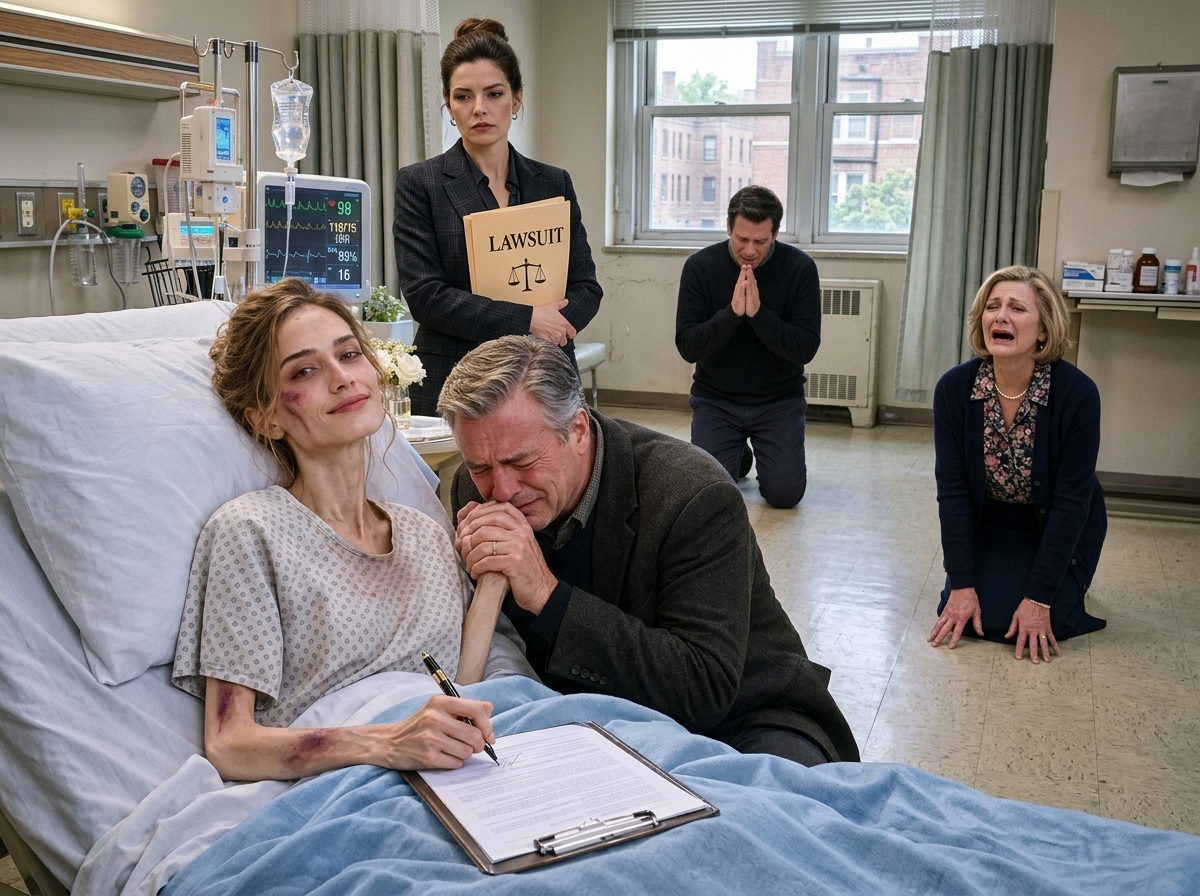
The doctor warned me that I had only 3 days left to live, but my mother-in-law gleefully spat pure poison: “Pray to God this toxic bitch just drops dead already, I’ve wanted her house for years!” My husband coldly echoed: “And in three days, I’m free to marry Jennifer.” Seventeen years of slavery rewarded with utter contempt and betrayal. Closing my tear-filled eyes, I grabbed my phone and called my father. He didn’t say a word, but I knew by tomorrow morning they would learn what true suffering feels like…
Chapter 1: The Critical Seventy-Two Hours
The physician delivered the prognosis with a clinical detachment that chilled me to the bone: the ensuing seventy-two hours would determine whether my biological functions could sustain life, or if my body would finally surrender to the systemic collapse tearing through my veins. My mother-in-law offered a thin, triumphant smile that didn’t reach her eyes, immediately staking a silent, predatory claim over my family home. My husband, the man I had tethered my existence to for nearly two decades, chuckled softly—a dry, dismissive sound—and began orchestrating the logistical details of his upcoming nuptials to another woman.
And I caught every single syllable.
I was forty-eight years old, pinned to an adjustable mattress in a private suite at Riverside Medical Center in Columbus. An IV line snaked into the bruised, needle-tracked skin of my forearm, pumping a cocktail of aggressive broad-spectrum antibiotics and supportive fluids into my circulation. A relentless, bone-deep fever had finally broken through my stubborn denial, terrifying me far more than I cared to acknowledge to the brisk nurses who checked my vitals every hour. Standing—or rather, lurking—beside my bedside were two individuals who had already drawn up the architectural blueprints for my erasure.
The supreme irony of my predicament was that a mere three weeks prior, I would have sworn under oath that I was merely suffering from standard, garden-variety exhaustion. Not the pleasant, restorative fatigue that follows a strenuous hike or a satisfying day in the garden, but a crushing, insurmountable weight. I own and operate a boutique residential restoration company, Bennett and Whitaker Restoration , and late summer is always an absolute circus of logistical nightmares. General contractors calling before the sun has crested the horizon; homeowners changing their minds about imported marble tile after the freight order has already cleared customs; and an incompetent plumber named Rick who treats voicemail messages as a personal insult to his manhood.
So, when my skin began blossoming into unexplained purple constellations of bruising at the slightest bump, and when climbing the staircase to my home office left me gasping like a stranded fish, I blamed the punishing demands of my enterprise. When I woke up twice in succession drenched in foul-smelling sweat that soaked clear through the high-thread-count sheets, I dismissed it as erratic perimenopausal hormones throwing a late-season tantrum. When I nearly folded like a cheap card table in the center of the kitchen on a crisp Thursday morning, I convinced myself it was simply the inevitable consequence of skipping breakfast in a frantic rush to answer client emails.
Mark, however, blamed me entirely.
“You’ve been complaining about being perpetually tired for a full month,” he had muttered back then, his tone flat and utterly devoid of maternal or marital tenderness, while I sat crumpled on the cold ceramic tiles with my spine pressed hard against the lower kitchen cabinets.
I remember looking up at his towering silhouette and thinking, with a chilling clarity, What a magnificent, comforting bedside manner you possess.
“Thank you, Dr. Bennett,” I had replied, my voice raspy. “Shall I make an appointment with you or schedule a consultation with your golf buddies?”
He hadn’t laughed. That ominous lack of humor should have triggered every defensive instinct I possessed, setting off alarm bells that could wake the dead. Instead, I let it slide, slipping it into the ever-expanding mental archive of minor marital grievances. By noon that same day, I had been wheeled into the emergency department under a barrage of flashing fluorescent lights. By dinner, my admission papers had been processed, and my ordinary life had officially evaporated.
The following morning, Dr. Evelyn Shaw stood at the foot of my bed wearing that particular expression favored by physicians—a meticulously calculated mask designed to project absolute calm without crossing the ethical boundary into dishonesty. Mark hovered uncomfortably near the window, his silhouette projected against the unforgiving Ohio sunlight. His mother, Dolores , occupied the visitor’s chair, clutching her oversized leather handbag in her lap with white-knuckled intensity, as if she genuinely believed a wandering orderly might pickpocket her between blood draws.
Dr. Shaw explained, in measured, clinical tones, that I was battling an aggressive hematological disorder severely complicated by an opportunistic infection. My lab numbers were terrifyingly low. The pharmacological onslaught had been initiated, but my marrow wasn’t responding with the vigor she had desperately anticipated.
“What does that actually mean?” Mark had demanded, his voice carrying an edge of irritation rather than terror, as if my failing organs were an inconvenient scheduling conflict for his weekend.
“It means we are monitoring her extremely closely,” Dr. Shaw replied, her eyes narrowing slightly as she took his measure.
“How closely?”
Dr. Shaw glanced down at my pale face before answering, her gaze lingering with professional pity. “The next seventy-two hours are critical.”
Dolores had leaned forward instantly, her eyes gleaming with morbid curiosity. “Critical as in—”
Dr. Shaw smoothly cut her off, refusing to take the bait. “Critical as in we must observe how Clare’s immune system reacts to the second round of broad-spectrum intervention. That is all.”
She offered no dramatic countdown, no cinematic ticking clock, no tearful movie speech. Just seventy-two hours. But to my husband and his mother, those seventy-two hours sounded less like a medical threshold and more like an expiration date.
Heavy pharmacological sedatives saturated my bloodstream, making my limbs feel as though they had been crushed beneath the wheels of a semi-truck that had subsequently reversed just to ensure total destruction. My eyelids were sealed shut by sheer exhaustion; I was profoundly too weak to participate in their callous banter, but my auditory nerves were functioning with terrifying acuity.
Dr. Shaw excused herself. The heavy wooden door clicked shut with a muffled latch.
A heavy, suffocating silence hung in the sterile air for perhaps five seconds. Then, Dolores spoke in a whisper that practically vibrated with predatory glee.
“Three days.”
Mark remained silent.
She emitted a soft, breathy laugh that made my stomach churn. “Three days. Good. I am taking the house.”
For a terrifying second, I suspected the high-powered narcotics were inducing auditory hallucinations. Sickness warps the mind, twisting reality into grotesque shapes. Then Mark laughed. Not a nervous, reflexive chuckle, but a full, resonant, unburdened laugh.
“And in three days,” he murmured, his voice laced with absolute liberation, “I am free to marry Jennifer .”
Jennifer. The name sliced straight through the chemical fog wrapping around my brain like a scalpel. I knew Jennifer—or, more accurately, I knew of her. Jennifer Cole , pharmaceutical sales representative out of Cincinnati. Fortysomething, divorced, sleek, and relentlessly ambitious. According to Mark’s carefully crafted narrative, she was “just a colleague.”
Just a colleague who happened to call him past ten o’clock at night on multiple occasions. Just a colleague who was positioned uncomfortably close to him in a group photograph from the regional Christmas party. Just a colleague whose name was inextricably linked to a mysterious hotel receipt from Mason, Ohio , originating on a night Mark swore he had driven straight home following a regional sales symposium.
I had questioned him back then; he had offered a glib explanation. I had accepted an excuse that didn’t quite hold water because seventeen years of marriage creates a massive inertia, and blowing up your life over a slip of paper felt exhausting. How impossibly foolish that sentiment appeared to me now. At the time, swallowing my doubts felt like the height of mature reasonableness.
Dolores lowered her voice, pitching it to a conspiratorial hum. “Will she move in immediately?”
Mark answered without a fraction of hesitation. “Eventually.”
I kept my eyelids clamped shut. My physical vessel felt impossibly heavy, leaden and sluggish, but my cognitive faculties suddenly snapped into razor-sharp focus.
Dolores continued mapping out my demise. “I want the downstairs guest suite. Your father’s old mahogany furniture will fit in there splendidly.”
A brief pause ensued. Then Mark said, his voice dropping an octave, “Mom, please don’t start measuring the drapes while Claire’s still physically breathing in the room.”
Dolores laughed again. That particular sound—dry, grating, and dripping with entitlement—inflicted a deeper wound than hearing Jennifer’s name. I had dedicated seventeen years of my life to treating Dolores like a beloved blood relative. I had driven her to countless ophthalmologist appointments when Mark’s demanding corporate schedule rendered him unavailable. I had paid out of pocket for an entirely new furnace when her old heating unit decided to expire a mere three days before Christmas, plunging her home into a deep freeze. I had sat beside her for hours in an uncomfortable vinyl chair at Ohio Health the morning she underwent gallbladder surgery, holding her hand because Mark claimed an urgent sales meeting in Cleveland was mandatory. And now, she was sitting ten feet from my hospital bed, carving up my estate like a vulture picking at a fresh carcass.
The ugliness of the real estate issue hadn’t materialized out of thin air; it had reared its head four months prior. Mark had been standing at our custom kitchen island, sorting through a stack of mail while I pounded out emails on my laptop. He had held up an official envelope bearing the seal of the county auditor.
“You know, after seventeen years of marriage, my name really ought to be on the deed,” he had remarked casually.
I had glanced up from my screen, frowning. “Why?”
He had shrugged, his posture entirely noncommittal. “Because I live here. The refrigerator is mine, too, though I’m not adding that to the paperwork.” He had chuckled. Then, noticing my silence, his expression hardened slightly. “I’m serious, Clare.”
“So am I,” I had replied.
His face shifted, displaying a flash of genuine annoyance. “It’s bizarre, Clare. What kind of arrangement is this? A husband isn’t even listed on the deed to his own family home.”
I snapped my laptop shut with a sharp click. “It isn’t your own house. It’s our home. There is a profound difference.”
He had rolled his eyes, throwing his hands up in exasperation. “Fine.”
And I had let it drop. Letting things go had become my specialty over the years—a quiet, toxic coping mechanism to preserve a fragile peace.
The house had belonged to my family long before Mark and I ever exchanged vows. My father had legally transferred the title to me years earlier as a foundational element of estate planning. Mark had been fully aware of that fact. He also knew I had never once weaponized it against him during our arguments. I consistently referred to it as our house. I had permitted him to completely gut and remodel the basement into his personal man-cave. I had allowed Dolores to host Thanksgiving dinner in our dining room for twelve consecutive years. Somewhere along the trajectory of our marriage, however, my acts of basic kindness had been twisted in their minds into a de facto transfer of title.
Yet, the deed was not the only ticking time bomb I had foolishly ignored. Eleven months prior to this hospital admission, following a series of increasingly bizarre inquiries from Mark regarding beneficiary designations and the legal disposition of separately owned property upon a spouse’s demise, I had quietly scheduled an appointment with Rebecca Sloan .
Rebecca had served as our family’s legal counsel for decades. She drafted ironclad trusts and wills. We had meticulously drawn up updated papers during that meeting, but I had ultimately failed to sign them. My father, Tom , had been privy to the situation. Every few months, he would casually inquire, “Are those papers still sitting gathering dust in Rebecca’s office?”
And every time, I would offer a weak smile and reply, “Dad, I’m simply not ready yet.”
He had never pressured me, never pushed me past my emotional boundaries. He would merely nod and say, “Then don’t sign them until you are.”
Now, Mark and Dolores finally unglued themselves from their chairs, announcing they were heading down to the cafeteria for coffee. The heavy door swung shut behind them.
The moment the latch engaged, I forced my eyes open. My smartphone rested on the rolling tray table just inches beyond my fingertips. Stretching my arm felt like moving a limb encased in wet concrete. It took me two agonizing attempts to close my fingers around the device, my hand trembling so violently I nearly batted it onto the linoleum floor.
I navigated to my contacts, located my father’s private number, and hit call.
He answered on the second ring. “Sweetheart?”
I swallowed hard, my throat feeling as though it were lined with sandpaper. “Dad… I’m here.”
I stared fixedly at the heavy hospital door. A profound, heavy silence stretched across the phone line. Then, my father spoke in a voice that was eerily devoid of surprise.
“I’ve been waiting for this call, Clare.”
I closed my eyes, a tear escaping down my temple. He wasn’t triumphant, and somehow, that quiet acceptance hurt worse than rage.
“Before I take a single step,” my father continued softly, “I need to hear you say it out loud. Are you finally done protecting him?”
I thought back across seventeen years of anniversaries, broken promises, subtle gaslighting, and my mother-in-law mentally hanging curtains in a house I built.
“Yes,” I whispered.
My father exhaled a long, shuddering breath. “Good.”
I waited, my heart pounding against my ribs.
Then he delivered the final directive. “Rebecca is coming to see you at the hospital tomorrow morning.”
For the first time since Dr. Shaw had dropped the ominous seventy-two-hour warning, my mind stopped fixating on whether I would survive the weekend. Instead, I began calculating precisely what Mark was about to forfeit if I did.
Chapter 2: The Legal Arsenal
Rebecca arrived precisely twenty minutes past nine the following morning, striding into the room in tailored navy slacks, low-heeled leather pumps, and wearing the unmistakable expression of an attorney who had already spent three frantic hours dismantling other people’s catastrophic life choices.
My father had materialized ten minutes prior to her arrival. He carried a cardboard tray holding steaming black coffee for himself, a soothing chamomile tea for me, and absolutely nothing for Mark. That singular omission was the ultimate barometer of my father’s internal state; Dad was a man who aggressively practiced extreme politeness—he had once genuinely thanked a tow truck driver who accidentally backed into his suburban mailbox.
He settled into the visitor’s chair, crossed one ankle over the opposite knee, and scrutinized my pale visage. “Did you manage to catch any sleep at all, sweetheart?”
“That translates to no,” I croaked. “It turns out hospital pillows are engineered by sadists with active grudges.”
Dad nodded solemnly. “That aligns with my working hypothesis.”
Neither of us brought up Mark immediately. I felt an overwhelming wave of gratitude for that restraint. Conventional wisdom dictates that hearing your spouse casually discuss your impending death and subsequent replacement should instantly ignite a pure, blinding rage that simplifies all emotional complexity. It doesn’t. At least, it hadn’t for me.
My mind kept traitorously dragging me backward, forcing me to recall the man Mark used to be. When our daughter Megan was eight years old, she contracted a virulent strain of pneumonia that landed us in the pediatric ward for two harrowing nights. Mark had steadfastly refused to leave her bedside, sleeping in one of those torturous, molded plastic reclining chairs because Megan would panic and cry whenever he stepped out of her line of sight. At two in the morning, I had urged him to go home for a proper shower and a change of clothes. He had returned an hour later from the cafeteria carrying two cups of atrocious hospital coffee, handed me one, and whispered, “You sleep now. I’ve got her.”
And he did .
That was the man I had married. That was the ghost I kept expecting to materialize out of the toxic fog of our deteriorating reality. People always pose the inevitable post-mortem question: Why did you stay? As if collapsing marriages arrive shrink-wrapped with warning labels slapped across the front. Ours hadn’t. It had degraded incrementally, inch by agonizing inch.
Mark secured a lucrative regional sales position, which brought an influx of capital accompanied by endless travel, high-stakes dinners, and suffocating corporate pressure. Initially, I felt intensely proud of his professional ascent. Then, the psychological shift began. He started returning home bristling with suppressed irritation over the most mundane domestic frictions—a stray light left burning, an electric bill that ticked up a few dollars, Megan calling him during a weekend golf game, or me simply asking what time he anticipated returning for dinner. The incidents were never explosive enough to pack a suitcase over; they were merely abrasive enough to make our home feel increasingly hollow.
And then there was the financial dynamic. Mark earned a very comfortable living, but my restoration company provided a steady, substantial stream of revenue, and the family real estate portfolio remained firmly anchored in my name. I had never brandished my financial independence like a club. In fact, I went out of my way to downplay it, smoothing over every rough edge to protect Mark’s fragile male ego.
Dolores, naturally, remained willfully blind to these distinctions. When her residential heating system failed during a bitter December freeze, Mark was trapped between corporate bonus cycles and strapped for cash. I quietly hired a local contractor and paid the entire bill out of my business account. Yet, during Christmas dinner a week later, Dolores beamed at the table and announced to our extended family, “My son takes such extraordinary care of me.”
I was standing precisely six feet away, holding a heavy ceramic casserole dish I had also personally funded. Did I correct her publicly? No. Why detonate a holiday ham over minor accounting discrepancies? But those micro-concessions accumulate over time. A single uncorrected falsehood becomes an accepted favor; a single swallowed insult hardens into permanent precedent. By the time Mark began making barbed jokes about my “trust fund advantage,” I had successfully conditioned everyone in our orbit—including my own husband—to believe I didn’t care.
Rebecca hoisted a sleek, thin leather portfolio onto the rolling tray. She leaned over to hug me with extreme care, ensuring she avoided my IV lines, before dragging her chair closer.
“How are you holding up physically?” she asked, her eyes scanning my chart.
“I feel like I’m being subjected to an intensive interrogation by sadists who weaponize blood pressure cuffs,” I muttered.
“That bad?”
“Worse. Everyone here is aggressively cheerful.”
Rebecca offered a dry smile, then glanced pointedly at my father. “Has she been briefed?”
“Only that your grand entrance was imminent,” Dad replied smoothly.
“Excellent.” Rebecca unzipped the leather folio.
The sight of the familiar manila tabbed folders triggered an immediate spike of internal mortification. I felt a hot flush of embarrassment crawl up my neck. Rebecca noticed my micro-expression immediately.
“We drafted the bulk of this documentation eleven months ago, Clare,” she reminded me gently.
“I know. You don’t need to make me feel more culpable than I already do.”
“Why are you feeling guilty?”
“For apparently scheduling the execution of my own basic common sense nearly a full year behind schedule.”
Dad stared fixedly at the acoustic ceiling tiles. Rebecca ignored him entirely, flipping open the stiff paper covers. “Clare, let’s be entirely clear. You are not formulating a brand-new, panicked decision from a hospital bed. You meticulously engineered ninety percent of these resolutions last year. You simply neglected to sign on the dotted line.”
Her words hit my chest with physical force because they were indisputably true. Eleven months prior, Mark’s interrogation-style questions regarding asset division, right of survivorship, and corporate bylaws had raised the hair on the back of my neck. He had expertly masked his financial probing as casual, pragmatic mid-life planning. Everyone our age needs to have their ducks in a row , he had insisted.
Technically, he hadn’t been wrong. That was the insidious genius of his manipulation.
Consequently, I had scheduled a confidential consultation with Rebecca. We meticulously overhauled my comprehensive estate plan, ring-fenced my business interests, restructured my beneficiary designations, and erected legal firewalls around my inherited property—safeguards I had foolishly neglected simply because I was wearing a wedding ring and naively assumed matrimony equated to absolute safety.
We finalized the drafts. Then, fate intervened in the form of our wedding anniversary. Mark surprised me with a bouquet of imported roses, took me out to an upscale bistro, and delivered a tearful, convincing monologue apologizing for his emotional detachment. For six glorious weeks, he regressed into the attentive husband I thought I had lost. Relieved, I instructed Rebecca to place the newly minted documents in suspension—not to destroy them, but to hold them in abeyance.
Dad had discovered the truth simply because I trusted him enough to confess. He hadn’t gloated or uttered a smug I told you so . He had simply asked periodically, “Are those papers still gathering dust in Rebecca’s office?”
And every time I replied, “Dad, I’m just not ready.”
His invariable response had been, “Then don’t sign them until you are.”
Rebecca tapped a manicured fingernail against the documents. “The framework is already constructed. We simply need to update the execution dates, verify a few asset valuations, and ensure you possess absolute comprehension before your signature touches the paper. We aren’t performing miracles before lunch.”
“I explicitly requested a miracle,” Dad noted deadpan.
“You’re paying my hourly retainer, Tom, which grants you a modest administrative miracle at best.”
Despite myself, a sharp bubble of laughter escaped my lips, immediately setting off a spasm of pain across my bruised ribs.
Rebecca’s tone instantly softened, dropping the professional veneer. “I am entirely serious about one critical principle, Clare: do not let manufactured urgency trick you into sloppy legal execution. Your current medical crisis does not bypass procedural integrity. Certain foundational documents can be properly executed right here in this sterile room if you so choose. Others must be handled sequentially through formal channels. Nothing transfers ownership simply because a dishonest man snaps his fingers.”
I nodded slowly. Her words provided the exact anchor I desperately required. I didn’t want my father swooping in to rescue me like a knight errant, nor did I want Rebecca waving a magical legal wand to instantly obliterate Mark. I simply wanted to reclaim my agency and step out of my long-standing passive role.
Over the next hour, Rebecca methodically walked us through the foundational mechanics without turning my hospital room into a dry law school seminar. The primary residential real estate was deeded exclusively in my name, having been legally conveyed to me via my father’s corporate holding entity prior to my marriage to Mark. My inherited stock portfolios and investment accounts were structurally segregated. My controlling ownership stake in Bennett and Whitaker Restoration was governed by a tight corporate operating agreement containing strict buy-sell provisions that prevented an estranged spouse from seizing operational control in the event of my incapacitation.
Of course, substantial legal gray areas remained: marital assets accrued over seventeen years, joint checking accounts, shared tax liabilities, and various co-signed obligations.
Rebecca locked her gaze onto mine. “Understand this clearly, Clare: this is not a cinematic narrative where you press a single magic button and Mark instantly departs with zero clothes on his back.”
“I never assumed there was a magic button,” Dad murmured.
“I was secretly hoping for one,” Rebecca retorted, pointing a pen at him. “No magic buttons. Real estate and corporate law require rigorous friction.”
She slid a single document across the tray table. “This is the financial authorization we mapped out last year. It is strictly limited, highly specific, and entirely tailored to protect your commercial interests and personal estate. We can update the parameters right now.”
I stared down at the crisp white paper. The bold black lettering began to smear and blur across my vision—not from emotional tears, but from the crushing weight of sheer physical exhaustion.
Rebecca observed my physiological collapse and instantly pulled the papers back. “That is unequivocally sufficient for today. We can resume tomorrow.”
“No,” I whispered, forcing my chin up. “I’m ready.”
“You’re profoundly ill, Clare,” Rebecca countered softly.
That objective observation inexplicably flared a spark of irritation within me—likely because it was undeniably true.
Dad stood up, quietly adjusting the scratchy hospital blanket over my shoulders without asking permission. “I’m heading out for a bit. I’ll return this evening.”
Rebecca gathered her files, sliding them neatly back into the leather portfolio. “Nothing moves forward until you fully comprehend it and actively choose it.”
Once the door clicked shut behind them, I surrendered to the heavy pull of exhaustion, sinking into a restless, fever-punctuated sleep. By evening, my internal thermostat spiked again, sending my temperature soaring. Nurses buzzed in and out of the room like anxious hornets, adjusting IV drips and pumping me full of antipyretics. For several agonizing hours, Mark’s calculated betrayal evaporated from my conscious mind, entirely eclipsed by the raw, primal terror of mortality.
I lay awake staring into the darkened abyss of the ceiling around two in the morning, my mind cycling through a loop of terrifying hypotheticals: What if this entire legal crusade is an absolute farce because my body is simply shutting down?
Images of Megan flashed across my mind—her future wedding day, children she might eventually bring into the world, milestones I was arbitrarily scheduled to miss. I thought about turning fifty, about petty arguments with my niece, about standing in my own sunlit kitchen on an utterly boring Tuesday afternoon. In the face of impending death, the grand architecture of revenge suddenly felt microscopic and utterly pointless.
Chapter 3: The Wolf in the Room
The morning sun crept sluggishly across the linoleum floor as my father returned, walking into my room to find me quietly wiping away stray tears. He possessed the rare emotional intelligence not to pretend he hadn’t noticed.
“Rough night?” he asked softly, pulling his chair close.
“I honestly don’t know if I possess the stamina to finish this,” I confessed, my voice cracking. “The medical treatments, the legal onslaught, the sheer emotional weight of it all.”
He leaned his forearms on his knees, watching me with steady, patient eyes. “To finish what, sweetheart?”
“The paperwork. Dealing with Mark. Untangling seventeen years of my life.”
Dad waited a beat before asking a surgical question. “Is that because you’ve fundamentally changed your mind?”
I shook my head violently against the pillow. “No. It’s because part of me still foolishly clings to the ghost of who he used to be.”
Dad exhaled slowly. “Then why are you crying?”
I wiped my face with the back of my hand. “Because I am so profoundly tired.”
He nodded, a gesture heavy with understanding. “That is an entirely different condition.”
A flash of defensive anger flared in my chest. “Dad, I am literally wired into an intravenous pole in a hospital ward. Of course I’m tired.”
“Then don’t fight the war today,” he replied smoothly.
I stared at him, baffled.
He leaned forward, his voice dropping to an intimate register. “Clare, being bone-tired does not mean you are obligated to grant anyone perpetual, unearned access to your life.”
That single sentence hung in the sterile air, carrying more pragmatic wisdom than a hundred hours of expensive legal counseling.
Around eleven o’clock, Mark materialized in the doorway, balancing a cellophane-wrapped bouquet of supermarket flowers in one hand and wearing his meticulously rehearsed, deeply concerned husband expression—the exact face he routinely deployed when charming nursing staff.
He leaned over and pressed a brief, perfunctory kiss against my forehead. “How is my girl holding up today?”
My girl. I had to swallow a sudden surge of caustic laughter.
“Still occupying space,” I replied flatly. “Good.”
He tossed the Kroger flowers onto the side table. “Do you need anything? Would you prefer a quiet afternoon without visitors?”
“Ideally, yes.”
For fifteen minutes, he performed the role of the devoted spouse, prattling on about highway traffic, corporate spreadsheet metrics, and an upcoming Cincinnati Reds game. Then, with the casual, breezy nonchalance of a man pulling out a restaurant receipt, he slid his leather briefcase onto the tray table and popped the latches.
“By the way,” he began smoothly, “there are a few routine financial authorizations I need you to sign while you’re laid up here.”
I stared fixedly at the sleek manila folder resting in his hands. “What specific sort of forms?”
“Oh, nothing overly complicated,” he murmured, flashing an easy, disarming smile. “Just standard administrative paperwork so I can manage the household bills, pay the mortgage, and handle routine banking accounts if your recovery takes a bit longer than anticipated.”
And in that precise, nauseating microsecond, the horrifying truth crystallized in my mind: Mark hadn’t suddenly developed a frantic, bureaucratic interest in our financial standing because I happened to be hospitalized. He had been actively plotting this corporate hostile takeover long before my immune system collapsed.
Mark pushed the folder closer to my fingers, treating the transaction with the casual indifference of someone handing over a dry-cleaning ticket. That casualness was infinitely more offensive than the documents themselves.
“What am I explicitly signing here?” I asked, my voice dangerously calm.
He leaned back in the visitor chair, crossing his legs. “Just standard power-of-attorney stuff so I can oversee the bills and bank accounts. Whatever logistical nightmares pop up while you’re laid up.”
“Laid up,” I repeated, tasting the condescending phrase on my tongue. “I truly despise that expression.”
He exhaled a sharp breath through his nostrils—there it was, that familiar, micro-expression of suppressed impatience I had spent years pretending not to notice. “Claire, I am literally trying to streamline our lives to make things easier for you.”
“Easier for whom?”
His facial structure tightened perceptibly. “Seriously?”
“Deadly serious.”
He flipped open the folder, tapping a manicured finger against the top margin of the primary page. “This legally empowers me to manage our financial liabilities if you are physically incapacitated.”
“What specific accounts does this cover?”
“All of them, basically.”
I locked eyes with him. “All of them?”
He offered me a patronizing smile—the universal expression people deploy when they assume you are deliberately obstructing simple logic. “I’m not going to steal your identity, Clare. Come on, just sign it and leave it here on the tray.”
He blinked in genuine confusion when I didn’t reach for the pen. “What’s the hold-up?”
“I prefer to read legal documents before my name goes on them.”
That single, declarative sentence inflicted vastly more structural damage to his carefully constructed facade than he realized.
“Fine,” he muttered, snapping the folder shut with an audible slap. “You’re exhausted and paranoid. Don’t turn this into a melodramatic domestic dispute.”
He stood up, planted a swift, dismissive peck on the crown of my head, and announced he needed to step out into the hallway to take an important corporate conference call.
The heavy door hadn’t even fully latched before I snatched my phone off the tray. My fingers, though weak, frantically opened the camera application. I snapped rapid, high-angle photographs of every single page inside that folder. The images were undeniably grainy—one shot featured half of my own thumb crowding the bottom corner, making it look suspiciously like a hasty listing for a used couch on Craigslist—but the text was fully legible.
I instantly forwarded the entire digital packet to Rebecca Sloan.
Then, I waited.
She called back precisely nineteen minutes later. I knew the exact duration because I had been staring fixedly at the digital wall clock.
“Do not sign a single syllable of those documents,” Rebecca stated without preamble, bypassing any polite introductory pleasantries.
“I was rather hoping you’d inform me it was merely a discounted gym membership enrollment,” I replied dryly.
“Clare, I am entirely serious,” she said, her voice dropping an octave. “One of these embedded riders grants Mark sweeping, near-unilateral financial authority. It is broad enough to legally siphon commercial assets and liquidate shared portfolios. Under no circumstances should you touch a pen to this paper.”
“Can he legally execute this just because I’m a patient?”
“He can certainly ask . You possess every legal right to refuse.”
“So the document itself is technically lawful?”
That stark reality disappointed me, reflecting how naive my internal expectations had become. Rebecca must have caught the deflation in my tone.
“Do not confuse morally repugnant behavior with criminally actionable fraud, Clare.”
“I’m trying not to.”
“People execute medical and financial powers of attorney for spouses routinely under catastrophic conditions. That isn’t the core issue. The actionable issue revolves around what you explicitly know, what he has deliberately lied to you about, and the transparent bad faith of his timing while you are physically incapacitated in a hospital ward.”
I glanced toward the closed door of my room, listening to the muffled squawk of the nurses’ station intercom. “Can we prove malicious intent?”
“Perhaps, perhaps not. Our primary objective right now is rigorous documentation. We meticulously log the evidence first; we decide how to deploy it later.”
I massaged my throbbing temples. “I genuinely detest that answer.”
“The most accurate legal answers are invariably the most boring,” Rebecca noted. “Your father would readily confirm that’s precisely why corporate accountants rarely star in Hollywood blockbuster franchises.”
She wasn’t wrong.
Later that afternoon, Megan blew through the hospital doors like a localized weather system carrying an overnight duffel bag, a massive insulated iced-coffee tumbler, and a visible aura of pure, unadulterated fury directed entirely at her father.
“At what exact point,” she demanded, marching straight to my bedside, “was someone planning to inform me that my mother was actively dying in an ICU?”
I stared at her, momentarily stunned. “Your father called you, Megan. He assured me he explained you were handling your teaching schedule.”
“He told me you had a stubborn case of the flu, Mom!”
I knew that specific, razor-sharp tone; I had lived with it since she was six years old. It was her do not test my patience register.
I raised a single hand in surrender. “Okay, fair point.”
She dropped her heavy canvas bag against the baseboard heater and wrapped her arms around my shoulders in a cautious, agonizingly gentle hug—so careful to avoid my IV lines that it nearly broke my composure entirely. When she finally pulled back, her face was drawn and pale. As a third-grade teacher, Megan possessed the infinite patience of a UN hostage negotiator, but today, that reservoir had run completely dry.
“Dad told me not to drive up from Indianapolis last night because you simply needed uninterrupted rest,” she continued, pacing a tight circle beside the window. “He spoke as if you had contracted a mild case of poison ivy.”
I remained silent, keeping my expression neutral.
Her hazel eyes narrowed into dangerous slits. “What is fundamentally wrong with him?”
There it was. The moment I had been desperately dreading. I wasn’t holding back out of any lingering desire to shield Mark from accountability; rather, the horrifying reality of breaking the news to your adult daughter that her father was actively planning your demise while conducting an adulterous affair—all while you were tethered to an IV pole—is simply not a scenario covered in parenting manuals.
“Your father and I are navigating some complicated adult issues,” I said carefully.
“What specific brand of adult issues?”
“Standard marital friction, Megan.”
She planted her hands on her hips, towering over the bed. “Mom, I am twenty-four years old, not a kindergartener.”
“Yes, and I am actively striving to prevent you from aging twenty years by lunchtime.”
Her mouth twitched with a microscopic hint of a smile before hardening once more. She dropped into the visitor’s chair. “Is he acting completely unhinged?”
That felt like a monumentally inadequate description. “Yes.”
“Define unhinged .”
I looked at her, weighing my words. “I will share precisely what you need to know the moment I have absolute clarity on our next steps.”
She leaned back, crossing her arms defensively. “That isn’t an answer, Mom.”
“No, Megan. That is a functional boundary.”
She didn’t like it. Neither did I, but she let the confrontation drop for the moment, recognizing she lacked the leverage to push further.
Chapter 4: The Paper Trail
The following morning, my father arrived carrying his battered laptop bag. Rebecca had enlisted his analytical mind to help assemble a pristine, legally airtight ledger combining our corporate records with our joint financial statements. Dad possessed a spiritual reverence for clean financial data; hand that man a chaotic spreadsheet, and he achieved a state of profound inner peace that most people only found on a tropical beach.
He seated himself near the window, booting up the machine and clicking briskly through encrypted folders. Suddenly, his rhythmic typing abruptly ceased. He didn’t gasp or make a dramatic exclamation; he simply froze.
“What is it?” I asked, shifting against the pillows.
Dad tilted the screen toward the ambient light, squinting through his reading glasses. “Clare, has anyone outside of you, myself, and Rebecca been actively requesting corporate valuation metrics and asset breakdowns for Bennett and Whitaker Restoration ?”
“No,” I said, a cold knot forming in my stomach. “Not unless…”
He swiveled the laptop so I could view the display. An automated audit log revealed an external data request executed late last month, querying corporate equity percentages, projected asset valuations, and operating bylaws.
My brow furrowed. “Who initiated that?”
Dad clicked the metadata link. The associated email address was instantly recognizable: jcolesp@pharma- Direct.com .
Jennifer Cole.
Every internal system within my body went completely dormant. Jennifer.
Dad nodded grimly, noting my silence. “I suppose I should stop feeling astonished by his audacity, yet I keep finding new depths.”
“What on earth could she possibly want with proprietary company valuation documents?” I whispered.
“That,” Dad remarked dryly, “is an extraordinarily pertinent question.”
By noon, we had uncovered the terrifying contours of the answer. There was no illegal computer hacking, no clandestine corporate espionage—just a paper trail composed of public records, accessible files, and internal corporate documents Jennifer had accessed with Mark’s explicit facilitation, cross-referenced with the financial spreadsheets Dad had systematically pulled together.
Jennifer hadn’t been snooping out of idle curiosity; she and Mark had been actively engineering a concrete blueprint for their joint future. Not some vague, distant someday fantasy—a ruthlessly scheduled timeline. Emails pulled from shared digital spaces referenced a high-end luxury condominium in Dublin, Ohio. There had been extensive correspondence with a commercial mortgage broker. Most damningly, one internal message exchanged between Mark and Jennifer featured the chilling phrase: Expected liquidity following imminent family estate restructuring.
I read the sentence twice, then a third time, letting the bureaucratic euphemism wash over me. It was a remarkably sanitized, corporate way of describing my funeral.
Dad adjusted his glasses on the bridge of his nose, his expression grim. “Corporate accountants practically invented euphemisms because prison orange clashes with everyone’s skin tone.”
I let out a sharp, incredulous laugh, immediately wincing as the motion pulled at my tender surgical incisions. “Please, Dad, don’t make me laugh. My internal plumbing is currently held together with medical staples.”
“I shall endeavor to become considerably less charming, though given my age, that shouldn’t require excessive effort.”
The digital excavation continued, uncovering territory that crossed from bureaucratic coldness into outright malice. At Rebecca’s instruction, we pulled historical transaction logs from our legitimate joint credit card accounts. When laid out chronologically across a digital spreadsheet, a series of seemingly random charges suddenly snapped into sharp, undeniable focus: upscale boutique hotels in downtown Cincinnati, romantic dinners at high-end steakhouses I had never set foot in, designer jewelry purchases, airline tickets to weekend getaway resorts, and a substantial resort fee Mark had explicitly expensed to me as a mandatory client entertainment retreat.
Over a fourteen-month window, we tallied approximately $38,400 funneled directly or indirectly into Jennifer’s orbit using joint marital funds.
I stared numbly at the final sum glowing on the screen: $38,400 .
Rebecca was patched in via speakerphone, her voice crisp and authoritative. “Approximately thirty-eight thousand, four hundred dollars diverted from marital assets to finance an extramarital enterprise. That forms the baseline of our financial dissipation claim.”
“So I am legally entitled to recover half of that immediately?” I asked, my voice tight.
A heavy, deliberate pause stretched across the phone line. I utterly despised that tactical pause.
“Do not spend those hypothetical funds in your head yet, Clare,” Rebecca cautioned.
“What does that caveat actually mean?”
“It means family court is not a slot machine where you pull a lever and collect an instantaneous payout. We systematically document the illicit spending; we construct the appropriate legal arguments for reimbursement. We do not guarantee judicial outcomes.”
“That is profoundly unsatisfying.”
“Yes,” Rebecca replied smoothly. “Do law schools specifically train attorneys to deliver that exact sentiment?”
“Only the competent ones.”
When the call disconnected, I sat in oppressive silence. Dad made no clumsy attempt to offer hollow reassurances; he understood the landscape too well. The financial theft, while infuriating, wasn’t the component that cut deepest. It was the calculated premeditation. Mark hadn’t simply stumbled into an ill-advised affair; he had methodically constructed a second life using stolen bricks from mine.
Later that afternoon, Megan announced she was heading down to the ground-floor cafeteria to fetch a fresh beverage. At least, that was the itinerary Mark believed she was following.
A moment later, Mark stepped out into the carpeted hallway to answer a ringing cell phone, believing the hospital room door provided adequate acoustic privacy. His carrying voice pierced the thin partition.
“Jennifer, stop calling my personal line here at the hospital…” A brief pause, followed by a lowered, agitated hiss. “No, I told you, seventy-2 hours doesn’t mean the exact second… Just hold tight!”
I heard every single syllable echoing down the corridor—and so did Megan. She was standing barely ten feet away near the nurses’ station, holding a stack of fresh paper cups, completely frozen in place.
When she pushed the door open and reentered my room, her physical demeanor had fundamentally shifted. She looked older, harder, stripped of youthful naivety in a single, brutal instant. She closed the door behind her with a soft, deliberate click.
“Mom,” she whispered.
I remained motionless against the pillows, my heart hammering against my ribs.
Her voice shook with suppressed fury. “Who the hell is Jennifer?”
There are defining moments in parenting where the dynamic simplifies with terrifying clarity. Your child poses a direct question, and every protective instinct screams at you to build a wall of lies to shield them from collateral damage. The agonizing flaw in my situation was that protecting Megan now required dragging her straight into the battlefield.
“Jennifer Cole,” I said, my voice raspy.
“I’ve heard that name mentioned before,” Megan breathed, her eyes widening. “Isn’t she that corporate sales rep who works with Dad?”
Megan stared at me, searching my face for any sign of a denial. “That isn’t an answer to my question, Mom.”
“No, it isn’t.” I shifted painfully against the supportive wedge pillows. “I have reasonable grounds to believe your father is engaged in a clandestine affair with her.”
She didn’t flinch. I watched her cognitive faculties absorb the devastating sentence, processing the horrific reality piece by piece.
“How long have you known?” she asked, her voice dangerously quiet.
“I have strongly suspected impropriety for several months.”
Her expression curdled into bitter disbelief. “Months, Mom? You’ve known about this for months and said nothing?”
“Suspected is not the same as verified. There is a profound operational difference.”
“That isn’t what I asked you!” she snapped, marching over to the window and folding her arms tightly across her chest before spinning back to face me. “And you didn’t think to inform your own daughter? I am twenty-four years old!”
“I am acutely aware of your age, Megan.”
“Then why does everyone in this family continually conspire to decide what I am emotionally capable of handling?”
That verbal strike landed precisely where it was aimed.
“Your father deliberately lied to both of us regarding the severity of my medical crisis,” I countered quietly.
“No, he certainly did,” she fired back, tears welling in her eyes. “And you spent months pretending everything in our family was functioning normally!”
“I was not pretending everything was fine.”
“Really?” Her voice remained terrifyingly subdued, which amplified its impact tenfold. “Christmas dinner? My birthday weekend? That trip we took together to Indianapolis? You sat across from me and smiled while knowing our entire family was a fabricated performance. You knew enough to quietly consult with an aggressive divorce attorney!”
I looked at my daughter, recognizing the fierce intelligence she had undoubtedly inherited from both sides of our families. Parenting an extraordinarily perceptive child often felt like enduring a rigorous cross-examination conducted by someone whose braces you had personally financed.
“I was desperately trying to insulate you from the collapse of my marriage,” I said softly.
“Well, congratulations on your stellar shielding,” she retorted bitterly, snatching up her overnight bag. “Mission accomplished. I’m in the middle of it now.”
“Megan, wait—where are you going?”
“I need air, Mom. Please don’t tell me not to drive angry.”
She looked at me as if I had completely lost my grip on sanity, yanked the door open, and vanished down the hallway.
I slumped back against the mattress, staring hollowly at the institutional paint on the door. For the first time since overhearing Mark and Dolores mapping out my estate, a bitter self-reproach took root: Have I spent so many years cowardly protecting the illusion of a family that I actively helped sustain the very lie that is now destroying us?
That internal realization offered none of the comforting warmth of righteous anger; it tasted entirely like ash.
Chapter 5: The Homecoming Trap
Two days later, Dr. Shaw strode into my room bearing an updated printout of my morning lab panels, wearing an expression considerably less guarded than her usual clinical mask. That is the surreal reality of extended hospital stays—you rapidly evolve into a certified expert in micro-expressions, reading a physician’s facial muscles like a seismograph because nobody dares utter a definitive prognosis until the raw data agrees with them.
She pulled up the visitor chair, leaning forward. “Your latest biomarker panels are tracking precisely in the direction we hoped to see.”
I held my breath, gripping the scratchy sheets. “Meaning?”
“Meaning your bone marrow is actively responding to the second-line therapeutic intervention. Your white count is rebounding.”
I exhaled a long, shuddering breath that felt as though it had been trapped in my chest for a week. “So I am definitively not dying in the immediate future?”
She offered a genuine, reassuring smile. “Let us phrase it this way: you have successfully navigated out of the immediate danger zone.”
Mark, who had been lingering near the foot of the mattress, immediately seized upon the phrasing. “So she’s completely out of the woods? We can discharge her?”
Dr. Shaw glanced sideways at Mark, her gaze lingering for perhaps two ticking seconds—long enough for me to catch the flash of professional contempt in her eyes. “She is stabilizing significantly. Discharge protocols can be initiated within forty-eight hours, provided her home environment is entirely low-stress.”
Mark nodded briskly. “Right. Excellent.”
Dr. Shaw added, with the dry, understated delivery of a seasoned hospital veteran, “That is traditionally the juncture where families utter a collective sigh of relief and express gratitude.”
I violently averted my face, staring fixedly out the window. If I had allowed the triumphant grin pulling at my lips to surface, I would have blown my entire cover.
I was officially discharged two days later.
Stepping across the threshold of my own home felt profoundly surreal. The entryway console table was unchanged. The framed photograph capturing Megan’s college graduation hung squarely in its designated spot. Even the minor scuff mark on the hardwood flooring where Mark had dropped a heavy bookshelf speaker during the basement renovation remained etched into the oak. Everything visually communicated normalcy, yet I knew the entire structure was built over a subterranean fault line.
Mark transformed instantly into the candidate for Husband of the Year. Freshly brewed coffee materialized on my nightstand every morning without fail. He solicitously inquired whether I required an extra supportive cervical pillow. He executed grocery runs unprompted, stocking the pantry with my favorite organic items.
On my second afternoon back, he strolled into the kitchen carrying a ceramic bowl of steaming butternut squash soup, sliding onto the adjacent stool at the kitchen island.
“You know what I’ve been ruminating on while you were recuperating?” he asked casually.
Whenever Mark utilized that particular tone of manufactured helpfulness, my nervous system went on immediate red alert. “Tell me.”
“I think we really need to streamline our administrative burdens while you’re still rebuilding your strength.”
There was that insidious word again: streamline .
“Streamline what specific aspects of our lives?”
“Bank accounts, recurring utility bills, the household property paperwork,” he rattled off with practiced ease. “Just basic logistical redundancies so I can manage the estate smoothly if your health ever experiences another unexpected dip.”
I slowly stirred my soup, watching the amber liquid swirl. “You seem remarkably, almost obsessively fixated on reducing my administrative workload lately.”
He forced a loud, theatrical laugh. “I’m your devoted husband, Clare! It’s called looking out for my partner.”
He studied my face for a microsecond, searching for any sign of resistance, before smoothly shifting conversational gears.
Dolores materialized on our front porch the following afternoon, bearing a heavy plastic container of homemade chicken noodle soup. I didn’t bother inquiring who had actually prepared it; over years of domestic warfare, I had learned never to ask probing questions when the realistic answer was a commercial warehouse club.
She bustled around my kitchen for twenty minutes, clucking maternally. “You look terribly pale and emaciated, Clare.”
“I nearly died of a systemic blood infection, Dolores.”
“I realize that, but you truly must force yourself to eat nutrient-dense foods. I’ll alert the entire local medical community to your miraculous recovery.”
She failed to appreciate my sarcasm. Roughly half an hour later, I distinctly heard the soft creak of floorboards echoing from the second-floor landing. Strictly speaking, my discharge orders explicitly prohibited me from navigating the staircase unless absolutely necessary, but maternal territorialism easily overrode medical advice.
“Dolores?” I called out, my voice echoing up the stairwell.
Silence.
“Dolores, if you’re looking for extra linens, the guest closet is downstairs.”
I hauled myself up the steps, moving with deliberate, measured slowness. When I reached the threshold of my primary bedroom suite, I found her standing directly beside my carved mahogany dresser. The top velvet-lined drawer was pulled halfway open, and my antique velvet jewelry box sat exposed on the surface.
“What precisely are you doing?” I asked, my voice cutting through the quiet room.
Dolores jerked her hands away as if she had touched a live wire, slamming the drawer shut with a sharp crack. “I was merely searching for an additional wool blanket for the guest room.”
I stared coldly at her from the doorway. “In my personal jewelry drawer? I wasn’t aware my diamond heirloom pieces generated ambient thermal heat.”
Her mouth tightened into a rigid, defensive line. “There is no need for your usual caustic sarcasm, Clare.”
“Apparently, basic boundaries are entirely beyond your comprehension.”
She shouldered past me in the narrow hallway without offering a word of apology. I naïvely assumed that humiliating episode would serve as a sufficient deterrent. I was disastrously mistaken.
The following afternoon, I caught her standing in the front bay window of the living room, pressing her smartphone camera directly against the glass pane, sweeping it slowly back and forth across the perimeter of the room.
“What are you doing now?” I asked from the archway.
She jumped, lowering the device with a guilty start. “Nothing at all.”
“You were systematically panning your phone across the window frame, Dolores. That looked remarkably like taking spatial measurements.”
She cleared her throat, recovering her defensive posture with practiced ease. “I was checking the dimensions for potential drapery replacements.”
She leveled a sharp, unrepentant glare at me. And there it was—not an ounce of genuine remorse, but raw, bitter annoyance, as if my continued survival was maliciously inconveniencing her schedule and delaying a delivery she had already been promised.
That evening, I called my father. He listened in absolute silence as I recounted the afternoon’s events.
“Do you want me to drive over and have a quiet word with her?” Dad offered.
“No,” I replied, a cold resolve settling over my bones. “I’m entirely finished needing external witnesses to validate my own eyes.”
Two days later, my phone buzzed against the bedside table, flashing an incoming text message from an unknown number: Claire, this is Jennifer Cole. We need to have a direct conversation. Please.
I stared at the glowing screen for a long, quiet minute. A second notification popped up instantly: I know you despise me, and you have every justification. But Mark has lied to you on an industrial scale. There is critical information you need to see.
My initial impulse was to delete the message and block the sender. Instead, I tapped out a short confirmation. We agreed to meet the following afternoon at a neutral public location—a well-lit Panera Bread in Dublin during peak afternoon rush hour. I informed Dad of my location and schedule as a basic safety precaution, but I drove myself there.
I arrived ten minutes early, claiming a corner booth with a clear line of sight to the double glass doors.
Jennifer walked in precisely at two o’clock. She wore tailored black slacks, a cream cashmere sweater, and wore zero visible emotional armor. She spotted me sitting by the window, hesitated for a fraction of a second, and then walked over. For a surreal moment, neither of us possessed a script for how two women caught in this particular geometry of betrayal were supposed to interact. We didn’t shake hands, nor did we launch coffee cups across the room.
She slid into the vinyl booth opposite me, keeping her hands flat on the laminate table.
“I was fully aware he was married when we met,” Jennifer stated without preamble, sparing us both any polite preamble. “I am not going to insult your intelligence by pretending otherwise.”
“A refreshing departure from standard procedure,” I noted dryly.
“He convinced me that your marital relationship had been emotionally dead for nearly a year,” she continued, her voice steady but tight. “He swore you both mutually acknowledged the end, that you were simply cohabitating temporarily while managing the complex financial disentanglement, and that a formal divorce was imminent. And like an absolute fool, I chose to believe him.”
Jennifer dropped her gaze to her paper cup. “I desperately wanted to believe him.”
That specific confession irritated me precisely because I understood the seductive mechanics of self-deception all too well.
“He continually assured me that your sudden medical emergency was merely delaying the final legal paperwork,” she added, looking back up.
“Did he happen to mention what he and his mother were discussing in my hospital room while I was heavily medicated?” I asked softly.
Jennifer blinked. “So you actually heard them?”
“Every single syllable.”
“Mark told me you were suffering from severe drug-induced paranoia,” she said, her expression darkening. “He spun a narrative claiming your medication was causing auditory hallucinations. But as time went on, his stories began fracturing. That’s when I realized I was being systematically played.”
I leaned back against the hard plastic bench. “And what precisely do you want from me, Jennifer? Absolution? A certificate of joint victimhood?”
“Nothing,” she replied firmly. “People always assume someone wants a handout or a dramatic confrontation. I simply reached a point where I refused to be made a party to his malice.”
She unlocked her smartphone, tapping the screen a few times. “There is documentary evidence you need to witness.”
She slid the device across the table toward me. The illuminated screen displayed an open text thread originating from Mark’s private number. The message read clearly: Once the estate legalities settle out, the primary residence transfers to us entirely. Mom can take over the downstairs guest suite.
I read the text twice, letting the words burn into my memory, before lifting my gaze. “He deeded away my family home.”
Jennifer winced, pulling a face of profound self-disgust. “Apparently, my ex-paramour is extraordinarily generous when dispensing real estate he doesn’t actually own.”
A strange, dark bubble of laughter rose in my chest, escaping my lips before I could suppress it. Perhaps I had remained hospitalized too long; perhaps there is a surreal threshold where domestic betrayal crosses the boundary of tragedy and loops straight around into absurd comedy.
Jennifer scrolled further, exposing a trove of digital receipts, confirmation numbers, and architectural floor plans for their future shared condo, alongside explicit logistical layouts detailing Dolores’s permanent integration into our domestic space. Mark had meticulously engineered an elaborate, multi-person future involving three different women, operating under the arrogant assumption that none of us would ever compare notes.
Jennifer pulled her phone back across the table. “I can download and email full PDF archives of this correspondence directly to your legal counsel if you require it.”
“I do.”
She nodded briskly, standing up from the booth. “Understand one final thing, Clare: this document sharing does not transform us into allies or friends.”
“I am well aware. I harbor no intention of offering you forgiveness.”
“I didn’t come here seeking it.”
That closing remark was arguably the most intelligent thing she uttered all afternoon.
I remained seated by the window long after she departed, watching the late-afternoon traffic stream past on the asphalt outside. I mentally cataloged the wreckage: Mark standing beside my hospital bed weaving elaborate falsehoods; Dolores aggressively measuring my windows with her smartphone; Megan crying in the corridor because her entire reality had been built on a foundation of parental deception.
My original strategic impulse had been to corner Mark in a private confrontation at home, delivering a crushing, closed-door ultimatum.
Suddenly, that plan felt entirely inadequate. Not because I craved a public circus, but because Mark’s entire operational strategy relied upon compartmentalization—telling entirely different, tailored lies to every individual in his orbit while banking on the assumption that we would all remain safely separated in our respective silos.
I pulled out my phone, thumbed open my calendar application, and began making preparations for Sunday dinner.
Chapter 6: The Sunday Dinner Ambush
By Saturday morning, Mark had thoroughly convinced himself that hosting our traditional Sunday family dinner was my olive branch—a sign that my medical crisis had softened my edges and prompted me to seek domestic harmony.
That delusion was exceptionally useful.
He stood at the kitchen island grinding fresh coffee beans while I sat perched on a stool wrapped in a heavy wool throw blanket, nursing a mug of herbal tea.
“So, who exactly is confirmed for the dining table tomorrow, honey?” he asked, pouring a generous splash of heavy cream into his ceramic mug.
“Dad, Megan, my brother David, Patty and her husband, and Dolores,” I replied smoothly, adding an extra layer of casualness. “And a couple of unexpected guests.”
Mark paused mid-pour, blinking in surprise. “Extra guests? Who else did you invite?”
“You’ll find out in good time.”
He grinned easily, clearly assuming I had invited some neighborhood friends to celebrate my homecoming. “Well, perhaps it’ll be a genuinely therapeutic evening for all of us. A fresh reset.”
A fresh reset. I forced myself to smile back, hiding the bitter taste rising in my throat.
That was the psychological burden people conveniently edit out of classic revenge narratives—they romanticize the process, making it sound delicious and emotionally liberating from the first page to the last. My reality was entirely different. I was still sharing a roof and sleeping under the same blankets as a man I had deeply loved for seventeen years. I still possessed an intimate, instinctual knowledge of how he took his coffee. I still automatically tossed his preferred brand of cereal into the grocery cart out of sheer muscle memory. When he coughed in the dead of night, some stubborn, hardwired fragment of my nervous system still twitched awake to check on him.
You cannot simply flip an internal switch and instantly deactivate seventeen years of deep-seated biological attachment simply because the other person earned your absolute contempt. You can only resolve to stop letting those lingering attachments dictate your future choices.
By six o’clock Sunday evening, my dining room table groaned under the weight of several oversized catering trays I had ordered from an upscale local Italian trattoria—lasagna al forno, chicken piccata, massive garden salads, and heavy loaves of garlic bread. Having recently survived a life-threatening hematological failure, nobody in their right mind was expecting me to spend six hours slaving over a homemade béchamel sauce.
Megan arrived twenty minutes early. The atmospheric tension between us remained palpable—she greeted me with an embrace, but it was executed with the meticulous, fragile carefulness of someone handling unexploded ordnance.
“Do you need me to set out the silverware and plates?” she asked quietly, slipping past me toward the oak cabinetry.
“Plates are in the lower left cabinet, sweetheart.”
We worked in silence for several minutes, the rhythmic clatter of porcelain filling the quiet kitchen. Finally, Megan stopped moving, her hands resting flat on the counter. “Is Jennifer actually coming tonight?”
I paused, turning to face her. “Yes.”
Megan closed her eyes, exhaling a slow, shaky breath. “Mom, I have to say it—this feels less like a family gathering and more like a tactical ambush.”
“Because it is an ambush, Megan.”
She stared at me in disbelief. I sighed, leaning against the counter. “I am not attempting to sugarcoat it.”
“Then why orchestrate this theatrical disaster?”
“Because your father has spent months running a multi-front information war,” I said steadily. “He manufactured a completely separate narrative for me, another for Jennifer, a third for his mother, and a fourth for you. Every single time someone confronts him in isolation, he seamlessly shifts the variables to protect himself.”
Megan folded her arms, shaking her head. “So your grand solution is to herd everyone into a single enclosed room?”
“Precisely.”
“And what on earth am I supposed to do while this plays out?”
“Absolutely nothing,” I instructed gently. “Megan, listen to me. You do not defend me, you do not attack him, and you are under zero obligation to choose a side.”
Her eyes softened with a flash of panic. “What if he looks right at me and demands I back him up?”
“Then you remain completely silent.”
She swallowed hard, her jaw tightening. She didn’t like the parameters—not by a long shot—but she gave a stiff, reluctant nod.
By six-thirty, the dining room was packed to maximum capacity. My father, my brother David, Mark’s sister Patty alongside her husband, and Dolores—adorned in her Sunday pearls and carrying an expensive bottle of dry red wine she knew I was medically prohibited from consuming—filled the space with clinking glassware and mundane chatter. Jennifer was parked in her sedan at a nearby commercial plaza, waiting for my coded text message. Mark, blissfully ignorant, remained entirely unawares.
Dinner proceeded with an eerie, surreal normalcy that made my skin crawl. Relatives debated the prospects of the local college football teams; Patty complained at length about an ongoing dispute with her suburban homeowners association; Dad regaled the table with an amusing anecdote about an incompetent general contractor who had accidentally installed a bathroom door completely backward. Dolores cheerfully devoured two massive helpings of lasagna inside the very dining room she had mentally cataloged as her personal domain.
Then, Mark stood up, tapping the side of his crystal wine glass with a silver spoon.
“I’d like to propose a toast,” he announced, his voice carrying effortlessly across the table.
I glanced sideways at Megan; she kept her gaze locked rigidly on her water glass.
Mark placed one hand affectionately on the back of my chair, leaning over slightly. “The past couple of weeks have served as a profound, terrifying reminder of how rapidly life can pivot on its axis.”
That opening gambit was remarkably rich, coming from him.
“Sometimes,” he continued, flashing a warm, charismatic smile that won over half the table, “you don’t truly appreciate what matters most until you are forced to stare the prospect of losing it right in the face.”
Dad stared fixedly down at his plate, his jaw muscles clenching so hard I could see the skin strain. I recognized that specific expression; he was expending monumental effort to maintain verbal restraint.
Mark gave my shoulder a light, proprietary squeeze. “So, let’s raise our glasses—to Clare, to her miraculous medical recovery, and to the gift of second chances.”
Chimes of crystal rang out around the room as glasses lifted. I waited patiently until every single person had taken a deliberate sip of their beverage.
Then, I set my water glass down with a soft click and spoke clearly into the quiet. “Actually, that is precisely what tonight’s gathering is truly about—second chances, and uncovering the unvarnished truth.”
Mark froze, his smile faltering slightly.
I reached down beside my chair, picked up the thick manila folder he had abandoned in my hospital room, and dropped it squarely onto the center of the dining table.
The sound of heavy cardboard striking wood cut through the ambient room noise like a gunshot.
Mark’s facial expression drained of color. “What on earth is that?”
“You know precisely what it contains, Mark.”
Patty looked back and forth between us, her brow furrowing in confusion. “What is going on here?”
I unclasped the folder, sliding the top document forward. “Mark, why did you feel an urgent, bureaucratic need to present me with these specific financial authorizations while I was heavily medicated in a hospital room?”
Mark’s voice instantly spiked, shedding its smooth veneer. “Seriously? We’re dragging administrative paperwork into a family dinner?”
“Just answer the direct question,” I said evenly. “Why bring them to my bedside?”
“It was standard authorization so I could manage household bills and bank accounts while you were incapacitated!”
“What specific accounts, Mark?”
His eyes narrowed dangerously. “We already discussed this ad nauseam.”
“No, Mark. You dictated; I was heavily sedated.”
Dolores slammed her fork down onto her porcelain plate with a harsh clang. “Clare, this aggressive line of questioning is wildly inappropriate and deeply inhospitable!”
I pivoted in my chair, locking my eyes onto my mother-in-law. “Actually, Dolores, since you brought up hospitality, I’ve been meaning to clarify a logistical detail with you.”
She stiffened instinctively. “What possible detail?”
“Have you officially finalized which bedroom you intend to claim for your permanent suite?”
Absolute, stunned silence blanketed the table.
Patty frowned, looking at her mother. “Mom, what is Clare talking about?”
Dolores whipped her head around to glare at Mark, panic flashing across her features.
Mark slammed his palms against the table, standing up so abruptly his chair tipped backward against the wall. “Claire, stop this right now! You were heavily drugged in that hospital room; you didn’t comprehend what you were hearing!”
I kept my gaze locked like a laser beam on Dolores. “Was it the downstairs guest suite, Dolores? Is that the room you measured?”
Her face drained of color.
I leaned forward, deliberately mimicking the exact, breathy cadence she had used over my hospital bed. “Three days. Good. I am taking the house.”
Patty’s fork slipped from her fingers, clattering loudly against her plate. My brother David’s chair scraped sharply against the hardwood floor as he shifted. For three agonizing seconds, the entire dining room became a vacuum of sound.
Then Patty turned a shocked, horrified gaze toward her mother. “Mom… did you actually say that?”
Dolores realized the trap had sprung shut. “I—I didn’t mean it in that literal context—”
“That is enough!” Mark bellowed, his face flushing a mottled, angry crimson. “This entire charade is completely ridiculous!”
“No, Mark,” I replied, my voice slicing through his anger with surgical precision. “What was truly ridiculous was your mother measuring my home for curtains before the medical staff had even confirmed whether my kidneys were failing.”
Dolores looked genuinely aggrieved, clutching her pearls. “I was doing no such thing! You are grossly twisting my words!”
“Please stop digging, Dolores,” Dad rumbled quietly into his napkin, though the slight twitch at the corner of his mouth entirely betrayed the fact that he was suppressing a massive grin.
I turned my attention away from the crumbling family matriarch and focused back on my husband. “And that brings us to our final guest of the evening.”
Megan sat rigidly at the corner of the table, her hands clenched tightly in her lap, staring blankly at the wood grain.
Mark went entirely rigid, his breathing shallow. “What guest? Who are you talking about?”
“Oh, you know her quite well, Mark. She works in your immediate industry.”
I casually reached down, tapped my smartphone screen, and dispatched a single, pre-scheduled text message.
Then, I raised my voice slightly. “Jennifer, come on in. Nobody is going to block the doorway.”
A heavy, breathless silence gripped the room. A few seconds later, the distinct, rhythmic click of heels echoed across the hardwood foyer. Mark whipped his head around toward the hallway archway.
Jennifer stepped out of the shadows, walking into the brightly lit dining room. She looked composed, though her jaw was set in a hard, unyielding line.
Patty gasped, throwing a hand over her mouth. “Oh, for the love of God…”
Mark lunged sideways, his chair crashing completely to the floor. “What the hell do you think you’re doing here?!” he roared at Jennifer.
Jennifer stopped ten feet away, meeting his unhinged glare with absolute ice. “You invited me into this mess indirectly, Mark. I figured it was time for an in-person family update.”
“This isn’t some sick joke!” Mark stammered, sweating profusely.
“No,” Jennifer said, her voice dropping to a deadly calm register. “It really isn’t.”
Mark spun back to face me, his finger trembling as he pointed it at my face. “You… you actually called her here?!”
“She initiated the contact first, Mark. I simply provided the proper venue.”
Jennifer reached into her designer handbag, pulling out her own phone without breaking eye contact.
“Jennifer, don’t you dare say another word,” Mark warned, taking a threatening step forward.
Jennifer ignored him entirely, looking directly at Patty and David. “Perhaps you all deserve to hear his exact phrasing. Allow me to read a few choice selections from our text thread.”
She illuminated her screen. “Once the domestic situation settles out completely, we won’t have to skulk around in the shadows anymore.”
Mark shook his head frantically, his face gray. “That is completely taken out of context—”
Jennifer smoothly swiped to the next message, reading aloud with pristine diction. “Once the estate legalities conclude, the primary residence transfers to us entirely. Mom can take over the downstairs guest suite.”
Dolores gasped audibly, her jaw dropping. “Wait… you promised me that downstairs suite!”
Jennifer glanced sideways at Dolores with a look of supreme pity. “Apparently, honey, he was running a franchise operation and handing out duplicate floor plans to everyone.”
Even Patty let out a sharp, hysterical snort of laughter before clapping a hand over her mouth.
Mark whirled on Jennifer, his voice cracking with panic. “You knew damn well what our situation was!”
Jennifer’s expression hardened into granite. “I knew you were legally married, and I deeply regret participating in that delusion. What I did not know was that your definition of a ‘separating marriage’ involved your wife currently fighting for her life in a hospital ward while you drafted a blueprint for her premature eviction!”
She swiped one final time. “Once Clare is out of the picture, I’ll clean up the remaining loose ends fast. Then we can finally get married in peace.”
The dining room descended into a tomb-like stillness. Nobody laughed. Nobody cleared their throat.
Mark slowly turned his head back toward me, his eyes wide with desperate realization. “You orchestrated this entire ambush… you set me up.”
Before I could formulate a reply, my father’s calm, steady voice intervened from the end of the table.
“Son,” Dad said softly, laying his fork down with deliberate care, “nobody had to set you up. We simply stopped running interference to clean up the catastrophic messes you created.”
Mark wheeled on him, his face purple with rage. “This is a private domestic matter between me and my wife!”
“Then perhaps,” Dad replied, maintaining absolute, terrifying eye contact, “you shouldn’t have elected to involve your mother, your corporate mistress, and the entire regional financial infrastructure.”
A dark, bitter laugh escaped Mark’s throat. “Oh, I see. So this is your grand, vindictive execution plan? You think you can throw me out onto the street with nothing?”
“No,” I replied, folding my hands neatly on the table. “That would be inefficient. Let’s review the legal reality: The primary residential deed is legally registered solely in my name, exactly where it has always been.”
Dolores immediately chimed in shrilly, “He has lived and breathed in that house for seventeen consecutive years!”
“So has our dining room table, Dolores, but it doesn’t hold an equity stake,” I retorted smoothly.
David lowered his gaze, struggling to suppress a grin. Patty stared down at her plate in utter mortification.
“Furthermore,” I continued, addressing Mark directly, “my inherited investment portfolios are legally segregated. My controlling corporate shares in Bennett and Whitaker Restoration are governed by strict operating bylaws you cannot unilaterally override simply because you signed a marriage license. You do not possess a legal claim to confiscate my life’s work.”
Mark let out a harsh, hysterical laugh. “You’ve lawyered up to the gills, haven’t you?”
“Yes, Mark. Of course I have. And before you start hyperventilating under the assumption that you walk away with zero recourse, relax. Rebecca has already factored in marital contributions tied to our kitchen and basement renovations, alongside our shared line of credit. Those legitimate liabilities will be settled through proper legal channels.”
That pragmatic reality momentarily stunned him into silence.
“I will likely be required to write a substantial settlement check before this is formally resolved,” I added coolly. “That, as they say, is precisely why competent attorneys exist.”
I turned my gaze slowly toward my mother-in-law. “However, Dolores? No one is moving into my bedroom suite.”
Mark pivoted sharply toward our daughter. “Megan… you knew about this corporate ambush?”
Megan slowly raised her head, her eyes flashing with a cold, adult clarity. “I knew enough, Dad.”
Mark took a desperate step toward her, his voice softening into a pathetic plea. “Megan, look at me. You know who I am. You know I’m not some monster.”
Megan swallowed hard, her throat visibly tightening. “Yes… I know who you used to be.”
“Then tell them!” Mark begged, his voice cracking. “Tell them this is insane!”
Megan held his gaze for a long, agonizing beat. Finally, she spoke in a whisper that carried across the silent room. “Dad… I love you.”
Mark’s shoulders relaxed fractionally, grasping at the straw.
Then she delivered the final blow. “But I don’t recognize the man standing in front of me right now.”
That single sentence visibly shattered something inside him. I saw his face crumple—and for one brief, treacherous second, I hated the fact that it hurt him. Seventeen years of shared history does not instantly evaporate into thin air simply because someone aggressively earned the bitter consequences of their actions.
Dolores broke the suffocating silence, her voice trembling with indignation. “Well, if I am not moving into my suite… where on earth am I supposed to live?”
I looked at her blankly. “Perhaps Jennifer has a spare bedroom in her Dublin condo.”
Jennifer answered instantly, her voice dripping with acid. “Absolute hard pass.”
Patty finally snorted openly into her cloth napkin, and even Dad permitted himself a quiet, satisfied smile.
Mark looked frantically around our dining room—scanning his mother, his ex-mistress, his disillusioned daughter, and finally landing on me. The entire elaborate architecture of his future had been meticulously engineered on the assumption that every single one of us would dutifully play the submissive, predictable roles he had assigned to us.
None of us had.
With a final look of unmitigated defeat, Mark pointed a shaking finger at my father. “You engineered this.”
Dad shook his head slowly. “No, son. I didn’t.”
He gestured toward me with his coffee cup. “Clare orchestrated this.”
A brief, heavy pause hung in the air.
“I merely answered the telephone,” I added softly.
Mark didn’t offer a dramatic movie monologue. He didn’t smash a glass or hurl an insult. He simply turned on his heel, snatched his car keys off the kitchen counter, grabbed his leather jacket from the back of the chair, and walked out the front door.
The heavy oak door clicked shut behind him.
I sat at the head of my dining table, listening intently to the profound, heavy silence he had left behind in his wake. I had mentally rehearsed that confrontation countless times during my sterile nights in the hospital. I had naively convinced myself I would feel a soaring sense of absolute victory.
Instead, I felt profoundly tired, drained, and achingly sad. Because while a disastrous marriage can be officially terminated in a single dramatic evening, seventeen years of shared human history cannot be erased with the stroke of a pen.
Chapter 7: The Red Maple
The formal divorce proceedings dragged on for seven excruciatingly mundane months—not the cinematic, fast-tracked legal battles depicted in television dramas, but seven ordinary, expensive, utterly irritating months filled with corporate emails prefixed by Privileged & Confidential , massive digital spreadsheets nobody wanted to sift through, and sterile conference rooms where opposing attorneys debated the residual equity of my kitchen backsplash as if it were a contested geopolitical border.
Mark never returned to the house following Sunday dinner. For the first week, he holed up in an extended-stay hotel near Dublin; subsequently, he leased a modest two-bedroom apartment in Hillyard. I was kept informed of his domestic arrangements entirely through Megan—not because I actively interrogated her, though admittedly, my restraint had limits.
“Is he managing okay?” I asked casually one afternoon while we were unloading groceries.
Megan paused, eyeing me across the kitchen island. “Are you asking that out of genuine maternal concern, Mom, or are you conducting a tactical assessment?”
I considered her question honestly. “Both, I suppose.”
She sighed softly. “He’s managing. He’s angry, but he’s functioning.”
“Good.” And I genuinely meant it.
That realization surprised me. Discovering that you desperately want a toxic marriage to terminate is entirely distinct from wishing physical or financial ruin upon the person forever. At least, it was for my psyche. I wanted Mark to confront the undeniable consequences of his actions; I did not require him to sleep beneath a highway overpass to prove to the world that I had been grievously wronged.
Rebecca had warned me early in the process that the real estate asset division would prove to be the most agonizingly tedious component. “The deed remains exclusively yours,” she had reminded me during a strategy session. “That constitutes both the cleanest legal asset and the dirtiest administrative battleground. Substantial marital capital flowed into home renovations. Furthermore, you utilized that joint credit line during the kitchen and basement overhauls.”
I had stared at her across her mahogany desk in sheer disbelief. “Let me process this: he systematically betrays me, funnels nearly forty thousand dollars of our shared capital into another woman’s lifestyle, and I am still legally obligated to write him a financial settlement check?”
Rebecca had calmly folded her hands over her files. “Family law, Clare, is rarely authored by romantic poets.”
“I’ve certainly noticed.”
Mark’s aggressive legal representation fought tooth and nail for maximum financial reimbursement tied to perceived marital equity contributions. Rebecca fought back strategically, leveraging the documented $38,400 diverted to Jennifer to aggressively offset their demands. In the end, I didn’t miraculously claw back every single penny down to the last hotel minibar fee—real life rarely affords that kind of cinematic bookkeeping closure. Some disputed expenditures became critical leverage points; others were conceded in exchange for undisputed title retention.
Ultimately, I preserved my home. I retained full operational control of my business. Mark walked away with his legally mandated share of our marital liquid assets, and I signed a final settlement check that kept me awake staring at the ceiling for several consecutive nights.
Dad found me sitting quietly on our back porch the morning after the ink dried on the final paperwork. I held a mug of black coffee in one hand and a lingering residue of bitter resentment in the other.
“On a scale of one to ten, how intensely do you despise him today?” Dad inquired gently, pulling up the adjacent Adirondack chair.
“Let’s go with a solid twelve.”
“That sounds operationally inconvenient.”
“I was forced to write a massive check to my ex-husband, Dad. For my own family home.”
Dad took a slow, deliberate sip of his coffee. “Not precisely, sweetheart.”
“It certainly feels indistinguishable from it.”
“You didn’t buy him out of your house,” he corrected mildly. “You purchased absolute domestic peace and a definitive expiration date.”
I hated how instantly accurate his perspective was, because it made it impossible to maintain my righteous anger.
“Did Rebecca script that particular aphorism for you?” I muttered.
“No, her hourly billing rate is far too steep for casual philosophy.”
Despite myself, a genuine smile broke through my fatigue. The financial sting lessened after that conversation—not immediately, but the mental weight finally began to lift.
Navigating Megan’s ongoing relationship with her father proved considerably more delicate. She continued seeing Mark for casual dinners every couple of weeks, occasionally talking on the phone, even assisting him in selecting a modest sofa for his new apartment. I had promised her from day one that her interpersonal bond with her father was strictly her own domain to manage.
Then I quickly discovered that intellectually endorsing a mature boundary and emotionally processing it are two entirely separate hobbies.
The first time she casually mentioned she was grabbing Thai takeout with him, a hot spike of irrational fury flared deep in my chest. I desperately wanted to lash out with an acidic reminder: After everything he deliberately put us through?
I bit my tongue and said nothing. But Megan possessed my genetic stubbornness; she could read my micro-expressions instantly.
“Mom, I’m completely fine,” she sighed, crossing her arms.
“What face?”
“You’re making the face .”
“I have no earthly idea what face you are referring to.”
“The exact facial expression where you verbally claim you’re fine while mentally shoving someone headfirst into an industrial wood chipper.”
I burst out laughing, the tension breaking instantly.
Megan’s expression softened, the defensive armor slipping away. “I still love him, Mom. I know what he did was monstrously selfish, but he’s still my father.”
“I know, Megan. Loving someone doesn’t mean you excuse their catastrophic choices.”
She looked down at her hands. “I was furious at you, too, for a long time.”
That admission still stung. “I know. I genuinely wish I had broken my silence sooner.”
“I wish you had trusted me sooner, too.”
We didn’t launch into a dramatic, tearful cinematic reconciliation scene. Instead, she simply reached across the table, plucked a French fry off my plate, and popped it into her mouth—which, in our family dynamic, constituted the highest possible tier of emotional restoration. Over the ensuing months, we forged our way back to a dynamic far more honest and resilient than the fragile illusion we had maintained before.
Jennifer vanished from my operational perimeter almost as swiftly as she had materialized. She terminated her relationship with Mark within weeks of our catastrophic Sunday dinner ambush. I never sought out details regarding their final parting. Roughly four months later, an unexpected text pinged on my phone: I genuinely hope you are continuing to heal and doing well.
I stared at the screen for a full minute before tapping out a neutral reply: I am. Take care.
That was the entirety of it. We did not transform into confidantes, nor did we schedule recreational drinks to compare notes on Mark’s cascading failures. She had knowingly participated in an extramarital relationship; her subsequent deception at his hands did not grant her absolution. But I possessed zero desire to expend precious mental real estate hating a woman I barely knew. Mark had already successfully expropriated far too much of my life’s energy.
Dolores proved to be an entirely different operational challenge. For several months following the divorce decree, she engaged in a relentless campaign of blame-shifting. She didn’t blame Mark, naturally; she assigned partial culpability to Jennifer, a larger share to Rebecca, a massive portion to my father, but placed the lion’s share squarely on my shoulders.
One afternoon, her caller ID flashed on my landline. When I picked up, she launched straight into an attack. “You utterly humiliated my son in front of his entire extended family!”
I sat at my kitchen island, staring directly at the precise patch of floor where she had once stood measuring my drapery dimensions. “Dolores, I was actively dying of systemic organ failure in a hospital ward while you and your son aggressively staked claims on my property. Thanksgiving dinner was the least of our mutual concerns.”
“You are a cold, unforgiving woman!” she shrieked before slamming the receiver down in my ear.
I considered that interaction a solid administrative victory.
Roughly six months later, her number flashed on my screen once more. Her tone had dropped an octave, sounding uncharacteristically subdued. “Clare… I shouldn’t have said those cruel things during our last conversation.”
I waited, offering zero conversational prompts.
She added defensively, “I was simply under a great deal of emotional stress.”
There it was again—her signature, pathetic little escape hatch, allowing her to evade direct accountability.
“No, Dolores,” I replied evenly. “You shouldn’t have meant them in the first place.”
Silence stretched across the phone line. I didn’t demand a groveling apology or press my advantage. At forty-eight years of age, I had finally internalized a fundamental life lesson: forcing someone else to genuinely comprehend your worth is merely another exhausting form of unpaid domestic labor.
We settled into a state of permanent estrangement. Polite, functional distance when societal norms dictated it. That was entirely sufficient.
Mark made one final, authorized appearance at the house after the ink on the divorce decree was completely dry, dropping by to collect a final batch of personal storage boxes from the detached garage. As he walked down the internal hallway toward the side exit, he abruptly halted.
He stared fixedly at the wooden door trim bordering our walk-in pantry. Etched lightly into the painted surface were vertical pencil marks chronicling Megan’s physical growth across the decades— Age 7, Age 9, Age 12, Age 15 . Mark had personally measured and penciled in at least half of those milestones himself.
He reached out, his thumb lightly tracing one of the faded pencil lines.
I stood quietly in the archway behind him. For a fleeting second, the harsh lines of bitterness softened, and I caught a glimpse of the man I had married decades ago—the exhausted young father who had willingly slept in a torturous plastic chair in a pediatric ward, the man who had brought me terrible cafeteria coffee and whispered, You sleep, I’ve got her.
I half-expected him to turn around and offer a genuine, unvarnished apology.
Instead, he cleared his throat, turning his head slightly. “Did you manage to locate my heavy-duty phone charger?”
The fragile illusion shattered instantly.
I stared at him, my expression deadpan. Then, a dry, incredulous laugh escaped my lips. “Check the kitchen utility drawer, Mark.”
He retrieved it, walked out the back door, and drove away.
And that, ultimately, was the summation of Mark: not an evil cinematic mastermind, not a comic-book villain, simply a deeply ordinary man handed an extraordinary, stable life who had grown fat and lazy on unearned comfort, ultimately confusing the privilege of being deeply loved with an inherent entitlement to consume whatever he desired.
Chapter 8: Epilogue
Exactly one year following my medical crisis, I scheduled a comprehensive follow-up appointment at Riverside Medical Center . Dr. Evelyn Shaw meticulously reviewed my updated blood panels, scanned my bone marrow metrics, and broke into a broad, genuine smile.
“Your lab panels are pristine,” she declared, tapping the tablet. “You are completely in the clear.”
Those four simple words carried more profound emotional resonance than any calculated act of revenge could ever generate.
On my drive back home to Columbus, I pulled into a local commercial nursery and purchased a robust, vibrant young red maple sapling.
My father drove over that Saturday morning to assist me with planting it in the sunlit expanse of our backyard. To be entirely accurate, he primarily supervised. At seventy-three years of age, aggressive supervision officially transforms into a legitimate, highly refined life skill.
When the heavy soil was finally tamped down around the root ball, Dad stepped back, wiped his hands on a rag, and squinted with one eye closed. “That trunk is leaning roughly two degrees to the port side.”
I surveyed the young sapling. “So am I, Dad. So am I.”
“Shall I fetch a couple of wooden stakes and straighten it out?”
I shook my head, offering a quiet smile. “No. Let’s just give it time to anchor itself.”
Dad nodded approvingly, tossing the shovel aside. “Sounds like a sound operational plan. Let’s go inside and brew some coffee.”
Sitting across from him at the kitchen island, watching the sunlight stream through the spotless glass windows, my mind drifted across the turbulent architecture of the past year.
For the vast majority of my adult life, I had operated under the catastrophic delusion that possessing inner strength meant seamlessly holding everyone else’s fragile world together. Do not unnecessarily upset Megan. Do not bruise Mark’s delicate ego. Do not challenge Dolores’s intrusive boundary violations. Never make financial independence feel uncomfortable. Never introduce awkward tension into holiday gatherings. Refuse to ask direct questions if you aren’t emotionally prepared to digest the devastating answers.
I had engineered a masterclass in keeping everyone else entirely comfortable—frequently at the direct expense of my own psychological and physical survival. Mark had tragically mistaken that radical emotional labor for inherent weakness. Dolores had enthusiastically followed his lead. For a painfully long stretch, I had inadvertently believed it myself.
Yet, looking back across the wreckage now, I realized the absolute pinnacle of my transformation wasn’t Jennifer walking uninvited into my dining room to detonate Mark’s carefully constructed double life. It wasn’t watching Dolores realize her architectural ambitions had been permanently canceled. It wasn’t even witnessing the exact microsecond when Mark finally understood that the future he had aggressively mapped out belonged exclusively to people who had utterly repudiated him.
The true turning point had occurred months earlier, in a sterile hospital room bathed in the harsh hum of fluorescent lights, compressed into two simple syllables whispered across a phone line:
Dad.
Because that was the precise moment I finally stopped agonizing over whether Mark was ever going to fundamentally change, and bravely elected to decide what I was going to do about it.
If you have ever lingered far too long in a decaying relationship simply because mustering the courage to walk away felt infinitely more terrifying than the exhausting daily performance of pretending everything was fine, you undoubtedly understand the heavy weight of that phone call.
And if you had been pinned to that hospital bed, tethered to an IV pole, listening to the architectural blueprints of your own erasure being casually drawn up by the people you trusted most…
I genuinely have to ask you: What precise words would you have spoken when you picked up the phone?