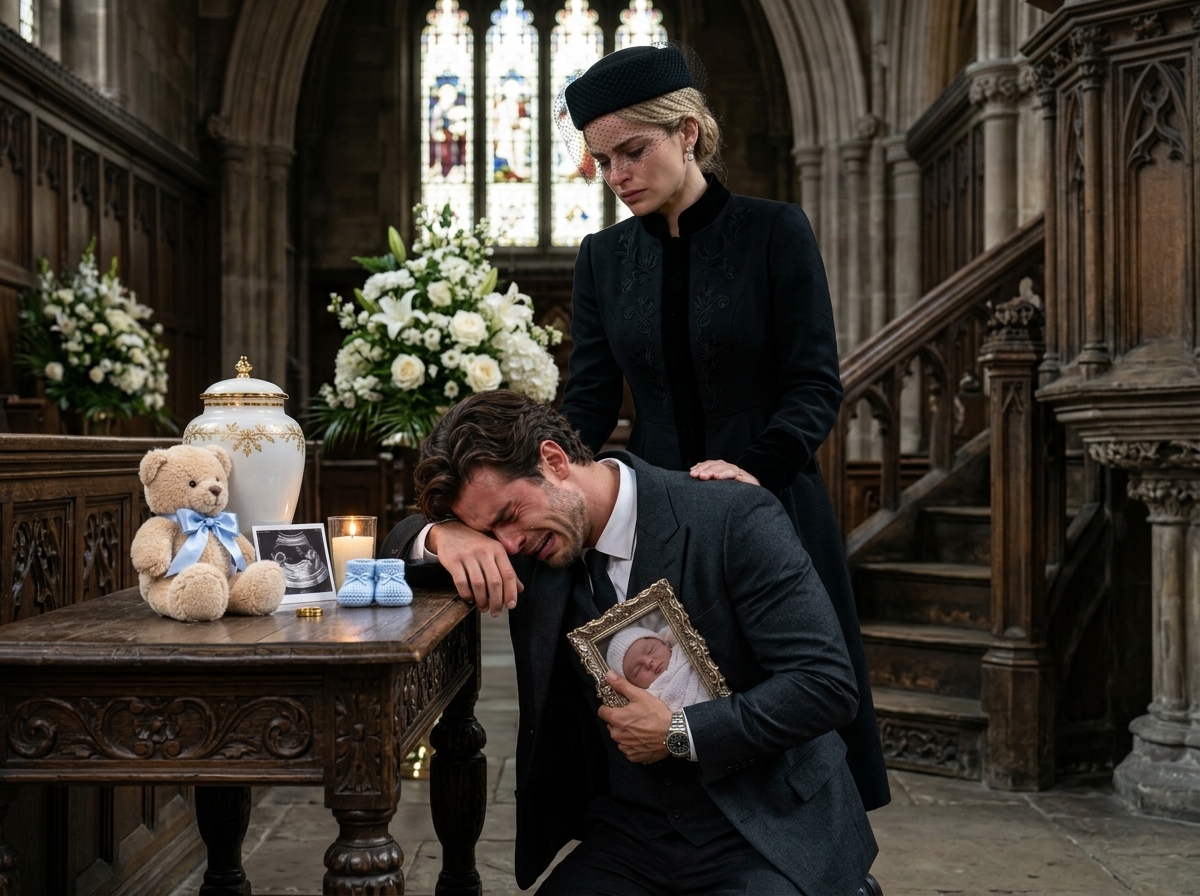
My 23-day-old son took his final breath in my arms while holding my finger, flatlining at 4:11 p.m. On my seventeenth call, my husband finally answered from a Greek terrace with his mistress, barking: “Is this an appropriate time to interrupt my dinner? Stop your drama, that’s what we pay doctors for!” Three minutes later, his mistress posted photos of them toasting champagne. But hospital records exposed a chilling secret: the doctor had phoned him nineteen minutes before our baby di//ed, and Nathan commanded…
Chapter 1: The Silence at Four-Eleven
There is an exact, suffocating weight to a hospital room when the machines finally stop screaming. It is not merely quiet; it is a profound, hollow vacuum that rushes in to fill the space where a living soul used to fight.
My name is Claire Whitmore . I will never forget 4:11 on that terrible autumn afternoon. That was the exact moment my twenty-three-day-old son, Ethan , took his final, shallow breath against my collarbone. His tiny, paper-thin fingers were wrapped clumsily around my index finger, holding onto this world with a fierce, trembling desperation that his underdeveloped lungs could no longer sustain. The heart monitor—that relentless digital rhythm that had accompanied every precious hour of his agonizingly short life—finally fell silent, flatlining into an unbroken, high-pitched tone that vibrated straight through my marrow.
I remember the attending physician lowering his graying head, his eyes swimming with a professional sorrow that felt infinitely distant. I remember a young nurse standing by the incubator, silently wiping scalding tears from her cheeks with the back of her sterile glove. And above all, I remember holding my little boy’s fragile, cooling body against my chest, whispering desperate, broken prayers into his soft brown hair, wishing with every shattered fragment of my being that I could somehow trade places with him, that I could breathe my own breath into his quiet mouth.
Ethan had never slept in the exquisite, sunlit nursery I had spent months preparing for him. He had never worn the cozy blue cashmere sweater I had knitted during my third trimester, marveling at the miracle of what was to come. And he had never once been held by his father. Not for a single second of his twenty-three days of existence.
For nearly a month, I had sat rooted in a hard plastic chair beside his incubator in the neonatal intensive care unit, watching teams of exhausted doctors and dedicated nurses wage an unrelenting war to keep his flickering spark alive. I had learned the agonizing vocabulary of every monitor alarm; I had memorized the volatile numerical fluctuations of his oxygen saturation and blood pressure; and every single night, huddled in the dim glow of the ward, I had prayed that the coming dawn would deliver a miracle.
Instead, that Tuesday afternoon, the medical team finally ran out of miracles. Their eyes told me everything before their voices could form the words.
When the doctors and nurses gently stepped back, affording us a shred of human privacy, I pressed my lips against Ethan’s cold forehead, tasting the salt of my own grief.
“Mommy’s right here, sweetheart,” I whispered, my voice cracking into a ragged sob. “You’re safe. Mommy’s got you.”
With a trembling hand, I reached into the pocket of my cardigan, pulled out my smartphone, and stared at the screen. At the very top of my recent call log, illuminated by the harsh blue light, was a name that felt like a mockery.
Nathan Whitmore.
My billionaire husband. The man who had vowed before God and hundreds of high-society witnesses to cherish and protect us.
Sixteen unanswered attempts. Sixteen times I had dialed his private line while our son fought for his next breath, only to be greeted by an automated voicemail box or a ringing tone that dissolved into empty space.
I pressed his number once more. Seventeen.
The phone hummed against my ear. One ring. Two rings. Three rings.
On the fourth ring, a click echoed through the speaker, followed by background noise that made my blood run instantly cold.
“Claire, what is it now ?” Nathan’s voice barked, tight with irritation and dripping with exhaustion.
Soft, melodic string music drifted through the receiver. The distinct, cheerful clinking of crystal wine glasses. A woman’s sultry, unrestrained laughter echoing across a crowded terrace.
He was still sitting at an exclusive, sun-drenched restaurant in Greece, dining with Vanessa Hart . The very woman he had been brazenly parading across Europe while I sat vigil beside our critically ill newborn in a New York hospital.
“Nathan,” I whispered, the word barely escaping my dry lips.
He sighed heavily, the sound saturated with the impatient annoyance of a CEO dealing with a minor administrative inconvenience. “I’m having a critical business dinner, Claire. Can whatever minor crisis you’ve invented wait until tomorrow?”
I stared down at Ethan’s impossibly peaceful face, the tiny blue blanket resting over his motionless chest.
“Our son died, Nathan.”
Silence. A vast, abysmal silence swallowed the background music, stretching across thousands of miles of ocean. For one fleeting, delusional second, my fractured mind imagined Nathan leaping from his chair so violently that the mahogany table would overturn. I pictured him demanding the hospital’s exact coordinates, screaming for a private jet, sprinting through the cobblestone streets toward the airport.
Instead, he exhaled a long, measured breath of pure exasperation.
“Claire… for God’s sake. The doctors were taking care of him. That’s what we pay them for.”
The words struck me like physical blows, knocking the remaining air straight out of my lungs. I couldn’t process the syntax of his sentence. I couldn’t comprehend how a human being—let alone a father—could utter such callous rhetoric.
“They couldn’t save him, Nathan,” I choked out, tears spilling freely down my cheeks. “Ethan is gone. He passed away in my arms five minutes ago.”
“I understand that you’re upset,” he replied, his tone shifting into that clinical, detached politeness he reserved for insubordinate junior executives. “Emotions are running high. But is this really an appropriate moment to interrupt my dinner? Can we discuss the funeral arrangements later this week?”
In the background, Vanessa’s voice murmured something playful and melodic. I heard Nathan shift the phone, his hand momentarily muffling the microphone as he muttered a low reassurance to his mistress.
When he returned to the line, his tone was brisk. “Vanessa is right here, and I need to get back to our table. I’ll call you whenever I have a free moment. Try to calm down, Claire.”
Click.
The line went dead.
I remained utterly motionless in the dim NICU alcove, holding the phone against my ear long after the dial tone began to hum. My newborn son was dead. His tiny heart had stopped beating. And his own father had just dismissed the news because it interrupted an expensive dinner party with his mistress.
Something deep inside my chest snapped—not with a dramatic crack, but with the quiet, terrifying finality of a fault line splitting open. The man I had loved, the man I had built an empire around, was a stranger. And as I would soon discover through the cold ink of hospital administrative records, his betrayal went infinitely deeper than mere absence. He hadn’t simply ignored my final desperate pleas; he had known precisely when our son was slipping away, and he had made a calculated choice that would stain his soul for eternity.
Chapter 2: The Architecture of Illusion
Nathan Whitmore hadn’t always been a ghost.
When our paths first crossed seven years ago, I was a twenty-six-year-old interior designer striving to establish my own boutique firm in Manhattan. He was thirty-three—ambitious, relentlessly charming, impeccably dressed, and already scaling the dizzying heights of international real estate and venture capital.
We met at a charity gala where I had been hired to coordinate the floral installations. When he approached me near the champagne fountain, I bluntly told him that his multi-million-dollar bachelor penthouse looked like an overgrown, sterile hotel lobby devoid of human warmth.
Nathan had thrown his head back and laughed—a rich, genuine sound that crinkled the corners of his dark eyes. It was the first time in his hyper-exclusive social circle that someone had spoken to him without cowering or curtsying.
Three weeks later, he retained my firm to completely redesign his residence from the floor up. Six months after that, he dropped to one knee beneath the sprawling branches of an ancient oak tree outside my mother’s suburban home, presenting a vintage diamond ring that caught the autumn sunlight like a prism.
He had looked into my eyes with a fierce, burning intensity and told me he wanted a real family. Children. Laughter echoing down long hallways. A home anchored by warmth and genuine devotion rather than imported marble and minimalist furniture.
“The one thing money can never buy, Claire,” he had whispered, pressing his palm against my cheek, “is someone who loves you for who you are when the cameras are turned off.”
I had believed him with every fiber of my being.
During the first few years of our marriage, Nathan was an exceptionally attentive husband. He marked anniversaries with thoughtful, deeply personal gifts; he surprised me with coffee in bed on grueling mornings; and he once canceled an impromptu high-stakes board meeting in Chicago simply because I had come down with a severe case of the flu and needed him close.
Then came the explosive international expansion of Whitmore Holdings .
His commercial empire ballooned across Europe and Asia, demanding an exponential increase in overseas travel. His corporate private jet became his primary residence; his phone calls home dwindled from hour-long evening debriefs to hurried, five-minute check-ins between connecting flights; and his emotional availability evaporated into the stratosphere.
And then, Vanessa Hart entered our orbit.
She was twenty-nine—glamorous, fiercely ambitious, relentlessly polished, and freshly appointed as the director of international communications for Whitmore Holdings. Initially, Nathan introduced her to me at a corporate dinner as an indispensable asset, a wunderkind whose administrative brilliance was steering their European expansion.
Within six months, however, the boundaries of her employment had blurred beyond recognition. Vanessa began answering his personal mobile phone when he was occupied. She accompanied him to high-profile dinners where wives were traditionally excluded. And eventually, she became a permanent fixture on his international itineraries, traveling by his side to every corner of the globe.
The turning point occurred on a rainy Tuesday evening when I stood in our master bathroom holding a plastic pregnancy test marked with two unmistakable pink lines. My heart swelled with a mixture of joy and apprehension. I dialed Nathan’s private line, eager to share the miraculous news.
It was Vanessa’s voice that answered from the luxurious suite of a Parisian hotel.
“Nathan is indisposed in the shower at the moment, Claire,” she purred, her tone dripping with casual, possessive familiarity.
I froze, the test slipping slightly in my damp palm. “Please inform my husband that his wife called, and have him return my call immediately.”
There was a brief, pregnant pause on the line. “Of course, Claire. I’ll make certain he gets the message.”
I should have packed my bags that very night. I should have consulted a divorce attorney before the sun rose. But I was trapped in the insidious psychological prison of sunken-cost fallacy; I had invested my youth, my heart, and my unconditional devotion into our marriage, and I desperately wanted to believe that our foundational vows could withstand a temporary corporate aberration.
When Nathan finally called back and I told him the news, his reaction seemed authentic. He rushed home from Paris two days early, swept me off my feet, and held me tightly against his chest.
“We’re going to be a family, Claire,” he promised, kissing the top of my head with a tenderness I had sorely missed. “Everything is going to change. I’m scaling back the travel.”
For a brief, euphoric window, he kept his word. He accompanied me to obstetrician appointments, marveling at the rhythmic beat of our baby’s heartbeat on the ultrasound monitor; he built an absurdly expensive, custom-designed nursery with imported Swiss wooden furniture; and he doted on me with all the fervor of a newlywed.
Then, the overseas crises resumed with a vengeance.
By my eighth month of pregnancy, Nathan’s international schedule had obliterated his domestic promises. He missed our critical thirty-week ultrasound; he was in Frankfurt during my prenatal baby shower; and when my obstetrician ordered strict monitoring at thirty-four weeks because little Ethan wasn’t gaining weight at the expected velocity, Nathan was packing his bags for a week-long summit in Athens.
I stood in the entryway of our massive, echoing foyer, tears streaming down my face as I begged him to postpone his flight.
“It’s only four days, Claire,” he insisted, zipping his leather garment bag with an impatient snap. “The Hellenic commercial acquisitions cannot be rescheduled.”
“I am terrified, Nathan,” I sobbed, clutching my swollen belly. “The doctors say the stress is causing Braxton Hicks contractions. I need you here.”
“You have access to the finest obstetricians and private nurses in the state of New York,” he countered, his expression hardening into corporate indifference. “That is hardly the same as sitting alone in a quiet house.”
“That is not the same as having my husband by my side!” I cried out.
He exhaled sharply, his patience dissolving. “Please, Claire, do not start this emotional melodrama again.”
In a desperate bid for connection, I grabbed his warm hand and placed it flat against my cotton shirt, right over my protruding abdomen. A second later, Ethan gave a strong, distinct kick against his palm.
Nathan’s features softened momentarily. He looked down, a fleeting, tender smile touching his lips. “There’s my little fighter,” he murmured.
Then, the shrill ringtone of his private phone pierced the silence.
Caller ID: Vanessa Hart.
Nathan’s expression instantly shuttered. He withdrew his hand from my stomach as if he had been burned, checked the screen, and walked briskly toward the waiting black town car idling in the driveway.
That was the absolute last time my husband ever touched our son.
Chapter 3: The Terminal Voyage
The promised four-day trip to Greece metastasized into six days. Then eight. Then ten.
Nathan’s daily check-in calls devolved into hurried text messages claiming that intractable bureaucratic negotiations with Greek maritime regulators were keeping him chained to his desk in Athens.
But Vanessa’s public and private social media profiles painted an entirely different, agonizingly vivid reality.
Private yacht charters cruising the azure waters of the Aegean. Crystal flutes brimming with vintage Dom Pérignon on sun-drenched whitewashed balconies in Mykonos. Romantic candlelit dinners overlooking the caldera in Santorini. And incriminating, geotagged photographs of my husband wrapping his strong arms around Vanessa’s waist, whispering into her hair against a backdrop of Mediterranean sunsets.
While they luxuriated in hedonistic splendor, my body betrayed me.
At thirty-five weeks, deep in the silent hours of the night, my water broke. I went into precipitous, violent premature labor weeks ahead of schedule.
Alone in our cavernous mansion, I dialed Nathan’s private number frantically.
Voicemail.
I sent frantic, weeping text messages informing him that something was catastrophically wrong, that the ambulance was taking me to Mount Sinai.
Hours later, after I had been rushed into emergency surgery and delivered a fragile, silent baby boy weighing barely four pounds and nine ounces, Nathan finally replied:
Stop being so dramatic, Claire. I’m locked in a board meeting with regional stakeholders. Handle it.
Fifteen minutes prior to that callous text arriving on my phone, Vanessa had uploaded a triumphant Instagram story showing her and Nathan clinking champagne glasses on a private terrace, celebrating a “successful corporate acquisition.”
Ethan’s first cry was so frail, so distressingly faint that I had to strain every nerve in my body to hear it over the rhythmic clicking of surgical equipment. The neonatal team rushed him out of the operating theater and down the sterile corridor to the intensive care unit before I could even touch his tiny hand. His lungs were critically underdeveloped, plagued by neonatal respiratory distress syndrome. He required immediate intubation, mechanical ventilation, and round-the-clock invasive monitoring to sustain his fragile spark of life.
For twenty-three agonizing days, I lived and breathed within the four glass walls of that NICU pod. I never once returned to the empty, echoing mansion in Westchester. I slept upright in a rigid vinyl chair, showering in a tiny hospital bathroom, existing entirely on lukewarm cafeteria coffee and sheer maternal adrenaline.
There were fleeting, deceptive moments of grace. Once, during the second week, Ethan fluttered his eyelids open while I cradled him tightly against my bare chest, his tiny dark eyes locking onto mine with an ancient, profound wisdom. Another morning, his blood oxygen saturation levels stabilized into a safe plateau, and his little fingers curled around my thumb with surprising tenacity.
Whenever these fragile victories occurred, I dutifully transmitted photographs and detailed medical updates to Nathan via encrypted messaging.
When Ethan opened his eyes for the very first time, I typed out: Our little boy looked at me today, Nathan. He has your eyes. Please come home.
Six hours later, Nathan replied with two chillingly economical words: That’s good.
Just two words.
I stared at that microscopic text bubble for hours, forcing my broken heart to convince myself that his brevity was merely a reflection of a hardworking executive’s overwhelming schedule, that deep down, he cared.
Yet inexorably, Ethan’s microscopic reserves began to deplete. His tiny body grew exhausted from the relentless, daily warfare against organ failure. The attending physicians finally pulled me aside into a sterile consultation room, their expressions grim, and warned me gently that my son’s fragile system was shutting down. They had exhausted every advanced therapeutic protocol in their arsenal.
I begged Nathan to drop everything and catch the next commercial flight out of Athens.
He accused me of weaponizing our dying infant to sabotage his career and manipulate his schedule.
Still, I dialed his number over and over again, refusing to accept that a man could willingly abandon his flesh and blood in their final hours upon this earth.
Until that fateful Tuesday afternoon at 4:11 p.m., when Ethan drew his final breath with only his mother to whisper him into the great unknown.
Chapter 4: The Memory Box and the Discrepancy
After Nathan abruptly severed our seventeenth phone call, the senior charge nurse entered the NICU alcove, her face etched with profound empathy, carrying a small, heavy rectangular box crafted from pale pine.
“I’m so sorry, Claire,” she whispered softly, placing the vessel on the edge of the medical cart.
Inside lay the sacred, heartbreaking remnants of my son’s brief earthly existence: his laminated hospital identity bracelet, a strip of heavy cardstock bearing his microscopic ink-stamped footprints, a lock of fine brown hair, and the tiny, hand-knitted blue cap the nurses had placed on his head after birth.
Embossed across the surface of his plastic identity bracelet in stark black lettering were the words: ETHAN WHITMORE.
I clutched the bracelet tightly against my chest, curling my body around the pine box as if shielding it from the harsh fluorescent lights of the ward.
Suddenly, my phone buzzed against the table.
For one hallucinatory, impossibly desperate microsecond, my brain screamed that Nathan had realized the magnitude of his cruelty, that he was calling back to recant his dismissal, to say he was on a tarmac heading home.
I snatched the device. It wasn’t a call. It was a push notification from social media.
Vanessa Hart had just uploaded a brand-new photograph to her public profile.
The image displayed an upscale, candlelit seaside restaurant overlooking the breathtaking expanse of the Mediterranean Sea. A single flickering taper candle sat between two crystal champagne flutes beaded with condensation. Across the linen-draped table sat my husband, dressed in an open-collared linen shirt, raising his glass toward the camera with a brilliant, untroubled smile gracing his handsome face.
The digital timestamp on the post read precisely 4:14 p.m.
Three minutes after my son had died. Three minutes after I had screamed into the phone that Ethan’s heart had stopped beating. Three minutes after a father was informed that his firstborn child had perished.
Vanessa’s jubilant caption celebrated their “private romantic evening under the Grecian stars, celebrating a historic corporate victory.”
I stared at the glowing screen until the bright pixels blurred into distorted smears of light. I didn’t scream. I didn’t shatter the phone against the floor. I simply saved the high-resolution image to my camera roll, a cold, methodical numbness washing over my entire nervous system.
Later that evening, a compassionate hospital social worker named Rebecca visited my alcove to discuss the mandatory administrative procedures. There was mountainous paperwork to navigate: a formal death certificate, municipal coroner releases, mortuary transport logistics—dismal bureaucratic realities no grieving mother should ever be forced to process alone.
When Rebecca gently asked if there was a family member or close friend she could contact to assist me through the coming days, my mind immediately flew to my older sister, Julia , who lived three hours away in Boston. Julia dropped everything within the hour, driving straight through the night to reach my side.
As Julia sat beside me in the quiet hospital lounge, holding my hand while I recounted the horrors of the past twenty-four days, Rebecca paused, reviewing a clipboard of administrative logs.
“There is one unusual administrative note in Ethan’s file, Claire,” Rebecca mentioned tentatively, her brow furrowing.
I looked up, wiping my tear-stained cheeks. “What kind of note?”
“An administrative assistant from your husband’s corporate office contacted the hospital registry yesterday afternoon,” Rebecca explained, adjusting her glasses.
“My husband’s office?” I echoed, my brow arching. “Who specifically?”
“A woman named Vanessa Hart.”
My stomach performed a sickening, violent cartwheel. Even while my twenty-three-day-old infant was actively fighting for his life in the intensive care unit, Vanessa had actively inserted herself as the administrative gatekeeper between my husband and the medical staff.
Rebecca continued, explaining that the hospital’s patient advocacy log contained a strict directive supposedly emanating from Nathan’s executive suite. It instructed attending physicians and nursing supervisors to consolidate all routine medical updates through corporate liaisons and strictly limit “unnecessary domestic interruptions” to Mr. Whitmore’s international schedule.
But that wasn’t the most damning revelation.
Embedded within the digital communication audit trail was a notation indicating that Nathan Whitmore himself had personally verified and reconfirmed those exact restrictive instructions during a direct telephone conference with the hospital administrator earlier that very morning .
At 9:36 a.m.
The exact same morning Ethan’s vital signs had begun their precipitous, critical crash.
I stared across the table at Rebecca, the blood draining rapidly from my face. “Are you telling me… are you telling me Nathan was explicitly informed of his son’s critical deterioration before lunch?”
Rebecca gently placed her hand over mine. “The complete communication logs need to be formally reviewed and subpoenaed, Claire. But the preliminary administrative trail strongly suggests that your husband’s absence was neither accidental nor born of ignorance. He knew.”
Chapter 5: The Unraveling of Whitmore Holdings
Julia arrived at the hospital just as dawn was breaking, her eyes red-rimmed from driving through a torrential downpour. When she walked into the sterile waiting lounge and saw me clutching Ethan’s memory box, she broke down completely, pulling me into a fierce, unbreakable embrace that lasted for ten unbroken minutes.
“We are going home, Claire,” Julia whispered fiercely against my hair, her voice vibrating with a lethal, protective fury. “You are not stepping foot back in that mausoleum alone. And we are going to make damn sure that monster pays for what he’s done.”
The following afternoon, Julia drove me back to the sprawling, monolithic mansion in Westchester.
The estate looked precisely as it always had—an opulent testament to unbridled wealth. Six sprawling bedrooms, sweeping imported marble floors, meticulously manicured botanical gardens, and a grand curved staircase that swept upward toward the master wing.
Yet as I climbed those stairs and pushed open the door to Ethan’s custom nursery, the opulence felt suffocating, toxic, and grotesque.
The custom Swiss crib sat completely empty, waiting for an occupant who would never arrive. The plush white rocking chair sat silently beside the bay window, draped with the blue knitted blanket I had folded with such tender anticipation. And in the polished mahogany dresser drawer lay the tiny blue cashmere sweater I had purchased during my second trimester, untouched and unworn.
My phone buzzed against the marble countertop.
An incoming text message from Nathan: Hope things have settled down at the hospital. We’ll discuss all the administrative details when I return to New York this weekend.
I read the screen twice, my mind struggling to comprehend the sheer, staggering disconnect from reality.
Settled down?
Our son was dead. His body was resting in a refrigerated mortuary drawer. And my billionaire husband was treating his passing like an inconvenient scheduling conflict that required minor administrative adjustment.
I forwarded Nathan’s text directly to Eleanor Price , a razor-sharp, nationally renowned family law litigator Julia had retained on my behalf.
When Eleanor invited us into her sleek Manhattan office later that week and listened to my comprehensive account of the seventeen unanswered calls, the Greek photographs, and the hospital communication logs, her expression hardened into cold granite.
“Before you even retain my services, Claire, I need to inform you of something deeply unsettling,” Eleanor said, sliding a folded legal memorandum across her desk.
My heart hammered against my ribs. “What is it?”
“Nathan’s corporate legal counsel contacted my office early this morning.”
“Why would his attorneys be calling you?”
“They wanted to ascertain whether I had been formally retained to represent you in matrimonial proceedings,” Eleanor explained, folding her hands. “More importantly, they specifically inquired whether you currently possess physical custody of certain hospital communication records and administrative logs.”
I stared at her, dumbfounded. “What records?”
“Documentation concerning a direct telephone conference your husband reportedly conducted with the hospital’s chief administrator at 9:36 a.m. on the morning your son passed away.”
The jigsaw puzzle pieces slammed violently into place in my mind. Someone within Whitmore Holdings’ executive apparatus had already realized that the digital audit trail exposed Nathan’s knowing abandonment, and they were frantically mobilizing to suppress the evidence before I could secure it.
Eleanor instructed me to preserve every digital artifact, text message, photograph, and medical record in our possession. Then, she looked me directly in the eyes and asked the question I had been too terrified to articulate myself.
“Claire… do you wish to proceed with a formal petition for divorce?”
The words hung in the sterile air of the office, heavy and unalterable. There was no theatrical triumph in my soul, no vindictive thrill—only an absolute, chilling certainty.
“I want a divorce, Eleanor,” I said quietly. “And I want a full forensic audit of every corporate account tied to Whitmore Holdings.”
Eleanor immediately set to work drafting the pleadings. Meanwhile, back at the Westchester mansion, deeply disturbing developments were unfolding.
Our longtime housekeeper, Margaret, pulled me aside into the laundry room while Julia was out running errands. Her hands were shaking as she clutched a dish towel.
“Mrs. Whitmore, I feel it is my moral duty to tell you something,” Margaret whispered, casting nervous glances toward the hallway. “That woman—Ms. Hart—called the house landline yesterday.”
“Vanessa?”
“Yes, ma’am. She demanded to know whether you had brought any medical paperwork or administrative logs home from the hospital. Furthermore, she instructed me to go upstairs and place a deadbolt lock on Ethan’s nursery door before Mr. Whitmore returns from Greece.”
My blood ran cold. They weren’t just trying to suppress the hospital records legally; they were actively attempting to sanitize the house of any physical reminders of my son’s existence, treating him like an embarrassing administrative error to be swept under the rug.
Worse still, late that evening, Margaret confessed that a corporate security operative dispatched by Nathan’s executive office had visited the mansion while I was at the lawyer’s office, picking the lock on the nursery filing cabinet and removing a preliminary medical intake summary.
I immediately alerted Eleanor, who secured an emergency Anton Piller injunction from a family court judge, legally freezing all residential access and forcing Whitmore Holdings to surrender every unredacted communication record in their possession.
And that was when the most devastating revelation of all came to light.
A senior medical records administrator at Mount Sinai Hospital came forward under whistleblower protection, revealing an additional, highly classified attempt by Nathan to control the narrative.
There had been a second, crucial phone call placed to Nathan’s private satellite number. Not at 9:36 that morning, when his condition was merely critical.
But at 3:52 p.m.
Nineteen devastating minutes before Ethan drew his final breath.
Dr. Mitchell, the head of pediatric intensive care, had personally dialed Nathan’s private line to issue a definitive, unambiguous warning: Your son is actively crashing. He is not going to survive this afternoon. If you wish to be present when he passes, you need to charter a flight immediately.
My hands began to shake so violently I could barely hold my coffee cup. Because at 4:11 p.m., when Nathan had answered my seventeenth call, he had acted with theatrical ignorance, feigning shock and treating the news as an irritating interruption to his seaside dinner.
Now, the absolute truth stood naked before me: Nathan hadn’t just known. He had known precisely when our son was dying, and he had chosen olives, champagne, and his mistress over the final heartbeat of his child.
Chapter 6: The Confession of a Coward
I demanded an immediate, formal face-to-face meeting with Dr. Mitchell to verify the hospital’s internal call logs. Accompanied by Julia and Rebecca, I sat across from the exhausted, sorrowful physician in a private conference room overlooking the New York skyline.
“Please, Dr. Mitchell, I need you to tell me the unvarnished truth about what happened at 3:52 that afternoon,” I pleaded, holding a small, framed photograph of Ethan against my chest.
Dr. Mitchell looked up, his eyes heavy with professional grief. “I placed that call personally, Claire. Your son’s vital collapse was precipitous and absolute. I knew we were losing him.”
“Did you speak directly to Nathan?”
“Yes. His private satellite number connected immediately.”
“Did you explicitly inform him that Ethan was dying?”
The doctor nodded slowly, a muscle ticking in his jaw. “I used unambiguous medical terminology. I explained that Ethan was in terminal cardiogenic shock, that our resuscitative measures were failing, and that if he intended to be present for his son’s final moments, he needed to authorize an immediate private transport out of Athens.”
My throat felt as though it had been constricted by a tightened cord. “What did Nathan say in response?”
“He paused for a long moment,” Dr. Mitchell recalled, his voice dropping to a somber murmur. “Then he asked whether there was anything he personally needed to authorize from a surgical standpoint.”
“And?”
“I informed him that we had exhausted all viable surgical interventions, and that I was calling purely to ensure he understood the absolute gravity of the situation.”
“Did he state that he was organizing a flight?”
Dr. Mitchell lowered his gaze to the polished table, unable to meet my eyes. “No, Claire. He did not.”
“Did he ask to speak to me?”
“No.”
“Did he ask how I was holding up?”
“He did not inquire about your well-being once.”
A suffocating silence filled the room. But as I prepared to stand, Dr. Mitchell raised a hesitant hand, signaling that there was one final, horrific detail I needed to hear.
“There is something else, Claire. Before I terminated the call… your husband made a very specific, chilling request.”
My heart stopped. “What kind of request?”
“He asked whether you had been informed that I had successfully reached him on his private line.”
When Dr. Mitchell explained that I was currently standing right beside the incubator holding our dying child’s hand, Nathan had issued a direct, urgent command: Do not tell my wife that you spoke to me. Do not let her know that I was reachable.
The room seemed to violently spin on its axis.
Nathan hadn’t just abandoned us out of negligence. He had known with absolute mathematical certainty that his son was dying; he had consciously chosen to remain in Greece with Vanessa; and he had actively conspired with the medical staff to conceal his accessibility from me so he wouldn’t have to endure my tears or shoulder the emotional weight of his cowardice.
For weeks, I had tortured myself wondering whether Nathan possessed a shred of human empathy left within his soul. Now, the mask was entirely pulverized.
I decided I could not remain another second in that echoing, ghost-filled mansion in Westchester. With Julia’s unwavering assistance, I packed my entire life into a series of cardboard boxes.
I gathered Ethan’s hospital blanket, still faintly scented with baby lotion; his framed photographs; his tiny blue cashmere sweater; his hand-knitted cap; and the pale pine memory box containing his tiny ink footprints.
As I zipped my final suitcase—realizing with a fresh wave of agony that this enormous luggage case was more than large enough to hold every single physical artifact my son had accumulated during his twenty-three days of life—I felt a fracture in my soul deepen into an abyss.
We arranged a simple, deeply personal memorial service for Ethan.
No corporate executives. No high-society sympathizers. No flashing camera lenses or PR handlers.
Just a serene, sunlit chapel overlooking the Hudson River. Masses of pure white lilies, a framed portrait of my sweet boy resting beside a delicate white casket, and a few close friends who truly loved us. I wanted the ceremony to honor Ethan’s pure, innocent soul—not Nathan’s vulgar wealth, not his scandalous affair, and certainly not our incinerated marriage. Just my baby boy.
Nathan remained marooned in Europe while the funeral arrangements were finalized, his corporate attorneys issuing formal warnings that he would not tolerate “public grandstanding” or defamatory press statements. Eleanor handled their threatening correspondence with ruthless legal precision, ensuring that not a single flunky from Whitmore Holdings dared interfere with my son’s final farewell.
Before walking out of the Westchester mansion for the final time, I climbed the grand staircase one last and pushed open the nursery door.
I left the custom Swiss crib untouched. The rocking chair remained positioned beside the sunlit bay window. But upon the polished mahogany dresser, I arranged Ethan’s framed photograph, his identification bracelet, and a certified copy of his death certificate.
Right beside those sacred relics, I placed the formal divorce pleadings and a handwritten letter addressed to my husband.
Nathan,
Our son lived for twenty-three days.
You missed his birth, every agonizing night he fought to draw breath, and the exact second his heart stopped beating.
He held my finger when he was frightened. He opened his dark eyes when I whispered to him. And on his final night on this earth, I lied to him and promised him that his father was on his way.
I told him his father loved him because I couldn’t bear the thought of my baby leaving this world feeling abandoned by the one person mandated to protect him.
You had twenty-three days to come home. You chose not to.
Goodbye, Nathan.
I placed my platinum wedding band squarely in the center of the paper, turned on my heel, and walked out of the mansion forever.
Chapter 7: The Collapse of the Empire
Following Nathan’s return to New York, the legal battle metastasized into an all-out corporate and domestic war.
Initially, Nathan’s high-priced legal team attempted to discredit the hospital’s communication records, arguing through public PR statements that Vanessa Hart had acted as an unauthorized gatekeeper without his direct knowledge, and that he had been “fatally confused” regarding the true severity of Ethan’s illness due to erratic international satellite signals.
They constructed a pathetic narrative portraying him as a grieving, emotionally devastated father who had been shielded from the harsh reality by an overzealous administrative assistant.
But Eleanor Price was a shark in a tailored pantsuit.
She systematically dismantled their manufactured narrative piece by piece, subpoenaing server logs, satellite routing tables, and internal corporate emails from Whitmore Holdings.
The digital forensic audit revealed an inescapable paper trail. Vanessa Hart had indeed weaponized her executive position to intercept domestic communications, but she had done so under explicit, written directives signed by Nathan himself, mandating that his personal calendar remain shielded from “domestic distractions.”
Worse still for Nathan, Vanessa—realizing that she was being systematically positioned by corporate counsel to take the absolute fall for executive-level depravity—turned state’s evidence in exchange for immunity from civil conspiracy charges.
She provided Eleanor with her private messaging archives, including a frantic text message Nathan had transmitted to her mobile phone mere minutes after Dr. Mitchell’s final terminal call from the hospital:
“If Claire ever finds out I knew he was dying and stayed in Mykonos anyway, she will never forgive me. Make sure the hospital logs stay buried.”
When Eleanor read those words aloud in a private settlement conference, the color drained entirely from Nathan’s face. The master of the corporate universe looked suddenly frail, hollowed out, and utterly pathetic.
Vanessa’s betrayal was absolute. Stripped of her corporate immunity, she was unceremoniously terminated by the Whitmore Holdings board of directors, her high-flying international career incinerated overnight. Her relationship with Nathan evaporated the moment the first subpoena was filed; she packed her designer bags and fled to London, leaving my husband to face the wreckage of his life entirely alone.
Facing overwhelming, incontrovertible evidence of marital waste, fraudulent asset concealment, and intentional infliction of emotional distress, Nathan’s high-priced attorneys finally advised him to wave the white flag.
The divorce settlement was finalized on a crisp, overcast November morning.
I declined the exorbitant, punitive financial settlements Eleanor initially proposed. I had no desire to drain Whitmore Holdings dry simply to fuel a bitter financial war; I wanted a fair, clean division of marital assets that ensured my complete and permanent financial independence without tethering my future to his corporate tainted empire in any way, shape, or form.
Nathan stepped down from his role as Chief Executive Officer of Whitmore Holdings, retreating into a quiet, disgraced semi-retirement as a minority shareholder while a professional board of directors assumed operational control of his crumbling conglomerate.
Whispers reached me through mutual acquaintances that Nathan had visited Ethan’s gravesite in Westchester on a bleak, freezing Tuesday afternoon. Dressed in a simple black coat, carrying a tiny blue cashmere sweater—the very one he had refused to look at while our son was alive—he had reportedly knelt beside the pale stone headstone for hours, weeping uncontrollably and begging forgiveness from a silent marker.
When mutual friends relayed this information, expecting it to bring me a sense of vindication or schadenfreude, I felt nothing.
His tears could not restart my son’s heart. His belated remorse could not buy back a single second of the twenty-three days he had squandered on private yachts and Mediterranean terraces.
A month after the decree was signed, I packed my remaining boxes and relocated to a small, unassuming coastal cottage in Maine.
There were no sweeping marble staircases here. No wrought-iron security gates. No cavernous, echoing rooms designed to intimidate guests.
Just whitewashed wooden walls, large bay windows that flooded every room with clean maritime sunlight, and a modest, overgrown garden out back where wild hydrangeas grew unchecked.
In the smallest bedroom overlooking the crashing Atlantic surf, I erected a pristine white wooden shelf. Upon it, I placed Ethan’s sacred memory box: his framed photographs, his knitted hospital cap, his identification bracelet, and the tiny blue sweater he never had the opportunity to wear.
Seeking purpose amidst the lingering echoes of grief, I began volunteering three days a week at a regional community hospital’s neonatal intensive care unit.
Sometimes I baked comforting meals for exhausted, terrified parents sitting vigil in the waiting lounges. Sometimes I organized administrative supply drives for premature infant care packages. And sometimes—most importantly—I simply sat quietly beside frightened mothers and fathers who were staring into the abyss, holding their trembling hands and letting them know they were not alone in the dark.
I never offered empty platitudes. I never promised that their fragile babies would miraculously survive. I understood with agonizing clarity how deeply uncertain and fragile life truly was.
Instead, I offered them something infinitely more powerful: my unbroken presence.
One stormy Tuesday evening, a young, nineteen-year-old mother sat sobbing on a vinyl bench outside the Maine NICU, her premature daughter fighting for every breath inside an incubator.
“I don’t know how to do this,” she whispered, her voice cracking with terror. “I’m so scared I’m going to lose her, and I’m completely all alone.”
I slid onto the bench beside her, gently wrapping my arm around her shaking shoulders. I reached out and took her cold, trembling hand in mine.
“You don’t have to know how to do this right now,” I murmured softly.
“Does it ever get easier?” she cried, looking up with tear-filled eyes.
I thought of Ethan. I thought of the terrifying moment his little fingers stopped moving. I thought of the empty nursery in Westchester, and the vast, unbridgeable chasm his absence had carved into my soul.
“I think,” I answered slowly, watching the rain streak down the hospital window, “we don’t necessarily get stronger. But we eventually learn how to carry the heavy things we once believed would destroy us.”
She leaned her head against my shoulder, her sobbing gradually softening into rhythmic, exhausted breaths. I remained anchored right beside her through the long, howling night, refusing to leave until the morning sun finally broke through the clouds.
And for the very first time since my son’s heart had stopped beating, I felt a quiet, enduring conviction settle deep within my chest: Ethan’s brief, twenty-three-day life had not been wasted. Through my grief, his memory was transforming into a beacon of comfort for others navigating the deepest shadows of despair.
Chapter 8: The Sanctuary of Memory
On what would have marked my beloved son’s very first birthday, the coastal sky above Maine arched like a vast, pale-blue cathedral dome. A crisp, salt-scented autumn breeze swept gently through the whispering pines surrounding my cottage.
I drove down to the quiet municipal cemetery overlooking the churning gray ocean, carrying an armful of freshly cut white lilies and a small, framed portrait of my sweet boy.
I knelt down beside his polished granite headstone, clearing away a few fallen autumn leaves with gentle fingers.
“Happy first birthday, my sweet angel,” I whispered, my voice steady and clear against the ocean wind.
I sat there for hours, talking to him as mothers talk to their children. I told him all about our little coastal cottage, about the wild hydrangeas blooming in the backyard, about my wonderful sister Julia, and about the brave families I had encountered while volunteering at the hospital. I told him how deeply I wished he were here to run across the wooden floors, to laugh, to grow, to live a magnificent life of his own.
Then, I reached into the pocket of my coat and pulled out his laminated hospital identity bracelet.
The microscopic black letters printed across the plastic still looked precisely as they had on the harrowing day he drew his first breath: ETHAN WHITMORE.
For so many months, those two words had functioned exclusively as a jagged shrapnel wound, reminding me only of everything I had been brutally stripped of.
But as I sat there in the golden autumn sunlight, watching the gulls wheeling across the horizon, I understood that the paradigm had fundamentally shifted.
For twenty-three miraculous days, I had been granted the profound, unearned privilege of being Ethan’s mother.
I had held him against my chest when the world was terrifying. I had comforted him through his pain. I had whispered songs into his ear. And I had loved him with an unconditional, ferocious devotion through every single agonizing second of his existence.
He had never learned to speak my name. He had never taken a clumsy toddler step across a living room rug. And I had never heard him utter the word Mommy .
But he had known the sound of my voice. He had felt the steady, protective rhythm of my heartbeat. He had recognized the warmth of my skin. And when his tiny, fragile hand reached out to grasp my finger, I had been right there beside him, anchored like a stone.
I pressed my palm flat against the cool, gray surface of his headstone.
“You were loved every single second of your breathing life, Ethan,” I whispered, the tears falling silently down my cheeks without burning. “You were never alone for a single moment.”
I kissed my fingertips and pressed them gently against the carved stone.
Nathan had once arrogantly declared that accumulated wealth and corporate power could solve virtually any crisis. For years, I had foolishly allowed myself to believe that our financial fortress would eternally insulate our family from the raw, unpredictable tragedies of human existence.
But my son had taught me a profound, immutable truth that no billionaire’s fortune could ever purchase.
The most precious, enduring gift we can ever bestow upon another human being is not a sprawling mansion, a lavish trust fund, or an empty, convenient promise.
It is the courageous, unyielding choice to remain firmly by their side when life becomes terrifying, uncertain, and dark.
My baby boy lived for only twenty-three days.
Nathan could never claw those days back from the void, and no amount of legal settlements or belated remorse could rewrite the cowardice of his absence. I would carry the phantom ache of his loss for the remainder of my days, wishing with every fiber of my being that fate had granted us a lifetime rather than a fleeting moment.
Yet as I stood up, brushing the damp earth from my knees and looking out toward the endless, magnificent expanse of the ocean, I knew one thing with absolute, unshakeable certainty.
When my son needed his mother most in all the world, I did not look away.
I stayed.
Every single agonizing night. Every terrifying medical crisis. Every breath until his final, quiet surrender.
And though my little boy was gone from this earth, the sacred love we forged during those twenty-three brief, beautiful days would remain woven into the very fabric of my soul, illuminating my path until the end of time.
THE END