My sister tore my shirt open on an exclusive beach in front of Navy officers and laughed at the scars across my back. My father stood silently as everyone stared at me like I was damaged beyond repair. For five years, my family had treated me as a disgraced failure who’d abandoned the military in shame. But moments later, an Admiral crossed the sand, studied my scars, and raised his hand in salute. His next words silenced the entire beach: “I’ve been searching for you for five years.”
The sunset spreading across the Coronado Bay Club should have been picture-perfect, an exquisitely arranged setting for my father’s naval retirement gala. Instead, it became the scene of my public humiliation.
“Everybody, take a good look at her,” my sister, Chloe, declared. Her voice carried above the crashing Pacific waves, drawing the attention of a hundred highly decorated officers. “Five years ago, she ran away from the Navy with her tail between her legs. And look at her now. Right where she belongs. Pouring drinks for real heroes.”
Quiet murmurs spread through the gathering. I stood behind my father, Captain Richard Sterling, holding a silver serving tray while wearing a cheap bartender’s shirt damp with sweat.
“The family’s favorite disappointment,” Chloe mocked, moving toward me. “Come on, Harper. Why don’t you tell everyone the truth? Tell them why you disappeared without a trace.”
My father gave her a sharp, warning look. “Enough, Chloe.”
But he made no effort to stop her. He’d always preferred the carefully maintained fiction that I’d resigned in disgrace to the frightening truth about my classified, disastrous extraction mission in Somalia.
Chloe suddenly seized my shoulder, her fingers tightening like a clamp. Instincts sharpened through years of operating in the world’s darkest places took over immediately. I let the tray fall and locked my hand around her wrist.
“Keep your hands off me,” I said quietly.
A wild, malicious satisfaction flashed in her eyes. “What’s wrong, Harper? You still want everyone to think you’re dangerous?”
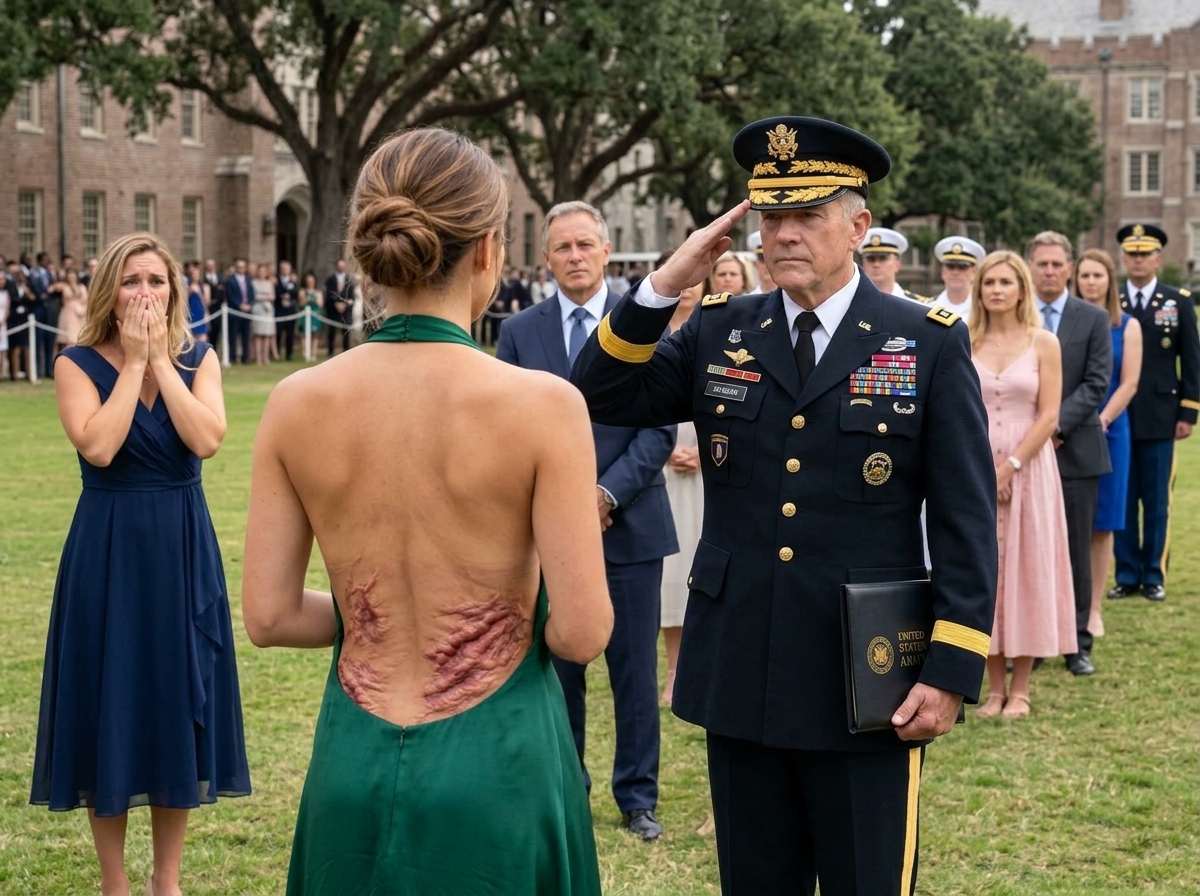
She violently threw her weight backward. The plastic buttons on my shirt snapped apart like flying shrapnel. The linen ripped along my spine, leaving my bare back exposed to the cold wind blowing in from the ocean.
All around us, the subdued conversations stopped.
A wave of horrified gasps broke from the surrounding officers.
I knew exactly what they were seeing.
The scars weren’t ordinary surgical marks. They were thick, twisted ridges of damaged flesh running from my shoulder blades to the base of my spine. Some were pale and smooth. Others remained dark red, as though the wounds beneath them had never completely healed.
Five years had passed since Somalia.
Five years of surgeries, physical therapy, sleepless nights, and learning how to stand without flinching whenever someone approached me from behind.
And now my sister had exposed the one part of my body I’d spent half a decade trying to protect from strangers’ eyes.
Chloe stared at my back.
For the first time that evening, her expression faltered.
Then she laughed.
“Oh my God, Harper. What happened to you? Did you get into a fight with a lawn mower?”
A few people looked away.
Nobody laughed with her.
My father stood three feet from me, his face drained of color.
He recognized those scars.
Or at least, he recognized what they might mean.
“Chloe,” he said, his voice suddenly hoarse. “Stop talking.”
But she was enjoying herself too much.
“Why? Everyone should see what happens when someone pretends to be a hero.”
I bent down, retrieved my fallen tray, and placed it carefully on the nearest table.
My hands weren’t shaking.
That surprised me.
For years, I’d imagined what I would do if someone finally forced my past into the open. I thought I’d panic. I thought I’d run.
Instead, I felt strangely calm.
“Are you finished?” I asked.
Chloe folded her arms.
“Not even close.”
Then a voice came from behind the gathering.
“Captain Sterling.”
It wasn’t loud.
It didn’t need to be.
The surrounding officers straightened almost instinctively.
My father turned.
An older man in Navy dress whites was walking across the sand. Silver hair showed beneath his combination cover, and four stars gleamed on his shoulder boards.
Admiral James Anderson.
I recognized him immediately.
My breath caught.
The last time I’d seen him, he was standing outside a military hospital, separated from me by a reinforced glass window.
He had watched as doctors wheeled me into surgery.
I’d been told afterward that he had personally signed the order restricting access to my records.
I’d also been told he couldn’t help me anymore.
Now he was walking straight toward me.
My father snapped to attention.
“Admiral Anderson, sir.”
The admiral barely glanced at him.
His eyes were fixed on my exposed back.
He stopped several feet away.
For a moment, he said nothing.
His expression changed as he studied the scars.
Recognition.
Grief.
Then something that looked remarkably like shame.
“Lieutenant Commander Sterling?”
The title struck the gathering like a physical blow.
Chloe’s smile vanished.
My father stiffened.
I swallowed.
“Former lieutenant commander, sir.”
Anderson shook his head.
“No, Harper.”
He removed his cover and tucked it beneath his arm.
“Not as far as I’m concerned.”
Then he stepped closer.
“Permission to speak with you?”
I almost laughed at the absurdity.
A four-star admiral asking permission to speak to a woman standing barefoot in torn bartender’s clothes.
“Of course, sir.”
He looked at my scars one final time.
Then he raised his right hand in a formal salute.
“I’ve been searching for you for five years.”
The beach fell completely silent.
I stared at him.
“Sir?”
“I’ve been looking for the officer who brought my people home.”
My throat tightened.
He continued holding the salute.
“And I believe I’ve finally found her.”
I raised my hand.
The movement hurt more than I expected.
Not physically.
Emotionally.
I hadn’t returned a salute in five years.
“Thank you, Admiral.”
Only after I lowered my hand did he lower his.
Behind us, somebody whispered, “What the hell is going on?”
Anderson turned toward my father.
“Captain Sterling. I believe you owe your daughter an explanation.”
My father opened his mouth.
Nothing came out.
Chloe stepped forward.
“Excuse me, Admiral, but there’s been some misunderstanding. Harper was discharged years ago. She abandoned her assignment.”
Anderson looked at her.
“Who told you that?”
Chloe gestured toward our father.
“He did.”
Every eye shifted to Captain Richard Sterling.
I watched the color disappear from his face.
Anderson’s voice remained controlled.
“Interesting.”
He turned back to Chloe.
“Because your sister didn’t abandon her assignment. She completed it under circumstances that would have killed almost anyone else.”
The admiral faced the assembled officers.
“Five years ago, an American intelligence extraction in Somalia went catastrophically wrong.”
My heart began hammering.
“Sir,” I said quietly.
He looked at me.
I shook my head.
There were things he couldn’t say.
Things that would endanger people who had already sacrificed enough.
Anderson understood.
He nodded once.
“I’ll keep this within what has been cleared for public acknowledgment.”
He looked toward the officers again.
“An extraction team was cut off after its evacuation route was compromised. Communications failed. Several personnel were seriously wounded. Lieutenant Commander Harper Sterling remained behind to help evacuate the survivors.”
I remembered the heat.
The choking smoke.
The metallic taste of blood.
A radio pressed against my ear.
Someone screaming for a medic.
And a young sailor named Daniel Price who kept asking whether we were going home.
Anderson’s voice seemed to come from a great distance.
“She sustained life-threatening injuries while shielding wounded personnel during the final evacuation.”
Chloe glanced at my back.
Her mouth opened slightly.
“The scars you just saw,” Anderson continued, “were sustained during that mission.”
Someone behind him muttered a curse.
My father looked down.
But Anderson wasn’t finished.
“Her actions contributed directly to the survival of eleven American service members.”
Eleven.
I closed my eyes.
There had been twelve people waiting for extraction.
Eleven had come home.
For five years, that number had followed me everywhere.
Anderson turned back toward me.
“I know what you’re thinking, Harper.”
I shook my head.
“Please don’t.”
“Daniel Price didn’t die because you failed.”
The name cracked something inside me.
I looked away.
“He died because the evacuation aircraft couldn’t reach him in time,” Anderson said. “You carried him farther than anyone believed possible.”
My knees nearly gave out.
For five years, I’d heard Daniel’s final words whenever I tried to sleep.
Tell my mother I wasn’t afraid.
I had delivered that message.
I’d sat across from his mother in her small Virginia kitchen and held her hands while she cried.
But I’d never forgiven myself.
Anderson reached into the black leather portfolio beneath his arm.
“There’s something else you need to know.”
He removed a sealed envelope.
My name was printed across the front.
Lieutenant Commander Harper Elizabeth Sterling.
I stared at it.
“What’s that?”
“An official notification. It was delivered to your last confirmed address several weeks ago, but there was no response.”
“I moved.”
“We know that now.”
His expression softened.
“Your case was reviewed after the final operational records became eligible for declassification and independent examination.”
My father suddenly stepped forward.
“Admiral, with respect, perhaps this isn’t the appropriate venue.”
Anderson turned slowly.
“Captain Sterling, your daughter was just publicly humiliated in front of the very institution she served.”
My father went still.
“I’d argue this is precisely the appropriate venue for correcting the record.”
The admiral handed me the envelope.
My fingers trembled as I opened it.
Inside was a formal letter.
I read the first paragraph.
Then I read it again.
My vision blurred.
The letter stated that the administrative record surrounding my departure had been reviewed.
The allegations of dereliction that had haunted my final months in uniform were not supported by the complete operational evidence.
The adverse findings against me had been set aside.
My service record was being corrected.
And my eligibility for military honors and formal recognition had been restored.
I looked up.
“Why now?”
Anderson took a slow breath.
“Because the last surviving classified communications file was recovered and authenticated.”
My stomach tightened.
“From the relay station?”
He nodded.
The relay station.
The place where everything had gone wrong.
For five years, the official investigators had worked from incomplete communications logs.
They knew the extraction had failed.
They knew people had died.
They knew I’d disobeyed an order to withdraw.
What they hadn’t possessed was the complete transmission explaining why.
I remembered speaking into the radio.
There are wounded Americans still inside. I’m not leaving them.
I had heard someone order an immediate withdrawal.
I’d refused.
And that refusal had been treated as evidence that I’d jeopardized the operation.
Until now.
“The recovered transmission establishes that the withdrawal order was issued before headquarters received confirmation of the surviving personnel’s location,” Anderson explained.
I looked down at the letter.
“And the review concluded?”
“That remaining in position was consistent with your duty to protect the wounded under the conditions you faced. The full evidence did not support the accusation that your decision caused the extraction’s failure.”
I pressed the paper against my chest.
For the first time in five years, someone with the authority to examine what happened had said the words I desperately needed to hear.
I hadn’t destroyed the mission.
I hadn’t betrayed my team.
And I hadn’t abandoned Daniel.
A sound escaped my throat.
I covered my mouth.
Anderson waited.
He didn’t rush me.
Neither did anyone else.
Then my sister spoke.
“So what? She still left the Navy.”
The words sounded painfully small against everything we’d just heard.
Anderson looked at her.
“Yes. Following devastating injuries, prolonged medical treatment, and a separation process complicated by an incomplete investigation.”
Chloe’s cheeks turned crimson.
“Well, nobody told us any of that.”
I looked directly at her.
“I tried.”
She froze.
“Harper—”
“I tried telling you that what happened wasn’t what Dad said it was.”
My voice was steady.
“You called me a liar.”
Chloe’s eyes flicked toward the gathering.
“That was years ago.”
“And you just tore my clothes off in front of a hundred strangers.”
She looked down.
For once, she had nothing to say.
A female officer stepped forward carrying a white linen shawl.
“Ma’am,” she said gently. “Would you like this?”
I accepted it.
“Thank you.”
As I covered my back, the officer’s eyes filled with tears.
She looked about my age.
“Lieutenant Commander,” she whispered, “my brother was on that extraction.”
I stopped breathing.
“What’s his name?”
“Michael Reyes.”
My hand flew to my mouth.
Michael.
The corpsman who’d kept three injured sailors alive while bleeding from his own shoulder.
“He made it?” I asked.
She nodded.
“He has two daughters now.”
I started crying.
Not quietly.
Not gracefully.
Five years of holding myself together collapsed in the middle of that beach.
The officer stepped forward and embraced me.
“He talks about you all the time,” she whispered. “He says he wouldn’t have a family if you hadn’t come back for him.”
I held on to her.
For several seconds, I couldn’t speak.
Then a man approached from behind the admiral.
He was tall and lean, wearing a dark suit.
A faint scar curved along his jaw.
I recognized his eyes before I recognized his face.
“Michael?”
He smiled.
“Hey, boss.”
I stared at him.
“You’re here?”
He nodded.
“Admiral Anderson invited me.”
I began shaking my head.
“No. No, I thought—”
“I know.”
He stepped closer.
“I know you thought we blamed you.”
I couldn’t move.
Michael reached into his jacket pocket and removed a small photograph.
Two little girls stood in a backyard holding a golden retriever.
“My daughters,” he said.
He turned the photo toward me.
“The older one’s named Harper.”
I broke.
Michael caught me as my knees buckled.
And for the first time in five years, I allowed someone else to hold me up.
When I finally pulled away, my father was standing beside us.
His eyes were wet.
“Harper,” he whispered.
I turned.
He looked older than he had an hour earlier.
His shoulders sagged beneath his dress uniform.
“I didn’t know.”
I studied him.
“What didn’t you know, Dad?”
He swallowed.
“That they’d cleared you.”
I felt something inside me go cold.
“That’s not what you told everyone.”
His eyes dropped.
“You told people I was a coward.”
“Harper—”
“You said I’d embarrassed the family.”
“I was trying to protect—”
“Your reputation.”
He stopped.
I took a step closer.
“That’s what you were protecting.”
The words landed harder than shouting would have.
My father rubbed a hand over his face.
“You have to understand. When those allegations surfaced, I had spent thirty years building my career. People were asking questions. Senior officers wanted to know what happened. I didn’t have answers.”
“So you invented one.”
He said nothing.
“You told everyone I’d run away because that was easier than admitting you didn’t know the truth.”
He looked at the sand.
I remembered the day I’d come home from the hospital.
I’d been using a walker.
My back had been covered in surgical dressings.
I’d stood in my parents’ living room while my father told me that someone with my record had no business wearing the uniform again.
He’d never asked about the wounds.
He’d never asked whether I could sleep.
He’d only asked how quickly I could move out.
“You were my father,” I whispered.
His face crumpled.
“I know.”
“You were supposed to believe me.”
There was a long silence.
Finally, he said, “I was afraid.”
I nodded.
“So was I.”
He looked up.
“I was afraid every single day over there. I was afraid when the shooting started. I was afraid when I couldn’t reach the helicopter. I was afraid when Daniel stopped breathing.”
My voice cracked.
“But I never let my fear make me abandon someone who needed me.”
He flinched.
“And you abandoned your own daughter.”
A tear rolled down his cheek.
For the first time in my life, Captain Richard Sterling had no defense.
Chloe stepped forward.
“Harper, I didn’t realize—”
“Don’t.”
She stopped.
I looked at her.
“You knew I’d been injured.”
Her lips trembled.
“You knew I couldn’t stand anyone touching my back.”
“Yes, but—”
“And you grabbed me anyway.”
She started crying.
“I’m sorry.”
I waited.
For years, apologies in our family had been little more than invitations to pretend nothing happened.
“I’m sorry,” she repeated. “I was jealous of you.”
I almost laughed.
“Jealous?”
“Dad talked about you constantly before Somalia. Everything was Harper this and Harper that. When you came back, I thought maybe it would finally be my turn.”
I stared at her.
“So you spent five years humiliating me?”
She looked away.
“I didn’t think—”
“No. You didn’t.”
My voice was quiet.
“But you made choices. Tonight was one of them.”
Chloe wiped her cheeks.
“Can you forgive me?”
I looked toward the ocean.
The sun had dropped below the horizon.
The water reflected long ribbons of orange and purple.
“I don’t know.”
She nodded miserably.
It was the most honest answer I had.
Admiral Anderson approached again.
“Harper, there’s one more matter.”
I turned toward him.
He held the black portfolio open.
“Your corrected record has also allowed the Navy to complete a previously suspended awards review.”
My heart began racing again.
He removed another document.
“This afternoon, the Department of the Navy authorized us to notify you that your actions during the extraction have been recognized through a combat valor award recommendation, which has completed the applicable approval process.”
I stared at him.
“What award?”
He paused.
“The Navy Cross.”
Everything around me seemed to disappear.
I looked at Michael.
He was smiling through tears.
“You earned it, boss.”
I shook my head.
“No. That mission was a disaster.”
Anderson’s expression grew solemn.
“Valor isn’t measured by whether a mission ends perfectly.”
He glanced toward the ocean.
“It’s measured by what someone chooses to do when everything falls apart.”
I thought about Daniel.
About the eleven survivors.
About every nightmare I’d carried.
“Daniel deserves it more.”
Anderson nodded.
“His sacrifice is being formally recognized as well. His family has been informed.”
I closed my eyes.
That mattered more than anything in the folder.
When I opened them, Anderson was watching me carefully.
“We’d like to arrange a formal presentation at a time and place you’re comfortable with. There will be no public announcement without coordinating with you and the appropriate authorities.”
I looked around the beach.
At the officers who had spent the evening believing my sister’s version of my life.
At the women who had whispered behind their champagne glasses.
At my father, who had sacrificed his daughter to protect a reputation that suddenly seemed very small.
“I don’t want a ceremony here,” I said.
Anderson nodded immediately.
“Understood.”
“I don’t want this to become part of my father’s retirement celebration.”
“Neither do I.”
I took a breath.
“And if there’s going to be a ceremony, I want the people who were actually there.”
Michael smiled.
“We can arrange that.”
I looked at him.
“All of them?”
“Everyone who can make it.”
My voice softened.
“And Daniel’s mother?”
Michael’s smile faded into something gentler.
“I think she’d want to come.”
Three weeks later, I stood in a quiet auditorium at Naval Station Norfolk.
There were no champagne fountains.
No extravagant flower arrangements.
No wealthy guests posing beside decorated officers.
Just rows of chairs, a simple platform, and eleven men and women who had survived a night none of us would ever forget.
Some walked with canes.
One used a wheelchair.
Michael stood beside his wife and their two daughters.
And in the front row sat Daniel Price’s mother.
She wore a blue dress and held a framed photograph of her son.
When I entered, she rose.
I went straight to her.
“Mrs. Price.”
She held out her arms.
I embraced her.
“I should have brought him home,” I whispered.
She pulled back and cupped my face.
“Harper, look at me.”
I did.
“My son died knowing someone loved him enough not to leave him alone.”
Tears spilled down my cheeks.
“You gave him that.”
I shook my head.
“I wish I’d done more.”
She smiled sadly.
“Of course you do. That’s why he trusted you.”
I held her hands for a long time.
Then Admiral Anderson called the room to attention.
The ceremony was brief.
He spoke about duty.
About sacrifice.
About the difference between following orders and understanding the responsibility behind them.
He made clear that the official review had corrected my record, not erased the losses we suffered.
When my name was called, I walked onto the platform.
The admiral presented the Navy Cross.
The medal felt heavier than I expected.
I looked toward the survivors.
Michael stood at attention.
The others followed.
Then, one by one, they saluted.
I returned their salute.
This time, my hand didn’t shake.
Afterward, I asked permission to say a few words.
Anderson stepped aside.
I approached the microphone.
“I spent five years believing that one terrible night was the only thing people would ever remember about me.”
The auditorium was silent.
“I thought I had failed everyone who trusted me.”
I looked at Daniel’s mother.
“But I’ve learned that surviving something doesn’t mean you have to keep punishing yourself for it.”
My voice grew steadier.
“We lost someone extraordinary that night. Nothing we do here will change that.”
I took a breath.
“But the people he helped save are still building lives. They’re raising children. They’re loving their families. They’re doing good things in the world.”
I looked at Michael’s daughters.
“And I think Daniel would have wanted that.”
Mrs. Price nodded through tears.
I touched the medal.
“This belongs to everyone who came home, and to the man who didn’t.”
When I stepped away from the microphone, the room rose to its feet.
But the applause wasn’t what I remembered most.
It was the silence afterward.
A peaceful silence.
For once, it didn’t feel like judgment.
It felt like belonging.
My father had asked to attend the ceremony.
I hadn’t invited him.
Two days after the beach incident, he’d sent me a letter.
Not an excuse.
Not a demand.
A letter acknowledging exactly what he’d done.
He admitted that he’d repeated allegations he hadn’t verified.
He admitted that he’d chosen his career over defending me.
And he admitted that he’d allowed Chloe’s cruelty because confronting it would have meant confronting his own failures.
He wrote that he didn’t expect forgiveness.
For once, he was right.
I wasn’t ready.
But I kept the letter.
That was all I could offer.
Chloe sent several messages during the following weeks.
I didn’t answer immediately.
Eventually, I wrote one response.
I hope you become someone who doesn’t need to hurt other people to feel important. But I need distance from you, and you need to respect that.
She replied with two words.
I understand.
I hoped she did.
The evening after the ceremony, I drove to a small house overlooking the Chesapeake Bay.
It wasn’t glamorous.
The porch needed painting.
The kitchen faucet leaked.
The living room contained more books than furniture.
But it was mine.
I’d bought it with money I’d saved while working civilian jobs during my recovery.
For five years, I’d believed it was the only future I deserved.
Now I understood something different.
It wasn’t a consolation prize.
It was a beginning.
I changed into comfortable clothes and carried a cup of tea onto the porch.
The air smelled of salt and rain.
My phone buzzed.
A message from Admiral Anderson.
The corrected records are finalized. Your service is no longer defined by those allegations. Whatever you choose to do next, I hope you know how many people are grateful you came home.
I read it twice.
Then I typed:
Thank you, sir. I think I’m finally starting to understand.
I set the phone down.
For years, I’d hidden my scars beneath high collars, heavy jackets, and carefully chosen clothing.
Tonight, I wore a simple sleeveless shirt.
The evening breeze touched my back.
I didn’t reach for a sweater.
I didn’t turn toward the wall.
I simply sat there, looking out across the water.
The scars were still ugly.
They still pulled painfully when I moved the wrong way.
They would never disappear.
But they no longer felt like evidence of failure.
They were evidence that I had been somewhere terrible.
That I had fought to bring people home.
And that, somehow, I had made it home myself.
I thought about my father’s retirement gala.
The serving tray.
Chloe’s laughter.
The sound of my shirt tearing.
And an admiral crossing the sand.
For five years, my family had called me a disgrace because they didn’t understand my silence.
They thought shame had kept me from telling the truth.
In reality, I’d been protecting people, carrying grief, and trying to survive memories I could barely put into words.
My father had worn his uniform to earn the admiration of strangers.
My sister had tried to destroy me to earn the approval of our father.
And I had spent too many years believing I needed either of them to tell me what I was worth.
I looked down at the photograph Michael had given me after the ceremony.
Eleven survivors stood together outside the auditorium.
Some smiling.
Some crying.
All alive.
On the back, he’d written a single sentence.
We never stopped looking for you either, boss.
I held the photograph against my heart.
The ocean breeze lifted my hair.
Somewhere across the bay, a ship sounded its horn.
And for the first time in five years, I didn’t hear helicopters, gunfire, or Daniel’s final words.
I heard the water.
I heard the wind.
I heard the quiet rhythm of a life that was finally mine again.
I had spent five years trying to prove I wasn’t the person my family believed I was.
But standing there in the evening light, I realized I no longer needed to prove anything to them.
The people whose lives had depended on me had known the truth all along.
And at last, so did I.
THE END.