PART 1
My husband walked into divorce court with three attorneys, an ironclad prenup, his glamorous mistress, and absolute confidence that he would leave with our fortune and full custody of our twin boys. Then the judge opened the company’s original ownership records, looked at the very first name listed, and asked my husband one question that drained every bit of color from his face.
By the time the custody hearing began that rainy Thursday morning in Fairfax County, Courtroom Four was nearly full. Our divorce had become local gossip because my husband, Adrian Hollis, was the celebrated CEO of Hollis Transit Systems, a company praised across the East Coast for its rapid growth and impressive profits.
The public knew almost nothing about me.
For twelve years, I stood quietly beside Adrian at charity galas, company banquets, and business events. Reporters called me a homemaker, and I never corrected them. After our twin sons, Samuel and Owen, were born, I disappeared from the spotlight entirely.
My silence allowed everyone else to write my story.
According to the rumors, Adrian had built an empire while I enjoyed the comfortable life he provided. Now I was supposedly trying to take what I hadn’t earned while fighting a hopeless custody battle.
Adrian looked completely at ease. His tailored navy suit, expensive watch, and neatly organized binder projected confidence. Sitting beside his three attorneys was Paige Ellison, the company’s communications director—and the woman he planned to marry as soon as our divorce was final.
Whenever no one was watching, she leaned close enough to whisper in his ear.
Their relationship needed no explanation.
His lead attorney, Russell Crane, had spent weeks preparing to prove that I was financially dependent, professionally inexperienced, and incapable of raising our sons without Adrian’s wealth. The prenuptial agreement, he believed, guaranteed victory because nearly every asset appeared under Adrian’s name.
Judge Henry Calder entered promptly, and the hearing began.
“Where is Mrs. Lane?” he asked, noticing my empty chair.
Adrian glanced at his watch and smirked.
“She’s never respected anyone else’s time.”
Paige quietly laughed.
Russell had barely begun requesting primary custody when the courtroom doors opened.
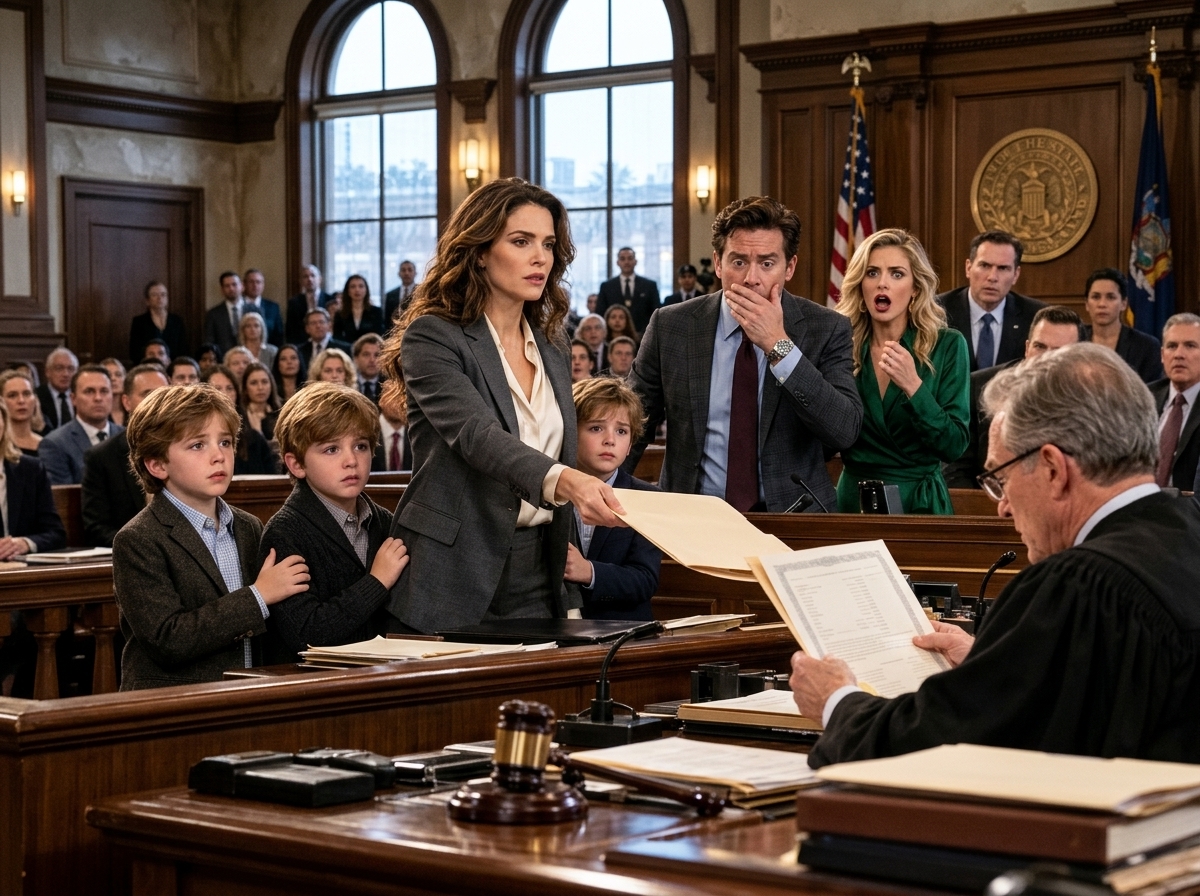
I walked in holding the hands of my eight-year-old twins.
They wore matching jackets and nervous expressions, but neither boy let go of my hand until we reached our table.
Paige whispered loudly, “She actually brought them?”
Judge Calder looked directly at her.
“One more interruption, Ms. Ellison, and you’ll be removed.”
Her smile vanished.
“I apologize for arriving late, Your Honor,” I said. “The boys asked to be here.”
“Children usually shouldn’t attend hearings like this,” he replied.
“I agree. But their father has already told them I abandoned our home, that I have no way to support them, and that they’ll soon be living with him and Ms. Ellison. I wanted them to hear the truth inside this courtroom.”
Adrian stiffened.
“That’s completely inappropriate.”
I never looked at him.
The judge asked a court officer to seat the boys nearby before allowing Russell to continue.
For nearly twenty minutes, he described Adrian’s wealth, our former home, private schools, investment accounts, and my supposed lack of income. He painted me as a woman who had contributed nothing except motherhood.
Finally, he requested primary custody.
When he finished, Judge Calder turned toward me.
“Mrs. Lane, who is representing you today?”
“I’m representing myself.”
Adrian leaned back with a satisfied smile.
The judge removed his glasses.
“You understand the seriousness of the allegations against you?”
“Yes, Your Honor.”
“Then you may respond.”
I calmly opened my leather handbag and removed a single sealed envelope.
Inside were the original incorporation papers for Hollis Transit Systems.
Judge Calder broke the seal, unfolded the first document, and his expression changed the moment he reached the ownership page.
Then he slowly looked up at Adrian.
PART 2
“Mr. Hollis,” Judge Calder said, “how long have you known that you work for your wife?”
The courtroom went so quiet I could hear the rain ticking against the tall windows.
Adrian didn’t answer. He didn’t move. I watched the color leave his face the way water leaves a sink—slowly at first, then all at once. Paige’s hand, which had been resting on his sleeve, slid back into her lap.
Russell Crane rose. “Your Honor, may I see that document?”
The clerk carried it to him. I watched him read the first page, then the second, then flip back to the first as if the words might rearrange themselves.
I didn’t need to see it. I had memorized every line years ago.
Articles of Incorporation, Hollis Transit Systems, Inc. Filed with the Virginia State Corporation Commission, March 3rd. Incorporator and sole initial director: Claire Margaret Lane. Shares issued: one million, to Claire Margaret Lane.
The date was fourteen years ago. Eleven weeks before I married Adrian.
“Your Honor,” I said, standing, “Mr. Crane’s own firm drafted our prenuptial agreement. Adrian insisted on it. His mother insisted on it. Section Four states that any business interest owned by either party before the marriage, along with all growth in its value, remains that party’s separate property.” I paused. “I signed it without changing a single word.”
Someone in the gallery let out a low whistle. The bailiff turned, and it stopped.
Judge Calder folded his hands. “Mr. Crane, I’ll ask again, since your client seems to have lost his voice. Was Mr. Hollis aware of this?”
Russell’s jaw worked. Then something shifted in his eyes, the look of a man who has just remembered he still has cards to play.
“Your Honor, these papers are fourteen years old. Corporate ownership changes. We are prepared to show that in August 2019, Ms. Lane voluntarily transferred a controlling interest in the company to my client.”
Adrian’s shoulders loosened. A little color crept back into his cheeks. He finally turned and looked at me, and he smiled the smile I had once fallen in love with—the one he used on investors, on reporters, on our sons when he wanted them to forget he had missed another birthday.
“Then why,” the judge asked, “is that transfer not in your filings?”
“We didn’t anticipate its relevance, Your Honor. We will produce it immediately.”
Judge Calder looked at the clock, then at my boys sitting stiffly on the bench beside the court officer. Owen was gripping Samuel’s sleeve.
“Here is what will happen,” he said. “This hearing is continued until next Thursday. Both parties will produce every ownership record, transfer, and shareholder agreement connected to Hollis Transit Systems. Until then, the children remain in Mrs. Lane’s care. Status quo.” He looked at Adrian over his glasses. “And Mr. Hollis, between now and Thursday, you will not discuss this case with your sons. Not one word. Do you understand?”
“Yes, Your Honor,” Adrian said. His voice came out smaller than I had ever heard it.
In the hallway, I knelt to zip the boys’ jackets. Samuel watched me with his father’s dark eyes and my serious mouth.
“Mom,” he whispered, “is Dad in trouble?”
“Dad and I have a disagreement about some papers,” I said. “That’s all. Grownup stuff. You did so well in there.”
Footsteps clicked on the marble behind me. I knew them without turning.
“Boys,” Adrian said warmly, “go look at the fish tank by the elevator for a second.”
“They’re staying with me,” I said.
He crouched beside me, close enough that I could smell the cologne I’d bought him three Christmases ago. “Clever,” he murmured. “Really. Digging up a piece of paper from before the boys were even born. But you’ve been out of the game for eight years, Claire. You think a filing makes you a businesswoman?”
“I think it makes me the owner.”
Paige appeared at his shoulder, her heels sharp, her lipstick perfect. “Adrian. The car’s here.”
He stood and buttoned his jacket. “See you Thursday,” he said, and then, so softly only I could hear it: “Read your email tonight.”
At 9:42 p.m., after the boys were asleep in the cramped two-bedroom townhouse I’d rented in Burke, my laptop chimed.
The message was from Russell Crane’s office. One attachment.
Stock Transfer Agreement — Hollis Transit Systems, Inc. — dated August 14, 2019.
It transferred 310,000 of my shares to Adrian Hollis. The math was elegant. Before the transfer, I held fifty-one percent of the company and Adrian held twenty. After it, I held twenty and Adrian held fifty-one.
It made him exactly what I had been.
I scrolled to the last page. There was my signature—the looping C, the sharp L, the little tail I always added to the final e. It was perfect.
It was mine.
And I had never seen that document in my life.
PART 3
I didn’t sleep that night. I sat at the kitchen table with the transfer agreement on one side of the laptop and the past on the other.
People assumed Adrian built Hollis Transit because Adrian was the kind of man people believed. Tall, easy laugh, a handshake that made you feel chosen. I was the opposite. I grew up in Norfolk, the daughter of a city bus mechanic named Calvin Lane, and I stuttered so badly as a girl that I once hid in a school bathroom for an entire afternoon rather than read a book report aloud.
But I could think. My father used to bring home the route schedules from the depot, and at eleven years old I was redrawing them at our kitchen table, finding the wasted miles, the buses that crossed paths for no reason. “You see the whole city like it’s an engine,” he told me once, wiping grease off his hands. “That’s a gift, Clairebear.”
He died of a heart attack when I was twenty-two, a semester before I finished my systems engineering degree at Virginia Tech. I used his life insurance and every dollar I had saved to build what he had seen in me: software that could reroute a city’s buses and delivery fleets in real time. I wrote most of the code in a rented garage in Arlington. I called it RouteWise.
I met Adrian at a logistics trade show in Richmond. He was a sales rep for a parking-meter company, and he wandered over to my folding table because I was the only exhibitor not talking. Within ten minutes he understood what RouteWise could do. Within a month he had sold it to Prince William County, which I could never have done, because I couldn’t get through a pitch meeting without my voice locking up.
We fell in love fast. He made me feel seen. I made him feel smart. When he proposed, I gave him an engagement present: I named the company after him.
“Every company needs a face,” I told him, laughing, the night I filed the papers. “You can be ours.”
I kept my own name. I kept the shares. I made him president of sales, and later CEO, and I stayed in the back office building the engine while he drove it in front of the cameras. Walter Brooks, a retired banker who had been my father’s friend, became our first CFO and bought nine percent. Years later, Ridgeway Capital bought twenty. I gifted Adrian twenty percent on our fifth anniversary.
Then the twins came seven weeks early.
Samuel was small but fierce. Owen was born with a hole in his heart. He had his first surgery at three weeks old and his second at fourteen months. For two years, my entire world was hospital hallways, feeding tubes, and machines that beeped in the night. I couldn’t think about board meetings. So I signed a revocable proxy giving Adrian authority to vote my shares “during the period of family medical leave.”
The leave never officially ended. I never revoked it. And somewhere in those years, Adrian started telling interviewers he had founded the company in a garage.
My garage.
I never corrected him. At first, I was too exhausted. Later, I told myself it didn’t matter whose name was in the magazine, as long as our family was whole. That was the lie I lived inside for eight years: that silence was the same thing as peace.
At 3:15 a.m., I stood up, went to the closet, and pulled down a plastic storage bin labeled OWEN — MEDICAL. Under the discharge papers and the tiny hospital bracelets was a spiral notebook. During those years, I had written down everything—every dose, every doctor, every hour.
I turned to August 2019.
August 14. Owen’s second surgery. Checked in at Inova Children’s 5:40 a.m. Surgery 7:15 a.m. to 1:50 p.m. Family waiting room the entire time. Nate stayed with me. Adrian came at 4 p.m., left at 5. Owen in PICU overnight. I did not leave the floor.
I read it twice. Then a third time. My hands had started to shake.
On the day I supposedly signed away control of my company, I had been sitting in a vinyl chair on the fourth floor of a children’s hospital, praying my son’s heart would keep beating.
I pulled the transfer agreement back up and zoomed in on the notary block at the bottom of the last page. I had skimmed past it before. Now I read every letter.
Subscribed and sworn before me this 14th day of August, 2019. Notary Public, Commonwealth of Virginia. Registration No. 7714893.
And above the seal, in neat, rounded handwriting, the notary’s signature.
Paige R. Ellison.
PART 4
Walter Brooks lived in a white farmhouse outside Leesburg with two arthritic beagles and a wall of books about railroads. He was seventy-four now. Adrian had forced him off the board three years earlier with a polite press release about “a well-earned retirement.”
He opened the door, looked at me for a long moment, and said, “I wondered when you’d come back.”
We sat at his kitchen table while the boys threw a tennis ball for the beagles in the yard. I showed him everything: the incorporation papers, the transfer agreement, my hospital notebook.
He read the transfer twice, then took off his reading glasses and rubbed his eyes.
“Paige Ellison was a notary in 2019?”
“She got her commission when she worked in the company’s legal office. Before Adrian promoted her.”
“Before Adrian promoted her,” Walter repeated dryly. Then he leaned forward. “Claire, I need to tell you why I really left. I didn’t retire. I asked too many questions. Starting in 2022, the company began paying a firm called Ellison Strategic Group for ‘communications consulting.’ Large monthly payments. No deliverables I could find. When I raised it with the audit committee, Adrian had me out within ninety days.”
My chest tightened. “Ellison.”
“I assumed it was a coincidence of names. I wanted to assume it.” He tapped the transfer agreement. “I don’t assume anymore.”
“I need records,” I said. “Bank records, board minutes, all of it. And I don’t have access to anything.”
Walter almost smiled. “You’re the majority shareholder of a Virginia corporation. You have a legal right to inspect the books. You don’t ask Adrian for permission. You send a written demand.”
We drafted it together at his kitchen table, and I mailed it that afternoon. Then I called Inova and requested every record from August 14, 2019, including the visitor badge logs.
That evening, Adrian came to the townhouse.
He didn’t bring lawyers. He brought takeout from the Thai place we used to love, which somehow felt worse. The boys ran to him, and I let them, because they were eight and he was their father. When they went upstairs to show him nothing—he didn’t follow; he stayed in the kitchen with me.
“Let’s be adults,” he said, setting the bag on the counter. “Here’s my offer. You sign a statement acknowledging the 2019 transfer. In exchange, you get joint custody, the Great Falls house, and two million dollars. Clean. Fast. The boys never have to sit in that courtroom again.”
“I didn’t sign that transfer, Adrian.”
“Of course you did. You just don’t remember. You weren’t exactly yourself back then.” His voice softened into something that sounded like concern. “The anxiety. The medication. The therapist. Russell has all of it, Claire. If you fight me, he’ll put every page of it on the record. Every bad day. Do you want the boys reading that someday?”
I gripped the edge of the counter. After Owen’s second surgery, I had fallen apart. I had seen a therapist for a year and taken medication for six months. I had gotten better. Adrian knew it. He had held my hand in the waiting room the first time I went.
“You’d use that,” I said quietly. “The worst year of my life. You’d use it against me.”
“I’d use whatever keeps my company.”
“Your company.”
He picked up his keys. “Thursday, everyone will see what you are, Claire. A sad, scared woman who couldn’t handle her own life. Sign the statement. It’s the last kindness I’m offering.”
The door closed behind him. I stood in the kitchen until the Thai food went cold.
When I finally turned off the light, I saw a small shape sitting on the stairs in dinosaur pajamas.
“Sammy. How long have you been there?”
He hugged his knees. “Mom, can I tell you something? I wasn’t supposed to hear it.”
I sat beside him. “You can always tell me.”
“Last weekend at Dad’s, I got up for water. He was on the phone in his office with Paige. He said the money had to move before the judge looks at it.” Samuel’s lip trembled. “And then he said, ‘The boys are the leverage. She’ll fold for the boys.’”
He looked up at me with wet eyes.
“Mom, what’s leverage?”
PART 5
I held my son on the stairs until he stopped shaking.
“Leverage,” I said carefully, “is when someone uses something important to get what they want. But you and Owen aren’t a thing anyone gets to use. Not Dad. Not me. Not anybody. You’re people. You’re my whole heart.”
“Are you going to fold?”
I thought about every gala where I’d stood silent. Every interview where Adrian told the garage story. Every time I’d decided the truth wasn’t worth the trouble.
“No,” I said. “I’m done folding.”
Three days later, the company’s general counsel, Thomas Greer, answered my inspection demand with a two-line letter claiming that “in light of pending litigation and the disputed status of share ownership,” the request would be “reviewed in due course.” It was a polite door slammed in my face.
That same evening, my phone buzzed with a text from a number I didn’t know.
St. Bernadette’s parking lot. 8 p.m. Come alone. —M
I almost didn’t go. Then I asked Walter to sit with the boys, and I went.
Marisol Vega was waiting in a gray Honda under a flickering lamp. She had been Adrian’s executive assistant for nine years. Before that, she had been the receptionist I hired the first month we had an office—a single mom from Woodbridge whose résumé had a gap no one else would forgive.
She handed me a flash drive through the car window.
“Wire confirmations,” she said. “Every payment to Ellison Strategic Group since 2022. Eleven point four million dollars. The LLC is registered in Delaware. Paige is listed as the managing member, but Adrian approves every invoice personally. I’ve seen his initials on them for years.”
I stared at the small piece of plastic in my palm. “Marisol, why are you doing this?”
“Because he’s made me sign for consulting deliverables that never came. Because if this blows up, he’ll say I approved them.” She looked at me steadily. “And because twelve years ago, you hired me when nobody else would. You probably don’t remember.”
“I remember,” I said. “You brought your daughter’s drawings to tape on the front desk.”
Her eyes filled. Then she cleared her throat and became all business again. “There’s something else. There’s a special board meeting Monday at nine. Adrian’s calling it on his own authority. He’s going to approve issuing two million new shares to himself as a ‘retention package.’”
The cold settled into my bones. If the board approved a new share issuance before the court ruled, it wouldn’t matter whether the transfer was forged. My stake would be diluted into nothing. By the time a judge untangled it, the company could be sold, borrowed against, gutted.
“He’s using my own proxy to vote my own shares against me,” I said.
“Then take it back,” Marisol said, and started her engine.
Walter and I stayed up past midnight with the flash drive. The payments were exactly as she’d described: twenty-thousand-dollar wires at first, then fifty, then a hundred and eighty thousand a month. Ellison Strategic Group had one employee, no website, and a mailing address at a shipping store in Wilmington.
“This isn’t consulting,” Walter said quietly. “This is a man moving furniture out of a house he doesn’t own.”
On Friday morning, I signed a formal written revocation of the proxy I had granted Adrian eight years earlier. Walter’s lawyer friend reviewed it. I sent it by certified mail, by email, and by courier to the company’s registered agent, to Thomas Greer, and to every member of the board.
On Monday at 8:57 a.m., I walked into the headquarters of Hollis Transit Systems for the first time in six years.
The lobby had been redesigned. A giant photo of Adrian, arms crossed in front of a fleet of buses, covered an entire wall. Under it, in brushed steel letters: Built from a Garage. Driven by a Vision.
I didn’t stop walking.
The receptionist tried to ask who I was. Marisol, at her desk outside the executive suite, simply stood and opened the boardroom door.
Seven heads turned. At the head of the long glass table, Adrian set down his pen.
“Claire,” he said pleasantly. “You’re not on the agenda.”
I pulled out the chair at the opposite end and sat down.
“I’m the agenda,” I said.
PART 6
For a moment, nobody breathed.
Then Thomas Greer, the general counsel, cleared his throat. “Mrs. Hollis—”
“Ms. Lane.”
“Ms. Lane. This is a closed meeting of the board of directors.”
“It’s a special meeting called by a man voting shares he doesn’t own, under a proxy that was revoked on Friday.” I slid copies of the revocation across the glass. “Under Virginia law, I’m entitled to vote my shares myself. And I’m requesting that my vote be recorded on any item affecting the capital structure of this company.”
Margaret Okafor, the managing partner from Ridgeway Capital, was a silver-haired woman with a reputation for eating bad CEOs for breakfast. She picked up the revocation, read it, and looked down the table at Adrian. “Is this true? Ms. Lane is the original founder?”
“It’s ancient history,” Adrian said smoothly. “She transferred her controlling stake to me in 2019. It’s documented and notarized. She’s confused, Margaret. The divorce has been hard on her.”
He slid his copy of the transfer agreement across the table. He even managed to look sad about it.
I slid my folder after it.
“These are certified records from Inova Children’s Hospital,” I said. “On August 14, 2019, I checked in with my son at 5:40 a.m. He was in surgery for six and a half hours. My visitor badge shows I never left the fourth floor until the next morning. The surgeon’s notes record that he spoke with me in the family waiting room at 2:05 p.m. and again at 6:30 p.m.”
I turned to the last page.
“The notary on Adrian’s document is Paige Ellison. The Virginia notary registry shows no record of her at the hospital, and I never met with her. I didn’t sign that agreement. Someone traced my name onto it.”
Margaret Okafor read the hospital pages slowly. Then she set them down beside the transfer agreement and folded her hands.
“Well,” she said, “one of these documents is lying.”
Adrian’s smile didn’t waver. If anything, it grew. That was when I felt the first cold prickle at the back of my neck.
“She’s right about one thing,” he said. “She was at the hospital. So the transfer was signed at the hospital. In the cafeteria, around noon, while Owen was in surgery. Paige brought it over. And Claire wasn’t alone.” He looked straight at me. “Her brother was there. Nate watched her sign it.”
The room tilted.
Nate. My little brother. The boy I had raised from the age of nineteen after our father died, who slept on my couch through college, who sat beside me in that waiting room holding a cup of vending-machine coffee and telling me bad jokes so I wouldn’t cry.
“That never happened,” I said. My voice cracked on the last word, and I hated it.
“Ask him,” Adrian said gently.
Margaret raised a hand. “I’m not interested in a family argument. I’m interested in fiduciary duty. I move that this board take no action on any share issuance, sale, or encumbrance of company assets until the court resolves the ownership dispute.”
“Second,” Walter said from the side of the room, where he sat as a shareholder.
“Shareholders don’t second,” Greer said.
“Then I’ll second,” said one of the independent directors, a quiet retired admiral named Douglas Fenn who hadn’t spoken all morning.
The vote passed five to two. The retention package was dead—for now.
Adrian didn’t argue. He simply gathered his papers, buttoned his jacket, and walked out. He didn’t look worried. He looked like a man who had just moved a piece he’d been saving.
In the parking garage, I called Nate. Straight to voicemail. I called again. Voicemail. I texted: Call me. Please. It’s about August 2019.
Three dots appeared. Then disappeared.
At 4:20 that afternoon, while I was helping Owen with his spelling words, my email chimed. A filing notice from the Fairfax County Circuit Court.
Respondent’s Amended Witness List.
The first name on it was printed in bold.
Nathaniel James Lane.
Attached was a sworn affidavit, signed and notarized that morning. The first sentence was all I could bring myself to read.
I personally watched my sister, Claire Lane, sign the stock transfer agreement in the cafeteria of Inova Children’s Hospital on August 14, 2019.
PART 7
Nate lived on the third floor of a brick building in Old Town Alexandria. I knocked for five minutes before he opened the door.
He looked terrible. Thirty-one years old and gray under the eyes, wearing a hoodie I’d bought him two birthdays ago. The apartment smelled like old pizza. On the coffee table, his phone screen glowed with a sports betting app.
“Claire,” he said. “You shouldn’t be here.”
“You signed an affidavit saying you watched me sign away my company.” My voice was steady, which surprised me. “In a cafeteria. While my son’s chest was open on a table upstairs.”
He sat down heavily on the couch and put his face in his hands.
“How much?” I asked.
He didn’t pretend not to understand. “A hundred and eighty thousand. Sports bets. Then online poker to win it back. Then loans to cover the poker.” His voice was muffled. “Two years ago, the guys I owed started calling my job. I didn’t know what to do. I couldn’t come to you. You had the boys and Owen’s heart and—” He swallowed. “Adrian found out. He paid all of it. Every dollar. He said I could pay him back someday.”
“And someday was this morning.”
He looked up. His eyes were red. “He said you signed it anyway, Claire. He said you signed it at home and just don’t remember, because of the medication. He said all I had to do was remember it for you. That it didn’t change anything. That it would just make things go faster.”
“Do you remember me signing anything that day?”
He didn’t answer.
“Nate. Look at me. You held my hand when the surgeon came out. You bought me a turkey sandwich I didn’t eat. You fell asleep on my shoulder at three in the afternoon. Do you remember me signing anything?”
“He’ll ruin me,” Nate whispered. “He has texts. My debts. He said he’d tell my company everything. I’ll lose my job. I’ll lose everything.”
“You’re going to lose yourself,” I said. “That’s worse.”
I left him sitting there. I made it to the car before I cried, and then I cried hard, with my forehead against the steering wheel, the way I hadn’t since the hospital.
The next morning, Dr. Evelyn Park, the guardian ad litem appointed to represent the boys, came to the townhouse. She was a kind, sharp-eyed woman in her fifties who sat cross-legged on the living room rug and let Owen show her his Lego bus depot.
“Who lives in the bus station?” she asked.
“The drivers,” Owen said. “And this is the mom. She fixes the routes so nobody gets lost.” He held up a Lego figure with a ponytail. Then he picked up another one, in a red dress, and put it outside the building. “She’s not allowed in. She’s mean when Dad isn’t looking.”
Dr. Park wrote something down and said nothing.
That afternoon, Adrian’s attorneys filed an emergency motion arguing that I was “emotionally unstable” and had “exposed the children to adult litigation” by bringing them to court. Attached to it, somehow, were pages from my 2019 pharmacy records.
I sat at the kitchen table and read every word. The shame came first, hot and familiar. Then something else came behind it, quieter and stronger.
I had been sick. I had gotten help. I had gotten better. And I had raised two little boys through all of it.
That wasn’t something to hide. That was something to survive.
On Wednesday evening, the night before the hearing, I found a plain manila envelope in my mailbox. No stamp. No return address. Someone had delivered it by hand.
Inside was a photocopy of a page from a notary journal—the official logbook every Virginia notary keeps. August 2019. The entries were neat and evenly spaced, except for one. Squeezed between August 13 and August 15 was a line for August 14, written in ink that looked darker, the handwriting cramped to fit.
C. Lane — Stock Transfer Agreement — ID: VA Driver’s License.
Clipped to the page was a yellow sticky note in round, familiar handwriting.
He’s going to let me take the fall for all of it. I won’t. Call your first witness tomorrow, and call me second. —P.
PART 8
Courtroom Four was fuller than the week before. Word had gotten out. A reporter from the Washington Business Journal sat in the second row, pen ready.
This time I left the boys with Walter. They didn’t need to see what was coming.
Adrian looked rested and expensive. Paige sat behind him instead of beside him, and she had brought her own attorney, a stern woman named Lorraine Whitaker. Adrian kept glancing back at them. He didn’t seem to like it.
Russell Crane called Nate first.
My brother walked to the stand in a borrowed suit and swore to tell the truth. Russell led him gently through the story: the hospital, the cafeteria, Paige arriving with a folder, me signing at a plastic table near the salad bar.
“Thank you, Mr. Lane,” Russell said. “No further questions.”
Judge Calder looked at me. “Ms. Lane, cross-examination?”
I stood. My knees felt like water. Every time I had ever spoken in public, my throat had closed. I thought of my father wiping grease off his hands. You see the whole city like it’s an engine.
I took a breath.
“Nate,” I said, “what did you eat in the cafeteria that day?”
He blinked. “I—I don’t remember. A sandwich.”
“Turkey,” I said. “You bought it from the vending machine on the fourth floor. Because in August 2019, the Inova Children’s cafeteria was closed for renovation.” I handed the clerk a letter from the hospital’s facilities department. “From July 22 through September 9. There was no salad bar. There were no tables. There was plastic sheeting and drywall.”
Russell rose. “Objection—”
“Overruled,” said Judge Calder, without looking up from the letter.
I turned back to my brother.
“Nate, who paid your gambling debts two years ago?”
“Objection! Relevance!”
“It goes to bias, Your Honor.”
“Overruled. The witness will answer.”
Nate stared at his hands. The room waited.
“Adrian did,” he said.
“And who wrote your affidavit?”
The silence stretched so long that the reporter stopped writing.
Then Nate looked up at me, and for a second he was nineteen again, standing in our father’s empty garage asking me what we were supposed to do now.
“Adrian’s lawyers wrote it,” he said, his voice breaking. “I never saw her sign anything. She never left the waiting room. She didn’t even go to the bathroom until the surgeon came out.” He turned to the judge, tears running down his face. “I’m sorry. I’m so sorry. I lied.”
The gallery erupted. Judge Calder’s gavel cracked twice. Russell Crane sat down very slowly, like a man realizing the floor under him had been painted on.
“Your Honor,” Russell said hoarsely, “I request a brief recess to confer with my client.”
“Denied. Ms. Lane, do you have another witness?”
“I call Paige Ellison.”
Adrian twisted in his chair. “What is she doing?” he hissed at Russell.
Paige walked to the stand. Up close, without the lipstick smile, she looked younger and frightened. Her attorney stood. “Your Honor, my client is testifying voluntarily and has been in contact with the Commonwealth’s Attorney’s office.”
Paige swore the oath. I showed her the notary journal page.
“Is this your journal?”
“Yes.”
“When was this August 14 entry written?”
She took a breath. “In March 2021. Adrian brought me the transfer agreement already signed. He told me Claire had signed it years ago but it was never notarized, and that it was just paperwork. He asked me to date it August 2019 and add it to my journal.” She looked at Adrian for the first time. “I knew. I knew it was wrong. I did it because I loved him and I believed he’d marry me.”
“That’s a lie,” Adrian said, rising. “Your Honor, she’s lying to save herself—”
“Sit down, Mr. Hollis,” Judge Calder said, “or you will be seated.”
Adrian sat.
“Ms. Ellison,” I asked, “what is Ellison Strategic Group?”
“It’s mine on paper. Adrian set it up. He controls the account. The money from the company goes in, and most of it goes out to accounts in his name.” Her voice steadied. “But that’s not the worst of it.”
The room went still.
“In March of this year, he used that same signature again. He pledged the entire company as collateral on a forty-million-dollar private loan from Brannock Credit Partners. He told me the money was to buy out Ridgeway. It wasn’t. It’s gone.” Paige looked at me, and something like an apology crossed her face. “The first payment is due in nineteen days. If it isn’t paid, Brannock can seize everything. The depots. The buses. The software. All of it.”
PART 9
Judge Calder called a recess and referred the entire matter to the Commonwealth’s Attorney before he left the bench. Adrian walked out surrounded by his three attorneys, but now none of them were speaking to him.
By that evening, the story was everywhere. Hollis Transit CEO Accused of Forging Wife’s Signature. My phone wouldn’t stop ringing. I turned it face-down and sat on the floor of the boys’ bedroom while they slept, listening to them breathe.
Nineteen days.
Twelve hundred employees. Four depots. Contracts with nine counties. Drivers who had been with us since the first route. All of it could disappear because of one man’s greed and one pen pretending to be my hand.
At seven the next morning, Margaret Okafor called an emergency board meeting. With my proxy revoked and Paige’s testimony on the record, the math was simple. I voted my fifty-one percent. Walter voted his nine. Ridgeway voted its twenty.
Adrian Hollis was removed as CEO in eleven minutes.
“We need an interim chief executive,” Margaret said, looking directly at me. “Someone who knows how the engine works.”
“I haven’t run anything in eight years,” I said.
“You ran a pediatric cardiac unit’s worth of chaos for two,” she replied. “And you built this thing. Nobody here knows it better.”
Admiral Fenn nodded once. “All in favor.”
Five hands went up.
The first thing I did as CEO was the thing I was most afraid of. I asked Marisol to gather every employee who could make it to the Manassas depot at shift change.
When I stepped up onto a loading platform at 3 p.m., more than eight hundred people were standing in the huge concrete garage—drivers in uniforms, mechanics with grease on their arms, dispatchers, accountants, cleaning staff. Somebody had found a microphone.
My throat closed. My hands went cold. For one long, terrible second, I was ten years old again in a school bathroom.
Then I saw an old man near the front with a gray beard and a faded company jacket. Earl Dawson. Our very first driver. Fourteen years ago, I had taught him the RouteWise tablet in a parking lot in Arlington.
He gave me a small nod.
“My name is Claire Lane,” I said. My voice shook, and I let it. “Fourteen years ago, I started this company in a garage with my father’s life insurance and an idea about buses. Most of you have never seen me. That’s my fault. I let someone else tell our story, because I was afraid to tell it myself.”
The garage was silent.
“I won’t lie to you. We’re in trouble. Money was taken. A loan was signed that should never have been signed. But I know every line of code in the system that runs your routes, and I know what this company is worth, because I know what you’re worth. I’m not going anywhere. And I’m not letting anyone take this from you.”
There was a pause. Then Earl Dawson started clapping. Slowly at first. Then the mechanics joined in. Then the dispatchers. Then the whole garage roared until the sound bounced off the steel beams.
Over the next ten days, I barely slept. Walter, Margaret, and I met with Brannock Credit Partners. Their lawyers had seen the court transcript. A loan secured by a forged signature was a loan they might never collect in court. They agreed to restructure. Ridgeway put in bridge funding. Two counties publicly renewed their contracts the same week.
On the twelfth day, FBI agents arrived at the Great Falls house at six in the morning. The wire transfers to Delaware had made it federal. Adrian was led out in handcuffs, still wearing his running clothes.
That night, he called me from the processing center.
“Tell the boys I built something,” he said. His voice was flat and hollow.
“You borrowed something, Adrian,” I said. “The boys are what you built. You still have a chance to be part of their lives. Don’t waste that one, too.”
He hung up without answering.
Later that week, Owen climbed into my lap. “Is Dad a bad guy now?”
I thought about it carefully. “Dad made very bad choices. He hurt people, and he has to face that. But you’re allowed to love him. Loving someone doesn’t mean saying what they did was okay.”
On Sunday evening, three days before Judge Calder’s final ruling, someone knocked on my door.
It was Diane Hollis. Adrian’s mother. The woman who had insisted on the prenup fourteen years ago, who had never once called me by my first name.
She stood on my doorstep in a camel coat, her hands clenched around her purse.
“May I come in?” she asked. “There’s something about my son I should have told you before you ever married him.”
PART 10
Diane sat at my small kitchen table and didn’t touch the tea I made her.
“When Adrian was twenty-six,” she said, “he worked at a property management firm in Baltimore. He forged his supervisor’s approval on expense reports. Eighty thousand dollars. They were going to press charges. My husband paid it all back, quietly, and they let Adrian resign.” She stared into the cup. “We told ourselves it was a young man’s mistake. We never spoke about it again.”
“The prenup,” I said slowly.
She nodded. “I insisted on it to protect our family’s property from him. Not from you. I was afraid he’d do it again, and I was too proud to warn you.” Her voice broke. “I let you walk into that marriage blind. And when I saw you in the newspaper this week, standing up in front of all those people… I realized you’d been carrying something I should have helped you carry.”
She opened her purse and slid a folded letter across the table.
“It’s addressed to Judge Calder. It tells him everything. And it tells him that you are the best mother those boys could have.” She finally looked up. “I don’t expect forgiveness. I’m only asking that you let me still be their grandmother.”
I reached across the table and took her hand. It was the first time we had ever touched.
“They’d like that,” I said. “So would I.”
On Thursday morning, it was raining again. Courtroom Four was packed. Adrian appeared by video from detention, in an orange jumpsuit, his face thin and gray.
Judge Calder took his seat and opened a thick file.
“I have reviewed the testimony, the hospital records, the forensic report from the Virginia Department of Forensic Science, the notary records, the report of the guardian ad litem, and a letter from the respondent’s mother,” he said. “My findings are as follows.
“First: Hollis Transit Systems was founded by Claire Lane before the marriage. Under Section Four of the prenuptial agreement, which the respondent’s own counsel drafted, her shares are her separate property. The purported 2019 stock transfer is a forgery. It is void.
“Second: The respondent’s motion regarding Ms. Lane’s mental health is denied. The court notes that seeking treatment during a child’s medical crisis is not evidence of instability. It is evidence of responsibility.
“Third: Primary physical and legal custody of Samuel and Owen is awarded to their mother. The respondent may have supervised visitation, conditioned on completing counseling and the outcome of his criminal proceedings.”
He paused and looked at me over his glasses.
“Ms. Lane, I have been on this bench for twenty-two years. It is rare for someone to walk into this room without a lawyer and walk out with the truth. Your sons are fortunate.”
Russell Crane quietly withdrew from Adrian’s case that afternoon. Four months later, Adrian pleaded guilty to wire fraud and forgery and was sentenced to six years in federal prison, with an order to repay what he took. Paige Ellison, who cooperated fully, received probation and lost her notary commission. She sent me one short letter, apologizing to the boys. I kept it for them, for when they’re older.
Nate entered a gambling recovery program the week after the hearing. He went to every meeting. On the boys’ ninth birthday, he showed up with a cake he’d baked himself, lopsided and covered in blue frosting, and handed me his ninety-day chip.
“I don’t expect you to trust me yet,” he said.
“Then keep showing up,” I said, and hugged him until he laughed.
Six months after Judge Calder’s ruling, on a rainy Thursday morning, I stood in front of the Manassas depot beside a canvas sheet stretched across the new sign.
The board had voted unanimously to let me rename the company. I’d asked the boys what they thought.
“Name it after Grandpa,” Samuel said. “The one who fixed buses.”
So when Owen and Samuel pulled the rope together and the canvas fell away, the steel letters read: LANE TRANSIT SYSTEMS. Founded in a Garage. Built by Everyone.
Earl Dawson cried. Marisol, now our chief of staff, pretended she wasn’t. Walter stood under a big black umbrella with Diane, both of them beaming like proud grandparents, which, I suppose, they were.
The giant photo in the headquarters lobby was gone. In its place hung a framed picture of my father in his mechanic’s coveralls, standing in front of a city bus in Norfolk, grinning, a wrench in his hand.
That night, I tucked the boys into bed in our new home, a small brick house with a big backyard and a garage I’d already started filling with tools.
“Mom,” Owen said sleepily, “were you scared? In court? And in front of all those people?”
“Terrified,” I said.
“Then how did you do it?”
I smoothed his hair back from his forehead, right above the faint scar on his chest that had once almost stopped my world.
“I realized being quiet and being peaceful aren’t the same thing,” I said. “For a long time, I let other people tell my story because I thought it was easier. But the truth doesn’t stop being true just because you don’t say it out loud. Sometimes the bravest thing you can do is stand up, shaking, and say your own name.”
Samuel opened one eye. “Your name is Claire Lane.”
“That’s right.”
“And you’re the founder,” Owen added.
“I’m the founder,” I said. “But you two are the best thing I ever built.”
I turned off the light and stood in the doorway, listening to the rain on the roof and my sons’ slow, steady breathing.
For twelve years, I had let silence write my story.
Now, finally, I was writing it myself.
THE END