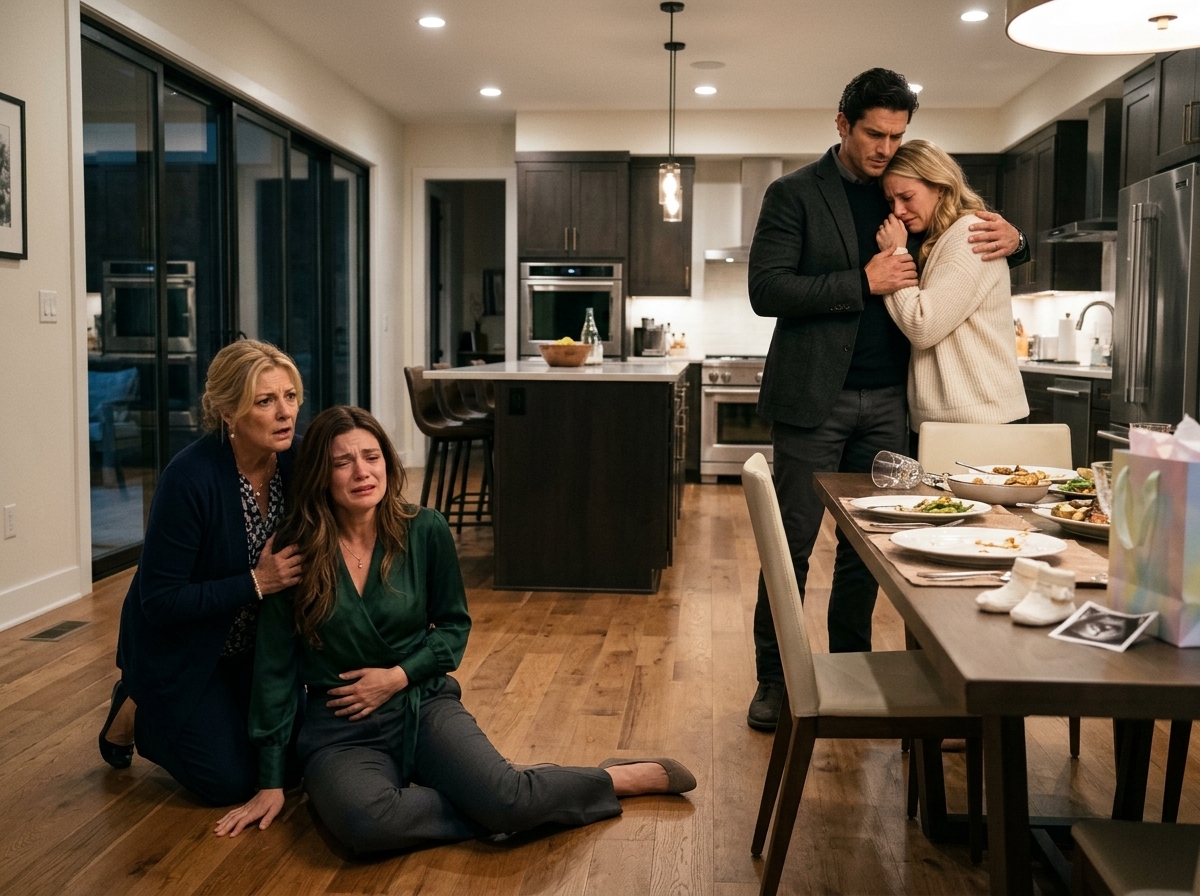
The first person my husband worried about after his childhood sweetheart shoved me into a dining table was the woman who had pushed me.
Not his wife.
Not the woman lying on the floor, unable to breathe.
And certainly not the tiny, unborn child whose life had just been placed in danger.
It was Sophia Reynolds.
I remember the sound before I remember the pain.
A terrible, hollow crack as my body collided with the solid oak edge of my mother’s dining table. Then came the sharp clatter of silverware, the shattering of a wineglass, and my mother’s scream.
“Claire!”
I tried to answer her, but no words came.
Pain exploded through my lower abdomen, stealing the air from my lungs. My knees buckled. The room tipped sideways, and I hit the hardwood floor with both hands pressed instinctively against my stomach.
For several seconds, I couldn’t straighten my body.
I couldn’t even move.
There was only one thought in my head.
Please. Not my baby. Please, God, not my baby.
My mother dropped beside me so quickly that her knees struck the floor.
“Claire, sweetheart, look at me.”
Her voice trembled.
I saw her face through a haze of tears, her eyes wide with terror as she reached toward me and then stopped, afraid to move me.
“Where does it hurt? Can you breathe?”
I opened my mouth.
Nothing came out except a broken gasp.
Across the room, Sophia Reynolds started crying.
Loudly.
Dramatically.
As though she were the one who had just been attacked.
“Oh, my God,” she sobbed. “Alexander, I didn’t mean to. She came toward me, and I just reacted. I didn’t mean to push her so hard.”
My husband moved immediately.
For one foolish moment, my heart lifted.
I thought he was coming toward me.
I thought he had finally realized what had happened.
Instead, Alexander Moretti walked past my mother and me and stopped in front of Sophia.
“Are you okay, Sophia?”
I stared at him.
My husband of five years.
The man who had once held my face between his hands and promised that I would never have to face anything alone again.
He placed a protective arm around Sophia’s shoulders.
She buried her face against his chest.
And I remained on the floor.
“Alexander!” my mother shouted. “Your wife is hurt!”
He glanced at me.
It was only a glance.
The kind someone gives a broken plate before deciding whether it needs to be cleaned up immediately.
“Claire, stop making this worse than it already is.”
Then he turned back to Sophia.
Something inside me cracked before I even knew whether my baby was alive.
I had imagined that the worst thing Alexander could ever do was stop loving me.
That night, I discovered there was something worse.
He could watch me suffer and feel inconvenienced by it.
And the most unbearable part was that less than an hour earlier, I had been preparing to give him the happiest news of our marriage.
My name is Claire Bennett Moretti.
I was thirty-one years old when my marriage collapsed in my mother’s dining room.
Until that evening, I would have described myself as a lucky woman.
Not because my life had been easy. It hadn’t.
But because I believed I had found the one person who would never walk away from me.
I had been eight when my father abandoned my mother and me.
There was no dramatic farewell, no final argument I could understand, no explanation that made sense to a little girl.
One Saturday morning, he kissed my forehead, told me he would be back before dinner, and disappeared.
I waited for him that afternoon.
Then the next day.
Then the next week.
For months, whenever a car slowed outside our house, I ran toward the window.
My mother never told me to stop looking.
She simply stood behind me, one hand resting on my shoulder, and waited until the car moved on.
Years later, I learned that my father had left for another woman and another life.
But knowing why someone abandons you does not erase the feeling of being unwanted.
It only gives your pain a name.
My mother, Margaret Bennett, raised me alone.
She worked as a school librarian during the day and cleaned offices three evenings a week. She wore the same winter coat for almost eleven years. She learned how to repair a leaking faucet, replace a broken lock, and stretch one roasted chicken into three different dinners.
Whenever I asked if she was tired, she smiled.
“A little,” she would say. “But I’ve got you. That makes me rich.”
As a child, I believed her.
As an adult, I understood how much she had hidden behind those words.
My mother never remarried.
She never complained about the life my father had left her to manage.
But I knew she had been lonely.
And for as long as I could remember, I had wanted to give her something beautiful in return.
That was why the dinner mattered so much.
Three weeks earlier, after months of appointments, cautious hope, and sleepless nights, I had discovered I was pregnant.
Alexander and I had been trying for nearly two years.
At first, we approached the subject playfully.
We talked about names over breakfast. We pointed out adorable children in restaurants. We joked about how our future baby would inherit his stubbornness and my terrible sense of direction.
But as the months passed without a positive test, those conversations became harder.
Eventually, we stopped having them.
I continued visiting my doctor.
Alexander became increasingly occupied with his work at the Moretti Group, the family-owned property development business his father had built into a regional empire.
I told myself we were simply going through a difficult season.
Marriage was not supposed to be effortless.
People became busy. They grew tired. They disappointed each other.
Love, I believed, meant choosing to remain.
Then one morning, I saw two pink lines appear on a pregnancy test.
I sat on the bathroom floor and cried.
Not because I was sad.
Because something I had almost stopped allowing myself to imagine had suddenly become possible.
At my first appointments, I was cautious.
I wanted to hear a heartbeat.
I wanted a doctor to tell me that the pregnancy was developing as expected.
I wanted to know that I could finally allow myself to be happy.
At thirteen weeks, Dr. Priya Shah showed me a small, miraculous image on the ultrasound monitor.
“There,” she said gently. “Do you see that?”
I nodded, unable to speak.
A tiny shape moved on the screen.
A little life.
My baby.
Our baby.
The heartbeat filled the examination room, quick and steady.
I cried so hard that Dr. Shah handed me an entire box of tissues.
I left the appointment carrying a printed ultrasound image in a white envelope.
For the first time in years, the future didn’t look like something I had to endure.
It looked like something I could welcome.
I decided to tell Alexander at my mother’s house.
There was a reason for that.
I wanted the woman who had spent her life making sure I never felt alone to witness the moment I became a mother myself.
I pictured Alexander laughing in disbelief.
I pictured his arms wrapping around me.
I pictured my mother crying with happiness while pretending she wasn’t.
It was such an ordinary dream.
A dinner.
A little announcement.
Three people who loved one another celebrating a fourth.
I had no idea how cruelly ordinary dreams could be destroyed.
That Thursday morning, I called Alexander while he was driving to the office.
“Remember dinner at Mom’s tonight?”
He sighed.
“Of course I remember.”
“Just us, okay? You, me, and Mom.”
“Claire, why are you being so particular?”
“Because I have something important I want to talk about.”
“Can’t you tell me now?”
I looked at the ultrasound envelope on my kitchen counter.
“No,” I said, smiling. “It’s something I want to tell you in person.”
He was silent for a moment.
“Fine. Seven o’clock?”
“Seven.”
“Don’t make it too late. I have an early meeting tomorrow.”
“I won’t.”
Before hanging up, I said, “I love you.”
He replied, “You too.”
I told myself not to overthink it.
Alexander had become less affectionate in recent months, but I remembered the man he used to be.
I remembered how he had walked me home through a thunderstorm on our third date because I admitted I was afraid of walking alone at night.
I remembered how he had brought soup to my apartment when I was sick, then stayed awake helping me finish a work presentation.
I remembered the first time he met my mother.
He had carried her groceries into the kitchen, fixed a loose cabinet hinge, and complimented the photographs she kept on her mantelpiece.
Later, when she left the room, he’d taken my hand.
“Now I understand where you learned to be strong.”
That was the Alexander I married.
Or perhaps it was the Alexander I had spent five years trying to find again.
By five that afternoon, I was at my mother’s house helping set the table.
The house smelled of roasted garlic, warm bread, herbs, and the lemon cake she had baked that morning.
She had spent the entire day cooking.
Alexander’s favorite dishes were everywhere.
Slow-roasted beef with rosemary.
Buttered potatoes.
Grilled vegetables.
Her special rice with fresh herbs.
A green salad with homemade dressing.
She had even bought the expensive sparkling water Alexander preferred, though I knew she considered paying so much for water ridiculous.
“Mom, you didn’t have to do all this.”
She waved a dish towel at me.
“Nonsense. Your husband works hard. Let him have a proper dinner.”
Then she looked at the little gift bag beside my purse.
“Are you sure you want to tell him tonight?”
I smiled.
“Yes.”
Inside the bag were tiny cream-colored baby socks and the ultrasound photograph.
I’d written a note on a small card.
Our greatest adventure begins in six months. You’re going to be a dad.
My mother touched the bag as though it contained something sacred.
“He’s going to be so happy.”
I wanted to believe that more than anything.
My mother studied my face.
“Are you happy, Claire?”
I laughed.
“Terrified.”
“That’s not what I asked.”
I looked down at my stomach.
Then I met her eyes.
“Yes, Mom. I really am.”
She embraced me.
For a few seconds, I was eight years old again, safe in the arms of the one person who had never left.
At six fifty-five, headlights swept across the front windows.
“He’s early!” my mother said brightly.
I picked up the gift bag, then quickly put it down again.
I wanted to wait until dessert.
I wanted the perfect moment.
The front door opened.
I heard Alexander’s voice.
Then another voice.
A woman’s laugh.
My smile disappeared.
Sophia Reynolds entered my mother’s home behind my husband.
She wore a fitted cream sweater, dark trousers, and a diamond bracelet that caught the hallway light. Her auburn hair fell in glossy waves over her shoulders.
She was carrying a bottle of wine.
“Surprise!” she said.
I looked from her to Alexander.
“What is Sophia doing here?”
He removed his coat.
“I invited her.”
“I asked you not to bring anyone.”
Sophia’s smile tightened.
“Oh, Claire. Don’t be like that. Alexander mentioned dinner, and I thought it would be lovely to spend some time together.”
“This was supposed to be private.”
Alexander frowned.
“What’s the problem?”
The question stunned me.
Not because he had misunderstood.
Because he had understood perfectly and decided it didn’t matter.
“I told you this morning,” I said quietly. “I wanted dinner to be just us and Mom.”
“And I told Sophia she could come. She’s practically family.”
There it was.
The sentence I had heard throughout our marriage.
Sophia is practically family.
Alexander and Sophia had known each other since childhood.
Their families moved in the same social circles. They attended the same private schools, spent summers at neighboring lake houses, and appeared together in photographs that filled the Moretti family albums.
Sophia knew his favorite childhood stories.
His least favorite foods.
The nickname his grandmother used.
The exact way he preferred his coffee.
And she made certain I knew she knew.
When Alexander and I first started dating, I thought their friendship was sweet.
She welcomed me with hugs and enthusiastic compliments.
She told me how lucky I was to have him.
But after we married, something changed.
She began calling him late at night.
She appeared unexpectedly at our anniversary dinners.
She asked him for favors she could easily have handled herself.
When I expressed discomfort, Alexander accused me of jealousy.
“She’s been in my life longer than you, Claire. You need to understand that.”
I tried.
For five years, I tried.
That evening, I made one last attempt.
“Alexander, can I speak to you alone?”
He glanced at Sophia.
“Whatever you want to say, you can say here.”
My mother appeared in the doorway, wiping her hands on her apron.
“Alexander! Welcome.”
He smiled politely and kissed her cheek.
“Margaret. Dinner smells wonderful.”
Sophia stepped forward.
“Mrs. Bennett, how lovely to see you.”
My mother, who had a gift for making even unwelcome guests feel comfortable, welcomed her warmly.
“There’s plenty of food. Come inside.”
I looked at the gift bag.
Then at my husband.
I told myself that the evening could still be saved.
Sophia could sit through dinner.
I could share the news afterward.
Alexander could surprise me.
Maybe I had been too sensitive.
Maybe becoming a mother would finally remind him of what we had together.
So I swallowed my disappointment.
And we sat down to eat.
The first twenty minutes were uncomfortable but manageable.
My mother asked Alexander about work.
He talked about a housing development project scheduled for announcement the following week and a major gathering the Moretti family was hosting that weekend.
Sophia interrupted frequently.
She corrected a date.
Added a name.
Reminded him of something his father had said.
Alexander listened to her with the attention I had spent months trying to earn.
I concentrated on my plate.
My mother noticed.
Of course she did.
She kept glancing at me, smiling gently, encouraging me with her eyes.
When Sophia began discussing the Moretti Foundation’s upcoming events, my mother asked an innocent question.
“Doesn’t the foundation help families who are struggling financially?”
“Among other things,” Sophia replied.
“That’s wonderful. I remember when Claire was little, there were months when a program like that would have meant the world to us.”
My heart warmed.
My mother rarely spoke about those years in front of strangers.
Sophia tilted her head.
“Yes. Claire has mentioned your difficult circumstances.”
Something in her voice made me look up.
My mother continued serving the rice.
“I suppose everyone needs a little help sometimes.”
“Of course,” Sophia said.
Then she took a bite and made a face.
“Oh.”
My mother paused.
“Is something wrong?”
“There’s cilantro in this.”
“Yes, just a little. I’m sorry. Do you dislike it?”
“I can’t stand it.”
My mother immediately reached for Sophia’s plate.
“I’m so sorry, dear. I can get you a fresh serving.”
“Well, it’s already mixed in.”
“I’ll try to remove it.”
“Mom,” I said, “you don’t have to—”
But my mother was already carefully picking out the small green leaves.
One by one.
Her hands moved with the same patience she had used to untangle my hair when I was a little girl.
Sophia watched her.
Then she smiled.
“I suppose when you’ve spent your life depending on other people, you learn how to please them.”
The room went silent.
My mother’s hands stopped moving.
For a moment, I couldn’t believe what I had heard.
I looked at Sophia.
“What did you say?”
She blinked.
“I was only making an observation.”
“About my mother?”
“Claire, don’t twist my words.”
“You just insulted her in her own home.”
Alexander set down his fork.
“Claire.”
I ignored him.
My mother put Sophia’s plate back on the table.
“It’s all right, sweetheart.”
But it wasn’t all right.
I could see the hurt in her face.
For the first time that evening, she looked small.
My mother, who had carried the weight of an entire family on her shoulders without complaint, was being humiliated by a woman who had never known what it meant to choose between groceries and an electricity bill.
“Apologize to her,” I said.
Sophia’s expression hardened.
“Excuse me?”
“You heard me.”
Alexander’s voice sharpened.
“Claire, enough.”
“No. She doesn’t get to come into my mother’s house and speak to her like that.”
Sophia gave a little laugh.
“You’re being incredibly dramatic.”
I pushed back my chair.
“Get out.”
My mother touched my arm.
“Claire, please.”
I shook my head.
“No, Mom. She needs to leave.”
Sophia looked at Alexander.
Her eyes immediately filled with tears.
“Did you hear that? She’s throwing me out because of one harmless comment.”
Alexander stood.
“Claire, apologize to Sophia.”
I stared at him.
“Are you serious?”
“You’re making a scene.”
“She insulted my mother.”
“She didn’t mean it that way.”
“Then she can apologize.”
Sophia whispered, “Alexander, it’s fine. I should go. I don’t want to cause problems between you.”
It was a performance I had witnessed before.
The trembling voice.
The carefully lowered eyes.
The suggestion that she was sacrificing herself for the sake of our marriage.
Alexander immediately turned toward her.
“You don’t have to go anywhere.”
Then he faced me.
“Apologize.”
I felt something change inside my chest.
“No.”
His jaw tightened.
“Claire.”
“No, Alexander. I’m not apologizing for defending my mother.”
“You’ve been hostile to Sophia from the moment we arrived.”
“Because I asked for one private dinner, and you ignored me.”
“You’re embarrassing yourself.”
I stood completely still.
For years, I had tried to avoid confrontation because I feared that an argument would become the beginning of abandonment.
I had learned to lower my voice.
To explain myself carefully.
To apologize first.
Not because I always believed I was wrong, but because I was terrified of losing someone I loved.
Alexander knew that.
He knew exactly how deeply my father’s abandonment had wounded me.
And then he looked me in the eyes and said the words that ended something between us forever.
“Don’t push me into doing what your father did and abandoning you and your mother.”
I stopped breathing.
My mother made a small, wounded sound.
“Alexander.”
But he didn’t take it back.
He stood there, looking irritated, as though he had merely made a reasonable point.
The room blurred.
I was eight years old again, standing at the window with my shoes on, waiting for a car that would never return.
Alexander had once held me through an entire night of tears after I found an old photograph of my father.
He had kissed my forehead and whispered, “I’m not him, Claire. I will never make you feel abandoned.”
Now he was using that same fear to make me obey.
I looked at the man I loved.
“How could you say that to me?”
He exhaled impatiently.
“Then stop acting like this.”
Sophia moved closer to him.
“Alexander, I think we should just go.”
I turned toward her.
“Yes. You should.”
“Claire,” Alexander warned.
I took one step away from the table.
“Leave my mother’s house, Sophia.”
Her eyes narrowed.
For an instant, the tears vanished.
“Who do you think you are?”
“I’m his wife,” I said. “And this is my mother’s home.”
I never saw her hands move.
I only felt the violent impact against my upper body.
Sophia shoved me with both hands.
Hard.
I stumbled backward.
My hip caught the edge of a chair.
I reached for something to steady myself, but my fingers closed on empty air.
Then the lower part of my abdomen struck the dining table.
Pain tore through me.
I fell.
And the room shattered into noise.
“Claire!”
My mother was beside me.
I curled onto my side, clutching my stomach.
The pain came in waves.
Sharp, deep, terrifying.
I tried to breathe through it, but panic rose faster than air could enter my lungs.
“Mom,” I whispered.
“I’m here.”
“Mom… the baby…”
Her face changed.
It was as though every drop of blood had drained from it.
She understood immediately.
My baby.
The little life she had seen on the ultrasound photograph.
The grandchild she had been dreaming about for three weeks.
She looked toward Alexander.
“Call an ambulance! She’s pregnant!”
But the words seemed to vanish into the chaos.
Sophia was crying against his chest.
“I swear I didn’t mean to hurt her! She frightened me!”
Alexander rubbed her back.
“It’s okay. Calm down.”
My mother screamed his name.
“Alexander, she’s in pain!”
He looked toward us, visibly annoyed.
“Then call someone if she needs help.”
My mother stared at him in disbelief.
“You are her husband!”
Sophia pulled at his sleeve.
“Please, Alexander. I can’t stay here. She’s going to blame everything on me.”
He reached for his coat.
I watched him.
My husband.
The father of the child I was desperately trying to protect.
He didn’t kneel beside me.
He didn’t ask where I was hurt.
He didn’t touch my hand.
“Claire, stop making this worse than it already is.”
Then he turned away.
Sophia followed him.
I heard the front door open.
A rush of cold evening air moved through the hallway.
And then the door closed.
The sound was strangely quiet.
Almost gentle.
It was the sound of my husband leaving me on the floor.
My mother pulled out her phone.
Her fingers shook so badly she could barely unlock it.
She called for an ambulance and gave the dispatcher our address.
“My daughter is pregnant,” she said, fighting to keep her voice steady. “Someone pushed her, and she hit her stomach on a table. She’s in terrible pain.”
I could hear questions coming through the phone.
My mother answered them.
I tried to concentrate on her voice.
On the warmth of her hand against my cheek.
On anything except the terrible possibility forming inside me.
What if the baby was gone?
What if the one good thing I had been waiting for was being taken away before I had even told its father?
“Mom,” I whispered.
She leaned closer.
“Yes, baby?”
“If something happens…”
“Don’t.”
Her voice broke.
I stared at her.
“If something happens to the baby…”
She gathered my trembling hand in both of hers.
“Listen to me. We don’t know that anything has happened. Help is coming.”
I wanted to believe her.
But then I felt a frightening cramp deep in my abdomen.
I cried out.
My mother pressed her forehead briefly against mine.
“Stay with me, Claire. Please.”
The ambulance arrived a few minutes later.
Two paramedics entered with a stretcher.
They asked questions.
How far along was I?
Where had I been struck?
Had I lost consciousness?
Was I bleeding?
I tried to answer, but my mother did most of the talking.
“Thirteen weeks,” she said. “She’s thirteen weeks pregnant.”
As they prepared to move me, I caught sight of the dining table.
The meal was still there.
Alexander’s favorite dinner.
The vegetables were growing cold.
The sparkling water remained untouched.
Sophia’s plate sat beside my mother’s, with a few pieces of cilantro carefully arranged along its edge.
And next to my purse was the small gift bag.
The one containing the baby socks.
I started crying again.
Not loudly.
Not dramatically.
Just a quiet, exhausted kind of crying that came from somewhere too deep for words.
My mother noticed what I was looking at.
She picked up the bag.
“I’ll bring it,” she whispered.
Then she followed the stretcher outside.
At the hospital, everything moved quickly.
Bright lights passed above me as the stretcher rolled through the emergency department.
A nurse asked me to describe my pain.
A doctor examined my abdomen.
Someone wrapped a blood pressure cuff around my arm.
Someone else asked whether the person who had pushed me was still nearby.
I answered that my husband had left with her.
The doctor paused.
Only for a second.
Then she continued examining me.
I didn’t want pity.
I didn’t want anyone looking at me as though I was a foolish woman who had chosen the wrong man.
I wanted one thing.
“Please,” I whispered. “Can you check my baby?”
The doctor nodded.
“We’re going to assess both of you.”
They ordered blood tests and an ultrasound.
Time slowed into something unbearable.
I lay on a narrow hospital bed with my mother sitting beside me.
Every few minutes, she rubbed my hand.
Every few minutes, I looked toward the door.
I told myself Alexander might still come.
Perhaps he would realize what had happened.
Perhaps he would return to my mother’s house, discover the ambulance had taken me away, and rush to the hospital.
I imagined the door opening.
His face pale with panic.
His voice breaking as he asked whether I was all right.
It was pathetic how badly I wanted that.
Even after everything.
Especially after everything.
But the door remained closed.
Eventually, a sonographer entered and prepared the ultrasound equipment.
I held my breath as the cool gel touched my skin.
The monitor turned toward her.
For several moments, she said nothing.
I watched her expression.
I tried to read the smallest movement of her eyebrows.
My mother’s grip tightened around my hand.
“Please,” I said. “Please tell me something.”
The sonographer looked at me gently.
“I can see the pregnancy. The doctor will review the images and explain everything.”
She moved the probe again.
Then I heard it.
A rapid, rhythmic sound.
Soft at first.
Then unmistakable.
My baby’s heartbeat.
I started sobbing.
My mother covered her mouth with both hands.
The sound filled the examination room.
For a few precious seconds, I forgot everything else.
Alexander.
Sophia.
The humiliation.
The pain.
There was only that tiny heartbeat.
Proof that my child was still there.
Still fighting.
Still alive.
But relief did not last.
Dr. Shah arrived after reviewing the ultrasound and examination findings.
She pulled a chair close to my bed.
I knew enough about hospitals to understand that doctors did not sit down for conversations like this unless there was something important to explain.
“The heartbeat is present,” she began, “and that is encouraging.”
I waited.
“But we’re concerned about the pain and bleeding associated with the trauma. There’s an area of bleeding near the pregnancy that we need to monitor carefully.”
My heart sank.
“What does that mean?”
“It means we need to watch you closely. Some pregnancies continue normally after a complication like this. Others don’t. I can’t promise you an outcome tonight.”
I stared at her.
“Am I losing my baby?”
“We don’t know that. Right now, your baby has a heartbeat. That’s what we know. We’ll continue monitoring you, manage your symptoms, and reassess.”
My mother asked about medication, activity, follow-up imaging, and warning signs.
I barely heard the answers.
All I could think was that a few hours earlier, I had been planning a joyful announcement.
Now I was listening to a doctor explain that she could not promise my baby would survive.
When Dr. Shah left, I turned my face toward the wall.
My mother stroked my hair.
“Sweetheart.”
I couldn’t answer.
She leaned closer.
“You don’t have to be brave for me.”
That was when I broke.
I cried until my ribs hurt.
I cried for the child I feared losing.
I cried for the husband who had abandoned me when I needed him most.
And I cried for the little girl inside me who had believed, all these years, that if she could love someone enough, he would never leave.
My mother held me until I had no tears left.
Later that night, when the room had grown quiet and the hospital corridor had dimmed, I looked at my phone.
No missed calls.
No messages.
Nothing from Alexander.
I placed the phone facedown.
Then I rested one trembling hand over my stomach.
“Stay with me,” I whispered to my baby.
Outside, rain began striking the hospital window.
For the first time in five years, I fell asleep without knowing where my husband was.
And for the first time, I was beginning to understand that the answer might no longer matter.
The next morning, I woke to the sound of a machine beeping softly beside my bed.
For one beautiful, foolish second, I forgot why I was in the hospital.
Then I moved.
A sharp ache spread across my lower abdomen.
Memory returned all at once.
Sophia’s hands.
The table.
My mother’s scream.
Alexander’s retreating back.
I closed my eyes.
My right hand moved toward my stomach before I was fully awake.
“Please,” I whispered.
A nurse entered and smiled gently.
“Good morning, Claire. I’m June. How are you feeling?”
“Is my baby okay?”
She stopped beside the bed.
“The last assessment was reassuring in that the heartbeat was present. Your doctor will review everything again today.”
I nodded.
It was not the answer I wanted.
But I understood that no one could give me certainty.
June checked my blood pressure and asked about the pain.
Then she glanced toward the empty chair beside my bed.
“Is there someone you’d like us to contact?”
“My mother is coming back.”
“Your husband?”
The question landed like a stone.
I looked at the hospital blanket.
“He knows I was hurt.”
June waited.
I could feel her watching me, but she didn’t press.
Finally, I said, “He hasn’t called.”
Her expression softened.
“I’m sorry.”
I hated those words.
Not because she said them.
Because they were appropriate.
Because I had become a woman lying in a hospital bed while strangers apologized for the absence of the man who had promised to love her.
June finished her checks.
Before leaving, she placed a cup of water within reach.
“If you need anything, press the call button. You don’t have to handle this by yourself.”
I thanked her.
After she left, I picked up my phone.
Still nothing.
I opened Alexander’s contact.
His photograph filled the screen.
It had been taken during our honeymoon in Italy.
He was standing on a balcony overlooking the sea, his dark hair windblown, smiling at something I had said.
I remembered taking that photograph.
I remembered how he had reached for the camera afterward, pulled me into his arms, and kissed me until I forgot why I was laughing.
The memory hurt worse than the bruises.
I typed a message.
I’m in the hospital.
I stared at it.
Then I erased it.
I tried again.
Alexander, I need you.
I erased that too.
Part of me wanted to tell him everything.
Another part wanted to know whether he would care enough to find out on his own.
I knew the second thought was unfair to myself.
I was not supposed to test love by refusing to ask for help.
But I had been asking Alexander to notice me for months.
To listen.
To defend me.
To respect my feelings.
And the night before, I had been lying at his feet in visible pain.
My mother had screamed for an ambulance.
He had watched her call for help.
He had known enough to know that I was hurt.
He had chosen to leave.
I put down the phone.
I couldn’t make that choice for him again.
My mother returned shortly after eight, carrying a small bag of clothes, my hairbrush, moisturizer, and the fuzzy socks I wore whenever I felt unwell.
She also brought the little gift bag from dinner.
I saw it immediately.
“Mom.”
She paused.
“I didn’t know whether you wanted this here.”
I looked at the bag.
For a moment, I couldn’t breathe.
Then I held out my hand.
She gave it to me.
I opened the top and touched the tiny socks.
They were impossibly small.
Cream-colored cotton with little embroidered stars.
I had stood in the baby section of a store for almost twenty minutes before choosing them.
I remembered feeling embarrassed by how emotional I became over something so simple.
Now I held them in my palm and wondered whether I would ever see them on my child’s feet.
My mother sat beside me.
“Claire, there’s something we need to talk about.”
I looked up.
She took my hand.
“What happened last night wasn’t just a family argument.”
“I know.”
“Sophia hurt you.”
“I know, Mom.”
“And Alexander left you there.”
I swallowed.
“I know.”
My mother looked toward the window.
“I spent half the night wondering whether I should have done something differently.”
I stared at her.
“Don’t.”
“If I hadn’t invited them—”
“Mom.”
“If I’d asked Sophia to leave earlier—”
“Stop.”
My voice came out sharper than I intended.
She looked at me.
I felt tears gathering.
“You did nothing wrong. You cooked dinner. You welcomed them into your home. And when I fell, you helped me. You were the only person who helped me.”
Her chin trembled.
“I was so afraid.”
“I know.”
“I thought…”
She stopped.
My mother was rarely unable to finish a sentence.
Watching her struggle frightened me more than I could explain.
“I thought I might lose you,” she whispered.
I reached for her.
She leaned forward carefully and wrapped her arms around my shoulders.
For a while, neither of us spoke.
Then she pulled back.
“Has Alexander called?”
I shook my head.
Her face tightened.
“Have you called him?”
“No.”
She nodded slowly.
I expected her to tell me I should.
Instead, she said, “All right.”
I studied her.
“You think I’m being stubborn.”
“No.”
“Then what?”
She smoothed the blanket over my knees.
“I think you’ve spent so long worrying about whether someone will leave you that you’ve forgotten you’re allowed to ask whether they deserve to stay.”
The words settled between us.
I looked away.
Because she was right.
And because knowing she was right meant facing something I wasn’t ready to face.
I met Alexander Moretti when I was twenty-four.
At the time, I worked as an independent exhibition designer, creating historical displays and restoring old community spaces for museums and nonprofit organizations.
My work was not glamorous.
I spent hours researching archives, negotiating with contractors, and figuring out how to make a limited budget produce something beautiful.
But I loved it.
I loved taking forgotten stories and giving them a place where people could see them.
Alexander and I met at a fundraising reception for the restoration of an old railway station.
He was representing the Moretti Foundation.
I was presenting the design proposal.
After my presentation, he approached me with two glasses of sparkling water.
“You’re Claire Bennett?”
I nodded.
“Alexander Moretti.”
“I know.”
He laughed.
“That sounded ominous.”
“Your name is on half the paperwork.”
He handed me a glass.
“I wanted to tell you that your presentation was excellent.”
“Thank you.”
“And that I think you’re wrong about the east entrance.”
I raised an eyebrow.
“Do you?”
“Completely.”
We argued about that entrance for almost forty minutes.
He believed the existing stonework should be replaced to improve access.
I believed it could be preserved while making the building accessible.
He challenged me.
I challenged him.
And somewhere between structural drawings and restoration costs, I realized I was enjoying myself.
The following week, he called to say he had reviewed my revised plans.
Then he asked whether I would have dinner with him.
I said yes.
He pursued me with a gentleness that surprised everyone who knew him.
Alexander came from wealth, influence, and an established family name.
He was accustomed to having doors opened before he reached them.
I came from a small house with a leaking roof and a mother who still clipped grocery coupons.
But he never seemed to care.
Or so I believed.
He loved my independence.
He admired my work.
He remembered small details.
When I told him I hated lilies because their scent gave me headaches, he sent sunflowers instead.
When he learned my mother enjoyed old mystery novels, he found a first edition by her favorite author.
He paid attention.
That was what made me fall in love.
Not the money.
Not the name.
Not the beautiful restaurants or expensive holidays.
The attention.
The feeling of being seen.
One evening, almost a year into our relationship, he found me crying after I received a birthday card from my father.
It was the first message I had received from him in years.
The card contained a generic greeting and a short line written in unfamiliar handwriting.
Hope you’re doing well. Dad.
I had stared at it for an hour.
Alexander sat beside me on the sofa.
When I finally told him why I was crying, he didn’t tell me to move on.
He didn’t suggest I was overreacting.
He simply listened.
Then he held me.
“Claire,” he whispered, “what your father did was cruel. You deserved better.”
I rested my head against his chest.
“What if everyone leaves eventually?”
He lifted my chin.
“Not everyone.”
“You can’t promise that.”
He looked directly into my eyes.
“I’m not him. I will never make you feel abandoned.”
I believed him.
That promise became a foundation I built my life upon.
And slowly, without realizing it, I allowed myself to depend on him in ways I had once sworn I never would.
Not financially.
I kept my career.
I kept my savings.
I even kept my maiden name professionally.
But emotionally, Alexander became the person whose approval could change the entire shape of my day.
When he was kind, I felt safe.
When he was cold, I worried.
When he withdrew, I searched my memory for whatever I might have done wrong.
And Sophia learned how to exploit that uncertainty.
At first, she was simply present.
A familiar face at family celebrations.
An old friend who hugged Alexander a little longer than I liked.
Someone who called him “Alex” in a tone that suggested the rest of the world knew him less intimately.
Then she began appearing during moments that belonged to us.
On our first wedding anniversary, she called during dinner because her car had broken down.
Alexander left before dessert.
I waited alone for forty minutes before the waiter quietly asked whether I wanted my remaining food packed.
When I told Alexander I was hurt, he replied, “What did you expect me to do? Leave her stranded?”
A year later, Sophia arrived unexpectedly during a weekend trip Alexander and I had planned.
She claimed she had been nearby and thought it would be fun to surprise us.
Alexander invited her to stay for lunch.
Lunch became an afternoon.
By evening, I had developed a headache and returned to our room.
When Alexander came upstairs, he accused me of being rude.
“She’s trying to be your friend, Claire.”
I apologized.
I apologized so often that the words eventually lost their meaning.
Then Sophia began working more closely with the Moretti Foundation’s event team, a position Alexander had encouraged her to pursue.
Their lives became even more intertwined.
They attended meetings together.
Traveled to events.
Exchanged messages late into the night.
When I entered a room, conversations sometimes stopped.
When I asked what they had been discussing, Alexander told me it was work.
I wanted to trust him.
I told myself jealousy could destroy a marriage just as easily as betrayal.
So I ignored the warning signs.
I ignored how Sophia would touch his arm when she laughed.
How she interrupted me whenever I spoke about our plans.
How she once told a group of friends that Alexander had promised to marry her when they were twelve.
“Of course,” she’d added with a laugh, “some childhood promises don’t work out.”
Everyone laughed.
I smiled too.
Later, in the car, I asked Alexander whether he understood why that comment bothered me.
He sighed.
“Claire, not everything is about you.”
I turned toward the window.
I remembered thinking that perhaps the problem really was me.
Perhaps I expected too much.
Perhaps I needed to become less sensitive, less possessive, less afraid.
I had mistaken my willingness to endure pain for maturity.
Now, lying in a hospital bed, I was beginning to see how dangerous that mistake had become.
That Friday afternoon, Dr. Shah returned.
She explained that the bleeding appeared stable, but I needed continued observation and follow-up.
My pain had eased slightly.
My baby’s heartbeat remained present.
Those were encouraging signs.
But the pregnancy was still vulnerable, and she wanted me to avoid unnecessary physical strain and return immediately if I experienced worsening pain, heavy bleeding, dizziness, or other concerning symptoms.
I listened carefully.
I asked questions.
I wrote down what I could remember.
Then, when she finished, I asked the question that had been sitting at the back of my mind since the previous night.
“Could the impact have caused this?”
She considered her answer.
“The timing and your symptoms are concerning, but we can’t assign every finding to one cause with certainty. What matters now is monitoring you closely and protecting your health.”
I nodded.
I appreciated that she didn’t offer false certainty.
But I also knew one simple truth.
Before Sophia pushed me, I had been preparing for a happy dinner.
After she pushed me, I had been carried into an ambulance.
I would not allow anyone to convince me that what happened was insignificant.
Later, a hospital social worker named Natalie visited.
She asked whether I felt safe returning home.
The question startled me.
“My husband has never hit me.”
Natalie nodded.
“I understand. I’m asking because you’ve described being injured during a conflict and not receiving support afterward.”
I looked at my hands.
“I don’t know.”
It was the first honest answer I had given anyone about my marriage in a long time.
She explained that I could document what had happened and that I had options if I wanted to make a police report or seek legal protection.
She didn’t tell me what to do.
She didn’t pressure me.
She simply made sure I understood that my safety mattered.
After she left, I sat in silence.
A marriage could appear respectable from the outside while becoming unbearable from within.
I had known women who stayed because they had no money, no family support, or nowhere else to go.
I had none of those obstacles.
I had savings.
A career.
A mother who would open her door before I even knocked.
Yet I had remained afraid.
Not of poverty.
Not of homelessness.
Of being abandoned again.
I rested my hand over my stomach.
For the first time, I wondered what kind of love I wanted my child to grow up seeing.
That evening, my mother received a message from Alexander.
I sat up when she told me.
“He contacted you?”
She nodded.
My heart began racing.
“What did he say?”
She hesitated.
“Claire…”
“Please. Just tell me.”
She handed me her phone.
The message was brief.
Margaret, I hope everyone’s had time to calm down. Please tell Claire she needs to stop escalating things. Sophia is very upset.
I read it twice.
Then a third time.
There was nothing about my injuries.
Nothing asking whether I was safe.
Nothing about the ambulance.
Just Sophia.
And his certainty that I was responsible for making everything worse.
My mother watched my face.
“Do you want me to answer?”
I shook my head.
She took the phone back.
“Then I won’t.”
I looked out the window.
Cars moved along the wet street below.
People were going home.
Families were making dinner.
Somewhere, children were asking for bedtime stories.
The ordinary world continued as though nothing had changed.
But everything inside me felt different.
I had spent the night fearing for my baby’s life.
Alexander had spent it worrying about Sophia’s feelings.
The contrast was so clear that I could no longer hide from it.
“Mom,” I said quietly.
“Yes?”
“Did Dad ever do this to you?”
She studied me.
“Do what?”
“Make you feel like you were asking for too much when all you wanted was to matter.”
She looked down.
For a long time, she didn’t speak.
Then she said, “Yes.”
The answer hurt.
Not because I hadn’t suspected it.
Because my mother had never wanted me to carry the weight of her marriage.
She had worked so hard to teach me independence.
And somehow, I had walked into a different version of the same loneliness.
“I thought Alexander was different.”
“So did I,” she whispered.
I turned toward her.
“How did you survive after Dad left?”
My mother smiled sadly.
“At first, I didn’t think I would.”
I waited.
“There were days I was angry. Days I was frightened. Days I couldn’t understand why the person who had promised to build a life with me could just walk away.”
She reached for my hand.
“But one morning, you needed breakfast. So I got up and made it. Then you needed to go to school. So I took you. Then the bills needed paying, and the roof needed fixing, and you needed someone to help with your homework.”
She laughed softly.
“Life kept asking things of me. And little by little, I discovered I could answer.”
I squeezed her hand.
“Did you ever stop loving him?”
She thought about it.
“I stopped waiting for him to become the person I needed.”
The answer stayed with me long after she went home to sleep.
On Saturday morning, my condition was reassessed.
The bleeding had not worsened.
My pain was more manageable.
Dr. Shah said that, if the improvement continued, I might be discharged with strict instructions for follow-up and rest.
I should have felt only relief.
Instead, I kept glancing at the phone beside my bed.
Two days.
Almost forty-eight hours had passed since Alexander walked out of my mother’s house.
He had not called me once.
I wondered where he was.
Whether he had slept beside Sophia.
Whether he had gone straight to work.
Whether he had thought about me at all.
I hated myself for wondering.
Around noon, my mother left briefly to get lunch.
I was alone when my phone rang.
Alexander’s name appeared on the screen.
For a moment, I could only stare.
Then my eyes filled with tears.
He was calling.
Finally.
Perhaps he had learned I was in the hospital.
Perhaps he had been ashamed.
Perhaps someone had told him how serious my injuries were.
Perhaps he was about to apologize.
I answered so quickly that my hand shook.
“Alexander?”
“Claire.”
His voice was clipped.
Businesslike.
I waited.
He didn’t ask how I was feeling.
He didn’t ask where I had been.
Instead, he said, “I need to remind you about tonight.”
I blinked.
“What?”
“The family gathering. At my parents’ house. We discussed it last week.”
I looked around the hospital room.
At the monitor beside my bed.
At the plastic identification bracelet around my wrist.
At the envelope containing my medical papers.
“I…”
“Don’t tell me you’ve forgotten.”
I tried to speak.
He continued.
“My father has invited several important people. The foundation trustees will be there, and we need to present a united front after Thursday’s unpleasantness.”
A united front.
I almost laughed.
The phrase sounded absurd in the silence of my hospital room.
“Alexander, do you know where I am?”
He sighed.
“Claire, I’m not doing this over the phone.”
“Have you even wondered where I’ve been?”
“You’re at your mother’s, I assume.”
I closed my eyes.
“No.”
“Then wherever you’ve gone to cool off. I don’t care to argue about it right now.”
A strange calm began moving through me.
He didn’t know.
He had not tried to find out.
Two days after watching me collapse in pain, he had simply assumed I was sulking somewhere.
“Alexander…”
“Listen carefully. Sophia will be there tonight, and I expect you to treat her respectfully.”
My hand tightened around the phone.
“She pushed me.”
“She told me it was an accident.”
“She hurt me.”
“Claire, you’re exaggerating what happened.”
I looked down at my hospital bracelet.
My other hand rested over my stomach.
Somewhere inside me, a tiny heart was still beating.
And the man who had helped create that life was lecturing me about manners.
He took my silence as agreement.
“Be there on time, Claire, and don’t embarrass me.”
The words entered me slowly.
One by one.
They settled in places that had once held affection.
I stared at the wall.
For five years, I had been terrified of hearing Alexander say he would leave me.
Now I was listening to him, and all I could think was that he had already left.
He just hadn’t realized it yet.
“Are you listening?” he demanded.
“Yes.”
“Good. Seven o’clock.”
I swallowed.
“Alexander?”
“What now?”
I wanted to tell him.
Right then.
I wanted to say, I’m in a hospital. I’m pregnant. Your childhood sweetheart nearly cost us our baby.
But something stopped me.
Not revenge.
Not pride.
A sudden, piercing realization that the news I had spent weeks cherishing deserved better than being thrown into a conversation with someone who couldn’t even ask whether I was safe.
“Nothing,” I said.
Then I ended the call.
I sat motionless for a long time.
When my mother returned, she found me holding the phone against my chest.
“Claire?”
I looked up.
“He called.”
Her expression brightened with cautious hope.
“What did he say?”
I told her.
Every word.
By the time I finished, my mother’s eyes were wet.
She sat down beside me.
“Sweetheart, you don’t have to go to that gathering.”
“I know.”
“You don’t owe anyone an explanation for being in the hospital.”
“I know.”
She studied me.
“Then what are you thinking?”
I looked toward the little gift bag on the bedside table.
I had planned to give Alexander a photograph.
A heartbeat.
A promise of a future.
Instead, I had received the clearest picture of my marriage that I had ever been given.
For the first time since the accident, I felt something stronger than fear.
Clarity.
“I think,” I said slowly, “that Alexander has spent five years believing I’ll accept anything as long as he doesn’t leave me.”
My mother listened.
“I think he believes I’ll always apologize first. That I’ll always protect his reputation. That I’ll keep quiet because I’m afraid of losing him.”
I touched my stomach.
“But I have someone else to protect now.”
My mother squeezed my hand.
“What are you going to do?”
I looked at her.
“I’m going to stop protecting the people who hurt us.”
I didn’t know exactly what would happen next.
I didn’t know whether my marriage could survive.
I didn’t even know whether my pregnancy would be safe.
But I knew one thing.
Alexander Moretti had called to remind me of my place in his family.
He had no idea that, before the evening was over, I would begin showing everyone what that place had cost me.
And this time, I would not be the one apologizing.
At six forty-eight on Saturday evening, Alexander sent me a text.
The driver will arrive at your mother’s house in ten minutes. Don’t keep everyone waiting.
I was sitting in a hospital bed.
My dinner was untouched on a tray beside me.
A fresh set of medical observations had just been recorded, and the nurse had reminded me to report any return of severe pain or bleeding.
I read the message once.
Then I placed the phone beside my pillow.
It was a strange thing, realizing that a person could know you intimately for years and still fail to understand you at all.
Alexander knew how I took my coffee.
He knew I slept with one foot outside the blanket.
He knew I cried at old films, hated crowded elevators, and always checked twice that the front door was locked.
But he hadn’t bothered to discover where I had been for the last two days.
He was sending a car to an empty house and expecting me to appear like a well-trained actress walking onto a stage.
At seven o’clock, my phone rang.
I let it ring.
At seven twelve, another message appeared.
Where are you?
At seven eighteen:
Claire, this is not funny.
At seven twenty-three:
My father is asking about you. You’d better have a good explanation.
I looked down at my stomach.
My body still ached.
Every unfamiliar sensation made me freeze and wonder whether something was wrong.
For nearly forty-eight hours, I had existed between hope and terror.
Meanwhile, my husband was angry that I had failed to arrive at a dinner party.
I wondered whether he would ever understand how completely he had failed us.
Then my mother entered the room with an expression I had never seen before.
Not fear.
Not grief.
Something harder.
“Claire,” she said, “I need to show you something.”
She closed the door and placed her tablet on my bedside table.
“What is it?”
“Remember when someone broke into my garage last winter?”
I nodded.
My mother had lost a few tools and an old bicycle. Afterward, I’d helped her install a small home security system.
One camera faced the front entrance.
Another sat on a bookshelf near the dining room, angled toward the hallway and part of the table.
We had installed it because my mother lived alone.
Most days, neither of us thought about it.
“I checked the recordings this afternoon,” she said.
My heart began to race.
“Mom…”
She opened a video file.
The image showed my mother’s dining room.
The timestamp read Thursday, 7:41 p.m.
For several seconds, I couldn’t move.
There we were.
My mother serving rice.
Sophia sitting with her back half-turned toward the camera.
Alexander at the head of the table.
Me beside the window.
I heard Sophia complain about the cilantro.
I watched my mother carefully remove it.
Then Sophia spoke.
“I suppose when you’ve spent your life depending on other people, you learn how to please them.”
Hearing the words again was worse than remembering them.
There was no confusion in her tone.
No innocent misunderstanding.
She sounded amused.
Almost pleased.
The recording continued.
I heard myself tell Sophia to apologize.
I heard Alexander order me to apologize instead.
Then came his voice, cold and unmistakable.
“Don’t push me into doing what your father did and abandoning you and your mother.”
My mother reached toward the tablet.
“We don’t have to watch the rest.”
“Leave it,” I whispered.
She withdrew her hand.
On the screen, I stood up.
Sophia moved toward me.
Then she shoved me.
Both hands.
A sudden, forceful movement that sent me stumbling backward.
The camera captured the impact with the table.
It captured my fall.
And it captured Alexander walking toward Sophia while I lay on the floor.
“Are you okay, Sophia?”
I watched him put his arm around her.
I watched my mother kneel beside me.
Then I heard my own voice.
“Mom… the baby…”
It was barely audible.
But it was there.
My mother’s face was white as she watched herself scramble for her phone.
Alexander reached for his coat.
“Claire, stop making this worse than it already is.”
Then he left.
The recording continued for several minutes.
My mother’s voice calling the ambulance.
My crying.
The dispatcher asking questions through the phone.
I had not remembered making so much noise.
In my memory, I had been almost silent.
But on the recording, I heard myself struggling to breathe and calling for help.
I stared at the screen until it went dark.
My mother closed the file.
Neither of us spoke.
Eventually, I whispered, “It’s all there.”
She nodded.
“Yes.”
“Everything.”
“Everything the camera could see and hear.”
I covered my face.
For two days, part of me had been wondering whether I had somehow misunderstood the entire evening.
Alexander had spoken with such certainty.
Sophia had cried so convincingly.
I had begun questioning my own memory.
Now there was proof.
Sophia had shoved me.
Alexander had watched.
And he had left.
My mother moved closer.
“I want you to have a copy.”
I nodded.
“I also think you should speak to someone who understands what to do with it.”
I knew she was right.
And for the first time, I was ready.
I called Leah Morgan.
Leah had been my closest friend since our university years.
We met during a volunteer project restoring a community theater, where she was helping negotiate permissions and I was assisting with exhibit displays.
She eventually became a family-law attorney with experience handling difficult separations and related civil disputes.
Over the years, she had watched my relationship with Alexander change.
She had noticed things I insisted were insignificant.
Once, after Alexander interrupted me four times during a dinner with friends, Leah asked whether I was happy.
I told her I was tired.
She didn’t argue.
She simply said, “Those aren’t the same thing.”
Now, when I told her where I was, she went quiet.
“What happened?”
I explained.
By the time I finished, she was breathing slowly, the way she did when she was trying to remain professionally calm.
“Claire, did you say you’re still in the hospital?”
“Yes.”
“And you’re pregnant?”
“Thirteen weeks.”
“Oh, Claire.”
The tenderness in her voice nearly undid me.
But I managed to continue.
“Mom found security footage. The whole thing is recorded.”
“Do not alter the original file,” she said immediately. “Preserve it exactly as it is. Make secure copies, and keep the original device and recording available.”
“I will.”
“Have you made a police report?”
“Not yet.”
“We can discuss that. You have the right to report what happened, and you should understand your options. But right now, I want you focused on your medical care.”
I took a breath.
“There’s something else.”
“What?”
“Alexander has a family gathering tonight. He expects me there.”
Leah was silent.
Then she asked, very carefully, “Does he know you’re in the hospital?”
“No.”
“Does he know about the pregnancy?”
“No.”
“Claire, why not?”
The question wasn’t accusing.
It was concerned.
I looked toward the little gift bag.
“Because I was going to tell him at dinner. Before Sophia pushed me. Before everything happened.”
Leah listened.
“And now?”
“Now he has spent two days telling me to stop embarrassing him.”
She exhaled.
“Have you told anyone in his family what happened?”
“No.”
“Would you like them to know?”
I considered that.
The Morettis had always been complicated.
Alexander’s father, Vittorio, was a stern man who valued discipline and loyalty.
His mother, Elena, was warmer, but she had spent decades maintaining peace between strong personalities.
They had welcomed me into the family.
At least publicly.
Yet whenever Sophia and I disagreed, everyone seemed to expect me to be the one who compromised.
I had kept quiet partly because I didn’t want to make Alexander look bad.
Partly because I didn’t want to be seen as the difficult wife.
And partly because I had convinced myself that private suffering was the price of a peaceful marriage.
But my silence had protected everyone except me.
“I want Elena to know,” I said.
Leah paused.
“Then let’s make sure she receives the truth, not an argument.”
At seven thirty-five, I sent Elena Moretti a message.
Elena, I’m sorry I cannot attend tonight. I am in the hospital after what happened at my mother’s house on Thursday. Alexander doesn’t know about my condition because he hasn’t asked or contacted me about it. There is a recording of what happened. I would like you to see it privately.
I read the message twice before sending it.
My finger hovered over the screen.
For one brief moment, I heard Alexander’s voice in my head.
Don’t embarrass me.
Then I pressed send.
Elena replied three minutes later.
Hospital? Claire, what happened? Are you safe?
I stared at the message.
Four simple words.
Are you safe?
Alexander had not managed to ask them in two days.
I sent the recording through a secure link after Leah helped us arrange access.
Then I waited.
My mother sat beside me.
Neither of us pretended to be calm.
At seven fifty-two, Elena called.
I answered.
“Claire.”
Her voice sounded different.
Thin.
Unsteady.
“Elena?”
“Sweetheart, I’ve just watched the video.”
I closed my eyes.
“I’m sorry you had to see that.”
“No,” she said fiercely. “Don’t you apologize.”
I heard a door close behind her.
She seemed to have stepped away from the gathering.
“Why didn’t Alexander tell us you were injured?”
“I don’t know.”
“He told us there had been an argument. He said Sophia had been upset and that you had overreacted.”
I swallowed.
“That’s what he told me too.”
Elena made a sound of disbelief.
“Where are you?”
I gave her the hospital name.
“How badly are you hurt?”
I hesitated.
There was no way to answer without revealing the truth.
But suddenly I was tired of hiding it.
Tired of protecting Alexander from information that belonged to him as much as it belonged to me.
“I’m pregnant, Elena.”
Silence.
Then a sharp intake of breath.
“You’re what?”
“I’m thirteen weeks pregnant.”
“Oh, my God.”
My mother reached for my hand.
I continued before fear could stop me.
“I was going to tell Alexander on Thursday. That’s why I asked him to come alone. I wanted to tell him with Mom there.”
Elena began crying.
I heard her trying to control it.
“Claire, the recording…”
“Yes.”
“When you said something about the baby…”
“That’s what I meant.”
Her voice broke.
“And Sophia pushed you into the table?”
“Yes.”
“Is the baby…?”
“There’s still a heartbeat.”
Elena exhaled shakily.
“But there are complications. The doctors are monitoring us. They can’t promise everything will be all right.”
For a long moment, I heard nothing but her breathing.
Then she said, “Does Alexander know?”
“No.”
“How can he not know?”
The question held more grief than anger.
I looked toward the hospital door.
“He didn’t ask.”
At the Moretti house, the family gathering was already underway.
Later, I learned there were nearly thirty guests.
Relatives.
Several longtime family friends.
Senior members of the Moretti Foundation.
People Alexander had spent weeks trying to impress.
The evening was supposed to celebrate a new housing initiative, a program Alexander had helped develop under the foundation’s name.
There would be speeches about responsibility.
Community.
Family.
Words that sounded beautiful when spoken beneath chandeliers.
I had attended enough Moretti events to know how they worked.
The flowers would be flawless.
The staff would move silently.
Vittorio would welcome guests with dignified warmth.
Elena would make sure everyone felt included.
And Alexander would stand beside Sophia, who managed many of the foundation’s events, smiling as though he had never failed anyone in his life.
Only this time, Elena knew what had happened.
She asked my permission to show the recording to Vittorio.
I gave it.
I asked that they keep it private and not turn my injuries into a spectacle for their guests.
Elena promised.
Then she ended the call.
For almost an hour, I heard nothing.
At eight forty-seven, Alexander called.
I watched his name appear.
My stomach tightened.
I almost declined.
But I needed to know whether he had finally understood.
I answered.
“Claire.”
His voice was low.
Controlled.
“Yes?”
“What have you done?”
I felt something cold move through me.
“Excuse me?”
“My mother just showed my father that recording.”
I waited.
“Do you have any idea what kind of position you’ve put me in?”
I stared at the ceiling.
There it was again.
Not Are you hurt?
Not Is the baby okay?
Not even I’m sorry.
Only the position I had put him in.
“Alexander, I didn’t put you in that position.”
“You sent private family business to my mother.”
“Your mother is my family too.”
“Don’t start.”
I closed my eyes.
“I’m in the hospital.”
He stopped speaking.
For the first time since answering, there was genuine silence.
“What?”
“I’m in the hospital, Alexander.”
“Since when?”
“Thursday night.”
A pause.
“Thursday?”
“After Sophia pushed me into Mom’s table.”
I could hear distant voices behind him.
Someone called his name.
He ignored them.
“Why didn’t you tell me?”
I laughed once.
It sounded terrible.
“Because you were standing there when it happened.”
“Claire, I didn’t know it was that serious.”
“You watched me fall. You watched my mother call an ambulance.”
“I thought you were exaggerating.”
“And whose fault is that?”
He didn’t answer.
I continued.
“Two days, Alexander. Two days, and your first phone call was to tell me not to embarrass you.”
“That’s not fair.”
“No?”
“I didn’t know you were in the hospital.”
“Because you didn’t ask.”
His breathing changed.
Then he said, “My mother says you’re pregnant.”
My eyes filled.
“Yes.”
A long silence followed.
I could almost hear him thinking.
Calculating.
Trying to fit this new information into the version of events he had already accepted.
“How far along?”
“Thirteen weeks.”
“You’re sure?”
The question hurt more than I expected.
“Yes, Alexander. I’m sure.”
“Why didn’t you tell me?”
I looked at the tiny socks lying on my blanket.
“I was trying to.”
“What?”
“That dinner. At Mom’s. The private dinner I asked you to attend.”
He said nothing.
“I had an ultrasound photograph. Little socks. A card telling you that you were going to be a father.”
My voice broke.
“I wanted it to be beautiful.”
He exhaled sharply.
“Claire…”
“But you brought Sophia. She insulted my mother. You threatened to abandon me. Then she pushed me, and you walked out with her.”
“I didn’t know.”
“You didn’t want to know.”
The words came out quietly.
Yet they felt more final than anything I had ever shouted.
On the other end, Alexander seemed to be struggling.
Then he asked, “Is the baby okay?”
For a moment, relief rose through me.
He had finally asked.
I wanted to cling to that one small sign of concern.
But I had learned something over the last two days.
A question asked only after someone discovers the consequences of your neglect does not erase the neglect itself.
“There’s a heartbeat,” I said.
“And?”
“The doctors found bleeding. They’re monitoring me. They don’t know what will happen.”
I heard him swallow.
“Oh, God.”
I waited.
Then he asked the question that made my decision painfully clear.
“Who else knows?”
I closed my eyes.
“Alexander.”
“My father wants to know whether you’ve told anyone outside the family. If this recording gets around, Sophia could be in serious trouble.”
I stared at the phone.
Somewhere deep inside me, the last fragile piece of hope went quiet.
“Your wife is in the hospital with a threatened pregnancy,” I said. “And you’re worried Sophia might get into trouble?”
“That’s not what I meant.”
“It is exactly what you meant.”
“Claire, don’t twist—”
“No.”
The word surprised even me.
I had never spoken to him like that.
Not once.
“No more telling me what I heard. No more telling me what I saw. No more deciding what I am allowed to feel.”
He was silent.
“You want to know who knows? My mother. My doctors. A hospital social worker. My lawyer. And now your parents.”
“Your lawyer?”
“Yes.”
“Why do you need a lawyer?”
I looked at the white walls surrounding me.
“Because I need to know how to protect myself and my child.”
He breathed out.
“Claire, you’re making this into something it doesn’t need to be.”
I felt my heartbeat steady.
For the first time, his disapproval didn’t frighten me.
“It became something serious when I hit that table.”
“Can we please talk about this privately?”
“We are talking privately.”
“Not on the phone. I’ll come to the hospital.”
I hesitated.
Part of me wanted to refuse.
Another part wanted him to see exactly what he had ignored.
“Fine,” I said. “But my mother will stay.”
He started to object.
I ended the call before he could.
Alexander arrived just after ten.
I heard his footsteps before I saw him.
They were quick and familiar.
For five years, I could identify his footsteps in our home without looking up.
I knew the sound of his keys hitting the hallway table.
The rhythm of his shoes on the stairs.
The way he paused outside our bedroom when he was trying not to wake me.
Now those same footsteps made my body tense.
My mother stood when he entered.
He looked exhausted.
His black suit was immaculate, but his tie had been loosened. His dark hair, usually perfectly styled, was disheveled.
His eyes found mine.
Then they moved to the equipment beside my bed.
The hospital bracelet.
The bruising visible near my arm.
The medical paperwork.
For the first time, he looked genuinely shaken.
“Claire.”
I said nothing.
He came closer.
“God. I didn’t realize…”
My mother stepped between us.
“Don’t touch her unless she wants you to.”
Alexander looked startled.
“Margaret, she’s my wife.”
My mother did not move.
“Then you should have remembered that on Thursday.”
He opened his mouth.
Closed it.
Then looked at me.
“Can we have a minute alone?”
“No,” I said.
He stared at me.
I had always granted him that request before.
Whenever a disagreement became uncomfortable, he asked to speak privately.
And in private, without witnesses, he could tell me I was too emotional, too sensitive, too insecure.
By the time the conversation ended, I was usually apologizing for having been hurt.
Not tonight.
“My mother stays.”
Alexander rubbed his forehead.
“Fine.”
He pulled a chair beside my bed.
For several seconds, he studied me.
Then his eyes moved toward my stomach.
“Thirteen weeks?”
I nodded.
He looked away.
“I can’t believe you were pregnant all this time.”
“Neither could I, at first.”
He smiled weakly.
It disappeared when I didn’t return it.
“Claire, I wish you’d told me sooner.”
The words struck me as almost unbelievable.
I looked at him.
“Do you know what I did on Thursday afternoon?”
He shook his head.
“I helped my mother cook your favorite dinner. I bought a card. I put our baby’s ultrasound photograph in a little bag.”
I reached toward the bedside table.
My mother handed me the gift bag.
I opened it.
Alexander stared at the socks.
Then I gave him the card.
His hand trembled as he unfolded it.
Our greatest adventure begins in six months. You’re going to be a dad.
He read the words.
Once.
Twice.
Then he lowered the card.
Tears filled his eyes.
“Claire…”
I wanted to feel something when I saw him crying.
Some comforting sign that the man I loved still existed beneath everything that had happened.
But I was too exhausted.
“I was going to give you that after dessert.”
He looked at the ultrasound photograph.
His face crumpled.
For a moment, the room was silent except for the low hum of medical equipment.
Then he whispered, “I’m going to be a father.”
I studied him.
“Maybe.”
He looked up sharply.
“What?”
I swallowed.
“The doctors can’t promise that the baby will survive.”
His eyes widened.
I continued before I lost the courage.
“Every time I feel pain, I wonder whether something is happening. Every time someone comes to examine me, I’m terrified they’ll tell me the heartbeat is gone.”
Tears slid down my face.
“Do you understand what these two days have been like?”
Alexander covered his mouth.
“I didn’t know.”
I shook my head.
“You keep saying that.”
He looked at me helplessly.
“What do you want me to say?”
I considered the question.
Five years earlier, I would have given him the answer.
I would have told him the exact words that might repair me.
I would have made it easy for him.
Now, I couldn’t.
“I wanted you to care enough to find out,” I whispered.
He lowered his head.
For several moments, he said nothing.
Then he reached for my hand.
I pulled it away.
His expression changed.
“Claire, please.”
“Don’t.”
“You’re my wife.”
“That didn’t seem to matter on Thursday.”
He flinched.
“I made a mistake.”
I looked at him.
“A mistake is forgetting an anniversary. A mistake is saying something thoughtless and apologizing. You watched me fall. You heard me crying. You saw my mother call an ambulance, and you left with Sophia.”
“She was hysterical.”
I stared at him.
He seemed to realize how terrible that sounded.
“I mean, she was frightened. I thought—”
“You thought her fear mattered more than my pain.”
He said nothing.
“And then you waited two days to call me.”
He closed his eyes.
“Claire, I know I handled things badly.”
“Badly?”
My voice rose.
My mother touched my shoulder.
I took a breath, conscious of the pain still lingering in my abdomen.
I couldn’t allow anger to overwhelm me.
Not now.
Alexander leaned forward.
“I’m sorry. I am. But please, don’t destroy our marriage over one terrible evening.”
I looked at him for a long time.
“One terrible evening?”
He nodded desperately.
I thought about Sophia’s late-night calls.
Our ruined anniversaries.
The apologies I had made for things I hadn’t done.
The years of being told that my feelings were unreasonable.
“No, Alexander.”
I shook my head.
“Thursday wasn’t the beginning of our problems.”
He stared at me.
“It was the night I finally stopped pretending they weren’t there.”
His phone vibrated.
He glanced at the screen.
I saw Sophia’s name.
Of course.
Even then.
Even in my hospital room.
Sophia was calling.
Alexander turned the phone facedown.
But I had already seen it.
“Answer her,” I said.
He looked up.
“Claire, no.”
“She’s probably worried about you.”
“Don’t do that.”
I almost smiled.
“What?”
“Don’t be sarcastic.”
The old irritation crept into his voice.
I felt something settle inside me.
There he was.
The familiar Alexander.
Uncomfortable with accountability.
Quick to become angry when he could no longer control the conversation.
He stood.
“We need to handle this carefully.”
I looked at him.
“Handle what?”
“The recording. The family. Sophia.”
I waited.
He continued.
“My father is furious. My mother is devastated. Sophia is saying the video makes things look worse than they were.”
I stared at him.
“The video shows exactly what happened.”
“She says she reacted instinctively.”
“She shoved a pregnant woman.”
“She didn’t know you were pregnant.”
“Neither did you.”
He looked away.
I watched him struggle with that truth.
Then he said, “I don’t want anyone’s life destroyed over this.”
The words might have sounded compassionate to someone who hadn’t been lying in the hospital for two days.
To me, they sounded like another request to remain silent.
I thought about the frightened little heartbeat I had heard on the ultrasound.
Then I looked at my husband.
“I don’t want anyone’s life destroyed either,” I said. “I want the truth acknowledged. I want to be safe. And I want the people responsible to stop pretending nothing happened.”
Alexander rubbed his face.
“You’re going to report Sophia?”
“I haven’t made a final decision about every step. I’m speaking to my lawyer.”
“Claire.”
“Don’t ask me to protect her.”
He stared at me.
“She’s been my friend since we were children.”
The sentence entered the room like an old ghost.
I had heard variations of it for five years.
But this time, it no longer had power over me.
“And I’m your wife,” I replied.
He looked at the little socks.
Then at my stomach.
His face twisted with something that might have been shame.
“I love you.”
For years, those words had been enough to make me forgive almost anything.
Tonight, they sounded terribly small.
“Love isn’t what you say when you’re afraid of losing someone, Alexander.”
He waited.
I met his eyes.
“It’s what you do when they’re hurting.”
He began crying again.
I didn’t move to comfort him.
For once, I allowed his feelings to belong to him.
After a while, my mother stood.
“Claire needs rest.”
Alexander looked toward her.
“I need more time.”
“You’ve had two days,” she said.
He lowered his head.
Before leaving, he turned toward me.
“Please don’t make any decisions tonight.”
I looked at him.
“I’ve already made one.”
His face tightened.
“What decision?”
I took a slow breath.
“I’m not going home with you.”
He stared.
Then he shook his head.
“Claire, you can’t be serious.”
“I’m going to stay with my mother when the doctors discharge me.”
“You’re my wife.”
I looked directly at him.
“Then you should have treated me like one.”
He stood motionless.
For the first time since I’d known him, Alexander Moretti had no answer.
He left the hospital room without touching me.
And unlike the night at my mother’s house, I didn’t watch the door hoping he would return.
I watched it close.
Then I turned toward my mother.
“Mom?”
“Yes, sweetheart?”
“Can we go home when the doctor says it’s safe?”
She leaned down and kissed my forehead.
“Of course.”
I closed my eyes.
For the first time since the fall, the word home no longer meant Alexander.
It meant a place where I could sleep without wondering whose feelings I would be expected to sacrifice the next morning.
And somewhere across the city, the Moretti family’s carefully maintained peace was beginning to fracture.
Alexander thought the worst was over because he had finally apologized.
He had no idea that the truth was only beginning to have consequences.
Alexander came to my mother’s house the morning after I was discharged.
I heard his car before I saw him.
That familiar low rumble in the driveway once made me hurry toward the window.
Now it made my stomach tighten.
I was sitting on the living room sofa, wrapped in my mother’s old knitted blanket, when the doorbell rang.
My mother looked through the front window.
“It’s Alexander.”
I closed my eyes.
The doctors had allowed me to leave the hospital with detailed instructions, follow-up appointments, and a warning not to ignore any worsening symptoms.
The bleeding had stabilized.
My baby’s heartbeat was still present.
But I was frightened.
I couldn’t move without noticing every sensation in my abdomen.
I couldn’t fall asleep without imagining an empty ultrasound screen.
I had been home less than twenty-four hours.
And Alexander had already found a way to bring the conflict to my door.
“Do you want me to let him in?” my mother asked.
I considered it.
A part of me wanted to refuse.
Another part knew that eventually, we would have to speak.
“Just for a few minutes.”
My mother opened the door.
Alexander stood on the porch carrying an enormous bouquet of white roses.
They were beautiful.
Expensive.
Perfectly arranged.
And completely wrong.
He stepped inside and looked around.
I watched his gaze move over the faded armchair, the bookshelf filled with worn novels, and the photographs of my childhood.
He had been here dozens of times.
Yet today, he seemed uncertain where to stand.
“Claire.”
I nodded.
He lifted the flowers.
“I brought these for you.”
My mother looked at them.
Then at me.
I said, “You can leave them on the kitchen counter.”
His face fell.
He was accustomed to being forgiven through gestures.
Flowers.
Jewelry.
Surprise trips.
A beautiful apology followed by an expectation that everything would return to normal.
He placed the bouquet down.
Then he sat in the chair across from me.
“How are you feeling?”
It was the first time he had asked me that question without an audience or an immediate demand attached.
“Still in pain.”
His eyes lowered toward my stomach.
“And the baby?”
“Still alive.”
He flinched.
I didn’t soften the answer.
I was not trying to be cruel.
I simply couldn’t pretend that my pregnancy was safe when it wasn’t.
“The doctors want to monitor the bleeding,” I explained. “I have another appointment this week.”
“I want to come.”
I looked at him.
He leaned forward.
“Claire, please. That’s my child too.”
I rested my hand over my stomach.
“Yes, Alexander. It is.”
Hope appeared in his expression.
“But being the father doesn’t mean you automatically get to walk into every room and act as though nothing happened.”
He lowered his gaze.
“I know.”
“Do you?”
“I made a terrible mistake.”
I watched him.
“What mistake?”
He looked confused.
“What do you mean?”
“I want to know what you think you did wrong.”
He rubbed his palms together.
“I should have checked on you. I should have realized you were seriously hurt.”
“And?”
“I shouldn’t have left.”
“And?”
He exhaled.
“Claire, how many times do you want me to say I’m sorry?”
There it was.
The irritation beneath the remorse.
I looked at him quietly.
“I want you to understand what you’re apologizing for.”
He leaned back.
“I understand.”
“Then tell me why you brought Sophia to dinner when I explicitly asked you not to.”
He looked toward the kitchen.
“She’d had a difficult week.”
I waited.
“She was upset about something at work, and I didn’t want her to spend the evening alone.”
“So you decided she mattered more than what I had asked.”
“That’s not fair.”
“Why?”
“Because I didn’t know you were planning to announce a pregnancy.”
I stared at him.
“You didn’t need to know that to respect my request.”
He looked down.
I continued.
“You could have told her you had plans. You could have asked me whether it was all right to bring her. You could have treated my mother’s home like a place where her wishes mattered.”
His jaw tightened.
“Claire, Sophia has been part of my life since childhood.”
“And that gives her permission to insult my mother?”
“No.”
“To put her hands on me?”
“No.”
“Then why are we still discussing how long you’ve known her?”
He opened his mouth.
Then closed it.
For a moment, I thought he might finally understand.
But instead he said, “Sophia is devastated.”
I felt the last of my patience drain away.
“Alexander.”
“She’s barely sleeping. She knows she shouldn’t have pushed you. But she didn’t know you were pregnant, and she’s terrified you’re going to report her.”
I studied his face.
“Do you hear yourself?”
He sighed.
“I’m trying to explain.”
“Every time I ask you to take responsibility for what happened to me, you tell me how Sophia feels.”
“Because she’s involved too.”
“She caused this.”
He rubbed his forehead.
“She didn’t mean for you to get hurt.”
I stared at him.
Then I spoke very slowly.
“You do not have to know a woman is pregnant to know that violently shoving her is dangerous.”
He said nothing.
“And you do not have to understand how frightened she is to know that the woman lying on the floor deserves help.”
My mother stood in the kitchen doorway.
Alexander glanced toward her, then lowered his voice.
“Claire, can we please stop fighting?”
“We’re not fighting. I’m explaining why I don’t feel safe with you.”
His face changed.
“Safe?”
“Yes.”
“I would never hurt you.”
I looked at him.
“You already have.”
His expression crumpled.
I watched him struggle with the sentence.
He seemed unable to reconcile it with the image he had always held of himself.
Alexander Moretti was a generous man.
A respectable man.
A man who sponsored charitable programs, donated to community projects, and remembered to send flowers on birthdays.
He was not, in his own mind, a man who could hurt his wife.
But the ability to be generous in public does not prevent someone from being cruel in private.
And a person does not need to raise his hand to make another person feel unsafe.
Alexander leaned forward.
“I love you, Claire.”
I looked at him.
“Then why did I feel so alone when I needed you most?”
He had no answer.
Three days later, I made a police report.
It was not a decision I made impulsively.
I spoke with Leah.
I spoke with my mother.
I reviewed the information the hospital social worker had given me.
I considered how public and painful the process might become.
Then I thought about the recording.
Sophia’s hands against my body.
My fall.
The sound of my mother crying for help.
The report was not a declaration that I knew every legal outcome or exactly what Sophia had intended.
It was a statement of what had happened.
And I was entitled to make it.
My mother accompanied me.
Leah helped me understand the process and preserve the relevant evidence.
We provided the original recording, photographs of my visible injuries, and information about the medical care I had received.
The officer who interviewed me was patient.
He asked me to describe the argument.
He asked where Sophia had been standing.
He asked whether I had touched her before she pushed me.
I answered each question.
Then he asked, “Why did your husband leave?”
I looked at my mother.
She was staring at the floor.
“I don’t know,” I said.
It was the truth.
I knew what Alexander had told me.
I knew he believed Sophia was upset.
But I did not understand how someone could walk away from a person they claimed to love when that person was lying injured on the floor.
As we left the station, my mother took my arm.
“How do you feel?”
I considered the question.
“Shaky.”
She smiled gently.
“That’s understandable.”
I took a slow breath.
“But I don’t regret it.”
She squeezed my hand.
“Good.”
I had spent years treating conflict as something dangerous.
As though speaking the truth might cause the world to collapse around me.
That afternoon, I discovered that sometimes the world remains standing.
Sometimes you tell the truth.
Sometimes your voice shakes.
And then you go home.
Sophia did not accept my decision quietly.
At first, she called Alexander repeatedly.
I knew because he told me.
He sent messages explaining that she was frightened and that the situation was getting out of control.
I stopped responding to anything that asked me to comfort her.
Then she began contacting mutual acquaintances.
A woman I knew from the Moretti Foundation sent me a screenshot of a message Sophia had posted online.
It did not mention me by name.
But everyone who understood the circumstances knew whom she meant.
It’s heartbreaking when someone you considered family twists an unfortunate accident into a weapon because of jealousy. The truth always comes out.
I stared at the words.
Jealousy.
An unfortunate accident.
A weapon.
Not once did Sophia mention that I had been taken to a hospital.
Not once did she acknowledge my injuries.
Instead, she was telling the familiar story in which she was misunderstood and I was cruel.
Within hours, messages began arriving.
Some people asked whether I was all right.
Others asked what had happened between Sophia and me.
One acquaintance suggested that perhaps we should all sit down and resolve the matter like adults.
I nearly threw my phone across the room.
My mother found me crying at the kitchen table.
“What happened?”
I showed her.
She read the post.
Then she handed back the phone.
“Don’t answer it.”
“She’s making me look like a monster.”
“Let her talk.”
“Mom, people are going to believe her.”
“Some will.”
I looked up sharply.
My mother sat beside me.
“Claire, people believed your father when he told them he had tried everything to make our marriage work.”
I stared at her.
“He said that?”
She nodded.
“He told friends I was difficult. That I cared more about you than about him. That I had made him feel unwanted.”
My chest tightened.
“Why didn’t you tell me?”
“Because you were a child.”
I shook my head.
“That’s horrible.”
“Yes.”
She took my hand.
“But the people who truly knew us eventually understood. And the people who wanted to believe him would have believed him no matter what I said.”
I looked at Sophia’s post again.
My mother leaned closer.
“You have evidence. You have people who saw what happened. You have doctors who treated you. Let the process work.”
I breathed slowly.
“She makes it sound as if I’m doing something wrong by refusing to forgive her.”
“Forgiveness is not something a person earns by demanding it.”
I closed the message.
For the first time, I did not feel compelled to defend myself to every person who might have heard a lie.
I forwarded the screenshots to Leah.
Then I put my phone away.
The following week, Sophia appeared at my mother’s house.
It was just after four in the afternoon.
My mother was at the grocery store.
I was resting on the sofa when someone knocked.
Through the window, I saw Sophia standing on the porch.
She wore sunglasses and carried a small basket.
My heart began pounding.
For several seconds, I considered pretending no one was home.
Then I remembered that I was in my mother’s house.
I had every right to decide who entered.
I went to the door but left it closed.
“What do you want, Sophia?”
She removed her sunglasses.
Her eyes were red.
“Claire, please. Can we talk?”
“Through the door.”
She looked offended.
“Seriously?”
“Yes.”
She exhaled.
“I brought some things for you. Tea. Fruit. A little blanket for the baby.”
My stomach tightened.
Hearing her mention my child made me feel physically ill.
“I don’t want them.”
“Claire, I’m trying to apologize.”
“Then apologize.”
She looked toward the driveway.
“Can you please open the door? I don’t want the neighbors hearing.”
I almost laughed.
Even now, appearances mattered more than honesty.
“No.”
Her expression hardened.
Then she sighed dramatically.
“Fine. I’m sorry I pushed you.”
I waited.
“I never meant for you to get hurt like that.”
“Then why did you push me?”
She crossed her arms.
“Because you were humiliating me in front of Alexander.”
I stared at her through the glass.
I could hardly believe she had said it.
“You insulted my mother.”
“I made one comment.”
“You mocked the life she worked so hard to build.”
Sophia rolled her eyes.
“Oh, please. Everyone knows your mother struggled financially.”
“That doesn’t give you the right to humiliate her.”
“I wasn’t trying to humiliate her.”
“Then why did you smile?”
She fell silent.
I watched her face change.
The tears disappeared.
The wounded expression vanished.
For a moment, she looked at me with open resentment.
“You’ve always acted like you’re better than me.”
I stared at her.
“What?”
“You come into the Moretti family with your little career and your tragic childhood story, and everyone acts as though you’re so brave.”
My chest tightened.
“Sophia, leave.”
But she continued.
“Alexander used to tell me everything. We were inseparable before you came along.”
I felt cold.
“There it is.”
She looked startled.
“What?”
“This was never about my mother. Or cilantro. Or one dinner.”
Sophia’s jaw tightened.
“You don’t understand our history.”
“You’re right,” I said. “I don’t understand why you think knowing someone longer means you have the right to hurt the people they love.”
She laughed bitterly.
“Alexander has always come when I needed him.”
I looked at her.
“And where has that left him?”
Her expression flickered.
For the first time, she seemed uncertain.
Then she leaned closer to the door.
“Listen to me. I’m sorry you were hurt. I’m sorry about the baby. But you need to withdraw the report.”
I stared at her.
“Why?”
“Because this could ruin my career.”
I glanced down at my stomach.
There it was.
The reason for the fruit.
The tea.
The baby blanket.
She hadn’t come because she was worried about my child.
She had come because she was worried about herself.
I felt suddenly exhausted.
“Sophia, I hope you understand someday what you’ve done.”
She scoffed.
“Don’t talk down to me.”
“I’m not.”
“Then call your lawyer. Tell her you want to end this.”
“No.”
Her face darkened.
“Alexander won’t forgive you if you destroy my life.”
For a moment, the old fear rose.
That familiar threat.
He will leave.
You will be alone.
You will lose him.
Then I looked around my mother’s living room.
At the photographs.
The old books.
The sunlight falling across the carpet.
At the place where someone had cared for me every day without asking me to become smaller in return.
I opened the door just enough for Sophia to hear me clearly, keeping my distance.
“Sophia, I nearly lost my baby.”
She looked away.
“And all you can talk about is what might happen to you.”
She swallowed.
I continued.
“Please leave. Do not come back here without an invitation.”
For a moment, she seemed ready to argue.
Then she picked up the basket.
“You’re going to regret this.”
I closed the door.
My hands were shaking.
But I did not regret it.
Not then.
Not later.
I told Leah about the visit.
She advised me to document the contact, preserve the recording from the front-door camera, and avoid further direct confrontations.
I followed her advice.
Then, over the next several days, something unexpected happened.
Alexander stopped asking me how I was feeling.
Instead, his messages became increasingly formal.
He spoke about legal exposure.
Reputational harm.
The importance of resolving private matters privately.
One afternoon, I received a letter from an attorney whose name appeared on the Moretti Foundation’s official letterhead.
The letter suggested that the dissemination of private family recordings could cause serious reputational damage and requested that I refrain from further sharing them.
I read it twice.
Then I called Leah.
“Can they do this?”
“Let me review it carefully,” she said.
I forwarded it.
Less than an hour later, she called back.
“Claire, this raises some serious questions.”
“What kind?”
“Why is counsel retained for the foundation getting involved in a personal dispute between you, your husband, and Sophia?”
I stared at the letter.
I hadn’t thought of that.
Leah continued.
“We need to determine whose interests this attorney represents and whether foundation resources are being used appropriately. Don’t respond yourself.”
I agreed.
The following day, Elena called me.
Her voice was strained.
“Claire, I’m sorry.”
I sat down.
“For what?”
“Alexander has made a terrible decision.”
I looked toward the window.
“What happened?”
She took a breath.
“He asked the foundation’s legal adviser to become involved in the recording.”
I closed my eyes.
“Why?”
“He said it was necessary to protect the organization from negative publicity.”
I looked at my mother’s quiet kitchen.
“So now I’m a threat to the foundation?”
“No,” Elena said immediately. “You’re not.”
I heard her swallow.
“Vittorio is furious. There are rules governing the use of the foundation’s resources. This is not a personal service Alexander can simply call upon.”
I remained silent.
Elena continued.
“The foundation’s board has asked for an internal review.”
I leaned back.
A strange sadness moved through me.
For all his intelligence, Alexander still seemed unable to understand that the danger to his reputation was not the existence of evidence.
It was what the evidence revealed.
I had not published the recording.
I had not called reporters.
I had not arranged a public confrontation.
I had simply preserved proof of what had happened and shared it with the people who needed to know.
Alexander had chosen to turn that into a threat.
“Elena,” I said softly, “I never wanted any of this.”
“I know.”
“I wanted to have dinner with my husband and tell him we were having a baby.”
Her breath caught.
For several seconds, neither of us spoke.
Then she whispered, “I’m so sorry, Claire.”
I closed my eyes.
“I know you are.”
And I believed her.
A week later, Vittorio Moretti came to see me.
He arrived alone.
No driver waiting at the door.
No assistant.
No lawyer.
Just a tall, gray-haired man holding a paper bag from a bakery.
My mother opened the door.
For a moment, the two of them stood facing each other.
Vittorio looked older than I remembered.
“Margaret,” he said quietly. “May I come in?”
She studied him.
Then she stepped aside.
He found me sitting beside the window with a book open on my lap.
I had been trying to read the same page for twenty minutes.
“Claire.”
“Vittorio.”
He placed the paper bag on the coffee table.
“Elena said these were your favorites.”
Inside were almond pastries from a bakery near the museum where I used to work.
I stared at them.
It was such a small thing.
And because of everything that had happened, it nearly made me cry.
He sat opposite me.
For a while, he said nothing.
Then he looked directly at me.
“I watched the recording.”
I nodded.
“I should have called sooner.”
I looked down.
“I know.”
He accepted the answer without argument.
“Alexander told me there had been a misunderstanding. He said Sophia was distraught and that the situation had been exaggerated.”
I remained silent.
“When Elena showed me what happened, I was ashamed.”
My eyes filled.
“Of me?” I asked before I could stop myself.
Vittorio looked startled.
“Of you?”
I swallowed.
“I know Alexander thinks I embarrassed the family.”
He leaned forward.
“Claire, you were hurt in your mother’s home. You were taken to a hospital. My son failed to help you.”
His voice grew rough.
“The embarrassment belongs to him.”
I stared at him.
No one in the Moretti family had ever spoken about Alexander that way in front of me.
Vittorio looked toward my mother.
“Margaret, I owe you an apology as well.”
She folded her hands.
“For what?”
“For raising a son who walked out of your home while your daughter needed help.”
My mother took a slow breath.
“I didn’t raise him, Vittorio.”
He lowered his head.
“No. You didn’t.”
She looked at him steadily.
“But you can still tell him what kind of man you expected him to become.”
The words seemed to strike him deeply.
For a long time, he said nothing.
Then he turned toward me.
“Whatever happens between you and Alexander, I want you to know Elena and I are concerned about you and the baby.”
I nodded.
“I appreciate that.”
“If there’s anything you need medically or otherwise—”
“Thank you,” I interrupted gently. “But Mom and I are managing.”
He accepted the boundary.
Then he said something I would remember for years.
“Claire, our family has spent too much time teaching Alexander how to succeed and not enough time teaching him how to take responsibility when he fails.”
He looked toward the floor.
“I can’t undo that.”
I felt tears slide down my cheeks.
“But I won’t ask you to pay for it.”
The Moretti Foundation’s review continued.
I learned the outcome gradually, through formal correspondence, public announcements, and what Elena chose to tell me.
Alexander had used organizational resources to seek advice about a personal incident.
He had involved foundation personnel in managing concerns about Sophia.
And when questioned, he initially described the matter as an attempt to protect the organization from a potentially damaging false accusation.
The recording made that description impossible to sustain.
The board concluded that he had allowed a personal conflict to influence his professional judgment.
He was asked to step down from his leadership position at the foundation.
Not because I demanded it.
Not because I sought revenge.
But because the people responsible for the organization could no longer trust how he had used his authority.
Vittorio also required him to take leave from his executive responsibilities at the Moretti Group while related concerns were reviewed.
For a man who had spent his adult life preparing to inherit a business empire, the humiliation was enormous.
Sophia’s position on the foundation’s events team came under scrutiny as well.
Her attempts to involve colleagues in the dispute, combined with concerns about her conduct and professional boundaries, ultimately ended her employment there.
She later withdrew some of her online statements following correspondence from Leah.
I didn’t celebrate.
I didn’t throw a party.
I didn’t take pleasure in imagining either of them afraid.
The consequences did not erase the nights I spent waking in panic.
They did not take away the bruises.
They did not make the next ultrasound any less frightening.
And they certainly did not return the version of my marriage I had once believed existed.
One evening, after the foundation announced Alexander’s departure, he called me.
I hesitated before answering.
“Claire.”
His voice sounded hollow.
“Hello, Alexander.”
For a long moment, he said nothing.
Then he whispered, “I’ve lost everything.”
I looked toward the bedroom, where my mother was folding baby blankets she had bought despite my insistence that it was too early.
I rested my hand over my stomach.
“Not everything.”
He laughed bitterly.
“My father doesn’t trust me. The foundation is gone. Sophia’s furious. People I’ve known my entire life won’t return my calls.”
I listened.
Then he said, “You could have stopped this.”
The words cut through me.
I closed my eyes.
“Alexander.”
“If you’d just kept the recording private—”
“I did keep it private.”
He fell silent.
“I shared it with your parents and the authorities. I haven’t published it. I haven’t tried to humiliate you.”
“You knew what would happen.”
“No,” I said. “I knew what happened to me. You chose what happened next.”
He breathed heavily.
For several seconds, I thought he might hang up.
Instead, he whispered, “I don’t know how my life became this.”
I looked down at my stomach.
I remembered the night at my mother’s house.
Sophia’s tears.
Alexander’s arm around her shoulders.
The sound of the front door closing.
“I do,” I said.
He waited.
“You kept choosing whatever was easiest for you in the moment. You chose Sophia’s comfort over my safety. You chose your reputation over the truth. And when people asked you to take responsibility, you chose to protect yourself again.”
My voice trembled.
“But every choice had a consequence, Alexander.”
He was silent.
Then he asked, “Do you still love me?”
I looked toward the window.
The sky was turning pink.
A neighbor was walking a dog along the sidewalk.
Somewhere nearby, a child was laughing.
I wanted to give him a simple answer.
Yes.
No.
Something clean enough to make the pain stop.
But love was not that simple.
“I love the man I believed you were,” I whispered.
His breathing changed.
“Claire…”
“But I don’t know how to live with the man you’ve shown me.”
He began crying.
I closed my eyes.
For five years, the sound of his sadness had made me rush to comfort him.
Tonight, I let the silence remain.
Then I said, “I need to go.”
“Please don’t leave me.”
The words echoed painfully.
They were the words I had been afraid of hearing my whole life.
Only this time, they were coming from him.
I took a slow breath.
“Alexander, I’m not leaving you to punish you.”
“Then why?”
“Because staying would mean teaching myself that what happened was acceptable.”
I wiped away a tear.
“And I can’t teach my child that.”
I ended the call.
Then I sat quietly, listening to the sounds of my mother’s house.
For the first time, I understood that choosing yourself does not always feel powerful.
Sometimes it feels like grief.
Sometimes it feels like losing a future you had already decorated in your imagination.
But grief was not proof that I was wrong.
It was proof that what I was letting go of had mattered.
And I could honor what had mattered without allowing it to hurt me again.
The following morning, I had another ultrasound.
My mother came with me.
We sat together in the examination room while Dr. Shah reviewed the images.
I watched the monitor with my heart in my throat.
The bleeding had improved.
There were still reasons for caution.
Still appointments ahead.
Still uncertainty.
But the baby had grown.
And the heartbeat remained strong.
Dr. Shah smiled.
“This is encouraging, Claire.”
I began to cry.
My mother laughed through her own tears.
“That’s my grandbaby.”
The doctor gave us a moment.
I looked at the tiny image on the screen.
The little life I had almost lost.
The life that had changed everything before taking its first breath.
For the first time since the accident, I allowed myself to imagine something beyond the next medical appointment.
A nursery.
Tiny socks.
A bedtime story.
A child laughing in the kitchen.
A small hand reaching for mine.
I was still afraid.
But hope had found its way back.
And this time, I wasn’t building that hope around Alexander.
I was building it around the life growing inside me.
The first time I felt my baby move, I was sitting in my mother’s garden.
It was a cool afternoon in early spring.
The air smelled of damp earth and newly opened flowers.
My mother was kneeling beside a row of lavender, complaining about weeds that appeared faster than she could remove them.
I was watching her work when I felt something flutter low in my abdomen.
At first, I thought I had imagined it.
Then it happened again.
A tiny movement.
So gentle that I barely dared to breathe.
“Mom.”
She looked up.
“What is it?”
I placed both hands over my stomach.
“I think…”
My voice disappeared.
She put down her gardening gloves.
“Claire?”
I looked at her.
“I think the baby moved.”
My mother froze.
Then she stood so quickly that she nearly lost her balance.
“Really?”
I started laughing.
And crying.
Both at once.
“I think so.”
She hurried toward me.
“Can I feel?”
I nodded.
She rested her hand against my stomach.
We waited.
Nothing happened.
My mother frowned in concentration.
“Come on, little one.”
I laughed again.
“Mom, it doesn’t work like that.”
“How do you know?”
We waited a little longer.
Then the movement returned.
A soft, unmistakable flutter beneath my skin.
My mother’s eyes widened.
“Oh.”
Her hand flew to her mouth.
“Oh, Claire.”
She began crying.
I leaned forward and embraced her.
We stayed like that in the afternoon sunlight, laughing through tears while the lavender moved gently in the breeze.
For months, my pregnancy had been defined by fear.
Medical appointments.
Bleeding.
Cautious conversations.
The memory of a dining table.
The sound of a door closing.
But in that moment, my baby was not a medical risk.
Not evidence in a family dispute.
Not the reason my marriage had fallen apart.
My baby was simply alive.
Moving.
Growing.
Reminding me that life could continue even after something precious had broken.
I closed my eyes and whispered, “Hello, sweetheart.”
And for the first time, the future felt beautiful again.
Leaving Alexander was not as simple as packing a suitcase.
There were legal documents.
Financial decisions.
Conversations about the house we had shared.
Discussions about how we would handle the arrival of our child.
There were days when I felt strong.
And there were days when I wanted nothing more than to crawl into bed and disappear.
The divorce process moved slowly.
Leah explained each step carefully.
She reminded me that ending a marriage and preparing to co-parent were separate responsibilities.
Alexander would remain our child’s father.
I had no intention of pretending otherwise.
But I needed clear boundaries.
I needed our child’s care to be stable.
And I needed to know that any future relationship between Alexander and our child would be based on responsibility rather than entitlement.
Alexander initially resisted the separation.
He sent flowers.
Letters.
Messages filled with memories.
Sometimes his words were tender enough to make me cry.
He reminded me of our honeymoon.
The little apartment where we lived before moving into the larger house.
The mornings we cooked breakfast together.
The ridiculous argument we once had about whether a dog could understand sarcasm.
He remembered details I had almost forgotten.
One letter arrived in an envelope written entirely in his handwriting.
Inside, he had enclosed a photograph from our wedding day.
I stood beneath a canopy of white flowers, laughing as Alexander whispered something in my ear.
I looked impossibly happy.
On the back of the photograph, he had written:
I still want this life with you.
I sat on my childhood bed and stared at those words.
I wanted to believe him.
I wanted to reach backward through time and find the young man who had once looked at me as though I were the most important person in his world.
For a moment, I allowed myself to imagine taking him back.
Perhaps he would change.
Perhaps the fear of losing me would finally teach him how to love.
Perhaps we could repair everything.
Then I remembered the hospital.
The two days of silence.
The phone call.
Be there on time, Claire, and don’t embarrass me.
I remembered his first question after seeing the recording.
What have you done?
And I understood something painful.
I could forgive Alexander without trusting him again.
I could remember the happiness without agreeing to return to the suffering.
I placed the photograph in a box.
Not because I wanted to erase our past.
But because I no longer wanted to confuse the past with the future.
As my pregnancy progressed, Alexander began attending counseling.
He told me about it during one of our carefully arranged conversations.
We met in a quiet room at Leah’s office.
There were no flowers.
No dramatic promises.
Just a table, two chairs, and the truth we had avoided for years.
Alexander looked thinner.
He had lost some of the confident arrogance I once mistook for strength.
“I’m seeing someone twice a month,” he told me.
I nodded.
“That’s good.”
He studied my face.
“I’ve been talking about us.”
I waited.
“About Sophia. About my father. About why I react the way I do when I feel criticized.”
I folded my hands over my stomach.
“Have you learned anything?”
He looked down.
“That I’ve spent a lot of my life trying to be seen as a good man instead of asking whether I’m behaving like one.”
I was quiet.
He continued.
“My father expected perfection. The family expected loyalty. Sophia was always there telling me I was right, even when I wasn’t.”
He swallowed.
“And you…”
I looked up.
“You were the person who actually told me when I was wrong.”
I gave a sad smile.
“And you hated me for it.”
His eyes filled.
“Sometimes, yes.”
It hurt to hear.
But I appreciated the honesty.
He took a breath.
“I told myself you were jealous of Sophia because it was easier than admitting I liked being needed by her.”
I looked at him carefully.
He continued.
“She depended on me. She praised me. She made me feel important.”
His voice cracked.
“And when you asked me to set boundaries, I treated it like you were trying to take something away.”
I looked down at my hands.
For years, I had wondered what Sophia possessed that I lacked.
Beauty?
Charm?
History?
Something irresistible?
Now I understood that Alexander had not always chosen Sophia because he loved her more.
He had chosen the version of himself he liked best when he was with her.
The rescuer.
The hero.
The man who could do no wrong.
With me, he had to be a husband.
He had to listen.
Compromise.
Apologize.
Accept that love was not admiration without conditions.
“I should have protected you,” he whispered.
I looked up.
“Yes.”
“I should have listened to you.”
“Yes.”
“I should never have brought Sophia to dinner.”
I nodded.
“And when she pushed you, I should have been the first person on the floor beside you.”
Tears blurred my vision.
He was finally saying the words I had once desperately needed.
But they came months too late.
And that was the tragedy.
Sometimes people learn how to love only after the person they hurt has learned how to live without them.
Alexander wiped his eyes.
“I know I can’t ask you to forget what happened.”
“No.”
“But is there any chance…”
He stopped.
I understood the question.
I had been expecting it.
“Alexander, I believe you can become a better man.”
Hope flashed across his face.
“But I can’t stay married to you while you learn how.”
The hope disappeared.
He looked at me for a long time.
Then he nodded.
Slowly.
Painfully.
“I understand.”
I wanted that to be true.
Perhaps someday it would be.
I reached for the glass of water on the table.
My baby shifted inside me.
Alexander noticed.
His eyes moved toward my stomach.
“Was that the baby?”
I nodded.
“Yes.”
He stared.
Then he whispered, “Can I…?”
He hesitated.
I considered the request.
There was no danger in allowing him to feel a movement.
And despite everything, I knew this child was his too.
I took his hand and placed it gently against the side of my stomach.
We waited.
Then the baby kicked.
Alexander inhaled sharply.
His eyes filled with tears.
“Oh, my God.”
He looked at me.
“Claire.”
I nodded.
He laughed softly through his tears.
“That’s our baby.”
For a moment, the room felt full of everything we had lost.
The family we had imagined.
The nursery we once planned together.
The future that might have existed if Alexander had made different choices.
I let him feel one more movement.
Then I gently removed his hand.
He understood.
And for the first time, he didn’t ask me to change my mind.
Sophia disappeared from my life gradually.
Her departure was quieter than I expected.
After the police investigation and legal process began, communication about the incident moved through the appropriate channels.
I no longer responded to her messages.
I no longer attended gatherings where she would be present.
I stopped asking people what she was saying about me.
Eventually, the messages stopped.
I learned later that Sophia had moved away to stay with relatives while she attempted to rebuild her professional life.
The legal consequences of the shove were handled separately from my marriage, and I let the people responsible for that process do their work.
I did not need to supervise her punishment.
I needed to recover.
One afternoon, Elena came for tea and mentioned that Sophia and Alexander were no longer speaking.
I looked at her.
“Really?”
Elena nodded.
“He finally confronted her about what happened.”
I stirred my tea.
“And?”
“She admitted that she pushed you because she was angry and wanted you to back down. She still insisted she hadn’t meant to cause serious injury.”
I remained silent.
Elena watched me.
“Does that surprise you?”
“No.”
I thought about Sophia standing on my mother’s porch.
You were humiliating me in front of Alexander.
She had said almost the same thing to me.
Elena continued.
“Alexander told her he could no longer defend what she did.”
I looked toward the garden.
Once, hearing those words would have meant everything.
I would have called Alexander.
Thanked him.
Believed that finally choosing my side meant our marriage could be saved.
But I no longer needed him to reject Sophia in order to validate my pain.
I knew what had happened.
My mother knew.
The recording existed.
And most importantly, I believed myself.
I looked at Elena.
“I’m glad he’s finally taking responsibility.”
She nodded.
Then she reached across the table.
“Claire, I want you to know something.”
I met her eyes.
“Whatever happens between you and Alexander, I don’t intend to disappear from your child’s life unless you ask me to.”
Her voice trembled.
“I know I’m not entitled to anything from you. But I’d like to be there, if you’ll let me.”
I studied her.
Elena had not caused the harm.
But she had lived inside the family system that allowed Alexander to avoid accountability for years.
I appreciated that she understood the difference between loving someone and excusing them.
“You’re the baby’s grandmother,” I said gently. “I’d like you to know your grandchild.”
She began crying.
I reached for her hand.
“But we need boundaries, Elena. Clear ones.”
She nodded immediately.
“Of course.”
“No surprise visits. No passing messages from Alexander when I’ve asked for space. No pressuring me to reconcile.”
“I understand.”
“And no pretending the past didn’t happen.”
She squeezed my hand.
“I promise.”
For a moment, I saw the older woman not as Alexander’s mother, but as someone grieving the family she had hoped we would become.
I understood that grief.
We were both learning how to love people without protecting them from the consequences of their choices.
My baby continued growing.
Week by week.
Appointment by appointment.
The most serious immediate concerns gradually eased, although my medical team continued following the pregnancy closely.
Every reassuring scan felt like a gift.
I began allowing myself small preparations.
At first, I bought only practical things.
A few blankets.
Plain white onesies.
A soft towel with little ducks embroidered along the edge.
I couldn’t bring myself to decorate a nursery.
The fear was still there.
It whispered that happiness might tempt fate.
But one afternoon, my mother came home carrying a pale yellow quilt.
She had sewn it herself.
Tiny flowers were stitched into the fabric.
I ran my fingers across the careful seams.
“Mom, it’s beautiful.”
She looked embarrassed.
“I thought the baby might need something cheerful.”
I held it against my chest.
Then I started crying.
My mother sat beside me.
“What’s wrong?”
I shook my head.
“Nothing.”
She waited.
Finally, I whispered, “I’m afraid to love this too much.”
Her eyes softened.
“Oh, Claire.”
“What if something happens? What if I get used to imagining the baby here, and then…”
I couldn’t finish.
My mother took the quilt and spread it across my lap.
“Sweetheart, you’re already a mother.”
I looked at her.
“You’ve been protecting this baby since the moment you knew. You’ve been going to appointments, taking care of yourself, worrying about every little sign.”
Tears slid down my cheeks.
“You can’t protect yourself from every possible heartbreak by refusing to feel joy.”
I looked at the quilt.
My mother smiled sadly.
“Love is always a risk. But that doesn’t mean it isn’t worth giving.”
I rested both hands over my stomach.
My baby moved.
A small, gentle reminder.
I took a breath.
“Can we paint the spare room?”
My mother laughed.
“Of course we can.”
And that weekend, with help from Leah and two of my cousins, the old spare room became a nursery.
We painted the walls a warm cream color.
Hung little clouds from the ceiling.
Placed a wooden rocking chair beside the window.
My mother found an old dresser and refinished it until the wood shone.
On the wall above the crib, I hung a small framed print.
It showed a tree with deep roots and branches stretching toward the sky.
Beneath it were the words:
You are loved. You are safe. You belong.
Every time I entered the room, I stopped to read them.
I wanted my child to grow up knowing those things without ever having to earn them.
By the time I was approaching the final weeks of pregnancy, Alexander and I had established a different kind of relationship.
Not a marriage.
Not a friendship.
But a cautious arrangement built around the child we would soon share.
Our lawyers helped us begin outlining a parenting plan.
We discussed communication.
Medical updates.
The practical details of the birth.
How future visits would work.
What boundaries would be necessary to keep our child away from adult conflict.
I made it clear that Alexander could not use the baby as a way to reopen arguments about our marriage.
He agreed.
For once, he seemed to understand that becoming a father would require actions, not declarations.
His return to the Moretti Group remained uncertain.
He had lost the foundation position that had once been a major source of his identity, and he was no longer the unquestioned future leader of the family business.
Vittorio had refused to intervene simply to restore his standing.
Alexander had to rebuild trust through his own conduct.
He continued counseling.
He began volunteering with a community organization outside the Moretti network.
Not as a director.
Not as a public figure.
Just as another person carrying boxes, helping prepare meals, and listening when people spoke.
I learned these details because he sometimes mentioned them in our conversations.
I didn’t praise him excessively.
I didn’t use them as proof that he had changed forever.
I simply hoped that his efforts were sincere.
The more important question was whether he could continue taking responsibility when no one was watching.
That answer would take years.
And I no longer felt responsible for providing it.
My daughter arrived on a rainy morning.
I was thirty-eight weeks pregnant.
The night before, I had struggled to sleep.
My back ached, the baby seemed determined to rearrange every organ inside me, and the rain tapped steadily against the windows.
My mother came into my room shortly after midnight.
“Still awake?”
I nodded.
“Your granddaughter is practicing gymnastics.”
She laughed.
“Just like her mother.”
I smiled.
“Was I difficult?”
“Terribly.”
“Mom!”
She sat on the edge of the bed.
“You were curious. Strong-willed. Always asking questions.”
I rested my hand over my stomach.
“That sounds exhausting.”
“It was.”
She brushed my hair away from my face.
“And wonderful.”
I looked at her.
“Were you scared when I was born?”
“Of course.”
“Even before Dad left?”
She smiled gently.
“Sweetheart, becoming a parent is frightening even when everything in your life is going well.”
I considered that.
“Did you ever regret it?”
Her eyes filled.
“Never.”
She leaned forward and kissed my forehead.
“Not for one second.”
A few hours later, I woke to a deep tightening across my abdomen.
At first, I thought it was another uncomfortable late-pregnancy sensation.
Then it came again.
And again.
I checked the time.
I called my maternity team and described what was happening.
They told me when to come in and what warning signs would require immediate attention.
By early morning, it was clear that labor had begun.
My mother drove me to the hospital.
The same hospital where I had once lain terrified that my baby might not survive.
As we walked through the entrance, I stopped.
My mother looked at me.
“Claire?”
I stared at the familiar corridor.
For a moment, I was back in that emergency room.
Thirteen weeks pregnant.
Clutching my stomach.
Begging someone to tell me whether there was still a heartbeat.
The memory struck so suddenly that I began to cry.
My mother put her arm around me.
“Sweetheart.”
I shook my head.
“I’m okay.”
She studied me.
“Are you sure?”
I took a slow breath.
Then I nodded.
“Yes.”
I looked down at my enormous stomach.
“We made it this far.”
My mother smiled through tears.
“Yes, we did.”
She squeezed my hand.
“Now let’s go meet this baby.”
Labor was nothing like I had imagined.
It was long.
Exhausting.
Painful in ways I could not have described beforehand.
There were moments when I felt brave.
And moments when I was certain I couldn’t continue.
My mother remained beside me.
She wiped my forehead.
Held my hand.
Helped me breathe.
Encouraged me when I was exhausted.
At one point, during a particularly difficult contraction, I gripped her hand so tightly that she winced.
“Sorry,” I gasped.
She laughed.
“Don’t you dare apologize.”
Even through the pain, I smiled.
Hours passed.
The medical team monitored the baby and me.
They guided me through every stage.
And finally, after a final effort that seemed to require every ounce of strength I possessed, I heard a sound I would remember for the rest of my life.
A cry.
Small.
Fierce.
Alive.
My daughter was born.
For a second, the world went completely still.
Then the doctor lifted her into view.
A tiny, red-faced baby with dark hair and clenched fists.
She was crying as though she had something important to say.
I began sobbing.
“Oh, my God.”
My mother covered her mouth.
“Oh, Claire.”
The nurse placed my daughter against my chest.
She was warm.
Real.
Beautiful.
I touched her tiny cheek.
“Hello,” I whispered.
Her cries softened.
I held her close, hardly daring to believe what was happening.
For months, I had imagined this moment.
But nothing had prepared me for the overwhelming force of it.
Love rushed through me so suddenly that it almost hurt.
Not the anxious love I had spent years giving Alexander.
Not the love that required me to be careful, accommodating, or afraid.
This was something entirely different.
It was fierce.
Immediate.
Unconditional.
My daughter turned her face toward me.
I kissed her forehead.
“You stayed,” I whispered.
My mother began crying harder.
I held my baby against my heart.
“You stayed with me.”
The room blurred.
I thought of the ultrasound monitor.
The hospital bracelet.
The doctors who could not promise that everything would be all right.
The nights I had spent whispering to the life inside me.
Please stay.
And now she was here.
Breathing against my skin.
I looked at my mother.
“She’s here, Mom.”
My mother nodded through tears.
“She’s here.”
I laughed and cried at the same time.
“We did it.”
She leaned down and kissed the baby’s head.
“Yes, sweetheart.”
Then she kissed mine.
“We did.”
I named her Evelyn Margaret Bennett.
Evelyn, because I loved the gentleness of the name.
Margaret, after the woman who had shown me what unwavering love looked like.
Bennett, the name my mother had carried through every difficult year without ever allowing hardship to make her cruel.
When the nurse asked whether I was sure about the name, I looked at the little girl sleeping in my arms.
“Yes.”
I was sure.
For once, I was not choosing something because I feared upsetting another person.
I was choosing it because it felt right.
Alexander was informed that our daughter had been born.
We had already agreed that I would not have him present during labor, and he had respected that boundary.
He sent a simple message.
I’m relieved that you and Evelyn are safe. Thank you for letting me know. Please tell me when you’re ready to discuss a visit.
I stared at the words.
There was no demand.
No accusation.
No attempt to make the moment about himself.
It was a small change.
But a meaningful one.
I replied:
Thank you. We’re both doing well. I’ll let you know when we’re settled.
Then I put my phone away.
I wanted the first hours of my daughter’s life to belong to her.
Not to the past.
Not to the conflict.
Not to the man whose choices had nearly destroyed the moment.
Just to this tiny child.
My mother brought the little gift bag from the hospital incident.
The cream-colored socks were still inside.
I had kept them through every appointment.
Every difficult night.
Every moment of uncertainty.
Now I took them out.
My hands trembled as I slipped them over Evelyn’s tiny feet.
They fit.
I started crying.
My mother sat beside me.
“Claire?”
I shook my head, smiling through tears.
“I bought these to tell Alexander he was going to be a father.”
She looked at the socks.
“I remember.”
I touched my daughter’s foot.
“I thought that dinner was going to be one of the happiest nights of my life.”
My mother held my shoulder.
I looked down at Evelyn.
Her little mouth moved in her sleep.
“And now…”
I couldn’t finish.
My mother leaned closer.
“Now what?”
I kissed my daughter’s forehead.
“Now I think the happiest night was the one where she finally came into the world.”
My mother smiled.
“That sounds right to me.”
Three weeks after Evelyn was born, Alexander saw his daughter in person.
We had arranged the visit in advance.
My mother was home.
The nursery was warm and quiet.
I had spent the morning feeling strangely nervous.
Not because I wanted Alexander back.
But because I was about to watch the man who had once walked away from us hold the child he had almost lost the chance to meet.
When he arrived, he carried no flowers.
No expensive gifts.
Just a small bag containing a children’s book.
He looked at me.
“How are you?”
“Tired,” I admitted.
He smiled faintly.
“I imagine.”
Then his eyes moved toward Evelyn.
She was sleeping in my arms.
For several seconds, he simply stared.
“She’s beautiful,” he whispered.
I nodded.
“She is.”
He approached slowly.
“May I?”
I looked at him.
Then I carefully placed our daughter in his arms.
Alexander held her as though she were made of glass.
His face changed.
All the practiced confidence disappeared.
He stared at her tiny fingers, her soft cheeks, the little movement of her chest as she breathed.
Then he began crying.
Quietly.
Without attempting to hide it.
“Hello, Evelyn.”
She stirred.
Her eyes opened briefly.
He laughed through his tears.
“I’m your dad.”
I watched him.
There was a time when seeing Alexander cry would have filled me with desperate hope.
Now I felt something calmer.
Sadness.
Compassion.
And distance.
He looked at me.
“Thank you.”
I nodded.
He lowered his face toward Evelyn.
“I’m sorry,” he whispered.
I didn’t know whether he was speaking to her or to me.
Perhaps both.
He held her for a while.
Then, when she became restless, he gave her back without argument.
I settled her against my shoulder.
Alexander watched us.
“You look happy.”
I considered the words.
“I am.”
He swallowed.
“I’m glad.”
For a moment, I saw the question in his eyes.
The one he still wanted to ask.
Whether there might someday be another chance.
Whether this little girl could bring us back together.
Whether the past might become something we could put away.
But he didn’t ask.
And I was grateful.
Because Evelyn did not exist to repair our marriage.
She was not a second chance Alexander could demand.
She was a person.
Our daughter.
And she deserved to be loved without carrying the burden of her parents’ mistakes.
Before he left, Alexander paused at the door.
“Claire?”
I looked up.
“Yes?”
He took a breath.
“I’ve thought about that night every day.”
I said nothing.
“About you on the floor. About your mother trying to help you.”
His voice cracked.
“About me walking out.”
I held Evelyn closer.
He lowered his head.
“I don’t think I’ll ever forgive myself.”
I looked at him for a long time.
Then I answered.
“I hope someday you learn how to live with what you did and become better because of it.”
His eyes filled.
“But that’s work you have to do, Alexander.”
He nodded.
“I know.”
I watched him step onto the porch.
Then he turned back.
“I really am sorry.”
For the first time, I believed he understood the full weight of those words.
I took a slow breath.
“I know.”
He looked at Evelyn once more.
Then he walked to his car.
I closed the door gently.
No anger.
No triumphant satisfaction.
No desire to call him back.
Just peace.
The legal and emotional work of ending our marriage continued after Evelyn’s birth.
There were still documents to finalize.
Co-parenting arrangements to establish.
Boundaries to maintain.
Days when exhaustion made everything feel harder than it should.
I did not become fearless overnight.
I still had moments when I questioned myself.
When I wondered whether I had been too harsh.
Whether another woman would have forgiven more.
Whether my daughter might someday resent me for not giving her a home with both parents living under the same roof.
When those thoughts came, I reminded myself of something important.
A family is not defined only by the number of people sharing an address.
It is defined by what happens inside that address.
Whether a child feels safe.
Whether love is expressed through kindness.
Whether mistakes are acknowledged.
Whether people are allowed to speak without being threatened with abandonment.
I wanted Evelyn to know her father.
I wanted him to become someone she could trust.
But I also wanted her to understand that marriage did not mean surrendering her dignity.
That love did not require silence.
That belonging did not need to be earned by enduring cruelty.
And I wanted her to know that her mother had chosen to protect those truths, even when doing so broke her heart.
One evening, several months after Evelyn was born, my mother and I sat together at the dining table.
The same table.
She had repaired the damaged corner.
A skilled carpenter had sanded and refinished the wood until the mark was barely visible.
But I still knew where it had been.
For a long time, I avoided looking at that place.
It reminded me of pain.
Of fear.
Of Alexander walking away.
Now Evelyn sat in her high chair nearby, happily waving a soft toy.
My mother had prepared a simple dinner.
Roasted chicken.
Potatoes.
Vegetables.
Nothing elaborate.
We ate slowly, talking about ordinary things.
A neighbor’s new puppy.
A book my mother had borrowed from the library.
A project I was preparing to resume when my work schedule allowed.
Evelyn made a delighted sound.
My mother turned toward her.
“Well, what do you think, young lady?”
Evelyn laughed.
It was a full, bright laugh that seemed too big for her tiny body.
My mother laughed too.
And suddenly I realized something.
For months, I had thought of this dining room as the place where my life fell apart.
But that wasn’t the whole truth.
It was also the place where my mother had knelt beside me.
Where she had called for help.
Where she had refused to abandon me.
Where the evidence of what happened had been preserved.
And now it was a place where my daughter was laughing.
I looked at the table.
Then at my mother.
“Mom.”
She looked up.
“Yes?”
“Do you ever wish we’d moved?”
She considered the question.
“Sometimes I thought about it.”
“Why didn’t you?”
She looked around the room.
“Because this is my home.”
I smiled faintly.
She continued.
“One terrible night doesn’t get to take every good memory out of it.”
I looked at Evelyn.
She was trying to put the soft toy into her mouth.
My mother laughed.
“Besides, we’ve made some lovely new memories here.”
I felt tears gathering.
“Yes.”
I nodded.
“We have.”
Years earlier, when I was a little girl, I believed the worst thing that could happen was for someone I loved to leave.
I thought abandonment meant I was not good enough.
Not lovable enough.
Not important enough to stay for.
My father’s departure had taught me to fear empty doorways.
And Alexander had used that fear against me.
But by the time I held Evelyn in my arms, I had learned something different.
People leave for reasons that do not determine your worth.
Sometimes they leave because they are selfish.
Sometimes because they are afraid.
Sometimes because they do not understand how to love without controlling.
And sometimes the person who needs to leave is you.
Not because you have failed.
But because remaining would mean abandoning yourself.
I thought about the girl I had been at eight.
Standing by the window.
Waiting for her father’s car.
I thought about the young woman who married Alexander, believing a promise could guarantee she would never feel that pain again.
And I thought about the woman lying on the floor of her mother’s dining room, clutching her stomach while her husband walked away with another woman.
If I could have spoken to her in that moment, I knew exactly what I would have said.
You are going to survive this.
The baby you are holding so desperately inside you will give you reasons to hope, even when you are terrified.
Your mother will stand beside you.
You will discover that being alone is not the same as being abandoned.
And one day, you will stop measuring your worth by who chooses to stay.
I could not go back and change that night.
I could not erase Sophia’s shove.
I could not make Alexander turn around.
I could not give my younger self the marriage she had dreamed of.
But I could decide what happened next.
And that decision changed my life.
One night, after Evelyn had fallen asleep, I stood beside her crib.
The room was quiet.
Moonlight filtered through the curtains.
Her tiny hands rested beside her face.
Above the crib, the framed tree hung against the cream-colored wall.
You are loved. You are safe. You belong.
I touched the wooden frame.
For a moment, I thought about Alexander.
I wondered whether he was sleeping peacefully.
Whether he still thought about the dinner.
Whether he understood how close he had come to losing something that could never have been replaced.
I hoped he did.
Not because I wanted him to suffer.
But because I wanted our daughter to have a father who understood the difference between being respected and being feared.
I hoped he would continue growing.
Continue taking responsibility.
Continue becoming someone Evelyn could know without learning to excuse his failures.
But his future was no longer mine to manage.
I looked down at my daughter.
Her little chest rose and fell.
Steady.
Peaceful.
Alive.
I reached into the drawer beside the crib and took out the cream-colored socks.
She had outgrown them.
They were folded carefully beside her first hospital bracelet and the ultrasound photograph I had once planned to give Alexander.
I held them in my palm.
Such tiny things.
Such enormous memories.
I remembered standing in the store, imagining the joy on my husband’s face.
I remembered picking myself off the floor in my mother’s dining room, terrified that my dream was ending.
I remembered hearing the heartbeat in the hospital.
I remembered the first kick.
The first cry.
The first time Evelyn opened her eyes and looked at me.
Then I thought about the woman I had become.
I was not the same Claire who had entered my mother’s dining room with a secret and a smile.
That woman had believed her happiness depended on Alexander choosing her.
The woman standing beside the crib knew better.
My happiness depended on the choices I made for myself and the people I loved.
I placed the socks back in the drawer.
Then I leaned over and kissed Evelyn’s forehead.
“I promise you something,” I whispered.
She stirred but did not wake.
“I will never teach you that love means accepting humiliation.”
I brushed a curl away from her cheek.
“I will never tell you to stay where you are not safe just because you’re afraid of being alone.”
My throat tightened.
“And I will always do my best to make sure you know how deeply you’re loved.”
Outside, the wind moved gently through the trees.
I stood there for a long time.
Then Evelyn opened her eyes.
She looked at me.
And smiled.
A small, sleepy smile.
The kind that made the entire world feel softer.
I laughed quietly.
“Hello, sweetheart.”
She reached toward me.
I picked her up and held her against my chest.
Her warm little body settled into my arms.
I carried her to the rocking chair and sat down.
For a while, we rocked together in the moonlight.
I thought about the words Alexander had spoken to me that terrible night.
Don’t push me into doing what your father did and abandoning you and your mother.
He had believed that the threat of abandonment would keep me obedient.
He had believed my fear made me weak.
He had believed that if he walked away, I would spend the rest of my life begging him to come back.
What he had never understood was that my mother had taught me another kind of love long before I met him.
A love that stayed when life became difficult.
A love that did not demand humiliation in exchange for affection.
A love that protected rather than threatened.
Alexander thought the Moretti name made him powerful.
He thought reputation could shield him from consequences.
He thought I would always remain the frightened little girl waiting at the window.
He was wrong.
The night he chose Sophia over me, he began destroying the trust that held his world together.
The day he chose his reputation over the truth, he deepened that destruction.
And the moment he tried to make me responsible for his choices, he proved he still had so much to learn.
But I no longer needed to watch his life unravel to understand the value of my own.
My victory was not his humiliation.
It was Evelyn sleeping peacefully in my arms.
It was my mother laughing in the kitchen.
It was a home where I no longer walked on eggshells.
It was waking every morning knowing that I did not have to beg anyone to care whether I was safe.
I looked down at my daughter.
She was already asleep again.
I kissed the top of her head.
Then I whispered the words I had once spent my entire life longing to hear.
“I’m here.”
I held her a little closer.
“And I’m not going anywhere.”
For the first time, I understood that a promise like that was not about preventing every loss or every disappointment.
It was about being present.
About choosing kindness when life became difficult.
About giving someone the security to grow without making them afraid to be themselves.
My daughter would someday learn that people were imperfect.
That relationships required patience.
That forgiveness could be beautiful.
But I would also teach her that forgiveness and reconciliation were not the same thing.
That compassion did not require abandoning boundaries.
And that no one, regardless of how deeply they were loved, had the right to make her feel worthless.
I gently rocked her as the moon climbed higher.
Somewhere in another part of the city, Alexander Moretti was learning how much he had lost.
But here, in the quiet of my mother’s house, I was discovering how much I had gained.
Not wealth.
Not status.
Not the admiration of strangers.
Something far more precious.
Freedom from the fear that had governed my life since childhood.
The courage to protect my peace.
And the privilege of raising a daughter who would never have to wonder whether her mother’s love depended on her obedience.
I had once believed my story would end if Alexander left me.
Instead, that was where the next part of my life began.
Because the night my husband walked away from me, he thought he was leaving behind a frightened woman who would always wait for him.
He never imagined that the woman he abandoned would rise from that floor, fight for her child, reclaim her dignity, and build a life in which his approval no longer mattered.
My name is Claire Bennett.
I am a mother.
I am a survivor.
And I am no longer waiting for anyone to choose me.
THE END.