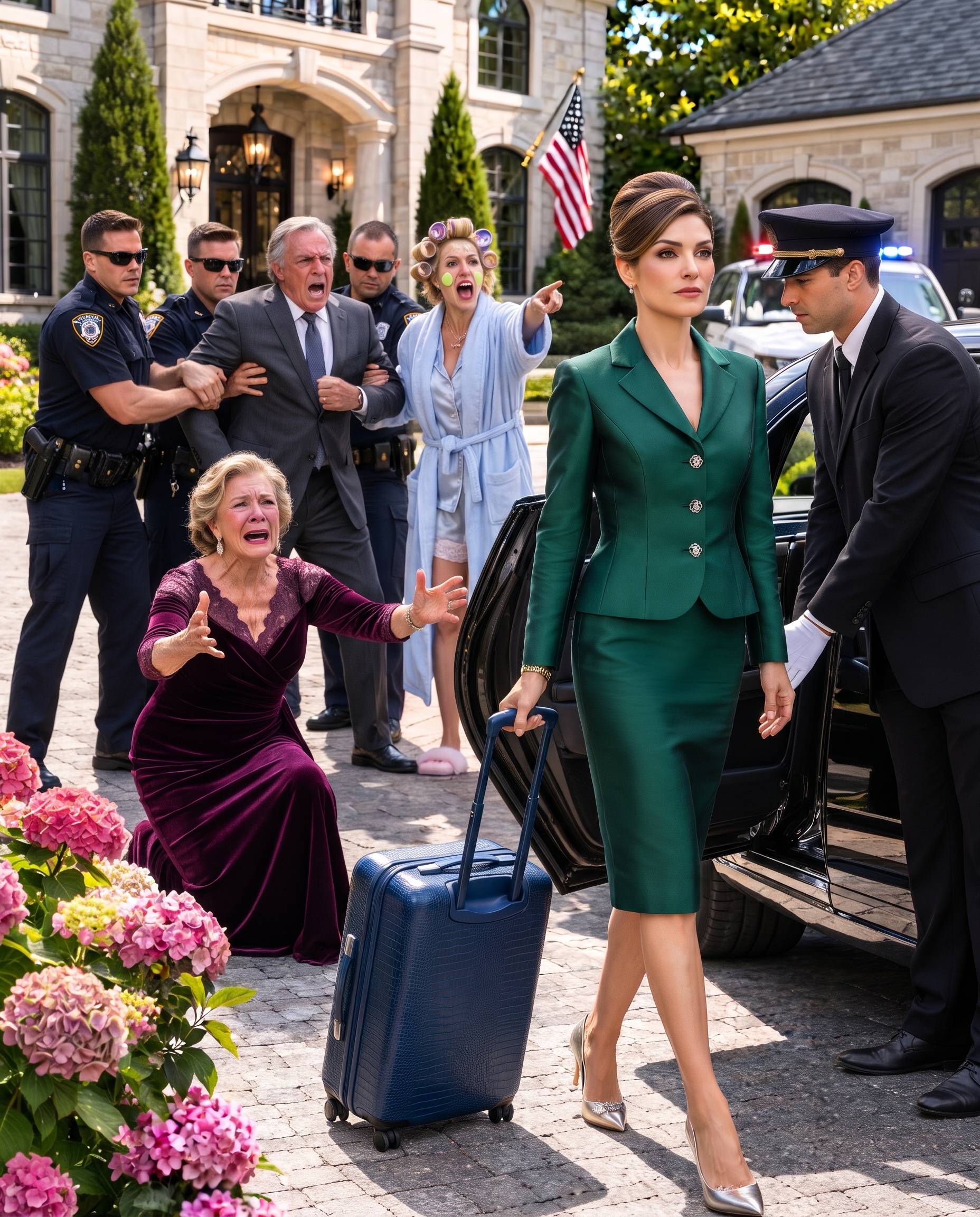
I missed the most important flight of my career and begged to borrow my parents car. “Your sister needs it for a spa day.” When I protested, my dad slapped me to the floor. I stood up, tasting blood—and walked out without a word. At 10:46 P.M., I opened my banking app… and locked..frozen everything.
Chapter 1: The Anatomy of a Fracture
The copper tang of blood inside my mouth had an exact market value: forty-eight thousand dollars a year.
It coated my tongue, thick and warm, welling from where my canine tooth had split the inner lining of my bottom lip. My shoulder struck the corner of the mahogany credenza in the entryway—an antique piece I had refinished myself two summers ago—sending a porcelain bowl of spare keys chattering against the polished wood.
My father stood over me, his hand still suspended in the humid, air-conditioned draft of the foyer. His chest heaved beneath his pressed linen shirt, his silver signet ring gleaming under the chandelier.
“Don’t you ever,” Michael Bennett whispered, his voice vibrating with a fury so fragile it sounded like breaking glass, “throw your money in my face in this house.”
Behind him, framed by the arched corridor leading to the sunlit kitchen, my mother, Kate , froze with a half-sliced cantaloupe in her hand. She did not drop the knife. She did not gasp. Her eyes darted instinctively toward the front windows, as if checking whether the manicured lawns of our Coral Gables neighborhood had witnessed the rupture.
From the stairwell came the soft, rhythmic pad of bare feet on hardwood. My younger sister, Jenna , appeared on the landing. She was draped in an ivory waffle-knit robe, her damp hair twisted into a microfiber turban. In her right hand, she held her smartphone, its screen illuminating a pastel confirmation page.
“Dad?” Jenna’s voice held the petulant, sing-song edge of someone whose morning latte had arrived tepid. “The appointment is at nine-thirty. If I don’t leave in ten minutes, The Biltmore Spa gives away the hydro-facial slot. I booked this three weeks ago. Why is Sarah screaming?”
“I am not screaming, Jenna,” I said. My voice was eerily level, though the words felt thick against my swelling lip. I pushed myself up from the credenza, my palms pressing against the cool parquet floor. “I am telling you that my car’s alternator died thirty minutes ago. The Uber surge is thirty-five minutes out because of an overturned tanker on the Palmetto. I have an eight-forty flight out of Miami International to Atlanta. The Omni-Horizon account presentation is at one o’clock.”
I looked directly at my father. “That contract is worth three point two million dollars to my agency. If I am not in that boardroom, the pitch falls to Henderson, who doesn’t even know the demographic models. I need the keys to the Lexus. For two hours. I will leave it in short-term parking and pay for the executive shuttle to bring it back to this driveway before dinner.”
Michael didn’t blink. He lowered his hand slowly, curling his fingers into a loose fist, tucking it into the pocket of his tailored slacks.
“Your sister has had a stressful month,” he said, as if reciting an indisputable law of physics. “She needs this day. You can reschedule your meeting.”
“It’s an executive pitch, Dad! You don’t reschedule the board of a national hospitality syndicate because your sister wants to be rubbed down with lavender oil!”
That was when the slap had landed. The impact was not a burst of sudden, theatrical thunder; it was an efficient, stinging shock that snapped my head to the left and ended four years of manufactured compliance in a single second.
“Do not make everything about you,” Jenna muttered from the stairs, her manicured thumb already scrolling past the scene below, indifferent to the red welt blossoming across my cheekbone. “You always do this. You make your work sound like brain surgery.”
I stood completely erect. My knees were shaking, but my spine felt as rigid as rebar. I didn’t reach up to touch my face. I didn’t wipe the thin smear of red from the corner of my mouth.
I looked past my father’s shoulder at my mother. Kate looked back, her eyes swimming with that familiar, poisonous helplessness she wore like expensive perfume.
“Sarah, please,” she mouthed silently, shaking her head. Don’t provoke him. Keep the peace.
Peace. For forty-eight months, peace had been an invoice delivered on the first of every month, paid entirely out of my direct deposit.
Without uttering another syllable, I reached down, took the handle of my leather carry-on bag, scooped my laptop briefcase off the parquet, and walked out the front door.
The Miami heat hit me like a physical wall, wet and suffocating at seven in the morning. The driveway was blinded by white morning glare. Parked under the shade of the grand banyan tree sat the Lexus RX 350 —pristine, freshly detailed, its comprehensive policy premium paid through my checking account forty-eight hours prior. Next to it sat my ten-year-old Honda Civic, silent and dead, its dashboard lights flickering feebly when I had tried the ignition twenty minutes earlier.
As I reached the curb, the heavy front door opened behind me. Jenna emerged, keys jingling in her hand, oversized designer sunglasses perched on her nose. She didn’t look at me as she unlocked the SUV with a cheerful double-chirp of the alarm. She climbed into the leather interior, fired the engine—the engine I had financed—and backed down the driveway, the exhaust sweeping warm air across my bare ankles.
I stood on the asphalt, my phone clutched in my palm.
A notification flashed on the screen: Delta Air Lines: Flight DL 1422 to ATL – Boarding Commenced.
I was thirty miles from the terminal.
The presentation was dead. My shot at the Senior Director seat was evaporating in the morning humidity. But as I watched the red taillights of the Lexus disappear around the curved coral-rock wall of the avenue, the hot, blinding panic inside my chest gave way to something terrifyingly cold.
I turned back toward the house. Through the sheer drapes of the front living room, I could see the silhouette of my father, pouring himself a fresh cup of dark roast, adjusting his cuffs, preparing to play the patriarch to an empty room.
I reached into my pocket, unlocked my phone, and opened my banking portal.
I didn’t call human resources. I didn’t call the police. Not yet.
Instead, I stared at the blinking cursor beneath my personal accounts, knowing with absolute, crystalline certainty that by midnight, the house on Alhambra Circle would discover precisely whose hands had been holding up the roof.
Chapter 2: Ten Forty-Six
“Don’t move. Let me look at it.”
Ryan Mitchell adjusted the articulated desk lamp, angling the cool, daylight-balanced LED beam across the left side of my face. We were sitting at the kitchen island of his twenty-fourth-floor apartment in Brickell. Below us, Biscayne Bay was a sheet of beaten pewter under the midday cloud cover, crossed by the white wakes of speedboats whose owners had never missed an executive flight because a sibling required hot stones on their shoulders.
Ryan’s thumb was extraordinarily gentle as he pressed a sterile gauze pad dipped in witch hazel against my split lip. His jaw was set so tightly that the muscles at the base of his temples pulsed rhythmically.
“We’re going to Urgent Care,” he said, his voice quiet, vibrating with an anger he was actively working to suppress. “We’re going to have an attending physician examine the contusion, run an orbital scan, and put the clinical notes on file. Tonight.”
“Ryan, it’s just a bruised cheek,” I murmured, wincing slightly as the antiseptic bit into the cut.
“It is an assault, Sarah,” he said, pulling back to look me squarely in the eyes. “Your father hit you because you asked for the car you insure so you could attend the meeting that pays his property taxes. Do not minimize this. If you minimize it today, you’ll be making excuses for him by Friday.”
He was right. Ryan was a senior acquisitions analyst in commercial real estate; his entire professional existence was built on dissecting bad contracts, identifying hidden liabilities, and cutting losses before a bad partner dragged an entire portfolio into receivership. For three years, he had watched my family siphon off my youth, my energy, and my capital, watching from the sidelines with the pained restraint of a man who loved someone trapped in a slow-motion collapse.
My phone, resting face-up on the quartz counter, vibrated. Then it vibrated again.
I didn’t need to look. Over the last four hours, seven messages had trickled in from my mother.
10:14 AM: Your father was under a tremendous amount of stress this morning, Sarah. You know how his blood pressure gets when he feels disrespected.
11:02 AM: Please call me. The air conditioning repairman is coming at two, and the service fee needs to be handled.
12:30 PM: Jenna said you took your bags. Where are you? The mortgage draft is scheduled for Friday. Please don’t let your anger make this family a casualty.
Ryan glanced at the illuminated screen, read the last preview banner, and let out a dry, humorless breath that sounded like tearing paper.
“The mortgage draft,” he repeated softly. “Not: Are you bleeding? Not: Did you make your flight? Not: I am horrified my husband laid hands on my firstborn. Just the mortgage draft.” He looked at me, his gaze fierce. “Sarah. How long has this house been your debt?”
I closed my eyes, leaning my forehead against my knuckles. The story was an old, rotting plank in the floor of my mind, one I had carefully avoided stepping on for four years.
“When I was twenty-five,” I began, my voice hoarse, “Michael came home on a Tuesday afternoon with a cardboard box filled with desk organizers. He told us Oakridge Furniture Logistics , where he’d been regional VP of sales for eleven years, was ‘repositioning.’ He promised Kate it was a strategic sabbatical. Three months. That was the timeline. He was going to launch a boutique supply-chain consultancy.”
“And?”
“And my promotion to Account Director came through three weeks later,” I whispered. “I was making eighty-five thousand. I had a security deposit ready for a loft in Coconut Grove. My parents sat me down at that mahogany table. Kate cried into her linen napkin. Dad told me that if I moved out, the bank would see the change in household occupancy during their loan restructuring. He said family wasn’t a business; it was a lifeboat. He asked for six months of bridge support. Just until his first three client retainers cleared.”
“And the retainers never came.”
“The retainers were phantoms,” I said, a bitter clarity finally cutting through the fog of my conditioning. “He never incorporated until last year. He sat in his study with the mahogany door closed, playing solitaire, reading industry trades, and ordering personalized executive stationary with foil lettering. Meanwhile, I picked up the mortgage shortfall: eleven hundred and fifty dollars. Then the Florida Power & Light bill: six hundred and twenty. The high-speed commercial-tier internet he ‘needed’ for his presentations: two hundred. The auto insurance for his Lexus and Jenna’s Mini Cooper: four hundred and eighty. The groceries. The pest control. The pool maintenance.”
I pulled my laptop across the counter, flipping the lid open. The screen glowed with the cold, unfeeling blue light of my personal banking portal.
“I ran the aggregates while I was waiting for you to pick me up at the corner of Alhambra,” I told him, tapping the trackpad. “Over the last twelve months alone, forty-eight thousand two hundred and ten dollars left this checking account to subsidize the estate of Michael Bennett. That doesn’t include the ‘loans’ to Jenna. The two hundred here for an emergency tire change. The four hundred there for her portfolio headshots.”
“Why did you stay, Sarah?” Ryan asked. The question wasn’t accusatory; it was profoundly sad.
“Because every time I packed a box, my mother had a migraine that lasted four days,” I whispered. “Every time I mentioned a lease, my father took me onto the back patio and reminded me that he gave me six hundred dollars toward the down payment on my first college beater car in 2014. He told me that keeping score was what poor-spirited people did. He told me that when his enterprise took off, I would have equity. He made me feel like an ingrate for wanting to keep the money I spent sixty hours a week earning.”
I looked at the transactions tab. My eyes scrolled through the line items, past the familiar utility charges, past the automated drafts.
Then, my finger stopped.
“Wait,” I muttered, leaning closer to the retina display.
“What is it?” Ryan leaned over my shoulder.
Tucked between a Publix supermarket charge and a recurring dry-cleaning bill were three debits I had never seen before. They had cleared within the last twelve business days:
- May 02: Apex Cloud Enterprise Solutions – $390.00
- May 07: LeadFlow Omni-Channel Marketing – $275.00
- May 11: BSS Operations ACH Direct – $640.00
“BSS?” Ryan frowned. “What is BSS?”
My stomach dropped into a cold, bottomless void. “Eight months ago, Dad asked to use my debit card to pay a one-time ninety-dollar filing fee to the Florida Department of State. He said his business credit card hadn’t arrived in the mail yet. He swore he’d reimburse me.”
I grabbed my phone, opening my secondary, archival Gmail account—the one I rarely checked, linked to an old domain I had registered in college. I typed Bennett Strategic Solutions into the search bar.
Thirty-two emails populated the window.
Account welcome kits. Software subscription receipts. Cloud storage tiers. And sitting at the very top, an automated notification from a commercial portal dated three weeks ago:
Billing Contact Confirmed: Sarah Bennett. Primary Authorization: Master Debit Account ending in 4109.
He hadn’t used my card for a one-time fee. He had anchored his entire phantom corporate infrastructure to my personal checking account. He was operating an LLC out of his study, billing his software, his lead funnels, and his corporate registrations to his daughter’s sweat, all while sneering at my career from across his breakfast table.
“He stole from you,” Ryan said, his voice dropping into a register of icy finality. “This isn’t family support, Sarah. This is unauthorized conversion of funds. In plain English: theft.”
I glanced at the digital clock mounted on the wall above the kitchen cabinets.
10:45 PM.
The urgent care visit was behind us. The contusion on my cheek was formally charted, photographs filed in an electronic health record under my name, a prescription for anti-inflammatory cream sitting unopened on the island. The silence of the Brickell high-rise was absolute, punctuated only by the hum of the refrigerator.
I clicked into the settings of my primary banking application.
My fingers did not tremble. The hesitation that had crippled me for four years had vanished with the strike of a hand.
At 10:46 PM , I initiated the sequence:
- Card Ending in 4109: PERMANENTLY LOCKED – REPORTED COMPROMISED.
- Secondary Authorized User (Jenna Bennett – Card 4110): REVOKED / CANCELLED.
- Automated Clearing House (ACH) Pre-Authorized Mandates:
- First Horizon Home Loans (Mortgage Sub-Draft): CANCELLED.
- Florida Power & Light (Auto-Pay): CANCELLED.
- Geico Commercial Auto Fleet Policy: CANCELLED.
- BSS Operations Recurring Direct Debit: DISPUTED & BLOCKED.
- Account Access: Single-factor phone authentication removed; transferred to a standalone physical security key.
I closed the laptop with a soft, definitive click .
The silence lasted exactly seventeen minutes.
At 11:03 PM , my phone lit up. Michael Bennett – Mobile.
I let it buzz against the quartz until it choked into voicemail.
At 11:07 PM , the first message arrived:
What did you do to the debit card? I am at the Shell station on LeJeune and the pump timed out.
Five minutes later:
Jenna was just humiliated at Prime 112. Her card declined for a table of four. She had to call her friend’s brother to cover the check. What the hell is going on with the secondary account? Fix this immediately.
I sat in the dim apartment, watching the screen pulse. I didn’t type a single character in response.
Then, at 11:18 PM , the final text landed, stripping away the last remaining shred of paternal pretense:
You have no idea what you’ve just jeopardized, you selfish child. We have institutional investors coming to the house tomorrow afternoon. The operational line must be clear. If you don’t unlock that portal right now, you will destroy this entire family.
I looked up at Ryan.
“Investors,” I whispered. “He told me he was a solo consultant. Ryan… what has he been selling?”
Chapter 3: The Ghost Enterprise
The next morning, the corporate fallout hit before the domestic war could even regroup.
At eight-fifteen, the caller ID displayed the direct office line of Daniel Price , Senior Vice President of Accounts at my firm, Vanguard Creative Partners .
I took a deep breath, smoothing down the lapels of the blazer I had borrowed from Ryan’s sister, who lived four floors down. “Good morning, Daniel.”
“Sarah.” Daniel’s voice had none of its usual brisk, caffeinated warmth. It was flat, clipped, and heavy with administrative weariness. “Henderson took the floor in Atlanta yesterday at one-fifteen. He tried. God knows the kid tried. But when the Omni-Horizon executives started probing the cross-platform integration models for the Caribbean properties, he froze. He didn’t know the margin forecasts. Because you wrote them.”
“Daniel, I can deliver that entire deck right now,” I said, my knuckles white against the edge of the kitchen table. “Over Zoom, via high-def teleconference, in twenty minutes. I have the live client architecture on my local drive. I can—”
“The Omni-Horizon committee doesn’t take Zoom pitches from account directors who ghost their flight during the final round of a multi-million-dollar RFP, Sarah,” Daniel interrupted, his sigh heavy through the receiver. “The client was insulted. They felt like a backup plan. They’ve tabled our proposal. They’re giving the Miami properties to Greyhound Media , and they’re holding the regional rollout in probate until the end of the quarter.”
The air left my lungs in a thin, hollow hiss. Six weeks of eighty-hour workweeks. Midnight strategy drafts. Endless market segmentation studies. Gone. Swallowed whole by a missing set of car keys and a manicure.
“Daniel, there was… an emergency,” I managed, fighting to keep my voice from cracking. “A family emergency. I was physically prevented from reaching the terminal.”
A long pause hung over the line. When Daniel spoke again, the professional frost had softened marginally, replaced by cautious concern. “Henderson said you sounded strange when you texted him from the road. Sarah, look… the board is meeting on Friday to finalize the Senior Director appointments. I wanted you in that chair. You earned that chair. But right now, the Managing Partners are looking at a four-hundred-thousand-dollar agency fee that just walked out the door. You need to get your house in order. Take the rest of the week. But Monday morning, I need you in this office with a portfolio review that justifies your seat.”
The line went dead.
I sat with my head in my hands, listening to the muffled drone of the Brickell traffic far below.
“We don’t mourn,” Ryan said, walking out of his home office. He wasn’t wearing his suit jacket; his sleeves were rolled to his elbows, and he carried a black leather portfolio case under his arm. “We audit.”
“Ryan, I just lost the biggest account of my career.”
“No,” he said fiercely, setting the portfolio down on the table. “You just saw the bill for four years of subsidizing a parasite. If you let this swallow you today, you lose the promotion on Monday, and then Michael wins by default. He pulls you back into that swamp because you won’t have the leverage to walk away. Get dressed. We have an appointment at eleven.”
“With who?”
“With someone who understands how to dissect a ghost.”
At eleven o’clock, we were sitting in a sun-drenched conference room on the tenth floor of a boutique financial tower in Coral Gables. Across the glass table sat Lily Chen , a certified public accountant who specialized in forensic corporate reconstructions, and Elena Torres , a litigator whose firm handled complex financial fraud and unauthorized corporate formation.
Elena was a woman in her late forties with razor-cut dark hair, sharp obsidian eyes, and a legal demeanor that suggested she viewed human emotion as a secondary distraction from balance sheets.
Spread across the glass were sixty pages of bank statements, electronic receipts, and public records Lily had pulled from the state database during the last two hours.
“Your father,” Elena said without preamble, tapping a manicured index finger against a printed certificate of incorporation, “is not running a consultancy. He is running a projection booth.”
“Explain,” I said.
Lily Chen spun her laptop toward me. On the screen was the corporate registry for Bennett Strategic Solutions LLC , filed with the Florida Department of State eight months ago. Michael Bennett was listed as the sole Managing Member. The principal place of business was my parents’ house on Alhambra Circle.
“The recurring charges you blocked last night?” Lily pointed to a spreadsheet. “Apex Cloud, LeadFlow Omni, the BSS transfer. Those aren’t standard administrative costs. They are high-tier enterprise software suites used to simulate large-scale marketing agency capabilities. He was buying email scraping databases, CRM pipelines, and white-label analytical templates. He was using your personal debit card to purchase the digital clothing of a twenty-person strategy firm.”
“And the money?” I asked. “Where was the revenue going?”
“What revenue?” Lily raised an eyebrow. “I ran a soft cross-reference on commercial deposits linked to that LLC address through public lien registries. There are no client retainers, Sarah. There are no corporate checks clearing. For eight months, the sole source of operational capitalization for Bennett Strategic Solutions LLC was a recurring monthly transfer from a single retail account: yours .”
My breath hitched. “He was laundering my household contributions as business capital?”
“Worse,” Elena Torres cut in, her voice dropping into a register that made the hair on my arms stand up. “He wasn’t just using your liquid cash to pay his subscriptions. He was leveraging your professional identity to manufacture credit.”
Elena pulled a fresh manila folder from her briefcase and slid a single sheet of paper across the glass.
It was an inquiry notification from Vanguard Capital Group —a private commercial mezzanine lender operating out of Fort Lauderdale. The document was dated six months ago.
“This is a preliminary commercial financing application,” Elena explained, watching my face closely. “For a two-hundred-and-fifty-thousand-dollar revolving line of credit. The applicant of record is Bennett Strategic Solutions LLC. Managing Partner: Michael Bennett.”
“I don’t understand,” I stammered. “How does this involve me? My name isn’t on his business.”
Elena turned the page over.
There, in Section 4—labeled Proposed Personal / Financial Guarantor —was my name: Sarah Bennett .
Below it was my exact date of birth. My Social Security number. My title at Vanguard Creative Partners. My exact W-2 compensation from the previous tax year, accurate down to the final three digits.
“Did you sign this document, Sarah?” Elena asked. The question was a formality; her eyes already held the answer.
“No,” I whispered. My stomach violently churned. “I’ve never seen this paper in my life.”
“He typed your name in the electronic signature portal,” Elena said coldly. “He used your secondary email address—the one he asked you to verify an insurance code for last autumn—to bypass the two-factor authentication. He didn’t secure the loan; the lender flagged a discrepancy in the corporate debt-to-income ratio and shelved the application in the preliminary review stage. No capital was disbursed. You are not currently liable for two hundred and fifty thousand dollars.”
Elena leaned forward, resting her forearms on the table.
“But the intent, Sarah, is unmistakable. Your father attempted to pledge your salary, your credit score, and your future earnings as the collateral engine for an imaginary company. And if that wasn’t enough…”
Elena paused, glancing toward the window before looking back at me.
“A colleague of mine in corporate leasing called me forty minutes ago. Michael Bennett has booked the private mezzanine salon at The Biltmore Hotel for tomorrow afternoon. He has invited eight local angel investors, two commercial real estate brokers, and three boutique brand owners for a private presentation.”
“A presentation for what?” I asked, my voice barely audible.
Elena turned the folder toward me, revealing a printout of an event flyer Michael had distributed through a local executive networking network:
Bennett Strategic Solutions: Unlocking Omni-Channel Hospitality Horizons. Co-Hosted by Senior Brand Partner Sarah Bennett.
“He didn’t just steal your credit, Sarah,” Elena said softly. “He told the investors that your agency’s client relationships belong to him. He’s selling your career as his company’s primary asset.”
Chapter 4: The Currency of Shame
The phone in my pocket began to vibrate with the furious, erratic rhythm of a trapped insect.
I didn’t answer it. We were sitting in Elena’s conference room, the midday sun now blazing through the blinds, casting prison-bar shadows across the mahogany table. Elena reached over, tapped the speaker icon, and signaled for me to remain silent.
“Sarah?” It was my mother’s voice, but it had abandoned its usual fragile breathiness. It was tight, strained, vibrating with a high-pitched hysteria. “Sarah, you have to answer me! The power company just sent a disconnect warning via automated text! The technician is coming tomorrow between eight and noon to pull the meter!”
“The account was closed, Kate,” I said evenly.
“You can’t do this!” she shrieked. It was the first time in twenty-nine years I had ever heard my mother raise her voice to me. “Your father is preparing for the most critical afternoon of his life! The Biltmore event is tomorrow! He has spent four months organizing these contacts! If the house is dark, if the phones are disconnected—”
“Why would the house be dark, Mom?” I interrupted. “Dad is a successful management consultant. He tells the neighbors he manages an international logistics portfolio. Can’t a high-powered partner cover a six-hundred-dollar electric bill?”
Silence fell over the line—a dense, suffocating silence that lasted four seconds.
“You are being cruel,” Kate whispered, her voice dropping into venomous intimacy. “You are punishing this family because of an argument. We made sacrifices for you, Sarah! When you were at Florida State, who paid for your dorm room furniture? Who bought your graduation dress? We poured everything into you, and the second you achieve a little success in the city, you look down on us! You act like a landlord!”
“I have paid your mortgage for forty-eight consecutive months, Mom. I have paid for the food in your pantry. I have paid the insurance on the car Jenna drove to her massage while I stood in the driveway with blood running down my chin.”
“Your father was under pressure!” Kate snapped, refusing the reality of the blow. “He reached his breaking point because you were being disrespectful! You pushed him! You have always known how to push him!”
“Goodbye, Mom.”
I hung up.
I looked at Elena. “Can she access my accounts?”
“Not anymore,” Lily Chen answered, closing her laptop. “I’ve initiated fraud freezes across all three credit bureaus. We filed identity theft affidavits with the Federal Trade Commission regarding the Vanguard Capital application. By five o’clock today, your financial footprint is an iron fortress. A mouse couldn’t open a department store charge card in your name.”
“Now,” Elena said, her eyes flashing with a predatory legal gleam, “we handle the theater.”
Before she could explain, my personal phone chirped with a direct text message. It wasn’t from my parents.
It was from Jenna .
Sarah. Please. I’m not at home. I’m at the Starbucks on Miracle Mile. Don’t tell Dad. Please come. You need to see this.
Ryan looked at the screen, then at me. “It could be an ambush. Michael might be using her phone.”
“No,” I said, studying the syntax. “Jenna doesn’t say ‘please’ twice in the same decade. She’s terrified.”
Thirty minutes later, Ryan and I walked into the shaded patio of the café on Miracle Mile. Jenna was sitting at a corner wrought-iron table beneath a blooming bougainvillea, wearing oversized tortoiseshell sunglasses and a wide-brimmed straw hat that shadowed most of her face. She looked small. For the first time in my life, she didn’t look like the untouchable princess of Alhambra Circle; she looked like a child who had wandered into deep water and realized her feet couldn’t touch the bottom.
On the table in front of her sat a battered, expandable accordion folder made of faded brown cardboard—an artifact I recognized instantly. It was the private operational file Michael kept in the locked bottom drawer of his executive roll-top desk.
Jenna didn’t look at Ryan. She kept her eyes glued to my face, her fingers knotting the fabric of her silk scarf.
“Did he hit you again?” she asked. Her voice was barely a whisper above the hiss of the espresso machine.
“No, Jenna,” I said, sitting down across from her. Ryan remained standing two paces behind my chair, his arms crossed, his posture unyielding. “He didn’t hit me because I left. What do you have?”
Jenna’s hands shook as she pushed the accordion file across the table.
“After you left yesterday… Dad went into his study. He slammed the door so hard the transoms over the hallway rattled. He stayed in there until three in the morning. When he went to sleep, I… I went in to find the spare key to the Lexus. I needed to get my clothes from the dry cleaners.” She swallowed hard, her throat bobbing. “The desk wasn’t locked. He’d left his personal ledger open.”
I pulled the ledger out of the file. It was a standard black-and-red ruled accounting book, filled with my father’s sprawling, theatrical handwriting in blue fountain-pen ink.
I opened to the most recent page, dated two months prior.
It wasn’t an accounting of consulting fees. It was an operational survival map:
- Fixed Household Nut: $4,100/mo.
- Direct Support (Sarah – ACH): $2,250 (Guaranteed).
- Operating Capital (Sarah – Card 4109): $1,300 (Absorbed).
- Discretionary Margin: $550 (Kate part-time clinic).
And beneath that, circled twice with red ballpoint ink:
CRITICAL: Sarah’s income must remain anchored to the household ledger through Q4. Do not disclose true overhead balance to Kate or Jenna. If Sarah transitions to an independent lease, the BSS corporate line fails the liquidity test.
I stared at the ink. The words didn’t dance; they stood there, cold and calculated.
He hadn’t been waiting for a business to launch. He had been actively managing my captivity as an asset class. He knew that the moment I signed a lease on an apartment in Brickell or Coconut Grove, the debt-to-income balance that allowed him to maintain the house, the car, and the bespoke image would instantly vaporize.
“He told me you paid a few hundred dollars for rent,” Jenna whispered, tears finally escaping the edges of her sunglasses, carving pale tracks down her bronzed cheeks. “He told me that you were living at home because your agency salary wasn’t enough to survive on in Miami. He told me that he was paying for my car, my allowances, my trips… out of his consulting retainers.”
“Jenna,” I said, my voice dead and dry, “Dad hasn’t earned a consulting retainer in four years. Every cocktail you drank at Prime 112, every spa treatment at The Biltmore, every designer pair of espadrilles in your closet… you bought with my marketing bonuses.”
She covered her mouth with both hands, a muffled sob tearing from her chest. “I didn’t know, Sarah. I swear to God, I didn’t know. He told me you were jealous of me. He said you hated that I was free while you had to sit in an office all day.”
“And when he struck me?” I asked, my gaze pinning her to the chair. “Yesterday morning. When I was on the floor bleeding on the parquet. Why didn’t you speak?”
Jenna looked down at the table. Her shoulders hunched inward. “Because I was afraid,” she wept. “Because if you were right… then everything we were doing was a lie. And I didn’t know how to live without the lie.”
She reached back into the accordion folder and pulled out a stack of heavy, glossy cardstock brochures.
“He printed these yesterday afternoon at FedEx Office,” she said, her voice trembling. “For the investor pitch tomorrow.”
I picked up the top brochure.
The cover was embossed with a silver corporate emblem: Bennett Strategic Solutions: Institutional Brand Architecture.
I turned the page.
My professional headshot—taken from my corporate biography on the Vanguard Creative Partners internal intranet—dominated page three. Beneath my photograph ran a fictionalized biography that credited me as Co-Founder and Chief Brand Architect . It claimed our firm had secured the Omni-Horizon account, citing my confidential strategy summaries as proprietary case studies developed exclusively by Michael Bennett’s agency.
He was presenting my intellectual property, my professional reputation, and my corporate career to a room full of private investors as the collateral justification for a five-hundred-thousand-dollar capital raise.
And the presentation was scheduled for two o’clock tomorrow afternoon in the Alhambra Salon at The Biltmore.
“Elena,” I said, pulling out my phone without breaking my gaze from the brochure. “Are you still at your desk?”
“I am,” the attorney responded instantly. “What did your sister give you?”
“Enough evidence to incinerate his entire universe,” I said. “Draft the affidavits. We’re going to the Biltmore.”
Chapter 5: The Collapse of the Facade
The Alhambra Salon at The Biltmore Hotel smelled of polished cedar, brass polish, and the faint, sweet decadence of catered espresso.
Through the tall, arched Mediterranean windows, the afternoon sun cast golden lozenges across twenty leather-backed executive armchairs arranged in a semi-circle before a high-definition presentation display. A linen-draped table in the rear held silver carafes of Jamaican Blue Mountain coffee, crystal carafes of iced water, and platters of miniature pastries.
At one-forty-five, Michael Bennett was in his element.
He wore a tailored charcoal-grey windowpane suit, a silk pocket square perfectly frothed in his breast pocket, his silver hair brushed back with executive precision. He held a crystal tumbler of sparkling water in his left hand, laughing with warm, paternal authority as he leaned toward Marcus Vance , a prominent Coral Gables real estate developer whose family office managed over forty million dollars in local commercial assets.
“The real challenge in luxury brand repositioning, Marcus,” my father was saying, his voice booming with smooth, practiced resonance, “is ensuring that your strategic team doesn’t just understand the creative—they have to understand the capital deployment. My partner—who handles our creative architecture—comes directly out of the tier-one agency ecosystem. We don’t pitch theoretical campaigns; we pitch balance-sheet expansion.”
Marcus Vance nodded, adjusting his gold rimless glasses as he flipped through the glossy brochure Michael had placed in his hands. “It’s an impressive portfolio, Michael. I was particularly intrigued by this Omni-Horizon project. The hospitality integration strategy is brilliant. Your co-founder, Sarah… she’s your daughter, correct?”
“She is,” Michael said, his smile radiating boundless, benevolent pride. “Brilliant girl. Trained her myself from the ground up. She leads our marketing operations. She’s currently finalizing the regional rollout contracts as we speak. Family integrity, Marcus. That’s the Bennett Strategic advantage. You aren’t hiring an agency that treats your capital like a fee; you’re partnering with a legacy.”
“A legacy,” a voice repeated from the rear arched entryway of the salon. “That’s a fascinating term for unauthorized representation.”
The salon fell dead silent.
The low murmur of conversation among the nine prospective investors in the room evaporated instantly.
Michael froze, his crystal tumbler suspended halfway to his mouth.
I stepped across the threshold.
I wasn’t wearing an oversized blazer or running shoes. I was dressed in my tailored navy Theory pantsuit, my hair pulled back into a severe, sleek low bun, my portfolio case held firmly under my left arm. The bruising along my left cheekbone was carefully subdued beneath medical-grade foundation, but if you stood within three feet, the faint yellow-violet shadow of the blow was unmistakable.
Beside me walked Elena Torres , her briefcase clicked open in her hand, and Daniel Price , Senior Vice President of Vanguard Creative Partners.
Michael’s face didn’t merely lose its color; it took on the grey, waxy translucence of a corpse. The theatrical warmth in his eyes shattered, replaced by an animal terror that darted toward the side exits.
“Sarah?” Michael managed, his voice dropping an octave, trying desperately to project an air of playful familial surprise. “Gentlemen, look—it seems my partner managed to break away from her executive briefing early after all. Sarah, darling, we were just discussing—”
“Mr. Bennett,” Elena Torres’s voice cut through the salon like a diamond glass-cutter. She stepped forward, pulling three bound, certified legal packets from her case and placing them squarely on the central presentation table, directly between Michael and Marcus Vance.
“My name is Elena Torres,” she announced, addressing the entire room. “I am senior litigation counsel representing Ms. Sarah Bennett. Standing to my left is Mr. Daniel Price, Senior Vice President of Vanguard Creative Partners.”
Marcus Vance looked from Elena to me, his brow furrowing. “Michael… what is this?”
“This,” Daniel Price said, stepping forward, his voice carrying the full, terrifying authority of a corporate officer whose agency managed thirty million dollars in billings, “is a formal notification of intellectual property theft and fraudulent representation.”
Daniel picked up one of Michael’s glossy brochures, holding it up for the room to see.
“The case studies on pages four through nine of this document are the proprietary work product of Vanguard Creative Partners. They were developed exclusively for the Omni-Horizon Hospitality syndicate by Sarah Bennett in her capacity as an Account Director at my firm. Mr. Michael Bennett has never been employed by, partnered with, or retained by Vanguard Creative Partners. He has no authority to license, pitch, or commercialize these campaign architectures.”
A collective, sharp inhalation swept through the prospective investors. One of the real estate brokers immediately set his pastry plate down, wiped his fingers with a napkin, and stood up.
“Sarah,” Michael choked out, stepping toward me, his hands trembling as he reached out in an instinctive, pleading gesture. “Sarah, please… don’t do this here. We can discuss the corporate allocations at home. This is a family matter—”
“It stopped being a family matter,” I said, my voice echoing off the vaulted Mediterranean ceiling, completely steady, completely devoid of rage, “at seven-fifteen yesterday morning, Michael. When you struck me across the face because I needed the car I pay for to catch the flight for the account you just plagiarized.”
The room seemed to drop ten degrees.
Marcus Vance looked at Michael’s hands, then at the faint, powdered shadow on my cheekbone. The developer’s face hardened into a mask of pure, absolute revulsion. He closed the brochure, placed it face-down on the mahogany table, and pushed his chair back.
“Elena,” I said quietly, turning to my attorney.
“As of eight o’clock this morning,” Elena addressed Michael, her voice echoing in the dead silence, “formal affidavits have been filed with the Florida Department of State, the Division of Consumer Services, and the State Attorney’s Financial Crimes Unit regarding the unauthorized use of Ms. Bennett’s credentials and identity in a commercial loan application filed with Vanguard Capital Group. A formal Cease and Desist has been served to Bennett Strategic Solutions LLC. Any further representation of Ms. Bennett as a partner, guarantor, or affiliate of this phantom entity will result in an immediate petition for injunctive relief and statutory damages.”
“This is a misunderstanding,” Michael stammered, looking frantically around the room at the men whose capital he had courted for four months. “Marcus… Jim… listen to me. Daughters… you know how emotional creative directors can be during contract restructuring. I built this! I provided the seed capital for her education! She’s acting out of personal spite—”
“Michael,” Marcus Vance interrupted, his voice dripping with quiet disgust as he collected his leather briefcase. “Stop talking. Just… stop talking.”
Marcus turned to me, bowed his head slightly with profound, mortified respect, and walked toward the arched doors.
Within ninety seconds, the other eight investors had gathered their coats, their portfolios, and their phones. Nobody shouted. Nobody argued. They filed out of the Alhambra Salon in the devastating, absolute silence that the wealthy reserve for people who have revealed themselves to be radioactive.
The catering staff, sensing the slaughter, quietly vanished through the service corridor.
The heavy oak doors clicked shut.
Only four of us remained in the massive salon: Daniel Price, Elena Torres, myself… and Michael Bennett.
My father stood behind the linen table, his hands pressed flat against the mahogany surface to keep his arms from shaking. The silk pocket square looked absurd now—a clown’s costume on an emperor whose clothes had been ripped away to expose bone and rust.
“You destroyed me,” he whispered, looking at me with eyes so full of hatred they were almost unrecognizable. “In front of Marcus Vance. In front of this city. You destroyed your own father.”
“No, Michael,” I said, stepping forward until I was standing across the table from him. “You were destroyed the day you decided your vanity was worth more than your daughter’s life. I didn’t destroy your business. You never had one.”
I turned on my heel and walked out of the salon.
As we reached the grand lobby of The Biltmore, Daniel Price paused beside the stone fountain. He reached into his suit jacket and pulled out a leather-bound folder embossed with the Vanguard Creative seal.
“The Omni-Horizon committee convened an emergency executive session at noon,” Daniel said, looking at me with a faint, knowing smirk. “Henderson told them the truth about why you missed the flight. All of it.”
My heart hammered against my ribs. “And?”
“The regional Managing Director said he wouldn’t trust an agency that threw its best strategist under the bus to save face.” Daniel handed me the folder. “They’re giving us the entire Southeast regional rollout. On one condition: you are named Senior Director of Brand Strategy, effective Monday morning. With full signatory authority.”
I took the folder. The embossed leather felt cool and real against my skin.
“Congratulations, Senior Director Bennett,” Daniel said softly. “Now go finish what you started.”
My phone buzzed in my hand.
I looked down. It was a photograph sent from my mother’s phone.
It was an eviction pre-notice and an emergency mortgage acceleration summons from First Horizon Home Loans, nailed to the front door of the house on Alhambra Circle.
Beneath it, Kate had written three words:
He’s coming home.
Chapter 6: The Driveway Eviction
The U-Haul van smelled of industrial floor sealant, old blankets, and diesel fumes.
Ryan backed it into the driveway of 1420 Alhambra Circle at ten o’clock on Saturday morning. The sun was blinding, reflecting off the coral-rock decorative pillars that framed the entrance to my childhood home.
In the front yard, driven deep into the St. Augustine sod, stood a pristine red-and-white sign that hadn’t been there four days ago:
FOR SALE – RE/MAX EXCLUSIVE LISTING.
The Lexus RX 350 was gone from under the banyan tree. In its place sat a battered, ten-year-old grey Toyota Corolla with peeling clearcoat on the hood—the vehicle Michael had been forced to purchase with the emergency liquidation of his tailored wardrobe and his remaining golf club memberships after the commercial lease company reclaimed the SUV.
The front door opened.
My mother emerged first. She wore gardening gloves and an old linen blouse, her eyes sunken into dark, plum-colored hollows of exhaustion. She didn’t look at me as I climbed down from the passenger seat of the van. She carried two plastic storage totes filled with old photograph albums, setting them down on the porch with a mechanical, defeated rhythm.
Kate had spent forty-eight hours with a housing counselor provided through the state mediation portal. She had discovered what Lily Chen already knew: without forty-eight thousand dollars of annual cash infusions from an unregistered occupant, the house was a financial black hole. The mortgage was in default. The private equity line was frozen. The only path that didn’t end in judicial foreclosure was an immediate, distressed short-sale.
Jenna came out next, carrying my old college graduation diploma frame and three garment bags filled with my winter coats.
She walked down the brick pavers, her head down, and set them inside the open cargo bay of the truck.
“I packed your books,” Jenna murmured, not meeting my eyes. “The ones from the study. And your design awards. They’re in the wardrobe boxes.”
“Thank you, Jenna,” I said gently.
She paused, her fingers gripping the metal edge of the roll-up door. “I got a job,” she said, her voice small, almost lost beneath the rustle of the banyan leaves. “At a photography studio in Wynwood. Running their client intake desk. Twelve dollars an hour. I start Monday.”
I looked at my sister. The designer sunglasses were gone. Her face was bare, pale, and real.
“It’s a start,” I told her. “Pay your own phone bill first. Everything else comes after that.”
She nodded once, a quick, jerky motion, and walked back up the porch steps without asking for a dime.
The screen door creaked.
Michael Bennett stepped onto the threshold.
He had aged ten years in ninety-six hours. The pressed linen shirts were gone; he wore an old polo with a frayed collar, his silver hair uncombed, his cheeks shadowed with four days of uneven, silver-grey stubble. He didn’t have his signet ring on—I knew without asking that it had gone to the pawnshop on Bird Road to cover the arrears on the electric meter.
He walked down the driveway, his gait heavy, his slippers scuffing against the brick pavers where he had once held court over neighbors and bank presidents.
He stopped three feet from where Ryan and I stood beside the rear of the truck. Ryan stepped forward instinctively, but I placed a hand on his forearm, holding him back.
Michael looked at the U-Haul. He looked at the boxes. He looked at the real estate sign planted in the grass he had paid other men to cut with my money.
“Are you satisfied now?” he asked.
His voice was hoarse, hollowed out by the cigarettes he had started smoking again after fifteen years of abstinence.
I picked up the final cardboard box from the curb—the one containing my high school yearbooks and my mother’s grandmother’s silver tea set, which Kate had silently slipped into my hands five minutes earlier.
“Satisfied with what, Michael?” I asked.
He gestured with a trembling, liver-spotted hand toward the house. “We’re selling. The agency is dissolved. The board at the club revoked my dining privileges yesterday morning. Your mother sleeps in the guest bedroom. Jenna looks at me like I’m a stranger who broke into the house. Is this what you wanted when you walked out that door?”
I set the box into the truck bed, turned around, and looked him dead in the eyes.
“Four days ago,” I said, my voice cutting through the humid morning air with the clean, surgical finality of an executioner’s blade, “I asked you for the keys to a vehicle I bought insurance for, so I could attend a meeting that would secure my future.”
Michael flinched.
“You didn’t just refuse me, Michael,” I continued, stepping into his space until he was forced to look up at the welt on my cheekbone. “You hit me. You struck your daughter because you believed that if you kept me small, you could keep yourself grand. You thought that if you broke my spirit, I would keep paying for your illusion until you died.”
“I was under pressure,” he croaked, looking away toward the banyan tree. “You don’t understand the pressure a man faces when—”
“A man,” I interrupted, “does not steal his daughter’s Social Security number to forge a commercial loan application. A man does not tell investors that his daughter’s sweat belongs to his ghost company. You were not under pressure, Michael. You were an addict. And your drug was looking like someone who never had to ask for help.”
He opened his mouth to speak, but the words withered on his tongue. There was no mahogany table to lean on. There were no prospective investors to impress. There was no daughter standing before him with an open checkbook and an apology for existing.
“I never thought you’d actually leave,” he whispered.
The confession was so quiet, so raw, that it sounded like an accidental exhalation.
“I know,” I said. “You thought my patience was a contract. You thought that because I loved this family, you owned the right to bleed me dry.”
I reached past him, grabbed the metal pull-strap of the U-Haul’s cargo door, and slammed it down. The latch engaged with a heavy, concussive clack that echoed down the quiet suburban avenue.
I turned the padlock, slipped the key into my pocket, and walked around to the passenger side of the cab.
I didn’t look back at the house on Alhambra Circle. I didn’t look at Michael Bennett standing in his scuffed slippers in the middle of his evaporating kingdom.
“Let’s go home,” I told Ryan.
Epilogue: A Clean Ledger
Six months later, the view from my balcony was worth every penny of the three thousand two hundred dollars that left my account on the first of every month.
The apartment was on the fourteenth floor of a modern glass tower overlooking Coconut Grove . Below, the masts of sailboats bobbed against the blue-green water of Biscayne Bay like rhythmic metronomes. The living room behind me was furnished with pieces I had selected, paid for, and arranged myself—a deep velvet sofa in forest green, a walnut dining table that had never seen an unearned invoice, and walls hung with original prints from local Miami artists.
There was no secondary cardholder on my banking dashboard. There was no automated clearing house mandate that didn’t terminate in an account bearing my solitary legal signature.
The transition had not been theatrical; it had been clinical.
The house in Coral Gables had sold in August for nine hundred and eighty thousand dollars. After the primary mortgage holder, the secondary line of credit, and the delayed property taxes were satisfied, my parents had walked away with seventy-two thousand dollars in liquid equity.
They used it to lease a two-bedroom garden townhouse in Kendall, thirty minutes inland from the coast.
Kate had taken a full-time position as an office administrator at a pediatric dental group. She managed the checkbook now. Every dollar that entered that townhouse was accounted for on an Excel spreadsheet Lily Chen had helped her configure during our single, quiet mediation session.
Michael had spent two months in sullen, isolated silence before the absolute finality of his circumstance forced him into the job market. Through a former junior colleague who took pity on him, he secured an entry-level position as an inventory auditor for an office equipment supplier in Doral. He earns forty-eight thousand dollars a year—an exquisite, poetic irony that I never pointed out to anyone. He drives the grey Corolla. He leaves the townhouse at seven in the morning and returns at six in the evening with grease on his cuffs and dust on his shoes.
He no longer offers financial advice to neighbors. He does not carry a signet ring.
Jenna lived in a shared studio apartment in Little Havana with two other graphic design interns. She worked forty hours a week at the photography studio, took weekend wedding shoots, and rode the Metrorail to work.
Last Tuesday, she met me for lunch at a small Cuban café near my office.
She arrived wearing a simple linen dress she had bought at a thrift boutique, carrying her own portfolio bag. When the bill arrived, she didn’t look away. She didn’t reach for her purse with that agonizing, theatrical hesitation she had perfected over a decade.
She pulled out a debit card—a simple, unadorned blue card from a local credit union—and placed it firmly on the leather folder.
“My treat,” she had said, looking me straight in the eyes. “I got a bonus on the summer catalog shoot.”
I didn’t argue. I didn’t reach for the check. I let her pay the thirty-eight dollars, and when she handed the receipt back to the server, there was a quiet, luminous pride in her eyes that no spa day at The Biltmore had ever provided.
Shortly before Thanksgiving, a white linen envelope had arrived in my mailbox, forwarded through Elena Torres’s office.
Inside was a single sheet of cream-colored stationery, covered in Michael’s distinctive, sprawling hand.
Sarah,
I am not writing this to ask for your assistance. Your mother informs me that the short-sale paperwork is fully executed and that the lender has discharged the remaining deficiency balance. The debt is clear.
I struck you. Every morning when I look in the mirror to shave, I see the hand that did it, and I know that whatever has become of my standing in this town, I earned it in that corridor. I told myself for four years that I was protecting this family’s dignity. The truth is much simpler and much uglier: I was terrified of being ordinary. And I made you pay for my terror.
You were right to lock the door. If you hadn’t, I would have dragged you down into the dark with me and called it love.
I do not expect an invitation to your home. I do not expect your forgiveness. I am writing this simply because the ledger must be balanced, even if the only currency I have left is the truth.
Your father,
Michael
I read the letter once, standing beside the kitchen counter of my apartment, the sea breeze blowing through the sliding glass doors, carrying the scent of salt and rain.
I didn’t cry. I didn’t burn it.
I folded it in half, walked into my home office, and placed it in the back of the bottom filing drawer—not as an heirloom, but as a receipt.
A receipt for the forty-eight thousand dollars a year I had spent to learn the most brutal, liberating lesson of my life:
Loyalty without boundaries is not devotion. It is an open invitation for your own execution.
Sometimes, people treat your patience like proof that you will never leave. They mistake your silence for a contract, your kindness for collateral, and your endurance for consent.
They forget that the same hands that build the lifeboat know exactly how to pull the plug.
I walked back out onto the balcony, picked up my glass of iced tea, and watched the sun sink behind the skyline of the city—a city where my name belonged entirely to me.