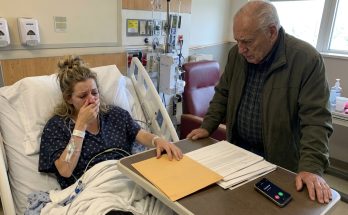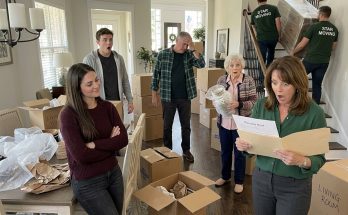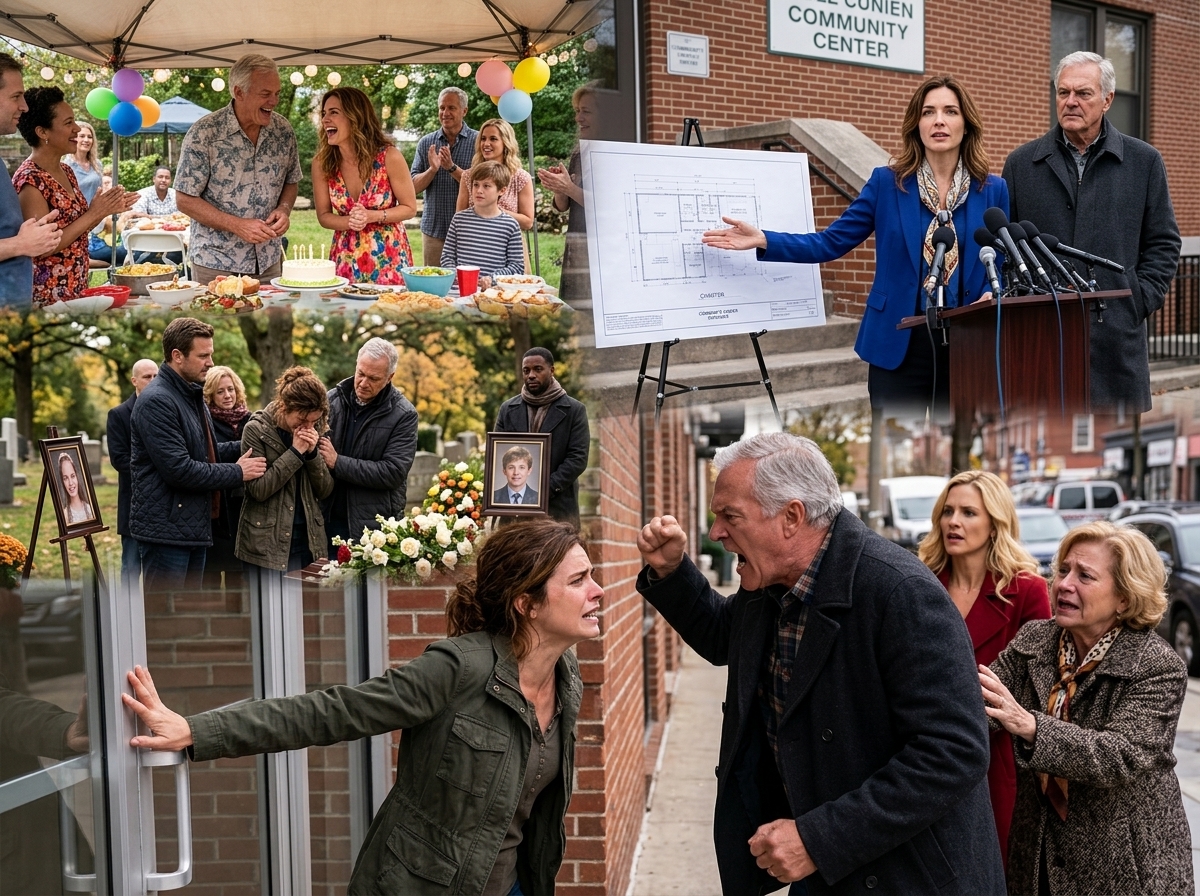
My Parents Skipped the Funeral of My Husband and Children for My Sister’s Birthday, Then Came Begging After My Settlement, Never Knowing What I Had Already Done With Every Dollar
Chapter 1
PART 2
The pounding started at 6:42 p.m.
I know the exact time because the doorbell camera sent a notification to my phone, and I sat at the kitchen table staring at it. My father’s face filled the little screen, gray-lit and stretched by the fisheye lens. He was wearing the navy wool coat my mother bought him for Christmas years ago, the one he wore to church and to the bank. His dress coat.
He had worn his dress coat to come see me.
He had not worn anything at all to the funeral, because he had not come.
“Claire!” His voice came through the speaker a half-second behind his mouth. “Claire, I know you’re in there. Your car’s in the driveway.”
Across the table, Aunt Ruth set down her coffee mug very slowly. She had been staying with me since the week after the funeral. She said it was temporary, but her winter coats were in my hall closet now, and her blood pressure pills were lined up on my windowsill next to Lily’s old ceramic frog.
“You don’t have to open that door,” she said.
“I know.”
“I mean it, honey. You don’t owe him a single thing.”
“I know,” I said again.
He knocked harder. Three heavy blows, the way he used to knock on my bedroom door when I was fifteen and had my music too loud.
“Claire, this is ridiculous. I drove two hours. Your mother is beside herself. Open the door.”
Beside herself. I almost laughed. My mother had not been beside herself when she texted me three days after I buried my family to let me know my sister’s feelings were hurt.
I stood up.
Ruth caught my wrist. Her hand was dry and warm and surprisingly strong for a seventy-one-year-old retired school librarian. “Leave the chain on,” she said.
I nodded.
The hallway felt longer than usual. Noah’s rain boots were still by the door. Little green frogs with bulging eyes painted on the toes. I had moved everything else of his into the spare room in October, but I couldn’t move the boots. Every time I tried, my hands just stopped working.
I turned the deadbolt and opened the door four inches, as far as the chain would allow.
My father looked older than six months should have made him. There was more white in his hair, and the skin under his eyes had gone loose and dark. For one terrible second, the old reflex rose up in me, the little-girl instinct to ask if he was okay.
Then he spoke.
“Well,” he said. “Finally.”
The reflex died where it stood.
“Hi, Dad.”
“Can I come in? It’s freezing out here.”
“No.”
He blinked like I’d spoken a foreign language. My father, Richard Hale, was not a man who heard the word no very often. He’d owned Hale Building Supply in Fredericksburg for thirty years. He coached Little League. He was a deacon. People said yes to Richard Hale.
“Claire. Don’t be dramatic.”
“You can say what you came to say from there.”
He glanced over his shoulder at the street as if worried a neighbor might be watching. Then he lowered his voice into the calm, reasonable tone I’d heard on the phone that morning in the hospital chapel. The voice that had told me my sister’s dinner reservation mattered more than three coffins.
“We saw the news,” he said.
“I figured.”
“Eighteen point seven million dollars, Claire.” He said the number carefully, almost reverently, like a man reading scripture. “Do you understand how much money that is?”
“I understand exactly what it is.”
“Then you understand you can’t handle something like that alone. People are going to come out of the woodwork. Financial vultures. Scammers. Men who’ll pretend to care about you.” He put one hand flat against the door frame. “You need family right now. People you can trust.”
I looked at his hand on my door frame. His wedding ring. The scar on his knuckle from when he’d built Lily’s tree house the summer she turned five. He had come to my house exactly one time to see my children, and he’d spent that afternoon building them something beautiful. I’d held on to that memory for years. I’d used it as proof that he loved them.
“Where were you on Friday, June fourteenth?” I asked.
His jaw tightened. “We’ve been over this.”
“We haven’t been over anything. You hung up on me.”
“I did not hang up on you. The call dropped. The restaurant was loud.”
“The call ended, Dad. Then you never called back. Not that night. Not the next day. Not the day of the funeral. Not once in six months.”
“Your mother texted you.”
“About Melissa’s birthday.”
He exhaled through his nose. “I’m not going to stand out here and fight with you on your porch like trash. Your mother wants to see you. Melissa wants to see you. We’re coming down Sunday, all of us. We’ll sit down like a family and figure out how to help you manage things.”
Chapter 2
There it was. Manage things.
“I don’t need help managing anything.”
“Claire, you’re grieving. You’re not thinking clearly. That’s not an insult, that’s just—”
“I’m thinking more clearly than I ever have in my life.”
He studied me then, really studied me, and something in his face shifted. A small calculation behind his eyes. I’d seen that look across the counter of his store when a contractor tried to negotiate on a bulk order of lumber.
“Look,” he said, softer now. “I’ll be honest with you, because you’re my daughter and you deserve honesty. Things have been hard at the store. The big box place opened off Route 3 and we’ve been bleeding for two years. I took out a line against the house. Your mother doesn’t even know how bad it is.” He swallowed. “I’m not asking for a handout. I’m asking for a loan. Family helps family.”
Family helps family.
Behind me, in the kitchen, I heard Ruth set her mug down hard.
“How much?” I asked.
He hesitated. “Four hundred thousand would get us clear.”
I nodded slowly, as if considering it.
“Come back Friday,” I said.
He frowned. “Friday?”
“Yes. Friday.”
“Why Friday? What’s Friday?”
I looked at him through the four-inch gap in my door, and I let him think about it. I watched the question move across his face. I watched him not find the answer.
He didn’t remember.
He didn’t even remember.
“Goodnight, Dad,” I said, and I closed the door.
He pounded on it for another eleven minutes. Then his headlights swept across my living room wall, across the framed photo of Ethan holding newborn Noah, across Lily’s crayon drawing of our family that I’d had professionally matted, and then they were gone.
I slid down with my back against the door and sat on the hallway floor next to my son’s rain boots.
Ruth came and sat beside me. Her knees cracked on the way down, and she said a word librarians are not supposed to say.
“Friday,” she said after a while, “is the day you buried them.”
“Seven months on Friday,” I said. “Seven months exactly.”
She put her arm around me. “He didn’t know.”
“No.”
“Are you going to tell them?”
“Tell them what?”
She gave me a long look over the top of her reading glasses. “Claire Elizabeth. You know what.”
I leaned my head on her shoulder and closed my eyes.
“They’ll find out,” I said. “They’ll find out the same way they found out about the money. From a headline.”
PART 3
To understand what I had already done, you have to go back to October.
Four months after the crash, I was sitting in a conference room on the eleventh floor of a glass building in downtown Richmond, across from a man named Daniel Brooks. Daniel was the attorney Ethan’s father had found for me. He was in his late fifties, had a soft Georgia accent and a gray mustache, and kept a framed photo of his own grandchildren on the credenza behind him. He was the first lawyer I’d ever met who seemed embarrassed by how much money he was talking about.
“They’re going to settle,” he told me. “The trucking company. Their internal logs came back from discovery, and it’s worse than we thought.”
“Worse how?”
He slid a folder across the table, then seemed to reconsider, and put his hand on top of it.
“Mrs. Miller, are you sure you want the details?”
“I want everything.”
He nodded and took his hand away.
The driver’s name was Raymond Ortiz. He was fifty-three years old, a grandfather, twenty-two years behind the wheel without a single accident. The company he drove for, a regional freight outfit out of New Jersey, had been pushing their drivers to falsify their hours-of-service logs for at least three years. Dispatchers sent text messages warning drivers that if loads arrived late, they’d lose routes. Raymond had been awake for nineteen hours when he crossed that median. His paper logbook said he’d slept eight. His phone records said otherwise. So did a dispatcher’s text sent at 3:12 that morning: Need you in Richmond by 8, no excuses this time, Ray.
I read that text eleven times.
No excuses this time.
“There will be a confidentiality offer,” Daniel said. “They’ll pay a premium to keep the dispatch records sealed. Frankly, it’s a lot of money on the table to stay quiet.”
“No,” I said.
“I figured you’d say that.”
“I want the records public. I want every trucking company in America to read those texts.”
He smiled under his mustache. “Then we’ll make that a condition.”
The settlement came in just under nineteen million. After the firm’s fees and costs, the number that would actually land in my name was a little over twelve and a half million dollars.
My Parents Skipped the Funeral of My Husband and Children for My Sister’s Birthday, Then Came Begging After My Settlement, Never Knowing What I Had Already Done With Every Dollar
Chapter 3
I remember going home that night and sitting in Lily’s room on the floor, surrounded by stuffed animals and the glow-in-the-dark stars Ethan had stuck to her ceiling in the shape of the Big Dipper, and thinking that there was no number on earth that meant anything to me anymore. I would have traded every cent of it, every cent of every bank in the world, for one more morning of Noah climbing into my bed with cold feet and asking if waffles were a breakfast food or a dessert food.
Money is supposed to be power. But I was learning that grief turns money into something else. Into a question.
What do you build with something you never wanted?
Margaret and Tom Miller came over the next Sunday, the way they had every Sunday since June. Margaret brought a pot roast. Tom brought the newspaper and a box of the lemon cookies Lily used to call “sunshine cookies.” Ruth made coffee. We ate at the dining room table, and for the first time in months, I talked about the future.
“I want to start a foundation,” I said.
Margaret set her fork down.
“For car seat safety,” I went on. “Free installations, free seats for families who can’t afford them. And truck safety. Fatigue monitoring. Electronic logs that can’t be faked. I want to fund the research and the lobbying and the whole thing. I want Lily and Noah’s names on it.”
Tom cleared his throat. He was a retired high school shop teacher, a quiet man with enormous hands, and he had not cried in front of me once since the funeral. Not once. He’d just kept his hand on my shoulder.
He cried then.
He covered his face with one of those enormous hands and his whole body shook, and Margaret put her arm around him, and Ruth reached across the table and took mine, and for a while nobody said anything at all.
When he finally lowered his hand, his eyes were red but steady.
“What do you need from us?” he asked.
“I need you on the board,” I said. “Both of you. And Ruth.”
“Me?” Ruth said. “Honey, I organized the Dewey decimal system for thirty-four years. I don’t know a thing about foundations.”
“You drove six hours to stand next to me when nobody else from my family would,” I said. “That’s the only qualification I care about.”
There was one more thing I did in that conference room in October. One more thing my father didn’t know.
“Mrs. Miller,” Daniel said, near the end of that meeting, “I have to ask you some uncomfortable questions about your estate planning.”
“Okay.”
“Right now, if something happened to you, with your husband and children gone, who inherits?”
I didn’t know. I’d never thought about it. Ethan and I had wills, of course, but everything in them went to each other and then to the kids.
Daniel explained it gently. Under Virginia law, with no spouse, no children, and no updated will, my estate would most likely pass to my parents.
My parents.
I imagined it. My father at my funeral. Standing in the front row this time, in the navy dress coat, accepting condolences. Then driving home to sign the paperwork on the money from my children’s death.
“Also,” Daniel said, reading from his notes, “you have a medical power of attorney on file from 2009. It names Richard Hale as your agent.”
I’d signed it before I left for college. Dad had insisted. Just in case, he’d said. You never know.
If I’d been in that SUV. If I’d been in a coma in a Richmond hospital instead of standing in a chapel with ash on my hands. My father would have been the one deciding whether to keep me alive.
On a Friday, maybe. Maybe he’d have had a reservation.
“I want to change all of it,” I said.
“I thought you might.”
We changed all of it.
And then I did the thing that Ruth called, with a kind of wicked admiration, “the masterstroke.”
I didn’t keep the money.
Not most of it, anyway.
With Daniel’s help and a trust attorney he brought in, I placed eleven million dollars into an irrevocable charitable trust, the permanent endowment of what would become the Lily and Noah Miller Foundation. Irrevocable means exactly what it sounds like. Once signed, it cannot be undone. Not by me. Not by a judge. Not by a father on a porch in his dress coat. That money will never belong to a person again. It belongs to every child who will ever ride in a car seat.
I kept enough to pay off my house, to live modestly, to go back to school if I ever wanted to. I set aside a fund for Margaret and Tom’s retirement, which they argued about for an hour and finally accepted when I told them Ethan would have haunted me if I hadn’t.
My Parents Skipped the Funeral of My Husband and Children for My Sister’s Birthday, Then Came Begging After My Settlement, Never Knowing What I Had Already Done With Every Dollar
Chapter 4
I signed the trust documents on a Monday morning in January.
The headline ran on Tuesday.
That was the thing my family didn’t know. When my father stood on my porch asking for four hundred thousand dollars, the money he was asking about was already gone. Gone into something bigger than any of us.
There was one more detail. A small one. Ruth said it was the cruelest thing I’d ever done, and then she said it was also the most beautiful.
The foundation’s first program was called the Friday Fund.
It pays the funeral costs for any family in Virginia who loses a child in a traffic crash. Casket, service, flowers, headstone. Everything. And it pays for something else, too. Travel. Gas money, plane tickets, hotel rooms. For grandparents. For aunts and uncles. For anyone who wants to be there and can’t afford to make the drive.
So that nobody, ever again, stands next to a coffin alone because somebody had somewhere better to be.
PART 4
They came on Sunday anyway.
I’d told my father to come back Friday, but my family had never been good at listening, so at two o’clock on Sunday afternoon, a white Lexus pulled into my driveway, followed by a silver SUV I didn’t recognize.
My mother got out first. Linda Hale, sixty-one years old, perfectly highlighted blond hair, a camel-colored coat, oversized sunglasses even though the sky was the color of dishwater. She was carrying a casserole dish wrapped in foil.
My father got out of the driver’s side.
Then the silver SUV’s doors opened, and there was Melissa.
My little sister was thirty-one. She had always been the pretty one, the easy one, the one who cried at the right times and laughed at the right times and somehow made every room organize itself around her. When we were kids, she’d broken my arm by pushing me off the top bunk, and my mother had grounded me for “making her feel guilty.” When I got into the University of Virginia, my parents threw Melissa a party because she’d made the cheerleading squad that same week. When I married Ethan, Melissa wore white to the rehearsal dinner.
I used to think I was imagining it. That every older sister feels that way. That I was being petty.
Then my family skipped my children’s funeral for her birthday, and I stopped thinking I was imagining anything.
A man got out of the driver’s side of the SUV. Tall, early thirties, with a careful haircut and a nervous face. I’d never met him, but I recognized him from the engagement party invitation they’d mailed me in November. Jason. Melissa’s fiancé.
Ruth stood beside me at the front window. “Want me to call the police?”
“No,” I said. “Let them in.”
She turned to stare at me. “Claire.”
“I want Margaret and Tom here. Can you call them?”
Ruth looked at me a long moment. Then a slow, knowing smile spread across her face, and she picked up her phone.
I opened the door before they knocked.
My mother swept toward me with the casserole held out in front of her like an offering, and for one disorienting second, I thought she was going to hug me. She didn’t. She stopped a few feet away and her face crumpled theatrically.
“Oh, sweetheart,” she said. “Oh, look at you. You’ve gotten so thin.”
“Hi, Mom.”
“I made your favorite. Chicken and rice.”
Chicken and rice was Melissa’s favorite. I’d hated it since I was nine. I didn’t say anything.
Melissa came up behind her and stopped on the second porch step. She looked at me with an expression I couldn’t read, something between nerves and resentment.
“Hey,” she said.
“Hey.”
“This is Jason.”
Jason stepped forward and held out his hand. It was a little damp. “Claire. I’m so sorry for your loss. I mean that. I’ve wanted to say it for months, I just… I’m sorry.”
He was the first person who’d come out of either car to say it.
“Thank you,” I said, and I meant it, and I watched Melissa notice that I meant it.
I let them in.
They filed into my living room and stood there awkwardly among Ethan’s books and the children’s drawings and the framed photos. My mother set the casserole on the coffee table. My father didn’t take his coat off. Melissa looked at the mantel, where three small brass urns sat beneath a painting of the Blue Ridge Mountains that Ethan had bought on our honeymoon. Ethan, Lily, Noah. The kids’ urns were smaller than a coffee can.
Melissa looked away fast.
“Sit down,” I said. “Margaret and Tom are coming.”
My mother’s head snapped toward me. “Ethan’s parents? Why?”
“Because they’re my family.”
“ We’re your family,” my father said.
My Parents Skipped the Funeral of My Husband and Children for My Sister’s Birthday, Then Came Begging After My Settlement, Never Knowing What I Had Already Done With Every Dollar
Chapter 5
“Sit down, Dad.”
He sat.
Margaret and Tom arrived twenty minutes later. Margaret hugged me in the doorway and held on a moment longer than usual, her lips near my ear.
“Ruth told us,” she whispered. “We’re right here.”
Tom nodded to my father. My father nodded back. Neither man said a word. They’d met exactly once, at my wedding, and they’d spent most of it talking about pressure-treated lumber. Now they sat across my living room from each other like two men on opposite sides of a courtroom.
I didn’t sit. I stood by the mantel, next to the urns.
“Okay,” I said. “You drove down here. Say what you came to say.”
My mother dabbed at her eyes with a tissue she’d pulled from her coat sleeve. “Sweetheart, we just want to be here for you. We know this has been so hard. And then all this money, all at once. It’s overwhelming. We just want to make sure you’re protected.”
“Protected from what?”
“From people taking advantage,” my father said.
Ruth, from the armchair in the corner, made a small noise that might have been a cough.
“We had an idea,” my mother went on, brightening. “Your father knows a wonderful financial advisor in Fredericksburg. Bill Garrett, from church. He manages money for half the congregation. You could set up an account with him, and your father could keep an eye on it. Just to help. Just until you’re feeling more yourself.”
“And while we’re all together,” Melissa said, “I wanted to ask you something.”
Everyone turned to look at her.
She smoothed her hair back. “Jason and I have been talking. About the foundation. We think it’s such a beautiful thing you’re doing. Really. And I have a lot of experience with social media, and events, and fundraising, and I thought maybe I could help. Like, be on the board, or be the spokesperson or something. Because people respond to a family story. Two sisters coming together after a tragedy. It’d be good for the foundation’s image.”
I stared at her.
“Two sisters coming together,” I repeated.
“Yeah.”
“After a tragedy.”
“I mean…” She shifted. “Yeah.”
“Melissa,” I said, “you didn’t come to the funeral.”
Her face went hot pink. “That’s not fair.”
“Which part isn’t fair?”
“You’re making it sound like I chose a birthday dinner over your kids.”
“Didn’t you?”
“It wasn’t like that! Mom and Dad had the reservation, and everyone was already there, and nobody knew what to do, and it was my birthday , Claire. It was my thirtieth! You only turn thirty once. And it’s not like us being there would have changed anything. They’d already—” She stopped.
The room went silent.
“They’d already what?” I asked quietly.
“Nothing. I didn’t mean it like that.”
“They’d already died,” I said. “That’s what you were going to say. They’d already died, so what difference would it make?”
Margaret made a sound like she’d been struck.
Jason was staring at his fiancée like he’d never seen her before.
“That’s not what I meant,” Melissa said. “You always do this. You always twist everything I say to make me look like the bad guy.”
“Everyone just calm down,” my father said, standing up. “This is exactly why we need to talk about this rationally. Claire, you’re emotional. That’s understandable. But I’m going to be blunt, because somebody has to be. You can’t possibly manage twelve million dollars by yourself. You don’t have the experience. I’ve been running a business for thirty years. Let me help you.”
“Your business is four hundred thousand dollars in debt.”
My mother turned her head so fast her sunglasses, perched on top of her head, slid down onto her nose. “Richard?”
My father went rigid.
“He told me,” I said. “On my porch. Wednesday night. He asked me for a loan.”
“You said it was handled,” my mother said to him. “You said the line of credit was temporary.”
“Linda, not now.”
“You told me—”
“ Not now. ”
I let that settle. Then I went to the side table, where I had placed a blue folder that morning, and I took out three sheets of paper.
“I want all of you to read this,” I said.
The first page was the trust document’s summary page. The Lily and Noah Miller Foundation Charitable Trust. Irrevocable. Funded in the amount of $11,000,000.00. My signature. Daniel Brooks’s signature. A notary’s stamp.
The second page was the foundation’s board of directors. Claire Miller, President. Thomas Miller, Treasurer. Margaret Miller, Secretary. Ruth Ann Hale, Director of Family Outreach.
The third page was my new will and power of attorney. I didn’t hand that one around. I just held it up so they could see the names. None of them were Hale except Ruth.
My father read the first page twice. I watched his lips move over the word irrevocable.
My Parents Skipped the Funeral of My Husband and Children for My Sister’s Birthday, Then Came Begging After My Settlement, Never Knowing What I Had Already Done With Every Dollar
Chapter 6
“What is this?” he said.
“It’s what I did with the money.”
“You gave it away?”
“I gave it to something that will outlive all of us.”
“You gave away eleven million dollars?” My mother’s voice climbed toward a shriek. “Are you insane? Claire, that was—that was a fortune! That was generational wealth! Do you have any idea what that could have done for this family?”
“Yes,” I said. “I know exactly what it could have done for this family.”
“Then how could you ?”
I looked at her. My mother. The woman who taught me to tie my shoes and drove me to piano lessons and sat in the front row at my high school graduation, and who sent me a text three days after I buried my babies to let me know my sister felt neglected.
“Because six months ago, I called you from a hospital chapel,” I said, “and I told you my husband and my children were dead, and I begged you to come. And you didn’t. And now you’re standing in my living room, in front of their ashes, and the only thing that made you come here was a number in a headline.”
Nobody spoke.
“You want to know what generational wealth is, Mom? It’s the thing you build for the people you love. I loved Lily and Noah. So I built it for them. Every child who survives a crash because their car seat was installed right. Every truck driver who doesn’t get forced to drive on no sleep. Every family who gets a check to pay for a funeral so they don’t have to choose between burying their kid and paying their rent. That’s Lily and Noah’s generation. That’s their wealth.”
My mother sat down heavily on the couch.
Melissa’s face had gone from pink to white. “So that’s it? You’re just cutting us out? Your own family?”
“No,” I said. “I’m not cutting you out of anything. You cut yourselves out on June fourteenth. I’m just finally accepting that you meant it.”
“You’re doing this to punish us,” my father said. His voice was low now, rough. “That’s what this is. Revenge. You gave away all that money just so we couldn’t have it.”
And here is the thing I want you to understand, because it’s the thing I didn’t understand myself until that exact moment, standing in my living room with three urns behind me.
He was wrong.
I hadn’t done it to punish them. I hadn’t even been thinking about them when I signed those papers. I’d been thinking about Noah’s rain boots. About Lily’s dinosaur bandages and the way she insisted on putting one on every stuffed animal that “got hurt.” I’d been thinking about Ethan, who once pulled over on the highway in a thunderstorm to help a stranger change a tire because, he said, “Somebody’s waiting for her at home.”
My family was so used to being the center of every story that they couldn’t imagine a decision I’d made that wasn’t about them.
“Dad,” I said, “the money was never about you.”
He looked at me like I’d slapped him.
“Neither was the funeral,” I said. “You should have come anyway.”
PART 5
They left within the hour. My mother forgot her casserole dish. My father didn’t look at me on the way out. Melissa slammed the SUV door so hard a neighbor’s dog started barking.
Jason lingered.
He stood on my porch after the others had gone to the cars, his hands jammed into his jacket pockets, looking at the frog rain boots through the open door.
“Can I ask you something?” he said.
“Sure.”
“On June fourteenth. Did you actually call them? And tell them? Before the dinner?”
“I called them from the hospital at about ten in the morning. The dinner was that night. The funeral was the next Friday. The dinner they skipped the funeral for was a second birthday dinner. The real one.”
He looked confused. “Wait. What?”
“Melissa’s actual birthday was the fourteenth. The day of the crash. That night they had the party at the house. The funeral was Friday the twenty-first. They had a reservation at the Inn at Little Washington that Friday for her birthday celebration. Booked months in advance. That’s the one my father meant on the phone. He told me Friday was her birthday dinner.”
Jason was quiet for a long moment. “She told me you never called. She said you cut everybody off after the accident and wouldn’t tell anyone when the service was. She said your family found out about it afterward. From your aunt.”
I didn’t say anything. I just went inside, picked up my phone, and came back out. I showed him my call log from June fourteenth. Dad. 10:07 a.m. 4 minutes, 12 seconds. Then I showed him my mother’s text from June twenty-fourth. Hope you’re managing. Melissa felt hurt you didn’t call her on her birthday.
My Parents Skipped the Funeral of My Husband and Children for My Sister’s Birthday, Then Came Begging After My Settlement, Never Knowing What I Had Already Done With Every Dollar
Chapter 7
He read it twice. Then he handed the phone back to me very carefully, as if it might break.
“I’m sorry,” he said.
“You didn’t do anything.”
“I believed her.” He looked out at the SUV, where Melissa sat in the passenger seat with her arms crossed, staring at her phone. “I’ve been believing a lot of things.”
He walked down the steps. Halfway to the car, he turned back.
“Your kids,” he said. “What were they like?”
Nobody in my family had asked me that. Not once.
“Lily wanted to be a veterinarian and a ballerina,” I said. “At the same time. She thought she could do surgery on animals in a tutu. Noah thought every truck was named Gary.”
Jason laughed, a small surprised sound, and then his eyes filled.
“Thank you,” he said. “For telling me.”
What happened next, I didn’t see coming.
Three days later, Melissa posted on Facebook.
I didn’t see it myself. I’d deleted my social media accounts in July. Ruth saw it, because Ruth, at seventy-one, had a more active Facebook presence than most teenagers.
“Claire,” she said, coming into the kitchen with her tablet held out like evidence at a trial. “You need to see this.”
It was long. Hundreds of words. A photo of Melissa and me at about ages eight and five, in matching Easter dresses, holding hands. The caption started with a broken heart emoji.
She wrote that she’d lost her beautiful niece and nephew and brother-in-law last summer and had been grieving silently ever since. She wrote that her sister had “pushed everyone away” in her grief and refused to tell the family the funeral arrangements. She wrote that they’d “found out too late” and had been “devastated” to miss it. She wrote that now, after the settlement, her sister had “given away millions to strangers” while their father’s family business, the business that had “put her through college,” was struggling to survive. She wrote that grief makes people do strange things and asked everyone to pray for Claire, who “isn’t herself,” and that the family “just wants our sister back.”
The post had four thousand shares.
The comments were brutal. Some people show their true colors when money is involved. Can’t believe she’d abandon her own parents. Grief doesn’t excuse greed. I hope she gets help.
My hands started shaking.
“She’s lying,” I said.
“Of course she’s lying.”
“People believe her.”
“People believe anything for about three days,” Ruth said. “Then the truth shows up.”
“How? I’m not posting anything. I’m not going to fight with my sister on Facebook while my children’s ashes sit on the mantel.”
Ruth set the tablet down and folded her hands on the table.
“Honey,” she said, “you don’t have to.”
The truth came from a direction none of us expected.
The reporter who’d written the original settlement headline was a woman named Dana Whitfield at the Richmond Times-Dispatch. She’d covered the crash back in June. She’d been at the funeral, standing in the back with a notebook she never opened. When Melissa’s post went viral, Dana did something reporters don’t always do anymore. She checked.
She called the church and confirmed the funeral had been announced in the paper’s obituary section six days in advance, with my parents listed by name as surviving family.
She went through Melissa’s public Instagram. On Friday, June twenty-first, at 7:48 p.m., Melissa had posted a photo of herself in a white dress, holding up a glass of champagne in an elegant candlelit dining room, my parents beaming beside her. The caption read: 30 and thriving. Best birthday weekend ever with my favorite people. Hashtags: #blessed #dirtythirty #familyfirst.
The funeral had ended at 2:30 that afternoon.
Dana called me. I almost didn’t answer.
“Mrs. Miller, I’m not going to write anything you don’t want written,” she said. “But your sister’s post is out there, and it’s getting picked up by some aggregator sites, and people are saying things about you that aren’t true. I have documentation. I’d like to give you the chance to respond.”
I sat for a long time with the phone pressed against my ear.
“I don’t want to destroy them,” I said finally.
“I understand.”
“I just want people to stop saying I abandoned my family.”
“Then let me just print the facts,” she said. “No commentary. No quotes from you about them. Just dates, times, and the public record. And whatever you want to say about the foundation.”
I thought about it for one more minute.
“Okay,” I said. “But one condition. Put the Friday Fund at the top. Not them. The program. If anyone’s going to read this story, I want them to read about what it does first.”
The article ran the following Sunday.
My Parents Skipped the Funeral of My Husband and Children for My Sister’s Birthday, Then Came Begging After My Settlement, Never Knowing What I Had Already Done With Every Dollar
Chapter 8
The first eight paragraphs were about the foundation. About Lily and Noah. About the trucking company’s falsified logs and the dispatcher’s text message. About the eleven million dollars, and the car seat program, and the Friday Fund, and the reason it was named what it was named.
Then, in paragraph nine, Dana wrote, plainly and without a single adjective, that the funeral had been publicly announced six days in advance. That my parents were listed as surviving family in the obituary. That on the afternoon of the funeral, my family had been photographed at a birthday celebration at a restaurant ninety miles away. She included the time stamp. She did not include the photo.
She didn’t have to. Melissa’s Instagram was public. Within hours, people found it themselves.
Melissa deleted her Facebook post by noon.
By evening, she’d deleted her Instagram.
By the next morning, the story had been picked up nationally, and then something happened I had not prepared for at all.
Donations started coming in.
Five dollars. Twenty dollars. A hundred. A retired couple in Ohio sent five thousand. A trucker’s wife in Texas sent fifty dollars and a handwritten letter about how her husband had been pressured to drive tired for years and had finally quit after reading about Lily and Noah. A woman in Oregon whose son died in a crash in 2011 sent a check and a single line: I stood alone. Thank you for making sure no one else has to.
By the end of February, the Friday Fund had received four hundred and twelve thousand dollars from strangers.
Ruth did the math at the kitchen table one night, then sat back in her chair and laughed until she cried.
“Do you know what that number is?” she asked.
I did.
Four hundred thousand dollars. Almost exactly the amount my father had asked me for on my porch.
The world had given it to my children instead.
PART 6
My mother called in March.
I let it ring three times before I answered. I don’t know why I answered. Maybe because I was tired of the version of myself that flinched every time a family name lit up my phone.
“Claire.” Her voice was thin and hoarse. “Please don’t hang up.”
“I’m not going to hang up.”
“Everyone’s seen it. Everyone at church. The women’s auxiliary asked me to step down as chair. Your father’s lost three of his biggest contractor accounts. People won’t even look at us in the grocery store.” She started crying. Real crying this time, not the tissue-dabbing kind. “Jason called off the engagement. Melissa hasn’t left her apartment in a week.”
I closed my eyes.
I had imagined this moment. Hundreds of times, in the dark of my bedroom, in the long afternoons in Lily’s room, I’d imagined my family finally understanding what it felt like to be abandoned by everyone around them. I’d imagined how satisfying it would be.
It wasn’t satisfying at all.
It just felt sad. One more loss stacked on top of all the others.
“Mom,” I said. “I didn’t do that. Dana printed what was true. That’s all.”
“I know.” She was quiet for a moment. Then she said something that I’ve thought about every day since. “I know. That’s the worst part. It’s all true.”
I didn’t say anything.
“I keep thinking about that day,” she said. “When you called. I keep hearing your voice. You sounded like you did when you were little and you’d had a nightmare. And I just… handed the phone back to your father. I didn’t even say I was sorry. I didn’t say anything.” Her breath hitched. “What kind of mother does that, Claire? What kind of mother hears her child like that and hands the phone away?”
I had no answer for her.
“I’m not calling for money,” she said. “I want you to know that. I’m not calling to ask you for anything. I just needed to say it out loud to you. I’m sorry. I’m so sorry. I don’t expect you to forgive me. I don’t think I would.”
I sat on the edge of my bed for a long time after she hung up.
Then I went into Lily’s room and lay on her bed and looked up at the glow-in-the-dark Big Dipper on the ceiling until the stars faded.
PART 7
In April, I met Raymond Ortiz.
Daniel Brooks advised against it. Margaret was against it. Even Ruth was uncertain. But Raymond had written me a letter through his attorney in February, and I had read it every night for six weeks, and I knew I needed to see his face.
His letter wasn’t long. His handwriting was careful and blocky, like a man who didn’t write by hand very often. He wrote that he didn’t expect forgiveness and didn’t deserve it. He wrote that he hadn’t driven a truck since that morning and never would again. He wrote that he had a granddaughter Lily’s age, and he couldn’t look at her anymore without seeing my daughter’s name in the police report. He wrote that he’d testified against his company, against his dispatcher, against people he’d worked with for twenty years, because he wanted me to know the truth even if it sent him to prison.
My Parents Skipped the Funeral of My Husband and Children for My Sister’s Birthday, Then Came Begging After My Settlement, Never Knowing What I Had Already Done With Every Dollar
Chapter 9
He wrote: I’m not asking you for anything. I just needed you to know that I know what I took from you. I’ll know it every day for the rest of my life.
We met in a small room at the courthouse in Richmond, with both our attorneys present. Raymond was smaller than I’d imagined. Gray-haired, heavyset, with a face that looked like it had been carved down by months of not sleeping. When I walked in, he stood up so fast his chair fell over behind him.
He didn’t say anything for a long time. Neither did I.
Then he started to cry. Not loudly. He just stood there with tears running down into his collar, his big rough hands hanging at his sides.
“I’m sorry,” he whispered. “I’m so sorry, ma’am.”
I had planned what I would say. I’d written it down. Rehearsed it in my car.
I didn’t say any of it.
Instead, I heard myself say, “Tell me about your granddaughter.”
He looked startled. Then he pulled out his wallet with shaking hands and showed me a photo. A little girl with braids and a gap-toothed grin, holding up a fish nearly as big as her arm.
“Sofia,” he said. “She’s seven.”
“Lily was seven.”
“I know.”
“She would have liked Sofia. She liked anybody who wasn’t afraid of fish.”
Raymond made a sound I will never forget. Something that was half sob and half laugh and entirely broken.
I’m not going to pretend I forgave him in that room. Forgiveness isn’t a door you walk through once. It’s a road. Some days I’m farther along it than others. But I can tell you that when I walked out of that courthouse, something heavy I’d been carrying since June felt a little lighter.
Raymond Ortiz didn’t wake up that morning wanting to kill my family. He was a tired man driving a truck because somebody who cared more about delivery schedules than human lives told him to keep going. The dispatcher who sent that text was charged with criminal negligence in March. The company lost its federal operating authority in April.
Raymond and I testified together in May, before a committee of the Virginia General Assembly, in support of a bill that would require tamper-proof electronic logging and in-cab fatigue detection on every commercial truck operating in the state.
People in the committee room called it Lily and Noah’s Law.
It passed in June, one year almost to the day after the crash.
Raymond sat beside me at the signing. When the governor handed me the pen, Raymond’s hand was on my shoulder.
Just like Tom’s at the funeral.
PART 8
My father came back on a Friday.
It was June twenty-first, the one-year anniversary of the funeral. I hadn’t invited him. I hadn’t invited anyone, really, but the foundation had arranged a small memorial gathering at the park near my house where Ethan used to push the kids on the swings. We’d planted a garden there in the spring with permission from the city. Sunflowers for Lily, because she said they looked like they were smiling at the sun. A little bronze triceratops for Noah, because he’d told everyone the triceratops was “the nicest dinosaur, because it only eats salad.”
About sixty people came. Margaret and Tom. Ruth. Daniel Brooks and his wife. Dana Whitfield. Raymond Ortiz and his wife and little Sofia, who spent the whole afternoon trying to climb the bronze triceratops. A dozen families whose funerals the Friday Fund had paid for, some of them driving hours to be there. Grandparents whose plane tickets we’d covered. An aunt from Tennessee who had flown in to stand beside her sister at her nephew’s funeral in March because the Fund bought her the ticket.
She hugged me for a full minute and said nothing at all, and nothing at all was exactly right.
I was standing by the sunflowers when Ruth touched my arm.
“Claire,” she said quietly. “Look.”
My father was standing at the edge of the parking lot.
He wasn’t wearing the navy dress coat. He was wearing jeans and an old flannel shirt, the kind he used to wear at the store. He looked thinner than he had in January. Older. He wasn’t walking toward us. He was just standing there with his hands at his sides, the way Raymond had stood in that courthouse room.
He’d driven two hours and stopped fifty yards short.
I walked over to him. It was the longest fifty yards of my life.
When I reached him, I saw that he was holding something. A small wooden box, sanded smooth, with a hinged lid.
“I don’t want anything,” he said before I could speak. His voice was rough. “I’m not here to ask you for anything. I sold the store. Closed on it last month. Paid off the line on the house. Your mother and I are fine. We’re going to be fine. I just… I wanted you to know that, first. That I’m not here for money.”
My Parents Skipped the Funeral of My Husband and Children for My Sister’s Birthday, Then Came Begging After My Settlement, Never Knowing What I Had Already Done With Every Dollar
Chapter 10
“Okay,” I said.
He looked down at the box in his hands.
“I didn’t remember,” he said. “When you said Friday. On your porch. I drove all the way home before I figured it out. I pulled over on 95 and sat on the shoulder for an hour.” His jaw worked. “Right about where it happened, I think. I didn’t know that until later. I just pulled over and couldn’t drive anymore.”
I didn’t say anything. I couldn’t.
“I need to tell you something, and I don’t expect it to fix anything. It’s not an excuse. It’s just the truth, and you deserve the truth from me for once.”
He took a breath.
“When I was nine years old, my little brother Danny got hit by a car riding his bike. He was six. My parents never talked about him again. Not once. They packed his room into boxes the week after the funeral and put the boxes in the attic, and if I said his name at the dinner table, my father would get up and leave. I learned that when something like that happens, you don’t look at it. You keep busy. You keep the schedule. You make the reservation and you keep it.” His voice cracked. “When you called me that morning, all I could think was I can’t. I can’t stand in a church in front of three coffins. I can’t do it again. So I did what my father did. I looked away. And I let your sister’s birthday be the reason because it was easier than admitting I was a coward.”
I stared at him. I’d never known he had a brother. Not once in thirty-four years had anyone said the name Danny in our house.
“That’s not an excuse,” he said again. “I know it’s not. You buried your husband and your babies, and I let you stand there alone because I was scared. That’s the worst thing I’ve ever done. I’ll carry it until I die.” He held out the box. “I made this. In the shop, before I sold it. It’s from Lily’s tree house. I took it down after the house sold. The new owners were going to tear it out.”
I opened the lid.
Inside, on a bed of folded flannel, was a single wooden board. Weathered gray, with a crooked line of letters carved into it in a child’s careful, wobbly hand.
LILY + NOAH’S CLUB. NO GROWNUPS. (EXSEPT DADDY AND GRANDPA)
I’d forgotten. I’d completely forgotten. That summer, after he’d built it, Lily had carved the sign herself with Ethan’s pocketknife while Ethan held her hand steady. And she’d added Grandpa to the exceptions because he’d built it.
My father had been allowed in their club.
I sat down on the curb of the parking lot because my legs wouldn’t hold me anymore, and I held that board against my chest, and I cried harder than I had cried since the hospital chapel.
After a while, I felt him sit down next to me. Carefully, slowly, like an old man. He didn’t touch me. He just sat.
“I’m not asking you to forgive me,” he said quietly. “I’m not asking to be back in your life. I just wanted you to have that. And I wanted to stand in the back today. If that’s okay. I won’t say anything. I’ll leave whenever you want me to.”
I wiped my face with the back of my hand.
“Mom?” I asked.
“She wanted to come. She didn’t think she had the right. She’s seeing someone. A counselor. We both are.” He paused. “She said to tell you she’s still sorry. Every day.”
“And Melissa?”
He was quiet a long time.
“Your sister’s going to need longer,” he said. “She’s angry. At you, at us, at everything. Mostly at herself, I think, but she’s not ready to see that yet. Your mother and I made her the center of the world for thirty years, and now she has to learn she isn’t. That’s a hard thing to learn at thirty-one.” He looked at me. “It’s our fault, not hers. All of it. We taught her that.”
I turned the wooden board over in my hands.
Except Daddy and Grandpa.
My daughter had decided he belonged. She’d carved it in wood.
“Stand in the back,” I said finally. “You can stay.”
He nodded. He didn’t thank me. He didn’t hug me. He just nodded, and something in his shoulders let go, and I realized it was the first honest thing that had passed between us in years.
PART 9
I’d like to tell you that everything was healed after that. That my family came back together and we had Thanksgiving dinners and my sister and I became best friends again.
My Parents Skipped the Funeral of My Husband and Children for My Sister’s Birthday, Then Came Begging After My Settlement, Never Knowing What I Had Already Done With Every Dollar
Chapter 11
That’s not what happened. Real life doesn’t stitch up that neatly.
What happened was slower. And smaller. And, I think, more real.
My father came to the next memorial. And the next. He started volunteering at the foundation’s car seat installation events on Saturdays, quietly, always in the background, never mentioning to the families that the woman whose name was on the banner was his daughter. He was good at it. Thirty years of hardware had given him strong, patient hands, and he could tighten a LATCH strap better than anyone on our team. Tom started working the events with him. Two old men in flannel shirts, kneeling in parking lots, buckling in other people’s grandchildren.
I watched them once from across the lot, laughing about something, Tom handing my father a wrench, and I had to go sit in my car for a few minutes.
My mother wrote me letters. Actual letters, on paper, once a month. She didn’t ask for anything in them. She wrote about her counseling sessions. About what she was learning. About memories of me as a little girl that she said she’d “let Melissa’s noise drown out” for years. She wrote about the time I was six and found a baby bird and kept it alive with an eyedropper for three days. She wrote that she’d forgotten how brave I was. That she was trying to remember now.
I didn’t answer them at first. Then, in the fall, I wrote back. Just a few lines. Then a few more.
In November, she came to a foundation fundraiser and stood in the back and cried through my whole speech and left without speaking to me. The next morning there was a note on my windshield. Thank you for letting me be there. I know I haven’t earned it.
Melissa took the longest.
Two years after the crash, on a gray Tuesday in March, a letter arrived with her handwriting on the envelope. It was four pages long. In it, she told me she’d been in therapy for almost a year. She told me she’d lost her job, then her apartment, then most of her friends after the Facebook post. She told me that for a long time she’d blamed me for all of it. That she’d told herself I’d set out to humiliate her.
Then she wrote:
My therapist asked me to describe Lily and Noah. I couldn’t. I sat in her office and I tried and I couldn’t think of a single thing about them besides their names and their ages. I’d been their aunt for seven years and I didn’t know what their favorite colors were. I didn’t know anything. That’s when I understood what I’d done. Not just at the funeral. For their whole lives. I never showed up for them, either.
I don’t expect anything from you. I just want to learn who they were, if you’ll ever let me. Even if it’s just one thing. Even if it takes years.
I read the letter three times. Then I took out a sheet of paper and wrote one line.
Lily’s favorite color was “sunflower.” Noah thought every truck was named Gary.
I mailed it the next day.
She wrote back a week later. One line.
Thank you. Tell me one more thing when you’re ready.
We’ve been doing that ever since. One line at a time. One thing at a time. Some months I don’t write at all. Some months I write three. She’s never once asked me for anything. Last spring, she came to a car seat event and spent six hours handing out water bottles in the sun. She didn’t tell anyone who she was.
We’re not best friends. We may never be. But we’re something now that we weren’t before. Two sisters learning, very slowly, how to actually be sisters.
PART 10
It’s been three years now.
The Lily and Noah Miller Foundation has distributed more than twenty-one thousand free car seats and performed over forty thousand safety installations across Virginia, Maryland, and the Carolinas. Lily and Noah’s Law has been introduced in nine other states and passed in four. A national trucking safety bill with our language in it is in committee in Washington right now. Raymond Ortiz travels with me when I testify. People listen differently when a truck driver and the mother of the children he killed sit at the same table and ask for the same thing.
The Friday Fund has paid for two hundred and eighty-six funerals.
And it has bought eleven hundred and forty plane tickets, bus tickets, tanks of gas, and hotel rooms, so that grandparents and aunts and cousins could stand next to the people they love on the worst day of their lives.
Eleven hundred and forty people who showed up.
My Parents Skipped the Funeral of My Husband and Children for My Sister’s Birthday, Then Came Begging After My Settlement, Never Knowing What I Had Already Done With Every Dollar
Chapter 12
I keep a list of their names in a binder in my office. On hard days, I read it.
Ruth still lives with me. She says she’s leaving “any day now,” but she just repainted the guest room and hung her own curtains, so I’m not holding my breath. Margaret and Tom come every Sunday. Pot roast and sunshine cookies. Some Sundays now, my father comes, too. He and Tom go out to the garage after dinner and work on whatever project Tom has going. Last month they built a wooden bench for the memorial garden, carved with a sunflower and a triceratops.
My mother hasn’t come to Sunday dinner yet. But she calls on Wednesdays. We talk for twenty minutes. Sometimes she tells me about her week. Sometimes she asks me to tell her a story about the kids, and she listens without interrupting, and when I finish, she says, “Thank you, sweetheart. Tell me another one next week.”
And there’s something else. Something I didn’t expect, and I’m still not sure how to talk about.
His name is Matthew. He’s a pediatric ER nurse who volunteered at one of our car seat events last fall. He has a laugh you can hear across a parking lot and a seven-year-old nephew he takes fishing every other weekend. He knew who I was before he met me, but he never asked about the settlement or the headlines. The first thing he asked me, standing by a minivan in a Target parking lot with a car seat manual in his hand, was, “What were your kids like?”
We’re taking it slow. Very slow. Some days the guilt of feeling happy hits me so hard I can’t breathe. But Margaret took my hand last Sunday and said, “Ethan would have liked him. And he’d have been furious if you spent the rest of your life alone because of a truck.” Then she squeezed my fingers and added, “He’d also want you to make Matthew take you somewhere nicer than a Target parking lot.”
I laughed so hard Tom came in from the garage to see what was wrong.
On the third anniversary of the funeral, we held the memorial in the garden again. It was a Friday, the way it should be.
More than three hundred people came this year. Families from the Friday Fund. Truck drivers. Nurses. Firefighters. Kids who’d survived crashes in car seats our volunteers had installed. A little boy named Elijah, five years old, whose mother’s minivan was rear-ended at fifty miles an hour on Route 288 last winter, ran up to the bronze triceratops and hugged its neck. His mother came over and held both my hands and couldn’t speak. She didn’t need to. I knew what that hug meant. I knew what it had saved.
Melissa was there, standing near the back with a bottle of water in each hand, waiting for anyone who looked thirsty.
My father was there, sitting on the new bench with Tom.
My mother was there, too, for the first time. She stood at the edge of the sunflowers in a plain gray coat, no sunglasses, and when I walked past her, she reached out and touched my sleeve, just lightly, the way you’d touch something you were afraid might break.
“They’re beautiful,” she whispered, looking at the flowers.
“Lily said they smile at the sun.”
My mother nodded and pressed her hand over her mouth.
At the end, I stood in front of everyone with the old wooden board from the tree house in my hands. I read Lily’s crooked letters out loud, misspelling and all. Lily and Noah’s Club. No grownups. Except Daddy and Grandpa.
People laughed. A few cried. My father put his head down.
“When my children died,” I said, “I learned that the people you expect to show up won’t always show up. That’s a hard thing to learn. Some of you have learned it, too. Some of you are learning it right now.”
I looked out at the faces. Margaret and Tom. Ruth. Raymond and Sofia. Matthew. My father. My mother. My sister, holding her water bottles.
“But I learned something else, too,” I said. “I learned that family isn’t decided by who shares your blood. It’s decided every single day, by who chooses to show up. And the most amazing thing I learned is that it’s never too late to start choosing. You can make a terrible mistake, and you can spend the rest of your life showing up anyway. That’s what forgiveness gives us. Not a clean slate. A chance to choose differently tomorrow.”
I set the board down on the bench, between my father and Tom.
“My daughter carved this sign for her tree house when she was five years old,” I said. “And she knew something it took the rest of us years to learn. She knew the door to the club could open. She just wanted you to earn your way in.”
My Parents Skipped the Funeral of My Husband and Children for My Sister’s Birthday, Then Came Begging After My Settlement, Never Knowing What I Had Already Done With Every Dollar
Chapter 13
The wind moved through the sunflowers, and every one of them turned its face toward the sun.
I like to think that somewhere, Lily saw that.
I like to think Noah was there, too, pointing at every truck on the highway and telling her its name was Gary.
And Ethan, standing behind them with his hands in his pockets, grinning that crooked grin, the one that always said, I knew you’d find a way.
I did, Ethan.
I found a way to keep showing up.
THE END