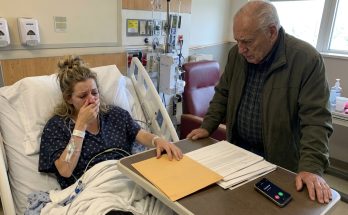
I was in labor with an 11-pound baby, but my doctor husband refused to allow a C-section. He insisted I deliver naturally because he believed I had humiliated his female resident. When it was finally over, he walked into the delivery room… He panicked then collapsed.
Chapter 1: The Second Opinion Nobody Ordered
My husband invoked another woman’s name while I was in labor, which was not the sort of anniversary gift I had expected from the father of my child.
“Claire, you are progressing,” Nathan said, standing at the foot of my hospital bed with the composed expression of a man explaining gravity to a particularly argumentative pigeon. “You are tired. That does not automatically mean surgery is the right choice.”
A contraction tightened across my abdomen and climbed upward until my ribs felt like they had been cinched with industrial cable. I gripped the bed rail and stared at the ceiling tiles. The one above me had a faint brown mark in the corner, shaped like Florida if Florida had been assembled by someone working from memory.
When the contraction passed, I opened my eyes.
“I didn’t say it automatically meant surgery,” I said.
Nathan glanced at the fetal monitor, though he had already been watching it for most of the night. “You said you wanted them to reconsider a C-section.”
“I want them to reconsider a C-section.”
“That is not the same as there being a medical indication.”
“I understand the difference.”
“Do you?”
His question sat between us with the quiet confidence of an object that had been placed there deliberately.
Dr. Priya Shaw, the attending physician, was reviewing my chart near the sink. Monica Reyes, the charge nurse, stood beside the monitor with one hand resting on the counter. Neither of them moved. In a hospital, silence is rarely empty. It is usually a form of documentation waiting to happen.
Another contraction began.
Nathan stepped closer. “Claire, I need you to trust the process.”
“I trust the process. I don’t trust the way you’re talking to me.”
His jaw tightened. It was a small movement, barely visible, but I had been married to him for seven years. I knew his jaw. I knew what it did when a resident contradicted him, when an insurance company denied a claim, when someone parked too close to his car, and when he was trying not to say something that would make him look as unreasonable as he felt.
“This cannot become another Leah situation,” he said.
For a second, I forgot the pain.
Leah.
Of all the things I expected to hear while I was in labor, the name of Dr. Leah Foster was not among them. I stared at Nathan, waiting for him to recognize what he had done and take the words back. He did not.
“What does Leah have to do with this?” I asked.
He looked away first.
That was when I understood that the problem was no longer whether my labor was progressing. The problem was that Nathan had brought an old grievance into a delivery room where I was supposed to be his wife, not a witness under cross-examination.
“I asked a question,” I said.
“Claire, this is not the time.”
“It became the time when you said her name.”
Priya turned from the chart. “Nathan, I need to have the medical conversation with Claire.”
“I’m not interfering.”
He said it with the serene conviction of a man standing in the middle of a hallway while insisting he was not blocking anyone.
I pushed myself higher against the pillows. My body was exhausted, my hair was damp against my neck, and a blood-pressure cuff had inflated around my arm so many times that it felt less like medical equipment and more like a small, judgmental animal.
“I want Nathan out of the conversation,” I said.
He looked at me as though I had slapped him.
“Claire.”
“I want to hear from Dr. Shaw.”
“You’re angry.”
“I’m in labor.”
“You’re also upset.”
“I am allowed to be both.”
Priya came to the bedside. “Nathan, let me answer her.”
He stepped back, but not far enough to disappear. He remained within reach of every sentence, every concern, every decision. His presence occupied the room like a second oxygen tank.
Priya explained what they were watching. The baby was large by ultrasound estimates, although no estimate was precise enough to be treated as a photograph. My labor had slowed. The fetal heart tracing was still reassuring, but the baby remained higher than they wanted. There was no immediate emergency, but there was enough uncertainty to justify another conversation.
“If your exhaustion continues and we don’t see meaningful progress,” Priya said, “we will reassess. That may include operative delivery. Right now, we still have options.”
“I want to know what would make you recommend surgery.”
“We would consider your cervical change, the baby’s position, the fetal heart rate, your condition, and whether continuing labor remained safer than delivering surgically.”
Nathan folded his arms.
I looked at him. “Is there something you want to add?”
“No.”
“Then please stop making faces every time I ask a question.”
His eyebrows lifted. “I’m making faces?”
“You’re doing the professional version of sighing.”
“I’m trying to remain calm.”
“You’re trying to make everyone think I’m pressuring them.”
“I have not said that.”
“You said this could become another Leah situation.”
Priya’s eyes shifted to him. “What does that mean?”
Nathan’s expression hardened. “It means we need to be careful that a patient’s anxiety does not turn into pressure on the medical team.”
The room became very quiet.
The monitor continued its rhythmic beeping. Somewhere in the hallway, a cart rolled past with a squeaking wheel. It squeaked three times, paused, and squeaked again, as though even the cart had developed a grievance.
I looked at Priya. “I want him out.”
Nathan’s face changed. The professional composure vanished first. Beneath it was hurt, then indignation, then the familiar instinct to explain why my decision was not actually what it appeared to be.
“Claire, you don’t mean that.”
“I do.”
“You’re making a decision while you’re exhausted.”
“I am making a decision because I am exhausted.”
“That is exactly what I mean.”
“No,” I said. “You mean that if I make a decision you dislike, it must have been produced by exhaustion, fear, or manipulation. You have a diagnosis for every opinion I have except the possibility that I know what I’m saying.”
Priya’s voice remained even. “Nathan, she has asked you to leave.”
“I’m her husband.”
“Yes.”
“I’m also an obstetrician.”
“Yes,” Priya said. “And that is becoming part of the problem.”
The words landed with the clean finality of a door locking.
Nathan stared at her. Then he looked at me. For seven years, I had known the shape of his anger. It was not loud. Nathan did not throw things or raise his voice. His anger became administrative. He stopped making eye contact. He spoke in short, polished sentences. He behaved as though the person who had upset him had become a poorly designed policy that needed revision.
“Fine,” he said.
He walked out.
The door closed behind him.
I began to cry, though not dramatically. Tears moved sideways into my hair. Monica handed me a tissue without saying anything. Priya waited.
“I’ve just asked my husband to leave the birth of his son,” I said.
“You asked someone who was making it harder for you to participate in your own care to step out,” Priya replied. “Those are not necessarily the same thing.”
Outside the room, footsteps moved away.
I thought that would be the end of the matter. I thought the labor would proceed, the baby would arrive, and the fight over Leah would eventually become something we discussed in a therapist’s office with neutral furniture and a bowl of decorative stones.
I was wrong about all three.
Because less than an hour later, the monitor changed.
And this time, no one had to explain to me that the room was no longer debating my fear.
It was responding to danger. Pages: 1 2 3