MY HUSBAND LAUGHED WHEN HIS FAMILY MOCKED MY POSTPARTUM BODY—THEN I FOUND THE “TRANSFORMATION CONTRACT” HE SIGNED IN MY NAME
PART 1 — DAY ZERO
My sister-in-law asked when I planned to get my body back six weeks after I delivered triplets.
My husband laughed—and told twelve relatives he had already bought me a solution.
The worst part was that the dinner was happening in my house.
Grant had invited his parents, his sister Tessa, his brother, two aunts, and enough cousins to fill every chair we owned. He had told me about it the night before, while I was warming a bottle with one hand and trying to soothe our daughter Nora with the other.
“It will be good for you to see people,” he had said.
What he meant was that it would be good for him to show off our six-week-old triplets without doing any of the work required to host twelve adults around them.
My name is Laurel Mercer. I was thirty-five, on maternity leave from my job as a claims operations supervisor, and measuring my days in three-hour feeding cycles. Nora, Owen, and Eli were healthy and safe, but they had been born at thirty-five weeks. Each bottle had to be tracked. Each diaper had to be logged. Our pediatrician wanted weekly weight checks until all three babies were firmly on their growth curves.
I was also recovering from abdominal separation, pelvic-floor weakness, and the kind of exhaustion that made me put my phone in the refrigerator twice.
Grant called it “being home.”
At five-thirty, he came upstairs while I was buttoning a loose blue dress over the soft compression shorts my physical therapist had recommended.
He leaned against the bedroom door and looked me up and down.
“Is that what you’re wearing?”
I stopped with one button between my fingers. “It is clean, it fits, and there is no formula on it. So yes.”
“I just thought you might wear the green dress.”
“The green dress hasn’t fit since my second trimester.”
“Right.” He glanced away too quickly. “I forgot.”
He had not forgotten. The green dress had been hanging on the outside of my closet door for four days.
Downstairs, our eight-year-old daughter, Piper, had arranged three battery-powered candles in the center of the dining table because Grant’s mother disliked “harsh overhead lighting.” Piper was old enough to notice when adults were unkind and young enough to believe it was her job to soften the room afterward.
“You look pretty, Mom,” she said when I came down.
“Thank you, sweetheart.”
Grant carried one casserole from the kitchen and accepted compliments as if he had cooked the entire meal. In reality, I had ordered the food from a local postpartum meal service using a gift certificate from my older sister, Mara. I had plated everything because Grant said foil containers looked cheap.
For the first twenty minutes, the conversation stayed on the babies. Who had the most hair. Which one looked like Grant. Whether Owen’s nose came from the Mercer side.
Then Nora stirred in the portable bassinet beside me, and I bent carefully to lift her.
Tessa watched me stand.
“So,” she said, swirling the ice in her glass, “when are you planning to get your body back?”
The table went quiet in that special way a room does when everyone knows something cruel has been said but no one wants to surrender the entertainment by objecting.
I settled Nora against my shoulder. “I didn’t realize it had gone anywhere.”
Grant’s brother coughed into his napkin.
Tessa smiled. She was forty, polished, and marketing director for ForgeWell Fitness, a chain of expensive gyms with eucalyptus towels and membership fees that required financing.
“You know what I mean,” she said. “You used to be so tiny.”
“She carried three babies,” Piper said.
My mother-in-law, Evelyn, gave her a warning look. “Adults are talking.”
Then she turned to me.
“Tessa is only concerned. When I had Grant, I was back in my old slacks before my six-week checkup.”
“You had one baby,” I said.
“And I didn’t make excuses.”
Nora gave a small sigh against my shoulder. I stared at the pale fuzz along the crown of her head and reminded myself that she was safe, fed, and loved. I reminded myself that the people at the table did not get to define the body that had brought her here.
Then Grant laughed.
It was not a nervous laugh. It was the easy, conspiratorial sound he used with coworkers when someone made a joke at another person’s expense.
“Everybody relax,” he said. “I’ve already handled it.”
I looked at him. “Handled what?”
“Your comeback.”
Tessa raised her eyebrows. Evelyn smiled.
Grant pointed his fork at me as if he were announcing a vacation he had booked.
“Monday morning,” he said. “No more excuses.”
“What happens Monday morning?”
He took another bite of potatoes. “It’s a surprise.”
The conversation moved on, but something inside me did not.
Twenty minutes later, Eli needed a bottle. Grant was telling his uncle about a corporate wellness proposal at work, so I fed Eli while I ate with my free hand. When I asked Grant to bring me the burp cloth from the counter, he said, “In a minute,” without looking away from his uncle.
His mother brought it instead.
“You know,” Evelyn murmured, “moving around more would probably help your energy.”
I almost laughed at the absurdity of telling a woman caring for three newborns that she did not move enough.
After dessert, Grant posed beside the bassinets while everyone took pictures. When I stepped into one photo, he said, “Let’s get one of just me and the babies first.”
Piper heard him.
I saw it in her face.
She came to stand beside me and slipped her hand into mine.
Advertisement
By nine-thirty, the relatives were gone. Grant stacked plates beside the sink and announced that he had an early meeting.
“You’re leaving this?” I asked.
“I loaded the dishwasher last time.”
“Six days ago.”
He kissed the air beside my cheek. “Try to sleep when the babies sleep.”
Then he went upstairs.
I was wiping mashed potato from beneath Piper’s chair when my phone buzzed. Grant had left the Mercer family group chat open on the shared tablet, and its notifications mirrored to my screen.
There was a photograph of me bending over Nora’s bassinet.
The angle emphasized the curve of my stomach beneath the blue dress. My face was turned away. I had not known anyone was taking it.
Grant had sent it at 6:14, while I was serving his family dinner.
His caption read:
Day Zero. Monday we begin.
Tessa had responded with a flexed-arm emoji.
Grant’s brother had written, You’re brave, man.
Evelyn had added, She will thank you eventually.
I stood in my kitchen with a damp cloth in one hand and felt something colder than embarrassment settle inside me.
Piper appeared in the doorway wearing her purple pajamas.
“Mom?”
I locked the tablet and turned it facedown.
“Why aren’t you in bed?”
She twisted one pajama sleeve around her wrist. “Is your body bad now?”
The question nearly broke me.
I crouched carefully so we were eye to eye.
“No. My body is healing. Healing and bad are not the same thing.”
“Aunt Tessa made it sound bad.”
“Aunt Tessa was wrong.”
Piper studied my face. “Dad laughed.”
“Yes,” I said, because I would not teach my daughter to pretend she had not seen what she had seen. “He was wrong too.”
I tucked her back into bed, fed Owen at midnight, Nora at twelve-twenty, and Eli at twelve-forty-five. Grant slept through all three alarms.
At 8:00 Monday morning, the doorbell rang.
I opened the door expecting a package.
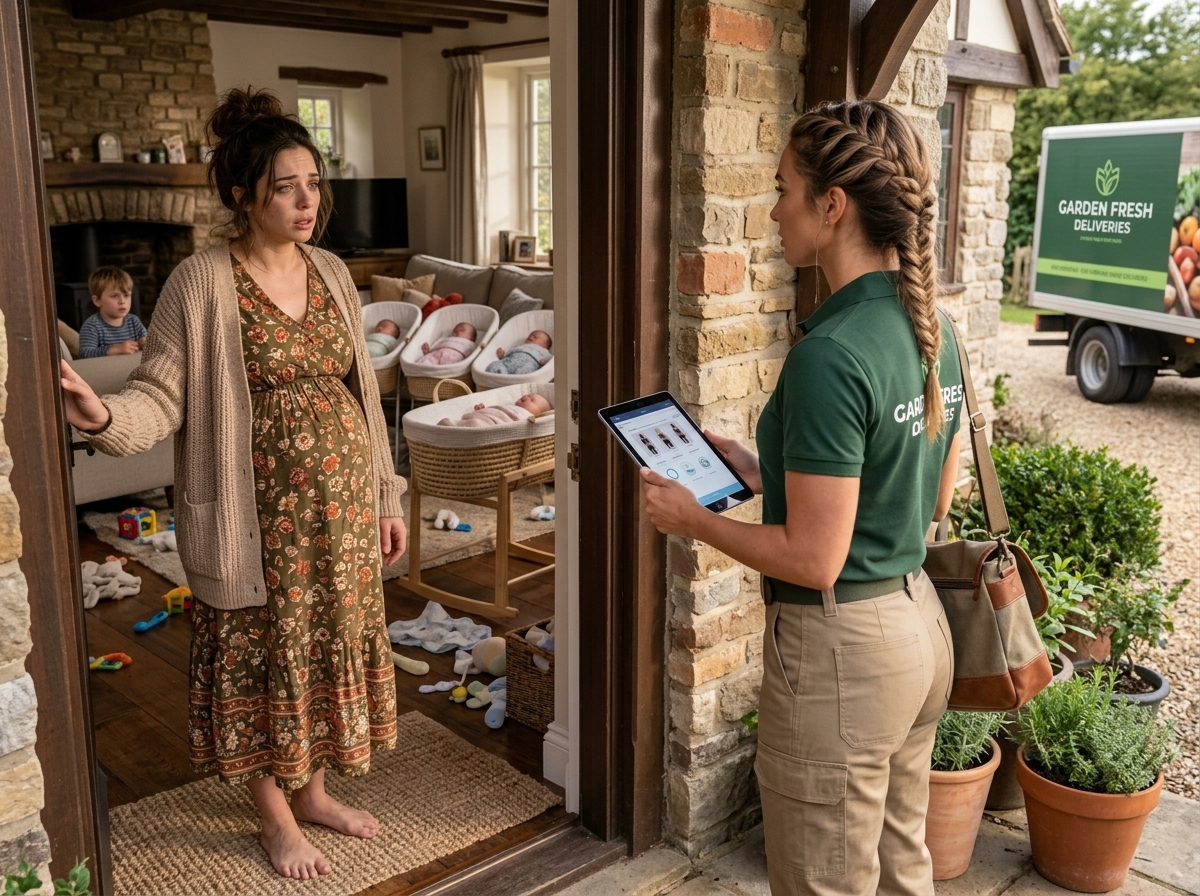
A woman in black athletic clothes stood on the porch beside a rolling photography case. She held a tablet with the ForgeWell logo across the screen.
“Laurel?” she asked brightly. “I’m Hannah, your transformation coach.”
Behind her, a photographer lifted two folded studio lights from the trunk of a car.
Hannah smiled.
“Your husband said we should start with the before pictures while the babies are sleeping.”
PART 2 — THE GIFT
I did not let them cross the doorway.
“There won’t be any pictures,” I said.
Hannah’s smile disappeared. “I’m sorry?”
“I didn’t schedule this. I didn’t hire you, and I did not agree to be photographed.”
The photographer stopped halfway up the walk.
Hannah looked at her tablet, then back at me. She was probably in her early thirties. There was nothing mocking in her face now—only confusion.
“I have a signed enrollment and media consent,” she said. “The notes say your husband arranged the timing because this was a surprise gift.”
“The surprise is that I know nothing about it.”
Nora began fussing in the living room. Hannah heard her and lowered her voice.
“Then we’re not coming inside.”
That immediate answer made me trust her more than I had expected.
She told the photographer to wait by the car and turned her tablet so I could see the appointment page. At the top was my name. Beneath it were the words Twelve-Week New Mother Transformation Pilot.
The status line said Participant confirmed.
“I didn’t confirm anything.”
“I believe you.” Hannah tapped the screen. “I’m going to mark the session as declined pending consent review. Would you like our membership office to contact you directly?”
“I want copies of everything with my name on it.”
“I’ll request them.”
Grant came down the stairs as they were leaving. His hair was damp, and he was fastening the cuff of a white shirt.
“What happened?” he asked.
Hannah glanced at me. “Mrs. Mercer has declined today’s session.”
Grant looked past her at the photography equipment. “We paid for the launch package.”
“Consent has to be voluntary at the time of the session,” Hannah said. “Someone from membership will follow up.”
He waited until their car pulled away before closing the door.
“Do you understand how embarrassing that was?” he asked.
“For you?”
“For both of us. Tessa squeezed you into a pilot program that already has a waiting list.”
“I didn’t ask to be squeezed into anything.”
“It was a gift.”
“A gift does not arrive with a photographer to document the part of my body you dislike.”
His jaw tightened. “This is exactly why I wanted professionals involved. You turn every conversation about your health into an attack.”
“My doctor is involved in my health. You, your sister, and a photographer are not.”
He checked his watch.
“I cannot do this right now. I have a pitch meeting at nine.”
“Of course you do.”
“We’ll talk tonight.”
He picked up his laptop bag and left.
At ten-thirty, a courier delivered a long white box tied with silver ribbon. Inside was a fitted green dress.
Not the old green dress from my closet. A new one.
Two sizes smaller than anything I had worn before pregnancy.
A card lay on top.
For the christening. Something to work toward. Love, Grant.
I was still holding the card when Mara arrived with coffee and a bag of diapers. She took one look at my face and put everything down.
“What did he do?”
I showed her the dress, the card, and the photograph from the family group chat.
My sister did not speak for several seconds.
Then she folded the tissue paper over the dress as carefully as if she were covering something contaminated.
“Please tell me there is a reasonable explanation for the photographer.”
“He bought me a transformation program.”
“Six weeks after you gave birth to three human beings.”
“Apparently there was a waiting list.”
Mara sat beside me on the couch. “Laurel, this isn’t clueless. Clueless is buying the wrong flowers. This is organized.”
Her word stayed with me.
Organized.
While she watched the babies, I opened our bank app.
Grant and I kept a joint checking account for household expenses and several labeled savings accounts. One of them was called Leave Reserve. I had built it with two annual bonuses so we could cover our health insurance deductible, formula, and extra help during my unpaid weeks of maternity leave.
The balance was $3,840 lower than it should have been.
The transfer description read ForgeWell Fitness—Annual Transformation Package.
There was also a pending $420 charge from a nutrition company I did not recognize.
I called Grant.
He declined the first call and answered the second.
“I told you we’d talk tonight.”
“You took $3,840 from the leave reserve.”
“For your health.”
“That money was for the babies and my medical deductible.”
“It is marital money, Laurel.”
“Then why didn’t your half of the marital partnership get a vote?”
He exhaled slowly. I could hear office voices behind him.
“The program is refundable after you complete the campaign. We get the membership at no net cost.”
“What campaign?”
There was a pause.
“Tessa is trying a small local promotion. Nothing has been finalized.”
“A photographer showed up at our house. That sounds finalized.”
“I have to go.”
“Did you also order something from BrightPlate Nutrition?”
“It is part of the package. I canceled your other meal delivery because the menus were too heavy.”
For one second, I could not speak.
The postpartum service Mara had given me delivered soups, grain bowls, protein-rich breakfasts, and freezer meals. My obstetrician had reviewed the sample menu and called it sensible. More importantly, it meant I could eat while caring for three infants.
“You canceled food that was already paid for?”
“You can still eat. BrightPlate sends measured portions.”
“It sends five lunches a week. What am I supposed to eat the rest of the time?”
“We have groceries.”
“You mean the groceries I buy and cook?”
“You are being dramatic.”
Then he hung up.
Mara found me staring at the dark phone.
“You and the babies can come stay with me,” she said.
“I’m not leaving my house today.”
“Then I’m staying here today.”
That afternoon, I began documenting everything. I saved the group-chat photograph, the bank transfer, the nutrition charge, and the gift card attached to the dress. I changed the password on my patient portal and banking profile. Then I called the meal service and restored the deliveries using my own card.
At four-fifteen, an email arrived from ForgeWell.
Welcome to the New Mother Transformation Pilot.
Below my name were five green check marks:
Annual membership paid.
Nutrition plan enrolled.
Media release signed.
Medical questionnaire completed.
Physician clearance confirmed.
I read the final line three times.
My six-week postpartum appointment was not until Friday.
No physician had cleared me for anything.
PART 3 — THE PLAN HE HID
Dr. Priya Patel called me personally the next morning.
“You are not cleared for a high-intensity exercise program,” she said. “We have never provided ForgeWell with a letter, form, or verbal approval.”
I sat at the kitchen table while Mara gave Owen a bottle nearby. My body felt cold even though sunlight was pouring through the windows.
“Could Grant have requested something through my portal?” I asked.
There was a short silence.
“A message was sent from your account nine days ago,” Dr. Patel said carefully. “It requested cancellation of your pelvic-floor physical therapy referral because you had ‘decided to pursue private fitness coaching instead.’ Did you send that?”
“No.”
My eyes went to the shared tablet charging beside the coffee maker.
During my pregnancy, I had used it to check test results. Grant knew the passcode, and until the day before, the portal password had been saved.
“Can the message history be preserved?” I asked.
“Yes. I’m also documenting today’s call. We can restore the referral, and I want you to keep Friday’s appointment. If anyone asks you to exercise before then, your answer should be no.”
“Thank you.”
“Laurel,” she added, “recovery is not a deadline. You delivered three babies six weeks ago. Your priorities are healing, adequate nutrition, rest where possible, and follow-up care. Weight loss is not your assignment right now.”
I pressed my fingers against my eyelids.
Those were almost the exact words I remembered from the hospital.
Grant had been standing beside my bed when Dr. Patel gave us the discharge instructions. He had nodded. He had asked whether I could climb stairs. He had carried the blue folder containing my recovery plan to the car.
I had not seen it since.
After the call, I checked the basket where we kept medical paperwork. The babies’ pediatric summaries were there. My insurance explanation of benefits was there. The blue folder was not.
“What are you looking for?” Mara asked.
“The plan Dr. Patel gave me when I left the hospital.”
We searched the kitchen desk, the nursery shelves, my nightstand, and the folder where Grant kept tax receipts.
Nothing.
At noon, Tessa called.
“Grant says you had some kind of misunderstanding with Hannah.”
“There was no misunderstanding. I never enrolled.”
“He told me you wanted help feeling like yourself again.”
“Did I ever tell you that?”
“Not directly.”
“Then why did you mock my body at dinner?”
She sighed as if I were exhausting her.
“Grant said you respond better when people are blunt. He said you two had agreed on accountability.”
I gripped the edge of the counter.
“Your version of accountability was humiliating me in front of my daughter?”
“Piper should have been upstairs.”
“Piper lives here.”
“I’m not trying to fight with you. This pilot could be a wonderful opportunity. Real mothers are tired of impossible fitness models. Your story would be relatable.”
“My story belongs to me.”
“Of course it does.”
“Then remove it from your campaign.”
Another silence.
“I can pause the photography,” she said. “But Grant signed a paid contract. Cancellation has to go through membership and legal.”
“I didn’t sign it.”
Her voice changed slightly. “He submitted an electronic signature under your name.”
“That is not the same sentence.”
“I need to call him.”
“Send me every document first.”
“Laurel—”
“Every document with my name, medical information, photograph, or signature. Today.”
I ended the call before she could refuse.
Grant came home at six carrying a digital bathroom scale.
He set the box on the kitchen island.
“This syncs with the ForgeWell app,” he said. “It tracks trends, not just weight.”
Mara was still there. She stared at him.
“You bought your wife a surveillance device?”
“I bought my wife a tool.”
“Take it back,” I said.
He ignored me and opened the refrigerator.
“Where did this soup come from?”
“I restored the meal delivery.”
He shut the refrigerator harder than necessary. “So now we’re paying twice because you refuse to try the plan?”
“We are paying twice because you canceled food without asking me.”
“I was trying to help.”
“You accessed my medical portal.”
His back went still.
Mara looked from him to me.
“You canceled my physical therapy referral,” I continued. “You sent a message pretending to be me.”
Grant turned around. “I canceled one appointment because it conflicted with the assessment.”
“You told the clinic I had chosen private coaching instead.”
“It was easier than explaining the whole program.”
“You mean your program.”
“Our program.”
“There is no ‘our’ in something I did not choose.”
For a moment, the only sound in the room was the gentle hum of the bottle warmer.
Then Grant looked at Mara.
“Could you give my wife and me some privacy?”
Mara folded her arms. “Could you stop making decisions about my sister’s body while she is feeding your children?”
“This is a marriage issue.”
“It became a family issue when you invited your family to shame her.”
I touched Mara’s arm. “I’m okay.”
She studied my face, then gathered her purse.
“Call me,” she said. “For any reason.”
After she left, Grant took his laptop bag upstairs and locked himself in the home office.
He did not come down for dinner. He did not help with the seven-o’clock bottles. At eight, he texted me from the second floor asking if I had seen his gray charging cable.
At nine, after all three babies were asleep, I went looking for it—not for him, but because the home office also held our printer and filing cabinet.
Grant had left the door open when he went to shower.
His laptop was locked. The filing cabinet was not.
The blue hospital folder lay beneath a stack of ForgeWell brochures in the bottom drawer.
Inside was my original recovery plan.
The first page included Dr. Patel’s instructions in bold:
No calorie restriction during early recovery.
No high-impact or high-intensity exercise until postpartum evaluation.
Continue pelvic-floor physical therapy and abdominal rehabilitation.
Grant had highlighted none of those lines.
Tucked behind the recovery plan was a ForgeWell medical questionnaire dated nine days earlier.
Someone had checked No beside abdominal separation.
Someone had checked No beside pelvic-floor symptoms.
Someone had checked Yes beside the statement confirming that I had consulted my physician and received approval to participate.
At the bottom of the page was my name in an electronic script font.
Laurel Mercer.
I had never completed the form.
I had never seen it.
And beneath the signature was the device information used to submit it.
Grant’s work email address.
PART 4 — THE CAMPAIGN
I photographed every page before putting the folder back exactly where I had found it.
Then I emailed the copies to myself, Mara, and a new cloud folder Grant could not access.
I did not confront him that night.
That surprised me.
For years, I had believed honesty meant addressing a problem immediately. If Grant hurt my feelings, I told him. If I made a mistake, I apologized. I thought a marriage stayed healthy when nothing dangerous was allowed to grow in silence.
But Grant had used my honesty as advance notice. Every time I objected, he changed the wording of what he had done until I sounded unreasonable.
So I stopped giving him time to prepare.
At 8:12 the next morning, Hannah emailed me a secure link containing the entire ForgeWell file.
Twenty-seven pages.
The annual membership was only the beginning.
The New Mother Transformation Pilot required three gym sessions and two recorded home check-ins each week. It included nutritional monitoring, weekly weigh-ins, access to health-app data, and permission to film “authentic domestic moments relating to the participant’s wellness journey.”
The media release granted ForgeWell permission to use my name, voice, pregnancy history, and before-and-after images in digital advertisements for five years.
The stated target was thirty pounds in twelve weeks.
My stomach turned when I opened the image folder.
The first photograph was the one from dinner—the image of me bending over Nora’s bassinet in the blue dress.
The second had been taken outside the hospital on discharge day. I was sitting in a wheelchair holding a diaper bag while Grant stood behind me with the infant carriers. I remembered thinking he had been taking a picture of all five of us.
He had cropped himself and the babies out.
Only I remained: pale, swollen, and four days postpartum beneath the unforgiving hospital entrance lights.
The file name was BEFORE_OPTION_A.
I closed the laptop and ran to the bathroom.
I did not get sick. I stood over the sink until my breathing slowed, then looked at myself in the mirror.
My stomach was softer than it had been. A purple line still ran beneath my navel. My breasts were sore. My eyes looked older than they had two months ago.
But behind the closed bathroom door, I could hear Nora making the small chirping sounds she made before waking.
This body had carried her.
It had carried Owen and Eli beside her.
It had endured months of monitoring, a complicated delivery, and six weeks of waking for three separate feeding schedules.
Grant had looked at the same body and seen an opening slide.
When I returned to the laptop, there was another email from Hannah.
I want to be clear that I did not know you had not personally consented. I have escalated the file to our compliance director. No photography or publication is authorized while the review is open.
She had also included part of the internal email chain.
Tessa had written three weeks earlier:
If Laurel genuinely wants to participate, her story could anchor the pilot. We need her direct confirmation before any filming.
Grant replied:
She is completely on board but self-conscious on camera. Let me handle the forms and scheduling so she doesn’t talk herself out of it.
Tessa answered:
I still need a signed release and verbal reconfirmation on shoot day.
Grant’s final response was one word.
Handled.
Tessa had been cruel at dinner. She had participated in the pressure and was willing to benefit from my humiliation. But the emails proved she had not known he signed my name.
Grant had lied to her too.
Attached to the campaign proposal was a deck bearing the logo of Whitaker Benefits, Grant’s employer. I opened it.
The title read:
ForgeWell Corporate Partnership: Wellness That Begins at Home.
Grant was an account director at Whitaker, and he had spent the past year competing for a senior regional position. ForgeWell wanted access to Whitaker’s employer clients. Whitaker wanted a wellness vendor that could produce measurable engagement.
Grant had offered them a personal success story.
Us.
One slide showed our wedding photograph beside a stock image of a fit couple jogging with a stroller.
Another described me as “a previously active working mother seeking structured accountability after a high-risk multiple birth.”
The final slide promised a twelve-week transformation campaign that would launch before Whitaker’s annual benefits conference.
If the partnership closed, Grant would receive a performance bonus and become the leading candidate for the senior director job.
The program was not a gift.
I was part of his pitch.
The babies woke almost together, and for the next hour I changed diapers, warmed bottles, and held Nora upright after feeding. Ordinary work. Necessary work. Work Grant had never once put on a presentation slide.
At eleven-thirty, Tessa called again.
This time, her voice was unsteady.
“Did Grant sign that questionnaire?”
“You have the same documents I do.”
“He told me you signed on the tablet.”
“I didn’t.”
“Laurel, I swear I did not know that.”
“You knew I had not spoken to you. You still stood in my dining room and commented on my body.”
“Grant said you asked us to keep you accountable.”
“And you never wondered why my face looked shocked?”
She had no answer.
Then she said, “There is something else.”
My grip tightened on the phone.
“When Grant first proposed using you for the campaign, I told him you might not want your hospital pictures public. He sent me a voice message.”
“What did he say?”
Tessa did not answer immediately.
When she finally spoke, the confidence was gone from her voice.
“He said if the family made you see how bad you looked, you would be easier to convince.”
The story continues—click the Next button below to read the next part.
PART 5 — WHAT HE TOLD THEM
“Send it to me,” I said.
Tessa hesitated. “Grant will know it came from me.”
“He used you to humiliate me, used my body to build your campaign, and signed my name after you told him you needed consent. Why are you still protecting him?”
“I’m trying to protect my job.”
“So am I. I am supposed to return to work in ten weeks. Do you know what happens if images of me leaving the hospital appear in a public weight-loss campaign? Do you know what happens when clients search my name and find my medical history turned into advertising?”
Tessa was quiet.
“Send me the message,” I repeated.
It arrived four minutes later.
Grant’s voice came through my phone, cheerful and impatient.
“She’s sensitive right now. If everyone treats the program like it’s already decided, she’ll go along with it. Honestly, once she sees the pictures and hears the family say it, she’ll realize how bad it’s gotten. Then she’ll be motivated.”
I listened twice.
Not because I had misunderstood, but because the first time I could not absorb the casual certainty in his voice.
The dinner had not gone wrong.
It had gone exactly as Grant intended.
He had told his family that I needed blunt accountability. He had left the green dress where I would see it. He had taken the photograph before Tessa asked her question. Then he had sat at the table and watched his plan work.
At noon, I had a video call with Denise Holloway, a family-law attorney Mara knew through her employer. I took the call from the bedroom while Mara stayed downstairs with the babies.
Denise was in her late fifties, with silver-framed glasses and a voice that made every sentence sound organized.
I told her about the money, the medical portal, the contract, and Grant’s use of my photographs. I expected her to tell me I was moving too quickly by contacting a divorce lawyer before confronting my husband.
She did not.
“You are gathering information,” she said. “That is not the same as making a final decision today.”
“He says the money is marital money.”
“A shared account does not give either spouse permission to impersonate the other person, sign health declarations, or enter them into a commercial agreement.”
She advised me not to drain accounts or block Grant from reasonable access to the children. She told me to preserve the original records, check my credit reports, and create a written log of the babies’ care—not as a competition, but because Grant had already shown he was willing to change the story.
“Do not diagnose him,” she said. “Do not insult him in writing. Do not threaten his employment. Stick to dates, documents, and specific actions.”
“What if he threatens to take the children?”
“Then save the threat and call me.”
After the consultation, I checked my credit. No secret loans or new accounts appeared. Relief moved through me, followed by anger that I had been forced to look.
I placed a free credit alert anyway.
Then I called ForgeWell’s compliance director, Nia Benton.
Nia had already frozen the campaign file. She asked me to confirm which photographs I had knowingly provided.
“None,” I said.
“Did you authorize your husband to complete the health questionnaire?”
“No.”
“Did anyone from ForgeWell speak with you before Monday?”
“No.”
She paused. “The trainer did the right thing by ending the session. No images will be published while we investigate. I also want you to know that our standard policy requires direct participant verification. That step was marked complete, but we have not found a call recording or confirmation email from you.”
“Who marked it complete?”
“I can’t give you personnel findings before the review is finished. But we are preserving the audit trail.”
Tessa had ignored warning signs. Grant had lied. Someone inside ForgeWell had clicked a box that should never have been clicked.
For the first time, however, people outside my marriage were preserving evidence instead of asking me to accept his explanation.
That afternoon, my phone filled with messages from Grant’s family.
His aunt sent a link about exercise improving postpartum mood.
His brother wrote, Grant is under a lot of pressure. Maybe don’t blow up a good opportunity over hurt feelings.
Evelyn called twice before leaving a voicemail.
“Grant says you are struggling with postpartum depression and have become suspicious of everyone. We are not judging you, Laurel. We want to help you make rational decisions until you feel like yourself again.”
I played the message for Mara.
Her face hardened. “Did any doctor diagnose you?”
“No.”
I had completed the postpartum mental-health screenings at the hospital and pediatric office. I had answered honestly. I was exhausted, angry, and hurt. None of those emotions made me incapable of understanding a bank statement or recognizing my own signature.
Grant had discovered the perfect defense. If I objected to what he had done, he would call my objection a symptom.
I saved the voicemail.
Then I sent one message to the family group.
I have not been diagnosed with postpartum depression, and no medical professional has questioned my ability to make decisions. Please do not repeat private medical claims about me. I will discuss the dinner and the ForgeWell contract when I am ready.
Grant called less than a minute later.
“Why would you send that to everyone?”
“Because you told everyone I was mentally unwell.”
“I told my mother you were overwhelmed.”
“She used the words postpartum depression and rational decisions.”
“That is her interpretation.”
“Like the gym contract was my signature? Like the canceled therapy was my decision?”
His voice dropped. “Have you been going through my files?”
“You hid my medical records in your file cabinet.”
“I put them somewhere safe.”
“Under your campaign proposal.”
Silence.
Then he said, “You do not understand what is at stake.”
“I understand exactly what is at stake. Your promotion.”
“My promotion helps this family.”
“You mean the family whose medical information you used without permission?”
“Nothing was public yet.”
The word yet told me everything.
He began speaking faster. Whitaker’s partnership review was in three weeks. The campaign would demonstrate authenticity. The $3,840 was reimbursable if the pilot launched. We would receive a year of family membership. His bonus could cover a night nurse twice a week.
Every benefit arrived after I gave up something first.
My privacy. My recovery plan. My right to say no.
“Withdraw the proposal,” I said.
“I can’t do that without destroying my credibility.”
“Then tell your employer the truth.”
“Laurel, be reasonable.”
I almost admired the word. He had forged my agreement and turned my hospital photograph into an advertising asset, yet reasonableness remained something I owed him.
“I’ll be home at six,” he said. “Mom and Tessa are coming Saturday. We need a family conversation before this gets any worse.”
I looked at the folder of evidence on my screen.
“Perfect,” I said. “Bring everyone who was at the dinner.”
He sounded relieved. “Good. Once they explain—”
“And Grant?”
“What?”
“Bring your laptop.”
PART 6 — THE FAMILY CONVERSATION
Grant believed Saturday’s gathering was an intervention for me.
I treated it like a meeting.
Mara took Piper to a movie with her own children. The triplets remained at home with us, safe in their bassinets in the adjoining family room. I kept the baby monitor beside my folder and asked Mara’s neighbor, a retired maternity nurse named Celeste, to sit with them during the conversation.
At two o’clock, Evelyn arrived carrying a chicken casserole and the expression of a woman prepared to forgive someone who had not apologized.
Tessa came alone. She would not meet Grant’s eyes.
Grant’s brother and two aunts sat around the same dining table where they had laughed six days earlier. Grant took the chair at the head.
“I appreciate everyone coming,” he began. “Laurel has been under an incredible amount of stress, and I think some things have become distorted.”
“Stop,” I said.
He stared at me.
I placed Dr. Patel’s recovery instructions in the center of the table.
“Before anyone discusses my mental state, you are going to look at the documents.”
Evelyn frowned. “Laurel, no one is attacking you.”
“Last Saturday, you said I was making excuses because my body had not recovered six weeks after delivering triplets. Grant told you my doctor wanted me to lose weight, correct?”
She glanced at him. “He said your doctor was concerned.”
I slid the paper toward her.
“My doctor instructed me not to restrict calories, not to begin high-intensity exercise, and to continue pelvic-floor physical therapy.”
Tessa read over her shoulder.
I placed the portal record beside it.
“Nine days ago, Grant used my account to cancel that therapy and claimed I had chosen private fitness coaching instead.”
“That is not what happened,” Grant said.
“This is the message sent from our tablet.”
“You had already talked about wanting to exercise.”
“I said I wanted to walk around the block without pain.”
“You are twisting private conversations.”
I added the ForgeWell questionnaire.
“This form denies symptoms that are documented in my medical chart and claims I received physician approval. It was submitted with my name and Grant’s work email address.”
One of the aunts put down her coffee.
Grant looked at Tessa. “You knew I was helping with the enrollment.”
“You told me she signed on the tablet,” Tessa said.
“She asked me to handle the paperwork.”
“No,” I said. “I did not.”
He turned to his mother. “This is what I mean. She is taking routine things couples do for each other and making them sound sinister.”
“Then let’s discuss the routine photography.”
I placed the two images on the table.
No one spoke when they saw the cropped hospital photograph.
Evelyn picked it up slowly. “This was the day you came home?”
“Four days after I delivered your grandchildren.”
Her face changed.
“Grant told us you had chosen the pictures,” his brother said.
“I didn’t know they existed.”
I showed them the campaign slide describing my pregnancy, the media release, and the thirty-pound target. Then I opened the bank statement showing the $3,840 taken from our leave reserve.
“That account was supposed to cover medical care, formula, and unpaid leave,” I said. “Grant used it to purchase a program I did not request so he could include me in a business proposal.”
Evelyn looked at her son. “Is that true?”
“The money would have been reimbursed.”
“That was not her question,” Tessa said.
Grant pushed his chair back. “Do not pretend you are innocent. You wanted the campaign.”
“I wanted a consenting participant,” she said. “You lied to me.”
“You made the comments at dinner.”
“Because you said Laurel had asked for accountability.”
I looked at her. “And that made it acceptable?”
Tessa’s face reddened. “No.”
“My daughter asked me that night if my body was bad.”
Evelyn closed her eyes.
Tessa whispered, “I’m sorry.”
“Piper is eight. She watched every woman at this table teach her that giving birth makes a woman’s body a public problem.”
No one defended themselves.
Then I played Grant’s voice message.
His own words filled the dining room.
If everyone treats the program like it’s already decided, she’ll go along with it.
When the recording ended, Grant stared at Tessa.
“You sent her that?”
“You used me,” Tessa said.
“I was trying to motivate my wife.”
“You were trying to frighten me into compliance,” I said. “You wanted the people closest to me to make me ashamed enough to become useful to your pitch.”
“That is ridiculous.”
“Then why did you call the dinner ‘Day Zero’ before anyone said a word?”
Grant looked around the table for support.
None came.
Evelyn’s hands were trembling around the hospital photograph.
“You told me her doctor said the extra weight was making her recovery worse,” she said.
“I said she would recover better if she were active.”
“You told me she refused therapy because she was lazy.”
“I never used that word.”
“You didn’t have to,” I said. “You gave everyone a version of me they could feel justified punishing.”
The baby monitor crackled. Eli was beginning to wake. I glanced toward the family room, but Celeste’s voice came softly through the speaker as she soothed him.
Tessa’s phone rang.
She looked at the screen and stood. “It’s Nia.”
She answered in the hallway. We heard only fragments of her side of the conversation.
“Yes.”
“I understand.”
“Immediately?”
“No, I won’t access the file.”
When she returned, her face had lost its color.
“I’ve been removed from the pilot pending investigation,” she said. “The whole campaign is suspended.”
Grant stood so quickly his chair scraped the floor.
“Fix it.”
Tessa stared at him. “You submitted a false health declaration.”
“It was a participant questionnaire, not a medical record.”
“You used Whitaker’s email and attached the campaign to your employer’s proposal. ForgeWell has to notify Whitaker’s compliance office.”
Grant’s expression changed for the first time.
Until then, he had been angry. Now he looked afraid.
“You can’t do that,” he said.
“I’m not doing it. Legal is.”
His phone buzzed on the table.
The email preview showed a subject line from Whitaker’s human resources department:
Mandatory Meeting—ForgeWell Partnership Review.
Grant looked at me as if I had sent it.
“Are you happy now?”
“No.”
“You may have destroyed my career over a fitness program.”
“You risked your career when you signed my name.”
His mother said, “Grant, sit down.”
He ignored her.
“If you turn this into a separation,” he said to me, “do not assume you can just take the children. A court will hear how unstable you’ve been.”
Mara’s warning flashed through my mind: save the threat and call me.
But Grant had chosen to make it in front of five witnesses.
Evelyn rose from her chair. “Do not use those babies to frighten her.”
“Mom, stay out of it.”
“You brought all of us into it.”
I closed the folder.
“I’m not taking the children away from their father,” I said. “I am protecting them from a home where their mother’s medical care can be canceled for a marketing deadline.”
Grant’s eyes narrowed. “What does that mean?”
“It means I met with a divorce lawyer on Thursday.”
The room went silent.
“And before you came downstairs,” I continued, “she filed the paperwork for a temporary parenting and financial agreement.”
The story continues—click the Next button below to read the next part.
PART 7 — THE WORK HE NEVER COUNTED
Grant moved into the guest room that night.
On Monday, he rented a furnished apartment ten minutes away. He told his family it was temporary. I did not argue with the word.
Denise negotiated an interim agreement that kept the triplets’ routines stable while giving Grant scheduled parenting time at the house and later at his apartment once it was equipped. Neither of us was permitted to speak negatively about the other to Piper. Household bills continued to be paid from the joint account. The remaining leave reserve could not be touched without written agreement.
Grant objected to the last condition.
“I’m not a criminal,” he told Denise during the conference call.
“Then a written spending agreement should not trouble you,” she replied.
He also demanded equal overnight custody immediately.
Our pediatrician did not oppose his involvement, but she recommended a gradual transition because the babies were still on coordinated feeding plans and Owen needed careful weight tracking. Denise suggested that Grant attend the next medical appointment and demonstrate that he understood the schedule.
He arrived twelve minutes late.
When Dr. Patel asked how much formula Eli usually took at the ten-o’clock feeding, Grant looked at me.
I did not answer for him.
When she asked which baby needed to remain upright longer after a bottle, he guessed Nora.
It was Owen.
Grant’s face reddened. “Laurel usually handles the medical details.”
“Then this is a good time to learn them,” Dr. Patel said.
For his first full Saturday parenting session, he came to the house at eight in the morning. Celeste was present for the first hour to review the feeding log, safe sleep arrangements, bottle preparation, and the signs that would require a call to the pediatrician.
Grant bristled at being supervised.
“I am their father.”
“Yes,” Celeste said. “That is why you need the information.”
I took Piper to breakfast and then to the library. It was the first time since the triplets were born that I had left the house for something other than a medical appointment.
At ten-fifteen, Grant texted asking where we kept the clean burp cloths.
At ten-forty, he wanted to know whether Owen’s bottle should be remade because the first one had been sitting out too long.
At eleven-twenty, he asked why Eli would not settle.
I answered questions related to safety. I did not leave the library.
When Piper and I returned at two, the babies were safe. Two slept in their bassinets while Grant held Nora against his chest. There were six used bottles by the sink, unfolded laundry across the couch, and a cold cup of coffee on the mantel.
Grant looked exhausted.
“They never stop,” he said.
“They’re six weeks adjusted,” I replied. “They aren’t supposed to.”
He glanced around the room. “How do you get anything else done?”
I thought about the dinner for twelve. The plated casseroles. The clean house. The blue dress he had photographed.
“Sometimes I don’t.”
He looked down at Nora.
“I didn’t know.”
“You didn’t ask.”
“I thought being home meant—”
“That I had time.”
He did not finish the sentence.
For one hopeful second, I saw understanding move across his face.
Then he said, “If we tell Whitaker this was a private marital misunderstanding, maybe they’ll reopen the promotion review.”
There it was.
Even his realization had become a path back to his job.
“It was not a misunderstanding,” I said.
“I know I handled it badly.”
“You still want me to change the description so the consequences are easier for you.”
“I am trying to preserve our income.”
“I have an income. And you still have a job for now. The promotion is not our emergency.”
He placed Nora gently in her bassinet.
“What do you want from me?”
“The truth without a sales pitch attached.”
He left without giving it.
The next week brought three separate reviews.
ForgeWell confirmed that the employee who marked my verbal consent complete had relied on an email from Grant instead of contacting me. The company refunded the $3,840, canceled the nutrition subscription, and placed a permanent restriction on my images and personal data while legal prepared a deletion certificate.
Tessa remained employed, but she lost leadership of the pilot. She sent me a written apology that did not contain the word if.
I chose the campaign over the obvious fact that you were uncomfortable. Grant lied to me, but I decided not to ask you directly because your answer might inconvenience me. I am sorry.
I believed she meant it.
I did not tell her that belief restored trust.
Whitaker’s compliance department interviewed me about the proposal. I gave them the documents and answered only what they asked. I did not request Grant’s termination. I did not need to.
The facts were enough.
He had presented his wife as a willing participant without speaking to her. He had used a false health declaration in materials connected to a vendor pitch. He had failed to disclose that the gym’s marketing director was his sister. He had described a private family arrangement as an approved corporate case study.
His promotion was withdrawn, and he was removed from the ForgeWell account pending final review.
Grant blamed Tessa, then ForgeWell’s paperwork, then the employee who had marked the consent box.
He blamed me last because blaming me first no longer worked.
Two days later, Tessa came to the house with a flash drive.
“Compliance found this in the campaign folder,” she said. “Grant uploaded it as a sample testimonial.”
It was a rehearsal video recorded in his car.
Grant looked into the camera and smiled the confident smile he used in presentations.
“Six weeks ago, my wife believed motherhood had cost her the woman she used to be. She needed someone who loved her enough to stop accepting her excuses.”
I paused the video.
That sentence hurt more than the photograph.
Not because it was cruel.
Because he had invented my shame before I ever felt it.
He needed me to hate my body so he could sell the story of saving me from it.
PART 8 — THE BODY THAT STAYED
Four months later, the green dress still had its tags.
For a while, it hung in the back of my closet because I could not decide what to do with it. Throwing it away felt wasteful. Returning it felt like one more errand created by Grant. Wearing it felt impossible for reasons that had nothing to do with size.
Eventually, Piper helped me fold it into a donation box.
“Was that the dress Dad wanted you to fit into?” she asked.
“Yes.”
“Are you giving it away because it’s bad?”
I smiled a little. Children listened even when adults believed a lesson had ended months earlier.
“No. It’s just a dress. But I don’t want it, and I get to choose what I wear.”
She considered that, then placed a sweater she had outgrown on top of it.
“I choose to give this away too.”
By then, Nora, Owen, and Eli were sleeping longer stretches. Owen had caught up on his growth curve. The color-coded feeding chart was no longer taped to the refrigerator, though Grant had taken a photograph of it so he could maintain the routine during his parenting time.
He had learned which baby needed to stay upright, which cry meant hunger, and how quickly three calm infants could produce seven loads of laundry.
Learning did not erase what he had done.
It made him a more capable father, which was good for the children. It did not automatically make him a safe husband.
Our temporary agreement became a formal separation plan. Grant contributed child support, reimbursed the leave reserve for the canceled meal service and unauthorized expenses, and continued individual counseling. We attended co-parenting sessions, not marriage counseling.
He asked once whether that meant I had given up on us.
“It means I am not using family therapy to negotiate whether I deserved consent,” I told him. “That part is not negotiable.”
He nodded.
For the first time, he did not argue.
Whitaker allowed Grant to keep his job after moving him out of partnership sales and placing a formal warning in his employment record. He lost the promotion and the performance bonus. I knew because the change affected his income disclosure, not because I monitored his career.
ForgeWell canceled the New Mother Transformation Pilot entirely. The company sent written confirmation that my photographs, health questionnaire, and campaign materials had been deleted from its active systems. The $3,840 refund went directly back into the leave reserve.
Tessa was reassigned to existing-member communications. She apologized to Piper in person.
“I said something unkind about your mom’s body,” she told her. “I was wrong.”
Piper looked at her for a long moment.
“Grown-ups aren’t supposed to do that,” she said.
“You’re right.”
Evelyn’s apology came later and was harder.
She sat across from me at the kitchen table while the babies napped.
“I was cruel because I believed my son,” she said. “But believing him does not excuse what I said. I should have remembered how vulnerable those first months can be. Instead, I made you feel watched in your own home.”
I thanked her for apologizing.
I did not tell her everything was fine.
She visited the babies according to the boundaries in our parenting agreement. She stopped commenting on my food, clothing, or recovery. When an aunt mentioned weight at a family gathering, Evelyn changed the subject before I had to.
It was not redemption in one speech.
It was better behavior repeated over time.
My own recovery was quieter.
I resumed pelvic-floor physical therapy with the original clinician. The first appointment did not involve a scale. We worked on breathing, posture, and moving without pain. Later, I walked around the block. Then I walked farther.
Some weeks I felt stronger. Some weeks a sick baby or a sleepless night rearranged every plan.
No one photographed the difference.
At my postpartum follow-up, Dr. Patel asked how I felt emotionally.
“Angry less often,” I said. “Clearer more often.”
“Those can both be signs of healing.”
I returned to work on a reduced schedule before resuming full time. My supervisor helped me review health-insurance options, dependent-care benefits, and the cost of adding backup childcare. The practical conversations steadied me. My life was no longer a dramatic campaign with a promised reveal. It was a series of choices I was allowed to make.
On the triplets’ six-month birthday, I booked a family photography session.
I chose the photographer.
I chose the location, a bright studio with cream-colored walls and wide windows. I chose a soft blue dress—not the one from the dinner, but close enough that Piper noticed.
“Blue is your brave color,” she said.
“Maybe blue is just my favorite.”
“It can be both.”
The photographer arranged Nora, Owen, and Eli safely on a padded blanket, then took individual portraits while Piper made faces from behind the camera. At the end, she asked whether I wanted a photograph alone with all four children.
For half a second, I thought about angles.
I thought about my stomach beneath the dress, the tiredness that still appeared around my eyes, and the hospital photograph labeled BEFORE_OPTION_A.
Then Nora reached for the neckline of my dress. Owen rested his cheek against my arm. Eli stared solemnly at the lights. Piper leaned into my shoulder.
“Yes,” I said. “Take it.”
When the image arrived two weeks later, I did not study my waist.
I saw Piper’s hand over mine.
I saw three healthy babies.
I saw a woman who had learned that protection did not always look dramatic. Sometimes it looked like changing a password. Saving a voicemail. Calling a doctor. Asking a lawyer the right question. Refusing to let someone else rename control as love.
Grant saw the photograph when he picked up the children that Saturday.
He stood in the entryway holding Eli’s carrier and looked at the framed print on the wall.
“That’s a beautiful picture,” he said.
“It is.”
“You look happy.”
I met his eyes.
“I am getting there.”
He nodded and carried Eli to the car.
I did become stronger after giving birth.
Not because Grant bought a membership, chose a smaller dress, or taught twelve relatives to inspect me.
I became stronger when I stopped confusing endurance with permission.
My body had never disappeared. It had never belonged to his family, his employer, or his campaign.
It was the one part of me that had stayed through everything.
And at last, the choices about what happened to it belonged to me again.
END
Thank you for taking the time to read this story. Let me know what you think in the comments.