Chapter 1
PART 2
For a long moment, nobody in my home moved.
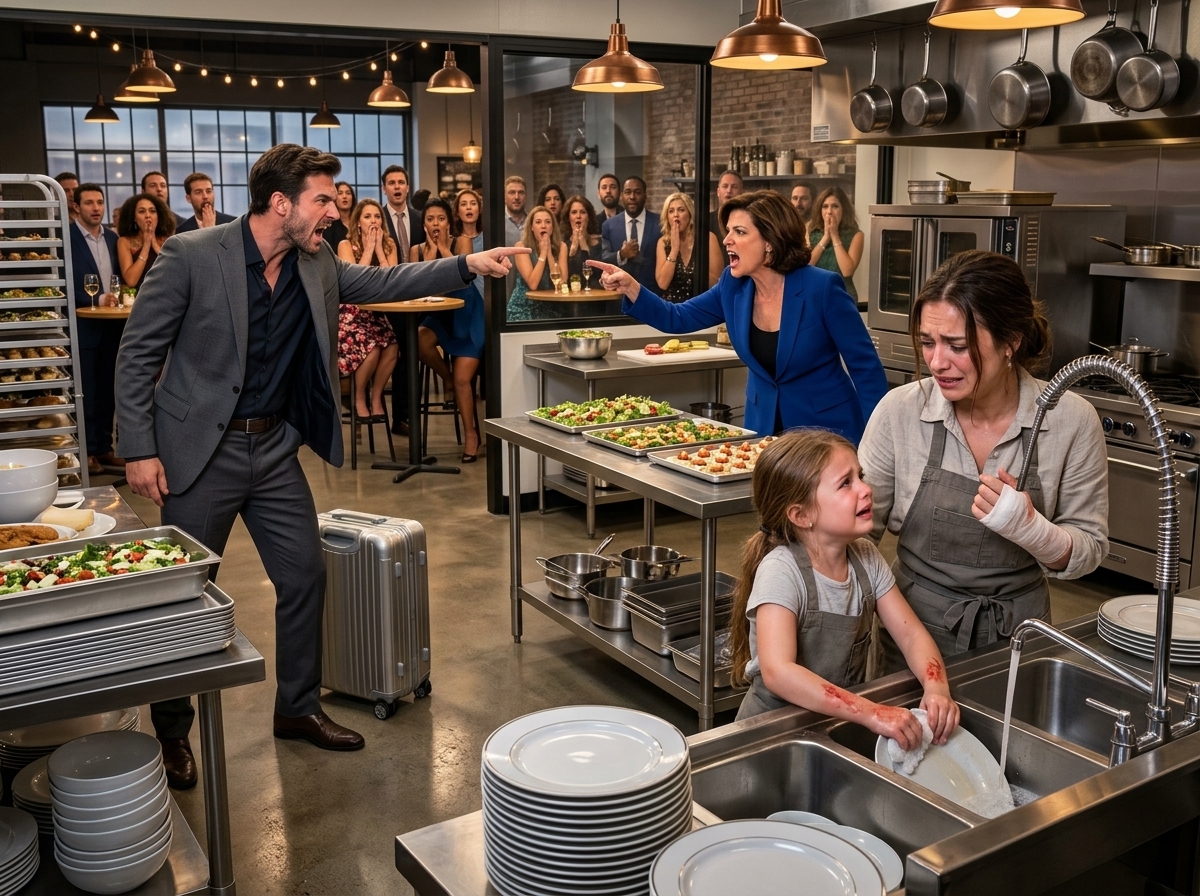
Twenty women sat frozen around two folding tables, forks halfway to their mouths. Somebody’s phone kept playing music, a cheerful song that suddenly sounded ugly in the silence. My suitcase lay on its side on the marble floor where I had dropped it, one wheel still spinning slowly.
And my daughter stood on a plastic stool at the kitchen sink, holding a serving dish almost as big as her chest, looking at me like I was a stranger who might make things worse.
Daddy… hurry, because if I don’t finish, Grandma said Mommy and I aren’t going to eat.
I have replayed that sentence in my head more times than I can count. At that moment, I didn’t understand everything it meant yet. But I understood enough.
I walked into the kitchen. I didn’t run, because I didn’t want to scare her. I reached past her and turned off the faucet. The steam rising from the sink hit my face, and I realized how hot that water really was. Hot enough that I pulled my own hand back.
“Olivia,” I said as softly as I could. “Put the dish down, sweetheart. You’re all done.”
She looked past me, toward the living room, toward her grandmother.
That look broke something inside me. My five-year-old daughter needed permission from someone else before she would believe her own father.
“You’re done,” I said again. “I promise. Daddy’s home.”
Slowly, she set the dish into the water. I lifted her off the stool, and she was lighter than I remembered. When I held her hands in mine, I had to swallow hard. Her small fingers were bright red, puffy, and wrinkled. There were two small blisters on her right palm, shiny and swollen. She flinched when my thumb brushed against them, but she didn’t make a sound.
She had learned not to make a sound.
I turned to Jessica. My wife was still standing by the sink with a kitchen towel in her hands, twisting it like she didn’t know what else to do. The bandage on her finger was soaked through. The blister on her wrist was open and angry-looking. Her eyes were fixed on the floor.
“Jess,” I said.
“I’m fine,” she answered immediately. Too fast. Like it was a line she had practiced. “It’s fine, Zayden. We were almost done. It’s just a busy day. Your mom has guests, and—”
“Jess. Look at me.”
She finally raised her eyes. And I saw fear in them. Not fear of my mother.
Fear of me. Fear of what I would say. Fear that I would take my mother’s side again.
That was the moment I understood how badly I had failed my family.
Behind me, I heard the scrape of a chair.
“Zayden, honey!” My mother’s voice floated into the kitchen, bright and sweet, the voice she used at church. “What a surprise! Why didn’t you call? Ladies, this is my son, the one I’ve been telling you about. The project manager.”
Chapter 2
A few of the women smiled nervously. Nobody said anything.
My mother walked toward the kitchen in her new red dress, limping slightly on her bad knee, her glass still in her hand. She stopped in the doorway and took one look at Olivia in my arms.
“Oh, don’t look at me like that,” she said with a small laugh. “She wanted to help. Didn’t you, Olivia? Kids love to feel useful. When you were her age, you were already helping me in the kitchen, and look how well you turned out.”
“Her hands are blistered, Mom.”
“It’s dishwater, Zayden. It’s not a fire.” She waved her hand. “Children are tougher than you think. You’re being dramatic. Now come, sit down, I’ll have Jessica fix you a plate—”
“Jessica isn’t fixing anything.”
I didn’t raise my voice. I’ve thought about that a lot since then. I wanted to scream. Every part of me wanted to scream. But Olivia’s face was pressed against my neck, and I could feel her little heart pounding, and I knew that if I yelled, she would learn that the house was just as frightening with me in it as it was without me.
So I stayed quiet. And somehow, the quiet was louder.
I shifted Olivia to one arm, took my phone out of my pocket, and dialed.
My mother’s smile slipped. “What are you doing?”
“911, what is your emergency?”
“My name is Zayden Ferris,” I said, keeping my eyes on my mother. “I need medical help at my home. My five-year-old daughter has scald injuries on her hands from hot water, and my wife is injured too. I’d also like an officer to come, please. I believe my daughter and my wife have been mistreated in my home while I was away.”
The kitchen went so silent I could hear the refrigerator hum.
“Zayden!” my mother hissed. “Hang up that phone right now! Are you out of your mind? In front of all my friends?”
The dispatcher asked me questions. Was anyone in immediate danger? Were the injuries serious? Was anyone breathing abnormally? I answered all of them calmly. She told me to run cool, not cold, water gently over Olivia’s hands and not to put ice or butter on them. Help was on the way.
I thanked her and hung up.
Then I turned toward the living room.
“Ladies,” I said. “I’m sorry to interrupt your afternoon, but the party is over. I need everyone to leave now, please.”
They left fast.
It was almost funny, in a sad way. Twenty grown women, who minutes earlier had been laughing at my mother’s joke about my wife belonging in the kitchen, suddenly couldn’t find their shoes quickly enough. Some of them wouldn’t look at me. A few muttered apologies. One woman grabbed a container of food from the table on her way out, and I let her take it. I didn’t care about the food.
My mother stood by the door, trying to save face.
Chapter 3
“He’s just tired from his trip,” she kept saying. “Just a misunderstanding. I’ll call you all tomorrow.”
But one guest didn’t leave.
She was an older woman, maybe in her late sixties, with short silver hair and reading glasses hanging from a beaded chain around her neck. She had been sitting at the far end of the second table, and I had barely noticed her. Now she walked straight into the kitchen, rolled up her sleeves, and turned on the faucet at the other sink.
“I’m Rosa Delgado,” she said. “I live on the fourth floor. I was a pediatric nurse for thirty-one years. Bring her here, honey.”
I hesitated.
“You called for help,” she said gently. “Let me help until it gets here.”
She tested the water with her wrist, adjusted it until it was cool, and showed me how to hold Olivia’s hands under the stream. Olivia whimpered at first, then relaxed a little as the cool water soothed her skin.
“That’s it, mija,” Rosa murmured. “That’s good. You’re being so brave.”
Then she looked up at Jessica.
“You too, dear. Come here. Let me see that wrist.”
Jessica didn’t move. She glanced toward the doorway, toward my mother, as if waiting for permission.
“Jess,” I said quietly. “Please.”
She came. Rosa unwrapped the soaked bandage from Jessica’s finger, and when I saw what was underneath, I had to look away for a second. The skin was raw and peeling. The blister on her wrist was bigger than I had first thought.
“How did this happen?” Rosa asked.
Jessica’s voice was barely a whisper. “The roasting pan. The oven mitts were… they weren’t in the drawer. I had to use a dish towel.”
“The oven mitts weren’t in the drawer,” Rosa repeated slowly.
“Carmen said I kept losing things, so she put them away. She said if I needed them, I should ask.”
“And did you ask?”
Jessica’s eyes filled with tears. “She was on the phone. She doesn’t like to be interrupted.”
Rosa said nothing. She just pressed her lips together and kept working. But when she glanced at me over her glasses, her look said everything.
“I’ve been to three of these lunches,” she told me quietly. “I didn’t like what I saw at the first one. I said something to your mother at the second one. She told me to mind my business. I came today because I wanted to see for myself.” She shook her head. “I should have called someone sooner. I’m sorry.”
“You’re not the one who should be apologizing,” I said.
And I meant it. Because I lived here. I was the husband. I was the father. And I hadn’t seen anything.
No. That’s not true. I had seen things. I had just chosen not to look.
My mother came back into the kitchen once the last guest was gone. Her face had changed completely. The sweetness was gone. Her mouth was tight, and her eyes were hard.
“Do you have any idea what you just did?” she said. “Those are my friends. My church friends. You humiliated me in front of every single one of them.”
Chapter 4
“Mom—”
“I raised you alone! Do you understand? Alone! Your father walked out when you were three, and I worked double shifts at that laundry until my hands cracked, and this is how you repay me? By calling the police on your own mother? Over some dishes?”
“It’s not about the dishes.”
“Then what is it about? Tell me! Because all I see is a spoiled wife who lies on the couch all day while I cook and clean—”
“You were sitting at the head of the table, Mom. In a red dress. With a drink in your hand. While my wife cooked for twenty people with an injured hand, and my daughter washed your dishes on her tiptoes.”
She opened her mouth. Then closed it.
“I heard you,” I continued. “I was standing right there by the door. I heard you tell a room full of women that my wife belongs in the kitchen. I heard you say you have to teach them young. And I heard you say that if Olivia didn’t finish, neither of them would get dinner.”
For the first time, my mother had no answer ready.
The doorbell rang.
Two paramedics came in first, a woman named Tasha and a younger man named Brian. They were kind and efficient. Tasha knelt down to Olivia’s level and introduced herself, and let Olivia hold her flashlight while she examined her hands.
“First-degree scalds on most of the fingers,” she told me, “with a couple of small second-degree spots on the palm. Rosa did exactly the right thing with the cool water. She’s going to be okay, Dad. It’s going to hurt for a few days, and we’ll want her pediatrician to check it, but she’s going to be okay.”
I breathed out for what felt like the first time in an hour.
Brian was looking at Jessica’s hand and wrist. He cleaned the wounds, applied a special dressing, and asked her a series of questions. How long ago had it happened? Had she seen a doctor? Had this happened before?
Jessica hesitated before the last question.
“Ma’am,” Brian said gently, “I’m just trying to understand what we’re treating.”
Slowly, Jessica pulled up the long sleeve of her shirt.
There were marks on her forearm. Old ones, mostly healed. Small, pale patches of shiny skin. The kind you get from splashing grease, from reaching into an oven too many times without protection, from pots handled with thin towels.
I had never seen them. In a year, I had never seen my own wife’s arms.
Long sleeves in Phoenix. In July. And I never asked why.
The police officer arrived a few minutes after the paramedics. Officer Daniel Hale was a tall man in his forties, with a calm voice and tired eyes, the kind of eyes that had seen a lot of kitchens like mine. He asked everyone to sit down in the living room, among the leftover plates and half-empty glasses.
My mother spoke first, of course. She always spoke first.
Chapter 5
“Officer, this is all a terrible misunderstanding. My son has been traveling for work, and he’s stressed. My daughter-in-law is very… sensitive. She has struggles, you understand. I’ve been helping her. I moved all the way from Baltimore to help this family, and I have a bad knee, and I do everything in this house—”
“Ma’am,” Officer Hale said politely, “I’ll get to your statement. Right now, I’d like to hear from Mrs. Ferris.”
Jessica looked at me.
I reached over and took her uninjured hand. “Tell him the truth, Jess. Whatever it is. I’m right here, and I’m not going anywhere. I’m going to believe you.”
She stared at me for a long time. Then she started to talk.
It came out slowly at first, and then all at once, like water breaking through a dam.
It had started small, a few weeks after my mother moved in. Comments about how Jessica cooked, how she folded laundry, how she let Olivia “run wild.” Then came the rules. Breakfast had to be on the table at seven sharp. The floors had to be mopped every day. My mother’s laundry had to be ironed, even her pajamas.
Then my mother started “helping” with the household money.
“She said I was wasteful,” Jessica said. “She said Zayden worked too hard for me to spend his money on nonsense. She took my debit card. She said she’d give me what I needed for groceries.”
I stared at her. “But I transfer money into our joint account every month. The statements—”
“Go to her email,” Jessica said quietly. “She changed the account email to her own months ago. You get your paycheck notifications. You don’t see the spending.”
I felt sick.
The lunches had started in the spring. At first once a month, then every two weeks. My mother would invite her friends from church, from the senior center, from the building. Jessica would cook for two days straight. My mother would take the credit for everything.
And then my mother began involving Olivia.
“She said Olivia was spoiled,” Jessica whispered. “That I was raising a lazy girl. She started giving her chores. Setting the table. Folding towels. I thought, okay, that’s not so bad. Then it was drying dishes. Then washing them. I tried to stop it. I told her Olivia was too little.”
“What did she say?”
Jessica’s voice cracked. “She said if I interfered, neither of us would eat. And she meant it. She keeps the pantry key. She keeps the fridge organized so she knows if anything’s missing. Some nights, when Olivia didn’t finish her chores, we went to bed with just crackers I had hidden in my purse.”
Officer Hale wrote something in his notebook. His jaw had gone tight.
“Why didn’t you tell your husband?” he asked. Not accusingly. Just gently.
Jessica looked at me, and there were tears running down her face.
“I did,” she said. “Once. In February. I told him his mother was being cruel to me. And he said…” She stopped.
Chapter 6
I remembered. I remembered every word, and they came back to me like a slap.
She’s sixty-two, Jess. She’s in pain all the time. She’s lonely. She’s not trying to be cruel, that’s just how she talks. Can you please just be patient with her? For me?
“He said to be patient,” Jessica finished softly. “And that night, his mother told me that if I ever complained to him again, she would tell him I was unstable. That I had been neglecting Olivia. That she had been writing everything down. She said a judge would believe a grandmother and a son over a woman with no job and no family nearby. She said I’d lose my daughter.”
I closed my eyes.
She had tried to tell me. She had tried, and I had handed her back to the person who was hurting her.
“I’m so sorry,” I said. My voice shook. “Jess, I’m so, so sorry.”
It was Olivia who changed everything after that.
She had been sitting on Rosa’s lap, her hands wrapped in soft, cool dressings, watching the grown-ups with her big, serious eyes. She had been so quiet that I had almost forgotten she was listening.
Then she tugged at my sleeve.
“Daddy,” she whispered. “Can the police open Grandma’s drawer?”
Everyone turned to look at her.
“What drawer, sweetheart?” I asked.
“The locked one. In Grandma’s room. In the big brown dresser.” She looked nervously toward my mother, then back at me. “Mommy’s phone lives there. And Mommy’s car keys. And Grandma’s secret book.”
My mother stood up so fast her chair tipped over. “That child doesn’t know what she’s talking about! She makes up stories. She’s always making up stories—”
“Grandma locks it with the little gold key,” Olivia continued, more quietly now. “She wears it on her necklace. When Mommy cries, Grandma writes in the book.”
Every eye in the room went to my mother’s neck.
There, hanging on a thin gold chain, resting just above the neckline of her new red dress, was a small brass key.
Officer Hale explained the situation carefully. He couldn’t force my mother to open the drawer without a warrant, and it was her personal property. But it was my home. And if my wife’s belongings were inside, that was a different matter.
“Mom,” I said. “Please open the drawer.”
“Absolutely not. That’s my private property.”
“Is Jessica’s phone in there?”
She didn’t answer.
“Mom. Is my wife’s phone in that drawer?”
“She wastes too much time on it,” my mother snapped. “I was helping her focus on her family. Somebody had to.”
Officer Hale raised his eyebrows. “Ma’am, if you are holding another adult’s personal property, including her phone and car keys, against her will, that is a serious concern. I’d strongly encourage you to return those items now.”
My mother looked around the room. At the officer. At the paramedics packing up their bags. At Rosa, who stared back at her without blinking. At Jessica. At Olivia.
Chapter 7
And finally at me.
I don’t know what she saw in my face. Maybe she saw that the son she had spent thirty-four years steering with guilt was finally standing still. Maybe she just saw that she had lost.
She pulled the chain over her head and dropped the key into my open hand.
My mother’s room had once been our guest room. I had painted it myself, a soft sage green, when she told us she was coming. I had put in a new mattress because of her back, and a recliner because of her knee.
The big brown dresser had come with her from Baltimore. I remembered it from my childhood. It had stood in her bedroom my whole life, and I had never once seen what was inside the top right drawer.
I knelt in front of it. My hands were shaking. Officer Hale stood behind me. Jessica waited in the doorway with Olivia in her arms.
The key turned easily.
The first thing I saw was Jessica’s phone, powered off, lying on top of a stack of papers. Next to it were her car keys, her wallet, and her debit card. And the pantry key. And, God help me, a pair of blue oven mitts, folded neatly.
Jessica made a small sound behind me, half laugh and half sob.
Under the phone was a pile of receipts, rubber-banded together. I flipped through them. Restaurant bills. Department store receipts. The red dress, three hundred and forty dollars. Catering supplies. A salon. Jewelry. Flowers. Thousands of dollars, all paid from our joint account. All from money I thought was going to groceries, Olivia’s preschool, and the savings account for her college fund.
Then I found an envelope addressed to Jessica. It had already been opened.
It was from Desert Willow Elementary School, a few miles away. It was a job offer. A second-grade teaching position. Jessica had been a teacher before Olivia was born. She had always said she wanted to go back when Olivia started school.
The letter was dated four months earlier.
“You applied?” I asked her.
She nodded slowly, staring at the letter. “In the spring. I had an interview. They never called back. I thought… I thought I just wasn’t good enough anymore.”
“They called,” I said. “They wrote. She kept it.”
Jessica slid down the doorframe until she was sitting on the floor, holding Olivia tight, and she cried in a way I had never heard her cry. Not quietly this time. Loudly, finally, like someone who had held it in for a year and couldn’t hold it anymore.
At the bottom of the drawer was a thick notebook with a floral cover.
The secret book.
I opened it. It was filled with my mother’s neat, looping handwriting. Page after page of dates and notes.
March 3. J. burned the rice. Told her no dinner. Cried in bathroom 20 min.
March 17. O. spilled juice on rug. Made her scrub it. Took 1 hour.
Chapter 8
April 9. J. tried to call her sister. Took phone. Told her Z. would be disappointed.
May 22. J. asked for her card back. Reminded her about the custody. She stopped asking.
It went on and on. My mother hadn’t been documenting Jessica’s “instability.” She had been documenting her own control. Every rule, every punishment, every tear, recorded like a household chore.
Officer Hale read over my shoulder. He didn’t say anything for a long time.
“Mr. Ferris,” he said finally, “I’m going to need to take photos of this. And I’m going to need to make a report. Given that a child was injured, I’m also required to notify the Department of Child Safety. I want you to understand that they will be looking at the situation to make sure your daughter is safe, and from what I see, you’re the one who called for help. That matters.”
“Do whatever you need to do,” I said. “I want everything on the record.
I was about to close the notebook when something slipped out from between the back pages. It fluttered to the carpet.
It was an old photograph, faded and curled at the corners. And a folded piece of yellowed paper.
The photo showed a small, dark kitchen with peeling wallpaper. A young woman stood at a sink piled high with dishes. She was thin, maybe twenty-three or twenty-four, with her hair tied back and her sleeves pushed up. Her hands were in the water.
In the background, at a table, sat an older woman with a heavy face and a cigarette, watching.
The young woman at the sink was my mother.
I recognized her from the few old pictures she kept around. I had never seen this one.
On the back, in pencil, someone had written: Baltimore, 1987.
My hands felt numb as I unfolded the paper. The handwriting was younger, rounder, but it was hers.
To myself,
Today Mama Ferris made me wash every dish from the christening while everyone else ate. My hands are red and cracked and they sting in the shower. She said a wife who can’t keep up doesn’t deserve to eat at the table. Frank didn’t say anything. He never says anything.
I am writing this so I never forget. When my baby grows up and gets married, I will be good to his wife. I will be the mother-in-law I never had. I will never make a woman feel the way I feel tonight.
I promise.
— Carmen, age 24
I read it three times.
Frank was my father. The man who walked out when I was three. Mama Ferris was my grandmother, the woman my mother never talked about except to say she was “a hard woman” and “good riddance.”
My mother had kept this letter for almost forty years. She had kept it in the same drawer where she locked away my wife’s phone.
I didn’t know whether to cry or scream.
I walked out of the bedroom and back into the living room, where my mother sat alone on the couch, surrounded by dirty plates and wilting flowers. She looked smaller than she had an hour ago. Older.
Chapter 9
I held up the paper.
Her face went white.
“Where did you get that?”
“It was in the drawer, Mom. With Jessica’s phone. With the notebook.”
For a moment, she looked like she might deny it. Then something in her collapsed. Her shoulders dropped. Her hands, those hands she always said had cracked from double shifts at the laundry, began to tremble in her lap.
“You weren’t supposed to see that,” she whispered.
“You wrote this,” I said. “You promised yourself you would never do this to anyone. And then you did it to my wife. And to my daughter.”
“I…” She shook her head. “I don’t know how it happened. I swear to you, Zayden, I don’t know. She was so… she had everything. A husband who came home. A nice apartment. A son who loved her. And I had nothing. I came here with nothing. I wanted… I just wanted to matter in this house. I wanted people to see that I mattered.”
“By taking away her phone? By taking away her food? By making a five-year-old wash dishes in hot water?”
“My hands were in that water every day for years!” she cried suddenly, and her voice broke. “Nobody ever cared about my hands! Nobody ever stopped it for me!”
The room went very still.
I sat down across from her. I felt exhausted, like I had run a hundred miles.
“Mom,” I said. “I’m sorry nobody stopped it for you. I truly am. What she did to you was wrong. What Dad did, standing there and saying nothing, was wrong.”
I took a breath.
“But I’m not going to be Dad. I’m not going to stand here and say nothing. Not anymore.”
She looked up at me with wet eyes.
“You can’t stay here tonight,” I said. “And you can’t stay here again.”
Officer Hale took my mother’s statement at the kitchen table. She didn’t fight anymore. She answered his questions in a flat, tired voice. He explained that the report would go to the county attorney’s office, and that she would likely be contacted about possible charges related to the child’s injuries and the withholding of food and property. He also explained that a temporary protective order could be requested.
I requested it. It was one of the hardest things I’ve ever done, and one of the easiest.
I booked my mother a room at a hotel near the airport and paid for a week. Officer Hale stayed while she packed a suitcase. She moved slowly because of her knee, and part of me, the part she had trained since I was a boy, wanted to rush in and help her.
I didn’t. I let the officer carry her suitcase down.
At the door, she stopped and turned around. She looked at Jessica, who was sitting on the couch with Olivia asleep across her lap, both of Olivia’s little hands wrapped in white dressings.
“Jessica,” my mother said.
Jessica looked up.
My mother opened her mouth, closed it, and opened it again. For a moment I thought she might finally apologize.
Chapter 10
Instead, she just said, “The oven mitts go in the second drawer. By the stove.”
And then she left.
Jessica stared at the closed door for a long time. Then, to my surprise, she laughed. It was a strange, broken laugh, but it was real.
“Forty years,” she said, “and the last thing she tells me is where the oven mitts go.”
I sat beside her on the couch. I didn’t try to hold her. I wasn’t sure I had the right yet.
“I don’t know how to fix this,” I said. “I don’t know how to make up for a year. For not seeing. For not listening when you told me.”
She was quiet for a long moment.
“You came home,” she said finally. “You came home, and you saw, and you didn’t look away. That’s more than I thought would ever happen.”
“It’s not enough.”
“No,” she agreed softly. “It’s not. But it’s a start.”
Rosa Delgado came back upstairs at nine o’clock that night with a pot of chicken soup and a bag of groceries.
“Nobody in this apartment is going to bed hungry tonight,” she announced, walking straight into the kitchen like she owned the place.
Olivia woke up at the smell. She padded into the kitchen in her pajamas, her bandaged hands held carefully in front of her, and stopped in the doorway.
She looked at the stove. At the sink, which was still full of dishes. Then at me.
“Daddy,” she whispered. “Do I have to finish the dishes first?”
I knelt down in front of her.
“Livvy, listen to me. You never, ever have to earn your dinner in this house. Not tonight. Not ever. Food isn’t a prize. It’s just something you get because you’re a person and we love you. Okay?”
She looked at me like she was trying to decide whether to believe me.
“Even if I’m bad?”
“Even if you’re bad. Even if you spill juice on the rug. Even if you break every dish in the kitchen. You always get to eat.”
She thought about it. Then she climbed onto a chair at the table, and Rosa set a bowl of soup in front of her. I sat beside her and blew on each spoonful before I fed it to her, since her hands were wrapped.
Jessica sat across from us and ate slowly, like she had forgotten how to eat without watching the door.
After dinner, I washed every single dish in that sink by myself. Two hundred plates, glasses, pots, and serving bowls. It took me until almost one in the morning. My hands ached. My back hurt.
With every dish, I thought about my wife and daughter standing at that same sink, day after day, while I was at conferences, at meetings, at airport hotels, telling myself everything at home was fine.
When I finished, I found the blue oven mitts and put them in the second drawer, by the stove.
Then I went to bed on the floor of Olivia’s room, because she asked me not to leave.
Chapter 11
The next few weeks were the hardest of my life.
I called my boss the next morning and asked for a leave of absence. When he asked why, I told him the truth. There was a pause on the phone, and then he said, “Take as long as you need, Zayden. Family comes first.” I’ll always be grateful to him for that.
We took Olivia to her pediatrician, who confirmed what the paramedics had said. Her hands would heal completely. No lasting damage. The doctor showed Olivia how the new pink skin was growing underneath, and Olivia was fascinated.
“It’s like my hands are getting brand new,” she said.
“That’s exactly what they’re doing,” the doctor told her.
Jessica’s wrist took longer. The doctor said she’d have a small scar. Jessica just nodded.
A caseworker from the Department of Child Safety came to visit a few days later. Her name was Ms. Okafor, and she was warm but thorough. She talked to Olivia alone in her room for twenty minutes, with the door open. She talked to Jessica. She talked to me. She looked through the notebook, the photographs, the receipts.
When she was finished, she sat with us at the kitchen table.
“I’ll be honest with you,” she said. “I see a lot of families. In a lot of cases, the parent who made the call is also part of the problem. I don’t see that here. I see a father who missed things he should have noticed, and a mother who was put in an impossible position. But I also see two parents who are going to protect this child. I’m going to recommend family counseling, and for Olivia to see a child therapist. I’d also recommend you both see someone individually.”
“We’ll do all of it,” I said. “Whatever it takes.”
She smiled. “That’s exactly what I needed to hear.”
I changed the passwords on every account. I moved the account email back to mine and Jessica’s. I sat down with Jessica and went through every statement from the past year, line by line. The total my mother had spent was a little over twenty-three thousand dollars.
“It’s just money,” Jessica said, watching my face.
“It was Olivia’s college money.”
“We’ll rebuild it. Together.” She put her hand on mine. “That’s the part I care about. Together. No more you handling the money and me not knowing. No more me handling the house and you not knowing. We both see everything.”
“Deal.”
We started couples counseling with a therapist named Dr. Linh Tran, a soft-spoken woman with a small office full of plants. The first session, Jessica talked for almost the whole hour. I just listened. It was the first time in a year I had truly just listened to my wife.
It was hard to hear. She talked about the loneliness. The way she stopped calling her sister in Tucson because my mother would stand in the room and listen. The way she started to believe she really was lazy and ungrateful. The way she would lie awake at night wondering if I knew, and deciding that I must know, and that I just didn’t care.
Chapter 12
“I thought you’d chosen her,” Jessica said. “Every time you called and your mom answered first and told you how wonderful everything was, and you just said, ‘That’s great, Mom,’ I thought, he’s chosen.”
“I didn’t know,” I said.
Dr. Tran looked at me kindly. “Zayden, is that completely true?”
I was quiet for a long time.
“No,” I admitted. “I knew something was wrong. I saw Jess losing weight. I saw the long sleeves. I saw Olivia go quiet. I just… it was easier to believe my mother. If I believed Jess, I’d have to do something. I’d have to go against my mom. And my whole life, going against my mom meant she’d cry and tell me how she’d sacrificed everything for me, and I’d feel like the worst son in the world.”
“So you chose the version of the story that didn’t make you the bad son,” Dr. Tran said gently.
“And it made me the bad husband. And the bad father.”
“It made you a man who made a serious mistake,” she corrected. “What you do next decides what kind of man you are.”
Olivia started seeing a play therapist named Miss Becca, who had a room full of dollhouses and puppets and art supplies.
For the first few sessions, Olivia would only play with the dollhouse kitchen. She would make the little mommy doll and the little girl doll wash dishes, over and over, while the grandma doll sat at the table.
Miss Becca told us not to worry. She said that was how children worked through things, by playing them out until they felt safe.
In the fourth session, Olivia did something different. She took the daddy doll and walked him into the dollhouse kitchen. She made him turn off the little plastic faucet. Then she made him pick up the little girl doll and hug her.
“And then,” Olivia told Miss Becca, “the daddy said, ‘You’re all done.'”
Miss Becca told us about it afterward, and Jessica and I both cried in the parking lot.
There were still hard moments. Olivia had nightmares for a few weeks. Sometimes she’d wake up screaming that she hadn’t finished. For a while, she wouldn’t go near the kitchen sink at all. She’d ask permission before taking a snack from the pantry, even though we had thrown the pantry lock away the very first day.
“Can I have a granola bar, Mommy?”
“Of course, baby.”
“Do I have to do a chore first?”
“Nope. Never.”
It took weeks before she stopped asking. The day she finally walked into the kitchen, opened the pantry, took a granola bar, and walked out without asking anyone, Jessica grabbed my arm and whispered, “Did you see that?”
We celebrated that granola bar like it was a graduation.
Jessica called Desert Willow Elementary the week after that terrible afternoon.
I sat beside her on the couch while she dialed. Her hands were shaking. The second-grade position had been filled months ago, of course. When she explained, stumbling over the words, that she had never received the letter because of “a family situation,” there was a long pause on the other end.
Chapter 13
Then the principal, a woman named Mrs. Gutierrez, said something that made Jessica cover her mouth.
She remembered Jessica’s interview. She said Jessica had been her first choice. She said she had wondered why Jessica never responded. And she said a first-grade teacher was going on maternity leave in January, and they would need a long-term substitute, with a strong chance of a permanent position in the fall.
“Would you be interested?” Mrs. Gutierrez asked.
Jessica couldn’t even speak. She just nodded, which obviously didn’t work over the phone. I laughed and leaned in toward the phone.
“She’s nodding very hard,” I said. “That’s a yes.”
About six weeks after that day, I got a letter from the county attorney’s office. My mother had accepted a plea agreement. She pleaded guilty to a misdemeanor charge related to Olivia’s injuries. She would complete a court-ordered parenting and anger management program, perform community service, and pay restitution for the money she had taken. The protective order would remain in place for two years. Any contact with Olivia would have to be supervised and only with our permission.
She had moved back to Baltimore. Her sister, my Aunt Lucia, had taken her in.
I read the letter twice. I didn’t feel happy. I didn’t feel angry either. I mostly just felt sad. Sad for the young woman in the photograph with her hands in the dishwater. Sad that she had become the thing she promised never to become. Sad that I had spent my whole life so afraid of her disappointment that I let her do the same thing to the people I loved most.
Jessica found me at the kitchen table holding the letter.
“Are you okay?” she asked.
“I don’t know,” I said honestly. “She’s my mom. And she did something terrible. And I don’t know how to hold both of those things at once.”
Jessica sat down beside me.
“You don’t have to figure it out today,” she said. “Dr. Tran says you’re allowed to love someone and still keep them out of your house.”
She smiled a little. “I’ve had a lot of time to think this year.”
In December, a small package arrived from Baltimore.
It was addressed to Jessica. Not to me. Jessica.
She stared at it on the kitchen counter for a whole day before she opened it. I didn’t push. When she finally did, I sat with her.
Inside was a thin envelope and a small box.
The letter was handwritten, in my mother’s familiar loops, but the lines were shakier than before.
Jessica,
My counselor says I should write to you. She also says I shouldn’t expect an answer, and that I shouldn’t write this letter to make myself feel better. So I will try to write it only for you.
What I did to you and Olivia was cruel. There is no other word. I told myself it was discipline. I told myself it was teaching. I told myself you were ungrateful. None of it was true. The truth is that I was jealous of you. You had a husband who loved you and a child who adored you and a home where you were safe. I never had any of that. And instead of being glad that you had it, I tried to take it away.
Chapter 14
I did to you exactly what was done to me. I promised myself when I was young that I would never do that. I broke that promise. I’m so ashamed.
I am not asking you to forgive me. I don’t think I would forgive me. I’m only asking you to know that I understand now what I did. I’m in a program. I go every Tuesday and Thursday. I volunteer at a food pantry, and every time I hand someone a bag of groceries, I think about the nights you and Olivia went to bed hungry because of me. I think it’s the right place for me to be.
The box is for Olivia, if you think it’s okay. If you don’t, please throw it away. You decide. Not me. Not Zayden. You.
— Carmen
Jessica read it in silence. Then she handed it to me. I read it too.
Inside the small box was a pair of tiny pink rubber gloves, the kind made for children, with little cartoon stars on them. And a folded note in careful print: For Olivia. For helping only when she wants to. With cool water. Only if Mommy says yes.
Jessica held the gloves for a long time.
“What do you want to do?” I asked.
She turned them over in her hands. “I don’t know yet,” she said. “But I don’t want to throw them away.”
She put them in the drawer by the sink. Not locked. Just put away.
Jessica started teaching at Desert Willow Elementary in January.
The first morning, she changed her outfit four times. She finally chose a short-sleeved blue blouse. The small scar on her wrist was visible, a pale mark just below her watch.
“Do you think the kids will ask about it?” she asked, looking in the mirror.
“Probably,” I said. “Kids ask about everything.”
“What should I tell them?”
I thought about it.
“Tell them it’s from a hard time that’s over now.”
She smiled at her reflection. “I like that.”
Olivia and I walked her to the car. Olivia had made her a card with a drawing of a woman with a huge smile standing in front of a school, with the words GOOD LUK MOMMY in big purple letters.
Jessica kissed us both and drove away, and I stood in the parking lot holding my daughter’s hand, watching my wife go out into the world again.
That afternoon, when Jessica came home, she was glowing.
“Twenty-two six-year-olds,” she said, collapsing onto the couch. “Twenty-two! One of them threw up. Two of them cried because they missed their moms. One of them told me I looked like a princess.”
“And?”
“And I loved every single minute of it.”
That night, I cooked dinner. I had been doing most of the cooking since the fall, and I had gotten a lot better. I had started with boxed macaroni and burned toast. By January, I could make a decent chicken stir-fry and something Olivia called “Daddy’s famous spaghetti,” which was really just spaghetti with a lot of cheese.
Chapter 15
I’ve learned a lot of things in the kitchen these past months. How long to boil pasta. How to tell when chicken is done. How hot the water from the tap really gets when you turn it all the way up.
And how many dishes twenty people leave behind.
It was a Saturday morning in late March when Olivia walked into the kitchen, dragged the plastic stool over to the counter, and climbed up on it.
I froze. Jessica, who was sitting at the table grading spelling tests, went very still.
It was the same stool. We had never gotten rid of it. I had thought about it. I had even carried it down to the trash room once. But then I brought it back, because I didn’t want Olivia to feel like we were hiding something from her. Miss Becca had told us that children need to see that the things connected to bad memories can become safe again.
Olivia stood on the stool and looked at me.
“Daddy,” she said. “Can I help make pancakes?”
My throat got tight. “You want to help?”
“Yes. Not because I have to. Because I want to.”
Jessica stood up slowly. She walked over to the drawer by the sink, opened it, and took out the little pink gloves with the cartoon stars.
“If you want to help with dishes after,” Jessica said softly, “you can wear these. And we’ll make the water cool. Only if you want to. Deal?”
Olivia looked at the gloves. “Who gave me those?”
Jessica glanced at me. Then back at our daughter.
“Grandma sent them,” she said. “She wanted you to have them.”
Olivia was quiet for a moment. “Is Grandma still mad?”
“No, baby,” Jessica said. “Grandma isn’t mad. Grandma is learning how to be kinder. It’s taking her a long time.”
“Like how my hands took a long time to get new skin?”
“Exactly like that.”
Olivia considered this very seriously. Then she nodded. “Okay. I’ll wear them later. First, pancakes.”
So we made pancakes. Olivia stirred the batter with both hands on the wooden spoon, her tongue sticking out in concentration, flour all over her face. She got batter on the counter, the floor, and somehow the ceiling. Nobody said a single word about the mess.
Jessica took about a hundred pictures.
When the pancakes were done, we sat at the table together. The same table where, six months earlier, my mother had sat in a red dress laughing about teaching girls to belong in the kitchen.
Olivia ate four pancakes, which was a new record.
After breakfast, she climbed back onto her stool. She put on the pink gloves. I turned on the faucet, and before she touched anything, Jessica held her own wrist under the stream, the one with the small scar, and tested the temperature.
“Cool,” Jessica said. “Perfect.”
Olivia washed exactly three forks and one plastic cup. Then she got bored and ran off to watch cartoons.
Jessica and I stood at the sink together and finished the rest.
Chapter 16
In April, Jessica decided she was ready for a video call with my mother.
We set it up carefully. Dr. Tran helped us plan it. Fifteen minutes. Jessica would sit with Olivia. I would be in the room. If anyone felt uncomfortable, we would end the call. No explanations needed.
When my mother’s face appeared on the screen, I barely recognized her. She had lost weight. Her hair, which she had always dyed a dark brown, was gray now. She wore a plain blue sweater. No red dress. No jewelry.
“Hi, Olivia,” she said. Her voice was quiet, careful.
Olivia leaned against Jessica’s side. “Hi, Grandma.”
“How are your hands, sweetheart?”
Olivia held up both palms to the camera. “They got new skin. See? It’s all pink and new.”
My mother pressed her fingers to her lips. Her eyes were wet. “They look beautiful,” she whispered. “I’m so glad.”
“I wore the gloves you sent,” Olivia told her. “I washed three forks.”
“Only three?”
“I got bored.”
And my mother laughed. A real laugh, soft and surprised. I hadn’t heard her laugh like that in years. Maybe ever.
“That’s the right number,” my mother said. “Three is plenty. You don’t ever have to wash more than you want to.”
She talked to Olivia about her preschool and her favorite cartoon and the drawing Olivia had made of a purple horse. She didn’t ask to visit. She didn’t ask when she could come back. She didn’t mention the court case or the protective order or anything about herself at all.
At the end, she looked at Jessica.
“Thank you for letting me see her,” she said. “I know I don’t deserve it.”
Jessica was quiet for a moment.
“She deserves to have a grandmother who’s safe,” Jessica said finally. “If you keep working toward being that person, we’ll keep having these calls. But it’ll be at our pace. Not yours.”
“Your pace,” my mother agreed immediately. “Always your pace.”
After the call ended, Jessica sat in silence for a long time.
“Are you okay?” I asked.
“I think so,” she said. “I think… I don’t hate her anymore. I don’t trust her. I might never trust her. But I don’t hate her.” She looked at me. “Is that strange?”
“No,” I said. “I think it’s the bravest thing I’ve ever heard.”
There’s one more thing I want to tell you.
After my mother left, the big brown dresser stayed in the guest room for months. Neither of us wanted to touch it. It felt like a piece of that terrible year still standing in our home.
Finally, one Sunday in May, I decided to do something about it.
I took it out to our building’s workshop and spent three weekends sanding it down. I stripped off the dark brown stain until the raw wood underneath showed through. Then I painted it the color Olivia chose, a bright, happy yellow she called “sunshine lemonade.”
Last of all, I took out the lock on the top right drawer. I unscrewed it, pulled it out, and filled the hole with wood putty. Then I painted over it until you couldn’t even tell it had ever been there.
Chapter 17
The dresser is in Olivia’s room now. The top right drawer is her art drawer. It’s full of crayons and markers and glitter glue and about a thousand drawings. Anyone can open it. Anytime.
The brass key sits in a small box in my desk. I kept it, along with the old photograph from Baltimore and the letter my mother wrote to herself when she was twenty-four. I’m not sure why. Maybe to remember. Maybe so that someday, when Olivia is old enough, I can show her all of it and tell her the whole story.
About how cruelty gets passed down like old furniture, from one generation to the next, unless someone decides to stop it.
About how her grandmother was hurt, and then hurt others, and then, too late but not never, tried to change.
About how her father almost looked away, and how grateful he is every single day that he came home two days early.
And about how her mother, who had every reason to break, didn’t. How she stood at that sink for a year, protecting her daughter in every small way she could, hiding crackers in her purse, holding on until help came.
Last night, after Olivia fell asleep, Jessica and I sat on the balcony watching the lights of Phoenix spread out below us. The desert air was warm. She was wearing a tank top, and I could see the small, pale scar on her wrist in the glow from the city.
“Can I tell you something?” she said.
“Always.”
“That day, when I heard the suitcase hit the floor… I thought it was going to get worse. I thought you’d be angry at me for not keeping things together. I thought you’d believe her.”
I took her hand, turning it over gently so her wrist faced up.
“I spent a year believing the easy thing,” I said. “I’m going to spend the rest of my life believing you.”
She leaned her head on my shoulder. Inside, through the open door, I could hear the dishwasher humming softly in the kitchen. I had loaded it myself after dinner. Olivia had “helped” by putting in exactly one spoon, and then declared she was done.
And she was.
In our house, she’s always allowed to be done.
THE END