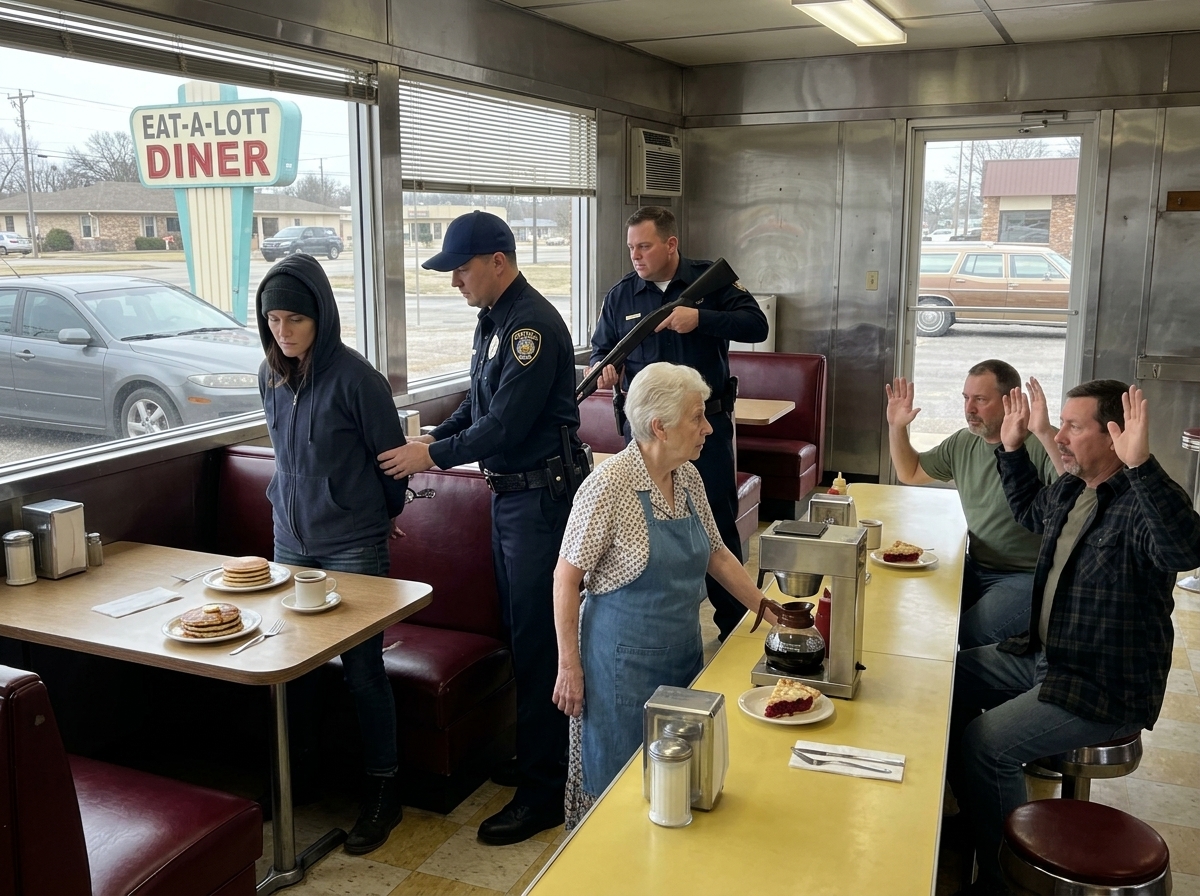
It becomes breathing.
Deputy Harris noticed.
“She’s weird, boss,” he said into the radio. “Just sitting there.”
Miller’s voice crackled back.
“Just drive, kid. We got a live one today.”
A pause.
Then Miller laughed.
“By midnight she’ll sign over that Bronco for a phone call.”
Harris didn’t answer.
But his eyes flicked toward the mirror again.
And suddenly the entire operation made sense.
Civil asset forfeiture.
Pressure.
Plea agreements.
Vehicles.
Cash.
Travelers with no local family.
People who couldn’t afford lawyers.
People who wanted out badly enough to surrender property rather than fight.
They hadn’t stopped me because they thought I was dangerous.
They stopped me because they thought I was disposable.
I leaned back against the plastic seat.
For the first time since leaving the diner, I almost smiled.
Not because the situation was funny.
Because they had made a catastrophic mistake.
I didn’t need a phone call.
And I didn’t need to tell them who I was.
The moment I had failed to make my scheduled secure check-in, a clock had started somewhere they couldn’t see.
Tier One personnel do not simply disappear.
Not after an overseas operation.
Not during monitored reintegration leave.
And especially not while carrying controlled equipment.
By the time the Explorer turned onto County Road 17, people several levels above Sheriff Boyd Miller’s understanding of law enforcement were already asking where I had gone.
The Oak Haven Sheriff’s Office looked exactly the way I expected.
One story.
Red brick.
American flag snapping above the parking lot.
Four marked cruisers.
Two seized vehicles parked behind a chain-link fence.
A black Dodge Charger.
A new Ford F-250.
Both nicer than anything deputies in a county this size should have been leaving to bake in the sun.
Interesting.
Harris opened my door.
“Watch your head.”
At least he said that.
Inside, the station smelled of old coffee, floor cleaner, and sweat.
They put me in an interview room.
Metal table.
Three chairs.
Camera in the upper corner.
Granger entered first.
Miller followed.
A deputy placed a clear evidence bag on the table.
Inside were several wrapped packages of white powder.
“Recognize those?” Granger asked.
I stared at the bag.
“No?”
Silence.
“Found in your truck.”
Silence.
Miller sat across from me.
“You seem like a smart woman.”
I looked at him.
“So I’ll explain how this works. Quantity like this? You’re looking at serious time.”
He tapped the table.
“Trafficking.”
Tap.
“Intent to distribute.”
Tap.
“Possibly federal charges.”
The last part almost amused me.
Almost.
“But,” Miller continued, “people make mistakes. Judges understand that. Prosecutors understand that.”
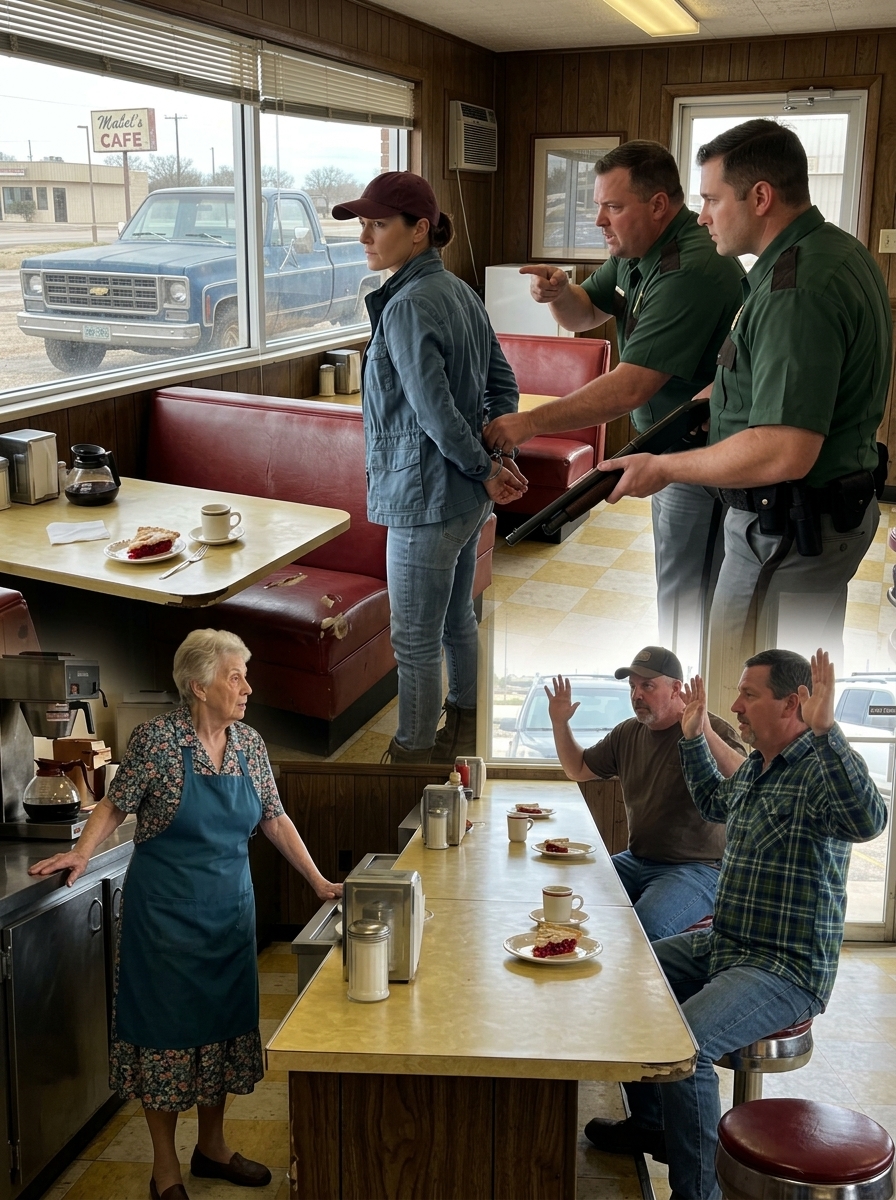
Granger slid a paper across the table.
“We can help.”
I looked down.
It was a property waiver.
The language was buried beneath paragraphs of legal terminology, but I recognized the structure immediately.
Voluntary relinquishment.
Vehicle.
Cash.
Personal property associated with alleged criminal activity.
There it was.
My Bronco.
Miller leaned back.
“You cooperate, maybe this becomes manageable.”
I didn’t touch the paper.
Granger pushed it closer.
“You sign, we tell the DA you were helpful.”
Still nothing.
His smile disappeared.
Advertisement
“You deaf?”
I held his gaze.
“No.”
It was the first word I had spoken since the arrest.
Both men went still.
Then Miller leaned forward.
“So you can talk.”
“Yes.”
“Then start.”
“I want counsel.”
Granger’s jaw tightened.
Miller stared at me for several seconds.
“Fine.”
He stood.
“But you might want to think about how expensive attorneys are.”
He reached the door.
Then looked back.
“That truck of yours may be the only thing you own worth selling.”
The door closed.
I waited.
Seven minutes later, Harris came in.
“Booking.”
They walked me down a hallway.
Photograph.
Height.
Weight.
Inventory.
Wallet.
Keys.
Watch.
Everything into separate plastic bags.
One deputy read questions from a computer screen without looking at me.
“Full legal name?”
“Alice Reed.”
“Date of birth?”
I gave it.
“Address?”
I gave him the Colorado mailing address connected to my leave documentation.
He typed.
Nothing happened.
“Social Security number?”
I provided it.
He stopped typing.
Then started again.
His forehead tightened.
“What?”
I said nothing.
He entered the number a second time.
The screen loaded.
Then returned almost nothing.
“No priors,” he muttered.
Granger, standing by the wall, shrugged.
“Everybody starts somewhere.”
The booking deputy rolled my fingers for prints.
Inkless scanner.
Thumb.
Index finger.
Middle.
Ring.
Little finger.
Left hand.
Then right.
Green lights appeared with each completed scan.
Until the final submission.
The machine made a sound I had never heard before.
Not a normal error beep.
Advertisement
A low electronic tone.
Then the screen went black.
For perhaps two seconds, nobody moved.
The display came back.
A red border filled the screen.
Deputy Harris leaned closer.
The booking officer frowned.
“What the hell?”
Granger stepped forward.
“What?”
The booking officer didn’t answer.
His face changed.
All the casual boredom disappeared.
“Miller.”
Sheriff Miller approached.
“What is it?”
The booking deputy pointed at the screen.
I could see the reflection in the glass partition beside them.
Four words appeared first.
IDENTITY MATCH RESTRICTED.
Then another line.
SPECIAL ACCESS RECORD.
Miller leaned closer.
A new warning appeared.
DO NOT MODIFY. DO NOT DELETE. DO NOT TRANSFER SUBJECT.
Then the final line loaded.
And the room went silent.
IMMEDIATE FEDERAL NOTIFICATION REQUIRED. DETENTION STATUS MUST BE REPORTED.
Harris looked at me.
Not like a drifter anymore.
Like he had suddenly realized he had been holding a match inside a room full of gasoline.
Granger recovered first.
“It’s probably a system error.”
Nobody answered.
Advertisement
“It happens,” he said.
The booking officer shook his head.
“I’ve never seen that.”
“Then reboot it.”
“I don’t think I’m supposed to.”
Miller’s voice sharpened.
“I said reboot it.”
The deputy reached toward the keyboard.
The screen changed again before he touched anything.
REMOTE SESSION ACTIVE.
A timer appeared.
00:00:01.
00:00:02.
00:00:03.
Miller stepped back.
“What is that?”
I finally spoke.
“That,” I said, “is probably the part where you should stop touching things.”
Every face turned toward me.
Granger crossed the room quickly.
“Who are you?”
“Alice Reed.”
“Who do you work for?”
“I requested counsel.”
His eyes narrowed.
“Federal?”
Silence.
“Military?”
Silence.
“Intelligence?”
Miller snapped, “Enough.”
But now he looked nervous.
For the first time since Higgins Diner, Sheriff Boyd Miller was no longer controlling the room.
His radio chirped.
“Sheriff?”
He grabbed it.
“What?”
“State dispatch is calling on line two.”
“Tell them I’m busy.”
“They said it’s priority.”
Miller stared at the radio.
Then at me.
Granger moved closer.
“Don’t answer until we know what this is.”
The front desk phone began ringing.
Another phone joined it.
Then another.
Within seconds, three separate lines were flashing.
Harris whispered, “Sheriff…”
“Shut up.”
Miller pointed toward me.
“Put her in holding.”
Harris hesitated.
The red warning remained on the screen.
“Sir, it says not to transfer the subject.”
Miller turned on him.
“She’s moving twenty feet down the hallway, Harris. She’s not being extradited to Mexico. Move her.”
Harris swallowed.
Then led me toward the cells.
As we passed dispatch, I heard a woman say, “Yes, ma’am, this is Oak Haven County Sheriff’s Office.”
Pause.
Her face went pale.
“Yes, ma’am.”
Another pause.
“I understand.”
She covered the receiver.
“Sheriff?”
Miller stopped.
“What?”
“She says she’s calling from the United States Department of Defense.”
Nobody spoke.
Granger muttered something under his breath.
Miller took the phone.
“This is Sheriff Miller.”
His voice was still authoritative.
At first.
“Yes.”
Pause.
“Yes, she’s here.”
Another pause.
His posture changed.
“No, she has not been harmed.”
Longer pause.
“No.”
He looked at the cuffs on my wrists.
“Standard detention procedures.”
The person on the other end said something.
Miller’s eyes lifted to mine.
“No, ma’am.”
Another pause.
“I said no.”
Then his mouth went dry.
“Twenty minutes?”
He looked toward the front windows.
“Who exactly is coming?”
The answer must not have pleased him.
He slowly lowered the phone.
Granger stepped toward him.
“What?”
Miller ignored him.
He looked at Harris.
“Take the cuffs off.”
Granger spun around.
“What are you doing?”
Miller repeated it.
“Take them off.”
Harris reached for his key.
I pulled my hands slightly back.
“No.”
He froze.
Miller stared.
“No?”
“The cuffs stay on.”
Granger laughed nervously.
“What kind of game is this?”
“No game.”
I looked at the booking-room camera.
“At Higgins Diner, Sheriff Miller publicly arrested me. Your deputies searched my Bronco. You claim they discovered narcotics. You transported me here in restraints. You presented paperwork asking me to relinquish my vehicle.”
Miller’s face hardened.
“I’m aware.”
“Good.”
I looked at the cuffs.
“Then I’d like the condition of my detention preserved exactly as it is until whoever you just spoke to arrives.”
Granger’s expression changed.
He understood first.
I wasn’t trying to escape the arrest anymore.
I was protecting the evidence of it.
“Put her in the interview room,” he said quietly.
Miller snapped, “You don’t give orders in my building.”
Granger stepped close to him.
“You told me she was nobody.”
“You told me the plate was clean.”
“It was!”
They had forgotten I was standing ten feet away.
Harris noticed.
He looked sick.
Then the station parking lot alarm chimed.
A deputy near the front windows swore.
Vehicles were entering fast.
First came two black SUVs.
Then a Texas Department of Public Safety unit.
Then another.
Then an unmarked sedan.
Then a vehicle carrying people who did not wear uniforms at all.
The entire building changed.
Everybody suddenly became aware of their posture.
Their hands.
Their words.
Their cameras.
The front door opened.
A woman in a dark suit entered first.
Behind her came two federal agents and a Texas Ranger.
She showed credentials to the desk officer.
“Where is Alice Reed?”
Nobody answered quickly enough.
So I did.
“Here.”
She looked toward me.
Her eyes went to the cuffs.
Then to Miller.
Then to Granger.
Her expression revealed almost nothing.
“Ms. Reed, are you injured?”
“No.”
“Were you advised of your rights?”
“Yes.”
“Did you request counsel?”
“Yes.”
She turned toward Miller.
“And after she requested counsel?”
Miller opened his mouth.
Granger interrupted.
“We followed procedure.”
The Texas Ranger spoke for the first time.
“Good. Then procedure will be easy to verify.”
He introduced himself as Ranger Daniel Mercer.
The woman in the suit did not give the room more than her last name.
“Special Agent Cross.”
That was enough.
Miller pulled himself together.
“We had probable cause. Anonymous narcotics tip. Vehicle matched. Drugs were discovered during lawful search.”
Cross looked at me.
“Did you consent to the search?”
“No.”
Miller jumped in.
“We had probable cause.”
Cross nodded once.
“Then I assume every stage was documented.”
Silence.
“Dash cameras.”
Miller’s jaw tightened.
“Body cameras.”
No answer.
“Evidence log.”
Granger said, “Of course.”
“Search photographs.”
Nobody spoke.
Cross looked at Mercer.
He already had a notebook out.
Then she turned back to Miller.
“We’ll need the Bronco secured exactly as it is.”
Granger moved immediately.
“We can handle evidence preservation.”
Mercer looked directly at him.
“No.”
One word.
Flat.
Final.
“No employee of this office touches that vehicle until it is processed by an outside team.”
Miller folded his arms.
“This is my county.”
Mercer’s expression didn’t change.
“It’s Texas.”
The front door opened again.
More personnel entered.
Miller’s power seemed to shrink with every pair of boots crossing the threshold.
I watched Granger.
He wasn’t angry anymore.
He was calculating.
That worried me more.
Men like Miller defended power loudly.
Men like Granger survived by deciding who to sacrifice.
Cross finally approached me.
“Ms. Reed, I can remove those.”
“Not yet.”
A flicker of understanding crossed her face.
“Understood.”
Mercer asked, “Sheriff, who conducted the vehicle search?”
Miller pointed toward Deputy Cal Watkins, the man who had held the shotgun to my back.
Watkins looked stunned.
Mercer turned to him.
“Body camera.”
Watkins swallowed.
“Battery died.”
“When?”
“Before the search.”
“Dash camera?”
“Vehicle malfunction.”
Mercer wrote something down.
“Who physically located the duffel?”
Watkins looked toward Miller.
That half-second glance was enough.
Mercer saw it.
Cross saw it.
I saw it.
“So,” Mercer said quietly, “you found a trafficking quantity of narcotics in an out-of-state vehicle after receiving an anonymous tip, but your body camera was dead, your vehicle camera malfunctioned, and you’re checking with your sheriff before answering who found the evidence.”
Watkins’s face drained.
“I didn’t say that.”
“You didn’t need to.”
Granger stepped in.
“This interview is over.”
Mercer looked almost amused.
“You’re not his attorney.”
“I’m an investigator with the DA’s office.”
“Then I imagine we’ll be discussing your involvement too.”
That landed.
Hard.
For the next hour, Oak Haven became a crime scene.
External officers sealed evidence lockers.
Computer drives were copied.
Dispatch logs preserved.
My Bronco remained untouched until a forensic team arrived.
They photographed every angle before opening a door.
Then they documented the duffel bag.
It had been placed beneath the rear seat.
Sloppily.
Too sloppily.
Whoever planted it assumed nobody would examine the scene beyond what was necessary to support a local prosecution.
They had not expected an outside forensic team.
The bag carried trace fibers inconsistent with anything inside my vehicle.
Its lower surface was dusty with fine red soil.
The floor of my Bronco contained pale highway dust and dried mountain mud from Colorado.
Different composition.
Different source.
But that wasn’t what broke the case.
Deputy Harris did.
He found me in the interview room nearly ninety minutes later.
The cuffs were finally gone.
He stood in the doorway with both hands visible.
“Can I talk to you?”
I looked at Cross.
She nodded.
Harris entered.
He looked exhausted.
“I didn’t know.”
I waited.
“I knew they did forfeiture cases. Everybody knew. Cars. Cash. Sometimes guns.”
His throat tightened.
“But I thought those people were guilty.”
Still I said nothing.
Harris stared at the floor.
“Two weeks ago Miller told us that travelers were easy because they never came back for court. Said the county needed money.”
He looked up.
“This morning Watkins put a black duffel in his cruiser.”
Cross leaned forward.
“Did you see what was inside?”
“No.”
“Did you see him remove it?”
“Yes.”
“Where?”
Harris glanced at me.
“At the diner.”
Silence filled the room.
“He opened the Bronco while Sheriff Miller had everyone inside distracted.”
My jaw tightened.
Not from surprise.
From confirmation.
Cross asked, “Do you have evidence?”
Harris hesitated.
Then pulled out his phone.
“My personal truck was parked behind the station this morning.”
He tapped the screen.
“I have a dash camera that records while parked.”
Cross stood.
Harris continued.
“It caught Watkins loading the bag into the county cruiser.”
That was the first crack.
Martha from Higgins Diner became the second.
One of the truckers became the third.
The diner had an old security system Miller apparently thought no longer worked.
The owner had installed a newer recorder three months earlier after a burglary.
It captured Watkins walking outside during the commotion.
Captured him approaching my Bronco.
Captured him opening the rear passenger door.
Captured him returning to the building without the duffel he had carried outside.
By sunset, the story had changed completely.
I was no longer the suspected trafficker.
Sheriff Boyd Miller was sitting in his own interview room.
Thomas Granger had stopped talking altogether.
Deputy Watkins had requested an attorney.
Investigators began checking old forfeiture files.
Patterns appeared almost immediately.
Out-of-state plates.
Minor stops.
Anonymous tips.
Drug discoveries with weak documentation.
Property waivers.
Cash settlements.
Charges reduced or quietly dismissed after travelers surrendered vehicles or money.
Seventeen cases in twenty-two months.
Then twenty-three.
Then thirty-one.
A machinery of intimidation hidden inside paperwork.
And once investigators started looking at the money, the whole structure began collapsing.
Auction records didn’t match county deposits.
Vehicles had been transferred below market value.
One had ended up with Miller’s brother-in-law.
Another with a company connected to Granger’s cousin.
Cash evidence totals had been repeatedly adjusted downward after seizures.
It wasn’t one dirty arrest.
It was a business.
And I had been selected because I looked alone.
That was the part that stayed with me.
Not the cuffs.
Not the planted drugs.
Not even the shotgun barrel against my back.
The calculation.
Someone had seen a woman eating pie alone.
Saw Colorado plates.
Saw an old Bronco.
Saw no family.
No local address.
No expensive clothes.
And decided there would be nobody powerful enough to ask questions if they took everything from her.
They were wrong about me.
But how many times had they been right about someone else?
Night had fallen by the time Cross entered the conference room where I waited.
My jacket was folded over the chair beside me.
My wrists carried thin red marks from the cuffs.
“Watkins is cooperating,” she said.
I nodded.
“Miller?”
“Counsel.”
“Granger?”
“Counsel.”
I almost smiled.
She sat across from me.
“Your command is aware you’re safe.”
“I assumed.”
“They were less calm several hours ago.”
“I assumed that too.”
Cross studied me.
“You could have identified yourself at the diner.”
“Yes.”
“Why didn’t you?”
I looked through the glass toward the hallway where outside investigators moved between rooms.
“Because the drugs weren’t mine.”
“That isn’t what I asked.”
I knew.
For several seconds I said nothing.
Then I answered.
“Men who plant evidence change behavior when they learn their target can hurt them.”
Cross remained silent.
“If I had identified myself,” I continued, “they would have apologized. Blamed a bad tip. Removed the bag. Deleted something. Rewritten a report.”
I looked at my wrists.
“They needed to believe I was powerless long enough to show exactly what they do to powerless people.”
Cross leaned back.
“And if the fingerprint system hadn’t triggered?”
“My missed check-in already had.”
For the first time that evening, she smiled.
Very slightly.
“Correct.”
The next morning, I returned to Higgins Diner.
The Bronco had been released after processing.
No contraband remained inside.
No evidence bags.
No strangers touching my property.
Just the same old truck I had driven into town the day before.
Martha was behind the counter.
When I walked in, she stopped pouring coffee.
For a second, neither of us spoke.
Then she came around the counter.
“I’m sorry.”
“You didn’t arrest me.”
“I should’ve said something.”
“You were afraid.”
Her eyes filled.
“That doesn’t make me feel better.”
I understood.
She led me back to the same corner booth.
The plate from the day before was long gone.
She brought me fresh coffee.
Then a slice of cherry pie.
“On the house.”
I looked at it.
“This whole thing started with pie.”
Martha gave a nervous laugh.
“I heard Sheriff Miller got arrested.”
“Detained pending charges.”
“Granger too?”
“He’s having a bad week.”
That made her laugh for real.
One of the truckers from the previous day sat three stools away.
He raised his coffee mug toward me.
“Ma’am.”
I nodded back.
For a few minutes, the diner was quiet.
Ordinary.
Sunlight came through the dusty windows.
A country song played softly from the kitchen.
A truck changed gears on the highway.
That was what I had been driving toward before Oak Haven.
Ordinary.
I had returned from the Horn of Africa with too many memories I couldn’t explain to anybody outside a narrow circle.
People kept telling me to decompress.
Rest.
Sleep.
Take a drive.
See somewhere quiet.
They talked about peace as though it were a location.
A cabin.
A mountain.
An empty road.
But peace had never worked like that for me.
Peace was knowing exactly where the exits were and choosing not to use them.
It was hearing a door open behind you without reaching for a weapon.
It was drinking coffee slowly.
It was sitting with your back to a window because, for once, you believed nobody was coming through it.
Martha refilled my cup.
“You heading somewhere?”
“Eventually.”
“Where?”
I looked outside at the Bronco.
“I don’t know yet.”
She smiled.
“Maybe that’s not such a bad thing.”
“No.”
It wasn’t.
My phone vibrated.
A secure message.
I checked it.
Cross.
One sentence.
Search warrants executed at three additional properties. More evidence recovered.
A second message arrived.
Case review expanding statewide.
I put the phone face down.
Martha noticed.
“Good news?”
I looked toward the county courthouse visible beyond the highway.
“Depends who you ask.”
She laughed again.
I finished the pie.
Paid anyway.
Left a twenty beneath the coffee cup.
Then walked outside.
The morning air was warm.
The Bronco door creaked the way it always did.
I climbed in and turned the key.
The old engine coughed twice before catching.
Before pulling away, I looked once toward the sheriff’s office.
Yesterday, Miller had told his deputies that by midnight I would surrender my Bronco just to earn a phone call.
Instead, before midnight, outside investigators had sealed his evidence room.
His deputies were giving statements.
His forfeiture cases were being reopened.
His accounts were being examined.
And the travelers he had counted on forgetting Oak Haven were being contacted one by one.
He had mistaken silence for weakness.
That was his first mistake.
He mistook an old truck for vulnerability.
That was his second.
But the mistake that destroyed him was believing nobody important would notice when a powerless stranger disappeared inside his jail.
The fingerprint scanner merely told him what he should have understood from the beginning.
Power does not always announce itself.
Sometimes it sits quietly in a Texas diner.
Sometimes it drinks bad coffee.
Sometimes it wears an old olive jacket and drives a forty-eight-year-old Bronco.
And sometimes, when you put handcuffs on it, it lets you.
Not because it is afraid.
Because it wants to see how far you are willing to go.
I shifted into gear.
Martha stood behind the diner window and raised one hand.
I raised mine.
Then I turned west.
Oak Haven disappeared in the rearview mirror.
Miles later, my wrists still carried faint marks from the cuffs.
I didn’t mind them.
They would fade.
Boyd Miller’s problem was that the records wouldn’t.
Neither would the videos.
Neither would Deputy Harris’s testimony.
Neither would the property waivers.
Neither would the names of all the people who had been frightened into surrendering what belonged to them.
For years, Miller and Granger had survived because their victims had entered Oak Haven individually.
One traveler.
One car.
One frightened stranger at a time.
Now those cases were connected.
Now there was a pattern.
And patterns were dangerous things.
Especially when someone finally knew where to look.
I drove another twenty miles before my phone buzzed again.
This time it wasn’t Cross.
It was my commanding officer.
The message contained only seven words.
Try not to get arrested again, Reed.
I stared at it.
Then, for the first time in weeks, I laughed.
A real laugh.
Not the short, controlled exhale people make when they’re pretending to be fine.
Something deeper.
Something I hadn’t realized I was missing.
I placed the phone beside me and kept driving.
The Texas horizon stretched ahead beneath a huge blue sky.
No destination.
No operation.
No coordinates.
No team waiting at an extraction point.
Just road.
For once, nobody needed Alice Reed to rescue anyone.
Nobody needed me to breach a door.
Nobody needed me to disappear into another country.
All I had to do was drive.
So I did.
And somewhere behind me, Sheriff Boyd Miller finally understood something I had learned years ago in much more dangerous places:
The quiet person in the room is not always the helpless one.
Sometimes they are simply waiting.
Watching.
Remembering every face.
Every lie.
Every mistake.
And waiting for the right system to ask one simple question.
Who exactly did you put in those handcuffs?