A briefing screen.
A restricted photograph.
A personnel profile attached to a document he had been warned not to copy.
His face drained.
“Gunny.”
Rourke did not turn.
“Not now.”
“Gunny.”
“I said not now.”
Diaz swallowed.
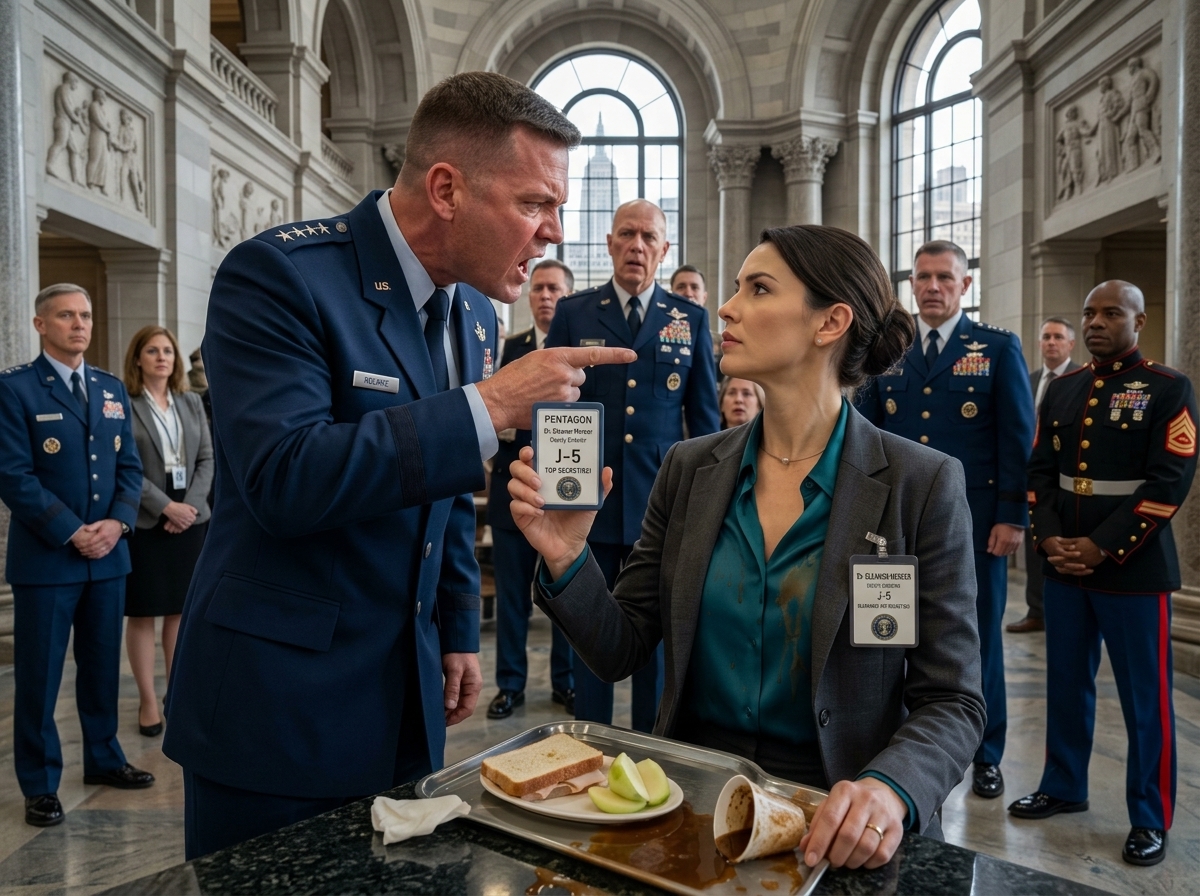
His gaze dropped to the front of my blazer.
My badge had turned inward when the coffee struck me.
Only the edge was visible.
A strip of blue laminate.
Part of a black federal seal.
Rourke followed Diaz’s eyes.
Then he looked at the badge.
And made his next mistake.
He reached for it.
I moved my hand.
Not dramatically.
Not aggressively.
Just enough.
His fingers closed on empty air.
A tiny movement.
But inside the Pentagon, small movements mattered.
People spent careers learning to read them.
Rourke stared at me.
“You hiding something?”
“No.”
I straightened the edge of my blazer.
“You are.”
The words stopped him cold.
“What did you say?”
“You heard me.”
His face tightened.
Diaz looked down.
I saw it.
Not confusion.
Guilt.
And that was when the encounter stopped being about a spilled coffee.
I had suspected something was wrong before I entered the cafeteria.
Now I knew it.
“You didn’t stop me because of seating policy,” I said.
Rourke’s eyes flicked toward Diaz.
Just once.
That was enough.
“You stopped me because somebody told you a woman in a gray blazer would enter through this side of the building around eleven hundred.”
Nobody in the room moved.
I continued.
“Someone gave you a description.”
His breathing changed.
“Someone told you to delay her.”
His jaw flexed.
“Embarrass her if necessary.”
Diaz looked like he wanted to disappear through the floor.
“Make it look like she caused the disturbance.”
Rourke went completely still.
And that silence answered the question.
A chair scraped across the floor near the east windows.
Everybody heard it.
One four-star officer stood.
Then another.
An admiral rose from his seat.
A general beside him set down his coffee.
Then the Chairman of the Joint Chiefs slowly pushed back his chair.
He looked past Rourke.
Directly at me.
“Dr. Mercer.”
His voice carried across the cafeteria without effort.
“We’ve been waiting for you.”
The room changed instantly.
Dozens of uniforms straightened.
Conversation vanished.
The captain who had laughed seconds earlier turned pale.
Rourke’s mouth opened.
Nothing came out.
I reached beneath my blazer.
Turned my badge outward.
The name sat clearly beneath the seal.
DR. MERCER.
Rourke stared at it.
Then at me.
Then toward the Chairman.
And for the first time since he had shoved me, he understood that I had never wandered into the wrong room.
I was exactly where I was supposed to be.
The Chairman walked toward us.
Nobody sat down.
A Navy admiral came with him.
So did an Air Force general and an Army general.
Four stars moved through that cafeteria, and the crowd instinctively opened a path.
Rourke did not.
He seemed physically incapable of moving.
“Sir,” he managed.
The Chairman ignored him.
His eyes went to the coffee on my blouse.
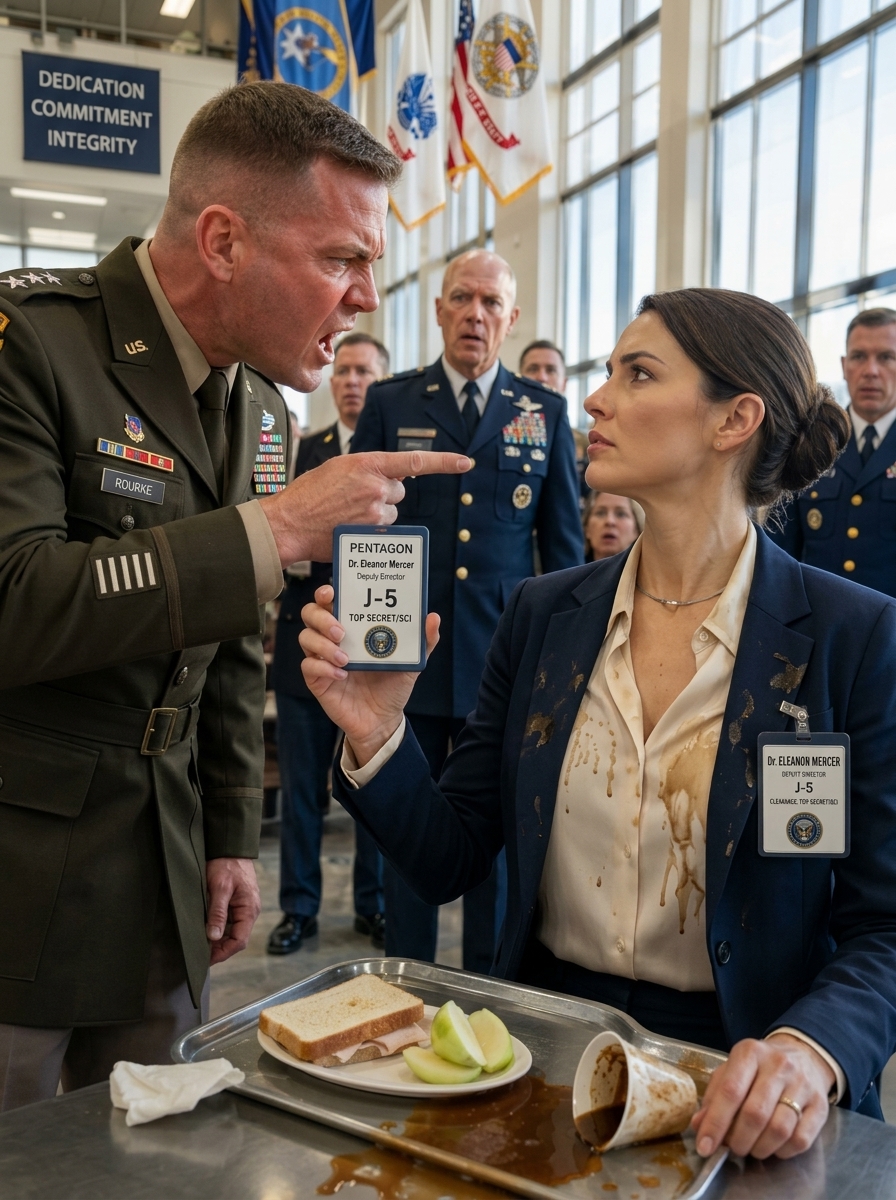
Then to the overturned cup.
Then to Rourke’s hand.
“What happened?”
Rourke found his voice.
“Sir, there was a misunderstanding.”
I said nothing.
The Chairman looked at him.
“What kind?”
“Access confusion, sir.”
“Access?”
“Yes, sir. I believed she had entered a restricted seating area.”
The Chairman looked around.
“So where is the restriction?”
Rourke hesitated.
“Sir?”
“The sign.”
Silence.
“The barrier.”
More silence.
“The written order.”
Rourke swallowed.
“There may have been a communication issue.”
The Chairman turned toward Diaz.
“Lance Corporal.”
Diaz stiffened.
“Yes, sir.”
“Was this seating area restricted?”
“By Gunnery Sergeant Rourke?”
“Yes.”
“Did he attempt to take your identification?”
“Yes.”
Rourke immediately spoke.
“Sir, I was trying to verify—”
“Stop.”
The single word hit harder than any shout.
Rourke stopped.
The Chairman’s expression changed.
Not anger.
Something colder.
“Security.”
Two Pentagon security officers moved in from the far entrance.
They had already been watching.
One of them reached for his radio.
I raised a hand.
“Not yet.”
Every head turned back toward me.
The Chairman studied my face.
He knew exactly what I meant.
This was bigger than Rourke.
Much bigger.
And he knew I knew it too.
“Doctor?”
“I want him in the room.”
Rourke blinked.
“What room?”
I looked at him.
“The room you were trying to keep me from reaching.”
For the first time, panic broke through his posture.
Not embarrassment.
Not fear of discipline.
Panic.
The Chairman nodded once.
“Bring him.”
Rourke looked at Diaz.
“Sir, I was following instructions.”
There it was.
The sentence everybody had been waiting for.
The Chairman turned back slowly.
“Whose?”
Rourke realized too late what he had said.
“I mean—”
“Whose instructions, Gunnery Sergeant?”
No answer.
“Who told you to stop Dr. Mercer?”
Rourke stared at the floor.
I watched his face carefully.
He was trying to decide which consequence frightened him more.
Telling the truth.
Or refusing to.
Finally he whispered, “I was told there might be an unauthorized civilian attempting to access the senior corridor.”
“By whom?”
Rourke’s lips tightened.
The Chairman stepped closer.
“You put your hands on a federal official inside the Pentagon after inventing an access restriction that did not exist.”
His voice remained quiet.
“And now you are telling me somebody ordered you to do it.”
Rourke said nothing.
The Chairman nodded toward security.
“Bring both Marines.”
Diaz looked terrified.
Rourke looked worse.
We left the cafeteria through the east corridor.
No one spoke as we passed.
The people watching us had no idea what they had just witnessed.
They thought the shocking part was that a Marine had shoved the wrong civilian.
They were wrong.
That was only the first layer.
Three minutes later, we entered a secure conference room.
No windows.
No personal electronics.
No recording devices.
A long black table stood beneath recessed lights.
Folders waited at six seats.
Mine was at the head.
Rourke noticed.
So did Diaz.
Neither looked comfortable anymore.
The Chairman sat opposite me.
The three other senior officers took seats along the table.
Rourke and Diaz remained standing near the wall with security behind them.
I removed my stained blazer.
Underneath it, my white blouse was ruined.
A dark coffee stain covered the left side from shoulder to waist.
I folded the blazer across the back of my chair.
Then I opened the black folder in front of me.
Rourke’s face changed.
He recognized the cover.
He had seen one like it before.
Maybe not the contents.
But the marking.
That mattered.
The Chairman clasped his hands.
“Dr. Mercer, proceed.”
I looked around the room.
“For the last seven months, an internal review team has been tracking irregularities tied to classified procurement routing.”
Rourke shifted.
I continued.
“Not missing weapons.”
“Not stolen intelligence.”
“Not anything dramatic enough to attract public attention.”
“Administrative routing.”
“Vendor priority.”
“Security exemptions.”
“Meeting delays.”
“Credential flags.”
“Small things.”
I looked directly at Rourke.
“The kind of things people ignore.”
His throat moved.
“Until enough small things create a system.”
The Army general opened his folder.
I slid several pages across the table.
“Twenty-seven meetings involving procurement investigations were delayed or disrupted in the last nine months.”
The Air Force general looked down.
“Fourteen involved the same contractor network.”
The admiral turned a page.
“Eight involved witnesses who later withdrew cooperation.”
“And five,” I said, “involved temporary access incidents blamed on administrative misunderstandings.”
The Chairman leaned back.
“The same pattern as today.”
“Yes.”
Rourke stared at the table.
Diaz looked sick.
I opened another section.
“This morning was controlled.”
Rourke looked up.
I watched comprehension arrive slowly.
“What?”
“My arrival route was changed at 0820.”
The Chairman nodded.
“Only six people were informed.”
Rourke’s face lost color.
“The east entrance.”
“Yes.”
“The gray blazer.”
“Yes.”
“The time.”
“Yes.”
His breathing became shallow.
I closed the folder.
“Someone inside this building received that information and passed it to whoever gave you your instructions.”
Rourke shook his head.
“No.”
“You were not guarding a cafeteria.”
“No.”
“You were part of a leak test.”
His eyes widened.
“You were the response.”
Silence.
Rourke finally looked toward Diaz.
Diaz took one step backward.
Security blocked him.
The Chairman turned.
“Lance Corporal Diaz.”
Diaz’s face collapsed.
“Sir, I didn’t know what it was.”
“Know what?”
“I didn’t know she was the target.”
I watched him.
Interesting choice of word.
Target.
Not visitor.
Not civilian.
Target.
Rourke cursed under his breath.
Diaz heard him.
Something in the younger Marine broke.
“He told me not to ask questions.”
Rourke spun.
“Shut your mouth.”
Security moved forward.
The Chairman did not raise his voice.
“Gunnery Sergeant, you will not speak unless addressed.”
Rourke clenched his jaw.
Diaz stared at me.
“I saw your picture.”
“Where?”
“In a packet.”
“What packet?”
“I don’t know.”
“Where?”
He hesitated.
“Gunny’s locker.”
Rourke’s chair was empty because he was still standing, but he looked as if somebody had kicked it out from under him.
The Chairman leaned forward.
“What else was in the packet?”
Diaz wiped his palms against his trousers.
“Times.”
“Entrance routes.”
“Names.”
“What names?”
“I only saw yours.”
“Why?”
“Because the picture was on top.”
I opened a blank page.
“What else?”
“A note.”
“What did it say?”
Diaz looked at Rourke.
Then at me.
“Delay Mercer.”
No one moved.
“How long?”
Diaz whispered, “Minimum twenty minutes.”
The Chairman’s eyes narrowed.
Twenty minutes.
That was not random.
Our secure briefing had been scheduled to begin at 1115.
At 1135, a procurement approval worth hundreds of millions of dollars would automatically clear unless one of three designated officials formally stopped it.
I was one of those officials.
The Chairman understood immediately.
So did the others.
The admiral pushed back from the table.
“The Meridian package.”
“Yes.”
The Army general looked at the clock.
11:19.
Sixteen minutes.
The Chairman turned to an aide near the door.
“Freeze the Meridian authorization.”
The aide moved.
I shook my head.
“No.”
Everyone looked at me.
The Chairman frowned.
“Doctor.”
“Do not freeze it.”
“Why?”
“Because whoever arranged this expects me to stop it the moment I arrive.”
The admiral leaned forward.
“So?”
“So if we stop it now, they know Rourke failed.”
Understanding moved around the table.
The Chairman looked at the clock again.
“You want them to think you’re still delayed.”
“Yes.”
“For how long?”
“Until 11:34.”
Rourke stared at me.
“You knew.”
I turned toward him.
“I suspected.”
“You let me—”
“I let you show me how far you had been instructed to go.”
His face hardened.
“You could have identified yourself.”
“I could have.”
“Then why didn’t you?”
“Because the moment I did, you would have changed behavior.”
He stared at me.
“You wanted me to touch you.”
“No.”
My voice sharpened.
“I wanted to see whether you would choose to.”
That hit him differently.
Because now he had nowhere to place the responsibility.
No order had forced his hand onto my shoulder.
No instruction required humiliation.
No security procedure required spilling my coffee.
Whatever operation had used him, the cruelty had still been his.
I turned to Diaz.
“Where did the instructions come from?”
“I don’t know.”
Rourke laughed once.
A dry sound.
“You think he knows?”
I looked at him.
“I think you do.”
He smiled without humor.
“You don’t understand what you’re dealing with.”
The Chairman’s expression changed.
“That sounds remarkably close to a threat.”
“No, sir.”
“Then explain it.”
Rourke exhaled.
His posture changed.
For the first time since the cafeteria, he stopped pretending.
“My instructions came through an internal message.”
“From?”
“Blocked sender.”
“Impossible inside this network.”
“I know.”
That mattered.
The Air Force general looked toward me.
I nodded.
“Continue.”
Rourke spoke carefully.
“Three days ago, I received a tasking packet.”
“Digital?”
“Printed.”
“Where?”
“My secured drawer.”
“Who has access?”
“Only me.”
“Then how did it appear?”
“I don’t know.”
The Chairman asked, “Why did you follow it?”
Rourke looked uncomfortable.
“Because it contained authentication.”
“What authentication?”
He hesitated.
Then gave a six-character code.
The admiral stopped writing.
The Chairman slowly looked at me.
I knew that code.
Everybody at the table did.
It belonged to an internal executive office.
One level beneath the meeting we were holding.
High enough that Rourke would reasonably believe the instruction legitimate.
High enough that questioning it could feel dangerous.
But not high enough to know my actual assignment.
Someone had stolen or duplicated access.
The clock read 11:26.
Eight minutes.
I opened another page.
“Gunnery Sergeant, exactly what were you told to do?”
“Identify Mercer.”
“And?”
“Slow her down.”
“How?”
“Any administrative means.”
“Did it authorize physical contact?”
“No.”
“Humiliation?”
“No.”
“Creating a false restricted zone?”
“No.”
He looked away.
Those had been his additions.
His choices.
His attempt to impress whoever had tasked him.
“Were you told what would happen at 11:35?”
“No.”
“Were you promised anything?”
Silence.
The Chairman noticed.
“Answer.”
Rourke’s voice dropped.
“A reassignment.”
“Where?”
“Quantico.”
“Position?”
He named it.
The Marine general at the table shook his head.
“That billet is already filled.”
Rourke stared at him.
“No, sir. I was told—”
“You were lied to.”
The words hit harder than anything else had.
Rourke looked genuinely stunned.
Whoever recruited him had never intended to reward him.
He had been disposable from the beginning.
Like me, in his mind.
Only now he knew the truth.
At 11:31, an analyst entered through the secure door and handed me a note.
I read it.
Then passed it to the Chairman.
Meridian approval remains active. External account moved. Secondary signatory preparing confirmation.
There it was.
The next step.
Someone believed I was still trapped in a cafeteria confrontation.
Someone was moving.
“Track it,” I said.
The analyst nodded.
“Already doing so.”
Rourke looked between us.
“What is Meridian?”
I ignored him.
11:32.
Three minutes.
The Chairman asked quietly, “How certain are you?”
“Enough.”
“What if they abort?”
“Then we learn who saw the delay fail.”
“And if they don’t?”
“We learn who benefits.”
The room fell silent.
11:33.
Diaz stared at the clock.
Rourke stared at me.
For the first time, there was something in his eyes besides fear.
Understanding.
He finally realized he had never been the center of this story.
He had been a doorstop.
Placed in the hallway to buy somebody twenty minutes.
11:34.
The secure phone rang.
Nobody moved for half a second.
Then the Chairman answered.
He listened.
His expression hardened.
“Confirmed?”
Pause.
“Hold all parties.”
He ended the call.
The Army general leaned forward.
“Well?”
The Chairman looked at me.
“You were right.”
I said nothing.
“Meridian was just approved.”
The admiral cursed softly.
“By whom?”
The Chairman gave a name.
No one reacted outwardly.
But every officer at the table knew it.
A senior civilian procurement official.
A man with twenty-eight years of government service.
A spotless public record.
And access to the authorization code Rourke had repeated.
Rourke sank into the nearest chair.
“That’s who—”
“Do not finish that sentence yet,” I said.
He stopped.
Because something still did not fit.
The official had access.
He had motive.
He could have planted the packet.
But he had no reason to personally know which cafeteria entrance I would use.
That information had been distributed only that morning.
Six people.
The senior official was not one of them.
Meaning there was still another leak.
Someone closer.
The Chairman saw it in my face.
“What?”
“The timing.”
He understood.
The room went cold.
I looked at Diaz.
“When did Rourke receive the gray blazer description?”
Diaz answered immediately.
“This morning.”
“What time?”
“About 0845.”
Rourke’s head snapped up.
“I got it at 0847.”
Not three days ago.
The packet had been earlier.
The description had come separately.
“Through what channel?”
Rourke hesitated.
“My phone.”
“Government device?”
“Yes.”
“Message?”
“No.”
“Call?”
“Yes.”
“Who?”
He gave a number.
The Air Force general wrote it down.
The Chairman looked toward his communications officer.
“Trace it.”
The officer stepped outside.
Thirty seconds later, he returned.
His face was unreadable.
“Sir.”
“Yes?”
“That extension originates from this floor.”
Nobody breathed.
“Which office?”
The officer hesitated.
The Chairman repeated the question.
“Which office?”
The answer landed softly.
“Executive coordination.”
My office.
Rourke looked at me.
For one second, everybody did.
I sat perfectly still.
There were four people authorized to use that extension.
Me.
My deputy.
My executive assistant.
And one rotating security liaison.
I knew exactly where all three had been that morning.
Or I thought I did.
The Chairman said, “Doctor?”
I closed the folder.
“Lock the floor.”
Security moved instantly.
Doors sealed.
Access logs froze.
No one left.
Phones were collected.
I stood.
Coffee still stained my blouse.
The physical discomfort had disappeared hours ago.
Now there was only the pattern.
A procurement scheme.
Controlled delays.
Manipulated access.
A compromised executive code.
A planted Marine.
A phone call from my own office.
Someone had built the operation close enough to study me.
Close enough to know what I wore.
Close enough to know when I entered the building.
Close enough to know that I disliked escorts and often crossed public spaces alone.
Rourke watched me.
“You really didn’t know.”
“No.”
For the first time all morning, his voice lost its aggression.
“They used me.”
“Yes.”
His face tightened.
“I thought…”
I looked at him.
“What?”
He struggled with the answer.
“I thought you were one of those people who walks into this place because they know somebody.”
“And that justified shoving me?”
“No.”
The word came quietly.
Not an apology.
Not yet.
Just recognition.
He looked at the coffee stain.
“No.”
The secure door opened.
Two investigators entered.
Between them walked a woman in a navy-blue suit.
My executive assistant.
Claire Donovan.
She had worked outside my office for eleven months.
Arrived before me every morning.
Knew my schedule.
Knew my entrances.
Knew which meetings mattered.
Knew I wore gray when I expected press cameras because dark navy looked too severe on television.
Claire stared at me.
Then at Rourke.
And for one fraction of a second, I saw the answer on her face.
Rourke saw it too.
“That’s her.”
Claire stopped.
The Chairman looked at him.
“Explain.”
“That’s the voice.”
Claire laughed.
A little too quickly.
“You cannot be serious.”
Rourke stood.
Security pushed him back down.
“She called me.”
“I’ve never spoken to you in my life.”
“You called at 0847.”
“I was in Dr. Mercer’s office at 0847.”
I looked at her.
“No, you weren’t.”
Claire turned toward me.
“Yes, I was.”
“No.”
“Doctor—”
“You arrived at 0856.”
Her expression changed.
Barely.
But enough.
“I checked the access log before this meeting.”
She said nothing.
“You were nine minutes late.”
“I was downstairs.”
“Where?”
“The lobby.”
“Which lobby?”
Silence.
The investigator beside her handed the Chairman a tablet.
He read the screen.
Then passed it to me.
At 0844, Claire’s badge had opened a restricted communications room on the east side of the floor.
At 0846, someone had placed an outbound internal call from that room.
At 0847, Rourke’s phone received it.
At 0849, Claire exited.
At 0856, she entered my office.
The room became completely silent.
Claire looked at me.
Her face had changed.
The pleasant efficiency was gone.
The professional warmth.
The woman who remembered birthdays and corrected briefing notes and carried almond milk because she knew I hated powdered creamer.
Gone.
“What were you promised?” I asked.
She did not answer.
Rourke laughed bitterly.
“That’s what she asked me.”
Claire turned toward him.
“You idiot.”
There it was.
No denial now.
The Chairman rose.
Security stepped closer.
Claire’s shoulders lowered.
The fight left her.
Not because she was sorry.
Because she knew the operation was over.
“Who recruited you?” I asked.
She looked at me.
“You already know.”
“The procurement official?”
She smiled faintly.
“He thinks he recruited me.”
That stopped everyone.
“What does that mean?”
Claire looked around the table.
“Meridian is bigger than one contract.”
I felt the atmosphere shift again.
The Chairman spoke.
“How much bigger?”
She looked at the black folder in front of me.
“You really think seven months of delays were about money?”
No one answered.
Claire’s smile disappeared.
“They were measuring response.”
My hands went still.
“What response?”
“Yours.”
The words landed directly on me.
“Meeting times.”
“Route changes.”
“How quickly security reacted when credentials failed.”
“Who called whom when systems went down.”
“Which offices were bypassed when senior officials got impatient.”
The Chairman stared at her.
“A mapping exercise.”
Claire nodded.
“Human infrastructure.”
Not secrets.
Not documents.
People.
Habits.
Shortcuts.
The invisible pathways power used when official systems failed.
That was what had been collected.
And suddenly the last seven months made perfect sense.
The procurement fraud was real.
But it had also been camouflage.
The real target was institutional behavior.
Who stepped in.
Who overrode.
Who called privately.
Who panicked.
Who trusted whom.
And today had been the final test.
Delay me.
Watch the chain react.
Map the response.
The Chairman looked toward the investigators.
“Take her.”
Claire did not resist.
But before she reached the door, she turned toward me.
“You know what the funniest part is?”
I said nothing.
“Rourke wasn’t supposed to touch you.”
Rourke looked up.
Claire almost smiled.
“He was only supposed to delay you.”
She looked at the stain across my blouse.
“All of this happened because he wanted to feel important.”
Then the investigators took her out.
Nobody spoke for several seconds.
Rourke stared at the floor.
Claire’s final words had stripped away the last excuse.
He had been manipulated.
Yes.
But not into cruelty.
That part had belonged to him.
The Chairman turned toward security.
“Gunnery Sergeant Rourke will be placed under investigation pending review of his conduct and involvement.”
Rourke stood slowly.
Then he looked at me.
“Dr. Mercer.”
I waited.
His voice sounded nothing like it had in the cafeteria.
“I was wrong.”
I said nothing.
“I saw a civilian.”
He swallowed.
“I thought that meant I could decide whether you belonged.”
His eyes dropped toward the stained blouse.
“That wasn’t my call.”
“No.”
He nodded.
“I know that now.”
Security escorted him toward the door.
Diaz followed separately.
Before leaving, Diaz turned back.
“Ma’am?”
“Yes?”
“I’m sorry I didn’t stop him.”
“You tried to warn him.”
“I should have done more.”
I watched him for a moment.
“Next time, do.”
He nodded.
“Yes, ma’am.”
Then he was gone.
The room emptied gradually.
Investigators took the folders.
Communications teams began locking down compromised systems.
Meridian was frozen.
Accounts were seized.
Access permissions were revoked.
And somewhere inside the building, careers that had looked untouchable that morning were beginning to collapse.
The Chairman remained behind.
He looked at my blouse.
“You want to change before the afternoon briefing?”
I looked down.
The coffee stain had dried into an ugly brown shape across the white fabric.
I thought about Rourke’s hand hitting my shoulder.
The captain laughing.
The quiet that spread through the cafeteria.
Claire’s hidden call.
Seven months of manipulation.
Twenty-seven delayed meetings.
Five access incidents.
People dismissed because they looked unimportant.
Warnings ignored because they came from civilians.
Rules invented because uniforms made them sound official.
“No.”
The Chairman raised an eyebrow.
“You’re going in like that?”
“Yes.”
“Why?”
I picked up my gray blazer.
The coffee stain on the sleeve matched the one on my blouse.
“Because everybody downstairs saw what happened.”
“And?”
“They should see what came after.”
For the first time that day, the Chairman smiled.
Not much.
Just enough.
Twenty minutes later, we walked back through the Pentagon.
People stepped aside.
Not because I wore stars.
I didn’t.
Not because I wore a uniform.
I didn’t.
They stepped aside because by then the story had traveled faster than either of us.
The civilian woman in the gray blazer.
The Marine who shoved her.
The Chairman who stood up.
The sealed conference room.
The security lockdown.
Rumors followed us through every corridor.
Most of them were wrong.
But one part was true.
I had not belonged in that cafeteria because somebody powerful had granted me permission to be there.
I belonged there because the building did not belong to the loudest uniform in the room.
Authority was not intimidation.
Rank was not permission to humiliate.
Security was not whatever rule somebody invented to make another person feel small.
And the people who understood power best were often the ones who did not need to announce it.
As we passed the cafeteria entrance again, I saw the young Army captain who had laughed.
He was standing near the doorway.
When he recognized me, his face went pale.
He straightened immediately.
I stopped.
He looked terrified.
“Ma’am.”
I glanced at him.
He clearly expected a reprimand.
I gave him none.
I only asked one question.
“Was it funny?”
His eyes dropped.
“No, ma’am.”
I waited.
“No.”
Then he added quietly, “It wasn’t.”
I nodded.
“That’s all.”
I kept walking.
The Chairman caught up beside me.
“You could have destroyed him.”
“I could have.”
“Why didn’t you?”
“Because humiliation was the lesson Rourke believed in.”
I looked ahead.
“I’m not interested in becoming Rourke.”
The Chairman said nothing after that.
At the elevator, my secure phone vibrated.
A message from the investigation team.
SECONDARY NETWORK IDENTIFIED. MULTIPLE DETENTIONS PENDING.
Below it was another line.
Claire Donovan was not the highest internal contact.
I stared at the screen.
The Chairman noticed.
“What?”
I handed him the phone.
His expression changed.
The elevator doors opened.
Neither of us stepped inside.
Because the story everybody in that cafeteria would tell for years ended with the Chairman standing and saying my name.
But that was not where the real story ended.
The Marine had only been the first piece.
Claire had been the second.
And somewhere deeper inside the Pentagon, someone who had spent seven months studying our routines had just learned that their network was beginning to collapse.
The Chairman handed my phone back.
“Still want to attend the afternoon briefing?”
I put the phone into my pocket.
Then I buttoned the coffee-stained blazer.
“More than ever.”
We stepped into the elevator.
The doors began to close.
And just before the cafeteria disappeared from view, I saw a maintenance worker wiping the last dark drops of coffee from the polished floor where Rourke had shoved me.
By evening, there would be no stain left.
No spilled cup.
No evidence that anything unusual had happened there.
But several floors above us, investigators were opening lockers, tracing calls, freezing accounts, and pulling access logs from servers across the building.
That stain would take much longer to clean.
And the people responsible had made one mistake they could never undo.
They thought the woman in the gray blazer was someone they could push aside.
Instead, they had shoved her directly toward the truth.