The Colonel’s Vanguard
Chapter 1: The Storm Gathers
The headlights of my military-issue sedan cut through the heavy North Carolina mist like twin bayonets.
I was still wearing my Class A dress uniform when I cleared the security gates of Fort Liberty that evening. The dark, midnight-blue wool of the jacket felt unusually stiff against my shoulders, ironed to razor perfection, decorated with four rows of service ribbons, two Bronze Stars, and the jump wings of a Master Parachutist. The gold oak-leaf insignia on my shoulder boards gleamed beneath the passing streetlamps as I navigated the winding, manicured boulevards of south Charlotte—an enclave where old money, political grease, and corporate pedigree insulated the state’s elite from the grit of the rest of the world.
My hands gripped the steering wheel with such sustained violence that the black leather groaned beneath my gloves. The dashboard clock clicked over with cold, mocking precision: 2142 hours.
Forty-seven minutes earlier, a scrambled, fourteen-second voicemail had arrived on my encrypted line. There had been no greeting. No context. Only the sound of shattering porcelain, a wet gasp, and my daughter’s voice—thin, reedy, stripped of air: “Mom… gatehouse… they’re taking the files… Richard found out—”
The line had gone dead with the blunt, unmistakable sound of a phone being stomped beneath a boot heel.
I didn’t call the local police. When an heiress marries into the Sterling empire, the local police are not a neutral shield; they are an extended wing of the Sterling estate’s private security apparatus. I called the only people whose oaths had not been bought on the private stock exchange.
I parked the sedan across two spaces in the ambulance bay of Mercy General Hospital, letting the engine idle hot. The hospital was a private, limestone-fronted medical pavilion subsidized heavily by the Sterling Family Foundation. Above the automatic glass entrance, brass letters announced the Sterling Pavilion of Surgical Excellence. A grim monument to private philanthropy masking generational rot.
The sliding doors parted with a soft hiss, admitting me into an expanse that smelled of high-grade surgical disinfectant, ozone, and cold terror.
A young triage nurse stepped into the corridor, her plastic clipboard held against her chest like an improvised breastplate. “Ma’am, restricted area. Emergency intake is down the eastern vestibule. If you’re here for visiting hours, they closed at eight—”
I didn’t break stride. I didn’t reach for credentials. I let my boots strike the linoleum with the measured, resonant cadence of a garrison commander taking the parade grounds. My gaze pinned her to the spot.
“My daughter,” I said. My voice was pitched at that terrifying, sub-audible hum that field officers use right before an artillery strike is cleared. “Where is Chloe Sterling?”
The nurse took in the brass. She took in the combat patches, the combat infantryman badge, and the gold plate pinned meticulously above my left pocket: COLONEL SARAH MILLER. The color drained from her cheeks. She was twenty-two, working the graveyard shift, and suddenly finding herself standing in the path of a Category Five hurricane in service dress.
“Room… Room 104-B,” she stammered, stepping backward until her hip hit the counter. “Ma’am, wait, the physician hasn’t signed off—”
I rounded the corner of the surgical observation wing. My blood turned into liquid nitrogen.
I wasn’t just late. They were already executing the extraction.
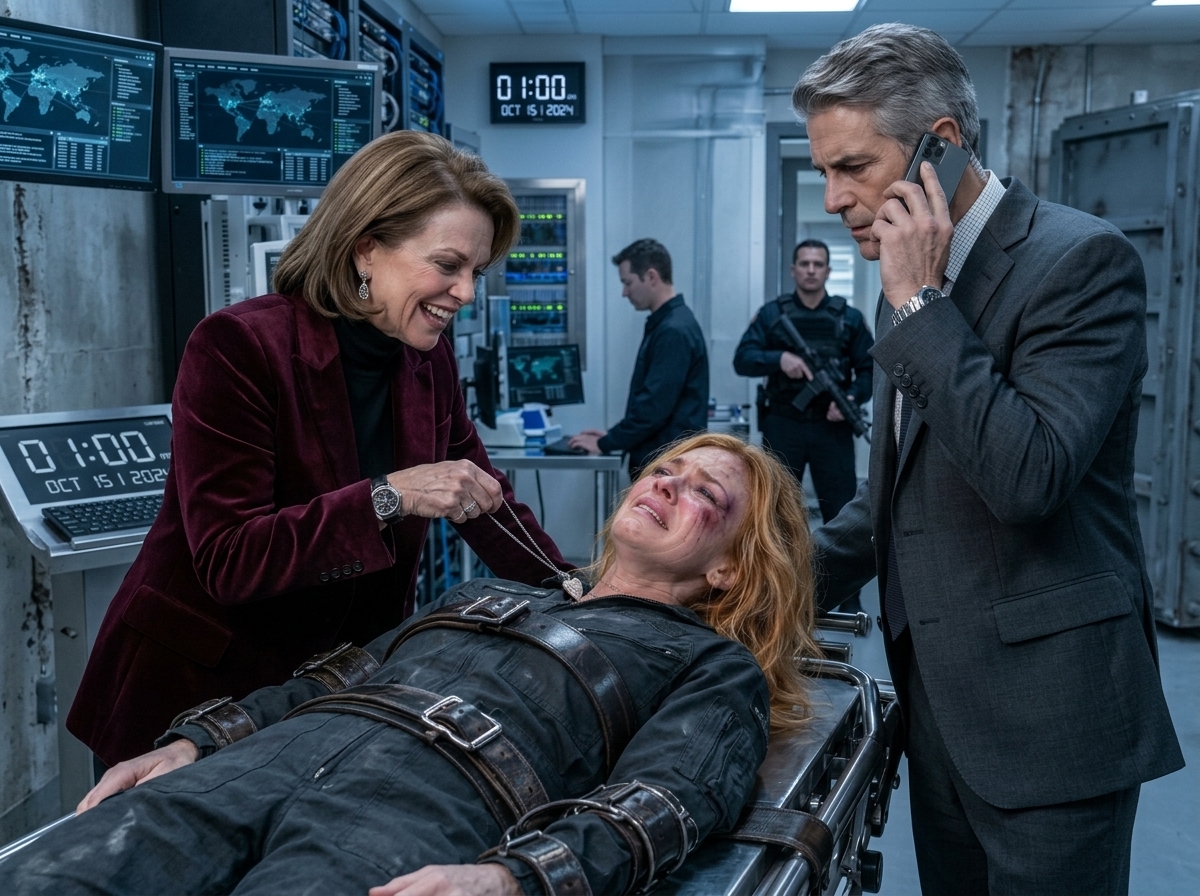
Two men in dark navy scrubs—men whose necks were as thick as telegraph poles and whose broad, scarred knuckles belonged on an offshore oil rig rather than in a postoperative ward—were wheeling a heavy steel transport gurney toward the rear freight elevator.
Strapped to the gurney was my daughter.
Canvas restraints, thick and olive-drab, were cinched tightly around her slender wrists and ankles, bolted to the tubular steel framework. Her right eye was swollen shut, surrounded by a ring of blackened, necrotic purple. Dried blood tracked from her lower lip across her chin, crusting against the torn collar of an ivory silk blouse—an expensive, bespoke piece meant for country-club dinners, now shredded across her collarbone.
She was thrashing with whatever fading adrenaline she had left, her heels kicking the foot of the gurney, making the metal casters shriek against the tile floor.
“Mom!” she screamed, the sound splintering into a broken wheeze. “Mom, don’t let them—”
The orderly at the front of the gurney stepped forward, extending an arm the size of a ham to bar my way. “Stand back, lady. Authorized patient transport. Step aside or security will remove you.”
I didn’t reach for a weapon. Twenty-six years in the infantry teaches you that the human body itself is an inventory of levers and fulcrums.
I caught his outstretched wrist with my left hand, stepped across his lead foot, and drove the heel of my right hand upward into his radial nerve while twisting his arm clockwise. The joint lock was clean, silent, and mathematically absolute. The man dropped instantly to his knees with a choked groan, his elbow locked at an angle that promised a compound fracture if he twitched a single muscle fiber.
The second orderly froze, his fingers twitching away from the gurney handles, his eyes widening as he recognized the predatory ease with which I had neutralized his partner.
“Get your hands off my daughter,” I said, barely raising my voice above a whisper.
I released the man’s arm, stepping past his kneeling form to the bedside. Chloe’s skin was radiating a dry, burning heat. Her breath came in shallow, panicked bursts that smelled faintly of iron and medicinal sedatives.
“Chloe,” I murmured, my gloved fingers touching her unbruised cheek. “Look at me. Eyes on me, soldier. I’m here.”
Her good eye focused on my face, the pupil dilated and glassy. “The… the necklace, Mom,” she whispered through split lips, her voice barely carrying over the hum of the fluorescent lights. “Don’t let her… don’t let her touch the locket…”
“Well, isn’t this an extraordinarily violent display of maternal hysteria?”
The voice behind me was like chilled vermouth: dry, sharp, and entirely devoid of human warmth.
I didn’t jump. I rose slowly, turning my back to the gurney so that my body formed an unbroken wall of wool and bone between my daughter and the people walking down the hall.
Standing five yards away was Beatrice Sterling, the matriarch of the family, wrapped in an ankle-length cashmere coat the color of dried bone. Flanking her were her two sons: Carter, the elder, sporting the bloated, red-faced look of a man whose liver had spent twenty years processing expensive bourbon, and Richard, my daughter’s husband.
Richard’s silk tie was slightly skewed. His knuckles were raw, the skin split across his index finger. He kept his hands stuffed deep into his slacks, his chin lifted at that familiar, rehearsed angle of juvenile defiance.
Beatrice held a manila legal folder in her manicured hands, her large solitaire diamond catching the harsh hospital light.
“Colonel Miller,” Beatrice said, offering an arched, theatrical smile. “Assaulting private hospital staff while in uniform. I imagine the Department of the Army has explicit regulations regarding field officers terrorizing civilian medical wards.”
“Step back, Beatrice,” I warned, my muscles coiled. “Before I forget this uniform is dry-clean only.”
“You have no authority here, Sarah,” Beatrice replied smoothly, tapping the folder with a fingernail polished in glossy crimson. “This is a private family matter. Chloe suffered a catastrophic nervous breakdown at the manor tonight. She became violent, threw herself down the terrace stairs, and attacked Richard with a pair of shears. We had her evaluated by our family physician. Dr. Evans signed the provisional 72-hour psychiatric hold twenty minutes ago.”
Richard shifted his weight, his eyes flickering toward Chloe with a venomous disgust that made my skin crawl. “She’s lost her mind, Sarah. We’re doing what’s best. We’re moving her to Oakridge Institute where she can be properly stabilized. You should be thanking us.”
Oakridge was a private, gated psychiatric fortress in the mountains near Asheville, entirely funded by the Sterling family trust. A place where troublesome wives, inconvenient whistleblowers, and family embarrassments were checked in and rarely, if ever, checked out.
“A closed facility,” I said, the realization settling into my gut like lead. “You’re trying to bury her.”
“We are managing a domestic crisis with discretion,” Beatrice countered, stepping forward until her jasmine perfume overpowered the chemical scent of the floor polish. “The transport papers are processed. Her husband has executed the medical power of attorney. If you interfere any further, Colonel, I will have the hospital administrator call the state police, and I will personally phone the Secretary of the Army before sunrise.”
She smiled, that serene, untouchable grin of a woman who had never once in her life faced a consequence that money couldn’t rewrite.
“Step away from the gurney, Sarah. Or your career ends tonight on this floor.”
I looked at Richard’s split knuckles. I looked at the legal papers in Beatrice’s hands. And for one terrifying heartbeat, the crushing weight of their institutional power pressed down on my chest, leaving me to wonder if my badge and my ribbons were enough to stop the machinery of a billion-dollar dynasty from grinding my child into dust.
Chapter 2: The Ghost in the Locket
“Nobody is calling the Secretary of the Army tonight without my written permission.”
The voice arrived from the double doors leading to the main rotunda. A woman in a charcoal trench coat stepped through, accompanied by two uniformed patrol officers. Her leather badge holder was clipped to her lapel, catching the light: DETECTIVE NORA WELLS, Charlotte-Mecklenburg Police Department.
I had known Nora since we were both second lieutenants in the Military Police Corps at Fort Bragg during the late nineties. When I left Fort Liberty three hours ago, she was the first call I made.
Beatrice didn’t flinch. She simply tilted her chin upward, her aristocratic composure hardening into pure condescension. “Detective Wells. I suggest you instruct your officers to wait outside. This is a private medical transfer, signed off by board-certified physicians. You have no legal standing here.”
“I have standing anywhere there’s an active felony assault report, Mrs. Sterling,” Wells said, stopping two paces short of Beatrice. She looked at Chloe’s swollen face, then shifted her gaze directly to Richard’s bruised knuckles. “Untie the young woman.”
The orderlies looked between Beatrice and the uniformed officers, their confidence evaporating.
Beatrice let out an irritated, theatrical sigh. “This is farcical. Look at her! She’s feral. She was biting the nurses! She refused to even let the orderlies remove her personal effects. Still clutching this… this pathetic piece of flea-market tin.”
Before anyone could react, Beatrice leaned over the side rails of the gurney. Her manicured hand darted out and snagged the delicate silver chain around Chloe’s neck.
It was a cheap, round silver locket, no bigger than a quarter. I had purchased it for twelve dollars at a roadside carnival near Fayetteville when Chloe was nine years old, right before my first deployment to Mosul. Beatrice had spent three years mocking it at family galas, calling it a “trinket for trailer parks.”
With a sharp, brutal yank, Beatrice snapped the chain.
“We don’t allow strangulation risks in transit,” Beatrice sneered, turning toward the open steel mouth of a biohazard disposal chute embedded in the hallway wall.
She moved to toss it inside.
What happened next exploded with such instantaneous, primal violence that even the patrol officers took a step back.
Chloe, who had been lying semi-conscious, groaning under the heavy canvas restraints, erupted. A sound tore from her throat—not a sob, not a cry of pain, but the savage roar of a cornered panther. With a violent heave of her spine, she arched upward against the straps. The metal frame of the gurney rattled furiously against the concrete deck.
She twisted her left shoulder with such reckless force that the heavy canvas buckle gave way with a wet snap of tearing stitching.
She didn’t reach for Beatrice’s throat. She didn’t reach for Richard.
She flung herself sideways off the gurney, her remaining wrist restraint jerking her arm backward as she hit the linoleum floor with a sickening, unpadded thud. Ignoring the impact, she scrambled across the polished tile on her knees, her fingernails clawing at the baseboard where the silver pendant had landed.
Beatrice recoiled in genuine disgust, tucking her coat around her knees. “Look at her! Look at this deranged display! Over a twenty-dollar trinket!”
Carter barked a harsh, nervous laugh. “Completely unhinged. The woman belongs in a padded cell. She’s clinically psychotic.”
Chloe didn’t look at them. She curled herself into a tight, shivering ball on the cold floor, her bruised face pressed against the baseboard, both hands clamped over the small silver disc against her breastbone. Her shoulders heaved with ragged, breathless sobs.
My heart felt as if it were being torn apart by bare hands. I dropped to my knees beside her, ignoring the orderlies, ignoring the officers, and wrapped my arms around her shivering body.
“I’ve got you,” I whispered into her hair, which smelled of copper, rain, and fear. “Chloe. It’s over. I’ve got you.”
As I held her, her violent trembling hitched. For half a second, the desperate weeping paused. Her small, bloodied hand slipped beneath my dress jacket, finding my ribcage.
She pressed the silver locket hard against my fifth rib.
One tap. Two short taps. One long, steady press.
My breath caught in my throat.
It was an old tactical signal we used when she was a child on military housing compounds—a game we played when I taught her how to navigate crowded public spaces. Asset secured. Mission active.
She wasn’t having a psychotic break. She had staged the entire breakdown.
I slowly stood up, letting my hands fall naturally to my sides. The grief in my chest transformed instantly into the icy, calculated stillness that takes over right before an ambush is sprung.
I reached inside the left breast pocket of my dress jacket, past my medals, and pulled out my encrypted mobile terminal.
“You think you control this room because your family’s name is carved into the limestone over the front door,” I said, my voice cutting through the corridor with absolute clarity. “You think you can buy doctors to sign institutional holds because you sit on the hospital’s executive endowment board.”
Richard sneered, stepping out from behind his mother. “We don’t just sit on the board, Sarah. We own the building. You’re outmatched. You’re a pensioned colonel with an attitude problem. Pack your daughter’s bags and get out of our way before I have Wells’ badge for breakfast.”
I looked directly into Richard’s eyes. “You forgot something critical, Richard. You forgot that while you were learning how to balance corporate ledgers, I was teaching my daughter how to survive behind enemy lines.”
I tapped the screen once.
A high-fidelity audio stream began to play through the phone’s speakers, amplified by the sterile acoustics of the concrete and tile hallway. The recording wasn’t from a phone call. It was a digital audio file recorded on a localized microphone, transmitted to my military server two hours ago.
“Mom, please pick up,” Chloe’s voice whispered from the speaker, raw, terrified, accompanied by the background hum of rain against leaded glass. “I found the offshore accounts. The routing codes from the defense contracts… they aren’t going to the prosthetics plant in Fayetteville. They’re being redirected to the Grand Cayman shell company. Richard found my thumb drive—he’s coming up the walkway—”
A violent bang shook the recording—the sound of an antique oak door being kicked off its latch.
“You think you’re walking out of here?” Richard’s voice roared through the speaker, distorted with a guttural, vicious rage entirely absent from his polished courtroom demeanor. “You think you can take those files to the board? I own you, Chloe! Everything you wear, everything you eat, this entire goddamn house belongs to the Sterling name!”
“Richard, please—stay back!” Chloe’s scream was followed by the sharp, sickening sound of an open hand striking skin, followed by a heavy body crashing into a coffee table.
Then came a third voice—cold, level, terrifyingly calm. Beatrice.
“Let her bleed, Richard. Don’t leave a mark on her neck. Pick up the laptop and take her personal phone. Lock the gatehouse from the outside. I’ll have Dr. Evans sign the involuntary psychiatric evaluation by midnight. By the time anyone asks where she is, she’ll be so heavily sedated at Oakridge she won’t remember her own maiden name.”
The recording clicked off.
The corridor went entirely dead.
The two orderlies took a collective step backward, their faces graying. The two patrol officers moved instinctively, their hands unsnapping the retention straps on their holsters, their eyes locked on Richard.
Richard looked as if he had been struck with a sledgehammer. His jaw went slack, his skin shifting to the color of wet chalk. “That… that’s an illegal recording. Wiretapping! That’s a federal violation! North Carolina is—”
“North Carolina is a one-party consent jurisdiction, Mr. Sterling,” Detective Wells interrupted, her voice dropping into a professional monotone that sounded like a prison door sliding shut. “And your wife was very clearly a party to the conversation.”
Beatrice was the only one who didn’t collapse into immediate panic. Her aristocratic mask shattered, replaced by the rabid, snarling desperation of a wolf caught in a snare. She turned to Carter, her voice dropping to a vicious hiss. “Get the legal team down here. Wake Vance up. Call the network affiliate. Now.“
Within twenty minutes, the corridor became a battlefield of corporate influence.
Three men in bespoke charcoal suits—the senior partners of Vance, Sterling & Howell—arrived through the main entrance, accompanied by a local television news crew from the local affiliate, their cameras already balanced on shoulders, the red tally lights blinking like ominous eyes in the dim hall.
The lead attorney, Arthur Vance, a silver-haired corporate mercenary with fifty years of litigation experience, pushed his way to the front, ignoring Detective Wells entirely.
“Colonel Miller,” Vance began, his voice dripping with practiced, condescending charm. “We strongly advise you to deactivate that recording and surrender that device immediately. What you have here is an unverified, highly edited domestic dispute that has zero bearing on the legal validity of a court-sanctioned medical transport. If you continue to obstruct this transfer, we will file immediate civil injunctions for extortion and malicious defamation. We will ensure your military pension is tied up in federal litigation until the day you die.”
The cameraman stepped forward, training his lens directly on Chloe, who remained on the floor, clinging to my boots.
Beatrice smoothed her lapels, the arrogant smirk returning to her lips. She believed the game was won. This was how the Sterlings operated: they didn’t fight in the dirt; they buried you under paperwork, legal fees, and coordinated media assassinations until you suffocated.
“You have five minutes to stand aside, Colonel,” Beatrice purred, adjusting her diamond earrings. “Before we make this very public, and very ugly.”
I looked at the cameras. I looked at the three attorneys. Then I looked past them, toward the glass doors of the ambulance bay.
Through the glass, the flashing red and blue lights of three unmarked black Suburbans illuminated the wet asphalt.
“You brought lawyers and a television camera to a corporate defense dispute, Beatrice,” I said quietly, stepping back to let Chloe lean against my legs. “That was your first tactical mistake.”
The emergency bay doors slid open with a violent crack.
The sound that followed wasn’t the squeak of hospital sneakers. It was the synchronized, iron-toed strike of six pairs of tactical combat boots moving in diamond formation.
Leading them was Major Denise Calloway, the Provost Marshal of Fort Liberty, her battle dress uniform pristine, her gaze like black ice. Behind her marched four armed Military Police investigators, their sidearms holstered in tactical rigs, and a woman in an impeccably tailored navy suit carrying a lead-sealed Department of Defense courier case.
The cameraman lowered his shoulder rig, his eyes wide. Arthur Vance stopped speaking mid-breath, his hand freezing inside his suit jacket.
The woman in the navy suit stepped past the Sterling legal team as if they were cardboard cutouts. She stopped directly in front of Richard, her identification badge held open in her left palm: SPECIAL AGENT CLAIRE MONROE, Office of the Inspector General, Department of Defense.
“Richard Sterling?” Agent Monroe asked, her tone entirely devoid of inflection.
Richard took an involuntary step back, his shoulders hitting the cold tile wall. “I… I have cleared contractor status. I run logistics for the Department of Defense. You have no jurisdiction over a domestic—”
“I don’t care about your marriage, Mr. Sterling,” Monroe said, snapping the locks on the courier case with two loud, metallic thuds. “I care about the twenty-four million dollars of defense appropriations you redirected through the Operation Valiant Return logistics pipeline.”
Beatrice’s face went rigid. Carter looked as if he were about to vomit onto the floor.
Monroe pulled a thick, red-stamped federal indictment from the case, holding it an inch from Richard’s nose.
“Richard Sterling, by authority of the United States District Court for the Eastern District of North Carolina, you are under arrest for federal procurement fraud, wire fraud, and grand treason against the United States Armed Forces.”
Richard gasped, his knees buckling, while Beatrice let out a strangled, breathless cry that sounded nothing like the queen of Carolina society.
Chapter 3: The Blood of the 104th
The emergency corridor transformed into a theater of federal execution.
The local patrol officers stepped back, hands on their duty belts, deferring instantly to the armed Military Police details who moved with mechanical efficiency. Major Calloway stepped forward, her voice slicing through the sudden, suffocating silence like a machete.
“Secure the suspect,” Calloway commanded.
Two Military Police officers stepped around Agent Monroe. Richard, his eyes darting frantically toward the exit, tried to pull his arms against his chest. “Wait! This is a jurisdictional error! Arthur, tell them! I’m a civilian contractor! You can’t arrest me without an Article 32 hearing!”
Arthur Vance, the shark who had swaggered into the hallway ten minutes earlier with the confidence of an emperor, didn’t move an inch. He took one look at the red federal seal on Monroe’s dossier, took half a step backward, and let his briefcase hang limp at his side. He was a corporate litigator; he knew the difference between a civil lawsuit and a federal treason indictment.
“Richard,” Vance muttered under his breath, his voice devoid of warmth. “Shut your mouth. Don’t say another word.”
“Arthur!” Richard shrieked, the panic finally breaking through his arrogant facade. “Do something!”
The larger MP caught Richard’s right wrist, whipped his arm behind his back with an economy of movement that left no room for resistance, and slammed him chest-first against the cinderblock wall. The impact rattled the framed medical certificates hanging nearby.
“Do not resist,” the MP barked, ratcheting the steel cuffs over Richard’s wrists with two sharp, unmistakable clicks.
“Get your filthy hands off my son!” Beatrice lunged forward, her fingers clawing at the MP’s tactical vest. “Do you know who we are? We built this city! We fund your congressional committees! I will have every one of your commissions stripped by sunrise!”
Major Calloway stepped directly into Beatrice’s path, her broad, six-foot frame eclipsing the older woman completely. “Step back, ma’am. Interfere with a federal arrest again and you will be placed in restraints alongside him.”
I remained on the floor, my arm supporting Chloe as she struggled to a sitting position. Her breathing was still ragged, her body battered, but her good eye was clear now. The glassy look had disappeared. She sat up straight, her chin lifting, watching her husband being pinned against the wall with an icy, tranquil focus.
“I found the ledgers, Richard,” Chloe said. Her voice was raspy, scraped raw from screaming in that isolated gatehouse, but it carried across the corridor like an artillery report. “I found the shell company in Nassau. The one registered under your brother’s middle name: Pelham Logistics.”
Carter Sterling went completely white. He looked at the floor, his breath coming in short, wheezing gasps, his hand trembling as he reached against the wall for balance.
“You thought I was just arranging floral centerpieces for your charity galas,” Chloe continued, her voice gaining strength with every word. “You thought because my mother was a soldier and my father was a mechanic that I didn’t know how to read a balance sheet. But you left your encryption keys on the home terminal when you went to the polo club in April. I spent three months archiving every transfer.”
She looked at Agent Monroe. “The money didn’t go to medical facilities, did it, Agent?”
Agent Monroe turned a page in her file, her eyes cold as slate. “No, Mrs. Sterling. It didn’t.”
She looked up, her gaze shifting from Richard to me.
“The funds were appropriated under the Operation Valiant Return mandate,” Monroe said, her voice dropping into a register that made the hair on the back of my neck stand up. “It was an eighty-million-dollar congressional earmark designed to manufacture advanced neural-interface prosthetics and fund cognitive rehabilitation for catastrophic combat casualties. Specifically, veterans returning from the Arghandab and Helmand campaigns.”
Monroe looked directly at Richard.
“Specifically, the 104th Airborne Division.”
A sound escaped my throat—a low, terrible sound that didn’t belong in a hospital hallway.
The 104th.
My old command.
The unit I had led through the orchards of the Arghandab Valley in 2011. I had carried those nineteen-year-old kids onto the medevac birds myself. I had held pressure dressings against severed femoral arteries while the rotors whipped the red dust into our eyes. I had sat in the living rooms of farmhouses in Ohio and Georgia, looking into the hollow eyes of mothers, promising them that their sons’ sacrifices would not be forgotten by the nation that sent them to war.
And Richard Sterling had stolen the money meant to buy their artificial limbs so he could maintain a stable of polo ponies and lease private Gulfstreams to Cabo.
My vision narrowed until the world consisted solely of the back of Richard Sterling’s head.
I took two steps forward before I even realized my feet were moving. The air in my lungs tasted like cordite. The hallway disappeared; I was back in the dirt, surrounded by the wreckage of an ambush, looking at a traitor who had just sold out my squad.
“Colonel Miller.”
Major Calloway’s hand gripped my right forearm. It was an iron grip, firm, respectful, but absolute.
“Stand down, Sarah,” Denise murmured, her voice tight with shared rage. “Let the system finish him. Don’t throw thirty years of service away on this parasite. He isn’t worth the paperwork.”
I stopped. I forced my breathing to slow, feeling the serrated edge of my pulse hammering behind my temples. I looked down at Calloway’s hand, then up at Richard.
Richard turned his head, his cheek smeared with grey paint from the cinderblock wall. When he saw the look in my eyes, he whimpered. A wet, pathetic sound. He realized, in that split second, that if we were sixty miles west in the training grounds of Fort Liberty, he wouldn’t be leaving this room in handcuffs; he would be leaving it in a canvas bag.
“Take him out,” Monroe said softly.
The MPs hauled Richard down the hallway, his designer loafers dragging against the tile. Beatrice followed them, screaming obscenities, her high heels clicking erratically as she threatened lawsuits, congressional inquiries, and divine retribution. Carter trailed behind them like a ghost, his face gray with the realization that his name was on the corporate paperwork.
The hallway fell quiet, save for the hum of the fluorescent fixtures.
The local news crew lingered for a second, their cameraman lowering his equipment. Detective Wells stepped into their path, flashing her badge. “Turn that gear off and clear the floor. Now.”
They scattered like pigeons.
I knelt back down beside Chloe. Detective Wells produced a pair of trauma shears from her pocket and cleanly severed the canvas strap still binding my daughter’s right wrist to the gurney rail.
Chloe collapsed forward into my chest, her arms wrapping around my neck with a ferocity that drove the breath from my lungs. She wasn’t crying now. Her body was rigid, her jaw clenched against my shoulder.
“I didn’t lose it, Mom,” she whispered into my ear, her voice breaking. “I kept it safe. I didn’t let them take it.”
“I know, baby,” I murmured, kissing her bruised temple. “I know.”
The battle did not end in the emergency room. It merely shifted terrain.
For the next six months, the Sterling empire went into full defensive fortification. The grand jury proceedings were buried beneath an avalanche of procedural motions, sealed filings, and emergency appeals. Richard was granted bail under electronic monitoring, retreating to the family’s thousand-acre estate behind twelve-foot wrought-iron gates.
Beatrice hired four separate public relations firms to flood the Carolina airwaves with stories about “rogue military overreach” and the “tragic mental breakdown of a fragile young woman.” They portrayed Chloe as an unstable opportunist who had become unhinged by the wealth of her husband’s family, an addict whose erratic behavior had forced her loving in-laws to seek compassionate medical intervention.
Chloe spent those six months at my quarters on Fort Liberty.
We didn’t go to country clubs. We didn’t give television interviews. Every morning at 0600, she ran the perimeter trail behind the barracks with me. Her split lip healed into a faint white line; her black eye faded into memory; the hollow, terrified look in her eyes was replaced by the cold, flinty resolve of an officer preparing for a contested river crossing.
She spent eight hours a day in a windowless briefing room in the headquarters building, working alongside federal forensic accountants, decoding the thousands of encrypted transactions she had pulled from the Sterling servers.
The final preliminary hearing for the state charges—the attempted kidnapping, felony assault, and the suppression of evidence—was scheduled for the second week of October in the Charlotte Federal District Courthouse.
The courtroom was packed to the gallery rails with reporters, industry lobbyists, and socialites who viewed the downfall of the Sterlings as the greatest spectator sport of the decade.
Chloe sat next to me at the plaintiff’s table, wearing a dark navy suit, her hair pulled back into a severe, professional chignon. She looked composed, impenetrable, and terrifyingly young.
Across the wide mahogany aisle sat the defense.
Richard wore a bespoke grey three-piece suit, though his skin was sallow and his eyes were ringed with dark circles. Carter sat beside him, chewing his fingernails until they bled.
And at the head of the table sat Beatrice.
She wore black silk, her hair styled to perfection, her neck encircled by a triple strand of South Sea pearls. She looked out over the courtroom not as a defendant, but as an empress reviewing unruly subjects. She still believed she was untouchable. She believed that forty years of political donations and backroom handshakes with the Fourth Circuit judges would buy her the outcome she required.
At the center of the bench sat Judge Robert Harmon, an eighty-year-old jurist with a reputation for running his courtroom like a dreadnought in heavy seas.
The hearing began with the expected procedural skirmishes. Agent Monroe testified to the discovery of the offshore accounts. The voicemail from the gatehouse was entered into the record, its chilling audio echoing through the wood-paneled room, making several members of the gallery gasp.
Then, Arthur Vance stood up.
He didn’t look worried. He looked smug. He held a leather portfolio under his arm and stepped to the podium with the easy, gliding gait of a man who had already seen the score at the end of the game.
“Your Honor,” Vance began, his voice resonant and buttery. “The prosecution has painted a very dramatic, very emotional picture here today. They have presented audio recordings of a tragic domestic squabble, and they have thrown around terms like ‘treason’ and ‘procurement fraud’ with reckless abandon.”
Vance turned toward our table, offering Chloe an oily, patronizing smile.
“However, the entire premise of the federal government’s corporate case relies upon internal documents allegedly exfiltrated from the primary databases of Sterling Defense Logistics. The government claims that these documents demonstrate unauthorized transfers conducted behind the back of the company’s founder and Chief Executive Officer, General Nathaniel Sterling.”
A murmur rippled through the gallery.
General Nathaniel Sterling. The patriarch. A legendary two-star general who had modernized military supply chains during Operation Desert Storm before founding the logistics company that made his family billionaires. He hadn’t been seen in public for nearly fourteen months. The rumor mill in Charlotte whispered that the old man was dying quietly in the family’s mountain retreat.
“The prosecution claims these transfers were fraudulent,” Vance continued, raising his index finger. “Yet, under the corporate charter of Sterling Defense Logistics, the Chief Executive Officer holds sole, absolute discretion over all non-appropriated reserve allocations. Unless General Nathaniel Sterling himself testifies that these transfers were unauthorized, the documents Chloe Sterling exfiltrated are not proof of fraud. They are classified, proprietary corporate records—stolen by a disgruntled spouse.”
Vance reached into his portfolio and pulled out a document affixed with a gold embossed seal.
“Tragically, Your Honor, General Sterling cannot testify. Nor will he ever testify.”
Judge Harmon peered over his reading glasses, his heavy white eyebrows knitting together. “Explain that assertion, Mr. Vance.”
Vance walked to the clerk’s bench, laying the paper down with a flourish.
“I submit to the court a certified medical affidavit, signed forty-eight hours ago by Dr. Aris Thorne, Chief of Neurology at the Carolina Brain Institute. The affidavit confirms that General Nathaniel Sterling is suffering from advanced, non-reversible vascular dementia. He is legally, medically, and cognitively incapacitated.”
Beatrice leaned back in her chair, her red lips curving into a slow, victorious smile.
“Under the terms of the Sterling Family Trust,” Vance stated, his voice ringing with triumph, “upon the cognitive incapacitation of the founder, full executive authority, full voting control, and the sole power of attorney over all corporate records transfers immediately to his designated trustee: his daughter-in-law, Beatrice Sterling.”
The courtroom went dead silent.
“As the sole legal executive of the corporation,” Vance concluded, turning his back on the judge to address the room, “Mrs. Sterling has explicitly refused to declassify or authenticate any of the documents exfiltrated by the plaintiff. Furthermore, she formally moves to suppress all internal corporate data currently in possession of the Department of Defense as illegally seized proprietary trade secrets. Without a competent CEO to allege fraud, Your Honor… there is no case.”
The lead federal prosecutor slowly sat back down, his face tight. Vance had found the silver bullet. They were going to bury the old general alive in a fraudulent diagnosis to legally invalidate the evidence that would send his grandsons to federal prison.
Judge Harmon rubbed his temples. He looked at the medical affidavit. He looked at Beatrice, then over at Chloe.
“Mr. Vance,” Harmon said, his voice weary. “If the founder is indeed legally non-compos mentis, the motion to suppress corporate ledgers as unauthorized transfers has significant precedent. Without corporate authentication, these records cannot be entered into evidence for the grand jury.”
The judge picked up his wooden gavel.
“I am inclined to grant the defense’s motion to suppress the financial exhibits pending—”
BANG.
The heavy, soundproof oak double doors at the rear of the courtroom didn’t just swing open.
They slammed into the interior brass stops with the violent, shuddering crack of a breaching charge.
Chapter 4: The General’s Vanguard
Every person in the gallery stood up in a wave of rustling wool and startled gasps. The bailiffs reached for their holsters, their boots pivoting toward the center aisle.
Standing in the frame of the open doors was an old man.
He was ninety-one years old, his frame lean and spare as a winter branch, but he stood with his spine locked at that unmistakable, ninety-degree angle found only in men who had survived four years at West Point and thirty years in the field. He wore a three-piece suit of dark charcoal wool, cut so sharply it looked like armor, with the combat infantryman badge pinned neatly to his lapel.
In his right hand, he carried a heavy, polished blackthorn walking stick with an engraved silver head. He didn’t lean on it for support; he held it like an officer holding a swagger stick during an inspection.
General Nathaniel Sterling.
Beatrice’s chair scraped loudly against the oak floor as she rose to her feet, her composure vanishing in an instant. Her face went from triumphant porcelain to the grayish hue of curds. “Nathaniel? What… what is the meaning of this? You should be at the estate—your doctors said—”
The General didn’t look at her. He didn’t even acknowledge that she occupied the same room.
He walked down the center aisle, the rubber tip of his cane striking the carpet with a measured, rhythmic thud that silenced every whisper in the gallery. Behind him marched two officers in the dress greens of the Judge Advocate General’s Corps, followed by a woman in a crisp white medical coat with the silver eagles of an Army Colonel pinned to her collar.
Arthur Vance stood frozen at the podium, his mouth hanging slightly open, holding his leather portfolio against his ribs like a shield that had suddenly lost its density.
The General reached the wooden gate separating the gallery from the well of the court. A bailiff moved forward, but Judge Harmon held up a flat, commanding palm.
“Stand down, bailiff,” Harmon said, his eyes wide behind his spectacles. “General Sterling. We were informed you were indisposed.”
The General pushed the gate open with the tip of his stick. He walked directly toward the plaintiff’s table, stopped two feet from my daughter, and slowly removed his grey fedora, resting it against his chest.
“Chloe,” the General said. His voice was like stones grinding together in a riverbed—rough, deep, weathered by half a century of command, but ringing with unmistakable clarity. “Forgive an old soldier for being late to the muster.”
Chloe rose slowly. For the first time in six months, a tear slipped past her eyelashes, tracing the line of her cheek. She didn’t speak. She simply inclined her head in a quiet, profound nod of respect.
Beatrice rounded the defense table, her voice climbing an octave into shrill, frantic indignation. “Your Honor! This is an outrage! My father-in-law is severely ill! He is suffering from advanced neurological decline! This woman has coached him—she has manipulated a senile veteran to disrupt these proceedings!”
The General turned his head. His eyes, a pale, washed-out blue, fixed Beatrice with a stare so cold, so stripped of mercy, that the woman stopped dead in her tracks, three feet from the mahogany rail.
“The only thing declining in this family, Beatrice,” the General said, each syllable dropping like an anvil onto the floor, “is the standard of basic human decency.”
He turned back to Judge Harmon, ignoring his daughter-in-law as if she were a puddle of dirty water on the road.
“Your Honor,” the General announced, his voice carrying effortlessly to the back of the vaulted room. “Allow me to introduce Colonel Eleanor Vance-Hayes, Chief of Neuropsychology at Walter Reed National Military Medical Center.”
The woman in the white coat stepped forward, opening an official military briefcase secured with twin combination dials.
“For the past seventy-two hours,” the General continued, “I have been residing in the VIP quarters of Fort Liberty, undergoing a comprehensive, independent cognitive and neurological evaluation administered by the Department of the Army. The results are certified by three separate board-certified military physicians.”
Colonel Vance-Hayes handed a thick, green-jacketed dossier to the court clerk, who passed it immediately up to Judge Harmon.
“I am not senile, Your Honor,” the General stated, leaning both hands on the head of his blackthorn cane. “My mind is as sharp as it was when I directed supply lines across the Iraqi desert in 1991. The document submitted by Arthur Vance is an outright forgery, procured from a private physician who sits on the payroll of my late son’s estate.”
Arthur Vance looked at the medical paper in his own hand as if it had transformed into a live rattlesnake. He dropped it onto the lectern, his fingers twitching toward his pockets, his eyes darting frantically toward the back exit. He knew what had just happened: he had submitted a fraudulent affidavit to a federal judge on the record.
“My son built this company to serve the soldiers who fight this nation’s wars,” the General said, his voice trembling slightly with a quiet, devastating sorrow. “When he died, I made the fatal error of trusting Beatrice to manage the family’s assets. I thought she possessed the character to honor his name.”
He looked at Richard. Richard couldn’t meet his gaze. He stared down at his manicured fingernails, his chest hitching in silent, frantic breaths.
“Instead,” the General murmured, “she raised a coward. A boy who beats women behind locked doors and steals the funding meant for paralyzed paratroopers.”
The General reached into the breast pocket of his charcoal jacket.
He didn’t pull out a paper. He pulled out a small, tarnished silver disc suspended from a broken chain.
The twelve-dollar locket.
The courtroom held its breath as the General walked to the bench and placed the cheap piece of carnival jewelry on the polished mahogany wood, directly in front of Judge Harmon.
With a thumb that had pulled triggers in three separate combat theaters, General Sterling pressed the microscopic latch on the side of the locket.
The front casing didn’t contain a photograph. It swung open to reveal a hollowed-out interior, precision-milled from aircraft-grade aluminum.
Nestled inside the cavity was a high-capacity, encrypted micro-solid-state drive, smaller than a postage stamp.
“They thought she was just a silly, sentimental girl,” the General said, turning his back on the bench to face the defense table. “Beatrice mocked her jewelry. Richard called it cheap trash. But Chloe didn’t just read the balance sheets, Your Honor. She spent four months using an encrypted hardware bridge I provided her to download the raw, unredacted transaction logs from Richard’s private server.”
The General’s eyes locked onto Richard.
“She didn’t run away that night because she was terrified, Richard. She ran because she had just finished copying the final ledger proving the existence of the offshore shell accounts in Zurich and the Caymans. She hid the drive in that locket because she knew that the only thing your mother hated more than my presence was her sentimentality.”
The realization hit the defense table like an armor-piercing round.
Chloe hadn’t been fighting to save a childhood memory in the emergency room. She had been protecting the entire repository of evidence that would dismantle the Sterling dynasty. She had taken a beating, suffered a fractured cheekbone, and endured being strapped to a transport gurney like a madwoman, all to keep that twenty-dollar piece of tin from falling into Beatrice’s hands.
“Chloe came to me seven months ago,” the General said softly, his voice cracking with emotion. “She brought me the initial anomalies. She asked me what she should do. And I told her… God help me, I told her to gather conclusive proof before we went to the Department of Justice. I told her to wait.”
He pointed a shaking, weathered finger directly at his grandson.
“My delay nearly got this girl killed in that guest house. And for that, I will spend the remainder of my days asking for her forgiveness.”
Something inside Beatrice Sterling snapped.
It was not a gradual unraveling; it was a catastrophic structural failure. The aristocratic facade, the forty years of cultivated southern poise, the polite country-club veneer—all of it disintegrated in an instant.
With a guttural, animalistic shriek that made the women in the front row recoil, Beatrice vaulted forward.
She didn’t target Chloe. She didn’t target the General.
Her hands hooked into talons, her diamond rings flashing beneath the chandeliers, she threw herself over the low swinging gate of the partition, lunging across the clerk’s table directly toward the bench where the silver locket lay.
“You lying little whore!” Beatrice screamed, her voice cracking into a raw, gravelly howl. “You destroyed this family! I’ll crush it! I’ll swallow the damn thing!”
She almost reached it. Her manicured nails brushed the wood of the judge’s bench.
Two United States Marshals hit her from the flank with the force of an oncoming train.
The impact slammed Beatrice hard against the oak paneling. The three strands of South Sea pearls snapped, scattering hundreds of white spheres across the carpet like teeth. She kicked, thrashed, and screamed like a feral beast, her designer skirt tearing as three deputy marshals pinned her shoulders to the floor, forcing her arms behind her back with mechanical, brutal efficiency.
“Secure her!” Judge Harmon roared, slamming his gavel down three times with such violence the sound echoed like gunshots. “Restrain that woman! Clear the well!”
As the steel cuffs clicked around Beatrice’s wrists, she twisted her head, her face purple with exertion, her hair wild and clinging to the sweat on her forehead. She glared up at the General, who stood unmoving, looking down at her with the cold, sorrowful pity one reserves for a rabid dog about to be put down.
“You’re finished, Nathaniel!” Beatrice spat, saliva spraying from her lips. “The company will be liquidated! You have no heirs! Richard is going to prison, and Carter is an idiot! You’ll die alone in an empty house!”
The General leaned forward slightly on his stick, his expression entirely dead.
“The company will not be liquidated, Beatrice,” the General said quietly. “Because you no longer hold a single share of it.”
Chapter 5: The Sovereign Fortress
The courtroom remained in an uproar for ten straight minutes while deputy marshals dragged Beatrice Sterling out through the secure side corridor. Her shrieks could be heard echoing through the ductwork long after the steel security door slammed shut behind her.
Judge Harmon sat behind his bench, his robe askew, his chest heaving with indignation. He adjusted his glasses, picked up his gavel, and brought it down once.
“Order,” the judge commanded, though his voice was completely unnecessary. The courtroom was frozen in place.
Arthur Vance was sitting at the defense table with his head buried in his hands, completely abandoned by his associates, who had already begun packing their leather briefcases to leave the well of the court. Richard Sterling sat upright, his eyes glazed, staring at the scattered pearls on the carpet as if they were the ruins of his own life.
General Sterling stepped back to the podium. He took another document from Colonel Vance-Hayes, laying it flat before the court clerk.
“Your Honor,” the General said, his tone returning to that dry, rhythmic military cadence. “Pursuant to Section 14 of the Sterling Family Testamentary Trust, created in 1994, I retained a unilateral revocation right over all corporate asset allocations in the event of proven criminal malfeasance by any acting trustee.”
He pointed to the notarized signature on the document.
“As of 0800 hours this morning, Beatrice Sterling, Richard Sterling, and Carter Sterling have been formally removed from all executive boards, stripped of all voting shares, and terminated from every subsidiary of Sterling Defense Logistics.”
The General turned to look at Chloe.
“Furthermore, under the terms of the trust’s Honor and Integrity Clause—a provision my late wife insisted upon when we incorporated thirty years ago—any individual who exposes systemic corruption within the executive ranks that directly endangers the lives of active-duty military personnel is entitled to assume the role of Sole Operational Trustee until a formal board can be convened.”
The General offered a faint, tired smile.
“Chloe Miller Sterling is now the primary trustee and majority voting shareholder of the company. She holds sixty-two percent of the voting equity.”
The General looked back at his grandson.
“She doesn’t just own your house, Richard. She owns the company that pays your bail bondsman. And I have instructed her to terminate your retainer.”
Judge Harmon looked down at the documents. He read the clauses with meticulous, slow precision. When he looked up, the weariness had left his eyes, replaced by the grim satisfaction of an old jurist who had finally seen a crooked ledger balanced.
“The court finds the medical affidavit submitted by the defense to be fraudulent,” Judge Harmon ruled, his voice echoing through the chamber like thunder. “The motion to suppress the financial records is denied with prejudice. Given the violent disruption of these proceedings, the verified flight risk, and the severity of the federal charges involving treasonous procurement fraud, bail for Richard Sterling and Beatrice Sterling is hereby revoked.”
He brought the gavel down with a sharp, final crack.
“The defendants are remanded to the custody of the United States Marshals Service pending trial.”
Richard stood up, his mouth opening to speak, but no sound came out. Two marshals took him by the elbows, pulled his arms behind him, and clicked the cuffs into place. He was marched past our table without a word. He didn’t look at Chloe. He couldn’t.
Carter Sterling put his head on the table and began to weep silently into his tailored wool sleeves.
Chloe didn’t smile. She didn’t cheer. She watched them go with the quiet, heavy grace of someone who understood that winning a war does not mean you celebrate the battlefield’s wreckage.
Eight months later, the Carolina autumn arrived with crisp, cool mornings that turned the leaves of the loblolly pines to deep shades of copper and gold.
I stood on the stone veranda of what used to be the Sterling family estate in south Charlotte.
The three-story antebellum manor still stood, its white columns rising into the blue sky, but the high wrought-iron gates were gone. In their place stood an open stone entryway, welcoming a steady stream of vans, civilian sedans, and supply trucks.
The sprawling south lawn—where Beatrice had once held her invitation-only polo galas—was now crisscrossed with paved, wheelchair-accessible walking trails lined with dogwoods and mountain laurel.
And the grim, isolated guest house where Richard had beaten my daughter behind locked doors was entirely gone.
Chloe had not simply renovated it. She had brought three commercial Caterpillar excavators onto the grounds the week after the federal trial concluded and personally directed the demolition until the structure was reduced to a pile of crushed timber, splintered heart-pine, and pulverized foundation stone.
In its place now stood a modern, two-story timber and glass pavilion, flooded with natural light from floor-to-ceiling windows. Above the front double doors, cut into a massive block of native Carolina granite, an inscription read:
THE OPERATION VALIANT RETURN RECOVERY INSTITUTE
Dedicated to the Families and Survivors of the 104th Airborne Division
The facility was fully operational. Down in the courtyard, veterans in physical therapy were navigating the parallel bars, assisted by staff therapists whose salaries were now permanently endowed by the thirty million dollars recovered from Richard Sterling’s frozen offshore accounts.
In the east wing, a fully funded legal defense clinic provided free representation to military spouses navigating domestic violence, institutional suppression, and predatory corporate agreements.
A soft knock sounded against the cedar doorframe behind me.
I turned to see General Nathaniel Sterling sitting in an electric wheelchair, his blackthorn cane resting across his knees. He looked frail—his body was finally succumbing to the weight of his nine decades—but his eyes were clear, bright with a quiet, peaceful pride.
“Colonel Miller,” the General said, nodding toward the courtyard. “The physical therapy team just took delivery of the third batch of neural-link prosthetic units. Designed and built right here in Mecklenburg County, using the original contract specifications.”
“My veterans thank you, General,” I said, leaning against the rail.
“Don’t thank me, Sarah,” the old man chuckled, looking over his shoulder toward the main office. “Thank the Chief Executive Officer. She works sixteen hours a day. I haven’t seen an officer organize supply lines with that much efficiency since Schwarzkopf was running the Seventh Corps.”
Through the glass wall of the corner office, I could see Chloe.
She was standing at a wide oak drafting table, reviewing architectural blueprints for the new dormitory expansion. She was wearing a simple, dark green linen shirt with the sleeves rolled to her elbows, her hair clipped back, a pencil behind her ear.
Around her neck, catching the morning light, rested the cheap twelve-dollar silver locket.
She had replaced the broken chain with a length of parachute cord—the same green, 550-pound cord used by paratroopers on drop zones. She had refused to polish the silver; she wanted the scratches, the dings, and the tarnished edges to remain visible to anyone who walked into her boardroom.
She looked up through the window, saw me watching, and smiled.
It was the same smile she had given me when she was six years old, learning how to ride a bicycle on the asphalt streets of Fort Bragg—the smile of a child who had fallen, scraped her knees, stood back up, and conquered the road anyway.
She stepped out onto the veranda, holding two mugs of black coffee, handing one to me and one to the General.
“The federal court in Raleigh just finalized the forfeiture decrees,” Chloe said, leaning her hip against the stone balustrade. “Richard received twenty-two years at Butner Federal Correctional Complex. Carter received eight for conspiracy. And Beatrice…”
Chloe paused, looking out over the gardens.
“Beatrice’s attorneys filed a petition for compassionate release yesterday. Citing depression and social isolation.”
I took a sip of the coffee, feeling the warm liquid cut through the crisp mountain air. “And what did the trustee say?”
Chloe’s expression didn’t change. The soft, gentle girl who had left for college five years ago had been tempered in the furnace of betrayal, and what had emerged was made of tool-grade carbon steel.
“The trustee informed the federal warden that the Sterling Foundation has officially reassigned all discretionary medical-advocacy funds to the veterans’ prosthetic clinic,” Chloe said evenly. “Mrs. Sterling will receive the exact same standard of medical care as every other inmate in the federal system. Not a dollar more. Not a penny less.”
General Sterling let out a dry, gravelly chuckle that turned into a quiet cough. “Well spoken, Madam Chairwoman. Very well spoken.”
The General turned his chair around, leaving us alone on the veranda as the morning bell rang in the dining hall below, signaling breakfast for the thirty recovering soldiers residing in the east wing.
Chloe stood beside me, her shoulder resting against my arm. I reached out and covered her hand where it rested on the cool stone railing.
“I thought I was weak, Mom,” she murmured, her voice dropping into a quiet, reflective tone. “That night in the hospital… when they were wheeling me toward that freight elevator… I thought I had failed. I thought needing you to come through those doors meant I wasn’t strong enough to survive on my own.”
I looked down at the silver locket resting against her chest, then turned to look into my daughter’s hazel eyes.
“Listen to me, Chloe,” I said, my voice steady, leaving no room for doubt. “In the military, when a unit is surrounded and outgunned by an entrenched enemy, they don’t surrender to prove their independence. They call for close air support. They consolidate the line, hold the perimeter, and wait for the armor to break the encirclement.”
I reached up and gently tapped the silver locket with my index finger.
“You held the perimeter for six months inside their fortress, entirely alone. You gathered the intel, you secured the evidence, and you kept the critical asset safe under direct physical assault.”
I put my arm around her shoulders, pulling her against my side.
“Calling for backup wasn’t weakness, Chloe,” I told her, my chest swelling with a pride so profound it felt like an ache. “It was the signal to commence the counterattack.”
Chloe leaned her head against my shoulder, watching the American flag rise above the recovery pavilion as the morning bugle played from a speaker across the lawn.
The Sterlings had spent three generations accumulating wealth, believing that power was something you bought in state houses, corporate boardrooms, and country clubs. They believed that because we carried no pedigree and held no trust funds, we could be discarded, silenced, and buried in the dark whenever we became inconvenient.
They had forgotten that some families do not measure their strength in balance sheets.
They had chosen the wrong daughter to break.
And they had chosen the absolute wrong mother to fight.
If you want more stories like this, or if you’d like to share your thoughts about what you would have done in my situation, I’d love to hear from you. Your perspective helps these stories reach more people, so don’t be shy about commenting or sharing.