PART 2: The Call That Changed Everything: A Mother’s Journey From Hidden Truths to a Home Built on Trust –
Explaining why Daniel was upset.
Explaining why I had stopped attending dinners with friends.
Explaining why I needed to leave gatherings early.
Explaining why I checked my phone whenever he texted.
Explaining why I had become quieter.
I looked down at the tiny face against my chest.
My daughter had stopped crying.
Her cheek rested against the towel, her lips moving softly as though she were dreaming already.
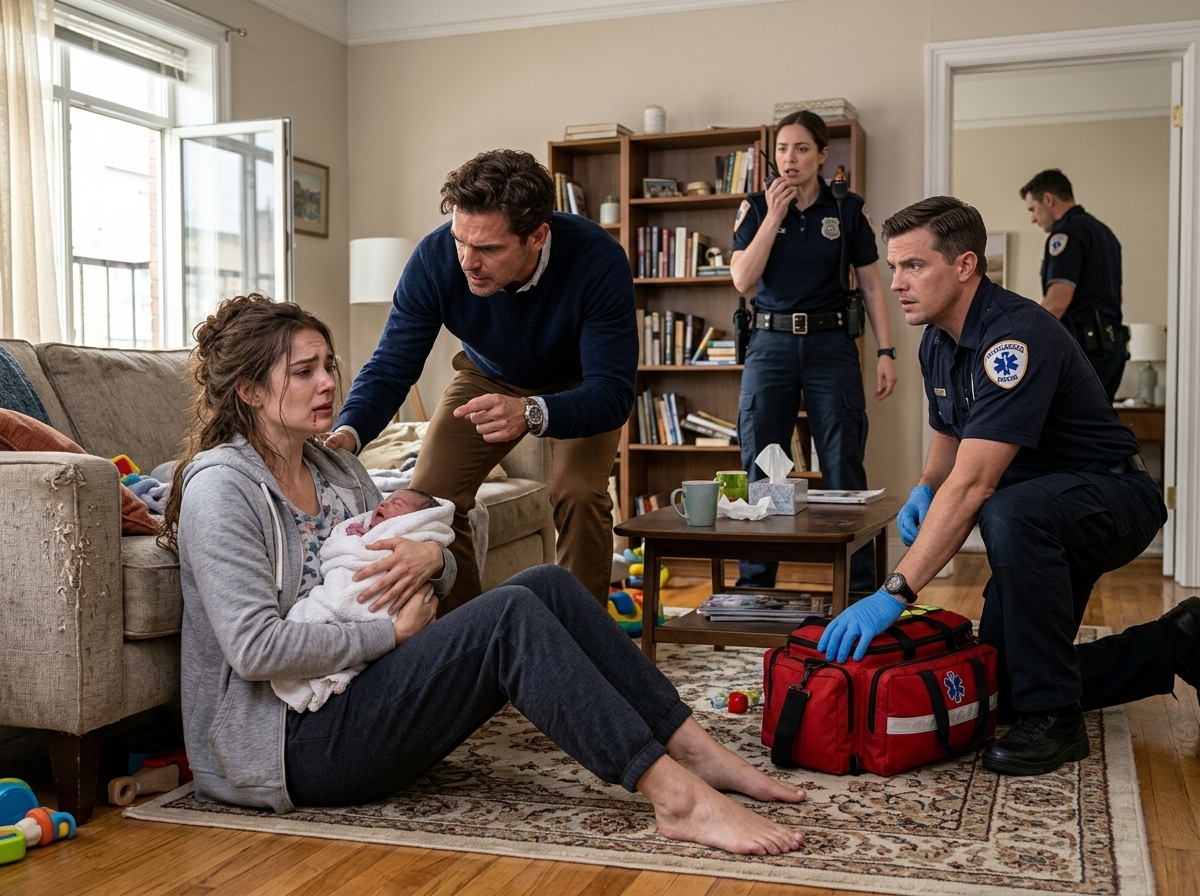
“What’s her name?” the female paramedic asked.
I stared at her.
I hadn’t expected the question.
Daniel and I had debated names for months, but he had rejected nearly every one I loved.
During the last week of my pregnancy, he had insisted we would decide after she was born.
Now I realized something strange.
For the first time in a very long time, nobody was waiting to overrule me.
“Nora,” I whispered.
The paramedic smiled.
“Nora.
That’s beautiful.”
From the hallway Daniel said, “We didn’t decide that.”
Officer Patel turned slightly.
“Sir, please stay where you are.”
Daniel looked at me.
It was a look I knew well—not rage exactly, but disbelief that I had made a decision without him.
Normally, that look would have made me second-guess myself.
This time I looked back at my daughter.
“Nora,” I repeated.
And somehow the name settled something inside me.
The medical team moved carefully.
One paramedic wrapped Nora in a thermal blanket while another helped me stand.
The moment I tried to put weight on my wrist, pain shot through my arm.
“You may have a fracture,” he said quietly.
“We’ll stabilize it.”
Daniel stepped forward.
“I’m her husband.
I’m riding with her.”
“No,” I said.
Everyone stopped.
My voice wasn’t loud.
That was what surprised me most.
For years I had imagined that standing up for myself would require courage that felt dramatic—some powerful declaration delivered without fear.
Instead, I was terrified.
My knees were shaking.
My face hurt.
I was wearing an old bathrobe over clothes that should have been packed neatly into a hospital bag.
But I still said it.
“No.
I don’t want him with me.”
Officer Patel nodded once.
“All right.”
Daniel stared at me.
“Mara.”
Hearing my name in his voice almost pulled me backward into the familiar pattern.
Mara, you’re making this bigger than it is.
Mara, think about what people will say.
Mara, you’re exhausted.
Mara, you know I didn’t mean it that way.
But then the phone on the bathroom floor crackled.
The dispatcher was still there.
“Mara?”
I looked at it.
“Yes?”
“You did exactly what you needed to do.”
I would remember that sentence for years.
Not because it solved anything.
It didn’t.
My marriage didn’t disappear when the ambulance doors closed.
My fear didn’t vanish.
The truth didn’t suddenly become simple.
But another person had heard what happened.
For once, my memory wasn’t standing alone.
At the hospital, time became strangely soft around the edges.
Doctors examined Nora first.
She was cold but healthy.
The pediatric nurse placed her beneath a warmer and spoke to her as though she were an honored guest.
“Well, Miss Nora, you certainly know how to make an entrance.”
I laughed.
It came out halfway between a laugh and a sob.
The nurse glanced at me but didn’t make a fuss.
She simply tucked another blanket around my shoulders.
My wrist was badly sprained, not broken.
My lip needed cleaning but no stitches.
The obstetrician who examined me spoke gently and explained everything before doing it.
Every person in the room seemed determined to give me choices.
Would I like water?
Would I like the lights dimmed?
Did I want Nora beside me?
Was there anyone I trusted enough to call?
That last question sat between us for several seconds.
I had someone.
I just hadn’t spoken to her properly in almost a year.
My younger sister, Elise.
Daniel never explicitly forbade me from seeing her.
That would have been too obvious.
Instead, whenever Elise visited, something went wrong.
Daniel had a headache.
Daniel had work.
Daniel thought Elise was disrespectful.
Daniel reminded me afterward of every awkward sentence she had spoken.
Gradually, calling my sister became exhausting.
So I stopped.
Now the nurse placed my phone in my good hand.
“You don’t have to call anyone,” she said.
“But sometimes it helps to have one familiar person nearby.”
I opened Elise’s contact.
My thumb hovered over her name.
Then I pressed Call.
She answered on the second ring.
“Mara?”
Her voice changed immediately.
“What happened?”
I couldn’t speak.
“Mara?”
“I had the baby.”
There was a silence.
“You—what?”
“She’s okay.”
“Are you okay?”
Another silence.
Then the truth came out in the smallest possible form.
“No.”
Elise arrived forty minutes later wearing mismatched shoes.
I noticed them before anything else.
One black sneaker.
One gray.
When she entered my room, she stopped near the door as though she was afraid I might ask her to leave.
Then she saw Nora sleeping beside me.
Her entire expression changed.
“Oh.”
That one word contained nearly a year of missed conversations.
She approached slowly.
“She’s beautiful.”
“Her name is Nora.”
Elise looked at me.
“You finally used Grandma’s name.”
I nodded.
Our grandmother Nora had raised us for several years when our mother was struggling financially after our father died.
She had been stubborn, practical, and incapable of letting anyone leave her kitchen hungry.
“She would have loved that,” Elise said.
For a few minutes we talked only about the baby.
Her fingers.
Her hair.
Her tiny nose.
Ordinary things.
Safe things.
Eventually Elise pulled the visitor’s chair closer.
“What happened at the house?”
My throat tightened.
“I’m not ready to tell the whole story.”
“Okay.”
That answer startled me.
No questions.
No judgment.
No I told you so.
Just okay.
I stared at the blanket.
“The dispatcher heard some of it.”
Elise’s face changed, but she remained calm.
“Then you don’t have to convince anyone.”
That was exactly what I needed to hear.
Later, Officer Patel came to speak with me.
He didn’t ask me to make decisions immediately.
He explained that statements had been taken, that the emergency call had been preserved, and that Daniel would not be permitted into my hospital room because I had asked that he stay away.
“What happens next?”
I asked.
“Tonight?” he said.
“You recover.
Your daughter gets checked again.
You sleep if you can.”
“And tomorrow?”
“Tomorrow there will be choices.”
I looked toward Nora.
Choices.
The word frightened me almost as much as Daniel did.
Because choices meant responsibility.
It meant I could no longer pretend everything was happening around me.
The following morning, a hospital social worker named Helen arrived.
She was in her late fifties, with silver-streaked hair and a notebook she barely used.
She asked where I wanted to go after discharge.
“My house,” I said automatically.
Then I stopped.
It wasn’t really an answer.
It was habit.
Helen waited.
“My sister has an apartment,” I said.
Elise, sitting near the window, immediately said, “You can stay as long as you need.”
“I don’t want to take over your life.”
“You won’t.”
“You have work.”
“I also have a couch.”
Helen smiled slightly.
“Sometimes the next step doesn’t need to be the permanent step.”
That became the plan.
Not forever.
Not divorce.
Not reconciliation.
Not some huge decision about the rest of my life.
Just Tuesday.
I would go home with Elise on Tuesday.
That afternoon, Daniel called the hospital twelve times.
I didn’t answer.
Then he began sending messages.
At first they were apologetic.
I’m sorry.
I panicked.
I was exhausted.
Please don’t let one terrible night destroy our family.
Then came explanations.
You know how much pressure I’ve been under.
Neither of us was thinking clearly.
You should have woken me sooner.
Then concern.
Is Nora okay?
I deserve to know about my daughter.
Then something different.
Your sister has always hated me.
Don’t let her turn this into something it isn’t.
I turned the phone facedown.
Elise had seen enough.
“I’m going to say something,” she said carefully.
I braced myself.
“I don’t hate Daniel.”
I looked at her.
“I thought you did.”
“I stopped trusting him.
That’s different.”
“Why?”
She hesitated.
“There were things you told me, Mara.
Then later you’d tell the same story differently.”
My stomach tightened.
“What things?”
“Remember Mom’s birthday dinner two years ago?”
I did.
Daniel and I had arrived nearly an hour late.
I had told everyone there had been traffic.
“There wasn’t traffic,” Elise said.
I stared at her.
“You called me from the car.”
A memory surfaced.
Rain against the windshield.
My hand trembling.
Daniel refusing to drive because I had disagreed with him about what gift we should bring.
He had pulled into a parking lot and stayed there until I apologized.
I had forgotten telling Elise.
Or perhaps I had worked very hard to forget.
“What else?”
Elise shook her head.
“Not today.”
“Tell me.”
“Mara—” “Please.”
She reached into her handbag.
“I brought something because I thought eventually you might ask.”
She handed me a plain envelope.
Inside were printed emails.
All from me.
Or rather, from an email account I had abandoned almost three years earlier.
I read the first.
Elise, I need you to keep something for me.
Attached below was a photograph of documents.
Bank statements.
A lease.
A handwritten list of dates.
My own words followed.
I keep changing my mind about whether anything is really wrong.
If I ever tell you that everything was fine, keep this anyway.
My hands went cold.
I looked at Elise.
“When did I send this?”
“Almost three years ago.”
I remembered none of it.
Not because my memory was gone.
Because I had spent years becoming skilled at packing uncomfortable truths into boxes inside myself.
On the final page was another note.
There’s an account Daniel doesn’t know I found.
I don’t know what it means yet.
Below it was a bank name and the last four digits of an account number.
I read the sentence twice.
Then three times.
“What account?”
Elise’s expression was troubled.
“I was hoping you could tell me.”
I looked at the date.
Three years earlier.
Long before my pregnancy.
Long before that night.
Long before the emergency call.
And suddenly I understood that the mystery of my marriage hadn’t begun on the bathroom floor.
That night had only been the first time someone else heard it.
PART 3: The Call That Changed Everything: A Mother’s Journey From Hidden Truths to a Home Built on Trust –
I didn’t investigate the account immediately.
That surprised Elise.
It surprised me too.
For the first few days after leaving the hospital, my world became deliberately small.
Nora ate.
Nora slept.
I tried to sleep.
Elise made soup and pretended not to notice when I cried over ridiculous things, including a commercial about laundry detergent.
Her apartment had only one bedroom, so she moved her desk into the hallway and gave Nora and me the room.
“You don’t need to do that,” I protested.
“I work from a laptop.”
“You need your space.”
“So do you.”
Arguments with Elise ended strangely.
They ended.
There were no punishments afterward.
No silence designed to make me apologize.
No three-hour discussions about my tone.
Sometimes we disagreed about something, and then fifteen minutes later she asked whether I wanted tea.
It took me nearly two weeks to stop waiting for the second part.
Daniel contacted me only through the channels the attorney recommended.
Helen, the hospital social worker, had connected me with a family-law clinic.
I had gone to the first appointment expecting someone to tell me what I should do.
Instead, the attorney, Rachel Kim, asked what I wanted.
“I don’t know.”
“That’s allowed.”
“What would you do?”
She smiled kindly.
“My job isn’t to live your life for you.
My job is to explain what your choices mean.”
Choices again.
I was beginning to understand why I had avoided them for so long.
Choices were frightening because they removed excuses.
During those first weeks, Daniel’s messages changed.
The apologies became more polished.
He had started counseling.
He understood that what happened was unacceptable.
He wanted to be involved in Nora’s life appropriately.
He said he would respect whatever boundaries professionals recommended.
Some of his words sounded sincere.
Maybe some of them were.
That was the hardest part.
People imagine that difficult relationships become easier to understand once something unmistakably wrong happens.
Mine didn’t.
Daniel had made me breakfast when I was sick.
He had sat beside my mother during cataract surgery.
He remembered exactly how I liked my coffee.
He could be funny and generous and thoughtful.
He was also the man whose voice I had heard through a locked bathroom door while holding our newborn daughter.
Both things were true.
Healing, I discovered, depended on allowing both truths to exist without letting the kinder one erase the other.
Three weeks after Nora was born, I finally returned to the mysterious account.
Elise sat across from me at her kitchen table while I opened the old emails.
The account wasn’t what I expected.
Daniel hadn’t hidden money from me.
I had.
Or rather, I had opened the account myself.
My name was the only one attached to it.
I stared at the old statement.
“This doesn’t make sense.”
Elise leaned closer.
Then I saw the deposits.
Small amounts.
Forty dollars.
Seventy-five.
Twenty.
Occasionally two hundred.
All transferred from an account I recognized.
My personal checking account from before I married Daniel.
I had nearly forgotten it existed.
“You were saving,” Elise said.
“For what?”
She looked at me.
“You really don’t remember?”
I searched the emails again.
Eventually I found one with the subject line JUST IN CASE.
Inside was a message I had sent to myself.
I am opening this account because every time I decide I need space, I change my mind the next morning.
I want enough money for a deposit on an apartment if I ever need one.
This doesn’t mean I’m leaving.
It means I want the choice.
I covered my mouth.
Elise reached across the table.
“I knew about the email,” she said.
“I didn’t know how much was there.”
We checked.
The account had accumulated nearly nine thousand dollars.
Years of tiny deposits.
Birthday money.
Freelance design jobs.
Refunds.
Cash I had quietly redirected and then forgotten.
Nine thousand dollars wouldn’t rebuild a life forever.
But it could start one.
I laughed suddenly.
Elise stared at me.
“What?”
“I was helping myself.”
“What do you mean?”
“Past me.”
I turned the laptop toward her.
“She didn’t know what was going to happen.
She wasn’t even sure she was right.
But she did this anyway.”
Elise’s eyes filled.
“Maybe she knew you’d need options.”
That evening I took Nora for a walk.
Autumn had settled over the neighborhood while I was busy learning how to become a mother.
Leaves moved along the sidewalk.
Someone was cooking with garlic in an apartment upstairs.
A man across the street was teaching a little boy how to ride a bicycle, one careful push at a time.
Ordinary life continued everywhere.
I had once believed major decisions announced themselves with certainty.
Instead, mine arrived quietly while pushing a stroller past a bakery.
I did not want to return to the house.
That realization was so simple I almost missed its importance.
Not I shouldn’t.
Not Elise thinks I shouldn’t.
Not the attorney advises caution.
I didn’t want to.
I wanted a key that belonged only to me.
I wanted to choose where the sofa went.
I wanted mornings that did not begin with checking another person’s mood.
When I told Elise, she nodded.
“What?”
“I’m waiting.”
“For what?”
“For the part where you ask whether I think you’re making the right decision.”
I smiled faintly.
“I’m not asking.”
“Good.”
Finding an apartment became our project.
Not a grand home.
Not the dream house Daniel and I had once planned.
A two-bedroom rental above a florist.
The kitchen was small and one cabinet door refused to close completely.
But sunlight filled the living room every afternoon.
The landlord, Mrs.
Alvarez, lived downstairs and had owned the building for thirty-one years.
When I told her I had a baby, she immediately showed me where previous tenants had stored strollers.
“You’ll hear the delivery truck at seven every morning,” she warned.
“That’s okay.”
“And the florist plays old music.”
“What kind?”
“Mostly Motown.”
“I can live with that.”
She looked at Nora.
“Babies like music.”
I signed the lease.
The day I moved in, Elise brought a folding table, our mother brought dishes, and two of my old coworkers arrived with boxes.
I had been ashamed to contact them.
I assumed they would ask where I had been.
Instead, my former colleague Priya hugged me carefully and said, “We missed you.”
That was all.
Later, as we assembled a bookshelf incorrectly for the second time, she asked whether I ever wanted to return to freelance work.
“I don’t know if anyone would hire me.”
Priya stopped tightening a screw.
“Mara, you didn’t forget how to design because you took time away.”
“I’m rusty.”
“Rust isn’t permanent.”
I wrote those words down later.
Rust isn’t permanent.
Neither, apparently, was isolation.
Life didn’t transform overnight.
There were meetings with attorneys.
There were discussions about safe arrangements concerning Nora.
There were forms and appointments and financial disclosures.
Daniel attended counseling and, through his attorney, expressed a desire to cooperate rather than contest every decision.
I didn’t know what his future choices would be.
For once, I stopped trying to predict them.
My responsibility was to make mine.
Two months after Nora’s birth, something unexpected arrived in the mail.
A letter.
Not from Daniel.
From his mother.
I almost threw it away unopened.
Daniel’s mother, Margaret, had always been gracious to me, but distant.
Whenever Daniel and I argued, she had a way of changing the subject.
“Marriage has difficult seasons,” she once told me.
At the time, I assumed she meant I should be more patient.
I placed the envelope on the kitchen counter.
It stayed there for three days.
Finally, during Nora’s afternoon nap, I opened it.
Mara, I have rewritten this letter many times because I don’t know whether contacting you is welcome.
I am not writing to defend Daniel.
I am writing because there is something I should have told you years ago.
I sat down.
The next line made my hands tremble.
When Daniel was eighteen, his father left our family.
Daniel believed for years that his father simply abandoned us.
That is what I allowed him to believe.
I kept reading.
The truth was more complicated.
Margaret explained that Daniel’s father, Thomas, had struggled with controlling behavior and intense anger during their marriage—not violence, she emphasized, but a pattern of criticism, withdrawal, and rigid control that had slowly shaped the household.
Eventually, Margaret asked him to leave.
But she never told Daniel why.
“I thought protecting him from the truth would protect his relationship with his father,” she wrote.
Instead, Daniel grew up believing his mother had failed to keep the family together.
He had spent years quietly resenting her.
Margaret had watched some of the same habits appear in her son.
She had seen them.
And she had said nothing.
Then came the line that hurt most.
I owe you an apology for my silence.
There were moments when I recognized behavior that concerned me, and I chose comfort over honesty.
I lowered the letter.
My first reaction was anger.
Not because Margaret had caused what happened.
Daniel was responsible for his own decisions.
But because she had known enough to wonder.
And wondering should have been enough to speak.
I finished the letter.
There was no request that I forgive Daniel.
No request that I reunite the family.
Only one request.
If you are ever comfortable, I would like to know my granddaughter.
I understand if that is not possible now.
I called Elise.
“What should I do?”
“You know I’m not answering that anymore.”
I sighed.
“You’re irritating.”
“I learned from Grandma Nora.”
I read the letter to her.
When I finished, Elise was quiet.
Finally she said, “What do you want?”
I looked through the living-room doorway.
Nora was asleep beneath a mobile of paper stars.
“I think I want to meet Margaret.”
The meeting took place at a café near my attorney’s office.
Margaret arrived early.
She looked smaller than I remembered.
For several seconds neither of us knew whether to hug.
We settled for sitting down.
“I’m sorry,” she said immediately.
“You already wrote that.”
“I needed to say it where you could see my face.”
I studied her.
“Why didn’t you tell me?”
“Because I was afraid of being wrong.”
That answer caught me off guard.
She looked down at her coffee.
“And because Daniel is my son.
Sometimes loving someone makes people brave.
Sometimes it makes them cowardly.”
I didn’t answer.
“I kept thinking he would mature,” she continued.
“Then I kept thinking your marriage was private.
Then every year it became harder to admit I had noticed anything at all.”
“Did Daniel know about his father?”
“Not everything.”
“Does he now?”
Margaret nodded.
“I told him after Nora was born.”
“How did he react?”
“He was angry with me.”
I expected that.
“Then,” Margaret said, “he asked me something.”
“What?”
“He asked whether I thought he had become like his father.”
I felt my chest tighten.
“What did you say?”
“The truth.”
She met my eyes.
“I told him some patterns were familiar.”
For the first time, I saw Margaret not only as Daniel’s mother but as another woman who had spent years questioning which truths were hers to tell.
“I’m not asking you to trust him,” she said.
“I’m not asking you to trust me either.”
“Then what are you asking?”
“A chance to earn whatever relationship with Nora you believe is appropriate.”
It was the right answer.
Not perfect.
Not easy.
But right.
We agreed to begin slowly.
Supervised visits.
Short ones.
No pressure.
Over the following months, Margaret kept every promise.
She didn’t carry messages from Daniel.
She didn’t ask me to reconsider the separation.
She simply came to see Nora.
Sometimes growth looked less like grand gestures and more like someone finally learning not to interfere.
By spring, Nora was six months old.
I was working again.
Only part-time, mostly from home.
Priya had referred me to a small publishing company that needed a freelance designer.
My first paycheck was modest.
I framed a copy of it anyway.
One rainy afternoon, while preparing tax documents, I opened the old savings account again.
There were several transactions I hadn’t noticed before.
One deposit in particular stood out.
Five hundred dollars.
Three years earlier.
The description contained a name.
M.
Bennett.
I assumed it was mine until I checked the date.
Then I remembered.
I hadn’t made that deposit.
I called Elise.
“Did you ever put money into my account?”
“No.”
“Are you sure?”
“Positive.”
“What about Mom?”
“She didn’t know about it.”
I stared at the transaction.
M.
Bennett.
Margaret Bennett.
Daniel’s mother.
My pulse quickened.
I called her.
When I asked about the deposit, the silence on the other end lasted several seconds.
Then she exhaled.
“I wondered whether you would ever find that.”
“You knew about my account?”
“Not exactly.”
“What does that mean?”
“Mara, there’s something else I should have told you.”
I closed my eyes.
“What?”
Her answer was quiet.
“Three years ago, you came to my house without Daniel.”
I sat completely still.
“I did?”
“You were crying.”
I remembered nothing.
Margaret continued.
“You asked me one question.”
“What question?”
She paused.
“You asked me whether people can love someone and still need to leave them.”
Outside my window, the rain tapped softly against the glass.
And suddenly a forgotten afternoon began coming back to me.
PART 4 (THE END): The Call That Changed Everything: A Mother’s Journey From Hidden Truths to a Home Built on Trust – 2.031
The memory returned in pieces.
Margaret’s kitchen.
A yellow teapot.
My coat folded across my lap.
Rain against the windows, just as it was raining now.
I remembered sitting at her table three years earlier, before Nora, before the hospital, before I had learned how quietly a person could disappear from her own life.
Daniel and I had argued the night before.
Not about anything important.
That was the strange part.
A dinner reservation.
I had changed the time without asking him.
The disagreement lasted hours.
By the next morning I wasn’t thinking about dinner anymore.
I was thinking about how tired I felt.
So I drove to Margaret’s house.
I didn’t know exactly why.
Perhaps some part of me hoped his mother would explain him.
Instead, I asked her whether love and leaving could exist at the same time.
“What did you tell me?”
I asked over the phone.
Margaret was silent.
“I told you yes.”
My eyes filled.
“Then why don’t I remember?”
“You were frightened by your own question.”
That sounded like me.
“You started defending him almost immediately,” Margaret continued.
“You said he was stressed.
You said every marriage had difficult periods.”
The exact phrases she had later repeated to me.
A realization settled over me.
“You learned those words from me.”
“Yes.”
Neither of us spoke.
For years I had remembered Margaret telling me marriage had difficult seasons and interpreted it as advice to endure.
Now I understood she had been repeating my own language back to me.
“Why did you deposit the money?”
“You told me you were trying to save.”
“I told you about the account?”
“Only that you had opened one.”
“Why five hundred dollars?”
“Because that was what I had in the emergency envelope in my desk.”
Despite everything, I laughed.
“You had an emergency envelope?”
“My mother taught me.”
“So did Grandma Nora.”
Margaret laughed too, softly.
Then her voice changed.
“I should have done more.”
“Maybe.”
I surprised both of us with the answer.
I no longer needed to rescue everyone from guilt.
“But I also told you I was fine,” I continued.
“You did.”
“And then I went home.”
“Yes.”
“Would you have stopped me?”
“I wanted to.”
“Why didn’t you?”
“Because you were an adult, Mara.
And because I didn’t know then what I know now—that sometimes supporting someone means telling the truth without trying to take over their decision.”
I thought about that for a long time.
After we ended the call, I sat beside Nora’s crib.
She had begun rolling onto her stomach in her sleep, something that made me check on her far more often than necessary.
Her fingers curled around the edge of her blanket.
I thought about the women who had quietly placed stepping-stones in my path.
Elise keeping the emails.
Margaret adding five hundred dollars.
The dispatcher remaining on the line.
The nurse asking whom I trusted.
Helen reminding me that the next step did not have to be permanent.
Rachel explaining choices instead of making them.
Priya telling me rust wasn’t permanent.
None of them had saved me.
That distinction mattered.
They had helped me remember I could move.
By summer, the legal process had become less frightening because it was no longer mysterious.
Daniel and I were separating permanently.
We communicated through structured channels.
Arrangements regarding Nora were made carefully, with professionals involved and her well-being placed first.
Daniel continued counseling.
One day, months after the hospital, I received a letter from him through the agreed process.
I almost refused to read it.
Eventually, I did.
It was different from his earlier messages.
There were no excuses.
No requests that I remember the good years.
No suggestion that stress, exhaustion, fear, or misunderstanding had caused what happened.
He wrote: I have spent most of my life believing an apology was supposed to get me something—another chance, forgiveness, reassurance.
I am beginning to understand that an apology can simply be an acknowledgment of harm.
I paused there.
The old Mara would have searched for hidden meaning.
Was he changing?
Did he want me back?
Was I supposed to respond?
The new version of me asked a simpler question.
Do I want to answer?
The answer was no.
So I didn’t.
That was not bitterness.
It was peace.
Several weeks later Margaret visited Nora.
By then Nora recognized her.
The moment Margaret entered the apartment, Nora kicked both feet and produced an excited sound that made Margaret laugh.
“Oh, so now you remember me?”
Nora grabbed her glasses.
“Yes,” Margaret said.
“Apparently you remember those.”
I watched them together.
There had been a time when I believed family was a fixed structure.
Husband.
Wife.
Child.
Grandparents.
A house.
A holiday photograph.
I had confused structure with safety.
Now our family looked different.
Elise came on Wednesdays and brought groceries she claimed were “accidentally buy-one-get-one-free.”
My mother stayed every Friday afternoon while I worked.
Margaret visited twice a month.
Priya became Nora’s unofficial aunt and bought her picture books far too advanced for her age.
Mrs.
Alvarez downstairs knocked whenever the florist received leftover daisies.
None of it matched the future I had planned.
Yet it felt more like home than anything I remembered.
One Saturday morning, I finally unpacked the last box from the old house.
It had sat unopened in my bedroom for nearly nine months.
Inside were photographs.
Wedding invitations.
Birthday cards.
A ceramic bowl Daniel and I bought on our honeymoon.
I lifted it carefully.
For years I had believed that moving forward required deciding what the past meant.
Was the marriage entirely a mistake?
Were the happy memories false?
Had Daniel ever loved me?
I finally understood that I did not need perfect answers.
A beautiful afternoon could have been beautiful.
A joke could still have been funny.
A holiday could still have mattered.
Those memories did not erase what came later.
And what came later did not require me to pretend I had never been happy.
Human lives were inconvenient that way.
They refused to become simple stories.
I wrapped the bowl again and placed it in a donation box.
Not because I hated it.
Because I didn’t need it.
At the bottom of the box, I found something else.
A notebook.
My pregnancy journal.
I had stopped writing in it around my seventh month.
The first pages were ordinary.
Doctor appointments.
Name ideas.
Lists of things to buy.
Then I reached an entry I had forgotten.
I hope my daughter grows up knowing that love should make room for her.
I read the sentence again.
Below it I had written: I hope I remember that too.
I sat on the floor and cried.
Not the desperate tears from the hospital.
Not grief exactly.
Something gentler.
Recognition.
The woman I had been before Nora’s birth had not disappeared.
She had been leaving messages everywhere.
In emails.
In savings accounts.
In journals.
She had been asking future Mara to listen.
So I did.
I tore the page carefully from the notebook and framed it.
It went beside my desk.
A month later, I was offered a permanent position with the publishing company.
Not full-time.
Three days a week, mostly remote.
Priya called before the official email arrived.
“You’re supposed to act surprised.”
“You’re terrible at secrets.”
“I kept it for almost eleven minutes.”
“That may be a record.”
“So?”
“So what?”
“Are you taking it?”
I looked around my apartment.
Nora was sitting on the floor surrounded by wooden blocks, trying unsuccessfully to place one on her head.
“I think so.”
“Think?”
I smiled.
“Yes.”
Saying yes no longer frightened me when I knew I was allowed to say no.
On Nora’s first birthday, we held a small party in the courtyard behind the florist.
There were paper lanterns, sandwiches, cupcakes, and entirely too many balloons.
Elise arrived first.
Mom came carrying enough food for twenty people.
Margaret brought a tiny knitted cardigan she had made herself.
Mrs.
Alvarez supplied flowers.
Priya brought three books and defended herself by claiming books did not count as excessive gifts.
Nora wore a yellow dress and spent most of the afternoon fascinated by a wooden spoon.
At one point I stepped back from everyone.
The courtyard glowed in late-afternoon sunlight.
Elise and Margaret were arguing cheerfully over how to cut the cake.
Mom was trying to take photographs.
Priya was reading a board book to a child who was currently holding it upside down.
I felt something I hadn’t expected.
Not triumph.
Not vindication.
Gratitude.
Life had not become perfect.
There were still difficult days.
I sometimes woke from uneasy dreams.
Certain sounds brought back memories I would rather not revisit.
Trust returned slowly.
Even harmless disagreements could make my heart race before my mind reminded my body that I was safe to speak.
I began seeing a counselor regularly.
She helped me understand something important.
Recovery was not becoming the person I had been before.
That woman had survived by doubting herself.
I was becoming someone new.
Someone who listened sooner.
Someone who did not confuse another person’s disappointment with danger.
Someone who understood that forgiveness did not always mean reconciliation.
Sometimes forgiveness meant releasing the hope that the past would become different.
My relationship with Margaret deepened gradually.
One afternoon she told me Daniel had asked whether she thought I would ever forgive him.
“What did you say?”
I asked.
“I told him that wasn’t a question I could answer.”
I smiled.
“You’re getting good at boundaries.”
“At my age, finally.”
“Grandma Nora would say you’re never too old to learn.”
Margaret looked toward my daughter.
“I wish I had met your grandmother.”
“You would have argued constantly.”
“Then I definitely wish I had met her.”
We laughed.
A year after the night Nora was born, I called the emergency dispatch center.
I had thought about doing it many times.
I didn’t expect to speak directly with the dispatcher, but after explaining why I was calling, a supervisor contacted her and asked whether she was willing to receive a message.
Her name was Andrea.
I wrote carefully.
I told her Nora was healthy.
I told her we had our own apartment.
I told her I had returned to work.
Then I stared at the screen.
There was so much more I wanted to say.
Instead, I wrote: You asked me to stay with you that night.
I want you to know that I did.
Not only during the call.
Afterward too.
Your voice became proof that what I heard and felt was real.
Thank you for staying.
Two weeks later, I received a response.
It was brief.
Mara, I remember your call.
I am glad you and Nora are doing well.
You made the decisions that carried you forward.
I only had the privilege of being there when you made the first one.
Give Nora a happy birthday from someone who heard her first cries. —Andrea I printed it.
It went into Nora’s baby book.
Someday, when she was old enough, I would tell her the story of her birth.
Not every detail.
Not until the details were appropriate.
But I would tell her something important.
I would tell her that the night she entered the world, many people chose to help.
And that afterward, her mother learned to choose too.
Two years passed.
Our apartment above the florist became crowded with toys, books, and evidence of a toddler who believed crayons belonged on every available surface.
One Sunday morning Nora stood near the window wearing pajamas covered in tiny strawberries.
“Mommy!”
“What?”
“Flowers!”
The florist downstairs was unloading buckets of tulips.
“You like those?”
“Pink.”
“They are pink.”
She considered this.
Then she pointed toward the kitchen.
“Pancakes.”
“That is a completely different subject.”
“Pancakes, please.”
I laughed.
“Fair argument.”
While I cooked, music floated up from downstairs.
Motown, just as Mrs.
Alvarez had promised on the day I signed the lease.
Nora danced badly and enthusiastically beside the table.
I watched her and thought about that frightened woman in the hospital who believed she had to solve the rest of her life before she could take the next step.
She had been wrong.
Lives are rarely rebuilt with one brave decision.
They are rebuilt with hundreds of ordinary ones.
Open the account.
Make the call.
Accept the spare room.
Sign the lease.
Take the job.
Tell the truth.
Rest.
Try again.
Trust carefully.
Love differently.
Make pancakes on Sunday morning.
Later that afternoon, Elise arrived with a small wooden box.
“What’s this?”
“A birthday present.”
“My birthday was last month.”
“I know.
I forgot where I hid it.”
I opened the box.
Inside was an old brass key.
I frowned.
“Grandma Nora’s house.”
My breath caught.
The house had been sold after our grandmother died.
“I found it while cleaning Mom’s garage,” Elise said.
“Obviously it doesn’t open anything anymore.”
I held it in my palm.
The key was worn smooth around the edges.
“I thought you might want it.”
“I do.”
I placed it beside the framed journal page on my desk.
A key to a house that no longer belonged to us.
At first that seemed sad.
Then I understood why it felt right.
A key did not have to open the same door forever to remind you that doors could open.
That evening, after Elise left and Nora was asleep, I stood by the apartment window.
The florist downstairs had closed.
The street was quiet.
Lights glowed behind neighboring windows.
Families eating dinner.
Someone practicing piano.
Someone laughing.
Someone washing dishes.
Ordinary lives.
Imperfect lives.
I used to think a happy ending meant getting back everything you lost.
Now I knew better.
Sometimes a happy ending was discovering you no longer wanted the old ending.
I didn’t get my old marriage back.
I got my voice.
I didn’t get the future I once imagined.
I got the freedom to imagine another one.
I didn’t give Nora the family photograph I had planned.
I gave her something better.
A home where love made room for her.
And, finally, room for me too.
I switched off the lamp and walked toward my daughter’s room.
At the doorway, I stopped.
Nora slept peacefully beneath her paper stars.
For a moment I remembered another night—the freezing bathroom floor, the towel, the phone beside me, and a stranger’s calm voice saying, Stay with me.
I touched the old brass key in my pocket.
“I did,” I whispered.
Then I closed the door gently, leaving it open just enough for the hallway light to shine through. – END OF PART 4 – LET SAY YES AND LIKE, SHARE THIS POST IN FACEBOOK SO THAT WE HAVE THE MOTIVATION TO SHARE MORE STORIES