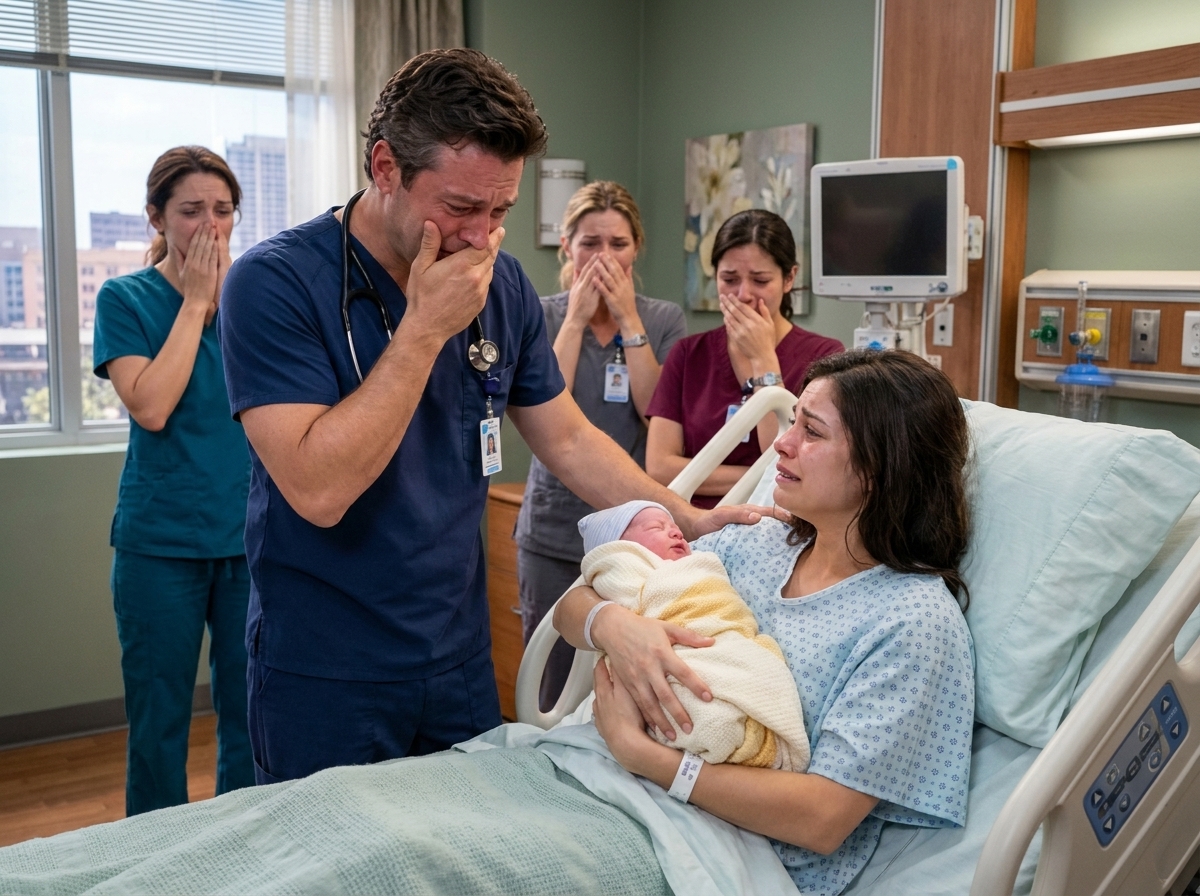
For a moment, I thought I had misunderstood him.
I glanced at the name embroidered on his coat.
ROBERT WRIGHT, M.D.
Then back at him.
“Your son?”
“Yes.”
My first reaction wasn’t anger.
It was confusion.
Logan had spoken about his family so rarely that I had learned not to ask questions. When we first met, he told me his mother had died when he was young. Months later, when I asked whether his father was still alive, he had gone quiet.
Advertisement
Eventually he said, “For all practical purposes, no.”
I had assumed that meant death.
Apparently, it didn’t.
“He told me he didn’t have family,” I whispered.
Robert’s expression tightened.
“For many years, he believed that.”
“Believed it?”
He looked at my baby again.
“There are truths people tell themselves long enough that they begin to feel exactly like facts.”
That answer irritated me.
I had just spent twelve hours bringing a child into the world alone.
I had no patience left for riddles.
“Doctor, please.”
He nodded immediately.
“You’re right. I’m sorry.”
He drew in a careful breath.
“Logan’s mother was named Margaret. We married very young. Too young, perhaps, though I loved her very much. Logan was our only child.”
Something in his voice changed when he said Margaret’s name.
Not grief exactly.
Something quieter.
The ache of a room long after everyone has left it.
“When Logan was six,” he continued, “my marriage began falling apart.”
He gave a faint, humorless smile.
Advertisement
“I was a young physician convinced that every emergency at the hospital required me personally. I missed dinners. School events. Weekends. I told myself I was providing for my family.”
His eyes lifted toward mine.
“I didn’t understand that providing a home and being present in it are two different things.”
I said nothing.
“Margaret and I separated. Logan stayed with her. I was supposed to see him every other weekend, but there were arguments, scheduling problems, work emergencies. Sometimes they were her fault. Sometimes mine. Mostly, if I’m truthful, two disappointed adults became very good at making communication difficult.”
“And Logan?”
“He was caught in the middle.”
Robert rubbed his thumb over the edge of his hospital identification badge.
“When he was thirteen, Margaret became ill.”
My arms tightened instinctively around my son.
Robert noticed.
“She had cancer,” he said gently. “She received treatment for nearly two years. Logan knew she was sick, of course, but she protected him from much of the seriousness.”
“Did you come back?”
“I tried.”
Something about the answer mattered.
Not I did.
I tried.
“Margaret and I had reached a point where almost every conversation carried years of unfinished hurt. She wanted control over the little time she felt she had left. I wanted to help. Logan wanted everyone to stop arguing.”
Robert sighed.
“And then Margaret died.”
I looked toward the sleeping baby in my arms.
“How old was Logan?”
“Fifteen.”
That explained some things.
Not everything.
But some.
The way Logan had always gone quiet around anniversaries.
The way he hated hospitals.
The way he kept one faded photograph of a woman with auburn hair inside an old book but never displayed it.
“What happened afterward?”
“Logan came to live with me.”
Robert’s voice dropped.
“It went badly.”
I looked back at him.
“We were almost strangers by then. He was grieving. I was grieving. And instead of recognizing that, I tried to create order. School schedules. Curfews. Grades. Rules.”
A small, rueful smile crossed his face.
“I was a physician. I knew how to identify symptoms in strangers, yet somehow I couldn’t recognize loneliness in my own son.”
I thought of Logan at twenty-nine, standing in our tiny kitchen late one night, fixing a cabinet hinge that had bothered me for weeks.
He had been quiet that evening.
When I asked what he was thinking about, he had said, “Nothing worth talking about.”
I had believed him.
Now I wondered how many times in his life people had accepted that answer because it was easier.
Robert continued.
“When Logan was seventeen, we had an argument. I don’t even remember what started it. College, perhaps. Or his mother. He accused me of arriving too late to be his father.”
Robert’s eyes drifted toward the window.
“And I said something I have regretted every day since.”
“What?”
“I told him that if he had already decided I had no place in his life, then perhaps I should stop trying to force one.”
The words didn’t sound cruel.
But I understood immediately why they had mattered.
To a grieving seventeen-year-old, they could have sounded like surrender.
“He left?”
“Not that night. But emotionally? Yes.”
Logan stayed with Robert until graduation, then moved away.
Advertisement
For years, they barely spoke.
A birthday message.
A Christmas card.
Occasionally an email that received a two-word reply.
Then nothing.
“Why didn’t Logan tell me any of this?”
“I don’t know.”
I laughed softly, but there was no humor in it.
“That seems to be the sentence everyone has for me lately.”
Robert flinched.
“I imagine it does.”
My son shifted against me.
His face scrunched for a second, then relaxed.
Robert watched him.
“What did you recognize?” I asked.
He smiled faintly.
“His expression.”
“He’s been alive for twenty minutes.”
That made Robert laugh.
It was a quiet, surprised laugh, as if he hadn’t expected himself to remember how.
“Margaret used to say the same thing about Logan. He was born looking offended by the entire arrangement.”
Despite myself, I smiled.
Robert’s eyes grew wet again.
“The shape around his eyes. The little crease beside his left eyebrow. Margaret had it. Logan has it. And your son…”
He stopped.
“Your son has it too.”
I looked down.
I had never noticed anything unusual.
To me, he was simply beautiful.
Red-cheeked, sleepy, tiny.
Mine.
“What’s his name?” Robert asked.
I hesitated.
Logan and I had once talked about baby names long before pregnancy became real.
He liked old-fashioned names.
I liked short ones.
There had been one name we both loved.
“Ethan.”
Robert nodded.
“Ethan.”
He said it as if committing it to memory.
A knock came at the door.
The nurse stepped inside.
“Mrs.—”
She checked my chart.
“Joanna, we need to take Ethan for a routine examination for a few minutes.”
Every part of me resisted immediately.
The nurse must have seen it.
“You can come with us if you’d prefer.”
“I would.”
“Of course.”
Robert stood.
“I should go.”
I stared at him.
“Wait.”
He stopped.
“Do you know where Logan is?”
That was the question beneath every other question.
Robert’s expression changed.
Not dramatically.
Just enough.
“You do,” I said.
He didn’t answer quickly enough.
I felt my stomach tighten.
“You know where he is.”
“I know where he was three months ago.”
I stared at him.
“Three months?”
Robert lowered himself into the chair again.
“Joanna, I need to be careful here.”
“No. You need to tell me the truth.”
He nodded.
“Logan came to see me about four months after he left you.”
My breath stopped.
He had gone to Robert.
While I was working breakfast shifts with swollen ankles.
Advertisement
While I counted coins at the laundromat.
While I slept alone in a rented room and convinced myself I didn’t need anyone.
Logan had gone to his father.
“He told you about me?”
“Yes.”
“And the baby?”
“Yes.”
My eyes burned.
“What did he say?”
Robert didn’t soften it.
“He said he had made the biggest mistake of his life.”
I looked away.
The words hurt more than I expected.
Not because they repaired anything.
They didn’t.
But because somewhere, while I had been learning to stop waiting for him, Logan had apparently understood what he had done.
“Then why didn’t he come back?”
“That,” Robert said quietly, “is the part I think Logan needs to explain himself.”
“I’m not asking Logan.”
“I understand.”
“No, I don’t think you do.”
My voice shook.
“I spent seven months wondering whether he was alive. Whether he hated me. Whether he had met someone else. Whether the moment I told him about this baby made me so easy to leave that I wasn’t even worth a phone call.”
Robert’s face tightened.
“He did try to contact you.”
I stared at him.
“What?”
“He said he wrote.”
“He knew my number.”
“He told me you had blocked it.”
I remembered the night two weeks after Logan disappeared when I finally changed phones because the old account had been in his name.
“He could have found me.”
“I agree.”
The answer stopped me.
Robert wasn’t defending him.
“He could have done more,” he said. “He should have done more. Whatever fear or confusion he was experiencing, you deserved an explanation.”
Advertisement
I looked down at Ethan.
That mattered.
Not enough.
But it mattered.
“So where was he?”
Robert hesitated.
“Trying to become someone who could come back.”
I almost laughed.
“That sounds very noble.”
“It wasn’t.”
His tone remained calm.
“It was messy. And late. And probably unnecessary. Logan spent years believing that men in our family leave when they don’t know how to stay. He convinced himself that he had become me.”
My eyes snapped toward him.
“He left because he was afraid of leaving?”
“Yes.”
“That makes absolutely no sense.”
“No,” Robert said. “Fear often doesn’t.”
He told me Logan had arrived unexpectedly at Robert’s house one rainy evening, carrying the same brown duffel bag he had taken from our apartment.
Father and son had not seen each other in almost five years.
Logan stood on the porch for nearly ten minutes before knocking.
When Robert opened the door, Logan’s first words were:
“I’m going to be a father, and I think I’ve already ruined it.”
For the first time in years, they talked until sunrise.
Not about Joanna.
Not at first.
They talked about Margaret.
About missed weekends.
About a seventeen-year-old boy who had interpreted exhaustion as rejection.
About a father who had mistaken financial responsibility for emotional reliability.
About two men who had allowed pride to preserve a misunderstanding long after they had forgotten why they were protecting it.
“Logan stayed with me for several weeks,” Robert said.
“Why?”
“He wasn’t doing well.”
My anger faltered.
“What does that mean?”
“He wasn’t sleeping. He had lost weight. He was having panic attacks.”
I closed my eyes briefly.
I had seen Logan anxious before.
Never like that.
“He began seeing a therapist,” Robert continued. “He found work nearby. He started saving money. He kept saying he wanted to come back to you when he could prove he wouldn’t run again.”
“That’s not how trust works.”
“I told him that.”
My eyes opened.
Robert gave a tired smile.
“Repeatedly.”
Something inside me loosened despite myself.
“You told him?”
“I said he was treating forgiveness like an examination he could study for. I told him there was no perfect speech that would erase what happened.”
“And what did he say?”
“That he knew.”
The nurse gently reminded me that Ethan’s examination was waiting.
I nodded.
Robert stood.
Before he reached the door, I asked one more question.
“You said you knew where Logan was three months ago.”
He stopped.
“Yes.”
“What changed?”
“He left my house.”
“Where did he go?”
“To look for you.”
I stared at him.
“He couldn’t find you?”
“You left your old apartment.”
“I couldn’t afford it.”
“He went to the diner.”
My heart skipped.
The diner.
I had stopped working there five weeks earlier when my pregnancy became too exhausting.
“He spoke to Marisol,” Robert said.
Marisol.
My former manager.
“She wouldn’t give him your address.”
A surprising warmth spread through my chest.
Of course she wouldn’t.
Marisol had once told me, “If that man comes asking questions, he’s bringing answers first.”
“She told him you were safe,” Robert continued. “But she said if you wanted him to know where you were, you would tell him yourself.”
I almost smiled.
“That sounds like her.”
“Logan agreed.”
“He agreed?”
“He said she was right.”
I looked down at Ethan.
“So he stopped looking?”
“No.”
Robert reached into his coat.
From an inside pocket, he removed a folded envelope.
My name was written across the front.
Joanna.
The handwriting was unmistakable.
Logan’s.
My throat tightened.
“What is that?”
“He gave it to me six weeks ago.”
“Why do you have it?”
“He asked me to keep it until he found a way to speak to you properly. Then he changed his mind and asked me to mail it.”
“Did you?”
“I tried.”
Robert turned the envelope over.
A postal label was attached.
RETURN TO SENDER.
My old apartment address was written beneath it.
For several seconds, I couldn’t speak.
The nurse quietly left the room, perhaps deciding we needed another minute.
I reached for the envelope.
Robert handed it to me.
It felt heavier than paper should.
“Did you read it?”
“No.”
I turned it over again.
The seal was intact.
“Where is Logan now?”
“I don’t know exactly.”
“That doesn’t sound like you.”
“He took a temporary construction job about two hours north. He said he needed to save enough money to rent a place. He calls occasionally.”
“When was the last time?”
Robert’s expression shifted.
“Yesterday morning.”
My fingers tightened around the letter.
“Yesterday?”
“Yes.”
“Did he know I was due soon?”
“He knew the approximate date.”
I stared at him.
Robert looked almost embarrassed.
“He asked about hospitals.”
My pulse quickened.
“What does that mean?”
“He knew which hospital you had originally planned to use, but he wasn’t sure whether you had changed arrangements after moving.”
I glanced around the room.
Then back at him.
“Does he know you work here?”
“Of course.”
A strange possibility entered my mind.
“Does he know I’m here?”
“No.”
Robert answered too quickly for it to be anything but true.
“He has no idea. I didn’t know either until I read your chart.”
My shoulders dropped.
For reasons I couldn’t fully explain, I was relieved.
I wasn’t ready for Logan to walk through that door.
I wasn’t ready for apologies.
I wasn’t ready to decide whether he belonged beside me.
And I especially wasn’t ready to let the enormous relief of Ethan’s safe arrival become tangled with seven months of unanswered questions.
Robert seemed to understand.
“I won’t call him unless you want me to.”
“Thank you.”
He nodded.
“I mean that.”
“I know.”
That surprised me.
Maybe I did know.
Robert Wright was still mostly a stranger.
But for the first time that day, someone had given me a choice instead of deciding what was best for me.
After Ethan’s examination, a nurse helped me settle into a quieter recovery room.
The hospital grew darker outside.
Lights appeared in office windows across the street.
Ethan slept beside me in his bassinet, wrapped in a striped blanket.
I placed Logan’s letter on the table.
For nearly an hour, I didn’t touch it.
At seven-thirty, Marisol called.
The moment I answered, she shouted, “Is he here?”
I laughed for what felt like the first genuine time in months.
“He is.”
“And?”
“Perfect.”
Marisol began crying loudly enough that I had to move the phone away.
“I knew it,” she said. “I told you. That boy was waiting for Tuesday.”
“You said Wednesday.”
“Well, babies enjoy proving adults wrong.”
I smiled.
Then I told her about Robert.
There was a long silence.
“His father?” she finally said.
“Apparently.”
“And Logan came looking for you?”
“You knew.”
“He came to the diner.”
“Why didn’t you tell me?”
“Because you were eight months pregnant, exhausted, and finally sleeping more than four hours a night.”
“Marisol.”
“I told him if he truly wanted to make things right, he could begin by respecting your peace.”
I rubbed my forehead.
“You could have told me.”
“Yes.”
There was no defensiveness in her voice.
“I should have.”
That disarmed me.
“I thought I was protecting you,” she continued. “But maybe I was making a decision that belonged to you.”
I looked at the letter.
“Everyone seems to have done a lot of that.”
“I’m sorry.”
I believed her.
“I know.”
“Are you going to see him?”
“I don’t know.”
“Good.”
“Good?”
“You don’t have to know tonight.”
After we hung up, I sat in the dim hospital room listening to Ethan breathe.
At nine-fifteen, I finally opened the envelope.
The letter was four pages long.
Logan’s handwriting became messier as it went.
Joanna,
I’ve started this letter nine times.
There isn’t a version where I can explain what I did and make it reasonable.
So I’m not going to try.
You told me we were having a baby, and instead of standing beside you, I panicked and left.
I have thought about that moment every day.
I wish I could tell you I left because I didn’t love you.
That would probably make more sense.
The truth is worse in a different way.
I left because I loved you, and suddenly I could see everything I might fail to be.
I heard my own father’s voice in my head. I remembered my mother waiting for him to come home. I remembered promising myself I would never make anyone feel abandoned.
Then I became frightened that I would.
And somehow, in one terrible night, I did the exact thing I feared most.
I stopped reading.
Tears blurred the page.
Not forgiving tears.
Not yet.
Just recognition.
I had spent seven months imagining Logan walking away without feeling anything.
The possibility that he had felt too much didn’t erase his choice.
But it changed the shape of it.
I continued.
I went to my father because I wanted to understand whether leaving was something men in my family simply did.
He told me something I never expected.
He said he didn’t leave me.
He failed me in other ways, but he never stopped trying to come back.
For years I remembered only the days he wasn’t there. I forgot the letters. The birthday calls. The times I refused to answer the door.
We were both responsible for losing each other.
You are not responsible for what happened between us.
Our baby is not responsible.
That is why I am not asking you to forgive me.
I am asking for one chance, someday, to tell you the truth face-to-face.
If your answer is no, I will respect it.
But I want to be a father.
Not in words.
In mornings and doctor appointments and grocery runs and sleepless nights.
In all the ordinary ways that matter.
I know I have no right to ask you to believe that yet.
So I won’t.
I will try to become someone whose actions eventually make belief possible.
Logan
At the bottom was a final line written separately.
P.S. There is one more thing about my family that I should have told you a long time ago. My father knows it too. I’m ashamed that fear kept me silent. If I get the chance to explain, I promise there will be no more missing pieces.
I read that sentence three times.
One more thing.
At that exact moment, someone knocked gently on the door.
Robert stood outside holding two paper cups.
“I brought tea,” he said.
I held up the letter.
“What is the other secret?”
His expression told me immediately that he knew.
He came inside and closed the door quietly.
For a long moment, he studied Ethan sleeping peacefully beside me.
Then he pulled the chair closer.
“It concerns Margaret,” he said.
“And Logan.”
My pulse quickened.
Robert folded his hands.
“Joanna, the woman Logan grew up believing was his mother loved him more than anyone in the world.”
My mouth went dry.
“Grew up believing?”
Robert nodded slowly.
“Margaret was his mother in every way that mattered.”
Then he looked directly at me.
“But she wasn’t the woman who gave birth to him.”
PART 3 THE FACE THAT BROUGHT A FAMILY BACK TOGETHER
For several seconds after Robert spoke, I simply stared at him.
The hospital room seemed suddenly too quiet.
“Logan was adopted?”
Robert shook his head.
“Not exactly.”
I frowned.
“What does that mean?”
He looked toward Ethan’s bassinet before answering.
“Margaret had a younger sister.”
“Had?”
“Her name was Elizabeth.”
I waited.
“Liz was twenty-two when Logan was born. She was bright, impulsive, funny. The kind of person who could walk into a room where she knew nobody and leave with three invitations to dinner.”
A faint smile touched his face.
“She and Margaret were complete opposites.”
“What happened?”
“Liz became pregnant during her final year of college.”
Robert leaned back.
“The baby’s father was not prepared for parenthood. He offered financial support, but there was no relationship between them. Liz intended to raise Logan herself.”
“So Logan was Elizabeth’s son.”
“Yes.”
“Why did Margaret raise him?”
Robert was silent for a moment.
“Liz became ill shortly after Logan was born.”
My heart tightened.
“She had an infection that became serious very quickly. Medicine was different thirty years ago. By the time doctors understood how rapidly she was deteriorating…”
He stopped.
I didn’t need the rest.
“She died?”
“Yes.”
I looked at Ethan.
The thought of a young mother holding her newborn without knowing how little time remained made my throat ache.
Robert must have sensed where my mind had gone.
“Logan was safe,” he said gently. “Loved from his first day. Liz held him. Margaret held him. Their parents were there. He was surrounded by family.”
I nodded, grateful for that detail.
“What happened afterward?”
“Margaret and I had been trying unsuccessfully to have a child. Liz had named Margaret as the person she wanted to raise Logan if anything happened to her.”
“And you adopted him.”
“Before his first birthday.”
I thought back to the letter.
P.S. There is one more thing about my family that I should have told you…
“Did Logan know?”
“Not until he was sixteen.”
My head lifted.
“After Margaret died?”
Robert nodded.
“She intended to tell him herself when he was older. She believed children should grow up knowing where they came from, but every year she found another reason to wait.”
“Why?”
“Fear.”
The word had become a recurring character in this family.
“She worried that if Logan learned she wasn’t his biological mother, he would think their relationship had been false.”
“That doesn’t make sense.”
“No.”
Robert gave me a tired look.
“But neither did Logan leaving you because he was afraid he might someday leave.”
Point taken.
“When did he find out?”
“A few months after Margaret’s funeral. He found the adoption papers while we were sorting through documents.”
I closed my eyes.
Fifteen years old.
Mother dead.
Relationship with father strained.
Then discovering the woman he thought had given birth to him was actually his aunt.
“He must have felt lied to.”
“He did.”
“Did you explain?”
“I tried.”
“And?”
“He asked who his biological father was.”
There it was.
Another layer.
“Who was he?”
“His name was Thomas Bell.”
“Was?”
“He died six years ago.”
“Did Logan ever meet him?”
“Once.”
Robert stood and walked toward the window.
“He found Thomas when he was twenty-one. I offered to go with him, but Logan refused.”
“What happened?”
“Thomas met him at a coffee shop.”
Robert’s reflection looked tired in the dark glass.
“They spoke for two hours.”
“Was it bad?”
“No.”
That surprised me.
“In some ways,” Robert continued, “I think that made it harder.”
“How?”
“Thomas wasn’t a villain. He wasn’t cruel. He wasn’t indifferent. He was simply a young man who had made a choice he later regretted and didn’t know how to reverse.”
I thought about Logan.
“That sounds familiar.”
Robert turned.
“Yes.”
Thomas had married years later and had two daughters.
He showed Logan photographs.
He told him about Elizabeth.
He answered every question Logan asked.
At the end of the meeting, Thomas said something Logan later repeated to Robert.
“I spent twenty years telling myself that staying away was respectful. Sometimes respect is just fear wearing good clothes.”
I felt the words settle heavily inside me.
Maybe families repeated patterns not because they were inevitable, but because people inherited explanations before they learned to question them.
“Did Logan stay in touch with him?”
“For a while.”
“Then Thomas died?”
“Heart attack.”
I instinctively looked at Ethan.
Robert anticipated the question.
“There was nothing hereditary identified. Logan has been evaluated. Ethan’s pediatrician can review the family history when appropriate.”
I nodded.
“So when you saw Ethan…”
“I saw Margaret.”
“His adoptive mother.”
“His aunt biologically. His mother in every other sense.”
Robert smiled.
“She and Liz looked very much alike. And Logan inherited those eyes from their side of the family.”
I looked at my son more closely.
For the first time, I imagined features moving backward through generations.
Not destiny.
Just traces.
A brow.
A mouth.
A familiar tilt of the head.
Proof that people could be gone and still leave something gentle behind.
“Why did Logan hide this from me?”
Robert’s expression saddened.
“You should ask him.”
“I’m asking you.”
“I think he believed that if you knew how complicated his family was, you would look at him differently.”
“I would have.”
Robert raised an eyebrow.
“I would have understood him better.”
“That,” he said, “is exactly what he was afraid of.”
I almost laughed.
“Your family has a terrible habit of deciding what other people can handle.”
“Yes.”
At least he had the decency not to argue.
Robert stood.
“I should let you rest.”
“Will you call him?”
He stopped.
I surprised myself with the question.
“Do you want me to?”
I looked at Ethan.
For months I had imagined seeing Logan again.
Advertisement
In some versions, I screamed at him.
In others, I walked past without speaking.
Sometimes he begged.
Sometimes I didn’t care.
None of those fantasies had included me sitting in a hospital bed with swollen feet, wearing a pale blue gown, while our son slept three feet away.
“I don’t want him to come here tonight.”
Robert nodded.
“But tell him Ethan was born.”
“You’re sure?”
“Yes.”
“Anything else?”
I thought carefully.
“Tell him we’re both healthy.”
Robert waited.
“That’s all?”
“For tonight.”
He gave a small nod.
“That’s enough.”
After he left, I expected to feel anxious.
Instead, I felt strangely calm.
Maybe because for seven months I had lived inside uncertainty.
Now facts were appearing.
Imperfect facts.
Complicated facts.
But facts all the same.
Ethan woke around midnight.
I fed him while the city darkened outside.
His tiny hand curled around my finger.
“You have an extremely complicated family,” I whispered.
He blinked at me.
“But we’ll figure it out.”
The following morning, there was a small envelope beneath my breakfast tray.
My name was written on it in Robert’s handwriting.
Inside was a note.
I told Logan exactly what you asked me to tell him.
He asked if he could send one message through me.
If you do not want it, I will not bring it.
—Robert
I read the note twice.
Then wrote beneath it:
Bring it.
An hour later, Robert returned.
He didn’t hand me a phone.
He gave me another piece of paper.
“He said a text felt too easy.”
On the paper, Logan had written:
Thank you for telling me.
I’m grateful you and Ethan are safe.
I won’t come to the hospital unless Joanna asks.
Please tell her I am nearby.
Not outside. Not waiting in the hallway.
Nearby enough if she needs anything.
I will respect whatever she decides.
—L
Nearby.
My heart beat faster.
“How nearby?”
Robert hesitated.
“About twenty minutes.”
“He drove here?”
Advertisement
“Last night.”
“And where is he?”
“A motel.”
I stared at the paper.
“He came immediately.”
“Yes.”
“But he stayed away.”
“You asked him to.”
I pressed my lips together.
That mattered too.
The old Logan—the frightened Logan—had fled from difficult emotions.
This Logan had driven toward them and stopped exactly where I asked him to stop.
Still, one responsible decision did not erase seven months.
I refused to confuse hope with trust.
Later that afternoon, Marisol visited.
She arrived carrying flowers, baby socks, soup, and enough opinions for three people.
She held Ethan with astonishing confidence.
“Oh,” she whispered. “Look at you.”
Ethan slept through the admiration.
Marisol looked at me.
“Have you seen Logan?”
“No.”
“Do you want to?”
“I don’t know.”
“That’s still allowed.”
I leaned back.
“Everybody keeps telling me that.”
“Good. Eventually you might believe us.”
I told her the story about Margaret and Elizabeth.
Marisol listened without interrupting.
When I finished, she looked down at Ethan.
“So Dr. Wright cried because this little face reminded him of his wife.”
“Yes.”
“And Logan spent half his life angry at a father who had made mistakes, while also carrying a secret about having another father.”
“Yes.”
“And then he ran from becoming a father himself.”
I sighed.
“When you say it like that, it sounds exhausting.”
“Families usually do when summarized.”
I laughed.
Then Marisol became serious.
“Joanna, understanding why somebody hurt you is not the same as deciding they can’t hurt you again.”
“I know.”
“But understanding still matters.”
“I know that too.”
She adjusted Ethan’s blanket.
“Then you’re doing better than you think.”
I was discharged the following afternoon.
The hospital arranged for a nurse to walk me downstairs.
Robert had offered to drive me home, but I declined.
Marisol was waiting with her car.
Before I left, Robert came to say goodbye.
He stood awkwardly near the door.
I realized he didn’t know what role he was allowed to occupy.
Doctor?
Grandfather?
Logan’s father?
Stranger?
Maybe all of them.
“Thank you,” I said.
“For what?”
“For telling me the truth.”
“I should have had less truth to tell.”
I smiled slightly.
“That would have been easier.”
He looked at Ethan.
“May I?”
I understood.
“Would you like to hold him?”
His eyes brightened.
“Yes.”
I placed Ethan carefully in his arms.
The famous physician who supposedly never lost composure immediately looked terrified.
“Support his head,” I teased.
“I delivered babies for twenty-seven years.”
“And yet you look like you’re holding a live grenade.”
Robert laughed.
Ethan yawned.
For several quiet minutes, I watched them.
Nothing dramatic happened.
That was what made it beautiful.
An older man held his grandson.
A baby slept.
A family relationship began without ceremony.
Before Robert left, he said, “Logan asked me not to give you his number unless you requested it.”
I considered that.
“Do you have mine?”
“Yes.”
“Give it to him.”
Robert searched my face.
“Are you sure?”
“He’s Ethan’s father.”
That didn’t mean boyfriend.
It didn’t mean partner.
It didn’t mean forgiveness.
But it meant something.
Robert nodded.
“I’ll tell him.”
At home, reality arrived quickly.
Ethan woke every two hours.
Laundry multiplied mysteriously.
I discovered that making a sandwich while holding a newborn required skills normally associated with circus performers.
Marisol came by almost daily.
Robert called once, politely, to ask whether I needed anything.
Logan did not call.
For three days.
Then four.
On the fifth morning, my phone buzzed while Ethan slept on my chest.
Unknown number.
I stared at it.
A message appeared.
Joanna. It’s Logan.
I have rewritten this message about twenty times, which probably proves I still overthink everything.
I don’t want to intrude.
I only wanted to ask how Ethan is.
And how you are.
I waited almost an hour before replying.
He’s gaining weight.
I’m tired.
Both normal, according to the nurse.
His reply came two minutes later.
I’m glad.
Then nothing.
No apology.
No request to visit.
No pressure.
The next morning:
Did you sleep?
I wrote:
In sections.
He replied:
I remember you once said naps under ninety minutes are just interruptions.
I stared at the screen.
I had said that.
Two years ago, after a double shift.
Against my will, I smiled.
Over the next week, our messages remained simple.
How is Ethan?
Do you need groceries?
Has the landlord fixed the heater?
Do you still like that terrible lemon tea?
He offered things.
I mostly said no.
He accepted no without turning it into an argument.
Then one rainy afternoon, my heater actually stopped working.
The room grew cold quickly.
I wrapped Ethan in another blanket and called the landlord.
No answer.
I called again.
Still nothing.
My thumb hovered over Logan’s name.
I hated that asking him felt like surrender.
Then I looked at Ethan.
Pride was warm in theory.
Not in an unheated apartment.
I typed:
Do you know anything about heaters?
His reply came immediately.
Enough to know when to call someone who knows more.
I laughed.
Then another message:
I can send a repair technician. You don’t have to see me.
That sentence made the decision for me.
Come over.
He arrived thirty-eight minutes later.
I knew because I watched the clock.
There was a knock.
Soft.
Three times.
My pulse quickened.
I opened the door.
Logan stood in the hallway.
For seven months, I had rehearsed this moment.
None of the rehearsals helped.
He looked thinner.
His hair was longer.
There were shadows beneath his eyes.
But he was still Logan.
The same brown coat.
The same scar near his chin from falling off a bicycle at twelve.
The same gray-green eyes I had once trusted enough to imagine growing old beside.
“Hi,” he said.
I almost laughed at the inadequacy of it.
“Hi.”
He didn’t move.
“Can I come in?”
I stepped aside.
His gaze went immediately to Ethan’s bassinet.
He stopped.
Every emotion crossed his face at once.
Wonder.
Grief.
Love.
Regret.
He covered his mouth with one hand.
I watched him fight tears.
“Is that him?”
“No, I borrowed a baby for dramatic effect.”
His eyes met mine.
For half a second, the old Logan appeared.
A smile.
Then it vanished beneath emotion.
“He’s beautiful.”
“He looks like an angry potato most mornings.”
“He’s the most beautiful angry potato I’ve ever seen.”
I folded my arms.
The humor faded.
Logan looked at me.
“I’m sorry.”
There it was.
Two words.
Months late.
Still necessary.
“I know.”
“No.”
His voice remained soft.
“I don’t think you do.”
“I read your letter.”
He swallowed.
“All of it?”
“Yes.”
He lowered his eyes.
“I wanted to tell you those things in person.”
“You should have told me before you left.”
“Yes.”
No defense.
That was unfamiliar.
“I thought if I admitted how terrified I was, you would stop seeing me as someone reliable.”
I stared at him.
“So you proved your reliability by disappearing?”
“I know.”
“At least you understand the irony.”
“I’ve had seven months to study it.”
I almost smiled again.
Almost.
The repair technician arrived soon afterward.
The problem turned out to be minor.
While he worked, Logan stood near the kitchen.
Ethan began fussing.
I picked him up.
Logan watched.
“Do you want to hold him?”
His head lifted.
He looked genuinely startled.
“Are you sure?”
“No.”
That was the truth.
“But I think you should.”
He washed his hands twice.
Then sat carefully on the sofa.
I placed Ethan in his arms.
Logan looked down at our son.
Everything in his face softened.
“Hi,” he whispered.
Ethan opened his eyes.
Logan laughed quietly.
“I’m your dad.”
My throat tightened.
He looked at me.
“If you let me be.”
I shook my head.
“That part isn’t mine to give you.”
Confusion crossed his face.
“You’re his father whether I forgive you or not.”
I sat opposite him.
“What you do with that is your responsibility.”
He nodded slowly.
“Then I’ll earn the rest.”
“No.”
His brow furrowed.
“You don’t earn fatherhood like a prize.”
I looked at Ethan.
“You show up.”
Logan lowered his head.
“Then I’ll show up.”
That evening, after he left, I found something on the table.
A small photograph.
It showed two young women standing beneath a flowering tree.
They looked almost identical.
One was Margaret.
The other had to be Elizabeth.
On the back, Logan had written:
My two mothers, in different ways.
I thought Ethan should know their faces someday.
Beneath the photograph lay another folded paper.
At first I assumed it was a note.
It wasn’t.
It was a copy of a lease.
A small apartment.
Three streets away.
Logan had signed it six weeks earlier.
Before Ethan was born.
Before he knew whether I would ever speak to him again.
Attached was a note.
I didn’t rent this because I assumed we would get back together.
I rented it because if you allowed me to be part of Ethan’s life, I wanted to live close enough that “I’m on my way” would mean minutes, not promises.
If you never want me back as your partner, I will accept that.
But I hope someday you will trust me as his father.
I stood in my quiet kitchen with the note in my hand.
For the first time since Logan had returned, hope frightened me more than anger.
Because anger asked nothing of me.
Hope did.
And the following morning, when Robert called, he revealed something that made the choice ahead even more complicated.
“Joanna,” he said, “Logan asked me a question last night.”
“What question?”
Robert paused.
“He wants to know whether I think you would be willing to meet with both of us.”
“Why?”
“Because there is one final part of this family story neither of us has told you.”
My stomach tightened.
“I thought the adoption was the final part.”
“So did Logan.”
“What changed?”
“While going through Margaret’s papers last week, I found a letter.”
“From whom?”
Robert’s answer came quietly.
“From Elizabeth.”
PART 4 (The End) THE FACE THAT BROUGHT A FAMILY BACK TOGETHER
Three days later, Logan and Robert sat across from me at Marisol’s kitchen table.
I had chosen neutral territory.
Not my apartment.
Not Robert’s house.
Not Logan’s new place.
Marisol had volunteered her dining room, her coffee maker, and—according to her—her ability to disappear while still hearing everything important.
She took Ethan into the living room.
“If anyone needs me,” she announced, “I am absolutely not listening.”
Then she shut the door.
Robert placed an old envelope on the table.
The paper had yellowed slightly.
Elizabeth Wright was written across the return corner in faded blue ink.
Logan stared at it.
“You still haven’t opened it?” I asked.
“No,” he said.
“Why?”
“Because Dad found it in a box of Mom’s things. It was addressed to both of them.”
Robert nodded.
Margaret and Robert.
“Then maybe it belongs to you,” I said.
Logan shook his head.
“I think it belongs to all of us now.”
Robert carefully opened the envelope.
Inside were six handwritten pages.
The letter had been written two weeks before Logan’s birth.
Not because Elizabeth expected anything bad to happen.
Quite the opposite.
She was making plans.
She had accepted a job.
She was saving for a small apartment.
She had bought a secondhand crib.
She was arguing with Margaret about baby names.
The letter contained ordinary worries.
Money.
Sleep.
Whether she would be a good mother.
Whether Logan’s father, Thomas, would eventually become more involved.
Then came the paragraph that silenced all three of us.
Robert read aloud.
“Margaret keeps telling me I don’t have to do this alone. I know that. But there is a difference between being alone and standing on your own feet while knowing somebody will catch you if you stumble.”
Robert stopped briefly.
Then continued.
“If anything ever happens to me, I know you and Robert would love this child as fiercely as I do. But promise me something. Don’t raise him to believe strong people never become frightened. Tell him courage isn’t the absence of fear. It is choosing what matters while fear is still sitting beside you.”
Logan lowered his head.
Nobody spoke.
Robert continued reading silently for a while, then handed the final page to Logan.
“You should read this part.”
Logan swallowed.
His voice shook slightly.
“If he grows up anything like me, he will probably spend too much time worrying about disappointing people. Remind him that love is not an examination. He doesn’t have to become perfect before he deserves a place at somebody’s table.”
My eyes burned.
That phrase.
Love is not an examination.
Advertisement
Robert had told Logan almost exactly the same thing months earlier.
“I didn’t know she wrote that,” Robert whispered.
Logan laughed softly, though tears had gathered in his eyes.
“Maybe Mom did.”
Margaret.
Mom.
The word came naturally.
For the first time since I had met him, Logan spoke about his family without sounding as though every noun required permission.
Robert folded the letter carefully.
“There’s more.”
I looked at him.
The remaining pages explained that Elizabeth had never expected Margaret to become Logan’s mother.
She merely wanted the people she trusted to remain present.
That was the secret at the center of everything.
Not scandal.
Not betrayal.
Not some dramatic conspiracy.
A promise.
A frightened young woman had asked her sister and brother-in-law to make sure her son always knew he had somewhere to belong.
And in their fear of losing him, they had hidden the story that might have made him feel most secure.
Logan sat very still.
“All those years,” he said, “I thought Mom kept the truth from me because she was afraid I wouldn’t consider her my mother.”
Robert nodded.
“She was afraid.”
“But Elizabeth never wanted me protected from the truth.”
“No.”
“She wanted me to know I belonged.”
Robert’s eyes lowered.
“Yes.”
Logan rubbed his hands over his face.
It would have been easy for him to become angry.
Maybe the old Logan would have.
Instead, after a long silence, he said, “I wish you had told me.”
Robert nodded.
“So do I.”
Another silence.
“But I also wish I had answered some of your calls.”
Robert looked up.
“I was the adult.”
“And I stopped being seventeen a long time ago.”
Something changed between them then.
No grand reconciliation.
No dramatic embrace.
Just two men allowing responsibility to exist on both sides of a table.
I realized that was probably how most families repaired themselves.
Not with one perfect conversation.
With dozens of imperfect ones where somebody finally stopped keeping score.
Logan looked at me.
“I did the same thing.”
“What?”
“What they did to me.”
I understood before he explained.
“I decided you couldn’t handle my fear, so I hid it.”
“Yes.”
“I decided silence would hurt you less than the truth.”
“Yes.”
“And when I realized I was wrong, I thought I needed to become perfect before I came back.”
I nodded.
He gave a sad smile.
“I really am their son.”
Robert almost objected.
Then Logan looked at him.
“Biological or not.”
Robert’s face softened.
“Yes.”
“You are.”
That afternoon marked the beginning of something.
Not the end of anything.
That distinction mattered.
Logan did not move back into my apartment.
I did not put his photograph beside my bed.
We did not tell people we were together.
Instead, he became reliable in small ways.
Tuesday mornings, he took Ethan to the pediatrician with me.
Thursday evenings, he brought dinner.
Saturday afternoons, he handled laundry while I slept.
At first, I checked the clock whenever he was supposed to arrive.
Six o’clock.
6:02.
6:05.
A knot would begin forming in my chest.
Then there would be a knock.
Every time.
One night, three months after Ethan was born, Logan was twenty-five minutes late.
I hated how quickly old fear returned.
My hands became cold.
My thoughts went immediately to that night.
The suitcase.
The empty closet.
The silence.
Then my phone rang.
“Joanna?”
“Where are you?”
“I’m sorry. There was an accident blocking the bridge. Nobody’s hurt here, but traffic isn’t moving.”
I closed my eyes.
He continued.
“I should have called sooner.”
“Yes.”
“I know.”
“Are you coming?”
“Yes.”
A pause.
“Unless you want me to turn around.”
“No.”
He arrived thirty-eight minutes later carrying cold takeout.
“I ruined dinner.”
“You called.”
He looked confused.
“What?”
“You called.”
His expression changed.
It was such a small thing.
But trust, I discovered, was often built from small things repeated until the body stopped preparing for disappointment.
Robert became part of Ethan’s life too.
At first, he visited with the stiff politeness of someone afraid affection might be interpreted as entitlement.
He brought practical gifts.
Diapers.
Bottles.
A thermometer.
One day, Marisol looked at his latest contribution and said, “Doctor, that child has enough medical supplies to open a clinic.”
The next week, Robert arrived with a ridiculous stuffed giraffe almost as tall as the crib.
Marisol approved.
“He’s learning.”
Robert and Logan were learning too.
They started having breakfast together twice a month.
Their conversations did not always go well.
Sometimes Logan returned frustrated.
Sometimes Robert became defensive.
But neither disappeared afterward.
That was progress.
One Sunday afternoon, I found them assembling a bookshelf in Logan’s apartment.
Robert was holding the instructions upside down.
“You’re a surgeon,” Logan said.
“I am not a carpenter.”
“It says Part A goes into Part B.”
“In medicine, letters are rarely this judgmental.”
I stood in the doorway laughing until they noticed me.
Logan looked embarrassed.
Robert pointed at him.
“He lost one of the screws.”
“I did not.”
“It rolled under the sofa.”
“That means temporarily misplaced.”
Ethan slept against my shoulder.
For a second, the scene before me felt impossibly ordinary.
A father.
A son.
A grandson.
A badly assembled bookshelf.
Maybe this was what healing looked like when nobody was performing it for an audience.
Six months passed.
Then nine.
I went back to work part-time at a bakery closer to home.
Marisol helped me find it through a cousin.
Logan continued construction work and began taking evening courses in project management.
“I spent years starting things and never finishing them,” he told me.
“I’d like to change that.”
“Don’t do it to prove something to me.”
“I’m not.”
He smiled.
“I’m doing it because I’m tired of proving things to myself.”
I liked that answer.
Our relationship remained careful.
But careful did not mean cold.
There were evenings when Ethan fell asleep between us on the sofa and neither Logan nor I moved because waking him seemed criminal.
There were mornings when Logan brought coffee exactly the way I liked it.
There were times our hands touched while reaching for the same bottle and neither of us pulled away immediately.
Still, I refused to rush.
One evening, nearly a year after Ethan was born, Logan asked me to walk with him.
Robert was watching Ethan.
We went to the small park beside the river.
Autumn had turned the trees gold.
For a while we walked without speaking.
Then Logan stopped near a bench.
“I want to ask you something.”
My stomach tightened.
“If that involves a ring, I’m pushing you into the river.”
He laughed.
“No ring.”
“Good.”
“Although I appreciate knowing your position.”
We sat.
He looked at the water.
“I want to know what we are.”
I had expected the question eventually.
“I don’t know.”
“That’s fair.”
“What do you want us to be?”
He considered his answer.
“Eventually?”
“Yes.”
“A family.”
“We already are.”
He smiled.
“I know.”
That answer pleased me more than I expected.
He continued.
“I would like to be your partner again someday. But I don’t want you to say yes because we have Ethan.”
“I wouldn’t.”
“I know.”
He looked at me.
“I also don’t want you to keep saying no because you think forgiving me means pretending I didn’t leave.”
That landed somewhere deeper.
For a long time, I watched leaves drift across the river.
“I don’t trust the man who left me,” I said.
“You shouldn’t.”
“But you aren’t acting like him anymore.”
Logan said nothing.
“I kept waiting for some moment when I would suddenly know everything was fixed.”
He smiled faintly.
“Did you find one?”
“No.”
“Neither did I.”
I looked at him.
“Maybe that isn’t how it works.”
He nodded.
“I don’t think it is.”
I reached for his hand.
It was the first time I had done so since his return.
He went completely still.
“You can breathe,” I said.
“I’m trying not to ruin the moment.”
“There you go trying to be perfect again.”
He laughed.
Then his fingers closed gently around mine.
“I forgive you,” I said.
His smile disappeared.
“Joanna—”
“I’m not saying what happened was acceptable.”
“I know.”
“And forgiveness doesn’t mean I’ll never be scared you’ll leave again.”
“I know.”
“It means I don’t want that night making every decision for the rest of my life.”
His eyes filled.
“Thank you.”
“Don’t thank me yet.”
He laughed through the emotion.
“There she is.”
We remained on that bench until the air became cold.
Nothing dramatic happened.
No music.
No applause.
No miraculous transformation.
We simply walked home holding hands.
That was enough.
Two years after Ethan’s birth, Robert invited everyone to dinner.
By everyone, he meant Logan, Ethan, me, Marisol, and eventually half the people who had become family by refusing to leave when things were inconvenient.
After dessert, Robert disappeared into his study.
He returned carrying a wooden box.
“For Ethan,” he said.
Inside were photographs.
Margaret as a child.
Elizabeth at college.
Robert and Margaret on their wedding day.
Logan on his first bicycle.
Thomas Bell at twenty-two.
Letters.
Family recipes.
A copy of Elizabeth’s original note.
On top was a blank journal.
“What’s that?” I asked.
Robert looked at Logan.
“For the things we tell him ourselves.”
Logan ran his fingers over the cover.
“No more secrets?”
Robert smiled.
“No more inherited silence.”
Ethan, who was far more interested in dessert than family history, pointed toward the kitchen.
“Cake?”
Everyone laughed.
“Yes,” Robert said, lifting him.
“History later. Cake now.”
By Ethan’s fourth birthday, Logan and I were living together again.
The decision had taken time.
That was precisely why it felt right.
He moved into my apartment first rather than asking me to move into his.
Six months later, we found a small house with a narrow backyard and an apple tree that produced exactly seven apples the first year.
Ethan considered this an extraordinary harvest.
Robert disagreed and attempted horticultural intervention.
Marisol told him to stop practicing medicine on vegetation.
On a bright Sunday in June, Logan and I married in that backyard.
Nothing elaborate.
Thirty-two guests.
Folded chairs.
Wildflowers in glass jars.
Ethan wore a small blue jacket and spent most of the ceremony trying to catch a butterfly.
Robert stood beside Logan.
Marisol stood beside me.
Before the ceremony, Logan found me alone in the kitchen.
“You look beautiful.”
“You’re not supposed to see me yet.”
“We abandoned traditional timing years ago.”
I smiled.
He became serious.
“Are you sure?”
I understood what he was really asking.
Not about the wedding.
About him.
About us.
About whether the life we had rebuilt was solid enough to stand on.
“Yes.”
His eyes searched mine.
“I’m sure because you stayed when staying became ordinary.”
He swallowed.
“That might be the nicest thing anyone has ever said to me.”
“It wasn’t entirely a compliment.”
“I’ll take it anyway.”
He kissed my forehead.
Then walked outside to wait for me.
Years later, people sometimes asked how Logan and I got back together.
They expected a dramatic story.
I could have given them one.
There was certainly enough material.
A hospital.
A crying physician.
A hidden adoption.
A lost letter.
An estranged father.
A man who ran away and somehow found his way back.
But that wasn’t really the story.
The real story happened afterward.
It happened every time Logan called when he was running late.
Every time Robert listened instead of explaining.
Every time I admitted I was frightened instead of pretending I needed nobody.
Every time Marisol reminded all of us that family could include people who shared neither blood nor surnames.
It happened when we stopped treating love as something proved through grand gestures and began recognizing it in consistency.
Years passed.
Ethan grew into a curious, cheerful boy who loved maps, pancakes, and asking questions no adult was prepared to answer before breakfast.
When he was old enough, we told him about Elizabeth.
We told him about Margaret.
We told him Robert was his grandfather in every meaning that mattered.
We told him families were sometimes complicated because people were complicated.
“But nobody wanted me?” he asked once, misunderstanding the story.
Logan immediately knelt beside him.
“Everybody wanted you.”
Ethan frowned.
“Even before I was born?”
“Especially then.”
I looked at Logan.
He looked at me.
There were some memories that never vanished completely.
But they changed.
They stopped being wounds you fell into and became places you could look back on from safer ground.
On Ethan’s tenth birthday, Robert gave him the family box.
By then Robert’s hair was almost entirely white.
Ethan opened the photographs one by one.
He found the picture of Margaret and Elizabeth beneath the flowering tree.
“Which one is which?”
Robert smiled.
“Your father still gets them mixed up in that photograph.”
“I do not,” Logan protested.
“You absolutely do.”
Ethan examined it.
Then he looked at me.
“Mom, I have her eyebrow.”
Everyone became quiet.
He was right.
That small crease beside his left eyebrow.
The one Robert had noticed seconds after Ethan was born.
The feature that had made an experienced physician cry in the middle of a hospital room.
Robert smiled.
“Yes,” he said.
“You do.”
Ethan seemed pleased.
Then he went back to the photographs.
I watched Robert watching him.
Ten years earlier, that same face had opened a door none of us knew existed.
Not because resemblance was destiny.
Not because blood determined love.
But because sometimes a familiar feature reminds people of unfinished conversations.
And unfinished conversations, when given enough honesty, can become beginnings.
That night, after Ethan went to bed, Logan and I sat on our porch.
The house was quiet.
Robert had gone home.
Marisol had left after packing herself three pieces of leftover birthday cake “for quality control.”
Logan reached for my hand.
“Do you ever think about that hospital?”
“Yes.”
“What do you remember?”
I thought about it.
The cold morning.
The suitcase.
The empty chair beside my bed.
My fear.
Then Ethan’s first cry.
Robert standing frozen near the doorway.
The letter.
Everything we didn’t know yet.
“I remember thinking I was alone.”
Logan lowered his eyes.
“I’m sorry.”
“I know.”
I leaned against him.
“But that isn’t where the memory ends anymore.”
He looked at me.
“Where does it end?”
I smiled toward the warm light glowing through our living-room window.
“With this.”
Inside was the wooden family box.
Beside it sat Ethan’s birthday cards.
A photograph of Margaret and Elizabeth rested on the mantel.
Another photograph showed Robert holding newborn Ethan at the hospital.
And beside it was a picture taken that afternoon.
Robert.
Logan.
Ethan.
Me.
Marisol squeezed into the edge because she refused to let the camera leave her out.
Nobody in the picture had a perfect history.
Nobody had made every right choice.
But everyone had stayed long enough to learn how to make better ones.
Logan squeezed my hand.
“You know what my mother wrote?”
“Which mother?”
He smiled.
“Exactly.”
Then he repeated the words Elizabeth had written before his birth.
“Love isn’t an examination.”
I rested my head against his shoulder.
“No.”
“It’s not.”
From upstairs came Ethan’s sleepy voice.
“Mom?”
I stood.
“Coming.”
Logan stood too.
“I’ve got him.”
“We both do.”
We climbed the stairs together.
And that, more than anything, was the ending I had once believed I would never have.
Not a perfect family.
Not a forgotten past.
Something better.
A family that knew the truth.
A family that could speak about fear without obeying it.
A family where leaving was no longer the only response to uncertainty.
A family where people called.
Returned.
Listened.
Stayed.
And years after I entered that hospital alone with one suitcase, one worn sweater, and seven months of heartbreak, I finally understood something I could not have imagined that cold Tuesday morning.
Sometimes the face of a newborn does more than resemble the people who came before him.
Sometimes it reminds the living that there is still time to choose what happens next.
We did.
And we chose one another.
– END OF PART 4 – LET SAY YES AND LIKE, SHARE THIS POST IN FACEBOOK SO THAT WE HAVE THE MOTIVATION TO SHARE MORE STORIES