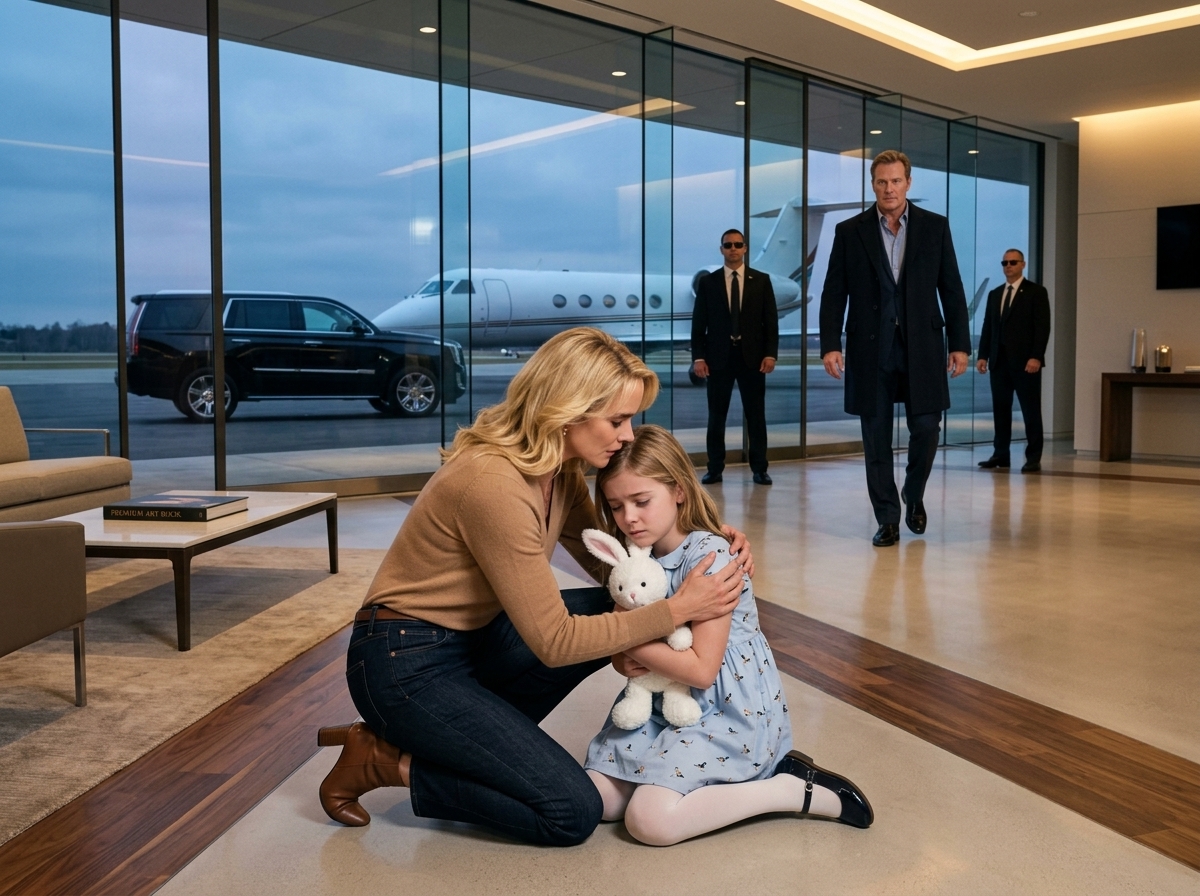
PART 2
For several seconds after Harlan Voss asked who had found his daughter, nobody moved.
The garage had gone strangely quiet.
Three engines idled behind him, exhaust curling pale through the frozen air.
Men in dark coats stood at a respectful distance, but no one looked relaxed.
All of them were watching Harlan.
Harlan was watching me.
“I did,” I repeated.
His eyes dropped to Belle.
Whatever people said about Harlan Voss—and people in Detroit said plenty—the expression that crossed his face when he knelt beside his little girl belonged to an ordinary frightened father.
“Hey, Bell.”
Belle’s eyes opened.
“Dad?”
The single word seemed to take something out of him.
“I’m here.”
He brushed the hair away from her forehead.
A gray-haired woman carrying a medical bag hurried forward with two others.
Harlan moved immediately so they could work.
I started backing away.
Someone had come for Belle.
Professionals had her now.
My hands were beginning to shake from the cold, and suddenly I remembered that my apartment was forty minutes away on foot, my coat was wrapped around a six-year-old, and I had an eviction notice folded beside three dollar bills in my purse.
I took two steps.
“Rue.”
I stopped.
Harlan was still crouched beside Belle.
His attention should have been entirely on her, yet somehow he had noticed.
“You said you wouldn’t leave her.”
“She has you now.”
“She asked for you.”
I looked down.
Belle’s fingers were sticking out from underneath my coat.
They were reaching toward me.
That was how I ended up riding to Henry Ford Hospital in the third SUV while one of Harlan’s doctors monitored Belle in the vehicle ahead.
It was also how I discovered that even a man who could apparently summon a private medical team into a parking garage in less than five minutes could not make a hospital move faster once his daughter was behind a set of double doors.
Harlan paced.
Not dramatically.
Not impatiently.
He walked exactly fourteen steps from one wall to another, turned, and walked fourteen back.
Again.
Again.
Again.
I sat in a plastic chair across from him wearing a blanket a nurse had found for me.
My waitress shoes squeaked every time I shifted my feet.
At twelve-thirty in the morning, a woman came hurrying through the waiting-room doors.
She was about Harlan’s age, maybe a little younger, with a long camel coat thrown over blue pajamas and her dark hair twisted into a careless knot.
“Harlan.”
He turned.
“Mara.”
She went straight to him.
“What happened?”
“Belle got separated from you.”
Mara closed her eyes.
“I know.”
He didn’t raise his voice.
That somehow made the sadness in her face worse.
“I thought she went downstairs with Theo,” Mara said.
“Theo thought she was with me.
I checked the rehearsal room, then the lobby, then—”
“We’ll talk about it later.”
“I am so sorry.”
“I know.”
Mara looked past him and noticed me.
Her eyes moved over the waitress uniform, the hospital blanket, and my bare arms.
“Who are you?”
Before I could answer, Harlan did.
“Rue Callaway.”
Something happened to Mara’s expression.
It was small.
So small I might have imagined it.
Her lips parted.
Then she looked at her brother.
Harlan gave her the faintest shake of his head.
That bothered me.
“What?”
Neither answered immediately.
I stood.
“What was that?”
Mara recovered first.
“Nothing.”
“That wasn’t nothing.”
Harlan rubbed one hand over his jaw.
“You’ve had a long night.”
“I work double shifts at a diner.
Long nights don’t make me hallucinate.”
Mara almost smiled.
Harlan didn’t.
A doctor entered before either could explain.
“Harlan?”
Everything else vanished from his face.
The doctor smiled.
“She’s stable.”
Harlan stopped breathing for a second.
I watched it happen.
Then he exhaled.
“The episode appears to have been triggered by exertion, cold exposure, and stress,” the doctor continued.
“Her numbers are responding well.
We’re keeping her overnight for observation, but at the moment I don’t see anything that suggests a larger complication.”
“Can I see her?”
“In a few minutes.”
Harlan nodded.
The doctor looked at me.
“Whoever kept her sitting upright and calm did exactly the right thing.”
Harlan’s gaze moved to me again.
This time there was something different in it.
Not suspicion.
Not calculation.
Gratitude.
The kind that made me uncomfortable because I hadn’t done anything extraordinary.
I had heard a child coughing.
I had stopped.
That was all.
At one in the morning, Belle was awake enough to complain that the hospital socks were ugly.
That was when I knew she was going to be fine.
“They have dots,” she informed me solemnly from her bed.
“They’re anti-slip dots.”
“They’re orange.”
“That does seem serious.”
“They don’t match anything.”
Harlan was sitting beside her.
For the first time all night, I saw him smile.
It changed his entire face.
“Your medical crisis is now officially fashion-related.”
Belle frowned at him.
“You don’t understand.”
“Clearly.”
She looked at me.
“You understand.”
“Completely.”
Harlan sighed.
“I’m outnumbered.”
Belle smiled.
Then she noticed my coat folded on the chair.
“That’s yours.”
“It is.”
“You gave it to me.”
“You looked colder than I was.”
Her expression grew serious.
“Thank you.”
Something tightened behind my ribs.
“You’re welcome, Belle.”
“You can have it back now.”
“Very generous.”
She nodded, apparently satisfied.
A nurse came in to check her monitor.
I reached for my coat.
It was time.
Really time.
Harlan followed me into the hallway.
“I’ll have someone drive you home.”
“That isn’t necessary.”
“It’s nearly two.”
“I’ve been outside after two before.”
“That does not make walking across Detroit at two in the morning a sensible transportation plan.”
I looked at him.
“You always talk like a board meeting?”
“Only when I’m tired.”
“That’s unfortunate.”
A surprised laugh escaped from the room behind us.
Mara.
Harlan glanced toward the door.
Then back at me.
“At least let my driver take you.”
I was tired enough to accept.
“Fine.”
“And, Rue—”
Here it came.
The check.
The reward.
The offer that would somehow make what happened in the garage feel like a transaction.
I braced myself.
Instead Harlan said, “You asked what happened when Mara heard your name.”
I lowered my coat.
“Yes.”
He hesitated.
“Did your mother’s name happen to be June?”
Every muscle in my body went still.
“June Callaway?”
“How do you know my mother?”
His expression told me the answer was complicated.
“She worked with my family a long time ago.”
“My mother worked in medical billing.”
“Later.”
“What does that mean?”
“Before you were born, and for several years afterward, she worked at the Meridian.”
I stared at him.
“The theater?”
“Yes.”
“My mother never worked at a theater.”
“I’m fairly certain she did.”
“You’re fairly certain?”
“Rue, I have photographs.”
The hallway suddenly seemed colder than the garage.
My mother had been dead for four years.
I knew the important things about June Callaway.
I knew she drank coffee strong enough to dissolve a spoon.
I knew she hated canned peas.
I knew she sang along badly to Smokey Robinson whenever she cleaned the kitchen.
I knew she had spent eighteen years processing hospital insurance claims and complaining about people who stapled forms in the wrong corner.
I knew she had raised me alone.
I knew she never talked about my father beyond saying he had not been ready to build a life with her.
I knew her.
Or I thought I did.
“The Meridian closed when I was little.”
“Twenty-one years ago.”
“I would remember my mother telling me she worked there.”
“You were five when she left.”
I stared at him.
“How do you know how old I was?”
Harlan went quiet.
That was the first moment I considered simply walking away.
I put on my coat.
“Tell your driver I found another ride.”
“Rue.”
“No.”
“There’s something you should see.”
“At two in the morning?”
“Not tonight.”
“Good.”
I walked toward the elevators.
“Your mother and mine were friends.”
That stopped me.
I turned slowly.
Harlan remained near Belle’s doorway.
“My mother’s name was Eleanor Voss,” he said.
“She ran the Meridian Foundation before the theater closed.
June worked with her.”
I knew Eleanor Voss.
Not personally.
Everyone in Detroit over thirty remembered her.
She had funded music programs, libraries, neighborhood playgrounds.
She had been photographed with mayors and teachers and famous musicians.
She had died twelve years ago.
“My mother knew Eleanor Voss?”
“Very well.”
“How well?”
“Well enough that my mother mentioned June in her will.”
I forgot about the elevator.
“What?”
Harlan took a breath.
“There is a box in the Meridian archive.
My mother left instructions that it be given to June Callaway if the theater ever reopened.”
“And if June was dead?”
“To her daughter.”
My hand tightened around my purse.
“You knew about this?”
“I knew a June Callaway existed.
Our attorneys tried to locate her years ago.
By then she had moved twice, and the contact information in the foundation files was decades old.”
“My mother didn’t exactly disappear.
She had a phone number.”
“I agree.”
Something about the answer surprised me.
No excuses.
No grand defense.
Just agreement.
“Our lawyers should have done better,” he continued.
“I should have done better.”
“Why didn’t you?”
“Because at the time, reopening the Meridian seemed impossible, and the box felt like one more unfinished obligation belonging to my mother.”
He glanced toward Belle’s room.
“I have spent the last year learning that unfinished obligations don’t disappear because you stop looking at them.”
I didn’t know what that meant.
I also didn’t want to know.
Not that night.
“I’m going home.”
“All right.”
“You aren’t going to stop me?”
His eyebrows lifted.
“No.”
That answer irritated me more than it should have.
I walked away.
“Rue.”
I turned one last time.
“Thank you for Belle.”
His voice was quiet.
No power in it.
No expectation.
Just a father speaking to the woman who had stayed with his daughter on a freezing garage floor.
I nodded.
Then I left.
My best friend Tasha was sleeping on my couch when I got home.
Technically, it was my couch.
Technically, it was also where Tasha slept three nights a week because her boyfriend snored like industrial machinery.
She woke when I came through the door at 2:38 a.m.
She squinted at me.
“Why do you look like you’ve been hit by a very expensive truck?”
I dropped my purse.
“I met Harlan Voss.”
Tasha sat upright.
“You did what?”
“I found his daughter.”
She stared.
“In a parking garage.”
Her mouth opened.
“She’s fine.”
Her mouth closed.
“Probably.”
It opened again.
“Tasha, could you please make the face after I finish?”
She pressed both hands over her mouth.
I told her everything.
The garage.
Belle.
The SUVs.
The hospital.
June Callaway.
Eleanor Voss.
The box.
When I finished, Tasha remained quiet for a full ten seconds.
That might have been a personal record.
Then she said, “Your mother had a secret theater life.”
“Apparently.”
“With rich people.”
“Apparently.”
“And Harlan Voss has a mystery box with your name on it.”
“My mother’s name.”
“Same difference.”
“No, it isn’t.”
Tasha studied me.
“You’re scared.”
“I’m exhausted.”
“You’re scared and exhausted.”
I sat beside her.
On the coffee table, underneath a half-empty cup of tea, was the eviction notice.
PAY OR VACATE.
Seven days.
I had already used two.
Tasha followed my eyes.
“You should see what’s in the box.”
“What if it’s nothing?”
“Then it’s nothing.”
“What if it isn’t?”
“Then at least you know.”
I leaned back and closed my eyes.
“My mother didn’t keep things from me.”
Tasha was quiet.
Then, gently, “Everybody keeps some things.”
I opened my eyes.
“She was my mother.”
“Exactly.”
“That isn’t an answer.”
“No.
It’s just permission for her to have been a whole person before she was yours.”
That stayed with me.
For the rest of the night.
At nine the next morning, my manager called to tell me I was late.
I informed him I was not scheduled until eleven.
He informed me that Lorraine had called off.
I informed him that this sounded like a Lorraine problem.
He threatened to cut my Friday shift.
I was at the diner by 9:45.
Being poor did not allow for dramatic principles.
By noon, I had refilled thirty-seven coffees, dropped one plate of hash browns, been called “sweetheart” by six strangers, and earned twenty-two dollars in tips.
At 12:17, a man in a charcoal coat walked into the diner.
I recognized him from the garage.
One of Harlan’s people.
My stomach sank.
He took a booth.
I walked over.
“If you’re here to kidnap me into a black SUV, I should warn you I have two tables waiting on pancakes.”
He blinked.
Then smiled.
“No kidnapping.”
“Good.”
“My name is Theo Bennett.”
The name clicked.
Mara had said she thought Belle had gone downstairs with Theo.
He seemed to read the recognition on my face.
“I’m Belle’s driver.”
“And yesterday?”
“Yesterday I made an assumption I won’t make again.”
There was no defensiveness in the words.
Only regret.
I softened.
“How is she?”
“Eating French toast and complaining that her father cuts strawberries incorrectly.”
I smiled before I could stop myself.
Theo slid an envelope across the table.
I didn’t touch it.
“What’s that?”
“Not money.”
“Good answer.”
“It’s Harlan’s number.
And an invitation to come to the Meridian tomorrow afternoon.”
“What’s wrong with the number I called last night?”
“That line routes through security.”
“Of course it does.”
Theo stood.
“There’s also a note.”
When he left, I opened the envelope.
One sheet of cream paper.
Four handwritten lines.
Rue,
Belle would like you to know she has recovered her shoe.
I would like you to know I will not open the archive box without you.
If you decide you never want to see it, I will respect that.
Harlan
I read it twice.
Then a third time.
On the back, in purple crayon, someone had drawn a lopsided heart.
Inside it was written:
THANK YOU FOR THE COAT.
BELLE.
That decided it.
Not Harlan.
Not Eleanor.
Not the mystery.
The purple heart.
I went to the Meridian the following afternoon.
The old Meridian Theater had spent most of my childhood behind plywood.
I passed it hundreds of times without really seeing it.
That day, for the first time, I looked.
The marquee had been restored but not lit.
MERIDIAN.
Tall gold letters stretched across the entrance.
Workers moved behind glass doors carrying ladders and paint cans.
Inside, marble floors had been cleaned until they reflected the chandeliers overhead.
The place smelled like plaster, dust, old wood, and something new beginning.
Harlan was waiting in the lobby.
No dark coat.
No army of men.
He wore rolled-up sleeves and held two paper coffee cups.
“You came.”
“You sound surprised.”
“I was.”
He offered me one.
I looked at it.
“Coffee?”
“Cream, no sugar.”
I stared.
He immediately looked uncomfortable.
“Mara remembered your mother drank it that way.
I guessed.”
“I drink mine black.”
“Right.”
He handed me the other cup.
I took it.
“You really are bad at this.”
“At coffee?”
“People.”
A faint smile.
“I’ve heard.”
We walked through the theater.
The auditorium took my breath away.
Deep red seats curved around a wide stage framed with carved gold leaves.
Above us, the ceiling had been painted midnight blue, scattered with tiny restored stars.
“It was almost demolished,” Harlan said.
“When?”
“Eleven years ago.”
“Why wasn’t it?”
“My mother made the building difficult to sell.”
“That sounds intentional.”
“It was.”
He looked toward the balcony.
“She believed buildings could become promises.”
I glanced at him.
“And you?”
“I believed buildings were buildings.”
“Past tense?”
He didn’t answer immediately.
Then he said, “Belle likes this place.”
That was answer enough.
We climbed stairs to a narrow hallway behind the balcony.
A woman was waiting beside an old wooden door.
Mara.
Today she wore jeans and a Detroit Lions sweatshirt.
She hugged herself when she saw me.
“I owe you an apology.”
“For what?”
“The hospital.
I acted strange when I heard your name.”
“That is accurate.”
She winced.
“I knew June.”
I stopped.
“You knew my mother?”
“I was ten when you were born.
Your mother used to sneak me chocolate-covered pretzels during foundation meetings.”
I had no idea what to say.
Mara reached into her pocket.
She handed me a photograph.
The edges were worn.
Four people stood beneath the Meridian marquee.
A much younger Eleanor Voss.
A teenage Harlan.
A little girl who was obviously Mara.
And my mother.
June.
My mother wore overalls.
Overalls.
I had never seen her wear overalls in my life.
She had paint across one cheek and was laughing at something outside the frame.
I touched the picture.
“She hated having her photograph taken.”
“She hated formal photographs,” Mara said.
“She loved bad ones.”
I laughed.
It came out wrong.
Too close to crying.
Harlan looked away.
Giving me privacy without leaving.
I appreciated that.
“What happened?”
I asked.
Mara’s expression softened.
“The Meridian ran into financial trouble.
The foundation couldn’t keep operating the way it had.
Your mother left Detroit for a while.”
“She never left Detroit.”
“For about eight months.”
I looked between them.
“Where did she go?”
“Cleveland,” Harlan said.
My heart gave a strange little jump.
I had been born in Cleveland.
That I knew.
My birth certificate said so.
Mom always said she had lived there briefly because rent was cheaper.
“She came back when you were a baby,” Mara said.
“She visited us a few times.
Then less often.
Eventually we lost touch.”
“Why?”
Neither answered.
That silence again.
I hated it.
“You both keep doing that.”
“Doing what?”
Mara asked.
“Looking at each other before deciding what I’m allowed to know.”
Harlan’s face tightened.
“You’re right.”
He unlocked the archive door.
“You should decide for yourself.”
The room beyond was small.
Metal shelves filled every wall.
Programs.
Photographs.
Ledgers.
Boxes.
Harlan crossed to a steel cabinet.
From the bottom drawer, he removed a wooden case about the size of a shoebox.
My name was not on it.
My mother’s was.
JUNE CALLAWAY.
Below that:
OR HER HEIR.
My heart started pounding.
Harlan placed the box on the table.
“I haven’t opened it.”
“You could have.”
“Yes.”
“Why didn’t you?”
“It wasn’t mine.”
Sometimes the simplest answers are the hardest ones to distrust.
I ran my fingers over the brass latch.
Locked.
“I don’t have a key.”
Mara frowned.
“Eleanor’s instructions said June had it.”
“My mother never gave me any key.”
Harlan looked at the lock.
“Then we can have a locksmith—”
I froze.
A memory surfaced.
Not a useful one.
A ridiculous one.
Mom’s sewing tin.
She had kept buttons, bent needles, old receipts, two subway tokens from New York, and a small brass key that didn’t fit anything in our apartment.
After she died, I had almost thrown it away.
Instead I had put the entire tin in a cardboard box marked MOM.
It was in the closet beneath my winter boots.
“I might have it.”
Harlan looked at me.
“You’re serious?”
“I think so.”
We did not call a locksmith.
I went home.
For twenty minutes I tore through the closet.
Tasha, who had arrived midway through the search, stood in the hallway eating cereal straight from the box.
“What are we looking for?”
“A sewing tin.”
“Red?”
I stopped.
“Yes.”
“It’s under your bed.”
“How do you know?”
“You made me help move your mattress last summer.”
I dropped to my knees.
There it was.
Inside, beneath spools of thread and mismatched buttons, lay the key.
Small.
Brass.
A stamped letter M on one side.
Tasha stopped chewing.
“Well.”
I picked it up.
“Yeah.”
“You want me to come with you?”
That was why I loved her.
She didn’t ask what was in the box.
She asked whether I wanted company opening it.
“No.”
She nodded.
“Call me after.”
“I will.”
“Even if you discover you’re secretly the princess of Michigan.”
“That is not a thing.”
“You don’t know.
You haven’t opened the box.”
I laughed.
And for the first time since the garage, I felt like myself.
The key turned.
Just once.
A tiny metallic click.
Harlan stood near the window.
Mara sat on an archive stool.
Neither came closer.
I lifted the lid.
There was no money inside.
No diamonds.
No impossible inheritance.
There were letters.
Dozens of them.
Some addressed to June.
Some to Eleanor.
All tied with faded blue ribbon.
Beneath them was a thick folder stamped with the seal of the Meridian Foundation.
And underneath that, a photograph.
I picked up the photograph first.
My mother sat on the edge of the Meridian stage.
I was beside her.
Five years old.
Missing a front tooth.
I knew the yellow sweater I was wearing because Mom had kept it until I was fourteen.
Eleanor Voss sat on my other side.
Mara was sprawled on the floor.
Teenage Harlan stood several feet behind us holding a broom and looking annoyed about it.
A laugh escaped me.
“You had terrible hair.”
Harlan looked offended.
“I was sixteen.”
“That is not a defense.”
Mara came closer.
“Oh, I remember that haircut.”
“Everyone can stop.”
For one precious second, the room felt ordinary.
Then I opened the folder.
The first page contained legal language I barely understood.
The second was easier.
MERIDIAN COMMUNITY STEWARDSHIP AGREEMENT.
Eleanor Voss — Founding Trustee.
June Callaway — Founding Trustee.
I looked up.
“What is this?”
Harlan’s expression became careful.
“A governance agreement.”
“For what?”
“The theater.”
I read further.
The Meridian building was owned by Voss Holdings.
But a permanent stewardship covenant created by Eleanor had placed restrictions on how the theater could be redeveloped.
Certain decisions required approval from the Voss family representative.
And from the Callaway representative.
I read the paragraph again.
“This says my mother had authority over the building.”
“A limited kind,” Harlan said.
“And now?”
He looked directly at me.
“Now you do.”
I laughed.
Nobody else did.
I stopped.
“No.”
Harlan slid another document toward me.
“Your mother named you as successor trustee.”
“I was five.”
“Only after you turned twenty-five.”
“I’m twenty-seven.”
“Yes.”
I stared at the signature.
June Callaway.
My mother’s handwriting.
Unmistakable.
A thousand memories lived in those loops and slants.
Birthday cards.
Grocery lists.
Notes in my lunchbox.
I sat down.
“What does this mean?”
“It does not mean you own half the theater,” Harlan said.
“Good, because for a second I was wondering whether I could sell my half and pay my rent.”
Mara smiled.
Harlan did not.
He had noticed something.
“Your rent?”
I immediately regretted saying it.
“Nothing.”
“Rue—”
“No.”
He stopped.
I appreciated that too.
“What it means,” he continued, “is that several parts of the reopening plan require approval from the community trustee.”
“You.”
“No.”
His eyes stayed on mine.
“You.”
The room became silent.
I looked at the construction plans visible through the glass.
Workers were rebuilding a theater worth more money than I could imagine.
Meanwhile, that morning, I had counted quarters to decide whether I could afford laundry.
“This is absurd.”
“It is unusual.”
“I serve pancakes.”
“So?”
“So I don’t know anything about operating a theater.”
“Neither did June when my mother met her.”
“How did they meet?”
Mara answered.
“Your mother wrote a letter to the newspaper complaining that the Meridian had raised ticket prices.”
I closed my eyes.
Of course she had.
Mara smiled.
“Eleanor hired her three months later.”
“That also sounds like Mom.”
“There’s more,” Harlan said.
He gestured toward the letters.
I reached for the first bundle.
The top envelope was addressed in Eleanor’s handwriting.
June,
If this renovation ever happens, I suspect Harlan will try to finish it without asking anyone for help.
This is one of his more exhausting qualities.
Harlan sighed.
“My mother was opinionated.”
I kept reading.
Only a little.
Enough to understand the letters were not business correspondence.
They were friendship.
Recipes.
Arguments.
Updates about children.
Plans.
Disappointments.
Apologies.
Life.
Then I found a sealed envelope beneath them.
The paper was newer than the others.
My name was written across the front.
RUE.
My hands shook.
“That’s Mom’s handwriting.”
Neither Harlan nor Mara moved.
I opened it.
Inside were four pages.
I managed only the first lines.
Rue,
If you are reading this, then the lights at the Meridian are coming back on.
That means Eleanor kept her promise.
And it means I finally have to explain why I left something important without ever telling you it existed.
Before you decide anything about the Meridian, there are three things you need to know.
First, I did not leave because the Voss family pushed me out.
Second, Eleanor and I made a choice that neither of us was certain was right.
Third—and this is the part you may find hardest to understand—one day Harlan Voss may need your vote more than you need anything from him.
I stopped.
My eyes lifted slowly from the page.
Harlan was staring at the letter.
“What vote?”
I asked.
His jaw tightened.
Mara looked down.
“Harlan?”
He walked to the window.
Outside, afternoon light spread across the restored gold balconies of the Meridian.
When he finally turned around, the businessman Detroit called ruthless looked almost embarrassed.
“The board votes in eight days.”
“On what?”
“The final redevelopment agreement.”
“And you need the community trustee to approve it?”
“Yes.”
I looked at my mother’s signature.
Then at the eviction notice still folded inside my purse.
Then at a man who could solve my financial problems without noticing the cost.
The timing suddenly felt far too convenient.
“Did you know who I was in that garage?”
Harlan’s answer came immediately.
“No.”
“Did you know before you sent Theo to the diner?”
“Yes.”
The distinction mattered.
I wasn’t sure why.
I looked down at my mother’s letter again.
There were three more pages.
And somewhere in them was a truth June Callaway had waited twenty-two years to tell me.
A truth tied to the Meridian.
To Eleanor Voss.
And somehow to the powerful man standing across from me.
For the first time in my life, having almost nothing made one decision strangely easy.
There was nothing Harlan Voss could offer me that I wanted more than the truth.
So I unfolded the second page.
And kept reading.
PART 3
My mother’s second page began with a sentence that sounded exactly like her.
Rue, if you are making that face you make when you think someone has lied to you, relax your forehead before you give yourself a headache.
I laughed.
A small, broken sound.
Mara covered her mouth.
Even Harlan smiled.
“She knew me,” I whispered.
“Yes,” Mara said gently. “She did.”
I kept reading.
The explanation was less dramatic than I had expected.
And somehow, because of that, it hurt more.
Mom wrote that she and Eleanor Voss had met in 1997 after the Meridian increased ticket prices during a renovation.
Mom had been twenty-two.
Broke.
Opinionated.
Working two jobs.
She had written a furious letter to the Detroit Free Press accusing the foundation of forgetting the neighborhood that had kept the theater alive.
Eleanor read it.
Then invited her to lunch.
Mom assumed she was going to be scolded.
Instead Eleanor asked, “If you’re so certain we’re doing it wrong, would you like to help us do it better?”
Mom said yes.
For the next six years, they worked together.
Eleanor understood money.
Mom understood what five dollars could mean to someone choosing between a movie ticket and groceries.
They fought constantly.
They became best friends anyway.
The community stewardship agreement had been their idea.
The Voss family would retain ownership of the building, but the Meridian could never become merely another private asset.
If the family wanted to make major changes, someone representing the neighborhood had to agree.
Mom became that person.
Then I was born.
Everything changed.
Not because of some grand betrayal.
Not because anyone forced her out.
Because life became expensive.
My grandmother’s health began failing.
Mom needed medical insurance.
Reliable hours.
A job that did not depend on donations, ticket sales, or the decisions of wealthy trustees.
So she took a job processing hospital claims.
She meant to stay involved with the Meridian.
But the theater’s finances deteriorated.
Eleanor became consumed with keeping the foundation afloat.
Mom became consumed with keeping us afloat.
Months became years.
Phone calls became Christmas cards.
Christmas cards became occasional letters.
And then distance hardened around a friendship neither woman had intended to lose.
I reached the third page.
There, my mother finally explained why she never told me.
I thought I would return when things settled down, she wrote.
Then I kept waiting for life to become settled.
You will discover, if you haven’t already, that life almost never does.
When you were little, the Meridian was just another story about a version of me you did not need yet.
When you became older, telling you became harder because I would have had to explain why I had waited.
I was embarrassed.
Not by the theater.
By myself.
I had been entrusted with something I loved, and I had walked away from it because there were bills to pay and people who needed me.
It took me too long to understand that choosing you was not the same as failing everything else.
I stopped reading.
I pressed the page against the table.
For four years after my mother died, I had carried a quiet anger toward her.
Not a big anger.
Nothing anyone saw.
Just a small selfish one.
Why hadn’t she saved more money?
Why hadn’t she planned better?
Why had every problem become mine the moment the hospital called to tell me she was gone?
Then I had felt guilty for thinking any of it.
Now, sitting in the Meridian archive, I realized my mother had probably asked herself the same questions for most of her life.
“You okay?” Mara asked.
I nodded.
Then shook my head.
“I don’t know.”
“That’s allowed.”
I read the last page.
Eleanor and I agreed that the stewardship seat would remain dormant until the theater reopened.
If that day came after I was gone, the choice would become yours.
Not because you owe me.
Not because you owe Eleanor.
And certainly not because you owe the Voss family.
You owe none of us anything.
Listen.
Ask questions.
Then decide what kind of place you believe should exist in the city where you live.
One more thing.
Do not let being broke make you think your judgment is for sale.
People with money are often very good at mistaking financial security for wisdom.
People without money sometimes make the opposite mistake and believe needing help means they have surrendered the right to say no.
Both are wrong.
Make your decision standing up.
Love,
Mom
P.S. If Harlan still scowls when he thinks, tell him his mother spent eighteen years trying to make him stop.
I lowered the letter.
Mara burst out laughing.
Harlan stared at the ceiling.
“I do not scowl.”
“You absolutely scowl,” Mara said.
I laughed too.
It surprised me.
Three days earlier I had been terrified of Harlan Voss.
Now I was sitting in an old theater with his sister, holding a letter from my dead mother while the terrifying man in question argued that his face had been misrepresented.
Life was strange.
Then I remembered the vote.
My smile disappeared.
“What are you asking permission to do?”
Harlan walked to the table.
He opened a different folder.
Architectural plans.
Financial projections.
Operating budgets.
Nothing I understood at first glance.
“The Meridian cannot survive as a traditional theater,” he said.
“That sounds like the beginning of a sentence my mother would hate.”
“Probably.”
“What’s the rest?”
“We are converting the upper floors into event and rehearsal spaces. The theater stays. The community rooms stay. We add conference facilities, private rentals, and commercial space on the western side.”
“Commercial meaning?”
“Two restaurants. Offices. Possibly a hotel partner later.”
I stared at him.
“So your plan is to save the neighborhood theater by turning part of it into something the neighborhood can’t afford?”
“That is one interpretation.”
“It’s mine.”
“I gathered.”
Mara sat back.
Harlan pulled out a chair.
He did not sit behind the desk.
He sat across from me.
“The alternative is permanent subsidy,” he said. “Which means the building remains dependent on the Voss family or another donor deciding every year that it deserves to exist.”
“And you don’t want that.”
“No.”
“Why?”
“Because my mother built something she believed belonged to Detroit. I don’t want Belle inheriting a building everyone calls public while privately hoping she remains rich enough to keep the lights on.”
That was the first thing he said about the project that made complete sense to me.
Still, I shook my head.
“I need time.”
“You have eight days.”
“I need information.”
“I’ll provide anything you ask for.”
“I don’t want your summary.”
A pause.
Then Harlan nodded.
“All source documents.”
“Yes.”
“Independent financial review?”
“Yes.”
“Community feedback from the last two years?”
“Yes.”
“Meeting notes?”
“Everything.”
“You’ll have it.”
I narrowed my eyes.
“You’re making this too easy.”
“I’m trying not to make it difficult.”
“That sounds like something a difficult person says.”
Mara laughed again.
Harlan ignored her.
“There is one condition.”
I stiffened.
There it was.
“Which is?”
“You read before you decide.”
I blinked.
“That’s it?”
“That’s it.”
I almost felt cheated.
The next seven days were the strangest of my life.
I worked at the diner from six in the morning until two.
Then I went to the public library.
Then the Meridian.
Then home.
Tasha created a spreadsheet because, according to her, watching me interpret financial documents was “an attack on mathematics.”
Mara introduced me to longtime theater employees.
Harlan stayed mostly out of my way.
That surprised me more than anything.
When I asked a question, he answered.
When he did not know, he said so.
When I disagreed, he did not turn the disagreement into a contest.
I began to wonder how much of Harlan Voss’s reputation belonged to Harlan Voss and how much belonged to people who disliked being told no by a man with enough money to make no permanent.
On Friday afternoon, I met Mr. Luis Alvarez.
He was seventy-two and had worked backstage at the Meridian for thirty-four years.
He had silver hair, suspenders, and the habit of calling every object in the building “she.”
“She leaks over there.”
“She sings over here.”
“She does not like cheap paint.”
I liked him immediately.
He showed me the old dressing rooms.
Then a small rehearsal hall on the third floor.
“This was your mother’s favorite room.”
I stopped.
“You knew her?”
“Everybody knew June.”
Apparently I had been the last person in Detroit to learn my mother had once possessed an entire second life.
Mr. Alvarez pointed toward a wall.
“You see that?”
Faded beneath layers of paint was a mural.
Children’s handprints.
Dozens of them.
Blue.
Green.
Yellow.
Red.
Near the bottom was one tiny purple hand.
Beneath it someone had written:
RUE C. — AGE 5
I stared.
“That’s mine?”
Mr. Alvarez smiled.
“June brought you on Saturdays.”
A memory surfaced.
Paint on my fingers.
Popcorn.
A huge dark room full of red chairs.
A woman with silver earrings kneeling to tie my shoe.
I had always thought it was a dream.
“Eleanor,” I whispered.
Mr. Alvarez nodded.
“She adored you.”
Something in my chest shifted.
My mother had not erased this place completely.
She had given me pieces.
I had simply been too young to know where they belonged.
Mr. Alvarez leaned against the wall.
“What do you think of the plans?”
“I don’t know yet.”
“Good.”
“You don’t want me to approve them?”
“I want you to think.”
He nodded toward the mural.
“Your mother thought. Eleanor thought. Harlan thinks too much.”
I laughed.
“That seems to be the consensus.”
“Buildings are easy compared with people,” he said. “A building tells you when something is wrong. Crack. Leak. Bad wire. People hide their damage behind nice coats.”
I thought of Harlan pacing fourteen steps across a hospital waiting room.
“What does he hide?”
Mr. Alvarez smiled.
“That is not my story to tell.”
Belle came to the Meridian on Saturday.
Her doctors had cleared her to return to normal activity, though Mara watched her with the focus of an air-traffic controller.
Belle wore both shoes.
I pointed this out.
She looked offended.
“I usually wear two.”
“I’ve only known you a week. I don’t have enough data.”
She considered that.
“Fair.”
Harlan stood nearby.
He had brought her to watch the children’s choir rehearse for the reopening.
When the music started, Belle sat beside me.
“Dad says you get to decide something important.”
“Harlan talks to you about theater governance?”
“What’s governance?”
“That answers my question.”
She swung her feet.
“He said your mom helped his mom.”
“Apparently.”
“My grandma Eleanor is in pictures everywhere.”
“I noticed.”
“She liked hats.”
“She did?”
“Dad says she had too many.”
From behind us, Harlan said, “She had a room for them.”
Belle whispered loudly, “He hated the hats.”
“I could hear that.”
“I know.”
I smiled.
There was nothing remarkable about the moment.
And that was what made it remarkable.
The feared Harlan Voss being teased by his six-year-old daughter.
Mara carrying juice boxes.
Children singing off-key on the Meridian stage.
Maybe power was not the most interesting thing about people after all.
Maybe what they did when no one was impressed mattered more.
My eviction problem did not disappear.
On Monday morning, I woke to another notice taped to my door.
I sat on the floor and stared at it.
Five days.
Tasha found me there.
“Oh, Rue.”
“I’m fine.”
“You’re sitting on the floor.”
“The floor is free.”
She sat beside me.
We remained there for a while.
Then she asked, “Are you going to tell Harlan?”
“No.”
“Why?”
“Because I’m voting on his project.”
“You can need help and still think.”
“My mother literally wrote that.”
“Then maybe listen to her.”
I did.
Just not in the way Tasha expected.
That afternoon I called Detroit’s tenant assistance office.
They reviewed the notice.
My landlord had followed the rules.
I owed six weeks of rent.
No villain.
No conspiracy.
Just arithmetic.
The caseworker helped me work out a repayment proposal.
My landlord agreed to give me thirty days if I could make a partial payment by Friday.
It was still difficult.
But difficulty felt different when it had numbers.
Numbers could be faced.
At the Meridian that evening, Harlan noticed I was distracted.
He did not ask why.
Instead he slid a folder toward me.
“What’s this?”
“The independent review you requested.”
I opened it.
“Thank you.”
He lingered.
“Rue?”
“Yes?”
“If something outside this project is affecting your ability to evaluate it, you can say so.”
I looked at him.
“How did you know?”
“You have read the same page for twelve minutes.”
I looked down.
I had.
I sighed.
“I’m being evicted.”
His expression changed.
Not pity.
Concern.
“When?”
“I have thirty days if I make a partial payment.”
“How much?”
“No.”
“I only asked—”
“And I’m answering.”
He sat back.
“All right.”
I studied him.
“You could probably solve it with what you spend on coffee.”
“Probably.”
“That’s exactly why you can’t.”
His face was quiet.
“I understand.”
“Do you?”
“No,” he admitted. “Not completely.”
That answer mattered.
He could have pretended.
He didn’t.
“But I understand why you don’t want the two things connected.”
“Yes.”
“They won’t be.”
“Thank you.”
He nodded.
Then, after a pause, “For what it’s worth, the Meridian is hiring temporary event staff next month.”
I raised an eyebrow.
“That sounds suspiciously like help.”
“It was in the staffing plan six months before I met you.”
“Convenient.”
“You asked for source documents. Check page forty-six.”
I did.
He was right.
I hated that.
“What’s the hourly rate?”
He told me.
It was nearly six dollars more than I made at the diner.
“Temporary?”
“Until the permanent operations team is selected.”
“Open applications?”
“Yes.”
“Then I’ll apply like everyone else.”
“I assumed you would.”
I stared at him.
That was the first moment I trusted him enough to be annoyed by him personally.
It felt like progress.
The night before the vote, I found the problem.
Not a scandal.
Not hidden theft.
Nothing dramatic.
Just three sentences buried in a sixty-page operating agreement.
The proposed commercial partner would receive priority access to the Meridian’s largest community room during peak weekends.
That room was the only space large enough for neighborhood graduations, youth performances, local meetings, and affordable receptions.
The commercial lease would keep the theater solvent.
It would also quietly make the most useful room harder for ordinary people to use.
I called Harlan.
It was 11:08 p.m.
He answered after two rings.
“Rue?”
“Page fifty-eight.”
Silence.
Then paper moved.
“You have the agreement?”
“Yes.”
“I’m looking.”
“Section fourteen.”
More silence.
Then, “I see it.”
“You knew?”
“I knew about priority scheduling.”
“Did you know how broad it was?”
A longer silence.
“No.”
I believed him.
That surprised me.
“What do you want?” he asked.
“For the commercial partner to get priority only in its contracted event spaces.”
“That reduces the lease value.”
“Yes.”
“Possibly significantly.”
“Yes.”
“And you still want it.”
“My mother helped create the community covenant because she was angry about ticket prices. What do you think she’d say if I handed the largest community room to corporate events every Saturday?”
Harlan exhaled.
“She would probably write another newspaper letter.”
“Exactly.”
“I’ll talk to legal.”
“No.”
“What?”
“Don’t talk to legal and come back tomorrow telling me it can’t be done.”
“What would you prefer?”
“Come back telling me what it costs.”
Silence.
Then Harlan said softly, “You sound like Eleanor.”
I looked at Mom’s letter on my kitchen table.
“No.”
I smiled.
“I sound like June.”
The board meeting lasted three hours.
There were no cameras.
No grand speeches.
No dramatic crowd.
Just fourteen people around a long table in a rehearsal room while rain tapped against the windows.
I preferred it that way.
Harlan presented the revised agreement.
The community room would remain protected.
The commercial partner would receive scheduling priority only in designated rental spaces.
The change reduced projected annual revenue.
To compensate, the reopening would happen in phases.
The hotel component would be postponed.
Two planned executive offices would be eliminated and converted into paid apprenticeship classrooms.
Someone complained.
Someone else worried about money.
A retired teacher asked about youth ticket prices.
Mr. Alvarez asked about union staffing.
Mara asked whether local artists would still receive discounted rehearsal access.
I listened.
Then Harlan looked at me.
“The stewardship trustee has final approval on community-use provisions.”
Everyone turned.
A week earlier, that would have terrified me.
People with titles.
People with money.
People who knew what EBITDA meant without secretly searching it on their phone.
Then I thought of my mother.
Twenty-two.
Working two jobs.
Writing an angry letter because theater tickets cost too much.
Maybe courage was not knowing everything.
Maybe it was knowing which questions you refused to stop asking.
“I have four conditions,” I said.
Harlan nodded.
“Go ahead.”
“Community programming gets guaranteed hours every month. Not ‘when available.’ Guaranteed.”
Someone began writing.
“Second, youth ticket pricing is protected for at least five years.”
Another note.
“Third, local apprenticeships must be paid.”
The finance director grimaced.
I looked at him.
“Unpaid opportunities are mostly opportunities for people who can afford to work for free.”
He stopped grimacing.
“Fourth, the stewardship trustee gets access to annual scheduling and affordability reports.”
Harlan folded his hands.
“Anything else?”
“Yes.”
Mara smiled.
I continued.
“The trustee cannot be a permanent family position.”
Harlan frowned.
“What do you mean?”
“My mother chose me because I was her daughter.”
“Yes.”
“That doesn’t mean my child someday should get this vote because of DNA.”
The room became quiet.
“I want a process created within two years for the trustee to be selected by a neighborhood advisory council. I can serve through the transition.”
Harlan stared at me.
Of everything I had said, this seemed to surprise him most.
“You’re giving up the seat?”
“Eventually.”
“Why?”
“Because my mother wanted the neighborhood represented.”
I touched the folder.
“She named me because she needed somebody she trusted to protect that idea until the building came back. The building is coming back.”
Across the table, Mr. Alvarez smiled.
Harlan looked down.
When he looked up again, something in his expression had softened.
“I support the amendment.”
The vote passed.
Not unanimously.
But clearly.
The Meridian would reopen.
And somehow I had become part of it.
Two weeks later, I made the payment to my landlord.
Not because Harlan gave me money.
He didn’t.
Not because I discovered a hidden fortune.
I didn’t.
I did it with two extra diner shifts, the money Tasha had insisted I accept for utilities she had never paid, and my first paycheck from the Meridian’s temporary events team.
I kept the apartment.
Barely.
But barely counted.
Three months later, I applied for a permanent job at the Meridian.
Community operations coordinator.
Harlan was not on the interview panel.
I had demanded that.
Mara told me afterward that he complained about being excluded.
I told her that suffering built character.
I got the job anyway.
The salary was not enormous.
It was enough.
Enough to pay rent without checking my balance first.
Enough to buy groceries without doing subtraction in aisle four.
Enough to replace the boots with the hole in the sole.
Enough to breathe.
I discovered that breathing room changes a person slowly.
You stop flinching when the phone rings.
You stop treating every small pleasure like evidence of irresponsibility.
You sleep differently.
Not perfectly.
Just without your entire future balanced on a number smaller than twenty dollars.
The Meridian reopened in October.
The marquee lit just after sunset.
Hundreds of people gathered outside.
Nothing about the evening was flawless.
One microphone failed.
A caterer delivered sixty fewer napkins than requested.
A volunteer accidentally locked a local jazz trio in a dressing room for eleven minutes.
I spent most of the evening carrying a radio and fixing problems.
I loved every second.
At seven-thirty, the children’s choir walked onto the stage.
Belle stood in the front row.
Both shoes firmly attached.
She saw me near the curtain and waved.
I waved back.
Harlan was sitting in the audience beside Mara.
He caught me looking.
For once, he wasn’t scowling.
The choir began.
The sound rose into the restored ceiling, where hundreds of painted stars glimmered beneath the lights.
I thought of my mother.
I wished she could see it.
Then I realized that was not exactly true.
Some part of her already had.
She had imagined it.
Maybe that was what promises were.
Things people built for days they might never personally reach.
After the performance, Belle ran backstage.
“How was I?”
“Terrible.”
Her mouth dropped open.
I grinned.
“You were amazing.”
“That wasn’t funny.”
“It was a little funny.”
She hugged me around the waist.
Children are strange that way.
Adults spend months deciding whether they trust someone.
Children often know much sooner.
When she released me, she looked at the wall behind us.
The old handprint mural had been preserved.
My purple handprint remained near the bottom.
Belle had added hers beside it.
BELLE V. — AGE 6
Purple too.
“You copied me.”
“I improved it.”
“Rude.”
“Mine has glitter.”
“That is admittedly difficult to compete with.”
Harlan approached from the hallway.
“You’re teaching my daughter sarcasm.”
“I think that ship sailed before I arrived.”
Belle nodded.
“Dad is sarcastic.”
“I am surrounded by traitors.”
Mara appeared behind him.
“Family.”
“Same thing.”
Belle grabbed Mara’s hand.
“Come see the cupcakes.”
Mara allowed herself to be dragged away.
Harlan and I remained near the mural.
For a moment we said nothing.
Then he reached into his jacket.
“Before you accuse me of giving you money—”
“I was about to.”
“It’s a letter.”
He handed me an envelope.
My name was written on it.
Not in my mother’s handwriting.
Eleanor’s.
I looked at him.
“Where did you find this?”
“My mother’s personal archive.”
“When?”
“Six months ago.”
I stared.
“You had a letter addressed to me for six months?”
“Yes.”
“Why didn’t you open it?”
He looked genuinely confused.
“It has your name on it.”
I smiled.
Of course.
I opened it.
Dear Rue,
You are five years old as I write this, which means you currently believe popcorn is an acceptable dinner and that the moon follows our car because it likes you.
Your mother says both beliefs will eventually pass.
I hope not entirely.
The letter was short.
Eleanor wrote about my mother.
How brave she was.
How stubborn.
How tired.
How much Eleanor regretted allowing distance to grow between them.
Then came the final paragraph.
If the Meridian ever opens its doors again and you somehow find yourself standing inside it as an adult, remember this:
Buildings do not make communities.
Money does not make communities.
Names on plaques certainly do not make communities.
People deciding to keep showing up for one another make communities.
Your mother taught me that.
I hope one day someone teaches Harlan too.
I laughed.
Harlan sighed.
“She really did enjoy criticizing me in writing.”
“She had concerns.”
“Apparently.”
I folded the letter.
“Thank you.”
“For giving you something addressed to you?”
“For not opening it.”
He looked toward the stage.
“That was the easiest promise in this whole building.”
There was something I had wanted to ask him for months.
That night felt like the right time.
“Why did you reopen it?”
He could have given me the polished answer.
Economic redevelopment.
Historic preservation.
Community investment.
Instead he leaned against the wall.
“Belle.”
I waited.
“My mother used to bring me here,” he said. “I hated it.”
“That seems impossible.”
“I was fourteen. I hated everything.”
“Fair.”
“She made me sweep floors. Carry programs. Set chairs. I thought the place was old and inconvenient and full of adults who asked too many questions.”
“Also fair.”
“After she died, I wanted to sell it.”
“What stopped you?”
“Mara.”
I smiled.
“That also seems likely.”
“She delayed the sale three times. Then Belle was born. When she was four, Mara brought her here.”
He looked toward the auditorium.
“There was no heat. Half the lights didn’t work. Belle walked onto that stage and started singing to an empty room.”
“What song?”
“‘You Are My Sunshine.’ Badly.”
“Important detail.”
“Very badly.”
I smiled.
Harlan did too.
“I was standing where you are,” he continued. “And for the first time, I understood what my mother had been trying to preserve.”
“The building?”
“No.”
He looked around.
“The possibility.”
That stayed with me.
Behind us, the audience applauded as another performer finished.
I touched Eleanor’s letter.
“Your mother was right about something.”
“Only one thing?”
“She was right that you needed help.”
Harlan gave me a tired look.
“I walked directly into that.”
“Yes.”
“Are you ever going to stop reminding me?”
“Probably not.”
He nodded toward the mural.
“Your mother wouldn’t either.”
The thought no longer hurt the way it once would have.
That was another thing I had learned.
Grief does not always become smaller.
Sometimes your life becomes larger around it.
There were still days I wanted my mother.
Still mornings when I reached for my phone before remembering there was no number I could call.
But now, when I thought about June Callaway, I no longer saw only the exhausted woman sorting bills at our kitchen table.
I saw a twenty-two-year-old writing an angry letter to a newspaper.
A young mother painting a community room.
A woman brave enough to leave something she loved when her family needed her.
A friend who regretted losing touch.
A person who had made imperfect choices for understandable reasons.
A whole woman.
Not merely my mother.
Understanding that felt like meeting her again.
A few weeks after opening night, I found Harlan in the lobby staring at a problem.
A new brass plaque had been mounted beside the entrance.
MERIDIAN COMMUNITY STEWARDSHIP ROOM.
Below it were two names.
ELEANOR VOSS
JUNE CALLAWAY
I stood beside him.
“You did this?”
“The board did.”
“You’re on the board.”
“I abstained.”
“Why?”
“Conflict of interest.”
I raised an eyebrow.
“You’re learning.”
“Painfully.”
I touched my mother’s name.
For years, I had thought success meant escaping the kind of life she lived.
No overdue bills.
No double shifts.
No counting tips underneath a restaurant table.
But standing there, I understood something I had missed.
My mother’s life had not been small because money was tight.
It had been enormous.
She had simply carried most of it quietly.
“Rue?”
I turned.
Belle was sitting on the lobby floor trying to tie a ribbon around a stuffed rabbit.
“What?”
“Can you help?”
I went to her.
The rabbit apparently required an elaborate bow.
Harlan stood above us.
“You know,” he said, “most people who encounter me unexpectedly don’t end up reorganizing my company’s redevelopment agreement.”
I tightened the ribbon.
“Most people probably don’t meet you while wearing a diner uniform and one hospital blanket.”
“True.”
Belle looked between us.
“How did you meet?”
Harlan and I exchanged a glance.
“You don’t remember?” I asked.
Belle frowned.
“The garage?”
“Technically.”
She thought about it.
“Rue saved me.”
Harlan’s expression softened.
“Yes.”
I shook my head.
“I kept you warm for four minutes.”
“That counts.”
“Your dad’s doctors did the important part.”
Belle hugged the rabbit.
“But you stayed.”
Three words.
Nothing more.
But you stayed.
My mother stayed when I needed her.
Eleanor stayed with the Meridian longer than anyone expected.
Mara stayed when her brother wanted to sell it.
Harlan came back when he finally understood what had been left to him.
Maybe Eleanor had been right.
Maybe communities were just people who kept choosing to stay.
Not forever.
Not blindly.
Just long enough to matter.
Belle ran toward the auditorium.
Harlan watched her go.
Then he looked at me.
“You missed a bus.”
“I did.”
“Do you ever think about that?”
“Sometimes.”
“What if your manager had let you leave on time?”
“I would’ve gone home.”
“And Belle?”
“Someone else might have found her.”
“Maybe.”
I smiled.
“You’re trying to turn this into fate.”
“I don’t believe in fate.”
“Neither do I.”
We stood beneath the restored Meridian lights.
People passed us carrying instruments and costume bags.
Mr. Alvarez complained somewhere in the distance about someone touching one of his ladders.
Mara was arguing cheerfully with a caterer.
Belle’s laughter floated from the auditorium.
For a building that had been empty for twenty-one years, the Meridian had become very loud.
I liked it that way.
Harlan put his hands in his pockets.
“Then what do you believe happened?”
I thought about the freezing garage.
The fifteen dollars and forty cents in my bank account.
The eviction notice in my purse.
A little girl handing me a phone.
A man repeating my name as if he might need to remember it.
My mother’s forgotten key.
Eleanor’s letters.
A purple handprint hidden beneath old paint.
I had spent years believing meaningful choices announced themselves.
That you knew when your life was changing.
That there would be music.
Certainty.
A sign.
Instead, sometimes the important choice was tiny.
You heard someone cough.
You stopped walking.
You answered a phone.
You opened a letter.
You asked one more question.
You refused money when accepting it would confuse something that mattered.
You accepted help when pride was the only reason not to.
You stayed.
“I think,” I said slowly, “I was having a terrible Tuesday.”
Harlan laughed.
A real laugh.
Belle shouted from the auditorium.
“DAD!”
He turned immediately.
“Coming.”
Before he left, he looked back.
“Rue?”
“Yeah?”
“I’m glad you missed the bus.”
I glanced at my mother’s name shining on the plaque.
For once, I let myself think about everything that had happened without worrying about what would happen next.
My rent was paid.
My job was steady.
The Meridian was alive.
Belle was safe.
Harlan and Mara had become something I had never expected them to become—not rescuers, not benefactors, but people I could call when something mattered.
Not family exactly.
Not yet.
Something chosen.
Something still growing.
And my mother, somehow, had become part of my future instead of only belonging to my past.
“Me too,” I said.
Harlan disappeared into the auditorium.
A moment later Belle began laughing again.
I remained beneath the lobby lights for another minute.
Then I went after them.
Because sometimes a life changes when somebody saves you.
And sometimes it changes because, when you finally find the place where you are needed, you choose not to walk past. Read More