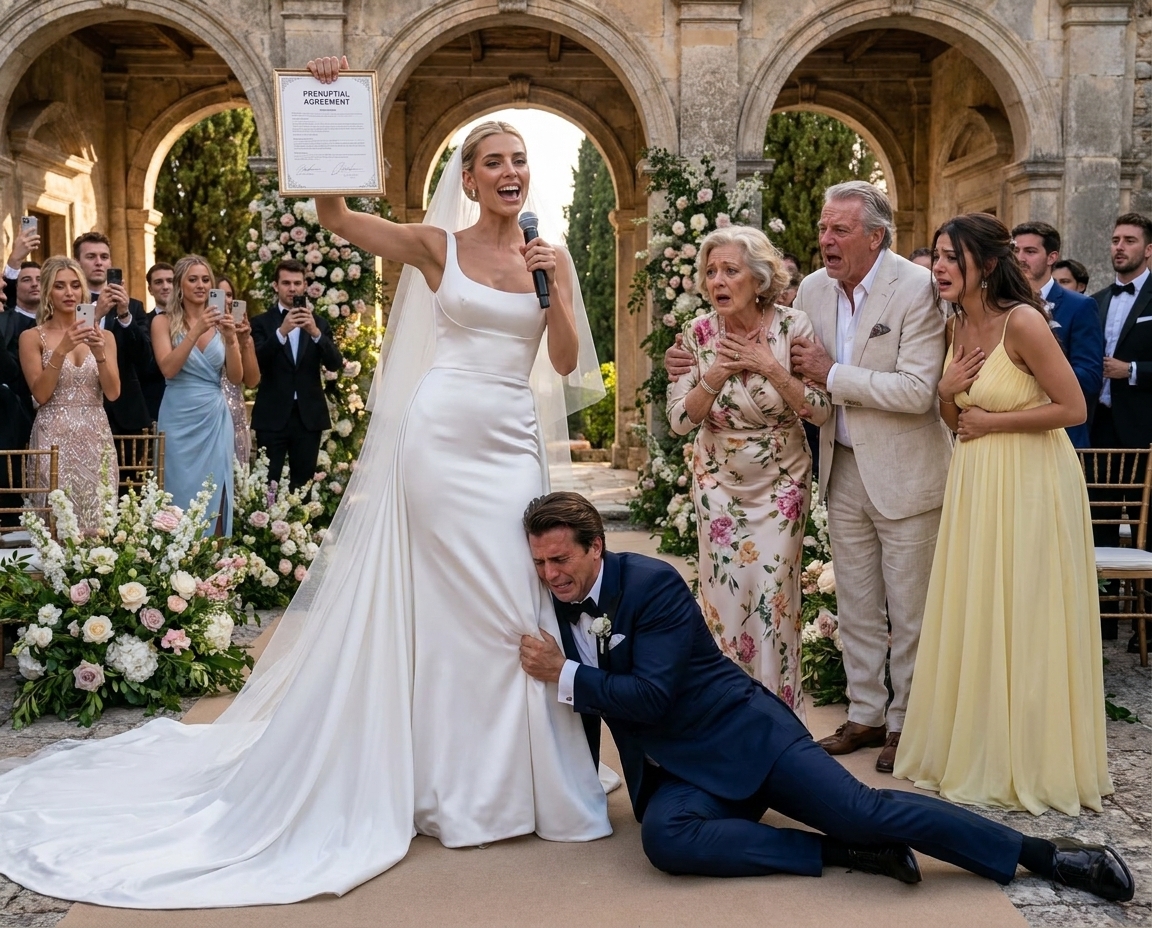
Only a few hours before my wedding, I stopped at my sister’s place to collect one last thing. As I walked toward the hallway, I overheard her quietly discussing a secret plan with our parents, a plan they had deliberately kept from me. I stood there listening until every unexplained change to my wedding finally made sense. I didn’t confront them or raise my voice. I simply walked into the room and said, “Thank you for telling me exactly who should not be standing beside me today.” By the time they reached the venue, the seating arrangement—and their place in my wedding—had already been completely changed.
The Architecture of Betrayal
Chapter 1: The Velvet Box
“Once she signs the marriage certificate, Jason can start moving the money.”
My mother’s voice drifted through the half-open living-room door with the exact same calm precision she used when discussing seating plans, florist charges, and which embarrassing relatives should be kept away from the best tables.
I stopped dead in the hallway of my sister’s upscale condo. I was still wearing my rain-dampened trench coat, the fabric heavy and clinging to my shoulders. A small, midnight-blue velvet box rested in my palm. Inside was a custom-engraved silver bracelet I had commissioned for Sydney to wear as my maid of honor, less than twelve hours from now.
Beyond the heavy oak door, someone slid a glass across a marble coffee table. Ice clinked against crystal.
Then my father, William, spoke.
“Meline won’t question him. She wants this wedding too badly. She’s always craved validation. Give her a ring and a ceremony, and she’ll sign whatever Jason puts in front of her.”
A quiet, melodic laugh followed.
Sydney’s.
My younger sister. The golden child. The person I had trusted with my dress fittings, my intimate guest list, and every nervous, vulnerable thought I had shared throughout two grueling years of wedding planning.
I remained perfectly still, though a cold dread coiled tightly in my gut. Rain tapped a chaotic rhythm against the tall, floor-to-ceiling windows overlooking the peaceful suburban street. The entryway smelled faintly of wet wool and the expensive, cloying lavender candle Sydney always lit when company was expected.
I had used my spare key because I wanted the delivery of the bracelet to be a private, emotional surprise. Instead, I heard my fiancé speak from inside the warm, dimly lit room.
“Are you absolutely sure Terrence doesn’t suspect anything?” Jason asked, his voice laced with a nervous tremor I had never noticed before.
My fingers closed around the velvet box, the edges biting into my palm.
Terrence was Sydney’s husband. A brilliant, respected cardiothoracic surgeon who worked exhausting eighty-hour weeks, yet still remembered to send my mother imported lilies on her birthday. He had always shown me more genuine kindness and interest than the people who had known me since birth.
Sydney laughed again, the sound devoid of any real warmth.
“Terrence? Please. He thinks the baby is his. He’s already putting together the crib.”
The hardwood floor of the hallway seemed to violently shift beneath my boots. The air grew immediately thin.
For three joyous months, my family had celebrated Sydney’s pregnancy like a localized miracle. My mother, Eleanor, had started knitting a white cashmere blanket. Dad had aggressively opened a high-yield college fund, bragging about it at his country club. Terrence carried an ultrasound picture in his leather wallet, showing it to the nurses at his hospital with tears in his eyes.
I pressed one trembling hand against the cool, painted wall to keep myself upright.
Jason lowered his voice, but the acoustics of the hallway carried every damning syllable.
“What happens after the wedding?” he asked. “Once the knot is tied?”
“We keep everything completely normal for a few months,” Sydney replied casually, as if discussing a vacation itinerary. “You deal with your debt. Dad stabilizes the firm. Then, once the dust settles, we decide what we really want.”
Mom interrupted, her tone sharp and managerial. “The important thing is getting through tomorrow without a hitch. Meline’s credit score is immaculate, and she has always saved far more than she spends. Once Jason is legally connected to her, she can act as the guarantor for the business credit line your father desperately needs. She’ll co-sign your loans, Jason, and we consolidate the mess.”
Dad made a dismissive, impatient sound in the back of his throat. “She doesn’t need to understand every dense legal document. She works in technical support, for God’s sake. Complex numbers make her nervous. Just tell her it’s standard spousal paperwork.”
I had to bite the inside of my cheek so hard I tasted copper to keep from laughing out loud.
They genuinely believed I answered angry support calls for a regional, mid-tier software company. I had allowed them to think that for years because explaining my real, highly technical work always produced the same agonizing reaction. Dad would patronizingly change the subject. Sydney would roll her eyes and look at her phone. Mom would ask, with feigned interest, whether I could finally repair her malfunctioning wireless printer.
They did not know I had spent the last eight years aggressively coding and creating proprietary data-security systems for international financial institutions.
They did not know the “small consulting company” I built—Mercer Data Systems—had quietly become an essential, contracted backbone to several national banking corporations.
Most importantly, they did not know that exactly three months earlier, I had sold a secondary, heavily encrypted platform to a global technology conglomerate for twelve million dollars.
The money was not sitting in some ordinary joint checking account Jason could magically access after we cut the cake. It was locked down, protected through a beautifully complex, carefully designed trust and business entity managed by my brilliant, ruthless attorney and financial adviser, Elias Ward.
I had paid for this entire wedding myself.
Every single imported white orchid. Every piece of gold-rimmed china. Every classical musician in the string quartet. Every velvet-cushioned chair.
For two years, my parents had proudly told their wealthy friends they were financing the entire lavish event. I had let them. Preserving their fragile, desperate pride had seemed so much easier than exposing the pathetic performance.
Now, standing in the shadows of the hallway, I understood it had never been about pride.
It was about control.
They believed that pretending to pay for the wedding entitled them to direct my life, to own my choices. The fact that they had financially contributed absolutely nothing made their arrogant certainty almost hallucinatory.
Inside the room, Jason spoke again, pacing. I could hear his leather shoes on the rug.
“What about Terrence? He’s a doctor. He’ll ask for a paternity test eventually, especially if the kid comes out looking like me.”
Sydney answered immediately, her voice chillingly hollow. “Then I’ll tell him our marriage became emotionally abusive and unbearable. Mom has been helping me document every minor disagreement for the past six months.”
Mom added smoothly, “A few written accounts, carefully worded and timestamped, will make him incredibly eager to settle privately. Men in his high-profile profession protect their reputation above all else. He won’t risk a messy, public scandal.”
A glacial cold spread through my veins, entirely unrelated to the damp rain on my coat.
They were not only planning to financially exploit me. They were methodically preparing to trap Terrence, a genuinely good man, with a malicious, false narrative created entirely in advance.
I slowly removed my phone from my pocket. My hands had miraculously stopped trembling. The panic was gone, replaced by a crystalline, terrifying clarity.
I opened the camera application, switched it to video, and pressed the red record button. The screen captured the dim, moody hallway, the narrow strip of warm, yellow light bleeding from beneath the living-room door, and every single damning word that followed.
Dad began aggressively detailing the catastrophic condition of his real-estate company. It was apparently weeks away from total failure—much closer to bankruptcy than he had ever admitted at our Sunday dinners. Two massive commercial developments had completely stalled. His primary lender had flatly refused another credit line without a financially flawless, independent guarantor.
Jason then confessed the depths of his own crisis. He owed nearly four hundred thousand dollars, accumulated from private, high-stakes sports gambling and incredibly reckless crypto investments, all carefully hidden from his corporate employer.
He needed liquid cash quickly and firmly believed marriage would give him unlimited access to my pristine credit and savings.
Sydney had been sleeping with him for almost a year. The baby growing inside her belonged to him.
Mom knew. Dad knew.
All four of them, sitting in that warm, expensive room, had calmly decided the easiest, most elegant solution to their collective failures was to let me marry a fraud.
Their glasses touched in a soft, celebratory toast.
I have everything I need, I thought.
I reached out and turned the brass handle.
Chapter 2: The Rehearsal of Lies
I pushed open the door. The heavy wood swung wide, hitting the rubber stopper with a dull thud.
The room went instantly, violently silent.
Sydney sat on a plush cream sofa wrapped in an expensive silk robe, one manicured hand resting protectively over her slightly rounded stomach. Jason stood casually beside the marble fireplace, his silk tie loosened, a crystal tumbler of scotch in his hand. Mom occupied a floral armchair nearby, legs elegantly crossed. Dad stood at the mahogany wet bar, still holding the expensive bottle he had just used to refill their glasses.
For several agonizing seconds, nobody dared to breathe.
Rainwater dripped from the hem of my coat, landing on Sydney’s immaculate, pale Persian rug with tiny, rhythmic splatters.
Jason recovered first. The color drained from his face, leaving his skin a sickly, ashen gray.
“Meline.”
I slowly raised my phone. The red recording symbol blinked steadily, highly visible in the dim lighting.
His expression shattered. The glass in his hand trembled. “How long have you been standing there in the dark?”
“Long enough to hear the business plan,” I said. My voice didn’t sound like my own; it was flat, metallic, and completely devoid of the love I had felt for him an hour ago.
Sydney rose too quickly, a flash of genuine panic crossing her eyes, and caught herself against the arm of the sofa. “You used my key? You snuck in?”
“You gave it to me for emergencies,” I replied, staring her down.
“That doesn’t mean you can skulk into my private home and record confidential family conversations!” she snapped, instantly pivoting to manufactured outrage.
I looked at the younger sister whose heartfelt wedding toast I had lovingly written on my laptop only a week earlier.
“I didn’t come to skulk. I came to bring you a gift.”
I walked forward and placed the midnight-blue velvet box on the center of the glass coffee table. It landed with a quiet, devastating finality.
Mom stood up, smoothing her designer skirt, adopting her crisis-management persona. “Meline, sweetheart, please. This is not what you think. You’re taking fragments of a conversation out of context.”
I turned my gaze toward her. “That specific sentence must be absolutely exhausting to say, Mother, especially right after people hear exactly what they think they heard.”
Jason placed his glass down on the mantelpiece so hard I thought it might shatter. “Meline, baby, look at me. Let me explain. Please.”
“You’re expecting a child with my sister. You owe nearly half a million dollars to bookies. You plan to use my social security number to clear it.” I tilted my head. “Which part requires further explanation?”
His mouth opened, then closed again like a suffocating fish. “The… the baby part. That part is incredibly complicated.”
“No,” I said, stepping back. “That part is unusually simple. It’s basic biology mixed with profound moral bankruptcy.”
Dad stepped away from the bar, projecting his chest, trying to fill the room with his usual overbearing authority. “Meline, stop this nonsense immediately. You are emotional. You are highly stressed about tomorrow. Go home, take a sleeping pill, get some rest, and we will discuss this reasonably in the morning like a family.”
“The wedding is in the morning.”
“Exactly,” Dad said, pointing a stern finger at me. “Three hundred influential people are attending. High-end vendors have been paid. Prominent families have traveled across the country. You need to think very, very carefully before you go and create a massive, humiliating public disaster over a private conversation you clearly misunderstood.”
I stared at him, letting the silence stretch until it became suffocating.
Throughout my entire childhood, he had repeated that exact same toxic message in a dozen different forms.
Do not embarrass the family, Meline.
Do not upset your sister, Meline.
Do not correct your mother in front of company.
Do not ask why the rules suddenly change whenever Sydney needs a bailout.
For thirty years, I had tragically mistaken my forced silence for love. I had mistaken my obedience for loyalty.
That night, standing on the ruined Persian rug, the spell broke.
“I understood every single word,” I said, my voice dropping to a lethal whisper.
Sydney’s gaze hardened into something ugly and defensive. “So what are you going to do?”
It was not an apology. It was a tactical, calculated question from a woman who only cared about her own survival.
I clicked my phone screen off and slipped the device deep into my coat pocket.
“I’m going to finish delivering the wedding gifts,” I said.
Mom moved closer, reaching out to touch my arm. I flinched away from her hand as if it were coated in acid. “Meline, what does that mean?”
I looked past her, locking eyes with Jason. He looked incredibly small.
“Be at the venue tomorrow. On time.”
His face shifted violently between deep confusion and a pathetic, desperate hope. “You’re… you’re still going through with it? You still want to marry me?”
“I said, be there.”
Dad exhaled a heavy breath, a smug smirk touching the corners of his mouth, clearly convinced his authoritarian control was rapidly returning. “Good. See? She’s seeing reason. We can resolve all this privately after the honeymoon.”
“No,” I said, turning on my heel. “We really can’t.”
Then I walked out.
Jason scrambled after me, his shoes slipping on the hardwood floor into the foyer. “Meline, wait! Just give me five minutes!”
I grabbed the handle of the front door and threw it open. Cold, biting rain blew aggressively against my flushed face.
He grabbed the doorframe, lowering his voice so my parents couldn’t hear. “I made mistakes. I panicked.”
“You didn’t make mistakes, Jason. You made highly detailed financial plans.”
“Sydney came after me! She threw herself at me when we were going through a difficult period!”
“We were not going through a difficult period,” I shot back, the lie making my stomach churn.
“You were always working! You were always staring at your laptops!”
“So because I was working to pay for the roof over our heads, you decided to start another family in my sister’s bed?”
His eyes shifted frantically back toward the living room. “I love you, Mel. I do.”
“No, you don’t. You just catastrophically miscalculated me.”
I stepped out into the storm. Behind him, Mom called my name, her voice shrill. I did not turn around. I didn’t even look back as the heavy door clicked shut, severing me from the only family I had ever known.
I climbed into my car, the interior dark and freezing, but I didn’t turn on the heat. As I put the car in drive, my phone buzzed. A text from Jason: Please don’t do anything crazy. Let’s talk.
I ignored it, a singular, cold thought crystallizing in my mind as the windshield wipers violently slashed back and forth.
I am going to burn it all down.
Chapter 3: The Surgeon and the Strategist
I drove toward the heart of the city with both hands steady on the leather steering wheel.
My incredibly expensive, custom-fitted wedding dress hung like a ghost in my parents’ guest room. My packed overnight bag sat in the trunk. My handwritten vows were beautifully printed on heavy ivory paper and tied with a silk ribbon matching the floral arrangements.
Until that horrific evening, every tiny, agonizing detail of the wedding had seemed so vitally important. Now, they were merely the elaborate stage props surrounding a decision I had already made.
At the first red light, I pulled out my phone and called Terrence.
He answered on the second ring.
“Meline?”
He sounded bone-tired. The chaotic, echoing noise of a hospital corridor moved faintly behind him.
“I need to see you,” I said, skipping pleasantries.
“Are you all right? You sound weird. Is it wedding jitters?”
“No. Terrence, I need you to leave the hospital. Right now.”
He asked nothing else. He knew me well enough to hear the absolute severity in my tone. “Where?”
I chose the dimly lit lounge of a boutique downtown hotel near the river. It stayed open late, catered to a quiet business crowd, and had high-backed leather booths far from anyone my parents might remotely recognize.
Terrence arrived exactly forty minutes later, wearing blue surgical scrubs beneath a dark, rain-flecked wool coat. He saw me sitting alone in the shadowy corner booth and hurried over, his brow furrowed with deep concern.
“You look like you’ve been standing in the rain for an hour,” he said, sliding into the seat opposite me.
“I was.”
He signaled a waiter for two coffees, then leaned in. “Is this about Sydney? Is the baby okay?”
The pure, unadulterated love in his voice almost broke my resolve. I placed my phone on the polished wooden table between us.
“It is about all of them, Terrence.”
The concern deepened across his handsome face. He watched my fingers hover over the screen.
I pressed play.
He sat perfectly still, his eyes locked on the dark device. He listened to Jason asking whether he suspected anything. He listened to his own wife, Sydney, casually admitting the baby she carried belonged to another man. He listened to my parents ruthlessly discussing their financial strategy to exploit me.
And then, the worst part. He listened to their calculated strategy for creating false, malicious evidence of domestic abuse against him, solely so he would accept a quiet, private settlement to protect his medical license.
The soft clink of their glasses ringing in the toast echoed from the phone’s tiny speaker.
When the twenty-eight-second recording ended, the silence at our table was deafening. A young waiter approached with our coffees, took one terrified look at Terrence’s devastatingly pale face, quietly set the mugs down, and practically sprinted away.
Terrence slowly folded his large, surgeon’s hands on the table. His knuckles were bone-white.
“How long?” he asked. His voice was a dry rasp.
“I don’t know. Sydney said almost a year.”
“The baby?”
“They said Jason is the father. I’m so sorry, Terrence.”
He closed his eyes. A single, ragged breath shuddered through his chest. For months, I had watched this man lovingly prepare for that child. He had shifted his brutal surgical schedules to attend every single ultrasound appointment. He had built the wooden crib himself, sanding the edges smooth because Sydney claimed delivery workers might damage her pristine floors. He had meticulously transformed a spare bedroom into a nursery, sending me a proud photograph of the pale-green walls just last week.
“She let me hear the heartbeat on Tuesday,” he whispered, staring blindly at his untouched coffee.
His voice stayed miraculously controlled, but I could see the absolute wreckage in his eyes.
“That doesn’t change the kind of incredible father you were prepared to be,” I said softly.
“No,” he said, looking up at me. “But it changes everything else.”
“Yes.”
He wiped a hand over his face, instantly shifting from a grieving father to a man evaluating a crisis. “The wedding is in twelve hours. It obviously will not result in a marriage.”
“No, it won’t.”
“Then cancel it right now. Call the venue. Send a mass email.”
“I heavily considered that on the drive over,” I admitted.
“But?”
“If I cancel tonight, hiding in my apartment, my parents will spend all of tomorrow doing damage control. They will tell everyone I panicked, became mentally unstable, or felt bitterly jealous of Sydney’s pregnancy. Jason will deny the debt. Sydney will cry and deny the affair. They will reduce the recording to a ‘misunderstood family disagreement’ and paint me as the hysterical villain. They control the narrative.”
Terrence’s jaw clenched. “Let them talk. You know the truth.”
“No,” I said, leaning forward, my voice hardening. “They also planned to create a false criminal record against you, Terrence. I want that stopped and burned to the ground before the seed is even planted.”
Terrence leaned back into the leather booth, studying my face as if seeing me for the very first time. “What are you proposing, Meline?”
“We allow everyone to arrive. We do not create a wild, screaming spectacle for cheap entertainment. We make a cold, undeniable, and highly public statement directly in front of the wealthy people whose names they intended to use as protection. We trap them in their own theater.”
“You want to expose them at the actual ceremony.”
“I want to permanently stop them from rewriting what happened tonight.”
He turned his gaze toward the large windows. The rain blurred the neon river lights into streaks of bleeding color. He was quiet for a long time.
“What do you need from me?” he finally asked.
“Your attorney.”
He almost smiled, though there was absolutely no humor in his eyes. “My father’s firm has three of the best sharks in the city.”
“One will be enough.”
We spent the next grueling hour in that booth, turning grief into tactical warfare. We made calls. Terrence contacted a senior family-law attorney who, despite the midnight hour, immediately drafted a formal, legally binding preservation notice covering Sydney’s electronic messages, hidden financial accounts, and relevant medical documents. He also initiated the paperwork for a court-ordered, independent paternity process.
Then, I called Elias Ward.
My attorney answered on the first ring, his voice crisp and alert. “Meline. It’s 1:00 AM. Something happened.”
“Yes, Elias. Something happened.”
I quickly but thoroughly explained the recording, the betrayal, and Jason’s explicit plan to access my assets to pay his gambling debts.
“Your assets are completely protected,” Elias said immediately, the sound of rapid typing echoing over the line. “The trust architecture was finalized and sealed three months ago after the software sale. Marriage would not grant Jason any access whatsoever to the business holdings or the twelve million. He would hit a titanium wall.”
“I know,” I said. “But what about the specific wedding contracts?”
“They are all under Mercer Data Systems, paid in full, except the luxury add-ons your parents aggressively requested last month.”
I closed my eyes, remembering. Months earlier, Dad had vehemently insisted that his real-estate firm, Vanguard Properties, appear as a primary co-host on the venue agreement. He claimed his high-net-worth clients would notice the family name on the event materials and it would boost his failing brand. The elite country club had required him to sign a secondary, legally binding guarantee covering the exorbitant upgrades he had personally demanded.
Thousands of imported white orchids.
A premium, top-shelf open bar.
Four extra tables of his business associates.
A lavish, catered private brunch the following morning.
I had agreed to let him sign it because I never imagined the secondary guarantee would actually matter. I was paying for everything anyway.
Now, it mattered immensely.
“If you formally cancel the reception right before the dinner service,” Elias explained, his tone sharpening with predatory legal realization, “your company will owe the agreed nonrefundable portion, which is already handled. However, your father legally remains solely responsible for the massive upgrades he requested and personally guaranteed under his business entity. We cannot magically transfer your cancellation obligations to him, but we can make absolutely certain the venue fiercely targets him for his own signed debts.”
“How much is my loss?” I asked.
“Approximately thirty-eight thousand, after we process the refunds and trigger the cancellation insurance.”
“And his?”
“Just over ninety thousand dollars, assuming the venue enforces the full add-on agreement, which they will. They are notoriously litigious.”
I looked at Terrence. I remembered Dad loudly telling his golf friends he had spent one hundred and fifty thousand dollars on his eldest daughter’s beautiful wedding.
For the first time in his life, part of that boastful statement was about to become horrifyingly true.
“Cancel the reception,” I told Elias. “But time the cancellation for exactly 4:30 PM tomorrow. After the ceremony time.”
“Meline, are you certain? This is a nuclear option.”
“I’ve never been more certain of anything.”
“What exactly will happen at the venue?”
“The absolute truth.”
Elias paused. I could hear him shuffling papers. “Do not improvise anything at the altar that creates legal exposure for yourself. Stick to documented facts.”
“I won’t. I’ll be clinical.”
“I’ll have the financial documents couriered to you by 9:00 AM.”
After the call ended, Terrence watched me slide the phone into my purse.
“Your family thinks you earn sixty thousand dollars a year answering phones,” he said quietly.
“Closer to fifty-eight, according to my mother’s constant reminders.”
“And you sold a proprietary technology platform for twelve million dollars.”
“Three months ago. Yes.”
“Does Jason know?”
“No. He thinks I’m a safe, boring, desperate woman with good credit.”
A tired, utterly disbelieving breath escaped Terrence’s lips. He shook his head slowly. “They planned all of this… this entire monstrous betrayal… without having the slightest clue who they were actually dealing with.”
“They never tried to understand me, Terrence. They only saw what they could use.”
Terrence lowered his gaze to the table. “Neither did Sydney.”
We left the hotel together, stepping back out into the rain. The storm hadn’t broken, and tomorrow was going to be a battlefield.
Chapter 4: The Bride Wears Armor
Before ten o’clock the following morning, the massive bridal suite at Oakbrook Lakes Country Club was an overwhelming chaos of soft acoustic music, curling irons, plastic garment bags, and shrieking bridesmaids carrying crystal champagne flutes.
I sat completely still before a grand gold-framed vanity mirror while a professional makeup artist meticulously worked concealer beneath my eyes. No one in the room could tell I had slept for less than two hours in a sterile hotel room.
The heavy suite door swung open, and Mom entered holding a silver clipboard like a weapon. She was dressed in a stunning navy-blue gown, her hair perfectly coiffed.
She stopped dead when she saw me in the mirror.
“Meline,” she breathed, her voice dripping with manufactured awe. “You look beautiful.”
“Thank you, Mother.”
Her sharp eyes thoroughly searched my face in the reflection, looking for cracks, for tears, for the hysterical woman who had stormed out into the rain. She found nothing but calm porcelain.
“The flowers arrived,” she said, stepping closer. “There was a small, irritating issue with the orchid wall your father ordered, but I handled it. I had to yell at the coordinator, but it’s perfect now.”
“I’m sure you did.”
She paused, clearly waiting for an accusation. She waited for me to bring up last night.
I offered absolutely none. I just stared at her through the mirror.
My icy, unnerving certainty made her deeply nervous. She shifted her weight. “We… we really should talk about last night, darling.”
“Not now. It’s my wedding day.”
“Meline, please. Your father and I only want what is absolutely best for everyone. We were just throwing around ideas to protect the family.”
“Then today should be incredibly educational for you.”
Her manicured fingers tightened violently around the edges of the clipboard. “What have you done?”
I smiled at my reflection, a perfectly measured, chilling expression. “The photographer is already out on the lawn. You should go check the family portraits. Make sure Dad looks successful.”
My profound calmness reassured her far more effectively than any screaming anger could have. I watched her internally calculate, deciding that my lifelong fear of causing a scene and canceling the event had finally controlled me. She believed I had swallowed the poison rather than embarrass them.
She leaned down and kissed my cheek, leaving a faint smudge of expensive lipstick. “You are making the right choice, Meline. I’m so proud of you.”
After Mom practically floated out of the room, Sydney walked into the bridal suite.
Her custom silver bridesmaid gown reflected every single point of light around her. It was heavily beaded, plunging at the neckline, and far more dramatic than the understated design we had originally chosen together. But that was typical of Sydney. She never simply entered a room; she commanded it.
The other bridesmaids immediately flocked to her, loudly admiring her dress and touching her hair. Sydney basked in the attention for a moment, resting one hand protectively over her stomach, before meeting my intense gaze through the mirror.
She dismissed the other women with a wave of her hand and walked over to my chair.
“Ready?” she asked, her voice light, probing.
“I’ve never been more ready for anything in my life.”
She offered me a careful, heavily guarded smile. “You seemed really upset last night. I was worried you were going to do something crazy.”
“I learned a lot last night, Syd.”
“Meline—”
“Your bridesmaid gift is on the vanity.”
I pointed to the midnight-blue velvet box sitting beside my perfume.
For one brief, microscopic second, a flash of genuine shame passed across her beautiful face. Then, like a shutter snapping closed, it vanished, replaced by her usual entitled curiosity.
She opened the box and gasped softly as she lifted the heavy silver bracelet. “Oh, Mel. It’s gorgeous. It’s so heavy.”
“I chose the inscription carefully. Specially for you.”
Sydney turned the intricate silver clasp toward the light and read the tiny, deep engraving on the inside band.
May you live with what you choose.
Her eyes snapped up toward mine, the smile dying on her lips. “What does that mean?”
“Exactly what it says, Sydney. Put it on.”
At 3:45 PM, the wedding coordinator gave the five-minute warning. The bridesmaids filtered out. I stood alone in the center of the suite, the heavy silk of my dress pooling around my feet. I picked up my bouquet of white lilies. My phone buzzed in my clutch. A text from Elias: Documents are secured. Venue notified of reception cancellation at 4:30. Good luck.
I took a deep breath, stepping out of the room. I was no longer a bride. I was an executioner.
Chapter 5: The Altar of Truth
The ceremony was scheduled to begin at exactly four o’clock.
Three hundred elegantly dressed guests filled the grand ballroom, seated in velvet chairs beneath massive crystal chandeliers and towering arrangements of pristine white orchids. Soft string music drifted through the air.
My parents occupied the front row, looking regal and terribly proud. Jason waited at the floral altar in a tailored black tuxedo. He wore the intensely relieved, controlled expression of a man who believed he had successfully dodged a bullet. He thought he had won.
Terrence sat beside his wealthy parents in the second row. His face was an unreadable mask of stone.
Near the heavy rear doors, Elias Ward stood quietly in a dark suit with two other attorneys and the frantic event director.
The traditional bridal march began. The heavy oak doors swung open.
I entered entirely alone.
Dad had fully expected to escort me down the aisle, to give me away like a piece of valuable property. At noon, I had coldly instructed the coordinator to change that detail.
A ripple of deep confusion moved through the crowded room when no one appeared beside me. Whispers broke out like a sudden breeze through dry leaves.
I walked forward slowly, my chin held high. The heavy hem of my dress dragged across the white runner with a soft, sweeping sound. Guests awkwardly raised their phones to record. Mom’s practiced smile stayed rigidly fixed, though her eyes narrowed into dangerous slits.
Jason watched me approach, his shoulders dropping in obvious, pathetic relief.
When I finally reached the altar, he smiled handsomely and extended his hand to take mine.
I stopped three feet away.
His hand remained suspended in the empty air between us.
“Meline,” he whispered, confusion leaking into his voice. “You look amazing. Give me your hand.”
The hired officiant looked awkwardly between us, clearing his throat.
I did not reach out. Instead, I turned slightly, facing the audience.
The vast ballroom fell into an uneasy, suffocating silence.
“Thank you all for coming today,” I said.
My voice carried perfectly through the small, high-quality microphone hidden among the floral altar arrangements.
“This ceremony will not continue.”
Jason dropped his hand, taking a panicked step back. Someone in the first row drew in a sharp, audible breath.
Mom stood up instantly, her chair scraping loudly against the floor. “Meline! What on earth are you doing?”
I looked past her, nodding toward the technician in the sound booth at the back of the room.
The massive digital projection screen behind the altar, originally set up to play a romantic montage of our relationship, suddenly came to life.
It showed no private, humiliating video. It showed no sensational, scandalous images.
It displayed only three highly magnified financial documents.
The first was Jason’s signed, legally binding financial disclosure from our prenuptial review, boldly declaring under penalty of perjury that he had zero undisclosed personal debt.
The second was an aggressive, formal lender notice connected to offshore accounts he had meticulously concealed, demanding immediate payment of $412,000.
The third was a damning email exchange in which Jason explicitly asked my father, William, how quickly a new spouse could legally become a primary guarantor for a corporate business credit line.
Elias had obtained every single document completely legally, through records Jason had foolishly submitted during our initial financial and marriage planning.
Jason spun around, staring at the massive screen towering above him. All the blood left his face.
“What… what is this?” he stammered into his lapel mic.
“That is the reason there will be no marriage today,” I announced to the room.
He lunged closer, his voice cracking. “You’re misunderstanding those! Those are old! They’re out of context!”
“Then please, Jason, explain the four hundred thousand dollars in gambling debt to the crowd. Take your time.”
A restless, shocked movement passed like a wave through the entire room. Jason’s parents, seated near the aisle, sat stiffly in horrified realization.
Dad aggressively rose beside Mom, his face flushed dark purple with rage. “Meline! This is highly inappropriate! Turn that screen off immediately!”
“No, William,” I answered, using his first name for the first time in my life. “Planning to use your daughter’s marriage to secretly obtain financial guarantees for your failing real estate company was not appropriate.”
The color instantly faded from Mom’s face. She grabbed Dad’s arm.
Sydney, pale and trembling in her silver dress, looked frantically toward the nearest fire exit.
I looked out at the sea of faces and continued, my voice unwavering. “Last night, I entered my sister’s home to deliver a bridesmaid gift. I overheard a very detailed conversation involving Jason, Sydney, and my parents.”
By then, the three hundred guests were completely, deathly silent.
I did not play the entire recording. I didn’t need to.
Only twenty-eight seconds.
The audio echoed through the massive ballroom speakers. Long enough for everyone to hear Jason ask whether Terrence believed the baby was his. Long enough for Sydney’s distinct laugh to confirm that he did. Long enough for Dad to confidently state I would sign whatever business documents they wanted because I desperately wanted their approval.
Then I stopped the audio.
No one screamed. No one dramatically fainted. The room simply became unbearably, horrifyingly still as prominent members of the community immediately recognized the arrogant voices of my parents.
Terrence stood up from the second row.
Sydney turned toward him, tears finally spilling down her perfectly contoured cheeks. “Terrence… Terrence, please, don’t.”
He ignored her completely. He walked forward calmly, holding a thick, sealed manila envelope. There was no screaming anger in his precise movements, only the cold efficiency of a surgeon cutting out a tumor.
He handed the envelope directly to Sydney’s attorney, an older man who had been invited as a guest under the impression that he would review a routine, boring family trust matter at the reception.
“These are formal, legal notices concerning immediate separation, preservation of all digital and financial records, and independent court-ordered parentage testing,” Terrence said, his voice carrying perfectly. “Do not contact me. All future communication will go through my legal counsel.”
Sydney stared at the thick envelope in her attorney’s hands as if it were a bomb. “Terrence, you can’t do this here! Not in front of everyone!”
“You planned the lie here,” he replied coldly. “I am ending it here.” Terrence turned and walked briskly down the center aisle, the heavy doors shutting behind him.
Jason stepped toward me, his hands raised in surrender. “Meline, I made a mistake. I was desperate.”
“You made a highly calculated financial plan, Jason.”
“I never would have actually taken your money! I swear to God!”
“You literally asked my father how quickly you could use my pristine credit to save yourself.”
“I was trying to help your family, too!” he pleaded, grasping at straws.
“My family was helping you conceal a massive debt so they could use you to control me.”
Jason’s father suddenly rose from his seat, his face thunderous. “Jason. Is the disclosure on that screen authentic?”
Jason turned toward him, visibly shrinking. “Dad, please, we can discuss this privately at home.”
“That was not my question, son.”
Jason gave no answer. He just hung his head.
Dad stepped aggressively into the center aisle, marching toward the altar. “You little brat. You are humiliating everyone in this room because your fragile feelings were hurt!”
I faced him, feeling absolutely no fear. “No. I am legally preventing a fraudulent, financially abusive marriage.”
“You think you are better than us? Because you saved some pennies at your little IT job?” he spat, waving his hand dismissively.
He still had absolutely no idea who I was.
Mom practically lunged forward, grabbing his arm, violently whispering for him to stop. She was smarter than him; she recognized the trap.
He ignored her, his ego blinding him. “You have absolutely no understanding of what it takes to maintain a real company, a grand household, or a family’s reputation!”
Elias Ward smoothly approached from the back of the room and calmly handed Dad a thick, black leather folder.
“What the hell is this?” Dad demanded, trying to shove it back.
“The cancellation accounting,” I said, stepping down from the altar.
Dad ripped it open, looking at the first page.
My company’s base obligations for the venue had already been legally resolved through early deposits and ironclad cancellation insurance.
His company, Vanguard Properties, however, remained entirely, legally responsible for every single lavish upgrade he had personally requested and guaranteed with his signature.
The premium liquor bar. The massive orchid walls. The extra filet mignon dinners. The private networking brunch designed to impress his investors.
The total balance due immediately exceeded ninety thousand dollars.
Dad’s eyes bulged. “You cannot put this on me! The reception hasn’t even happened!”
“You signed the secondary guarantee, William.”
“You were paying for the goddamn wedding!” he yelled, losing all composure.
“I paid for my agreement. You guaranteed yours. And the venue requires payment in full upon day-of cancellation.”
He flipped through the dense pages frantically, his hands shaking.
Mom leaned over his shoulder, her eyes wide with terror. “William… you told me there was only one bill! You said she covered it all!”
“There were separate, distinct add-on schedules,” I replied calmly. “Elias strongly advised both of you to read them before you aggressively demanded the upgrades.”
Dad looked up, his face twisted in a sneer of pure desperation. “Where would someone like you even get the money to pay for all the base costs anyway? It was eighty grand!”
Even with the entire room watching him completely lose control, the old, arrogant hierarchy remained deeply embedded in his voice.
“Someone like me?” I asked.
“You fix computer problems! You answer phones!”
I slowly reached down, removed the stunning, three-carat diamond engagement ring I had bought for myself, and placed it on the officiant’s table. It made a sharp clink.
“I own a highly classified data-security firm.”
He scoffed loudly. “That little consulting business you run from your laptop?”
“Three months ago, I sold one of its encryption platforms to a global conglomerate.”
Mom stared at me, her mouth hanging slightly open.
“For how much?” she asked.
Her single question revealed absolutely everything about her soul. Not whether I was emotionally alright. Not why I had never felt safe enough to tell them. Only the dollar amount.
“That is no longer relevant to you,” I said.
Elias stepped forward, closing the black folder in Dad’s hands. He turned to the stunned crowd.
“Ladies and gentlemen, the reception has been formally canceled,” Elias announced, his voice projecting authority. “The venue staff in the lobby will provide clear instructions regarding transportation and the return of any gifts. Dinner service will not proceed. We ask that you exit the property in an orderly fashion.”
Guests slowly, awkwardly rose from their chairs. Some whispered furiously. A few of Terrence’s colleagues approached me, offering silent nods of respect. Others practically sprinted for the exits without meeting my eyes, eager to escape the blast radius.
I stood at the front of the emptying room. I did not feel victorious. I didn’t feel triumphant.
I felt like someone who had just escaped a burning building seconds before discovering that its foundation had been completely empty for decades.
Chapter 6: The Stolen Foundation
The weeks following the catastrophic wedding were surprisingly, deafeningly quieter than the ceremony itself.
That surprised me. Public humiliation creates immediate, chaotic noise, but the real, lasting consequences usually arrive silently—through scheduled meetings, dry legal notices, and certified mail envelopes.
Jason’s high-end corporate employer swiftly opened an aggressive internal investigation after learning through the grapevine that he had concealed substantial, illegal debts and attempted to use professional, corporate contacts to explore fraudulent funding for his personal obligations.
He was forced to resign before the investigation formally ended. His pending promotion vanished into thin air. So did the polished reputation he had spent ten years carefully building.
He called me repeatedly from various burner numbers. I answered exactly once.
“I love you, Mel,” he said, sounding like a broken child.
“You loved the security you assumed I could provide.”
“That isn’t fair! I was trying to fix it!”
“Neither was planning an entire fraudulent marriage around my credit score.”
“Sydney manipulated me!” he cried. “She knew I was weak!”
“You were not confused or manipulated when you signed the legal financial disclosure swearing you had no debt.”
He fell silent for a long time. Then, the true Jason emerged.
“Mel… can you at least help me with the bookies? They’re threatening me. You have the money. I know you do now.”
That single sentence removed every last, lingering trace of doubt in my mind.
I ended the call without another word and permanently blocked the number.
Meanwhile, Terrence’s independent medical testing rapidly confirmed Jason was indeed the biological father of Sydney’s child.
The divorce proceeded through brutal, private mediation. Because Terrence had wisely purchased his luxury condo before the marriage and kept the ownership entirely separate, he retained the property. He still, showing far more grace than my family ever deserved, gave Sydney a generous sixty days to arrange new housing.
Sydney sent me exactly one text message during this time.
You ruined my child’s life before it even started.
I sat on my sofa and read the text several times. Then I typed my answer.
Your child deserves to be raised by adults who tell the truth.
She did not reply.
My parents, however, chose a completely different, highly aggressive approach.
For ten days, they desperately spun a web of lies to their remaining friends, claiming I had suffered a massive, hysterical mental breakdown from “wedding stress” and had wildly misunderstood an innocent, out-of-context family discussion.
But then, someone inevitably asked why the massive financial documents displayed on the fifty-foot screen at the ceremony carried Jason’s verified, legal signatures.
Their story abruptly changed. They began claiming I had become deeply secretive, paranoid, and violently obsessed with money. That explanation also rapidly failed because too many influential guests had heard Dad loudly demand how “someone like me” could possibly afford the massive wedding.
Eventually, backed into a corner by debt, they hired an aggressive litigation attorney.
Arthur Vance sent a threatening, certified letter to my apartment claiming my parents had suffered severe financial distress and “irreparable emotional harm” because of the public reception cancellation. He demanded immediate reimbursement for the ninety-thousand-dollar country club balance and heavily suggested that a much larger, quiet settlement might prevent “unnecessary and painful disclosure” involving my “private history.”
Elias read the letter aloud inside his sleek, glass-walled downtown office. He tossed it onto his desk with a scoff.
“What private history?” Elias asked, raising an eyebrow. “They are heavily implying they have some sort of leverage on you.”
“I have no idea,” I said, genuinely confused. “My parents kept every single medical form, old school record, and childhood document locked in a filing cabinet. I was a boring kid.”
Elias slowly removed his wire-rimmed glasses, tapping them against the desk. “Do you want to negotiate with them just to make them go away?”
“Absolutely not.”
“Good. Because I wouldn’t let you anyway.” He opened a heavy drawer and placed a thick, red folder on the desk between us. “There is something incredibly important you need to see, Meline.”
Eight months earlier, while diligently preparing the massive sale of my software platform to the conglomerate, Elias’s forensic accounting firm had conducted a routine, legally mandated deep-dive review of my entire financial history. They examined old college loans, paid student debt, background checks, and anything that might remotely create a future intellectual property or ownership dispute.
One bizarre, tiny irregularity had led to another.
My paternal grandfather, a wealthy but estranged man, had created an irrevocable trust fund for me when I was just a child. According to the original charter, when I turned eighteen, it should have contained roughly four hundred thousand dollars—more than enough money to comfortably cover my college tuition, housing, and basic living costs as a young adult.
When I was eighteen, my parents sat me down at the kitchen table and somberly told me the trust investments had been completely destroyed during a severe market downturn. The money was gone.
I believed them. I had cried, but I believed them.
I immediately took out massive, high-interest student loans. I worked brutal evening shifts in the university’s freezing technology lab and spent every weekend stocking shelves at a local grocery store until my hands bled.
Meanwhile, Sydney attended a wildly expensive private liberal arts college without a single dollar of debt. She studied abroad in Paris and Rome. For her twenty-first birthday, my parents surprised her with a brand-new, cherry-red sports car with a giant bow on it.
According to Elias’s exhaustive, forensic investigation, my trust had never collapsed.
In fact, its tech-heavy investments had drastically increased in value.
Instead, my parents had systematically withdrawn nearly four hundred and fifty thousand dollars over three years, utilizing forged authorization forms that did not carry my genuine signature.
The stolen money passed through a shell company and directly into their personal accounts. It paid for Sydney’s elite education. It paid for her European travel. It bought the red sports car. And it provided the massive down payment on Dad’s very first major commercial development project—the project that launched Vanguard Properties.
I stared at the pristine, certified bank records spread across Elias’s desk.
A stark copy of the sports-car dealership invoice appeared directly behind a trust withdrawal slip illegally signed in my name.
The dates were exactly four days apart.
“They stole it,” I whispered, the breath leaving my lungs.
“Yes,” Elias said grimly. “Every cent.”
“Why didn’t you tell me this before the wedding?”
“We were still meticulously verifying the forged signatures with experts and fighting to obtain the archived records from the former, highly uncooperative trustee. We couldn’t risk tipping them off. The final, undeniable certification arrived yesterday morning.”
I turned my chair and looked through the massive office window at the tiny pedestrians moving along the busy sidewalk far below.
For years, my parents had calmly explained that Sydney received more financial support because she was more social, more ambitious, and better suited for “high society opportunity.” They made me feel like my labor was expected, and her luxury was deserved.
She had not received more because she deserved it.
She had received exactly what they violently stole from me.
The anger that rose in me then was not hot and chaotic like the night in the hallway. It was absolute zero. It was glacier ice.
“What can we do to them?” I asked, turning back to Elias.
“You have a bulletproof civil claim for restitution,” Elias stated. “There may also be severe criminal implications—wire fraud, grand theft, forgery—but the age of the transactions and the specific statutes of limitations matter. However, the threat of exposure alone will destroy them. We should proceed surgically.”
“Set the meeting,” I said.
Chapter 7: The Accounting
Arthur Vance requested a meeting at a high-end, neutral coffee shop downtown.
Elias advised me not to attend alone. I agreed to go only after my parents’ attorney confirmed in writing that the meeting explicitly concerned a final financial settlement regarding the venue bill.
A licensed private investigator, quietly employed by Elias, sat two tables away, drinking an espresso as a lawful, objective witness.
My parents arrived fifteen minutes late, wearing the exact same polished, arrogant expressions they used at formal charity dinners whenever they wanted to pretend conflict simply did not exist.
Mom sat across from me, placing her designer bag on the spare chair. Dad remained standing for several tense moments, physically attempting to establish dominance through his height and tailored suit.
It no longer affected me. I looked at him like he was a stranger.
“We want to resolve this without any more unnecessary embarrassment for the family,” Dad said, finally sitting down and adjusting his tie.
“So do I,” I replied smoothly.
Mom carefully placed her leather gloves beside her steaming coffee. She looked at me with deep, practiced disappointment. “You have hurt this family beyond anything we could have ever imagined, Meline. The gossip is destroying your father’s business.”
“You tried to arrange my marriage as a corporate financing strategy.”
“That is an incredibly ugly, malicious interpretation of events,” she said, not missing a beat.
“It is literally on the recording, Mother.”
“Audio recordings can be easily misunderstood or digitally altered,” Dad interjected confidently.
“Signatures are much harder,” I said.
Dad leaned forward, folding his arms on the table. “We know about the software sale, Meline.”
There it was. The real reason they were here.
“How?” I asked.
“Our attorney ran a deep background review of your business records to assess your liability for the wedding bill.”
Elias would later severely question how Arthur Vance had illegally obtained that sealed corporate information, but at that moment, I only watched my parents’ eyes.
Mom leaned forward, her eyes gleaming with an ugly, ravenous light.
“Twelve million dollars, Meline.”
She spoke the number with absolute reverence. Not pride for her daughter’s genius. But raw, unchecked possession.
“You allowed us to struggle, to face bankruptcy, while keeping that massive secret hoarding in your bank account.”
“You deeply believed I answered technical support calls,” I reminded her.
“You aggressively encouraged us to believe that! You lied by omission!”
“You never asked a single follow-up question about my work in eight years.”
Dad lowered his voice to a threatening rumble. “We raised you. We paid for your childhood. We provided your roof. We provided your expensive education.”
“No,” I said, my voice dropping to match his. “I paid for my education. With loans and blood.”
“Not entirely,” Dad scoffed.
I reached into my large leather bag and slowly removed the heavy, red manila folder Elias had prepared.
Mom’s eyes tracked it like a hawk. “What is that?”
“The accounting you seem to have forgotten.”
I pushed the heavy folder across the small table.
Dad snatched it up and ripped it open. The very first page contained the original, notarized trust agreement established by my grandfather. The second page showed its massive balance on the exact day I turned eighteen.
The next twenty pages documented every single illegal withdrawal.
After that came the stark, undeniable copies of Sydney’s tuition payments, her European travel receipts, and the red sports-car dealership invoice.
Dad’s arrogant expression changed slowly, melting from anger into absolute, unadulterated terror.
Mom reached over and snatched the records from his hands. She scanned the pages, her breathing shallow. “Where… where did you get these?”
“From the forensic accounting division of the institution that managed the trust.”
“These records are decades old!” Dad sputtered. “They mean nothing now!”
“They are certified bank records of felony fraud.”
Dad’s voice tightened, a frantic edge creeping in. “We made difficult financial decisions for the good of the whole family, Meline! We were trying to build Vanguard!”
“You violently forged my signature to steal my future.”
“We were your parents! We had the right!”
“You were legal trustees who committed grand larceny.”
Mom slammed her hand on the table. “Sydney needed more support! She wasn’t strong like you!”
“So you gave her my grandfather’s legacy.”
Mom violently pushed the folder away, her eyes flashing with a desperate, venomous justification.
“You survived, Meline! Look at you! You have twelve million dollars! You didn’t even need it!”
That single, horrific sentence told me everything I ever needed to know about my mother.
Not that she was sorry. Not that they had fundamentally misunderstood the concept of ownership.
Only that I had survived their abuse. As though my eventual success magically erased their violent theft.
Elias, who had been waiting patiently outside the shop, walked in and moved silently to my side. He placed a crisp, legally binding settlement agreement directly on top of the red folder.
The terms were brutal and crystal clear.
They would permanently withdraw every public statement concerning my emotional stability and professional conduct.
They would sign non-disclosure agreements agreeing never to reveal my private records, discuss my finances, or contact me again.
And most importantly, they would repay the stolen trust amount, with two decades of compounded interest, by immediately transferring their remaining equity in a large, aging commercial property Vanguard owned, and arranging the rapid sale of their nonessential personal assets to cover the rest.
In exchange, I would resolve the civil claim quietly and not hand the forgery evidence over to the District Attorney for criminal prosecution.
Dad read the opening page, his face completely bloodless. “You want the Monroe Street property.”
“I want the exact value you stole from me.”
“That building is literally all Vanguard has left of value! If we lose that, we have nothing!”
“You used my stolen trust to begin Vanguard. I am simply foreclosing on a bad investment.”
For the first time in my life, Mom looked genuinely, profoundly afraid. She looked at me not as a daughter, but as an executioner.
“Meline… you would really take your own parents’ retirement? You would put us on the street?”
“You took my education and my security before I was even old enough to understand a bank statement.”
“We can negotiate the amount,” Dad pleaded, his arrogance entirely broken. “We can work out a payment plan.”
“The amount has already been mathematically calculated,” Elias answered calmly. “It is non-negotiable.”
Dad shut the folder, his hands trembling violently. “We will not sign this extortion.”
Elias didn’t blink. “Then we file the massive civil claim tomorrow morning. We seek the full value, punitive damages, and legal costs. And I will personally courier this folder to the fraud division of the DA’s office.”
“You think a jury will believe her over us?” Dad spat, though there was no heat left in it.
“We have certified bank records and handwriting experts,” Elias replied. “It won’t even go to trial. You will go to prison.”
The last ounce of fight completely disappeared from Dad’s expression. He looked once more at the copy of Sydney’s sports-car invoice. Throughout my entire life, he had easily controlled every room by loudly deciding which facts deserved attention.
Now, the absolute facts were printed on stark white pages he could not yell over or interrupt.
They signed the documents three days later in the sterile silence of Elias’s downtown conference room.
No one celebrated. No one spoke.
Mom cried quietly, bitter tears splashing onto the paper while she aggressively scrawled her name.
Dad signed the deed transfer without ever once looking up at me.
Chapter 8: Harbor House
The transferred property was an aging, massive three-story brick building located near a busy commuter train station.
My parents’ failing firm had purchased it years earlier with grand visions of transforming it into luxury corporate offices, but the project had stalled and bled money.
I could have easily sold it to a developer and recouped the cash.
Instead, I hired contractors and completely renovated it from the ground up.
The two upper floors were gutted and transformed into eight beautifully furnished, secure transitional apartments explicitly designed for women escaping financially controlling and abusive homes.
The sprawling ground floor became a state-of-the-art technology-training center, offering free childcare, career counseling, and evening coding classes.
Terrence, utilizing his vast hospital network, connected me with a brilliant local nonprofit that specialized in helping displaced families rapidly rebuild their lives and credit scores after sudden trauma.
The building officially opened fourteen months after the canceled wedding.
We called it Harbor House.
Not after me. Not after my grandfather. And certainly not after my family.
Simply Harbor House. A safe place to weather the storm.
On opening day, a visibly exhausted woman in her early forties stood inside one of the bright, sunlit apartments, tightly holding a brass key. Her young daughter ran excitedly toward the large window, pressing her hands against the glass, and joyfully announced that she could see the silver train rushing by.
The woman looked at me, tears welling in her eyes.
“How long can we stay here?” she asked, her voice trembling.
“Long enough to make a real, sustainable plan,” I told her.
Her fingers tightened around the cool metal key. “No one… no one has ever said that to me before.”
Standing in that room, watching the daughter watch the train, gave me infinitely more satisfaction than selling my tech platform for twelve million dollars ever had.
Jason eventually moved to another state after formally declaring severe bankruptcy. He found mundane work completely outside the financial advising sector and slowly, mercifully disappeared from our shared social circles.
Sydney raised her son in a tiny, cramped apartment not far from my parents. She and Jason eventually established basic financial support through incredibly tense, court-supervised arrangements, but they never once attempted to create the romantic life they had arrogantly imagined in her living room. The reality of each other was far too ugly.
Terrence successfully completed his divorce. He threw himself back into the surgical work that had always kept him grounded and sane.
A year later, I saw him at a fundraiser. He introduced me to Elena Ruiz, a brilliant, fiery architect who volunteered her weekends redesigning community spaces for Harbor House.
They treated each other so carefully. Honestly.
Watching them laugh together did not make me feel abandoned or jealous. It reminded me that real love actively makes room for the truth, rather than violently demanding blindness.
As for my parents, they were forced to sell their massive suburban house to cover their remaining debts and moved into a modest, two-bedroom rental on the edge of town.
I did not directly force that sale. Their own staggering business debts did. For decades, maintaining the illusion of wealth had consumed vastly more money than their real lives could actually support. Without my stolen trust fund, without my wedding payments to prop up their image, or the massive credit guarantee they had desperately hoped to obtain through Jason, the numbers finally, inevitably became impossible to hide.
A year after the settlement, Mom began sending me handwritten letters.
The first accused me of horrific cruelty and destroying the family.
The second detailed her failing health and her deep, bitter loneliness.
The third contained one single sentence I had unconsciously waited thirty years to read:
We were wrong to treat you as though your only value was what you could provide for us.
I kept that letter in a drawer. I did not answer it.
Forgiveness, I had finally learned, did not require reopening a dangerous door.
Dad never apologized directly. He was incapable of it. But six months after Harbor House opened, a small, unmarked envelope arrived at my office. Inside was the spare brass key to Sydney’s former condo—the one she had been forced to sell during the divorce.
A small, jagged note was wrapped around the key.
You were always better at building things than we ever understood.
It was not enough to erase thirty years. But it was more than he had ever managed to give before.
I placed the key inside my desk drawer, right beside the engraved silver bracelet Sydney had been too ashamed to ever wear.
Exactly one year after the wedding date, I hosted a dinner party in my new, spacious downtown apartment.
It was not a lavish, catered gala. Only twelve people seated comfortably around one long, scarred wooden table.
Terrence and Elena arrived early to help chop vegetables. Elias Ward brought a massive loaf of warm bread from a tiny bakery near his office. Clara, my very first employee at Mercer Data Systems, carried two bottles of excellent wine and loudly complained that I had arranged the silverware with unnecessary, psychotic precision.
The large balcony doors stood wide open to the warm, breezy summer air. Someone played soft jazz from a phone resting near the kitchen sink.
No one discussed social status. No one aggressively asked how much anything cost.
Halfway through the meal, Elena stood up and raised her wine glass.
“To Harbor House,” she said, her eyes shining. “And to the incredible woman who understood that security is not the same thing as secrecy.”
Everyone around the table looked toward me.
I remembered the dark hallway outside Sydney’s living room. The heavy, wet coat on my shoulders. The crushing weight of the velvet box. The arrogant voices casually arranging my financial execution without ever attempting to understand the woman I had become.
For years, I had deeply believed my family underestimated me because I had somehow failed to explain myself clearly.
The truth was far simpler, and far darker.
Understanding me would have required them to completely abandon the convenient, obedient version of me that financially benefited them. They needed me quiet. Grateful. Available.
The wedding did not end because I discovered I was unloved.
It ended because I finally, truly understood that love without respect is merely access wearing a familiar face.
I raised my glass, meeting Terrence’s eyes across the table.
“To honest rooms,” I said.
Terrence smiled, a real, genuine smile. Elena reached over and clinked her glass against mine. The lively conversation immediately resumed around the table, a symphony of chosen family.
Later, long after everyone had gone home, I stepped out onto the balcony alone.
Thousands of glittering city lights stretched out endlessly beneath me. Somewhere far beyond them stood the elite country club where three hundred guests had once waited in the silence for me to make a lifelong promise to a lie.
I had not made it.
That was not the greatest failure of my life. It was the very first promise I had ever kept to myself.
Inside, twelve used glasses stood clustered beside empty plates and happily folded napkins. Proof that people had come into my home wanting absolutely nothing except food, warm conversation, and time.
I closed the heavy glass balcony door and walked into the kitchen to gather the dishes.
A shiny brass key to Harbor House rested on the granite counter, left there after an afternoon planning meeting.
I picked it up. It was ordinary. Small. Light enough to vanish inside a pocket.
Yet it opened a place where absolutely no one ever had to trade their obedience for shelter.
My family once confidently believed they were guiding me down an aisle toward a restrictive life they had perfectly designed to serve themselves.
They never realized I had already spent years quietly building my own exit.
I switched off the kitchen light. The apartment became beautifully, perfectly silent.
For the very first time in my life, the quiet did not feel like something dangerous was being concealed in the dark.
It felt exactly like peace.
If you want more stories like this, or if you’d like to share your thoughts about what you would have done in my situation, I’d love to hear from you. Your perspective helps these stories reach more people, so don’t be shy about commenting or sharing.
Source: topstoryusa.store