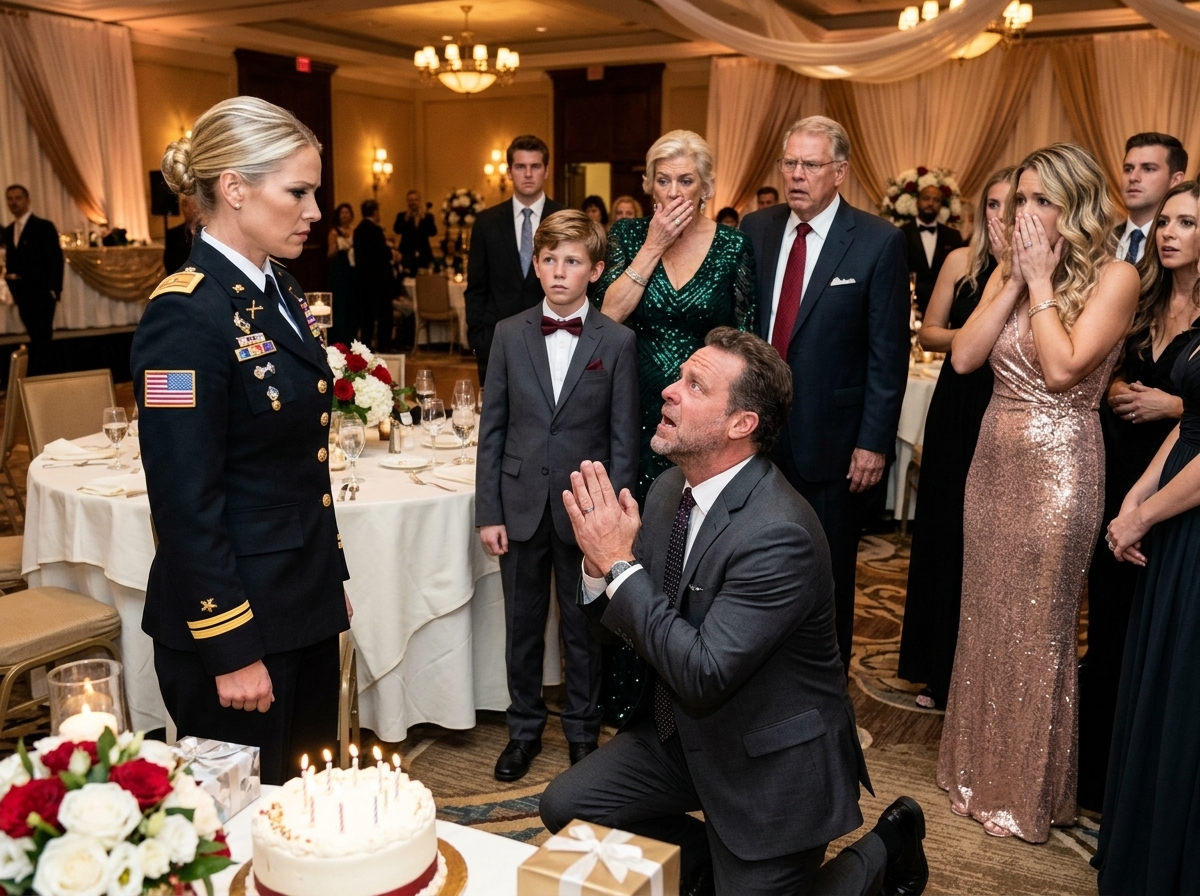
At 2:07 a.m., my husband sent me a text asking me not to come to our seven-year-old son’s birthday because his wealthy family was embarrassed by me.
“There will be important people there,” Ethan wrote.
“Mom thinks the way you dress and speak will embarrass us.”
I stared at the message inside our ten-million-dollar Virginia home—the same house I had quietly rescued from foreclosure—and calmly typed back, “I understand.”
What Ethan didn’t realize was that I had spent twelve years allowing his family to confuse my silence with weakness.
They made fun of my plain clothes, my aging SUV, and my vague “government job.”
His mother, Margaret, once asked whether I had bought my Thanksgiving dress at a grocery store.
His father introduced me as someone who “handles paperwork for the government.”
I never bothered correcting them.
The truth was, I had enlisted in the United States Army at eighteen and worked my way into the senior officer ranks.
I had commanded soldiers overseas, sat through classified briefings, and served in places Ethan’s family would never receive clearance to know existed.
But that night, the insult wasn’t truly about me.
Upstairs, my son Noah was asleep beside the birthday decorations I had spent three weeks putting together. He had made me promise I would be there.
“Front row, Mom?”
“Front row,” I had promised him.
Then Margaret sent me a message.
“Thank you for being reasonable. Noah will be busy with his friends. He probably won’t even notice.”
Something inside me broke.
I walked into my study, opened the biometric safe Ethan had never bothered asking about, and removed two sets of documents.
One contained my military identification, official orders, and formal photograph in dress uniform.
The other contained the deed, financing records, and paperwork proving that the holding company controlling our home belonged to me.
Five years earlier, Ethan’s development company had nearly gone under. His father had refused to rescue him.
I had.
At 3:41 a.m., I called my attorney, Howard.
“I need you to review everything related to the house.”
He fell silent. “What happened?”
“My husband just told me I’m not welcome at my son’s birthday inside the house I paid for.”
By morning, Howard confirmed what I already believed: legally, I still controlled the property.
At 4:12 a.m., I made one more choice.
My military leave had officially ended at midnight, and a government vehicle was scheduled to pick me up for a command briefing.
Normally, I arranged for them to collect me away from the house so Ethan’s family wouldn’t start asking questions.
This time, I gave them my exact home address.
By nine, luxury cars had begun lining our street. Investors, executives, country-club friends—the “important people” Ethan was convinced I would embarrass.
I remained upstairs.
At 9:16, Ethan texted me again. “Thanks for understanding. Maybe just stay upstairs until everyone leaves.”
I looked at my uniform hanging beside the mirror.
Then I put it on.
Downstairs, they began singing “Happy Birthday” without me.
I heard Noah stop them.
“Where’s Mom?”
Margaret replied, “Mommy had something important to do.”
“No,” Noah said. “She promised.”
I moved toward the staircase.
Then the doorbell rang.
Through the massive front windows, several dark government vehicles rolled to a stop outside.
Uniformed personnel stepped onto the driveway.
I reached the top of the stairs.
Margaret noticed me first.
For twelve years, that woman had always managed to find something wrong with the clothes I wore.
That morning, she couldn’t find a single word.
Ethan turned toward me, his champagne glass frozen halfway to his lips.
“Claire?”
I walked slowly down the stairs.
His gaze moved from the ribbons on my chest to the insignia on my uniform.
“What rank are you?”
Before I could answer, an older guest whispered, “Oh my God.”
Then a uniformed officer stepped through the open front door, spotted me, snapped sharply to attention, and raised a precise salute.
“Ma’am.”
The entire room fell silent.
And just as the color disappeared from Ethan’s face, another vehicle pulled into the driveway.
Howard climbed out holding the blue folder containing the documents connected to our house.
Ethan recognized it instantly.
“Claire,” he whispered, “what are you doing?”
I looked at the family who had spent twelve years believing I should feel lucky they tolerated me.
Then Howard opened the folder.
Howard opened the blue folder.
For one brief second, I thought about asking him to close it.
Not because I had changed my decision.
Because Noah was still standing beside the dining table wearing a paper birthday crown, looking from me to Ethan with the serious confusion only a seven-year-old could have.
This was supposed to be his morning.
Whatever happened between the adults standing in that room, I refused to turn my son’s birthday into a courtroom.
I raised one hand.
“Howard. Not yet.”
He stopped immediately.
Ethan released a breath, apparently mistaking my restraint for surrender.
“Claire, whatever this is, we can discuss it privately.”
“We will.”
Margaret recovered enough to straighten her pearl necklace.
“Then perhaps you should explain why you’ve invited military personnel into a private family celebration.”
Before I could answer, a small hand caught mine.
“Mom?”
I looked down.
Noah’s birthday crown had slipped sideways. His eyes traveled over my uniform, lingering on the ribbons before returning to my face.
“Are you going somewhere?”
I knelt, ignoring the sharp crease my trousers made against the marble.
“I have a meeting, sweetheart.”
“On my birthday?”
“Yes.”
His fingers tightened.
“But you promised.”
The room blurred around the edges.
I had stood beside hospital beds overseas and delivered news no parent should ever hear. I had learned how to speak through exhaustion, grief, and fear.
Nothing prepared me for the disappointment in my son’s voice.
“I promised I’d be here when you celebrated,” I said. “And I am.”
He studied me.
“Then can we do the candles again?”
A quiet laugh escaped my throat.
“Absolutely.”
Behind us, Margaret made an impatient sound.
“The guests have already—”
“Mom,” Ethan interrupted.
It was the first time in twelve years I had heard him stop her before she finished criticizing me.
Noah tugged my sleeve.
“Can you stand in front?”
I looked toward the dining table.
The cake was shaped like a rocket, with seven blue candles and tiny silver stars. I had ordered it from the same bakery that made his first birthday cake.
“Front row,” I whispered.
He smiled.
And for the next three minutes, nothing else mattered.
I stood beside him while the guests awkwardly resumed singing. Noah leaned against my hip, one arm wrapped around my waist. When the song ended, he closed his eyes so tightly his cheeks wrinkled.
He blew out every candle.
Then he whispered something I barely heard.
“I wished you could stay.”
I kissed his hair.
“I know, baby.”
The officer waiting near the entrance respectfully looked away.
I turned to him.
“Captain, please inform the driver I’ll be outside shortly.”
“Yes, ma’am.”
He stepped back through the doorway.
Only then did I face Ethan.
“We need to speak in the study.”
Margaret stepped forward.
“Whatever concerns this family concerns me.”
“No,” I said. “It doesn’t.”
Her mouth opened.
I didn’t wait for the response.
“Howard, come with us.”
Ethan followed, his footsteps uneven against the polished floor.
Behind us, Noah was showing his friends the rocket cake, unaware that the adults were about to discover how fragile their beautiful world had become.
The study smelled faintly of cedar and old paper.
Sunlight cut across the Persian rug, illuminating the desk where I had spent countless nights reviewing financial statements while Ethan slept.
Howard placed the folder down.
Ethan closed the door.
“What is this?” he demanded. “Some kind of humiliation exercise?”
I turned toward him.
“You asked me to hide in my own home.”
“I asked you to avoid an uncomfortable situation.”
“For whom?”
He rubbed his forehead.
“Claire, you know how my mother gets.”
“I do. I’ve known for twelve years.”
“Then you understand.”
“No, Ethan. I understand that you were willing to hurt our son rather than disappoint your mother.”
He flinched.
“That isn’t fair.”
“Neither was telling him I wasn’t coming.”
He looked at Howard.
“Why is he here?”
Howard opened the folder and slid a document across the desk.
“Because your wife requested an independent review of the property’s ownership and associated financing.”
Ethan stared at the page.
His expression changed slowly.
First confusion.
Then recognition.
Then something much closer to fear.
“Fairhaven Holdings?”
I said nothing.
He looked up.
“You know about Fairhaven?”
“I own it.”
The clock above the fireplace ticked three times.
Ethan laughed once.
A short, disbelieving sound.
“That’s impossible.”
Howard placed another document beside the first.
“Mrs. Bennett is the sole owner of the holding company.”
Ethan gripped the edge of the desk.
“But Fairhaven purchased the debt.”
“Yes,” Howard said.
“And refinanced the property.”
“Yes.”
“And the capital infusion into my company—”
“Was funded through a separate investment vehicle controlled by your wife.”
Ethan lowered himself into the chair.
I watched him calculate.
Five years of business meetings.
Five years of believing an anonymous investor had recognized his brilliance.
Five years of thanking strangers while dismissing the woman sitting across from him at dinner.
“You saved the company,” he whispered.
“I kept it alive.”
“Why didn’t you tell me?”
“Because you told me you couldn’t bear another person knowing you had failed.”
His eyes lifted.
I remembered that night perfectly.
Ethan sitting on our bedroom floor, surrounded by overdue notices, telling me he would rather disappear than ask his father for help again.
I had held him until dawn.
Then I had called Howard.
“I thought I was protecting your dignity,” I said.
Ethan pressed both hands against his face.
For a moment, I almost reached for him.
Then I remembered his message.
Maybe just stay upstairs until everyone leaves.
My hand remained at my side.
Howard cleared his throat.
“There’s another matter.”
Ethan looked up sharply.
“What matter?”
Howard hesitated.
“Claire, I received the final transaction records while driving here.”
He removed a thinner envelope.
“I believe you should see them before we proceed.”
I opened it.
The first page showed a request for additional financing against Ethan’s company assets.
The second contained an investor presentation.
The third made my stomach tighten.
Fairhaven Holdings was listed as a guarantor.
Below it appeared a signature.
Mine.
Except I had never signed it.
I looked at Howard.
“When was this submitted?”
“Eleven days ago.”
Ethan’s face drained.
“Claire—”
“Did you authorize this?”
He stood so quickly the chair struck the wall.
“I didn’t know they used your name.”
“Who?”
He said nothing.
“Ethan.”
“My father was handling the financing.”
I looked down at the signature again.
It was an excellent imitation.
Almost perfect.
Except whoever copied it had used my old signature, the one I stopped using professionally after a legal name correction years earlier.
Howard’s voice was quiet.
“The lender flagged inconsistencies and contacted my office. No funds were released under that guarantee.”
A knock sounded at the door.
Before anyone answered, Margaret entered.
“I think we’ve entertained this spectacle long enough.”
She stopped when she saw the papers.
Her gaze went straight to the envelope.
Not the deed.
Not the company records.
The forged guarantee.
I noticed.
So did Howard.
“Margaret,” I said, “who signed this?”
She didn’t even glance at the page.
“Your husband has worked very hard to maintain this family’s standing.”
“That wasn’t my question.”
Her expression hardened.
“You’ve always enjoyed making things difficult.”
Ethan stared at her.
“Mom. What did you do?”
She turned on him.
“Everything I have ever done was for you.”
The silence that followed was so complete I could hear children laughing in the garden.
Howard closed the folder.
“Mrs. Bennett, I recommend we continue this conversation with counsel present.”
Margaret’s eyes narrowed.
“You’re threatening me?”
“No,” I said. “I’m giving you an opportunity to stop talking.”
She looked at my uniform.
Then at the house around us.
And finally, with astonishing bitterness, she said, “You think wearing medals makes you better than us?”
I held her gaze.
“No. I think telling the truth makes us responsible for what happens next.”
Ethan stepped between us.
“Mom, tell me you didn’t forge Claire’s signature.”
Margaret looked toward the window.
“Your father said the investment would collapse without additional security.”
“So you signed her name?”
“We were going to replace the guarantee once the financing closed.”
Howard’s pen stopped moving.
Margaret realized too late what she had admitted.
Ethan backed away from her.
“You knew she owned Fairhaven?”
His mother’s face changed.
That was the moment I understood something I had never considered.
Margaret hadn’t simply discovered my secret.
She had known.
Perhaps not everything about my military career.
But enough about the money.
Enough about the house.
Enough to understand that the woman she called an embarrassment was the reason her family still had a home to entertain investors in.
“How long?” I asked.
She lifted her chin.
“Does it matter?”
“How long have you known?”
“Three years.”
The words landed without drama.
Somehow, that made them worse.
Three years of Thanksgiving insults.
Three years of jokes about my salary.
Three years of telling Noah his mother should learn how to dress properly.
“You knew,” Ethan whispered.
Margaret looked at him.
“I was trying to protect you.”
“From what?”
“From becoming dependent on her.”
He stared at his mother as though seeing her for the first time.
Then the study door opened again.
His father, Richard, stood in the doorway.
His face was pale.
“Margaret,” he said, “stop.”
She turned.
“You told me everything was arranged.”
Richard looked at the documents.
Then at Howard.
Then at me.
And in that sequence, I saw a man recognize that his control had finally reached its limit.
“I advised against using the guarantee,” he said.
Margaret laughed bitterly.
“You prepared it.”
Richard’s jaw tightened.
Howard opened his notebook.
“Mr. Bennett, are you confirming involvement in the preparation of this document?”
Richard said nothing.
I stepped closer to the desk.
“Here’s what happens now. You will preserve every record connected to this transaction. Howard will notify the lender and the appropriate authorities. You will not contact anyone to alter, destroy, or explain away the evidence.”
Margaret crossed her arms.
“You can’t destroy this family over paperwork.”
I looked at her.
“No, Margaret. You made choices. The consequences belong to you.”
Ethan turned toward me.
“Claire, please. Think about Noah.”
I felt something inside my chest go very still.
“I have been thinking about Noah since two in the morning.”
He lowered his eyes.
“That’s not what I meant.”
“I know.”
The clock struck ten.
Outside, a car horn sounded softly.
My driver was waiting.
I looked at Howard.
“Proceed carefully. No public accusations. No unnecessary spectacle. Let the evidence speak.”
He nodded.
Then I turned to Ethan.
“I’ll be taking Noah to my sister’s house this evening. We can discuss parenting arrangements through our attorneys.”
His face crumpled.
“Are you leaving me?”
I watched the man I had loved for twelve years struggle to understand that love did not erase injury.
“I don’t know what our marriage becomes after today,” I said. “But I know it cannot remain what it was yesterday.”
He swallowed.
“Claire—”
“I have to go.”
I walked past him.
He didn’t try to stop me.
At the front door, Noah came running from the garden, carrying a slice of cake on a paper plate.
“Mom! Wait!”
I knelt again.
He held out the plate.
“I saved you the biggest piece.”
The frosting had smeared across his fingers.
I took it carefully.
“Thank you, sweetheart.”
He glanced toward the vehicles.
“Are those your friends?”
“Some of them are people I work with.”
He considered this.
“Are you a soldier?”
I smiled.
“Yes.”
“Like the people in the pictures at the museum?”
“Something like that.”
He touched one of my ribbons.
“Did you help people?”
My throat tightened.
“I tried.”
He nodded solemnly.
Then he hugged me.
Not the quick embrace of a child eager to return to his presents.
A long, fierce hug.
“I don’t think your clothes are embarrassing,” he whispered.
I closed my eyes.
For one moment, the entire world narrowed to the warmth of his cheek against mine.
“Neither do I, baby.”
When I stood, Ethan was watching from the doorway.
I saw tears in his eyes.
But I couldn’t carry those tears for him.
Not anymore.
The drive to the briefing passed in near silence.
The captain sitting across from me glanced once at the untouched cake balanced carefully on my lap.
“Everything all right, ma’am?”
I looked out at the trees flashing past the window.
“No,” I said.
Then, after a moment, “But it will be.”
At headquarters, I did what I had trained myself to do for years.
I worked.
I listened.
I made decisions.
I answered questions with the clarity expected of someone entrusted with other people’s lives.
No one in the conference room knew that beneath the polished table, my hands occasionally trembled.
When the briefing ended, I sat alone for several minutes.
My phone contained seventeen missed calls from Ethan.
Four from Richard.
Nine from Margaret.
And one message from Noah, sent from his father’s phone.
A photograph.
He was standing beside his birthday cake, smiling with blue frosting on his nose.
Underneath, Ethan had typed his words.
Mom, I kept your chair.
I stared at the photograph until the screen dimmed.
Then I called my sister.
Rebecca answered immediately.
“Claire?”
“Can Noah and I stay with you tonight?”
There was a pause.
Then the sound of a chair scraping across the floor.
“Of course.”
I tried to thank her.
Instead, my voice broke.
Rebecca didn’t ask for an explanation.
She simply said, “I’ll make up the guest room.”
By evening, the story had already begun moving through Ethan’s social circle.
Not the full story.
Just fragments.
A uniformed officer.
A mysterious property company.
A birthday party interrupted.
Someone had taken photographs of the government vehicles outside the house.
Someone else had noticed Howard leaving with documents.
Ethan called again at six.
This time, I answered.
“Claire.”
His voice sounded exhausted.
“Mom’s telling everyone you planned this to humiliate us.”
I stood beside my SUV in the headquarters parking lot.
“Did you correct her?”
Silence.
“Ethan?”
“Yes,” he whispered.
“What did you say?”
“That you came downstairs because Noah asked for you.”
I closed my eyes.
“And?”
“That the house belongs to you.”
The wind moved through the trees.
For the first time that day, I heard something unfamiliar in his voice.
Not fear of losing status.
Shame.
“I told Dad to leave,” he continued. “Mom too.”
“Did they?”
“Eventually.”
I leaned against the car.
“I’m picking Noah up in thirty minutes.”
“I know.”
Another pause.
“Claire, I read the messages I sent you.”
I said nothing.
“I kept reading them. I couldn’t believe I wrote those things.”
“But you did.”
“Yes.”
His breath caught.
“I did.”
When I arrived home, the driveway was empty.
The balloons still hung over the entrance.
Inside, the dining room smelled of extinguished candles and vanilla frosting.
Ethan stood near the staircase holding Noah’s overnight bag.
He looked as though he had aged years in a single afternoon.
Noah rushed toward me.
“Mom!”
I caught him.
“Ready for an adventure?”
He nodded.
“Are we sleeping at Aunt Rebecca’s?”
“We are.”
“Can we make pancakes tomorrow?”
“Absolutely.”
He ran upstairs to retrieve his favorite stuffed dinosaur.
Ethan and I stood alone.
For several seconds, neither spoke.
Then he held out a small envelope.
“I found this in Mom’s office.”
Inside were copies of the financing documents.
Emails.
Notes.
And a letter addressed to Richard from a private financial adviser.
I skimmed the first page.
Then stopped.
Margaret and Richard had not merely attempted to use Fairhaven as security.
They had planned to transfer control of Ethan’s remaining company assets into an entity they controlled once the new financing closed.
Ethan would have been left with the liabilities.
They would have kept the profitable holdings.
I looked up.
“He was going to sacrifice you.”
Ethan’s eyes filled.
“He told me the restructuring was for my protection.”
I studied the documents again.
Richard had refused to rescue his son five years earlier.
Now I understood why.
To Richard, failure wasn’t something a family survived together.
It was leverage.
And Margaret had spent years making sure Ethan remained desperate for his father’s approval.
“Why are you giving me this?” I asked.
Ethan swallowed.
“Because Howard needs it.”
He looked down.
“And because I don’t want to be like them anymore.”
I folded the papers.
“That decision will take more than one afternoon.”
“I know.”
Noah appeared at the top of the stairs.
“Dad, where’s my dinosaur’s hat?”
Ethan wiped his face quickly.
“In the front pocket, buddy.”
Noah descended with his backpack bouncing against his shoulders.
At the door, he turned.
“Dad?”
“Yes?”
“Are you coming tomorrow?”
Ethan looked at me.
I answered gently.
“Dad and I are figuring some things out.”
Noah frowned.
“Did somebody do something bad?”
I knelt beside him.
“Some grown-ups made choices that hurt people.”
“Did I?”
The question nearly brought me to my knees.
“No,” I whispered. “Never you.”
He studied my face.
“Are you still my mom?”
I pulled him close.
“Every day of your life.”
He looked toward Ethan.
“And he’s still my dad?”
Ethan knelt beside us.
“Always, buddy.”
Noah reached for both our hands.
For one painful moment, we were connected by the small fingers of a child who had done nothing to deserve the distance opening between his parents.
Then he let go.
“Okay,” he said softly.
And we left.
The investigation unfolded over the following months.
It was neither swift nor glamorous.
There were interviews, preserved emails, accounting records, and long meetings in rooms without windows.
Howard coordinated with independent investigators and the lender’s attorneys.
The forged signature became only one piece of a larger financial scheme.
Richard had manipulated investor disclosures, concealed losses, and directed company funds through entities controlled by relatives.
Margaret had knowingly assisted with false documents and misleading financial representations.
Their own correspondence established what they had done.
No dramatic confession was necessary.
Their words were already there.
When the lender initiated legal action, Richard attempted to shift responsibility onto an employee.
The employee produced archived instructions bearing Richard’s approval.
When Margaret claimed she had acted without understanding the documents, investigators recovered messages in which she discussed exactly how the guarantee would conceal the true ownership of the property.
Their explanations collapsed beneath their own records.
Ethan cooperated.
He surrendered access to the accounts.
He gave investigators the documents he had found.
And when his father demanded that he withdraw his statement, Ethan refused.
That refusal cost him.
Richard removed him from the remaining family business interests.
Margaret stopped speaking to him.
Several investors withdrew from projects associated with the Bennett name.
The company Ethan had once believed defined his worth entered a painful restructuring.
He lost his executive position.
He sold his luxury car.
For the first time since I had known him, he had to decide what kind of man he wanted to be without a wealthy family standing behind him.
Meanwhile, I filed for separation.
Not as punishment.
As protection for the space Noah and I needed to breathe.
The first weeks were difficult.
Noah cried twice at bedtime because he missed his father.
He asked why we couldn’t go home.
He worried that if he loved one parent too much, the other might disappear.
Rebecca and I found a child therapist who helped him put words to feelings that were too large for a seven-year-old.
Ethan attended the parenting sessions when invited.
He listened.
Sometimes he cried.
Sometimes he became defensive.
But he kept coming.
One rainy Thursday, Noah’s therapist asked him what he remembered most about his birthday.
I expected him to mention the soldiers.
Or the argument.
Or the strange way everyone had stopped talking.
Instead, he said, “Mom came downstairs.”
The therapist smiled gently.
“Why was that important?”
Noah swung his legs beneath the chair.
“Because Grandma said she wasn’t coming.”
He looked at me.
“But she did.”
I covered my mouth.
Ethan lowered his head.
Noah continued, “And she stood in front like she promised.”
That night, after Noah fell asleep, I sat alone on Rebecca’s porch.
Rain tapped against the wooden railing.
My phone rang.
Ethan.
I almost let it go unanswered.
Then I picked up.
“Hello.”
“I wanted to apologize,” he said.
“You’ve apologized before.”
“I know. But I keep thinking about something Noah said today.”
I waited.
“He wasn’t surprised you were a soldier. He was surprised you came.”
I closed my eyes.
“That should tell you something.”
“It does.”
His voice cracked.
“I made our son believe his mother might not show up because I was afraid of disappointing my parents.”
Neither of us spoke for a long time.
Then he said, “I don’t expect you to forgive me.”
I watched rain gather on the porch steps.
“Good,” I whispered. “Because I don’t know if I can yet.”
“I understand.”
“For years, Ethan, I thought if I loved you quietly enough, eventually you’d stop needing me to prove I belonged.”
He breathed unevenly.
“I know.”
“No. I don’t think you do. I was proud of you when your company succeeded. I was proud when you failed and kept trying. I never needed you to be rich.”
My voice trembled.
“I just needed you to be kind.”
On the other end, he began crying.
I let him.
I didn’t rescue him from the silence.
For once, he had to sit inside the consequences of what he had done.
The criminal case reached its conclusion the following spring.
Richard entered a guilty plea to multiple financial offenses.
Margaret pleaded guilty to charges connected to the fraudulent documents and her role in the scheme.
Their sentences included imprisonment, financial penalties, and restitution obligations. Richard also lost control of the businesses he had spent decades using to dominate his family.
The remaining assets were subject to court-supervised proceedings.
Their carefully cultivated social standing disappeared almost overnight.
But the moment that stayed with me wasn’t the sentencing.
It was Margaret turning toward Ethan outside the courtroom.
“You’ve destroyed your father,” she said.
Ethan stood beside me, his hands trembling.
“No, Mom.”
She stared at him.
“You chose her.”
He looked toward the courthouse steps, where Noah was waiting safely with Rebecca, far from the proceedings.
Then he faced his mother.
“I chose to stop lying.”
Margaret’s expression twisted.
“After everything we’ve given you?”
Ethan’s voice was barely audible.
“You never gave me permission to be myself.”
For the first time, Margaret had no answer.
She turned away.
Ethan didn’t follow.
I watched him stand there, breathing through the loss of a family he had spent his entire life trying to please.
Then he looked at me.
“I wish I’d said that twelve years ago.”
“So do I,” I answered.
It wasn’t forgiveness.
But it was true.
Summer arrived slowly.
Noah turned our temporary home at Rebecca’s into a kingdom of toy dinosaurs, blanket forts, and unfinished drawings.
Rebecca, who had spent years worrying that my marriage was draining the light from me, began laughing more often.
One evening she found me making pancakes for dinner.
“You know,” she said, leaning against the counter, “I always thought you were the strongest person I knew.”
I flipped a pancake.
“That’s a dangerous compliment.”
She smiled.
“But I think you misunderstood strength.”
I looked at her.
“You thought it meant carrying everything without letting anyone notice how heavy it was.”
The spatula stopped in my hand.
Rebecca stepped closer.
“You don’t have to do that here.”
I looked toward the living room.
Noah was building a spaceship out of cardboard boxes.
His laughter filled the house.
For the first time in years, I let myself cry without apologizing.
Rebecca wrapped her arms around me.
And I held on.
By August, Ethan had found work with a small construction firm.
Nothing prestigious.
No executive office.
No country-club invitations.
He supervised renovation projects and came home with dust on his boots.
He began attending counseling on his own.
He never asked me to keep his progress secret.
He never demanded credit for doing what he should have done years earlier.
When Noah visited him, they built birdhouses, cooked terrible spaghetti, and went fishing at a nearby lake.
Ethan sent photographs.
Not to impress me.
Just so I could see our son smiling.
One afternoon, he asked whether we could meet for coffee.
I agreed.
We sat at a small café near the river.
He wore jeans and a faded work jacket.
For once, he didn’t look uncomfortable being seen in ordinary clothes.
“I’ve been thinking about the house,” he said.
I stirred my coffee.
“What about it?”
“You should keep it.”
“I intend to.”
He nodded.
“I know you don’t need my permission.”
I looked up.
He gave a faint, embarrassed smile.
“I’m learning.”
Outside, sunlight moved across the water.
Then he reached into his pocket and placed his wedding ring on the table.
My chest tightened.
“I haven’t stopped loving you,” he said.
I stared at the ring.
“But I understand love doesn’t entitle me to another chance.”
He pushed it toward me.
“I wanted you to know that whatever you decide, I won’t fight you for the life you built.”
I touched my own ring.
For twelve years, I had worn it through deployments, sleepless nights, and countless small humiliations.
I remembered the young man who once waited outside a military hospital for six hours just to bring me dinner.
I remembered how he used to make me laugh.
I remembered loving him before his family’s expectations became the loudest voice in our marriage.
“I loved who we were,” I whispered.
His eyes shone.
“So did I.”
“But I can’t go back to being that woman.”
“I don’t want you to.”
We sat in silence.
Then I removed my ring.
Ethan closed his eyes.
I placed it beside his.
Not as an act of revenge.
As an acknowledgment that the marriage we had entered twelve years earlier had ended long before either of us admitted it.
“We can be good parents,” I said.
He nodded, tears slipping down his cheeks.
“I’d like that.”
“And maybe someday, we’ll be friends.”
He managed a small smile.
“I’d like that too.”
We left the rings on the table between us until the coffee grew cold.
Then we each took our own.
The divorce was finalized that autumn.
There was no celebration.
No victory speech.
Only paperwork, signatures, and the quiet grief of closing a door that had once led somewhere beautiful.
We established a parenting arrangement that gave Noah stability and meaningful time with both of us.
The house remained mine.
But I no longer wanted to live inside every memory it contained.
Howard helped me arrange a sale.
When the property finally transferred to its new owners, I walked through the empty rooms one last time.
The dining room looked enormous without furniture.
The staircase seemed smaller.
I stood where Margaret had first seen me in uniform.
For years, I had imagined that if her family ever discovered who I truly was, everything would change.
They would respect me.
They would apologize.
They would finally understand.
But standing there, I realized their approval had never been the prize.
My freedom was.
I went upstairs to Noah’s old bedroom.
On the windowsill sat a tiny paper rocket.
I recognized it immediately.
He had made it the night before his birthday.
Blue construction paper.
Silver stars.
A crooked yellow flame.
I picked it up.
Inside, folded so tightly I almost missed it, was a small piece of paper.
I unfolded it.
Seven-year-old handwriting covered the page.
My birthday wish is for Mom to know she is my hero even when nobody else knows.
I sat down on the empty floor.
For several seconds, I couldn’t breathe.
Then I laughed through tears.
All those years I had hidden my accomplishments.
All those years I had mistaken invisibility for peace.
And my little boy had seen me anyway.
Not the uniform.
Not the rank.
Not the house.
Me.
I pressed the paper against my chest.
The final beautiful truth wasn’t that I had secretly owned the mansion.
It was that the only person whose admiration I had ever truly needed had never required proof.
That evening, I drove to our new home.
It was smaller.
A white house with blue shutters, a wide front porch, and a backyard large enough for Noah to build his imaginary space station.
Rebecca lived fifteen minutes away.
Ethan lived twenty.
There were no marble floors.
No enormous chandeliers.
No dining room designed to impress strangers.
But when I opened the front door, the smell of fresh cookies greeted me.
Noah came racing down the hallway.
“Mom!”
I caught him before he could knock us both over.
“What’s the emergency, Captain?”
He grinned.
“I made something!”
He dragged me into the living room.
A cardboard rocket stood beside the sofa, decorated with aluminum foil and colorful stickers.
On its side, in uneven blue letters, he had written:
MOM AND NOAH SPACE EXPLORERS.
I smiled.
“Where are we going?”
“Anywhere.”
He looked up at me.
“As long as we go together.”
I knelt beside him.
“Deal.”
A knock sounded at the door.
Ethan stood outside holding a small toolbox.
Noah had asked him to help repair the backyard swing.
For a moment, we simply looked at each other.
Then Ethan smiled.
“Permission to come aboard?”
Noah shouted from the living room.
“Granted!”
I stepped aside.
Ethan entered, removed his shoes, and headed toward the backyard with our son.
I watched them through the kitchen window.
Ethan knelt beside the swing, explaining how the bolts worked.
Noah listened with exaggerated seriousness.
Then he handed his father a wrench.
They laughed.
It wasn’t the family I had once imagined.
But it was a family learning how to love without pretending nothing had happened.
Later, Rebecca arrived with dinner.
We ate around a wooden table that had cost less than one of the chairs in our old dining room.
Noah told ridiculous jokes.
Rebecca laughed so hard she spilled her water.
Ethan helped wash the dishes before leaving.
At the door, he paused.
“Claire?”
I looked up.
“Thank you for letting me be here.”
I studied him.
The man standing before me was no longer the husband who had asked me to hide upstairs.
He was still imperfect.
Still carrying regret.
Still learning.
But he was trying to become someone our son could trust.
“Thank Noah,” I said gently. “He’s the one who invited you.”
Ethan smiled.
“I will.”
When he left, Noah climbed into my lap on the porch swing.
The evening air smelled of cut grass and approaching rain.
Fireflies blinked among the trees.
He rested his head against my shoulder.
“Mom?”
“Yes, sweetheart?”
“Do you miss the big house?”
I thought about the marble staircase.
The chandeliers.
The enormous rooms filled with people who had never truly welcomed me.
Then I looked at the small white house behind us.
Warm light spilled through the windows.
Rebecca was humming in the kitchen.
Noah’s cardboard rocket stood proudly beside the sofa.
“No,” I whispered. “Not anymore.”
He considered that.
“Good.”
“Why good?”
“Because I like this house better.”
I kissed his forehead.
“Me too.”
He yawned.
“Mom?”
“Yes?”
“Next birthday, can we have a party here?”
“Of course.”
“With Dad?”
“Yes.”
“And Aunt Rebecca?”
“Absolutely.”
He lifted his head.
“And you have to stand in front.”
I smiled through the sudden ache in my chest.
“Front row?”
He nodded.
“Always.”
I held him close as the first stars appeared.
Twelve years earlier, I had married into a family that believed wealth was power, silence was weakness, and love was something people had to earn by becoming acceptable.
They had been wrong about all three.
The greatest power I possessed had never been my rank.
It wasn’t the money.
It wasn’t the house.
It was the ability to stand up when someone I loved needed me, even when standing up meant walking away from everything familiar.
Noah’s breathing slowed against my shoulder.
Inside, the kitchen light glowed softly.
Somewhere in the distance, thunder rolled across the Virginia hills.
I looked down at my sleeping son and remembered the message that had started it all.
Maybe just stay upstairs until everyone leaves.
I had spent twelve years staying quiet.
Twelve years making myself smaller.
Twelve years waiting for people who looked down on me to finally see my worth.
But on my son’s seventh birthday, I had walked down those stairs.
And somehow, that single decision had led me here.
To a porch swing.
To a sleeping child.
To a home where nobody had to hide.
I brushed a strand of hair from Noah’s forehead.
“I’m here,” I whispered.
He stirred, barely awake.
“I know, Mom.”
Then he smiled in his sleep.
And for the first time in longer than I could remember, I wasn’t waiting for permission to belong.
I was already home. Read More