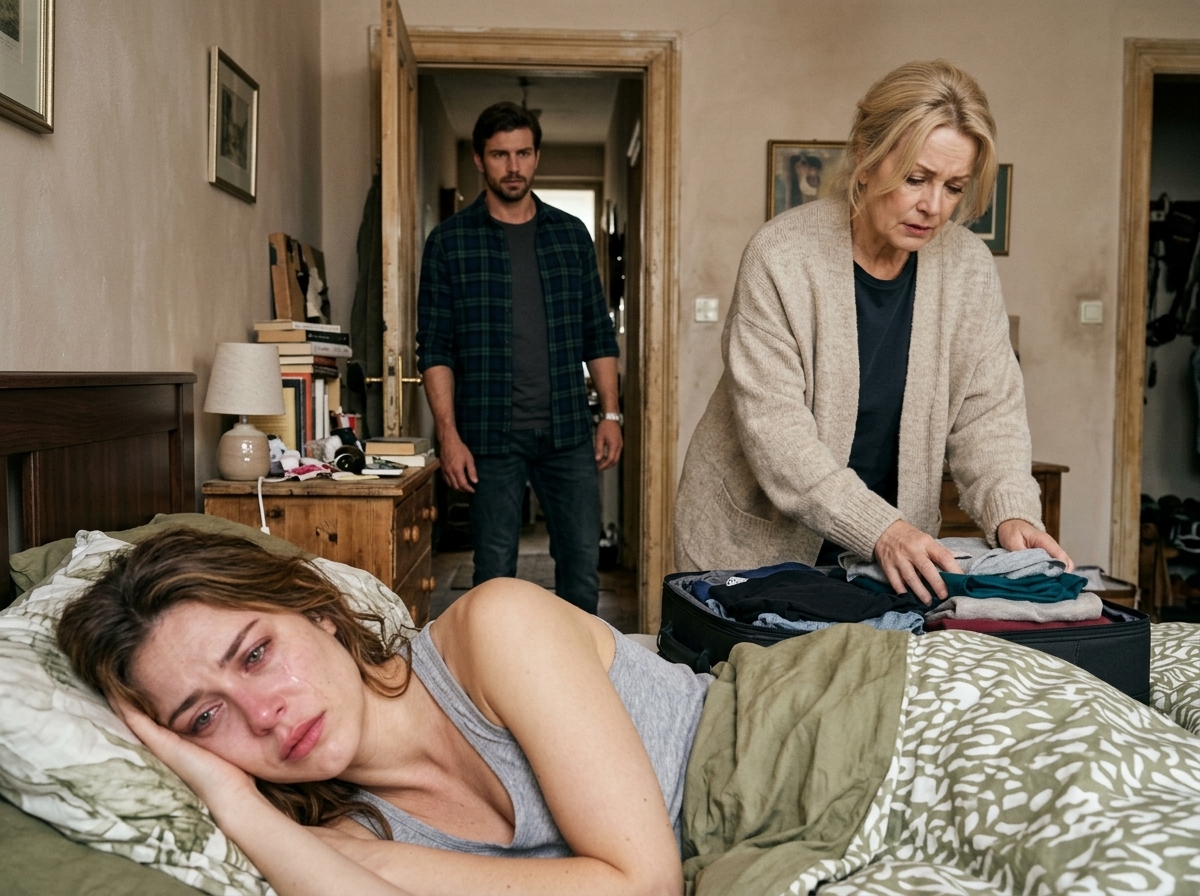
I kept my eyes closed and pretended to be asleep. But the next morning, I did something she never saw coming…
PART 1: THE MIDNIGHT BETRAYALAt 12:07 in the morning, I saw my mother-in-law secretly place something in my carry-on luggage. Half a minute later, she murmured into her phone, “It’s in her bag. Call airport security at six. By breakfast, she’ll be finished.”
I didn’t open my eyes.
Instead, I smiled.
My name is Harper Lawson. I’m 36, and throughout seven years of marriage, my husband’s relatives had confused my quietness with ignorance.
My mother-in-law, Lorraine, was the sort of woman capable of ruining someone’s reputation while offering them freshly baked cookies. Her son, Preston, my husband, had inherited both her vicious nature and her fixation on wealth.
Three months before that night, I’d uncovered the disappearance of almost $2.4 million from Lawson Holdings, the hospitality business established by my deceased father.
Preston served as CEO. Lorraine oversaw the company’s public relations division.
And fifty-two percent of the business belonged to me.
They referred to me as their “little decorative shareholder.”
What they didn’t know was that I’d worked for eleven years as a forensic accountant before I married Preston.
Earlier that evening, I’d mentioned over dinner that I was catching an early flight to Chicago.
“Business again?” Lorraine asked, rolling her eyes.
“Just a meeting.”
Preston chuckled. “Sweetheart, leave the important decisions to people who understand money.”
I gave him a smile.
“Of course.”
Now, beneath my bedcovers, I heard Lorraine gently shut my suitcase.
A soft metallic click sounded in the bedroom.
Moments later, her footsteps faded into the distance.
I remained still until the corridor became completely quiet.
Then I finally opened my eyes.
My heart pounded fiercely, yet I made no attempt to approach the luggage.
Instead, I picked up my phone.
The miniature surveillance camera concealed inside the digital clock on my dresser continued recording.
I’d set it up two weeks before, after realizing someone had been entering my bedroom repeatedly whenever I wasn’t home.
I accessed the live footage.
And there she was.
Lorraine Lawson, dressed in her luxurious silk robe, opening the interior compartment of my carry-on bag.
She pulled a small, dark object from her pocket.
She placed it inside my suitcase.
Afterward, she made a phone call.
“Preston, it’s done. Make the anonymous report at six sharp.”
A cold sensation spread through my stomach.
My own husband.
The man who had vowed to keep me safe.
The same man who was asleep barely twenty feet from me.
Their plan went far beyond embarrassing me.
They intended to have me detained at the airport for carrying a concealed weapon I didn’t even know was in my possession.
I kept looking at the footage.
Then I dialed a number I’d prayed I would never have to use.
“Detective Ortega,” I whispered when he answered. “I have the evidence you asked me to preserve.”
His tone immediately grew serious.
“Harper, what happened?”
“My husband and his mother just made a very serious mistake.”
And before the sun rose, they would learn just how devastating that mistake was.
PART 2: THE TRAP THEY NEVER SAW COMING
Detective Raymond Ortega pulled up at 1:43 a.m. with a second officer.
I met them in the upstairs hallway, still in my pajamas.
“Don’t touch the suitcase,” Ortega said.
“I haven’t.”
He gave me a long look. “Good. Let me see the recording.”
I passed him my tablet, and for three minutes neither officer said a word. On the screen, Lorraine unzipped my bag, tucked a handgun into the lining, and made her call.
When it ended, Ortega let out a slow breath.
“She really planned to send you through security with that?”
“Apparently.”
“Why?”
I glanced at the closed bedroom door down the hall.
“Because I’m about to expose what her son did to my father’s company.”
I told them everything. For months, I’d been tracing odd transfers out of Lawson Holdings into consulting firms controlled by Preston’s associates. I’d already handed bank records, invoices, and internal emails to an independent attorney and a team of financial-crimes investigators. By now it was far more than suspicion. We had doctored invoices, unauthorized wire transfers, and emails instructing employees to bury the payments.
I was due in Chicago that morning to meet my attorneys about the next step. Lorraine and Preston must have believed that an arrest at the airport would wreck my credibility before I could act.
Ortega examined the original video file. He had the officers photograph the firearm where it lay, then recover it and bag it as evidence.
“Has your husband ever threatened you?” he asked.
“Not directly. He prefers financial threats.”
I showed him the message Preston had sent two days earlier: Sign the settlement agreement, Harper. Otherwise, things could get very ugly.
That agreement would have forced me to sell most of my shares to Preston for a fraction of their worth. I had refused.
Ortega looked up. “They want you desperate enough to sign.”
“That’s what I think too.”
“Then we make sure this attempt is documented properly.”
By 4:30, the officers had left with the gun and the footage. I’d given a formal statement and kept copies of everything. I changed into a cream-colored pantsuit, packed a fresh bag, and got ready for my flight.
At 5:15, Preston wandered into the kitchen, looking oddly cheerful.
“Big day, sweetheart?”
“Very big.”
He poured himself a cup of coffee. “Still planning to fight me over the company?”
I met his eyes. “Are you worried?”
He chuckled. “I’m worried you’ll embarrass yourself.”
Lorraine swept in wearing her pearls and an expression of staged concern.
“Harper, darling, are you sure you packed everything?”
“Everything I need.”
She traded a quick glance with Preston, then smiled.
“I hope your trip is unforgettable.”
“Oh, Lorraine,” I said softly. “I’m sure it will be.”
At 5:48, I drove out of the estate. In my rearview mirror, a black Mercedes pulled out after me. It was Preston’s, with Lorraine in the passenger seat. They wanted a front-row view of my humiliation.
What they didn’t know was that Ortega had already contacted airport police, and investigators were quietly documenting the setup.
At 6:02, Preston made his anonymous call, reporting that a woman matching my description was carrying a concealed weapon onto a departing flight. The airport’s reporting system recorded the whole thing.
At 6:19, my phone buzzed.
Security might have a few questions for you. Don’t make a scene.
Then a second message arrived.
Maybe now you’ll understand who controls this family.
I forwarded both to Ortega and walked calmly toward the terminal.
For the first time in seven years, I wasn’t afraid of what Preston might do next.
I was curious how he would explain what he’d already done.
PART 3: THE CONFESSION AT GATE B14
Chicago O’Hare was not where my day began. It began at Terminal 2 of our home airport, at 6:31 a.m., in a gray corridor behind the security checkpoint, where two airport police officers and Detective Ortega were waiting for me with coffee.
“Right on time,” Ortega said. “Your husband’s call came in at 6:02. Dispatch flagged it, and we’ve been tracking it since. Nobody is going to search you, Harper. We already know there’s nothing in your bag.”
“And the Mercedes?”
“Parked in short-term. Both of them just walked into the terminal.” He glanced at the officer beside him. “They’re heading for the checkpoint. They want to watch.”
I nodded. My hands were steady. I’d spent eleven years walking into boardrooms where everyone wanted me to be wrong, and the feeling was familiar.
“Then let’s let them watch.”
I stood in the security line like any other traveler, my bag on the belt, my boarding pass in my hand. Fifty feet behind the rope, near a coffee kiosk, Preston and Lorraine pretended to study a departure board.
Lorraine had a handkerchief ready. I could see it in her fingers, a little white flag she’d planned to dab at her eyes with once the scene began. Preston kept checking his watch.
The TSA officer scanned my bag. Nothing. She waved me through.
I collected my things and turned.
Preston’s face had gone slack. Lorraine’s handkerchief hung from her hand like a dead bird.
I walked straight toward them. Ortega and the two officers fell in behind me, a few steps back.
“Good morning,” I said pleasantly. “You’re up early.”
Preston recovered first. “Harper! We, uh, wanted to see you off.”
“How thoughtful.”
“There was a call,” Lorraine blurted. “We heard someone made a report. We were so worried.”
“About what?”
“That you were in some kind of trouble.”
“Funny,” I said. “Because the person who made that call was standing in your driveway at 6:02.”
Preston’s jaw worked. “I don’t know what you’re talking about.”
Ortega stepped forward and held up his badge. “Mr. Lawson, Mrs. Lawson. I’m Detective Raymond Ortega. I’d like you to come with me. Both of you.”
“On what grounds?” Preston snapped.
“False reporting of a weapon on an aircraft. Conspiracy to commit that offense. Possession of a firearm in connection with an attempt to frame another person.” He paused. “And we’ll see what the prosecutor adds.”
Lorraine laughed, a thin, brittle sound. “This is absurd. Harper is hysterical. She’s been unstable for months. Ask anyone.”
“I will,” Ortega said. “I’ll also ask them to watch a video.”
He turned the tablet toward her.
I had never seen Lorraine lose her composure. In seven years, not once. She’d been gracious at funerals, gracious at weddings, gracious when she’d told me my father’s company needed “a more experienced hand.”
Now she watched herself on the screen, in her silk robe, sliding a handgun into the lining of my suitcase, and every ounce of color left her face.
“That,” she whispered, “was edited.”
“The original file has metadata,” Ortega said. “And a second camera you didn’t know about caught your car leaving the driveway at 5:51 this morning.”
Preston grabbed his mother’s arm. “Don’t say anything. Not one word without Gerald.”
“Gerald Haines?” I asked. “Your attorney? He’s already been called. He’s meeting you at the station.” I tilted my head. “He sounded very surprised.”
The two of them were separated before they ever left the terminal. That’s standard, Ortega told me later. Nothing dramatic, just a quiet room, a recorder, and a clock on the wall.
Lorraine lasted forty minutes.
I wasn’t present, but I read the transcript afterward, and I’ll admit I read it twice. She started with outrage. Then came denial, then tears. Then, around the half-hour mark, she realized Preston was being interviewed in the next room and nobody was telling her what he’d said.
That was the crack.
“He made me do it,” she said suddenly. “It was his idea. He said Harper was going to take everything. He said we’d lose the company.”
“The gun,” Ortega said. “Where did it come from?”
“It was Preston’s. From his safe.” Her voice rose. “I only put it in the bag. I never meant for it to go off or anything. I only wanted her to be stopped.”
“Stopped from doing what?”
She looked at him with something close to bewilderment, like a woman explaining the obvious to a child.
“From taking back what’s hers.”
Ortega waited.
“Her father built that company,” Lorraine said, and for the first time her voice cracked. “My husband worked for him for twenty years, and what did he get? A gold watch and a pension. When Daniel Lawson’s will…” She stopped, shook her head, started again. “When Harper’s father died, I thought finally, finally, our family would have something. And then I found out she held fifty-two percent.”
“So your son married her.”
Lorraine didn’t answer.
“He married her for the shares,” Ortega said gently.
“It was never supposed to hurt her,” Lorraine whispered. “We were going to take care of her.”
I put the transcript down at that point and stood at my kitchen window for a long time. It wasn’t news. Some part of me had known for years. But there’s a difference between knowing and reading it in someone’s own words.
Preston held out for six hours.
He insisted on his attorney, then on a different attorney, then on a deal. By the afternoon he’d learned that Gerald Haines had already contacted the prosecutor’s office on his own account. Haines had been advising on the consulting-firm payments for two years, and he was not about to be the last person standing when the music stopped.
“They’re cooperating,” Ortega told me over the phone that night. “Haines gave us a proffer this afternoon. Names, dates, account numbers. He says your husband personally directed the transfers.”
“The $2.4 million?”
“And a good deal more. You were right to be worried. The total looks closer to $6 million over four years.”
I closed my eyes.
“Harper,” he said, more quietly. “Are you all right?”
“I’m fine.”
“You don’t have to be.”
I laughed, and it came out wet. “Thank you, Detective.”
“Raymond,” he said. “I think we’re past the formalities.”
The case took eleven months.
I won’t walk through every hearing. Forensic accounting, as I know better than anyone, is not cinematic. It’s spreadsheets and subpoenas, depositions that run all day, and a thousand small facts that add up to one large truth.
But a few moments stay with me.
The first was the day Preston’s consulting firms were unwound. Dozens of shell companies, each named something bland like Meridian Advisory or Northgate Strategic, all revealed to be the same handful of people moving money in circles. My team of investigators and I reconstructed every payment. At the end of it, we recovered a little over $4.9 million. The rest had been spent on a boat, a lake house, and a gambling habit that I had somehow never noticed.
The second was the day Preston pleaded guilty to wire fraud, embezzlement, and conspiracy to make a false report. His attorney had advised him that a trial would only make things worse. He wore a gray suit that no longer fit, and when the judge asked if he understood the charges, his voice came out hoarse.
“Yes, Your Honor.”
I sat in the second row. He didn’t look at me until the very end, when the deputy touched his arm to lead him away. Then he turned his head, and for a moment we were just two people who had once, in some earlier version of our lives, believed in each other.
“I’m sorry,” he mouthed.
I held his gaze and didn’t answer. Some apologies are real. That doesn’t make them enough.
He received six years in federal prison and a restitution order that would follow him for the rest of his working life.
Lorraine pleaded to a reduced charge and received probation with community service, a result that shocked no one more than her. She’d expected, I think, to be treated as the matriarch of a family wronged. Instead she spent two hundred hours sorting donations at a food pantry. The first week, I’m told, she complained to the supervisor about the lighting.
By the end, she stopped complaining.
The third moment came on a Tuesday in May.
I was sitting in my father’s old office, the corner one on the fourteenth floor with the window facing the lake, which Preston had converted into a “conference lounge” and which I’d quietly converted back. The walls still held pale rectangles where Preston’s framed magazine covers had hung.
An envelope sat on the desk. It had been forwarded from the prison.
I didn’t open it right away. I made tea. I watched a freight ship slide across the horizon.
Then I slit it open.
Harper,
I don’t expect an answer. I only wanted to say that you were right about everything, and that I was too proud to listen. When we met, I did see the shares first. I won’t lie about that. But somewhere in the second year I stopped seeing them. I started seeing you. That’s the part I couldn’t forgive myself for, because it meant I knew exactly what I was doing when I kept going.
Your father would have hated me. He’d have been right.
Preston
I read it twice. I folded it once, set it down, and sat with my hands in my lap.
Forgiveness, I’ve found, isn’t a switch. It’s closer to weather. Some days I’m further from it, and some days closer. That Tuesday it wasn’t there. But the anger had thinned, the way fog thins when the sun finally reaches it.
I filed the letter in the bottom drawer and went back to work.
Lawson Holdings is thriving now. We’ve reopened three of the properties that Preston’s cuts had shuttered, and we rehired most of the staff he’d laid off. A scholarship in my father’s name funds hospitality-management students who couldn’t otherwise afford it. At the first ceremony, an old night-shift bellman named Walt took my hand and told me my father used to learn every employee’s children’s names.
“You look like him when you smile,” he said.
I’d never heard anything that made me prouder.
In the evenings, I sometimes walk the lakefront with Raymond Ortega. We aren’t anything defined. We eat dinner on Fridays, argue about baseball, and talk about nothing important. He’s never once asked me to be smaller than I am.
The small camera that once sat in my bedroom clock is in a drawer now, a keepsake from a different life. I don’t need it anymore. But I kept it.
Because on the worst night of my marriage, someone opened my door in the dark, certain I was asleep, certain I was powerless, certain the quiet woman in the bed would never see the trap before it closed.
She was wrong about the first thing.
And I made sure she was wrong about the rest.
The lake outside the fourteenth-floor window was a hard, indifferent silver that May morning. For three years, the Lawson Holdings letterhead had featured a sleek, modern, sans-serif monogram that Preston had commissioned—something sharp and corporate that looked like it belonged on a hedge fund in Zurich rather than a hospitality enterprise built on the warmth of grand lobbies and family-run hotels.
I had replaced it within forty-eight hours of retaking the corner office. The original crest—my father’s crest, designed in 1974 with its subtle serif and the small, understated anchor at the base—was back on every sheet of stationery, every invoice, and every keycard.
My assistant, Chloe, knocked twice before pushing the door open. She was twenty-four, sharp-eyed, and had a habit of organizing my calendar with the merciless efficiency of a military strategist.
“Mr. Haines is on line two,” she said, her expression carefully neutral. “He says it’s about the Westin lease restructuring, but he sounds… jumpy.”
Gerald Haines. The man who had helped my husband siphon six million dollars over four years, who had written the consulting-firm bylaws on thick vellum paper while smiling across our dining room table, and who had ultimately traded his co-conspirators for a prosecutorial pass. He had avoided prison time through his cooperation agreement, but probation had a way of shrinking a man’s world. He was currently advising a regional bank on internal controls—a cruel irony that only the legal system could invent.
“Tell him I’m in a meeting, Chloe.”
“I already told him that. He said he’d wait.”
“Then let him wait.”
She smiled faintly, a brief flicker of satisfaction, and closed the door.
I looked down at the financial statements for the previous quarter. The numbers were strong—healthier than they had been even in the final years of my father’s life. When Preston took over the day-to-day operations under the guise of modernization, he hadn’t just looted the accounts; he had hollowed out the soul of the company. He had cut the night-audit staff by half, outsourced the laundry to a facility in Indiana that ruined half our linens, and replaced our veteran concierges with automated kiosks that emitted a faint, high-pitched whine whenever a guest tried to check in after midnight.
We had spent the last two years restoring the human element. Walt, the night-shift bellman whose hands had shaken slightly when he thanked me at the scholarship ceremony, had been promoted to Director of Guest Relations. He now spent his evenings walking the grand corridors of our flagship hotel, greeting guests by name and making sure the young trainees understood that hospitality wasn’t a transaction; it was a sanctuary.
My phone buzzed on the mahogany desk. A text from an unknown number.
Haines wants to meet. Off the record. It’s about your father’s estate before the merger.
I stared at the screen. My father’s estate had been settled years ago, or so I thought. When Daniel Lawson died of a sudden aneurysm in his study, his will had been read by our family attorney, a man named Henderson who had since retired to Boca Raton and stopped returning my calls six months before Preston’s arrest.
I picked up the desk phone and dialed Raymond Ortega’s direct line.
Act II: The Intersecting Lines
Raymond had left the precinct eighteen months ago. He was working now as an independent security consultant for high-net-worth families—essentially doing the same kind of threat assessment and asset protection he’d done as a detective, but with better hours and an office in a converted brick carriage house down near the harbor.
We met at a small diner three blocks from my office at 6:00 PM. It was raining—a cold, steady drizzle that turned the asphalt into a black mirror reflecting the neon signs of the district.
He was sitting in a corner booth, nursing a black coffee. He wore a tweed jacket with leather patches on the elbows that made him look less like a former homicide investigator and more like a retired professor of history, though the way his eyes tracked every person who walked through the diner door hadn’t changed.
“You look tired,” he said by way of greeting.
“Haines texted me,” I said, sliding into the vinyl booth across from him. I didn’t bother with a menu. I ordered a black coffee from the waitress with a nod.
Raymond didn’t look surprised. He stirred his coffee with a small plastic straw, though it was already dissolved. “Haines has been trying to sell information to anyone who will buy it. The prosecutor’s office keeps swatting him down, so now he’s trying the private sector.”
“What does he think he has?”
“Insurance,” Raymond said, looking up. “When a man like Gerald Haines realizes he’s traded his reputation for three years of community service and a permanent asterisk on his CPA license, he starts looking for leverage. He thinks if he can hand you something big enough, you’ll drop the civil suit we filed to recover his share of the legal fees.”
“Is there anything?”
Raymond took a slow sip of his coffee. “Your father’s final will. The one drafted three weeks before he died.”
The diner was quiet except for the low murmur of the kitchen fan and the rain drumming against the single large window. My coffee arrived, steaming in a heavy ceramic mug. I wrapped my hands around it, feeling the heat sink into my skin.
“My father’s will was straightforward,” I said quietly. “Fifty-two percent to me, forty-eight to the foundation and various endowments. Preston and Lorraine spent two years trying to find a loophole in it before they realized the only way to get control was through the marriage.”
“That’s what you were led to believe,” Raymond said.
“Go on.”
“Henderson didn’t retire to Boca because he wanted to play golf, Harper. He retired because he was terrified. Three days after your father died, Preston walked into Henderson’s office with a signed codicil—one that reallocated twenty percent of your voting shares to an LLC controlled by Preston and Lorraine under the guise of an ‘emergency management clause.’”
My breath caught. The room seemed to contract, the yellow light of the diner flattening into a harsh glare.
“That’s forgery,” I said. “Henderson would have known.”
“Henderson did know,” Raymond said softly. “And Preston used Haines’s consulting firms to funnel fifty thousand dollars a year into a Swiss account under Henderson’s daughter’s name for her medical school tuition. It wasn’t just embezzlement, Harper. It was an insurance policy.”
I stared at him through the steam rising from my cup. The memory of my father’s funeral came back to me with sudden, sharp clarity—standing by the open grave in the freezing wind, Preston standing behind me with his hand on my shoulder, his fingers heavy and warm and entirely empty. He had already stolen the ground beneath my feet while I was still weeping over the casket.
“Where is the document now?” I asked.
“Haines has a copy. He kept it in a safe deposit box at the First National branch on 4th Street. The same branch where Preston kept his emergency passport.”
“And you know this because…”
“Because Haines tried to sell it to me last week before he came to you.” Raymond reached into his coat pocket and slid a folded manila envelope across the Formica table. “I didn’t buy it. I confiscated it under my private investigator’s license as potential evidence of an ongoing financial conspiracy. But it’s yours, Harper. You’re the victim of record.”
I didn’t touch the envelope immediately. I looked at the dark paper, water-stained at the corner from the rain.
“Preston is serving six years,” I whispered. “He’s in a federal facility in Michigan. His lawyers tried for a compassionate release last month because of his blood pressure, and it was denied.”
“He’s not the problem anymore,” Raymond said. “It’s what’s left of their network. Lorraine didn’t stop when Preston went away. She’s been quietly buying up commercial real estate in the suburbs through third-party nominees—using the remainder of the funds they managed to squirrel away before the freeze.”
“She’s sorting donations at a food pantry,” I said, remembering the report from the probation officer.
“She’s also running a property acquisition front out of a strip mall in Aurora,” Raymond replied, his voice flat. “She’s playing a long game, Harper. They both thought you’d eventually sell Lawson Holdings to the hospitality group in Chicago and retire to a beach somewhere. They didn’t count on you being tougher than your father.”
Act III: The Confrontation at Aurora
Two days later, I drove out to Aurora myself.
I didn’t tell Raymond. I didn’t tell Chloe. I took my father’s old Buick—the one Preston had tried to sell three times before I had it towed to my own garage and restored—and drove forty miles west through the gray sprawl of industrial parks and franchise strips.
The address Haines had given us was a storefront squeezed between a nail salon and a tax preparation service. The sign on the glass door read Meridian Holding & Trust.
The bell chimed as I pushed the door open. The interior smelled of old carpet and floor wax. A receptionist with heavily frosted hair and a bored expression looked up from a computer terminal displaying a solitaire game.
“Can I help you?”
“Tell Lorraine Lawson that Harper is here,” I said.
The receptionist’s fingers hovered over the keyboard. She didn’t recognize my name immediately, or perhaps she did, because the color drained from her face in stages.
Before she could reach for the phone, the inner door swung open.
Lorraine stood in the frame. She wore a beige cardigan that had seen better days, and her hair was shorter than it had been during the trial, graying noticeably at the temples. She didn’t look like the matriarch who had sat in the terminal watching her son’s world collapse. She looked like a woman who had spent too many hours in fluorescent-lit rooms trying to balance books that didn’t balance.
She stopped dead when she saw me.
“Harper,” she said. Her voice was thinner than I remembered, raspy from years of filtered cigarettes and quiet panic.
“Close the door,” I told her.
She looked back at the receptionist, who was already sliding out of her chair and heading for the exit with her purse in hand. The door clicked shut behind her, leaving the two of us in the small, carpeted reception room.
“You shouldn’t be here,” Lorraine said, her hands coming together to twist the hem of her cardigan. “The police… if you’re recording this—”
“I’m not recording anything, Lorraine.”
I walked past her into the inner office. It was small, dominated by a metal desk stacked with tax forms, property deeds, and bank statements printed out on dot-matrix-style paper. On the wall hung a framed photograph of Preston at age twelve, smiling awkwardly beside a sailboat that my father had rented for his birthday.
“You’re still doing it,” I said, looking at the papers on the desk. “Even after federal prison, even after the restitution orders, even after everything your son put us through.”
Lorraine followed me in, standing by the doorway like a trespasser in her own office. “It was supposed to be for the grandchildren,” she whispered, her voice cracking. “Preston’s children. You don’t know what it’s like to watch everything you built—everything your husband worked forty years for—go to someone who inherited it by accident.”
I turned around and looked at her. Really looked at her.
For years, I had carried a picture of Lorraine as a formidable enemy—a spider at the center of a web, cold and calculating and immune to consequence. But standing here in the fluorescent gloom of an Aurora strip mall, she looked remarkably small. Her shoulders were rounded, her posture defensive, her eyes filmed with the stubborn, blind resentment of people who believe the world owes them a debt simply because they were in the room when it was written.
“My father didn’t inherit Lawson Holdings,” I said, my voice dangerously calm. “He started it with a single motel on the interstate in 1968. He worked fourteen-hour days for twenty years while my mother balanced the books on a kitchen table. When you and your husband came into our lives, my father gave your husband a job because he felt sorry for him when his architectural firm went under.”
Lorraine flinched.
“He paid for Preston’s private school,” I continued, stepping closer. “He paid for your home in Winnetka. And when my father died, your son didn’t mourn him. He sat in his study and figured out how to pick his pockets before the body was even cold.”
“He loved you,” Lorraine said, her voice rising in a desperate defensive flare. “Preston loved you in his own way.”
“Preston loved the reflection he saw of himself in my bank account,” I said. “And you loved the address.”
I reached into my coat pocket, pulled out the manila envelope Raymond had given me, and tossed it onto the stack of property deeds on her desk. It landed with a dry thud.
“What is that?” she asked, her eyes darting to the folder.
“Henderson’s copy of the forged codicil,” I said. “Along with the bank records showing the payments to his daughter’s medical school account. The prosecutor’s office has already agreed to reopen the financial fraud investigation if I sign the affidavit this afternoon. That means another indictment. That means Preston serves the rest of his sentence without the possibility of parole, and you join him under a federal conspiracy charge.”
Lorraine stared at the envelope as if it were a venomous snake. Her breath hitched, a dry, shuddering sound.
“You wouldn’t,” she whispered. “He’s your husband.”
“He’s my ex-husband,” I corrected her. “The divorce was finalized six months ago. Did he forget to mention that in his letters?”
She gripped the edge of the desk, her knuckles white. The defiance drained out of her, leaving behind something older and much more fragile—the absolute, crushing terror of someone who has finally run out of doors to hide behind.
“What do you want?” she asked.
“Everything,” I said. “Every property acquired through Meridian Holding. Every account, every shell company, every dollar remaining from the six million you and your son drained out of my father’s hotels.”
“We don’t have it all left. We spent—”
“I don’t care what you spent,” I interrupted. “You will sign over the remaining deeds to Lawson Holdings by five o’clock today, or I sign the affidavit and hand it to the U.S. Attorney before dinner.”
She looked at me for a long time, her chest heaving under the worn beige cardigan. Then, slowly, she sank into the metal office chair, her hands trembling as she reached for a pen.
Act IV: The Weight of the Anchor
By Friday evening, the paperwork was complete.
The properties had been transferred back to Lawson Holdings without a single media leak or courtroom battle. I wanted no headlines, no public spectacle. The story of Preston’s betrayal had already cost our brand enough goodwill; the quiet recovery of our assets belonged in the dark, where it started.
I drove back into the city just as the sun was setting behind the downtown skyline, painting the glass towers in shades of amber and bruised violet.
Raymond was waiting for me at my apartment. He had brought takeout from the Greek place down the street—lamb kebabs, lemon potatoes, and a bottle of inexpensive red wine he knew I liked.
We sat on my balcony overlooking the lake. The wind was crisp, carrying the faint, clean scent of water and diesel from the harbor.
“It’s done?” he asked, pouring the wine into two water glasses.
“It’s done,” I said, taking the glass from his hand. My fingers felt cold, despite the mild evening air. “Lorraine is packing up the Aurora office. She’s moving to Florida to live with her sister.”
“And Preston?”
“I didn’t tell him,” I said, looking out toward the horizon where a single red navigation light blinked from a buoy in the channel. “Let him think whatever he wants. It doesn’t matter anymore.”
Raymond sat back in his chair, stretching his long legs out. He was quiet for a long time, watching the light on the water.
“You know,” he said softly, “most people in your position would have gone public. A book deal, a profile in the Wall Street Journal, something to vindicate the public record.”
“Vindication is expensive, Raymond,” I said, taking a sip of the wine. It was dry, with a sharp, clean finish that cleared the taste of the day out of my mouth. “And it doesn’t change anything. The only thing that matters is what’s left standing when the noise stops.”
“And what is left standing?”
I looked around the balcony. The wrought-iron railing my father had installed when he bought the building in the nineties. The small herb garden I’d planted in terra-cotta pots by the sliding door. The quiet hum of the city below us—a city that didn’t know my name, didn’t care about my losses, and kept moving forward regardless of who fell behind.
“Lawson Holdings,” I said. “And us.”
Raymond turned his head and looked at me, a faint, slow smile touching the corners of his mouth.
“Us,” he repeated, as if tasting the word to see how it fit.
“Don’t read too much into it, Detective.”
“Raymond,” he reminded me gently.
“Raymond,” I agreed.
I set my glass down on the iron table, reached across the space between our chairs, and took his hand. His fingers were warm, steady, and entirely real—no hidden cameras, no secret ledgers, no second set of motives waiting in the dark.
For the first time in five years, the wind off the lake felt like nothing more than the weather.
THE END..!