My parents shoved my 8-year-old daughter into a thunderstorm over a lie, and 3 hours later, when my father saw me beside her hospital bed, he realized I had already made the call.
Chapter 1: The Ledger and the Culvert
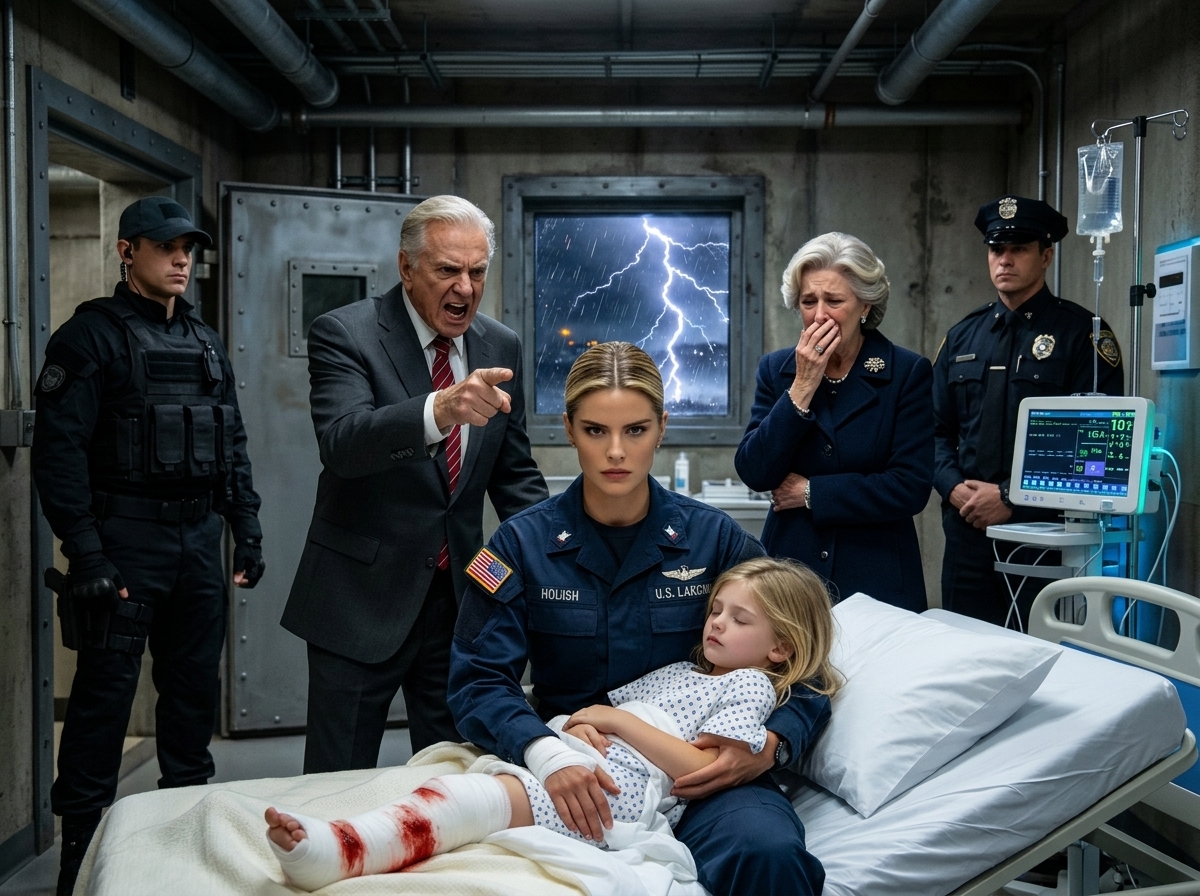
The emergency department smelled of scorched coffee, floor stripper, and damp wool. Under the violent glare of fluorescent tubes, the first thing my eyes locked onto wasn’t the heart monitor or the tangled IV lines. It was my daughter’s feet.
They were swathed in coarse medical gauze, propped gingerly on a folded blue towel. Across the white weave, blooming like dark rust, were jagged red blossoms of seeping blood.
The rest of eight-year-old Ava was barely visible beneath three industrial warming blankets. A pediatric butterfly needle was taped to the delicate, bruised skin on the back of her left hand. When I crossed the threshold, my boots squeaking against the linoleum, her eyelids fluttered open. Her gaze was clouded, her pupils dilated with shock, but the moment she focused on my face, her cracked lips parted.
“Mommy,” she whispered. The sound wasn’t a voice; it was a frayed thread of air. “You came.”
I sank to my knees beside the metal gurney, ignoring the ache in my joints from twenty straight hours of military transit. I reached out and took her right hand. Her fingers were terrifyingly frigid—like river stones hauled out of an icy creek bed in the dead of winter.
“I’m here, baby,” I choked out, wrapping both of my calloused hands around her tiny knuckles, trying to pour my own body heat into her veins. “I’m right here. I’ve got you.”
“I didn’t take Grandma’s necklace,” she breathed, staring at the ceiling tiles with a hollow, rehearsed intensity. It was the rhythm of a child forced to recite an agonizing catechism under duress. “I told him. But Grandpa said… he said I was a lying granddaughter. He said he didn’t need one of those in his house. Then he opened the front door, and the rain came in all over the hardwood.”
My throat seized. A suffocating pressure clamped down behind my sternum, but I kept my breathing measured. In the military, panic gets people killed.
“I didn’t have my shoes, Mommy,” she murmured, her lower lip trembling. “I asked him for my sneakers. I asked for my coat.”
Standing at the foot of the bed, adjusting the dials on the convection warming unit, was a registered nurse whose plastic badge identified her as Priya Nair . Priya had the calm, unreadable face of someone who worked triage on trauma nights, but as Ava whispered the word shoes , I watched the nurse’s jaw muscle feather into a hard, rigid knot. She had already received the field briefing from the patrolman who pulled my child out of the dark, and hearing it firsthand from an eight-year-old was clearly eroding her clinical detachment.
“Her core temperature registered at 93.4 degrees when the paramedics rolled her through the bay,” Priya said softly, keeping her eyes fixed on the digital monitors. “Severe stage-two hypothermia. We have her up to 96.1 now. The pediatric physician assessed the lacerations—sharp gravel and jagged asphalt, mostly superficial, though we’re watching for infection. The retention pond runoff isn’t clean. But she’s strong, Lieutenant. She’s going to survive.”
“Where did they find her?” My voice came out flat, stripped of inflection—the voice I used when requisitioning munitions under incoming mortar fire.
“In a storm drain at the cul-de-sac on Larksburg Drive ,” Priya replied, checking the IV drip chamber. “Right where the street slopes into the municipal drainage basin. A patrol cruiser spotted movement in the culvert. She had crawled four feet inside the corrugated metal pipe just to escape the gale.” Priya paused, her dark eyes softening with a mother’s agony. “The officer said she was curled in a ball, holding her bare feet in her hands to keep them from freezing.”
“Mommy,” Ava whimpered, her grip tightening with surprising strength. “Jason put it in my bag. I saw him slide the velvet box into the zipper pocket. I told Grandpa, but Grandpa never listens to me. He never listens.”
“I’m listening,” I said, leaning down until my forehead touched her cold cheek. “I’m listening to every single word, Ava. And nobody is ever going to silence you again.”
She let out a ragged sigh, her eyelids drifting shut under the heavy sedation of the warming fluids, though her fingers remained locked around mine like a vice.
I glanced at the industrial wall clock hanging above the hand-sanitizer dispenser: 10:44 PM. Exactly three hours and four minutes had passed since my daughter had stepped off her grandparents’ covered porch in star-printed cotton pajamas into a flash-flood downpour.
Behind me, the pneumatic corridor doors hissed open.
I didn’t need to look up to identify the cadence of the footsteps. Heavy, deliberate heel strikes—the stride of a patriarch who navigated the world convinced that the ground beneath his feet owed him rent.
Richard Hayes filled the doorway. At sixty-three, he possessed the broad, unyielding frame of a man who had hoisted furnace units into basements for thirty-one years. Over his button-down church shirt, he wore a navy windbreaker damp with rain. Half a step behind his right shoulder stood my mother, Linda Hayes , clutching her leather handbag to her stomach with both hands like a shield, her knuckles white.
My father’s eyes flicked to the bed, evaluating the machinery, before snapping upward to meet mine.
He didn’t see his daughter; he saw an operational problem. He saw my combat uniform—the scorched-earth pattern of the Army Operational Camouflage Pattern fatigues I hadn’t shed since boarding the military transport in Germany. Then his gaze drifted to the embroidered black lettering on the name tape stitched directly above my left breast pocket: HAYES . His own name.
The color drained from his weathered cheeks, siphoning away like water down an open sewer.
“You’re supposed to be overseas,” Richard stammered, his baritone voice lacking its usual booming certainty.
“I was,” I replied evenly.
Linda gasped, a theatrical, wounded sound, tears erupting instantly along her mascara-lined lids as if a valve had been turned. “Oh, Megan, honey! If you had only been here where you belonged, none of this terrible misunderstanding would have happened!”
I rose from the bedside chair with slow, deliberate precision. I kept my posture rigid, my voice deadly quiet so as not to disturb Ava’s tenuous rest. “I trusted you to be here for her, Mom. That was the contract.”
Before my father could deploy his well-worn defensive rhetoric, the doorway darkened. Two figures moved smoothly into the room, flanking my parents.
The first was a uniformed Grove City police officer with a field notebook gripped in his gloved hand. The second was a sharp-eyed woman in a charcoal tailored blazer, a county identification badge clipped to her leather belt. Her laminated credentials identified her as Denise Park , senior investigator with the Franklin County Child Protection Crisis Unit.
Richard looked at the officer. He looked at the county investigator. Then he looked back at me, his eyes narrowing as he frantically worked the arithmetic.
I watched the exact second the reality pierced his skull. He realized I hadn’t arrived in a hysterical scramble from an off-base apartment. I had been seated at this bedside for twenty uninterrupted minutes before his truck even pulled into the hospital lot.
Two critical calls had already been placed into the institutional machinery of the state. The narrative he had spent the last two hours rehearsing in the dry cab of his truck was already dead on arrival.
“Megan,” Richard whispered, his voice darkening with a dangerous edge. “What the hell did you just do?”
Cliffhanger: The police officer didn’t give me time to answer. He stepped between my father and the gurney, his hand resting near his duty belt, and said, “Mr. Hayes, step into the hall. You are currently the subject of an active felony investigation.”
Chapter 2: The Geometry of the Trap
To understand how my daughter ended up shivering in a drainage pipe while her grandfather slept in dry sheets, you have to understand the architecture of the Hayes family.
I am First Lieutenant Megan Hayes . At thirty-one, my trade in the United States Army was logistics. I managed fuel convoys, ammunition manifests, and supply lines. I lived in a world governed by strict custody chains, serial numbers, and signed requisition forms. I succeeded in that world because I possessed an absolute, borderline-religious reverence for documentation. In the military, if an event is not transcribed into an official record, it does not exist.
I grew up at 216 Larksburg Drive , a two-story colonial that looked like the very picture of Midwestern prosperity. My father, Richard, had built Hayes Heating and Cooling into a regional monopoly through relentless hard work and an extraordinary talent for never forgiving an insult. My mother, Linda, managed the reception desk at Grace Community Church , a woman capable of weaponizing maternal cheerfulness to neutralize any conflict before it could threaten our pristine family image.
Then there was my older sister, Kayla . Kayla was thirty-four, managed a cosmetic dental practice, and had married Brent Callahan , an amiable, spineless man who drove installation vans for my father. Their ten-year-old son, Jason , was my father’s undisputed prince—a boy hailed as “the future of the company” so frequently that he had developed an early taste for casual cruelty.
And then, there was Ava.
Ava was born on a freezing dawn eight years ago. Her biological father, Daniel Pruitt, was a boy I had met during my junior year of college. When Ava was five months old, Daniel walked out to purchase milk and simply deleted himself from our lives. He stopped answering calls; he let his lease lapse; he vanished into the slipstream of the country.
I gave Ava my own surname on her birth certificate. I was twenty-three years old, holding an infant in a recovery ward, and I naively believed handing her the Hayes name was an act of honor—a protective cloak.
My father disabused me of that notion twelve hours later.
He stood over the plastic bassinet in the hospital corridor, his arms folded across his chest, smiling that thin, chilling smile he usually reserved for subcontractors who had underbid an installation.
“A Hayes name is earned, Megan,” he told me, his voice barely louder than a whisper. “It isn’t an entitlement. Let’s see what she actually does with it.”
I spent the next eight years making excuses for that sentence. He’s stressed. He’s old-fashioned. He just wants us to be resilient.
What I refused to admit to myself was that Richard Hayes kept an invisible ledger in his breast pocket. In that ledger, every family member was either an asset or a debtor. Kayla had married a man my father could dominate. Kayla had produced a male heir. Kayla lived twelve minutes down the interstate and sat in the second pew every Sunday. In Richard’s ledger, Kayla’s account was paid in full.
I, conversely, was bankrupt. I had abandoned Grove City at eighteen for an ROTC scholarship. I had conceived a child out of wedlock with a man who evaporated. I had, in my father’s perennial grievance, “chosen the government over the family.”
And yet, with a pathetic, childish desperation that still burns my pride, I loved him.
When Ava turned two, I was assigned to Fort Knox , renting a drafty duplex in Radcliff, Kentucky . For five golden years, it was an isolated paradise of two. We ate blueberry pancakes for dinner on Fridays. She fell asleep clutching a one-eared plush hare named Mister Rabbit. I packed her school lunches with handwritten notes tucked into the napkin folds.
Every eight weeks, we made the three-hour trek north to Larksburg Drive. Those visits were masterclasses in death by a thousand cuts.
When Ava was five, my mother handed Jason a sprawling mountain of Christmas gifts wrapped in foil with hand-tied satin ribbons. She handed Ava a single pair of acrylic mittens stuffed inside a crinkled brown grocery bag.
“Oh, goodness, we completely ran out of wrapping paper!” Linda had trilled, letting out a musical, dismissive laugh.
I laughed along with her. I actually laughed. The mittens were two sizes too large.
When Ava was seven, at Thanksgiving, Kayla guided my daughter away from the dining room and seated her at a rickety card table tucked into the laundry alcove. “The main table is reserved for the adults and the boys, honey,” Kayla said smoothly. There were two unoccupied chairs at the mahogany table. My mother simply slid a tureen of gravy over to obscure the empty place setting. Ava said nothing, but her wide brown eyes tracked the deliberate exclusion. Children are terrifyingly literate in the language of rejection.
Then the orders dropped.
Fourteen months prior to this night, my battalion commander handed me deployment papers: eighteen months at Camp Arifjan , Kuwait. Staging logistics for regional operations. Wheels up in ninety days.
I sat in my sedan in the post parking lot, the exhaust humming, and stared at the void. I had no spouse. Daniel was a ghost. My lease was expiring. The Department of Defense requires single parents to file a formal Family Care Plan—a binding legal dossier naming the temporary guardians who will assume physical custody of your child. If that plan fails, the military initiates administrative separation.
I selected my parents.
I desperately told myself that living under my father’s roof would finally dissolve the cold distance between them. I thought eighteen months of Ava’s radiant, gentle nature would force him to close his damn ledger. I called it an act of faith.
In reality, it was a cowardly gamble with my daughter’s soul.
On March 28th, five days prior to my deployment, we gathered around the kitchen table on Larksburg Drive with an elderly notary named Mr. Allcott. I signed the temporary guardianship delegation. I signed the military power of attorney. And I executed a voluntary monthly allotment authorizing an automated transfer of $1,200 directly from my military pay into my mother’s primary checking account.
“Oh, Megan, this is far too much,” Linda protested, pressing the allotment form back toward me with fluttering fingers. “Honestly, she’s our flesh and blood. We’d take our little angel for free.”
“It’s for her expenses, Mom,” I insisted, sliding the paper back across the table. “Her nutrition, her field trips, her fall wardrobe, her health insurance copays. Please. Let me carry my own weight.”
Richard sat at the head of the table, silent. His eyes never left the black ink of my pen. I signed the authorization block. I didn’t verify the account signatories. I assumed it was my mother’s private household account. That single, sloppy assumption was the first operational failure that would nearly cost my child her life.
The morning I deployed, eight-year-old Ava stood on their wide front porch, bravely waving as my taxi backed down the drive. She didn’t weep. She held Mister Rabbit under her arm and squared her shoulders, mimicking the posture she had seen me use during base reviews. I watched her figure shrink in the rear glass until the turn onto the highway swallowed her whole.
For the first six months, our connection was sustained through the jittery pixels of Sunday video calls. But around Thanksgiving, the landscape began to decay.
The calls, once forty minutes of breathless updates about third-grade spelling bees, dwindled to brief, tense check-ins. Linda would hold the phone, her face an impenetrable mask of cheerful obstruction. “Oh, Megan, sweetie, you just missed her—Kayla took her to the outlet mall!” or “She’s already asleep, darling, she had such a long day at church choir!”
Then came December 9th.
A flat manila envelope arrived at Camp Arifjan. Inside was Ava’s official school portrait, a plastic bookmark, and a sheet of green construction paper folded into thirds.
I unfolded it beneath the humming fluorescent tubes of my barracks.
It was a crayon drawing. On the far left of the page, grouped tightly beneath a smiling yellow sun, stood my entire family: Richard, Linda, Kayla, Brent, and Jason. They were rendered in bright, saturated colors, their stick-figure arms linked in an unbroken chain of solidarity.
On the far right of the paper, separated by an enormous, yawning chasm of untouched white space, stood a solitary little girl with brown pigtails. She had no mouth. Her arms were pinned rigidly to her sides. Across the vast white void between them, no bridge was drawn.
At the bottom of the page, in hesitant second-grade lettering, she had printed: MY FAMILY .
I turned the paper over with trembling fingers. In the corner, her classroom teacher had jotted a quiet note in pencil: Ava spent three consecutive recess periods working on this in the library. When I asked her about the space in the middle, she told me that’s where the yelling lives.
That night, my hands violently shaking, I purchased a standard green-covered military record book from the Post Exchange for $3.49. On the first ruled page, I documented the date, the time, and the contents of the drawing.
It was the beginning of an administrative war.
By late January, the operational anomalies accelerated. On January 22nd, my cot telephone rang at 0200 Kuwait time.
“Lieutenant Hayes? My name is Barbara Reeves . I’m the guidance counselor at Maple Ridge Elementary .”
The woman spoke with the cold, measured cadence of a clinician who understood that every syllable could be scrutinized in a courtroom. She outlined three specific observations:
First, Ava’s school nutritional account had been sitting at a negative balance of $212 since late November. For eight weeks, my daughter had been steered away from the hot lunch line and handed the district’s designated “alternative meal”—two slices of untoasted white bread enclosing a single cold square of processed cheese. The students had taken to calling it the “debt tray.”
Second, her footwear. Ava’s winter sneakers had completely deteriorated, the canvas tearing at the toe box to expose damp socks during recess. When Mrs. Reeves offered to pull a replacement pair from the school’s charitable supply locker, Ava had frantically declined, weeping that “Grandma said accepting charity makes the family look dirty.” The shoes on her feet were size 12.5. Ava wore a size 2.
Third, during a private session the previous Tuesday, Ava had revealed that my father had instituted an explicit rule in the household: when domestic conflict erupted, “real Hayes family members” remained in the living room to resolve it. Ava was ordered onto the unheated back sunporch. Because, in Richard’s precise words, she was merely a “boarder.”
I immediately patched a call through to Larksburg Drive. It was 6:00 PM in Ohio.
“She’s an incorrigible fabulist, Megan,” my father stated with chilling equilibrium, the sound of his evening news broadcast rumbling in the background. “The girl lies. She craves attention because her mother chose an overseas desert over raising her. The school lunch balance is an administrative clerical error by the county. Her shoes fit fine last month. Ask your mother. Ask Kayla. She looks adults directly in the eye and spins fiction. Honestly, I fear she inherited her father’s moral character.”
He didn’t scream. He didn’t bluster. He spoke with the terrifying, synthetic tenderness of a man who was methodically laying down a defensive smokescreen. He was establishing a preemptive record: if Ava ever reported the rot inside that house, her testimony was already contaminated by a documented history of “emotional instability.”
Three days later, my mother called, weeping hysterically into the receiver. She informed me that my confrontational tone had spiked Richard’s blood pressure to 178 over 104, threatening the integrity of his cardiac stent. “Do you want to murder your father from across the world, Megan? Is that your objective?”
I realized then that direct engagement was tactical suicide.
I placed a secure call to Captain Dana Morgan , a seasoned operational attorney with the Army Judge Advocate General’s Corps whom I had served with at Fort Knox.
“Stop engaging them,” Dana commanded, her voice cutting through the satellite lag like a scalpel. “Every time you challenge them, you give them operational intelligence on what we know. Be bland. Be cooperative. Let them establish their pattern while you log the receipts. In family court, Lieutenant, rage is dismissed as maternal hysteria. Cold, contemporaneous documentation is an executioner’s axe.”
In March, the extortion escalated. Richard commandeered our scheduled nine-minute video terminal.
“Your $1,200 allotment doesn’t remotely offset the logistical burden of housing this child,” he announced, leaning into the lens until his graying temples filled the frame. “Inflation has gutted our discretionary income. The utilities alone have increased forty percent. I calculate an out-of-pocket deficit of roughly $9,000 since last spring. I require an immediate supplemental adjustment of $600 monthly, or I will be forced to formally surrender physical custody to county child services.”
“Upload the itemized invoices to my secure military email, Dad,” I replied, keeping my features totally expressionless. “The moment I see the utility statements and grocery receipts, I will adjust the bank draft.”
Richard’s eyes hardened into flint. “Invoices? From your own parents? After the sanctuary we’ve provided while you pursue your career? The issue isn’t currency, Megan. The issue is your treasonous lack of respect.”
The tipping point arrived on the first Sunday of April.
The connection connected at 0900 Eastern Standard Time. Linda was gripping the tablet, forcing Ava down onto the floral cushions beside her. My daughter was clad in an oversized fleece hoodie zipped tightly to her throat, despite the indoor temperature reading 74 degrees on the wall thermometer behind her.
“Ava, sweetheart,” I said gently. “How are your classes?”
“Fine,” she whispered.
“Is your grandfather treating you well?”
Linda instantly leaned into the frame, her synthetic smile obscuring half the screen. “Oh, he spoils her rotten! She’s his little princess, aren’t you, Ava?”
Ava didn’t answer her grandmother. Instead, she locked her gaze directly into the tiny camera aperture. Her eyes were wide, dark, and hollowed by terror.
Slowly, carefully, keeping her lips entirely silent behind her grandmother’s shoulder, she mouthed eight distinct syllables:
Don’t… call… Grandpa…. He… sends… me… out.
The screen went abruptly black. Linda had terminated the call.
I did not weep. I did not throw my equipment across the bay.
At 0600 hours the following morning, I stood at the position of attention before the mahogany desk of Colonel Raymond Delgado . I laid out my green notebooks, Mrs. Reeves’s clinical reports, the bank records, and the green construction-paper drawing.
Colonel Delgado read the dossier in total silence for twenty-two minutes.
When he reached the final page, he unscrewed his brass fountain pen, signed an immediate emergency operational reassignment authorization under the provisions of Family Care Plan Failure, and looked up at me.
“Retrieve your soldier, Lieutenant,” he said.
Cliffhanger: I touched down at Columbus International Airport on June 10th under total operational silence. I didn’t announce my arrival to a soul. But two nights later, as a catastrophic Category-4 squall line rolled across Ohio, my disposable phone lit up with a call that shattered our tactical timeline into pieces.
Chapter 3: The Gathering of Shadows
The emergency room hallway was suffocatingly narrow. Through the thin drywall separating the treatment bay from the administrative lounge, I could hear the muffled, resonant rumble of Richard’s voice.
He was holding court with Officer Tom Whitaker , deploying the practiced cadence of a distinguished Rotarian explaining a minor misunderstanding to a subordinate.
“The girl suffers from an attachment disorder, Officer,” Richard was saying, his tone dripping with sorrowful indulgence. “My wife’s vintage pearl necklace—an irreplaceable family heirloom passed down from her grandmother—vanished from the master dresser this afternoon. When we confronted Ava, she experienced an acute behavioral meltdown. She bolted out the back door in a hysterical rage. We spent forty-five minutes combing the neighborhood in my truck, but in this downpour, the visibility was zero. We were literally on our way to the precinct house to file a missing juvenile report when your dispatcher contacted us.”
Sitting across from me in the family consultation room, Denise Park lowered her ballpoint pen and looked up. The child protection investigator had been taking my formal statement for twenty minutes.
“Is your father aware,” Denise asked softly, “that the municipal drainage culvert where Ava was recovered is exactly 0.4 miles from their driveway?”
“My father is aware of whatever reality preserves his authority,” I replied, my voice steady despite the adrenaline burning in my throat.
Just then, the consultation room door clicked open. Captain Dana Morgan stepped inside. She had driven ninety minutes through blinding torrential rain from the military legal annex in Cincinnati. She was dressed in her full Army service uniform, her ribbon racks immaculate, carrying a battered leather litigation briefcase.
“Status?” Dana demanded, setting the briefcase on the laminate table.
“Stage-two hypothermia managed; core temp stabilized at 96.8,” I reported crisply, shifting into military briefing protocol. “Lacerations dressed. County protective custody paperwork is initiated. My father is currently in corridor four attempting to establish a juvenile-theft defense with the responding officer.”
Dana snapped open the brass locks of her case. “The jurisdictional baseline is absolute. You are the sole surviving legal and physical custodian of the minor. The temporary guardianship signed in March contained an automatic revocation clause contingent upon your physical presence in the continental United States. The moment your boots cleared customs at John Glenn Airport, Richard Hayes became a legal stranger to your daughter.”
She pulled out a certified, blue-backed legal instrument bearing the gold embossed seal of the Franklin County Juvenile Court.
“Judge Marlene Ostro signed an ex-parte emergency protection order thirty minutes ago via secure digital transmission,” Dana continued, sliding the document to Denise Park. “Suspension of all visitation rights. Mandatory 1,000-foot protective perimeter covering the minor, the mother, and any medical or educational facility they occupy. If Richard Hayes steps within arm’s reach of that hospital bed, he commits a fourth-degree felony.”
Denise scanned the document, nodded with sharp professional satisfaction, and stood up. “Let’s go manage corridor four.”
When we exited the consultation room, my parents were standing beside the nursing station. Linda was softly crying into a lace handkerchief, leaning her delicate frame against the counter, while Richard leaned over Officer Whitaker, gesturing emphatically with an unlit cigar.
“Officer, I demand you verify her psychological records with—” Richard began, but his words died as Denise Park stepped into his path.
“Mr. Hayes,” Denise said, her voice ringing clear through the sterile hallway. “I am serving you with an immediate, temporary protective order issued by the juvenile division. You and your wife are instructed to vacate this facility immediately. Any attempt to communicate with Ava Hayes, directly or through third parties, will result in your summary arrest.”
Richard’s face contorted into a mask of purple fury. His veneer of civic dignity cracked, revealing the snarling contractor underneath.
“This is an outrage!” he barked, slamming his palm against the reception counter, causing a tray of plastic specimen cups to rattle violently. “I have housed, clothed, and fed that ungrateful child for over a year! I have spent thousands of dollars out of my personal retirement—”
“You spent twelve hundred dollars a month of my combat pay,” I said, stepping past Dana until I stood six inches from his chest. “And tonight, you threw an eight-year-old girl into a seventy-mile-per-hour thunderstorm without her shoes.”
“She stole from her grandmother!” Richard roared, his eyes bulging. “She is a thief and an incorrigible liar!”
“Richard, please!” Linda wailed, tugging at his jacket sleeve. “The doctors are watching!”
“Officer Whitaker,” Dana said calmly from behind me, her voice cold as dry ice. “Enforce the perimeter, or I will contact the Ohio State Highway Patrol to assume command of this scene.”
Whitaker took a firm step forward, his hand resting directly on his service weapon’s retention hood. “Mr. Hayes. Outside. Right now.”
Richard glared at me, his chest heaving, his fists clenched so hard his knuckles shone white under the fluorescent tubes. “You think you’re so damn clever, Megan. You think because the Army gave you some brass bars that you run this family? You don’t have a shred of proof. It’s my word against an emotionally disturbed eight-year-old. Let’s see whose credit holds up in court.”
He spun on his heel and marched toward the sliding glass exit, his wet boots leaving dark, oily impressions across the spotless white floor. Linda cast one terrified, pleading glance in my direction before scurrying after him like an obedient shadow.
Twenty minutes later, the ward settled into an uneasy silence.
Priya Nair slipped into the room carrying a warm cup of herbal tea for me and a tiny plush bear for Ava. My daughter had drifted back to sleep, her breathing finally rhythmic, her hand still loosely curled within mine.
“She talked to me while you were in the hall,” Priya whispered, checking the saline line. “She told me about the necklace.”
“She told you?”
Priya nodded grimly. “She said around 6:30, her cousin Jason came into her bedroom claiming he was searching for his baseball mitt. He was lingering by her school bag for ten minutes. Then, twenty minutes later, the grandmother started screaming from the master suite that her pearls were gone. The grandfather marched straight down the hallway, didn’t ask a single diagnostic question, seized Ava’s backpack, and turned it inside out over the hardwood. The velvet jewelry box tumbled out.”
“It was an execution,” I whispered, the bile rising in my throat.
“The little girl told him she saw Jason zip it inside,” Priya continued, her voice trembling slightly. “The grandfather called her a parasite. He seized her by the upper arm, marched her to the front foyer, wrenched the deadbolt open, and told her that liars don’t sleep under a Hayes roof.”
My fingernails bit into the palms of my hands until I broke the skin.
“We need physical corroboration,” I told Dana, who was seated in the corner, furiously typing on her encrypted military tablet. “Richard will claim Ava’s testimony is a trauma-induced confabulation. He’ll get a family-court psychologist to label her unreliable.”
“We may already have it,” Dana replied, looking up from her screen. “Before I left Cincinnati, I reached out to your mother’s neighbor. The retired nurse at 214 Larksburg.”
“ Ruth Dobbins ?”
“Mrs. Dobbins installed an advanced digital security system last October following a string of catalytic-converter thefts on the block,” Dana said, adjusting her glasses. “A wide-angle camera mounted directly beneath her garage overhang. It possesses an uninterrupted, high-resolution field of view that encompasses the entire front porch, walkway, and curb of 216 Larksburg.”
My breath caught in my throat. “Does it record audio?”
“High-fidelity directional microphone,” Dana confirmed with a grim, razor-thin smile. “And Mrs. Dobbins has already placed the encrypted cloud backup files into the custody of the county prosecutor.”
Cliffhanger: What Dana didn’t know yet—what none of us realized until the digital timestamps were rendered—was that the camera had not merely captured the moment Ava was forced into the deluge. It had recorded a five-minute conversation that occurred on the front walkway four hours earlier.
Chapter 4: The Projection of Treason
The county administrative complex on Mound Street smelled of damp municipal carpeting and scorched electrical wiring. On Wednesday morning, six days after the storm, we gathered in Conference Room 3B.
It was a bleak, sterile chamber centered around an imitation walnut conference table capable of seating sixteen. At the head of the table sat Carla Bennett , the lead forensic investigator for Franklin County Children Services. Carla was a formidable woman in her late fifties with cropped silver hair, rimless bifocals, and the weary, immovable aura of an official who had spent three decades witnessing human depravity dressed up as parental discipline.
On the left side of the table sat my parents, flanked by their private legal counsel, Gerald Holloway —a slick, silver-haired defense attorney smelling strongly of bay rum who kept rhythmically clicking an expensive gold ballpoint pen.
I sat directly opposite them. I wore my crisp Army service uniform, my ribbons straight, my hands resting flat on the table on either side of my green logbooks. Dana sat beside me, her legal files stacked with geometric precision.
Kayla and Brent had been barred from the primary conference table and ordered to remain in the witness ante-room down the corridor. Even through the soundproofed oak door, I could hear the sharp, agitated click of Kayla’s high heels pacing the ceramic tile.
“Let’s dispense with the theatrics, Ms. Bennett,” Gerald Holloway began smoothly, spreading his palms over the polished wood. “What occurred on the evening of June 12th was an unfortunate domestic disciplinary incident that escalated unpredictably due to an unprecedented weather event. A young girl, caught red-handed committing grand larceny against her own grandmother, suffered an acute emotional disturbance. Mr. Hayes attempted to implement a traditional time-out on the covered porch to allow her to regain composure. The child fled impulsively. My clients are pillars of the Grove City community. To convert this family tragedy into a criminal circus is an unconscionable overreach.”
“A traditional time-out?” Carla Bennett repeated without looking up from her open file. She adjusted her bifocals. “Mr. Holloway, the National Weather Service issued a tornado watch and a severe thunderstorm warning for Franklin County at 16:30 hours. When Ava Hayes was recovered by municipal law enforcement at 20:47 hours, the ambient air temperature was 58 degrees, sustained winds were clocked at 48 miles per hour, and she was trapped in an active stormwater retention culvert. Her core body temperature was 93.4 degrees. In the state of Ohio, that is not a ‘time-out.’ That constitutes child endangerment under Revised Code 2919.22, a felony of the third degree.”
Richard shifted violently in his leather chair, his face reddening. “The child is a pathological manipulator! She stole a four-thousand-dollar heirloom!”
“Did she?” Carla Bennett asked quietly.
She reached into her canvas briefcase, extracted a matte-black flash drive, and set it squarely in the center of the walnut table.
“Yesterday morning, my office concluded a forensic review of the digital audiovisual surveillance footage provided by Mrs. Ruth Dobbins of 214 Larksburg Drive,” Bennett stated, tapping the thumb drive with a manicured nail. “The system utilizes automated optical motion-tracking sensors. It captures forty-eight hours of rolling high-definition footage before archiving to local storage.”
Linda’s hand flew to her throat, her knuckles catching the collar of her floral blouse.
“I want to review the timeline,” Bennett said, opening her laptop and rotating the widescreen display toward the center of the table. “This file is timestamped Thursday, June 12th, at 15:52 hours. Approximately three hours prior to the alleged theft.”
She pressed the spacebar.
The screen bloomed into razor-sharp, full-color video. The camera angle was elevated, looking across Mrs. Dobbins’s manicured lawn toward my parents’ concrete front walkway and the blooming hydrangea bushes framing the porch.
Kayla’s silver Lexus SUV was parked crookedly against the curb.
On the sidewalk stood Kayla and her ten-year-old son, Jason. The boy was dressed in his youth baseball uniform. Kayla was crouched before him, her manicured hands gripping his shoulders with intense, theatrical urgency.
The audio track, filtered through high-end noise-canceling software, emerged from the laptop speakers with horrifying clarity.
“Say it back to me, Jason,” Kayla’s voice commanded, tight and sharp. “Word for word. What do you say?”
The boy looked at his cleats, nervously shifting his weight. “I say… I went in to find my glove, and I saw Ava sliding Grandma’s velvet box into the zipper pouch of her backpack.”
“And where were you standing?”
“In the doorway. No—by the television.”
Kayla gave his shoulders a firm, exasperated shake. “Pick the doorway and stick to it! Don’t waffle. Look Grandpa right in the eyes. He’s already primed. Mrs. Reeves called Grandma again yesterday about those stupid sneakers. If Grandpa catches that little leech stealing, nobody will listen to another word that comes out of her mouth. Not the school. Not the counselor. And especially not Aunt Megan when she drags her tail back from the sand.”
“Mom,” the boy’s voice cracked, a flicker of childhood terror breaking through his coaching. “Is Grandpa gonna hit her?”
“Grandpa is going to ship her to a foster home where she belongs,” Kayla snapped, rising to her feet and dusting off her designer denim. “That twelve hundred dollars a month is supposed to keep our family afloat while Dad sorts out Brent’s hours. She doesn’t belong here. Now get inside and get the box.”
The video froze.
The conference room became a vacuum. The only sound was the low, mechanical drone of the ceiling air conditioning vents.
I looked across the table at my father.
Richard sat entirely motionless. His mouth was slightly parted, his eyes fixed on the frozen frame of his eldest daughter gripping his grandson’s shoulders. The color in his face hadn’t just drained; it had curdled into a sickly, gray ash. The immaculate illusion of his kingdom, the righteous myth of his patriarchal authority, had just been detonated by the very child he had elevated to the throne.
“Kayla… planned it?” Richard muttered. It wasn’t a question. It was the sound of an old man reading his own execution order.
“There’s an additional clip,” Carla Bennett said, her voice dropping into an icy register. “Timestamp 19:41 hours.”
She tapped the key.
The screen shifted to a wall of gray, churning water. The porch light illuminated the violent horizontal sheets of rain whipping across the decking.
The front door flew open. Richard stepped into the frame, his frame silhouetted by the warm interior chandelier. In front of him, huddled on the welcome mat in thin cotton pajamas, stood my daughter.
“I asked for my sneakers, Grandpa!” Ava’s tiny, terrified voice pierced the roar of the wind. “Please, it’s flooding!”
“You should have contemplated the weather before you robbed this family,” Richard’s recorded voice bellowed, hard and pitiless. “Get off my porch. Now.”
He stepped back. He slammed the heavy oak door. The latch clicked shut.
My daughter stood alone in the deluge for four seconds, her arms wrapped tightly around her ribs, before stepping off the porch into the pitch-black storm.
“Turn it off,” Gerald Holloway whispered, his professional veneer entirely shattered, his gold pen rolling abandoned across the mahogany veneer. “Turn it off now.”
“No,” Carla Bennett replied ruthlessly. “We are going to watch the 19:51 segment.”
At 19:51 hours, ten minutes after Ava had been driven into the night, the front door cracked open a second time.
My mother emerged. She was wearing pink terrycloth house slippers. In her left hand, she carried a heavy black flashlight; draped over her right arm was Ava’s bright yellow rain slicker—the coat she had worn to school for two consecutive winters.
Linda walked down the concrete steps into the pouring rain. Her hair was instantly plastered to her skull. She hurried down Larksburg Drive, vanishing beyond the camera’s optical frame at 19:54.
At 20:06 hours, twelve minutes later, Linda reappeared.
She was completely alone. The yellow raincoat was gone. The flashlight was gone.
She ascended the porch steps slowly, mechanically, like a sleepwalker. When she reached the top landing, she didn’t open the door. She stopped beneath the flickering porch light. She placed both of her hands over her mouth, her body shuddering with silent, violent sobs.
She stood frozen on that porch for exactly forty-one seconds by the digital timestamp.
Then, she dropped her hands, wiped her face, turned the brass knob, entered the warm house, and closed the door behind her.
She did not summon emergency services. She did not contact the police dispatch. She did not alert the neighbors.
She sat inside that illuminated home for one hour and eight minutes until an officer’s flashlight beam caught the yellow fabric of that coat discarded at the mouth of the retention pipe.
“Linda,” Richard whispered, turning his head slowly toward his wife of thirty-eight years. His voice was hollow, stripped of all resonance. “You… you went out there? You knew where she was?”
Linda didn’t raise her head. She sat slumped in her executive chair, staring down at her lap, her manicured hands trembling violently.
“Linda!” Richard roared, slamming his fist onto the table, his eyes wild with betrayal. “You found her! And you let me sit in that living room and tell the responding officer that she bolted into the woods?!”
“What was I supposed to do, Richard?!”
The shriek tore out of my mother’s throat like an animal tearing through a trap. She snapped her head up, her face grotesque with tears, her makeup streaked in black rivers down her neck.
“I stood at the mouth of that drainage pipe!” Linda sobbed, her chest convulsing. “I shone the light into the corrugated metal! I could hear her shivering in the dark! I called her name three times! But she wouldn’t crawl out… she looked at me with those eyes, and she was terrified of me! She wouldn’t come near me!”
“You left her in a sewer?!” Richard gasped.
“I left the coat on the concrete bank!” Linda screamed back, her aristocratic veneer completely annihilated. “And then I walked back to the house, and I stood on the porch, and I realized… I realized that if I came inside and told you where she was, you would tell me she needed to spend the night there to learn a lesson! And if I argued with you, you’d accuse me of siding with Megan! And if I defied you, you’d throw me out into the rain next!”
The conference room went dead silent.
“You would have done it, Richard,” Linda whispered, her voice dropping into a ragged, broken croak. “You shouted at that poor bank teller until she vomited in the lobby over a twelve-dollar checking fee. You screamed at Ava’s school counselor until the principal threatened a trespass warrant. You have turned this entire family into hostages. I was terrified of you.”
Before my father could formulate a defense, the conference room door burst open with a concussive bang.
Kayla stormed into the room, her designer leather tote bag swinging wildly from her shoulder, her hair escaping its clip. Brent trailed three paces behind her, looking like a man marching toward an electric chair, his hands raised in a pathetic gesture of appeasement.
“This entire proceeding is illegal!” Kayla shrieked, pointing a manicured, trembling finger directly at Carla Bennett. “You can’t use that video! That was private property! That’s an unlawful interception of a private mother-and-son conversation!”
“Kayla, sit down and shut up,” Gerald Holloway warned under his breath, burying his face in his hands.
“I will not shut up!” Kayla screamed, turning her blazing fury directly upon me. “You think you can swan back in here in your little green costume and pass judgment on us?! You abandoned that kid! Who sat through her dental appointments?! Who handled her behavioral outbursts?! We sacrificed our lives for your mistake! Do you have any idea what it costs to maintain an eight-year-old child?!”
“I sent you twelve hundred dollars every thirty days, Kayla,” I said, rising slowly from my chair, my voice dangerously low.
“Twelve hundred dollars is nothing!” Kayla spat, her lips pulling back in a feral snarl. “It didn’t cover a fraction of the disruption! Brent’s commercial hours got slashed by thirty percent in January! We had property taxes! We had the second mortgage! That money was compensatory! We earned every damn cent of it!”
She stopped dead.
The silence that followed was absolute.
I watched the realization strike her like a physical blow. Her eyes widened, darting from Carla Bennett’s glowing laptop screen to the cold, predatory smile spreading across Captain Dana Morgan’s face.
Cliffhanger: Dana reached into her litigation case and pulled out a two-inch-thick, bound financial forensic audit, slamming it onto the table with the thunderous finality of a gavel. “Thank you, Mrs. Callahan,” Dana whispered. “The grand jury has been waiting for that exact confession.”
Chapter 5: What Rain Is For
The forensic audit did not take long to dismantle what remained of my family.
Captain Dana Morgan had spent eleven sleepless days cross-referencing my bank statements with the subpoenaed transaction logs from my mother’s account at Fifth Third Bank. The financial trail was not sophisticated; criminals driven by arrogance rarely bother to cover their tracks with elegance.
The account that received my automated $1,200 monthly allotment possessed a secondary corporate debit card issued under the name Kayla Callahan .
Over the course of fourteen months, exactly $16,800 of my combat hazardous-duty pay had flowed into that registry.
Dana’s color-coded spreadsheet laid bare the anatomy of the theft with mathematical brutality:
Of that $16,800, precisely $2,640 had been expended on Ava. That figure included budget groceries, generic school supplies, and two pairs of clearance-rack shoes purchased in an incorrect size.
The remaining balance—$14,160—had been systematically diverted:
- $4,220 to cover four premium park passes and a luxury resort suite at Walt Disney World for Kayla, Brent, and Jason.
- $6,210 directly wired to an architectural masonry firm for the fabrication of a white waterfall quartz kitchen island in Kayla’s suburban residence.
- $3,730 disbursed to satisfy two delinquent installments on Brent’s heavy-duty pickup truck and an extravagant weekend rental at a lakefront property in Michigan.
When Brent Callahan was formally confronted with the financial summary during his subsequent deposition, the man collapsed. He didn’t hire an attorney; he moved his belongings into his brother’s unfinished basement in Hilliard and handed over eighteen months of domestic text messages and checking records. He swore under oath that Kayla had assured him the allotment was a discretionary “family stipend” granted with my explicit blessing.
In the criminal proceedings that concluded in mid-September, the hammer fell hard and fast.
Under the crushing weight of the audiovisual surveillance and the financial paper trail, Richard Hayes waived his right to a grand jury indictment and entered a negotiated guilty plea to one count of third-degree child endangerment. The state demanded prison time; Gerald Holloway fought tooth and nail, citing my father’s documented cardiac history.
Judge Marlene Ostro sentenced Richard to eighteen months of intensive state probation, eighty hours of community service at a municipal homeless shelter, a mandatory twenty-six-week cognitive behavioral intervention course, and a permanent, lifetime criminal protection order barring him from ever approaching within five hundred feet of Ava or me.
My father paid his statutory fines in crisp, hundred-dollar bills peeled from a leather clip. Dana, who monitored the sentencing from the gallery, told me that throughout the ninety-minute hearing, Richard never once turned his head to look at my mother.
Linda entered an Alford plea to a misdemeanor charge of contributing to the unruliness or delinquency of a minor. Her sentence was suspended in lieu of twelve months of probation, mandatory psychiatric counseling, and identical protective stipulations.
Kayla’s reckoning was of a different order. While the county prosecutor determined that coaching a minor child to bear false witness fell into an ambiguous statutory void under Ohio criminal code, the county Department of Job and Family Services registered a formal, substantiated finding of severe emotional maltreatment against her permanent record.
Within forty-eight hours of that finding being logged, her employment as practice manager at the cosmetic dental clinic was terminated. Her state licensing certifications to participate in pediatric dental programs were revoked.
In November, following an eleven-minute civil hearing before Magistrate Alvin Reyes , a judgment was entered against Kayla for the full sum of $14,160, garnished via monthly judicial orders. Every single cent received from that judgment is automatically diverted into an irrevocable educational trust fund established for Ava. I have never touched a penny of it.
The family empire did not survive the blast radius.
My father sold Hayes Heating and Cooling to an HVAC conglomerate based in Marysville for sixty cents on the dollar. The historic brick house at 216 Larksburg Drive went on the market in August; a young couple with a newborn infant purchased it before the leaves turned. I heard through an old high school classmate that they painted the front door a vibrant, defiant crimson.
Linda vanished from the social registry of Grace Community Church. She moved into the spare sewing room of her sister Joyce’s ranch home in Columbus. Joyce, a woman who possessed none of my mother’s performative fragility, reportedly refused to speak to her across the evening dinner table for six months.
In late August, a bulky legal envelope arrived at Dana’s military office. Inside were fourteen pages of yellow legal paper covered in Linda’s tight, looping script.
I read the letter at midnight in my kitchen, the paper rustling softly beneath my fingers while a mug of black tea cooled on the table.
My mother did not utter a single apology.
Instead, she offered an autopsy of her marriage. She wrote about forty years spent learning to read Richard’s domestic silences the way mariners read hurricane squalls. She wrote about the terrifying, slow-motion process of letting a bully carve away your moral marrow until you mistook the hollow cavity for peace.
“I stood at the mouth of that drainage pipe,” she wrote near the final page, “and I couldn’t make my feet move the final ten feet into the muck. I was terrified that if I pulled her out, the whole life I had built would come crashing down around my ears.”
I folded the yellow pages. I didn’t burn them. I didn’t tear them into confetti. I simply placed them into the steel military lockbox alongside my green record books, clicked the padlock shut, and walked upstairs to check on my sleeping child.
I wasn’t mourning Linda Hayes. I was mourning the phantom mother I had spent thirty-one years inventing in my imagination—the mother who would have plunged into that flooded culvert with bare hands and dragged her grandchild out of the dark.
On July 3rd, Ava and I relocated permanently to Radcliff, Kentucky.
Colonel Delgado had quietly pulled the administrative levers of the Army Human Resources Command, securing my permanent reassignment to a logistics battalion at Fort Knox with a brief, handwritten notation appended to my personnel jacket: Officer’s familial circumstances necessitate geographic stability and domestic proximity.
We leased a small, sun-drenched yellow bungalow three blocks from Maple Elementary .
Ava began seeing Dr. Imani Okoye , a pediatric trauma psychologist who kept a ceramic bowl filled with smooth, river-polished stones on her low mahogany desk. For six months, Ava would select a single stone, roll the cool weight between her small palms, and narrate the architecture of that rainy night in fragments.
One humid Tuesday afternoon in late September, Dr. Okoye summoned me into the consultation room. Ava was curled on the oversized armchair, holding a dark gray pebble to her cheek.
“I want to tell you about the flashlight, Mommy,” Ava whispered, looking at the window blinds.
“I’m right here, baby,” I said, perching on the edge of the ottoman.
“I saw the yellow circle coming down the grass,” Ava said, her voice small, calm, and utterly devoid of malice. “I was way back inside the pipe, where the spiders live. And I heard Grandma call my name. But I didn’t move.”
“Why didn’t you move, sweetheart?”
“Because Grandma was in the kitchen when Grandpa opened the front door,” Ava replied, turning the stone over in her fingers. “She was right there by the refrigerator. And she didn’t say stop. So I knew that if I came out, and she took me back to that house, Grandpa would just say I was lying about the rain, too.”
She looked up at me, her brown eyes impossibly clear.
“Was it my fault, Mommy? Was it my fault because I hid from the light?”
My heart tore open, but my gaze didn’t waver. I reached out, took both of her hands, and enveloped them within mine.
“No, Ava. It was not your fault. When a child is hiding in the dark, the grown-up’s only job in the entire universe is to crawl into the pipe and pull them out. If a grown-up stops at the edge because they’re scared of getting their shoes dirty, that is a grown-up’s failure. It is never, ever the child’s. Do you hear me?”
Ava nodded slowly. She kept the stone.
It has been sixteen months since that Thursday.
Ava is nine years old now. She is thriving in the fourth grade, tackling long division with ferocious stubbornness, and learning to play the alto saxophone with an agonizing, screeching enthusiasm that rattles the windowpanes of our yellow house.
She wears bright, neon-orange athletic sneakers—size 2.5—which she personally selected from the shelves of the post exchange. The night we brought them home, she insisted on wearing them to bed beneath her blankets.
We eat blueberry pancakes for dinner every single Friday. Mister Rabbit rests upon her pillow, his remaining ear threadbare and grey, but secure.
In March, I pinned on the twin silver bars of an Army Captain. Dana Morgan traveled down from Cincinnati to execute the formal promotion oath in the battalion headquarters. When she punched the silver rank insignia into my epaulets, her eyes were swimming with tears she furiously claimed were the result of seasonal allergies.
Brent Callahan sends Jason’s school portrait every October in a plain white envelope. The boy is twelve now, all knobby elbows and crooked teeth, playing second base for a rec league in Hilliard. I have never responded to the letters, but I keep the photos tucked in a drawer. I remember a terrified ten-year-old boy holding a stress ball in a yellow interrogation room, and I pray to God he finds a way to escape the ledger his grandfather built.
Last Friday, Ava arrived home from school carrying an art project. The teacher’s prompt had been simple: My Family .
I stood before our refrigerator for a long time, a dish towel gripped in my hands, studying the heavy paper she had affixed to the enamel with two ceramic magnets.
She had drawn our yellow bungalow with its vibrant crimson trim. Standing in the front yard was a tall figure in a green military uniform with captain’s bars drawn carefully in yellow crayon, and a smaller figure with brown pigtails sporting neon-orange shoes. Beside us was a floppy-eared gray hare, and an enormous, wildly inaccurate golden retriever she has named Biscuit, whom she insists we are adopting in the spring.
In the upper-right corner, leaning over a wooden fence, stood an elderly woman with silver hair holding a plate of lemon bars: Mrs. Ruth Dobbins, who still mails a handwritten card to Kentucky every second Tuesday. Beside her stood a man with a thick gray mustache holding an envelope: my uncle Pete Hayes , the only brother who severed ties with Richard the day the body-camera footage was verified.
Every single figure on that paper was holding hands.
Their arms stretched across the page, an unbroken, interlocking chain of color that spanned the entire canvas. There were no voids. There was no yawning white chasm. There was no empty space where the yelling lived.
At the bottom of the sheet, rendered in neat, confident cursive, my daughter had written:
THE ONES WHO COME INTO THE RAIN.
I didn’t weep in front of her. I waited until her bedroom door was latched, until her soft, rhythmic breathing filled the upstairs hallway, before I allowed the tears to fall into the sink.
People frequently ask me about that night in the pediatric emergency room. They ask about the moment my father walked through the door in his damp church windbreaker, the blood draining from his temples as he realized the police and the state had already occupied the field.
Richard believed I had destroyed him with a single phone call from a traffic light on Stringtown Road.
He was wrong.
The call wasn’t placed from a sedan at a red light. The call was a decision I executed six months earlier in the freezing sand of Kuwait, the night I opened an envelope and looked at an eight-year-old child standing alone in a white desert of paper.
It was the immutable vow that no word my daughter ever uttered would be dismissed as a phantom. It was the absolute operational certainty that a family is not an accident of genetics, nor is it a balance sheet of debts and obligations managed by a petty domestic tyrant.
A family is the people who step off the porch. A family is whoever crawls into the corrugated steel when the water is rising to your chest and says: I see you. You are safe. Take my hand.
Outside our kitchen window, the summer sky has darkened to the deep, purplish hue of an old bruise. A distant rumble of thunder rolls across the Kentucky hills, rattling the storm sashes.
In the living room, Ava doesn’t flinch. She is curled on the rug, her bright orange sneakers planted firmly on the floorboards, turning the page of her mystery book.
I step away from the sink, pick up a thick fleece blanket, and walk into the room to sit beside her.
The rain begins to hammer the metal roof, violent and loud, but the porch light is burning bright into the dark, and inside this house, nobody has to ask for their shoes.
THE END