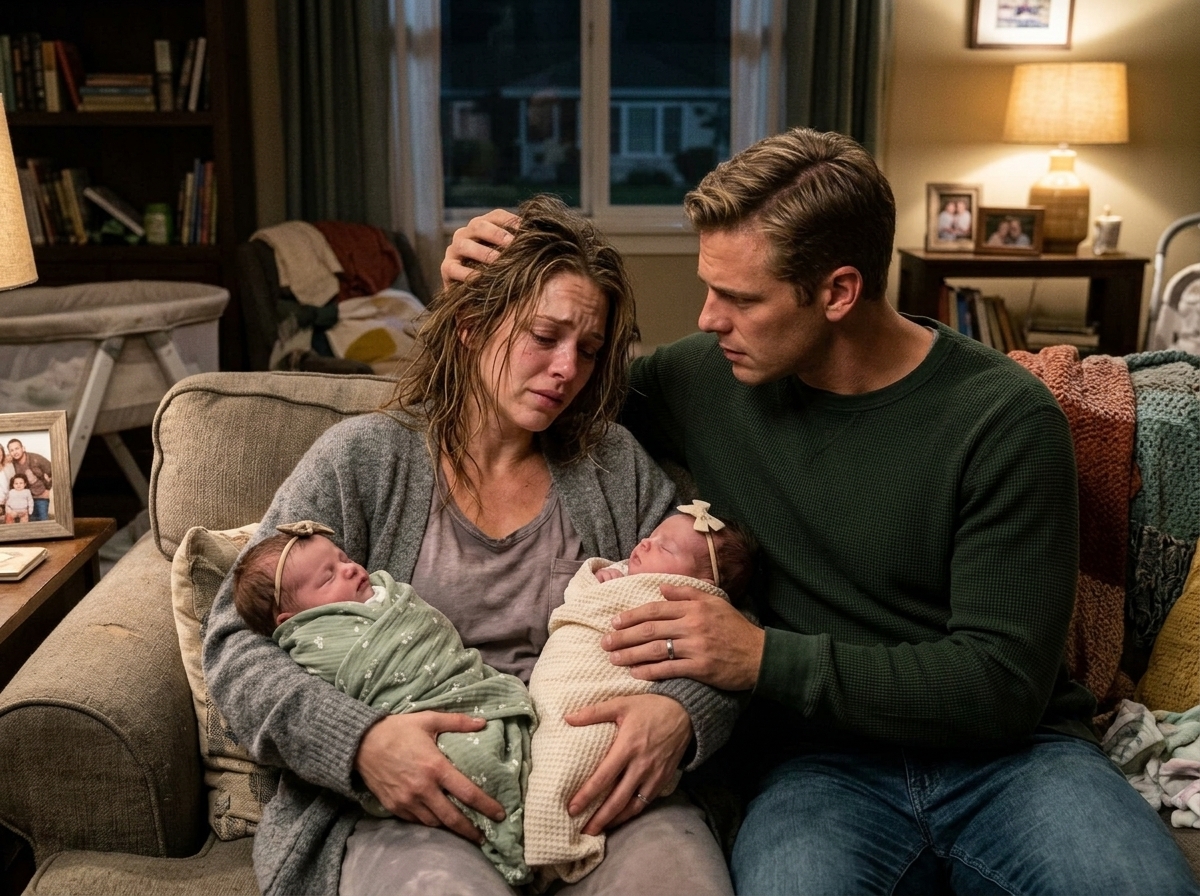
I was barely alive, bleeding beneath a freezing New York overpass, holding my newborn twin daughters against my chest when the city’s most feared Mafia boss discovered us. My husband had discarded all three of us because I hadn’t given him a son. But when Elias Vance lifted us into his armored SUV, he made a promise that would turn powerful men against him: “From now on, you’ll live with me.”
My name is Ava Miller, and until that night, I’d learned through poverty just how invisible a woman could be.
My husband had always wanted a son more than he wanted a wife. When I delivered twin girls, he looked at our babies as if I’d intentionally brought shame upon him.
He called them “a curse.”
Not one person stood up for me.
Only hours after giving birth, still terribly weak, I was dragged out of our apartment wearing barely enough to protect myself from the winter cold. Everything that followed returned in broken flashes—the pain tearing across my back, the frozen pavement under my knees, and the desperate way I held my daughters close.
Then everything went black.
Elias Vance discovered me beneath a deserted overpass near the Hudson River, where the glow of the city began to disappear. I later learned he’d ordered his convoy to stop after spotting something beside a concrete barrier.
He initially believed I was already dead.
Then he noticed the blood.
Elias wasn’t known for kindness. He commanded one of New York’s most terrifying criminal organizations, and men who failed to repay their debts sometimes vanished before morning.
But something shifted beneath my coat.
A baby.
And then a second one.
Elias immediately knelt beside me while his armed security team moved into position along the road. My daughters lay against my chest, their tiny faces gray from the freezing temperatures. I’d wrapped my body around them, trying to shield them from the wind.
“Boss,” one of his guards cautioned, “we need to call an ambulance.”
“They won’t survive if we wait for one.”
Elias stripped off his costly wool coat, unbuttoned his shirt, and held both newborns against his bare chest to warm them.
Then he picked me up.
I was so light that one of his guards later told me Elias’s face changed the moment he lifted me into his arms.
“Who did this to her?” someone demanded.
Elias examined the wounds covering my back.
“Find out.”
His armored SUV raced through Manhattan as one of his men contacted a private doctor. Throughout the journey, Elias held my daughters tightly against his chest. He wouldn’t allow anyone else to take them until we arrived at his penthouse.
For the next three days, I slipped in and out of consciousness, caught between fever and darkness.
When I finally opened my eyes, I found myself staring at a ceiling I didn’t recognize. Terror swept over me before I even attempted to move.
“My babies?”
Near the window, a man seated in a chair lowered the file he’d been reading.
Elias.
I knew his face instantly. Even in the poorest parts of the city, everyone recognized him.
“They’re both alive,” he answered.
Relief washed through my entire body.
But it didn’t last.
I struggled to sit upright. “He’ll come looking for them.”
Elias’s gaze turned cold. “Who will?”
I hesitated for several seconds before managing to answer.
“My husband.”
Then everything I’d endured began pouring out.
“He wanted a boy. Someone to inherit everything. When the midwife told him I’d delivered girls, he said they were cursed.”
Elias went completely still.
“He allowed other men to hurt me,” I said quietly. “Afterward, he abandoned us outside. He said daughters weren’t worth the cost of feeding.”
A baby cried somewhere in the room next door.
I attempted to get to my feet, but Elias had already started toward the doorway.
Suddenly, one of his guards stepped inside with a phone in his hand.
“Boss, we located her husband.”
Elias accepted the phone.
As he studied its screen, his expression shifted.
“What is it?” I whispered.
He glanced toward me, then toward the room where my daughters lay sleeping.
“Your husband isn’t coming here to take his daughters home.”
My blood turned to ice.
Elias secured the penthouse door.
“He’s coming because he just learned who saved you.”
For a moment, I couldn’t breathe.
“What does that mean?” I asked.
Elias didn’t answer immediately. He handed the phone back to his guard, crossed the room, and stopped beside my bed.
“Your husband has been asking questions about me,” he said. “Specifically, whether the woman I brought home from the waterfront is still alive.”
My fingers tightened around the blanket.
“He knows I’m here?”
“Not yet. But someone told him my convoy picked up a woman and two infants near the Hudson.”
I looked toward the adjoining room.
“Please,” I whispered. “Don’t let him take my babies.”
Elias lowered himself into the chair beside me.
“Look at me, Ava.”
I forced myself to meet his eyes.
“Nobody is taking your daughters out of this house.”
There was something terrifying about the certainty in his voice. I’d heard men make promises before, usually right before breaking them. My husband had promised to protect me, feed me, and give our children a good life.
Instead, he’d nearly killed us.
“Why would you help me?” I asked.
For the first time, Elias looked uncomfortable.
“Because someone should have.”
A soft knock interrupted us.
An older woman entered carrying a tray with soup, bread, and a glass of water. Her silver hair was pinned neatly behind her head, and her expression softened when she saw me awake.
“I’m Margaret,” she said. “I’ve been helping care for your girls.”
“My girls?”
“They’re doing beautifully, considering what they went through.”
My eyes filled.
“Can I see them?”
Margaret smiled.
“Of course.”
She disappeared into the adjoining room and returned carrying one of my daughters, while a younger nurse followed with the other.
I reached out with trembling arms.
The moment their warm little bodies settled against me, something inside my chest broke open.
They were alive.
Both of them.
One stirred against my shoulder, making a tiny sound of protest. The other opened her eyes briefly before falling asleep again.
I kissed their foreheads over and over.
“I’m sorry,” I whispered. “I’m so sorry, my beautiful girls.”
Margaret rested a gentle hand on my shoulder.
“You have nothing to apologize to them for.”
But I did.
At least, that’s how it felt.
I’d brought them into a world where their own father hated them before they had even learned to open their eyes.
Across the room, Elias watched silently.
Then one of my daughters began crying.
He moved before anyone else.
“She’s hungry?” he asked Margaret.
“Probably. But her mother needs to recover enough to feed her comfortably.”
“I can do it,” I insisted.
The nurse approached to help me position the baby, and Elias immediately turned toward the window to give us privacy.
It was such a small gesture.
Yet after months of being treated like property, that simple act of respect nearly made me cry again.
Over the next several days, I began learning about the strange world Elias Vance inhabited.
His penthouse occupied the upper floors of a Manhattan building overlooking the river. Security personnel guarded every entrance. Elevators required private access codes, and cameras monitored the hallways.
A doctor visited twice each day to check my injuries.
Margaret made sure I ate.
The nurse helped me care for the twins whenever exhaustion overwhelmed me.
And Elias?
He appeared every evening.
Sometimes he carried documents. Sometimes he arrived with his tie loosened and exhaustion written across his face.
But he always asked the same question.
“How are the girls?”
At first, I didn’t understand why he cared.
Then, on the fifth evening, he arrived carrying two small boxes.
“I was told newborns need more clothing than anyone expects,” he said awkwardly.
Inside were tiny knitted sweaters.
One pale pink.
One soft blue.
I stared at them.
“They’re beautiful.”
“The woman at the store said they were practical.”
I almost laughed.
“Elias, they’re cashmere.”
He glanced at the sweaters.
“Is that bad?”
For the first time since giving birth, I genuinely smiled.
“No. It’s just that my daughters have never owned anything so expensive.”
He looked at the babies asleep beside me.
“Then they’re overdue.”
That evening, he asked whether I’d chosen names.
I shook my head.
“My husband wouldn’t let me.”
Elias went very still.
“He said naming them would make them harder to get rid of.”
The silence afterward felt enormous.
Then Elias asked, “What would you have named them?”
I looked down at their sleeping faces.
The smaller twin had a delicate little mouth and a habit of curling her fingers around mine.
“Lily,” I whispered.
Then I touched her sister’s cheek.
“And Grace.”
Elias repeated the names softly.
“Lily and Grace.”
He nodded once.
“Beautiful names.”
I watched him walk toward the door.
“Elias?”
He turned.
“Thank you.”
His expression shifted almost imperceptibly.
“Get some rest, Ava.”
That night, I slept without dreaming of the overpass.
But the next morning, my past found me.
I was eating breakfast when angry voices erupted outside my room.
“He’s demanding a meeting,” one of Elias’s guards said.
“Then he can demand it somewhere else.”
“Boss, he says this involves missing property.”
The spoon slipped from my fingers.
I knew exactly what that meant.
My husband.
His name was Victor Miller, and before we married, he’d been a small-time businessman operating several warehouses near the waterfront.
After our wedding, his finances improved dramatically.
He told everyone he was a brilliant entrepreneur.
What he never told anyone was that much of his income came from transporting goods for men whose names were never supposed to appear on paperwork.
Victor had always been careful around powerful people.
Cruel to those beneath him.
Submissive to those above him.
That was why I couldn’t understand why he would risk confronting Elias Vance.
Unless he believed he had something to gain.
The door opened.
Elias entered with a folder in his hand.
“How much do you know about your husband’s business?” he asked.
My stomach tightened.
“Not much. He never allowed me near his office.”
“Did he ever ask you to sign documents?”
I thought for a moment.
“Sometimes.”
“What kind?”
“Bank forms. Shipping papers. He told me they were routine.”
Elias exchanged a look with the guard behind him.
“Do you remember when?”
“Before the babies were born. A few months ago.”
He opened the folder and placed a document on my bedside table.
My signature appeared at the bottom.
I stared at it.
“That’s mine.”
“I know.”
“What is it?”
“A loan guarantee.”
I looked up.
“For how much?”
“Four million dollars.”
The room tilted.
“That’s impossible.”
“Victor used your name to guarantee a debt connected to one of his companies.”
“I don’t have four million dollars.”
“He knew that.”
My hands began shaking.
“Then why would he do it?”
Elias hesitated.
“Because your name was attached to assets he intended to move out of the company before his creditors discovered what he’d done.”
I stared at him.
“You’re saying he used me to steal money?”
“I’m saying he wanted someone else responsible when the debt came due.”
I thought about the months before my delivery.
Victor had become increasingly nervous, leaving the apartment late at night and returning furious over the smallest things.
He’d blamed me for every financial problem.
When I became pregnant, he’d announced that our son would eventually inherit his business.
A son.
Always a son.
Now I wondered whether the obsession had been about something more than pride.
“Did he really want a boy?” I asked.
Elias studied me carefully.
“I think he wanted an heir he could control. Someone he imagined would protect what he thought belonged to him.”
“And because I gave birth to daughters…”
“He decided you were disposable.”
I covered my mouth.
For months, I’d blamed myself for something I couldn’t control.
Now I understood that my husband had been using our unborn child as another excuse to justify his cruelty.
Elias gathered the documents.
“There’s something else.”
My heart sank.
“What?”
“Victor owes money to people who don’t appreciate being lied to.”
I looked at him.
“People like you?”
Elias didn’t pretend otherwise.
“Yes.”
The answer frightened me.
Yet it also explained something I’d been afraid to ask.
“Did you know him before you found me?”
“Not personally. One of his companies handled shipments for businesses connected to mine. When he started moving money through false invoices, people began asking questions.”
“And now he knows I’m here.”
“He believes you can help him get out of trouble.”
I looked toward the nursery.
“He doesn’t care about Lily and Grace.”
“No,” Elias said quietly. “I don’t believe he does.”
That afternoon, an attorney arrived.
Her name was Rebecca Shaw.
She wore a charcoal suit, carried a leather briefcase, and spoke with the calm precision of someone who had spent years confronting people who believed money made them untouchable.
Elias introduced her as an attorney experienced in family law and financial fraud.
“I’d like Rebecca to explain your options,” he said. “Whatever you decide, you should understand them.”
Rebecca sat opposite me.
“First, Ava, I need to know something important. Did you freely agree to sign those financial documents?”
“No.”
“Did your husband explain what you were signing?”
“He told me they were ordinary business forms.”
“Did he threaten you?”
I looked down.
“Sometimes.”
Rebecca waited.
Then I told her about the shouting.
The locked doors.
The money Victor withheld.
The way he’d made me ask permission to buy groceries.
The threats that became physical whenever I questioned him.
And finally, the night my daughters were born.
By the time I finished, Rebecca’s expression had hardened.
“We need medical records, photographs of your injuries, and a formal statement,” she said. “We can also work on emergency protective orders and custody arrangements.”
“Would he still have rights to the babies?”
“He could attempt to assert them. But the abuse and abandonment you’ve described are extremely serious. We’ll take the appropriate legal steps to protect all three of you.”
I glanced toward Elias.
He was standing beside the window.
His jaw was tight.
“Will you tell me something?” I asked Rebecca.
“Of course.”
“If I leave this building, can Victor make me come back?”
“No, Ava. You’re an adult. Your husband does not own you.”
The words struck harder than I expected.
He does not own you.
I repeated them silently.
Rebecca reached across the table.
“You’re allowed to leave him.”
I started crying.
Not because I was frightened.
Because someone had finally said something I had almost forgotten was true.
That evening, Elias found me sitting near the nursery window.
Manhattan glittered beneath us.
The girls slept in matching bassinets while I watched cars move across the distant streets.
“Rebecca told me you agreed to proceed,” he said.
“I did.”
“Good.”
I hesitated.
“Elias, why haven’t you asked me for anything?”
He frowned slightly.
“What would I ask for?”
“Money. A favor. Something.”
His expression changed.
“Is that what you’re expecting?”
I swallowed.
“Every man who’s helped me has eventually told me what I owe him.”
Elias pulled a chair beside mine.
“You don’t owe me your gratitude, Ava. You don’t owe me your loyalty. And you certainly don’t owe me yourself.”
I looked at him.
“Then why?”
For several moments, he said nothing.
Finally, he leaned forward.
“When I was nine, my mother took me and my little sister out of our apartment in the middle of a snowstorm.”
I watched his face.
“My father had been drinking. He’d broken my mother’s wrist and threatened to kill her if she stayed.”
My breath caught.
“We walked for hours. My sister couldn’t stop crying. Nobody opened their doors.”
He stared toward the city.
“Eventually, a woman working the night shift at a diner let us inside. She gave us hot chocolate, called for help, and stayed with us until morning.”
“What happened to your sister?”
Elias looked down.
“She got sick that winter. Pneumonia. She died before spring.”
“I’m so sorry.”
He nodded.
“I’ve spent most of my life trying to forget that night.”
His eyes moved toward the bassinets.
“Then I saw you beneath that overpass.”
For the first time, I understood.
It wasn’t simply pity.
He had seen something he recognized.
A woman trying desperately to keep her children alive.
And a little girl he had never been able to save.
“I couldn’t leave you there,” he said.
I reached across the space between us and placed my hand over his.
“Your sister would have been proud of you.”
He looked away.
But he didn’t withdraw his hand.
Three nights later, Victor made his move.
It began shortly after eleven.
I’d just finished feeding Grace when an alarm sounded softly somewhere beyond the bedroom.
Not a screaming siren.
A low electronic tone.
Then I heard footsteps moving quickly through the hallway.
My body froze.
Elias appeared almost immediately.
“Stay with Margaret,” he said.
“What’s happening?”
“Someone tried to enter the building using false credentials.”
“Victor?”
“We’re checking.”
The door closed behind him.
I held Grace against my chest while Margaret lifted Lily from her bassinet.
Neither of us spoke.
Five minutes passed.
Then ten.
Finally, Elias returned.
His face was unreadable.
“Was it him?” I asked.
“Two men working for him.”
I felt sick.
“What did they want?”
“They claimed they were here to retrieve stolen property.”
My entire body went cold.
“Us.”
Elias said nothing.
He didn’t need to.
I looked down at Grace.
Her tiny fist rested against my shirt.
“He’s never going to stop.”
Elias came closer.
“Then we make sure he cannot reach you.”
The following morning, Rebecca brought disturbing news.
Victor had reported me missing.
Worse, he’d claimed I was mentally unstable after childbirth and had been kidnapped by Elias.
“He filed a police report,” Rebecca explained. “He’s alleging that Elias is holding you against your will.”
I stared at her.
“But that’s a lie.”
“Then we’re going to establish the truth on the record.”
Rebecca arranged for me to speak with investigators, with an independent attorney present.
She also made sure my medical records were preserved.
The doctor who treated me documented the injuries across my back, the effects of exposure, and my severe physical condition after childbirth.
Photographs taken when I first arrived at the penthouse showed bruising, cuts, and evidence of prolonged neglect.
I could barely look at them.
That woman lying unconscious on the examination table looked like a stranger.
Her cheeks were hollow.
Her lips were blue.
Her body was covered in injuries.
And her arms were still curled protectively around the space where her babies had been.
Rebecca quietly closed the folder.
“You survived something terrible, Ava.”
I shook my head.
“I almost didn’t.”
“But you’re here.”
For the first time, I began to believe that being alive might eventually mean more than simply surviving.
Victor’s claims triggered an investigation into the circumstances of my disappearance.
Rebecca helped me provide a formal statement to detectives who were not connected to Elias.
She explained that my husband’s financial fraud allegations would be handled separately from the violence committed against me.
At first, I feared nobody would believe my story.
After all, Victor had money.
Influence.
Connections.
And I was a woman who had once been too poor to buy winter coats for her newborn daughters.
But the evidence was difficult to dismiss.
Hospital records confirmed the timing of the twins’ births.
Security footage from our former apartment building showed me being forced outside shortly afterward.
A neighboring business had recorded a vehicle leaving the area.
Investigators also located the midwife who’d attended the delivery.
Her testimony changed everything.
She admitted Victor had become furious after learning the babies were girls.
She’d witnessed him threaten me.
And she’d heard him instruct two employees to remove me from the apartment.
“Did you attempt to intervene?” one detective asked.
The midwife began crying.
“I was afraid he’d hurt me too.”
For years, fear had protected Victor.
Now that fear was beginning to break.
But there was one piece of evidence nobody expected.
It came from Victor himself.
Four days after his failed attempt to enter the building, he sent a message to an associate, demanding that the woman Elias was sheltering be returned before she could speak to authorities.
He described me as a financial liability.
Not his wife.
Not the mother of his children.
A liability.
Investigators obtained that message through a lawful search of the associate’s communications after he agreed to cooperate.
Rebecca showed me a copy.
I read it three times.
Then I handed it back.
“I want to testify.”
She looked at me.
“Are you certain?”
“Yes.”
“Victor may try to intimidate you.”
“He’s been intimidating me for years.”
I took a slow breath.
“I’m done helping him do it.”
The first court appearance was held several weeks later.
By then, the twins had gained weight, my fever was gone, and I could walk without assistance.
Margaret helped me choose a simple navy dress.
Rebecca had arranged for Lily and Grace to remain safely with their nurse during the hearing.
Elias offered to accompany me.
I hesitated.
“You don’t have to.”
“I know.”
“People are going to talk.”
“They already do.”
I studied him.
“Your reputation could make this harder.”
He nodded.
“Then I’ll stay out of the courtroom if that’s what you want.”
I hadn’t expected him to say that.
Victor had never once given me a choice when he could make the decision for me.
“I’d like you there,” I said.
Elias nodded.
“Then I’ll be there.”
The courtroom was smaller than I expected.
No dramatic chandeliers.
No grand staircase.
Just wooden benches, fluorescent lighting, and a judge who looked far more interested in the evidence than anyone’s reputation.
Victor sat beside his attorney.
He wore an expensive dark suit and the same expression I’d seen throughout our marriage.
Absolute confidence.
When he noticed me, his face changed.
First surprise.
Then anger.
Then something resembling satisfaction.
He leaned toward his attorney and whispered.
A few minutes later, his attorney began arguing that I’d been manipulated by dangerous individuals and had abandoned my husband during a period of severe emotional instability.
I listened without reacting.
Then Rebecca stood.
She introduced medical reports.
Photographs.
Witness statements.
Documentation of the twins’ condition.
Evidence that Victor had attempted to locate me through men falsely claiming official authority.
Finally, she presented financial records showing that Victor had placed substantial obligations under my name while concealing the true nature of the transactions.
The judge examined the materials carefully.
Victor shifted in his chair.
His attorney objected to some of the evidence, and the judge made clear that financial fraud allegations would require separate proceedings.
But the protection request concerned something more immediate.
Whether I and my daughters were in danger.
Then the judge asked me to speak.
I stood.
My legs shook.
I gripped the edge of the witness stand.
“Mrs. Miller,” the judge said, “tell the court why you’re afraid to return to your husband.”
I looked directly at Victor.
For a moment, I saw the man who had once brought me flowers.
The man who’d promised me a beautiful life.
The man who had held my hand when I first learned I was pregnant.
Then I remembered the pavement beneath my knees.
The cold.
The blood.
And the tiny cries beneath my coat.
“Because he threw me and our newborn daughters out into the winter,” I said. “Because he knew we could die, and he didn’t care.”
Victor suddenly stood.
“That’s a lie!”
The judge ordered him to sit.
But Victor couldn’t stop.
“She’s always been dramatic! I gave her everything!”
My hands tightened.
“No,” I said.
The courtroom quieted.
“You gave me just enough to make me afraid of losing it. Then you used that fear to control me.”
Victor’s face reddened.
“You wouldn’t even give me a son!”
Silence fell.
His attorney grabbed his sleeve.
Too late.
I stared at him.
“That’s what you still believe?”
He seemed to realize what he’d said.
But the anger was already spilling out.
“I built everything for my family!”
“You nearly killed your family.”
The judge ordered both of us to stop speaking directly to each other.
I turned back toward the bench.
“I’m asking the court to protect my daughters,” I said. “I don’t want revenge. I just want them to grow up knowing they’re safe.”
When the hearing concluded, the judge granted a temporary order protecting us while additional proceedings continued.
Custody arrangements would be addressed through the appropriate family court process.
It wasn’t a final victory.
But for the first time, Victor could no longer simply order me home.
Outside the courtroom, reporters gathered around Elias.
Questions flew.
“Mr. Vance, why are you involved with Victor Miller’s wife?”
“Are these allegations connected to your business operations?”
“Are you planning retaliation?”
Elias said nothing.
He simply moved aside so Rebecca and I could reach the waiting car.
As we approached the sidewalk, Victor emerged from the courthouse.
“Ava!”
I stopped.
Rebecca immediately stepped closer.
Victor stared at me across the distance.
“You think you’ve won?”
I felt Elias beside me, but he didn’t interfere.
Victor pointed at him.
“You think that man is going to protect you forever?”
I took a breath.
“No, Victor.”
He frowned.
“I learned I can protect myself.”
Then I turned away.
I didn’t look back.
The criminal investigation continued over the following months.
One of the men involved in my assault agreed to cooperate with prosecutors.
He provided information about Victor’s orders, the removal of my belongings from the apartment, and the vehicle used that night.
Another witness confirmed Victor had known I was seriously injured before ordering me abandoned.
Meanwhile, financial investigators uncovered false invoices and unauthorized transfers involving companies Victor controlled.
The four-million-dollar guarantee bearing my signature became an important part of the investigation.
An independent handwriting expert determined that while the signature itself was mine, several material pages had been substituted after I signed the original paperwork.
Rebecca explained that the finding did not automatically erase every potential financial complication, but it supported my account of deception.
By then, Victor’s businesses were already collapsing.
Partners withdrew.
Banks reviewed transactions.
Creditors filed claims.
People who had once praised him as a visionary entrepreneur suddenly claimed they’d barely known him.
But the greatest surprise came one evening when Elias asked me to join him in his study.
He looked unusually serious.
“There’s something I need to tell you.”
My stomach tightened.
“What?”
He motioned toward the chair across from his desk.
I sat.
“Victor’s financial problems began before your pregnancy.”
“I know.”
“Some of those problems involved businesses connected to mine.”
I nodded slowly.
“You told me that.”
“What I didn’t tell you was that one of my associates wanted to use Victor’s debt as leverage.”
“Leverage for what?”
“To take over his warehouses.”
I studied him.
“And?”
“And when I found out how Victor had treated you, that associate suggested we could settle the matter privately.”
I felt cold.
“What does privately mean?”
Elias looked directly at me.
“Exactly what you’re afraid it means.”
I stared at him.
“Did you agree?”
“No.”
“Why?”
“Because putting Victor in a grave wouldn’t give your daughters justice. It would make me another man deciding your future without asking you.”
I didn’t know what to say.
Elias leaned back.
“I’ve done things I’m not proud of, Ava. I won’t insult you by pretending otherwise.”
Outside the window, the city lights reflected across the dark river.
“I’m trying to make some different decisions now.”
I watched him carefully.
“Because of me?”
“Partly.”
“And the rest?”
His expression softened.
“Because Lily smiled at me yesterday.”
I blinked.
He looked almost embarrassed.
“She was lying in her bassinet. I made a ridiculous face, and she smiled.”
“Babies do that.”
“I know.”
“Sometimes it’s just gas.”
He gave me a wounded look.
“It was definitely a smile.”
I laughed so hard that tears came into my eyes.
And for one brief, wonderful moment, nothing in the world frightened me.
As winter turned into spring, my life changed in ways I never could have predicted.
Rebecca helped me establish my own bank accounts.
I began counseling with a therapist experienced in domestic abuse.
I learned how to recognize the patterns I’d once mistaken for love.
The intimidation.
The isolation.
The gradual destruction of my confidence.
I also learned that recovery wasn’t a straight line.
Some mornings, I woke terrified without knowing why.
Sometimes a raised male voice made my hands shake.
Sometimes I felt guilty for being happy.
My therapist told me that surviving violence did not mean I had to become fearless overnight.
I simply had to keep moving toward a life in which fear no longer made every decision.
Elias never pressured me to speak about those sessions.
Instead, he began asking whether I wanted to go outside.
At first, that seemed impossible.
The thought of leaving the penthouse made my chest tighten.
But one warm afternoon, we took Lily and Grace to a private garden overlooking the river.
Margaret accompanied us, along with security who remained at a respectful distance.
The twins slept in their stroller.
Flowers were beginning to bloom.
For the first time in months, I felt sunlight on my face without wondering when someone would punish me for enjoying it.
Elias stood beside me.
“How does it feel?”
I considered the question.
“Strange.”
“Strange?”
“To be outside and not feel like I’m running away.”
He nodded.
We stood quietly for a while.
Then I asked something that had been troubling me.
“Elias, what happens when all of this is over?”
“What do you want to happen?”
“I don’t know.”
And that was the truth.
I’d spent so many years being told what I wanted that having choices felt almost frightening.
“I can’t live in your penthouse forever.”
“You can stay as long as you need.”
“But eventually, I need to stand on my own.”
He looked at me with something like pride.
“Then we’ll make sure you have the chance.”
I shook my head gently.
“No, Elias. I need to make sure.”
He smiled.
“Fair enough.”
Two weeks later, I began working with a nonprofit organization that supported women escaping abusive relationships.
At first, I volunteered only a few hours each week.
I helped sort donated clothing.
Prepared supplies for mothers with infants.
Spoke with women who were afraid to file police reports.
One afternoon, a young mother arrived carrying a little boy.
She had bruises on her wrists.
Her voice shook when she spoke.
“I don’t have any money,” she whispered. “I don’t know where to go.”
I knelt beside her.
“You don’t need to figure everything out today.”
She looked at me uncertainly.
“How do you know?”
Because I’d once been lying beneath a bridge, certain nobody would ever come.
But I didn’t tell her all of that.
Instead, I said, “Because I’ve been where you are.”
And for the first time, my past felt like something I could use to help someone else rather than simply something I had to endure.
Meanwhile, Victor’s criminal case moved forward.
Prosecutors ultimately charged him with offenses arising from the assault and abandonment, along with separate financial crimes supported by the investigation.
Two of the men who had helped remove me from the apartment entered guilty pleas and agreed to testify.
Victor continued insisting he was innocent.
Until the day the security footage was played in court.
I sat beside Rebecca as the grainy images appeared on the monitor.
There I was.
Barely able to stand.
Holding two bundles against my chest.
A man grabbed my arm.
Another opened the door.
Then the recording showed me being forced into the freezing night.
I heard someone behind me gasp.
I couldn’t move.
Every sensation returned.
The wind.
The pain.
The terror of knowing my babies might die.
Then I felt a hand resting on the bench beside mine.
Elias.
He didn’t grab me.
He didn’t demand that I look away.
He simply placed his hand where I could choose to take it.
I did.
Victor’s attorney attempted to challenge the interpretation of the footage.
But combined with medical records, witness testimony, and communications investigators had recovered, the evidence was overwhelming.
Several weeks later, Victor agreed to plead guilty to multiple charges.
At sentencing, I was permitted to address the court.
I walked to the lectern carrying a photograph of Lily and Grace.
Not because I wanted to make Victor suffer.
But because I wanted him to understand whom he’d abandoned.
“My daughters were less than a day old when their father decided their lives were worthless,” I said.
Victor stared at the table.
“He didn’t know their names. He didn’t know which one cried first or which one curled her tiny hand around my finger. He didn’t know that Grace was a little smaller than Lily, or that both of them fought to survive.”
My voice shook.
“But he knew they were girls.”
I paused.
“And that was enough for him to decide we didn’t deserve to live.”
The courtroom was silent.
“I used to believe I had failed as a wife because I couldn’t give him the child he wanted. Today, I understand that my daughters were never the problem.”
I looked toward Victor.
“The problem was a man who believed love had to be earned by being born the right way.”
For the first time, Victor raised his eyes.
I didn’t see remorse.
Only bitterness.
But it no longer mattered.
“I don’t need him to apologize,” I continued. “I don’t need him to understand. I need my daughters to grow up knowing that nobody gets to decide their worth.”
When I finished, I stepped away.
The judge imposed a substantial prison sentence for the crimes to which Victor had pleaded guilty, along with financial penalties and restitution obligations where authorized.
The separate family court proceedings ultimately resulted in my receiving sole legal and physical custody of Lily and Grace, with Victor’s parental contact restricted under the court’s orders.
The financial proceedings took longer.
Some assets were frozen.
Claims were contested.
Rebecca continued helping me separate my legitimate obligations from the fraudulent transactions Victor had arranged.
It wasn’t simple.
Justice rarely arrived in one perfect moment.
But Victor could no longer reach into my life whenever he wanted.
He could no longer threaten me into silence.
And he could never again convince me that my daughters were a curse.
Outside the courthouse, I stood beneath a bright blue sky.
Elias waited near the car.
“How do you feel?” he asked.
I thought about it.
“Free.”
He smiled.
“Good.”
Then I did something that surprised us both.
I hugged him.
For a moment, he stood perfectly still.
Then his arms settled gently around me.
“Thank you,” I whispered.
“You don’t have to keep thanking me.”
“I know.”
I pulled back and smiled.
“But I want to.”
Six months later, I moved out of Elias’s penthouse.
Not because we had argued.
Not because I no longer felt safe.
But because I’d found a small apartment overlooking a quiet park.
It had two bedrooms, a narrow kitchen, and windows that caught the morning sunlight.
The building wasn’t luxurious.
There were no marble floors.
No private elevators.
No armed guards standing in the hallway.
But the lease was in my name.
Every piece of furniture had been chosen by me.
And when I closed the front door at night, I knew the space belonged to my daughters and me.
Elias helped carry the last box upstairs.
He stood in the living room, looking around.
“It’s smaller than the penthouse,” he observed.
“Most places are.”
He smiled.
I placed a vase of flowers on the kitchen counter.
“I love it.”
“I can see that.”
Lily was sitting in her playpen, trying to grab Grace’s sleeve.
Grace responded by making an indignant little noise.
Elias crouched beside them.
“Still fighting over everything?”
Lily squealed.
He smiled at her.
“That’s what I thought.”
Watching him with my daughters, I felt something warm and unfamiliar settle inside me.
It had been growing slowly for months.
Not gratitude.
Not obligation.
Something else.
“Elias?”
He looked up.
“Would you like to stay for dinner?”
His expression softened.
“I’d like that.”
We ate pasta at my little kitchen table while the twins slept nearby.
No servants.
No expensive wine.
No one hovering outside the door.
Just two adults talking about ordinary things.
He told me about a difficult business meeting.
I told him about a woman at the nonprofit who had finally found permanent housing.
We laughed over Lily’s determination to pull every blanket off her sister.
And for the first time, I saw what life with Elias might look like beyond danger, security, and rescue.
But there was something we still needed to discuss.
After dinner, I placed my fork down.
“Elias, I need to ask you something.”
He looked at me.
“Anything.”
“What happens if your world becomes dangerous again?”
He didn’t pretend not to understand.
“That’s a fair question.”
“I won’t raise my girls around violence.”
“I know.”
“And I can’t be with someone who expects me to ignore it.”
He studied me for a long moment.
“Are you asking whether I can change?”
“I’m asking whether you want to.”
His expression became serious.
“I’ve already begun.”
Over the previous months, he’d started severing ties with several criminal operations that had once helped sustain his power.
He was transferring legitimate businesses into properly managed structures, cooperating with attorneys and accountants, and distancing himself from men who treated violence as a routine business tool.
It was complicated.
There were legal consequences he couldn’t simply erase.
And walking away from a criminal organization wasn’t as easy as closing an office.
“I can’t promise my past will disappear,” he said. “And I won’t ask you to pretend it doesn’t exist.”
I nodded.
“But I can promise I’m taking responsibility for the choices I make now.”
I looked toward my sleeping daughters.
“I need more than promises.”
“I know.”
He reached across the table, then stopped before touching my hand.
“May I?”
I smiled faintly.
“Yes.”
His fingers closed gently around mine.
“Then judge me by what I do.”
And I did.
I didn’t fall in love with Elias because he was powerful.
Or wealthy.
Or feared.
Those were the things that had initially made me afraid of him.
I fell in love with him slowly, through ordinary moments.
He learned how to change diapers without looking horrified.
He memorized the girls’ pediatric appointments.
He brought groceries when I was too exhausted to shop.
He sat through community fundraising meetings where nobody cared who he was.
He listened when I disagreed with him.
And when I told him I wasn’t ready for something, he accepted it.
There were difficult conversations.
Questions about his past.
Arguments about security.
Moments when I wondered whether someone who had lived so long through power and fear could truly build a different life.
I didn’t pretend those concerns vanished.
Neither did he.
But month by month, his actions began matching his words.
He divested himself of illegal business interests, submitted to the legal scrutiny that followed, and rebuilt his work around legitimate investments.
Some former associates walked away.
Others threatened him.
His lawyers spent long hours helping him address outstanding legal obligations.
He couldn’t rewrite what he’d done.
But he could stop repeating it.
And gradually, the man New York had once known only as a ruthless criminal began living like someone who understood that respect meant more than fear.
On the twins’ first birthday, I invited a small group of people to my apartment.
Margaret arrived carrying homemade cupcakes.
Rebecca brought two little stuffed animals.
The nurse who had cared for the girls during their first fragile days arrived with flowers.
Several women from the nonprofit came with their children.
And Elias appeared at the door holding an enormous gift bag.
I narrowed my eyes.
“What did you buy?”
“Nothing extravagant.”
“Elias.”
He hesitated.
“Two little rocking horses.”
I looked inside.
They were beautifully made, hand-painted, and probably cost more than my dining table.
I sighed.
He smiled.
“They’re practical.”
I burst out laughing.
“You said that about the cashmere sweaters.”
“And I was right.”
That afternoon, we gathered around a small birthday cake.
Lily reached for the frosting.
Grace copied her.
Within seconds, both girls had icing on their cheeks, fingers, and clothes.
Everyone laughed.
I stood nearby, watching the room.
For so long, I’d believed family meant enduring whatever people did to you.
Keeping quiet.
Forgiving cruelty.
Accepting pain because someone shared your name.
But here were people who had chosen to care.
Margaret, who had sat beside my bed when I was too weak to hold my babies.
Rebecca, who had helped me find my voice.
Women who understood what survival cost.
And Elias.
The man who’d found three nearly lifeless strangers beneath an overpass and stopped his entire convoy because he couldn’t bear to leave them behind.
He stood beside me, holding Grace while Lily tugged at his sleeve.
“They’re getting big,” he said.
I smiled.
“Too fast.”
He looked at the photograph displayed on my bookshelf.
It had been taken shortly after we left the hospital.
I was sitting in the penthouse, still pale and exhausted, holding my daughters while Elias stood beside us.
Margaret had taken it.
At the time, I hadn’t understood why Elias wanted a copy.
Now I did.
It wasn’t a picture of a powerful man rescuing someone helpless.
It was a picture of three people who had survived.
And a fourth who had chosen not to walk away.
Several months later, Elias asked me to dinner at a quiet restaurant overlooking the Hudson River.
It wasn’t an extravagant affair.
No private orchestra.
No champagne tower.
Just a table near the window and the city lights reflecting on the water.
After dessert, he reached into his jacket.
My heart skipped.
“Elias…”
He smiled nervously.
“I know what you’re thinking.”
He placed a small velvet box on the table.
Inside was a simple diamond ring.
Beautiful.
Elegant.
Nothing like the enormous jewelry Victor had once used to impress strangers.
“I’ve spent most of my life believing that being feared meant being powerful,” Elias said.
I watched him.
“Then I met a woman who had every reason to be afraid and still found the courage to rebuild her life.”
My eyes filled.
“You taught me something I should have learned years ago.”
“What?”
“That protecting someone doesn’t mean controlling them.”
He took a slow breath.
“I love you, Ava. I love Lily and Grace. And I want to spend my life being someone all three of you can trust.”
Tears slipped down my cheeks.
He continued before I could answer.
“But if you’re not ready, nothing changes. You and the girls will always have my respect.”
I looked at the ring.
Then at the man sitting across from me.
A man whose past was complicated.
Whose future would require work.
But who had never once made me feel that love was a debt I needed to repay.
“Yes,” I whispered.
Elias went completely still.
“Yes?”
I laughed through my tears.
“Yes, Elias.”
He stood, moved around the table, and slipped the ring onto my finger.
Then he kissed me.
Gently.
Like a man who understood that the most precious things in life couldn’t be taken.
Only given.
We married the following spring.
It was a small ceremony in a garden overlooking the river.
Margaret cried.
Rebecca smiled through most of the vows.
Lily and Grace, dressed in matching white dresses, scattered flower petals in entirely the wrong direction.
And Elias?
He cried when he saw me walking toward him.
The man whose name once made grown men tremble stood beneath an arch of white flowers, wiping tears from his face because two little girls were laughing at his feet.
During the ceremony, he made promises not only to me, but to them.
He promised to listen.
To protect without controlling.
To teach them courage without teaching them cruelty.
To show them every day that being daughters made them no less valuable than any son.
And when the officiant pronounced us married, Lily shouted something that sounded suspiciously like “Dada.”
Everyone laughed.
Elias knelt immediately.
She reached for him.
He picked her up, then gathered Grace into his other arm.
I stood beside them, laughing and crying at once.
Years later, people still occasionally asked how I had met my husband.
Some knew his old reputation.
Others knew only the quieter man who now supported community programs, attended school events, and insisted on making pancakes every Sunday morning.
Lily and Grace grew into bright, stubborn, fearless girls.
They knew their biological father had made terrible choices, though we explained the truth gradually in ways they could understand.
They never had to wonder whether they were wanted.
Every birthday, every school play, every scraped knee, Elias was there.
He never tried to erase their history.
He simply helped us build a future that wasn’t controlled by it.
And each winter, when the city turned cold, we visited the organization that had helped so many women find safety.
We donated coats.
Blankets.
Baby supplies.
Sometimes I spoke to mothers who had only just escaped dangerous homes.
When they asked whether life could truly become different, I told them the truth.
Healing took time.
Justice wasn’t always simple.
Love didn’t erase trauma.
But a different life was possible.
On one particularly snowy evening, many years after that terrible night, I stood beside our living room window watching white flakes drift over Manhattan.
Lily and Grace were sitting on the carpet, arguing cheerfully over a board game.
Elias stood behind me, wrapping his arms gently around my waist.
“You’re quiet,” he said.
“Just thinking.”
“About what?”
I looked toward the distant river.
“The night you found us.”
His arms tightened slightly.
“That feels like another lifetime.”
“It does.”
I turned to face him.
“Do you ever regret stopping?”
He looked genuinely startled.
“Ava.”
I smiled.
“I know. Silly question.”
He brushed a strand of hair from my cheek.
“I spent years believing I had everything because I could make people afraid of me.”
He glanced toward our daughters.
“That night, I found out I had almost nothing that mattered.”
I rested my forehead against his.
“And now?”
He smiled.
“Now I have everything.”
From the carpet, Grace called out.
“Dad! Lily’s cheating!”
“I’m not!” Lily protested.
Elias sighed dramatically.
“Duty calls.”
I laughed as he crossed the room to settle their dispute.
And standing there, watching the three people I loved most in the world, I thought about the woman I’d once been.
Bleeding beneath a freezing overpass.
Holding two newborn daughters against her chest.
Convinced the world had no place for any of us.
She couldn’t have imagined this room.
These voices.
This laughter.
She couldn’t have imagined that the very man strangers feared would become the one who taught her what gentleness looked like.
But most importantly, she couldn’t have imagined the woman she would become.
A woman who no longer needed permission to speak.
Who no longer confused obedience with love.
Who knew that her daughters had never been a curse.
They had been the reason she kept fighting.
And on the coldest night of my life, when everything had been taken from me, I had held them close with the last strength in my body.
I once believed Elias Vance had saved three lives beneath that overpass.
He had.
But the truth was bigger than that.
He had given us a chance.
And together, we had made that chance into a home.
THE END.