PART 1
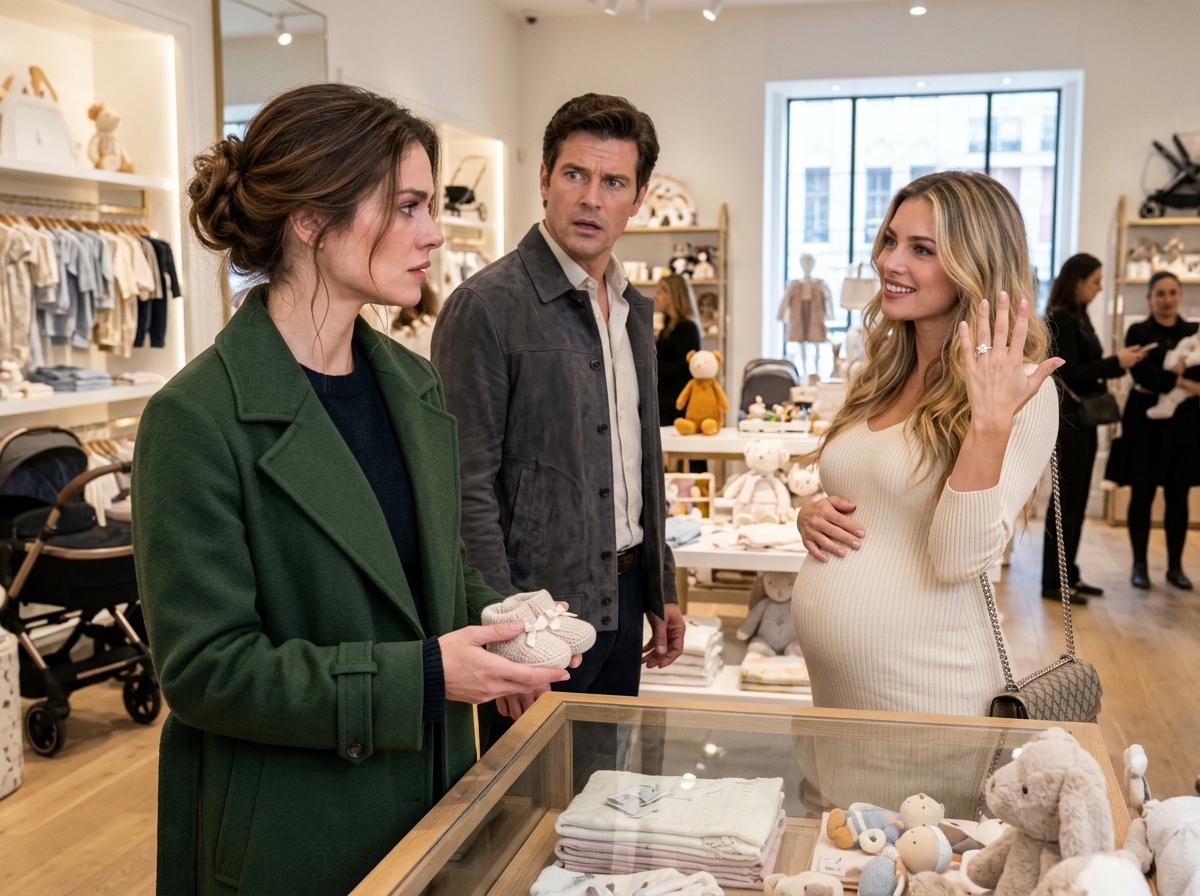
Savannah lifted her engagement ring in front of me, five months pregnant with my husband’s child, and asked whether I thought I should congratulate them. Minutes later, she casually told me their wedding date, and I watched the confidence disappear from Grant’s face. But the pregnancy, the affair, and even the diamond on her finger were not the most dangerous things revealed inside that boutique.
My name is Claire, and the day Grant underestimated me was the day he destroyed himself.
I had been holding a pair of cashmere baby booties when I heard my husband laugh.
I knew that laugh.
For the first seven years of our marriage, I had believed it belonged to me.
Then I turned.
Grant stood near the fitting rooms.
Savannah Cole was beside him.
I already knew her name.
I had seen the photographs.
The messages.
The hotel charge Grant forgot to move from our joint credit card.
But I had never seen her in person.
And I definitely had not seen her stomach.
She wore a chocolate-brown maternity dress stretched over an unmistakable pregnancy.
Five months.
Maybe six.
Grant saw me.
The color drained from his face.
“Claire.”
I carefully placed the baby booties on the display table.
“You’re pregnant.”
Savannah rested one hand over her stomach.
“Yes.”
Grant stepped toward me.
“I was going to tell you.”
I looked directly at him.
“When?”
“Tonight.”
“Tonight.”
“I wanted to do it properly.”
I almost laughed.
Properly.
As if there were a proper way to tell your wife that your mistress was carrying your child.
Savannah looked between us.
For one second, she seemed uncertain.
Then she straightened.
And smiled.
“I suppose there’s something else you should know.”
Grant’s voice changed.
“Savannah.”
She ignored him.
Instead, she lifted her left hand.
The diamond caught the chandelier light.
Large.
Oval-cut.
Platinum band.
For one strange second, I looked down at the smaller engagement ring Grant had given me fourteen years earlier.
I was still wearing it.
Savannah moved her fingers slightly.
“Grant proposed last weekend.”
Grant closed his eyes.
Then Savannah looked directly at me.
“Don’t you think you should congratulate us?”
There it was.
Not just betrayal.
Humiliation.
She wanted a reaction.
Maybe tears.
Maybe anger.
Maybe she wanted me to give Grant another reason to describe me as emotional.
But I was tired.
Tired of anger.
Tired of grief.
Tired of trying to understand a man who had already made his choices.
So I smiled.
“Congratulations.”
Grant’s eyes snapped open.
Savannah blinked.
My calm bothered them more than screaming would have.
Then I tilted my head.
“When’s the wedding?”
“Claire,” Grant warned.
I kept my eyes on Savannah.
Her smile returned.
“October eighteenth.”
For two seconds, nobody moved.
Then Grant’s expression changed.
Confusion.
Recognition.
Alarm.
He turned toward Savannah.
Too late.
October 18.
I knew that date.
Three days earlier, I had spent forty minutes discussing it with my attorney.
Grant knew it too.
Or at least he was supposed to.
I watched him stare at me while Savannah kept talking about the wedding as though nothing had happened.
Finally, Grant interrupted her.
“Claire, can we talk?”
“We are talking.”
“Privately.”
Savannah frowned.
“Grant?”
He ignored her.
That was when I knew he had remembered.
I picked up the baby booties again.
His voice dropped.
“You knew?”
“About the baby? No.”
His jaw tightened.
“I mean October eighteenth.”
Savannah looked from him to me.
“What about October eighteenth?”
Grant said nothing.
I could have answered her.
I could have explained why one date had suddenly frightened a man who had walked into that boutique believing his future was completely under control.
But I didn’t.
Not yet.
I simply looked at Savannah’s engagement ring, then back at my husband.
“Congratulations,” I repeated.
And behind me, the boutique went completely silent.
PART 2
I paid for the booties.
That’s the part people never believe when I tell this story. My husband’s pregnant fiancée was standing ten feet away, and I walked to the register, handed the saleswoman my card, and waited while she wrapped a pair of eighty-dollar cashmere booties in tissue paper with trembling hands.
They were for my sister Lauren. Her baby shower was Sunday. Nothing Grant had done was going to take that away from her.
“Would you like a gift receipt?” the saleswoman whispered.
“Yes, please.”
Behind me, I heard Savannah’s voice, sharp now. “Grant, what is she talking about? Why does she know about October eighteenth?”
“Not here.”
“You told me the divorce was finalized in March.”
I signed the receipt slowly.
March.
So that was the lie he’d told her. Not I’m leaving my wife. Not it’s complicated. He had told her it was already done.
I took my bag and walked out into the late-August heat of Carytown without looking back. I made it all the way to my car before my hands started shaking so hard I dropped my keys on the pavement.
I sat behind the wheel for eleven minutes. I know because I watched the clock.
Then I called Diane.
Diane Okafor’s office sat on the fourth floor of an old tobacco warehouse in Shockoe Bottom, all exposed brick and steel beams. She was fifty-two, unshakably calm, and had the kind of stare that made opposing counsel check their own math.
She listened to the whole thing without interrupting. When I finished, she leaned back in her chair.
“October eighteenth,” she said. “She actually said October eighteenth.”
“Word for word.”
“And he reacted.”
“He looked like someone had pulled a fire alarm inside his chest.”
Diane almost smiled. “Good.”
October 18 was the date of our evidentiary hearing before Judge Patricia Holloway. Six weeks earlier, after I’d found the hotel charge and the messages, I’d hired Diane and quietly filed for divorce. But the affair wasn’t why we were going to court on October 18.
The money was.
Bennett Homes was my father’s company. Thomas Bennett had built it from a single pickup truck and a borrowed table saw into one of the most respected residential builders in central Virginia. When he died four years ago, his controlling shares passed into a family trust, with me as beneficiary. Grant, who’d been the company’s CFO, stepped up as CEO.
I’d been the design director for twelve years. I knew every floor plan we’d ever built.
I had never paid close attention to the books. That had been Grant’s job.
And according to the forensic accountant Diane had hired, roughly one point eight million dollars had walked out of Bennett Homes over the last eighteen months.
Our emergency motion asked the court to freeze Grant’s control of company accounts and compel a full accounting. Grant had been formally served. His attorney, Phil Garrity, had tried to postpone the hearing. Judge Holloway had refused.
“He was supposed to know that date cold,” I said. “Why would he let her plan a wedding on it?”
“Because men like Grant don’t believe court dates apply to them,” Diane said. “He assumed he’d settle, or stall, or charm his way out before then. A wedding date was just a promise to his girlfriend. He never put the two calendars side by side.”
“Until today.”
“Until today.” She tapped her pen against her legal pad. “But here’s what interests me, Claire. She said he told her the divorce was final in March.”
“Yes.”
“In March, you hadn’t even found the hotel charge yet.”
I stared at her.
“So either he was planning to leave you long before you caught him,” Diane said, “or he showed that woman something that made her believe it.”
A knock sounded on the door. Marcus Bell leaned in, a tall man in his early forties with rolled shirtsleeves and reading glasses pushed into his dark hair. He was the forensic accountant. I had met him exactly twice, and both times he had looked at me as if he were sorry about something he hadn’t told me yet.
“Diane said you might be here,” he said. “I was going to call you tonight. I traced the largest group of transfers.”
He set a folder on the desk.
“Most of the missing money went to a vendor called SC Interiors LLC. Staging, finishing work, model-home furnishings. The invoices look clean. The problem is, SC Interiors has never staged a single house. No employees. No warehouse. Just a bank account and a mailbox in Glen Allen.”
“Who owns it?” Diane asked.
Marcus opened the folder to a Virginia business filing and slid it toward me.
The registered agent was a law firm I didn’t recognize.
But the managing member had signed her name in looping, confident blue ink.
Savannah R. Cole.
SC.
Savannah Cole.
I felt the floor tilt beneath my chair. “She’s in on it.”
“Maybe,” Marcus said carefully. “Or maybe someone needed a name on the paperwork that wasn’t his.”
That night, I couldn’t sleep. I sat at the kitchen island of the house my father had helped us design, staring at the booties in their tissue paper, trying to decide whether the woman in the brown maternity dress was my enemy or another one of Grant’s investments.
At 11:14 p.m., the doorbell rang.
I checked the camera on my phone.
Savannah Cole was standing on my front porch in the rain, mascara streaked down her face, holding a manila envelope against her chest.
PART 3
I opened the door, but I didn’t step aside.
Up close, without the chandelier light and the smile, Savannah looked younger than I’d thought. Twenty-nine, maybe thirty. Her hair was soaked. One hand rested protectively on her stomach, the other gripped the envelope so hard the paper had buckled.
“I’m not here to fight,” she said.
“It’s eleven o’clock at night.”
“I know.” Her voice cracked. “He won’t answer my calls. He dropped me off at my apartment and said he had to ‘handle something.’ I’ve been sitting in my car for two hours trying to decide whether I’m crazy.”
Rain dripped off the porch roof between us.
I thought about closing the door. I had every right to.
Then I thought about my father, who used to say you can learn more from a frightened person in five minutes than from a confident one in five years.
“Kitchen,” I said. “You can have tea. Not wine.”
She almost laughed. “I can’t have wine anyway.”
She sat at my island where Grant used to drink his coffee. I put a towel around her shoulders out of pure instinct, then hated myself a little for it.
“He told me you were divorced,” she said. “He told me you’d been separated for two years. That you lived here because the house was tied up in the company and you were too proud to leave. That you were bitter.” She glanced at me. “He said you’d make a scene if you ever saw me.”
“I bought baby booties.”
“I noticed.” She wiped her face. “That’s when I started to think maybe he’d lied about you. And if he lied about you…”
She pushed the envelope across the counter.
Inside was a document on heavy paper. Final Decree of Divorce. Circuit Court of the City of Richmond. Grant’s name. My name. A case number. A judge’s signature.
And at the bottom, above the line marked Respondent, my signature.
Except I had never signed it.
It was close. Close enough to fool someone who’d never seen my handwriting. But I make my C with a hard angle at the top, a habit from drafting class in college. This one curved.
“He showed me this in April,” Savannah said. “After I found out I was pregnant. I was upset. I said I wouldn’t be someone’s secret. He went to his car and came back with this. He said, ‘See? You’re not a secret. You’re my future.’”
“It’s forged.”
She closed her eyes. “I figured that out about an hour ago.”
I flipped to the last page. There was a notary block. An embossed seal. A signature and a commission number.
“There’s something else,” Savannah said quietly. “Back in February, he asked me to sign some papers for a business. He said it was for tax reasons. He’d set up a design company in my name so I’d have something of my own. He said I’d never have to do anything. He just needed me to be the ‘manager’ on paper.” She looked at me. “Is that bad?”
I thought of the blue ink on Marcus’s filing. Savannah R. Cole.
“Savannah,” I said slowly, “do you know how much money has gone through that company?”
“I don’t even know what bank it’s at.”
“About one point eight million dollars. Stolen from my father’s company.”
The color left her face so fast I reached out to steady her.
“He’s going to say I did it,” she whispered. “Isn’t he? That’s why it’s in my name.”
I didn’t answer. I didn’t have to.
For a long moment, the only sound was the rain and the hum of the refrigerator. Then Savannah did something I didn’t expect. She laughed, a broken, exhausted sound.
“He bought this ring at a jeweler in Short Pump,” she said, twisting it. “Forty-two thousand dollars. I asked how he could afford it with the divorce settlement. He said the company had a good year.”
“The company had a terrible year,” I said. “We laid off six framers in May.”
She pulled the ring off and set it on the counter between us. It sat there like evidence.
“I’m not asking you to forgive me,” she said. “I knew he was married when we started. I told myself it didn’t count because you two were ‘basically over.’ That’s on me. But this baby didn’t do anything wrong, and I’m not going to prison for him.”
I believed her.
I didn’t like her. I wasn’t sure I ever would. But I believed her.
“My attorney will want to talk to you,” I said. “You’ll need your own lawyer too.”
“Okay.”
“And you can’t tell Grant you came here.”
“He already knows something’s wrong. He kept asking what you said to me.”
I turned back to the forged decree to photograph it for Diane. My phone light caught the notary block, and for the first time I read the name printed beneath the seal.
My hand froze over the page.
Natalie J. Pruitt, Notary Public.
Natalie had been my roommate at Virginia Tech. She was the maid of honor at my wedding. She was godmother to the baby I lost six years ago, the one who never got a name.
And for the last nine years, Natalie Pruitt had been the controller of Bennett Homes.
The woman who balanced every account Grant had been draining.
PART 4
I didn’t call Natalie.
Every cell in my body wanted to. I wanted to drive to her townhouse at midnight and pound on the door and ask her how she could look me in the eye at Christmas, at Lauren’s engagement party, at my father’s funeral, while she stamped her seal onto my forged name.
Diane stopped me before I’d even finished telling her.
“Not one word,” she said the next morning. “If she’s involved, she’ll warn him. If she’s being used, she’ll panic and destroy something. Either way, we lose.”
“She was my best friend.”
“Then she’ll still be your best friend in seven weeks, or she won’t. But you won’t find out by ambushing her.”
So I went to work.
I sat in design meetings. I approved tile samples for a cul-de-sac in Midlothian. I walked past Natalie’s glass office twice and watched her wave at me with her usual crooked smile, and I waved back.
It was the hardest performance of my life.
That afternoon, I drove to my mother’s house.
Ellen Bennett lived in the same brick colonial in Bon Air where I grew up. She was seventy-one, sharp as a tack, and had never once in fourteen years called Grant by a nickname.
I told her everything. The boutique. The ring. The baby. The forged decree. Natalie.
She didn’t gasp. She didn’t cry. She went upstairs and came back down with a cream-colored envelope, sealed with tape that had yellowed slightly.
My name was written across the front in my father’s handwriting.
“He gave this to Harold Vance the year before he died,” Mom said. “Harold gave me a copy for safekeeping. Your father said to give it to you only if Grant ever ‘showed his true colors.’ I was hoping I’d die with it unopened.”
My throat closed. “Dad suspected him?”
“Your father didn’t suspect people. He watched them.” She sat down beside me. “Grant once told him a supplier had raised prices twelve percent. Your father called the supplier himself. They’d raised them four.”
“Why didn’t he say anything to me?”
“Because you loved Grant. And because you’d just lost the baby, and you were barely holding together. He didn’t want to take one more thing from you.” Her voice softened. “So he built a wall around you instead.”
I opened the envelope.
Claire,
If you’re reading this, then I was right, and I’m sorry for it. I hope I was wrong. I hope you’re reading this as an old woman laughing at your foolish father.
But in case I wasn’t wrong, here’s what you need to know. I never put your shares where Grant could reach them. The trust holds them. Harold is the trustee. The company cannot be sold, merged, or pledged without the trustee’s written consent and yours. Grant knows the trust exists. He does not know about Article Nine. Ask Harold.
You have always been stronger than people think, including you. Especially you.
Love, Dad.
I read it three times. Then I folded it carefully, the way he used to fold blueprints, and went to see Harold Vance.
Harold was eighty-three and still practicing out of a converted Victorian on Monument Avenue. He wore bow ties and kept peppermints in a crystal dish. My father had trusted him more than any person alive, except my mother.
“Article Nine,” Harold said, settling into his leather chair, “is what your father called his insurance policy.”
He opened a thick binder.
“It says that if the chief executive of Bennett Homes is found to have committed fraud, forgery, or theft against the company, the trustee may remove him immediately, without a board vote, and his own ten percent stake is subject to forfeiture to cover the losses.”
I sat very still. “Grant doesn’t know about this?”
“Your father had me draft it as a separate amendment. It was filed with the trust, not the corporate bylaws. Grant never asked to read the trust. He assumed he understood it.” Harold smiled faintly. “Your husband has always been a man who reads summaries.”
For the first time since the boutique, I felt something like hope.
Then Harold’s smile faded.
“However,” he said, “there’s something you should see. Grant came to visit me two weeks ago. Very polite. Asked after my health. Then he handed me this.”
He slid a single page across the desk.
It was a document appointing Grant Whitmore as successor trustee of the Bennett Family Trust, effective immediately upon Harold’s resignation. It requested that Harold step down “due to advancing age.”
At the bottom was my signature. Again.
And beneath it, the same embossed seal.
Natalie J. Pruitt, Notary Public.
“I told him I’d think about it,” Harold said. “I’m a slow thinker, at my age. But Claire, look at the date.”
I looked.
Signed and notarized on the 9th day of June, 2022.
June 9, 2022.
I knew exactly where I had been on June 9, 2022.
I had been standing at my father’s graveside, with Grant’s arm around my waist and Natalie Pruitt holding my other hand.
PART 5
“It’s impossible,” Diane said, when I showed her. “That’s the beauty of it. He picked the one day of your life with a hundred and fifty witnesses.”
“He probably didn’t even remember,” Marcus said. He was spreading bank records across Diane’s conference table, color-coding them with sticky tabs. “He would have backdated it to before he became CEO, to make it look like your father’s era. He just grabbed a date.”
“He grabbed my father’s funeral.”
Nobody said anything for a moment.
Then Marcus pushed a bottle of water toward me. “For what it’s worth,” he said quietly, “the people who do this always make one stupid mistake. It’s usually a date.”
I looked up. He held my gaze a second longer than necessary. Then he went back to his sticky tabs.
Grant came home that Friday.
He hadn’t slept in our house for three weeks. He’d been staying at a “corporate apartment” downtown, which I now understood was Savannah’s place. But at seven o’clock on Friday evening, he let himself in with his key, carrying a bag from my favorite Thai restaurant.
“Pad see ew,” he said, holding it up. “Extra basil.”
I didn’t move from the couch. “Put your key on the counter.”
He put the food on the counter instead.
Grant had always been good-looking in a way that made strangers trust him. Broad shoulders, easy grin, the slightly rumpled hair of a man who’d just come in from a golf course. For fourteen years, I’d mistaken his charm for warmth.
“I owe you an apology,” he said. “A real one. What you saw on Wednesday, that wasn’t how I wanted any of this to go.”
“You wanted it to go with a forged divorce decree?”
He didn’t flinch. That scared me more than anything.
“Savannah’s very emotional right now,” he said gently. “The pregnancy has been hard on her. She’s confused about some things.”
“She’s not confused about your forty-two-thousand-dollar ring.”
He sat down in the armchair across from me, elbows on his knees, the posture of a counselor.
“Claire. Let’s be adults. We both know this marriage ended a long time ago. Maybe after the second miscarriage. Maybe after your dad died. You stopped being here. I stopped trying. That’s sad, but it’s not criminal.” He spread his hands. “I’m offering you a clean exit. You keep the house. I keep my position at the company. We sign, we settle, and we cancel this hearing. Nobody has to drag anything through court.”
“And the one point eight million?”
His jaw ticked. Just once.
“Marcus Bell is a hired gun. He finds what he’s paid to find.”
“He found SC Interiors.”
Silence.
Grant leaned back. When he spoke again, his voice had dropped half an octave, and all the warmth had drained out of it.
“Here’s what’s going to happen if you push this. My attorney is going to stand up in front of Judge Holloway and talk about your history. The depression after the miscarriages. The therapist you saw for two years. The night I found you on the bathroom floor crying so hard you couldn’t breathe. He’s going to ask whether a woman with that history is stable enough to run a company with a hundred and forty employees. He’s going to ask whether she might have made some bookkeeping errors herself.”
I felt the words land like slaps. He’d chosen every one of them carefully. He knew exactly where my scars were, because he’d been the one holding the bandages.
For one terrible second, I was back on that bathroom floor.
Then I thought of my father’s letter. You have always been stronger than people think, including you.
I stood up.
“I grieved two children, Grant. I grieved my father. I went to therapy because I was brave enough to ask for help. If you want to stand in a courtroom and use my grief as a weapon, go ahead. I’ll be sitting right there. And everyone in that room will see exactly what kind of man does that.”
He stood too. For a second we were face to face, the way we’d stood at our wedding altar.
“You’re making a mistake,” he said softly.
“No. I’m correcting one.”
I held out my hand.
He looked at it for a long moment. Then he dug his house key from his pocket and dropped it in my palm.
“Enjoy the pad see ew,” he said, and walked out.
I locked the door behind him. My knees were shaking. I went to the front window to make sure he left.
His silver Audi pulled out of the driveway and turned left.
But it didn’t drive away.
It stopped at the end of the street, under the big oak by the Hendersons’ mailbox, behind a car that had been parked there with its lights off.
I knew that car. A white Honda Pilot with a Virginia Tech alumni sticker on the back window and a dent in the rear bumper from the time I’d backed into it during junior year.
The passenger door opened.
Grant climbed in.
And in the glow of the dome light, I watched Natalie Pruitt lean over and hand him a thick folder.
PART 6
I didn’t sleep. At 6 a.m., I drove to Westbrook Senior Living.
Natalie’s mother, June, had lived there for three years, ever since early-onset dementia stole her ability to remember which day it was. Natalie visited every Saturday at seven, before work, before anything. I knew because I used to come with her.
I sat in the courtyard by the koi pond and waited.
At 7:04, Natalie came through the glass doors carrying a bag of June’s favorite lemon cookies. She saw me and stopped so abruptly that a nurse nearly walked into her.
For a long moment, neither of us spoke.
Then she sat down on the bench beside me. She didn’t ask why I was there. She already knew.
“I saw you at the window last night,” she said finally. “I told him you saw us. He said you couldn’t have.”
“I’ve known since Wednesday, Nat. I’ve seen your seal.”
She pressed the heel of her hand against her eyes.
“How much do you hate me?”
“I don’t know yet. That depends on the next ten minutes.”
She was quiet for a while. A koi surfaced, opened its mouth, and sank again.
“Do you know what Westbrook costs?” she said. “Eleven thousand a month. Mom’s long-term-care insurance ran out two years ago. I sold my condo. I cashed out my 401(k). By last spring, I had about six weeks before I’d have to move her to a state facility where they’d have kept her strapped to a chair in a hallway.”
“You could have come to me.”
“I know.” She laughed, bitterly. “But Grant came first. He found out because I asked about advancing my bonus. He said the company could ‘help.’ He started paying Westbrook directly through a consulting line item. I was so relieved I didn’t ask questions. And three months later, he put a stack of documents on my desk and asked me to notarize them.”
“And you said yes.”
“I said no. The first time.” Her voice broke. “He showed me the Westbrook payments. He said if anyone ever looked at them, it would look like I’d been embezzling to pay for my mother. He said he’d be shocked. Heartbroken. He’d ‘have no choice’ but to report me.” She turned to me. “He said I’d go to prison and Mom would end up in that hallway anyway.”
I looked at my oldest friend, gray-faced and trembling, clutching a bag of lemon cookies, and something inside my anger cracked.
Not enough to forgive her.
Just enough to see her.
“What was in the folder last night?”
Natalie reached into her purse and handed me a flash drive.
“The real ledger,” she said. “Not the one I give the auditors. Every dollar he moved, where it went, and when. I made a copy before I gave him the original. I’ve been making copies of everything since February.” She swallowed. “I think part of me always knew this day would come.”
My hand closed around the drive. “Will you testify?”
“If you can promise me my mother won’t end up in that hallway.”
“I can promise you I’ll pay for Westbrook myself for as long as she needs it. What happens to you is up to the court. You’ll need a lawyer, Nat. A good one.”
She nodded. Tears ran down her face. She didn’t wipe them away.
“There’s something else,” she said. “Something worse. You need to hear it before October eighteenth.”
“Worse than forging my signature at my father’s funeral?”
“Grant’s selling the company.”
The courtyard went silent around me.
“He can’t. The trust…”
“He thinks he’s handled the trust. That’s what the successor-trustee paper is for. Once Harold’s out, Grant signs as trustee and uses the power of attorney you gave him when you had your surgery in 2019. Remember? He was handling the bills while you recovered.”
I did remember. A hospital bed. Anesthesia fog. Grant holding a clipboard, saying, Just so I can pay the mortgage, babe.
“The buyer is the Brennan Group,” Natalie said. “Victor Brennan’s been trying to buy your father’s company for fifteen years. Grant’s been negotiating with him since January. Twelve million for the controlling interest. Closing is scheduled for October sixteenth. The wire goes to an account Grant opened in Delaware. And from there…”
She stopped.
“From there, what?”
Natalie looked at me with something like pity.
“Claire, he’s not marrying Savannah.”
“What?”
“The wedding at Castle Hill on October eighteenth? She’s paid the deposits. She’s ordered the cake. She thinks her father is walking her down the aisle.” Natalie’s voice dropped to a whisper. “I saw his calendar on his laptop last week. He booked one first-class ticket from Dulles to Lisbon. Departing October seventeenth.”
“One ticket.”
“One ticket.”
Grant wasn’t just abandoning me.
He was going to leave a pregnant woman standing at the altar in a wedding gown, holding the paperwork for one point eight million stolen dollars in her own name, while he drank champagne over the Atlantic.
PART 7
I had to tell her.
Diane told me to wait. Diane wanted to bring Savannah into her office with Savannah’s new attorney present, under controlled conditions, so everything was documented and nobody could later claim I’d coached a witness.
But I kept thinking about the cake.
About a woman picking out flowers for a wedding that was never going to happen.
So I compromised. On Monday evening, I drove to Savannah’s apartment in Scott’s Addition with Diane on speakerphone in my pocket.
Savannah opened the door in leggings and an oversized sweatshirt. Her kitchen table was covered with wedding favors: little glass jars of honey with lavender ribbons. She’d been tying bows.
“I’ve been doing these all day,” she said. “I don’t know why. I guess I didn’t know what else to do with my hands.”
I sat down across from her. I told her about the Brennan sale. The Delaware account. And the single ticket to Lisbon.
She didn’t cry. That surprised me.
She picked up a honey jar, turned it in the light, and set it down very carefully.
“I knew,” she said. “Not about Lisbon. But I knew something. Two weeks ago, he left his phone on my counter, and a notification popped up from TAP Air Portugal. When I asked him about it, he said it was a business trip with Victor Brennan. He kissed me and said, ‘Don’t worry, I’ll be back before the honeymoon.’” She smiled without humor. “I’m not an idiot, Claire. I just wanted to be one for a little longer.”
She got up, went to her bedroom, and came back with her phone.
“After the boutique,” she said, “I started recording him. Virginia’s a one-party consent state. My cousin’s a paralegal. I checked.”
She pressed play.
Grant’s voice filled the small kitchen, tinny but unmistakable.
“Nobody’s going to look at SC Interiors, babe. And if they do, you just say you staged a few houses. You’re a designer. It’s believable.”
Savannah’s voice: “I’m not a designer. I sell cosmetics at Nordstrom.”
Grant laughed. “Then you’re a very believable cosmetics girl.”
My stomach turned. Through the phone in my pocket, I heard Diane exhale slowly.
“There are nine more like that,” Savannah said. “One where he talks about the ‘funeral date problem.’ One where he says Claire’s ‘too sad to fight.’”
“He’s wrong about that,” I said.
Savannah looked at me for a long time. “Yeah,” she said. “I’m starting to see that.”
That was when someone knocked on the door.
Three sharp raps. A pause. Two more.
Savannah went white. “That’s his knock.”
I stood up. There was no back door. The apartment was on the third floor.
“Don’t open it,” Diane said from my pocket.
“Savannah,” Grant called through the door, his voice syrupy. “Baby, I know you’re home. Your car’s downstairs. I brought your favorite cheesecake.”
Savannah’s hand went to her stomach. She winced.
“I’m fine,” she whispered. “I’m fine.”
Grant knocked again, harder. “Savannah. I saw a black Range Rover in the guest spot. Whose car is that?”
Mine.
Savannah gripped the edge of the table. Her breath hitched. She bent forward slightly, both hands on her belly now.
“Savannah?”
“It’s tightening,” she gasped. “It keeps… it’s been doing this since this morning, but now it’s…”
She was twenty-four weeks pregnant.
I didn’t think. I yanked the door open.
Grant stood in the hallway holding a white bakery box. His face went through about six expressions in one second.
“Claire? What the…”
“Move,” I said. “She’s having contractions. We’re going to VCU Medical Center right now.”
“I’ll take her.”
“No,” Savannah said, from behind me. Her voice was thin but steady. “You won’t.”
Grant stared at her. Then he looked at me, and for the first time in fourteen years, I saw something like fear in my husband’s face. Not fear for Savannah. Fear for himself. Because the two women he’d built his entire scheme around were standing together in the same doorway.
I put my arm around Savannah’s waist and walked her past him. He didn’t try to stop us.
The ER doctors were wonderful. Preterm contractions, they said. Probably triggered by stress and dehydration. They gave her fluids and medication and monitored the baby’s heartbeat for three hours.
I sat in a plastic chair beside her bed the whole time, listening to that tiny galloping heartbeat on the monitor.
Around midnight, the contractions stopped. The baby’s heartbeat stayed strong.
“It’s a girl,” Savannah said, out of nowhere. “I haven’t told anyone. Not even him.”
I didn’t know what to say. So I just held the cup of ice chips while she drank.
At 12:40 a.m., my phone buzzed with an email from Commonwealth Bank.
Notice of Account Restriction. Pursuant to an Order of the Circuit Court, all accounts held individually or jointly by Claire B. Whitmore have been temporarily frozen pending further proceedings.
Attached was the motion that had prompted the order. Filed that afternoon by Phil Garrity on behalf of Grant Whitmore.
It accused me of embezzling one point eight million dollars from Bennett Homes.
And attached as Exhibit A were dozens of SC Interiors invoices.
Every single one bore my signature, approving payment.
PART 8
“He’s flipping the board,” Diane said the next morning. “Classic move. If he can’t hide the theft, he’ll hand it to you.”
We were in her conference room again. Marcus had brought coffee. My sister Lauren had come too, eight months pregnant and furious, sitting with her swollen feet propped on a second chair.
“Those signatures are fake,” Lauren said. “Obviously.”
“Obviously,” Diane agreed. “But it’ll take a handwriting expert to prove it, and until then, Claire can’t touch her own money. And there’s more.”
She slid a letter across the table.
Notice of Special Meeting of the Board of Directors of Bennett Homes, Inc. Purpose: To consider the suspension of Design Director Claire B. Whitmore pending investigation of financial irregularities.
It was called for Thursday at 10 a.m. Signed by board chairman Ray Calloway.
Ray had been my father’s first business partner. He’d taught me to ride a bike in our cul-de-sac. He’d cried at my wedding.
“Ray would never,” I said.
“Ray just did,” Marcus said gently. He opened his laptop and turned it toward me. “I found something else in Natalie’s ledger. Two months ago, SC Interiors wired forty thousand dollars to a consulting company in Ray Calloway’s son’s name. And there’s an email from Grant to Victor Brennan describing Ray as ‘on board for a seat after closing.’”
I closed my eyes.
Everyone my father had trusted. Grant had found each of them, one by one, and figured out their price. Natalie’s was her mother. Ray’s was his son. Mine, Grant must have thought, was my grief.
He’d been wrong about me. That was the one mistake he couldn’t afford.
“Then I’m going to that board meeting,” I said.
The boardroom of Bennett Homes overlooks the James River. My father picked the building because he said a man should be able to see moving water when he makes big decisions. It reminded him nothing stays still.
Seven board members sat around the long walnut table. Grant sat at the head, in my father’s chair, wearing a navy suit and a look of deep sorrow.
“I want to say first,” he began, “how painful this is for me personally. Claire is my wife. Whatever our differences, I’ve never wanted to see her hurt. But I have a responsibility to the company and to our employees…”
“You have a responsibility to tell the truth,” I said. “Let’s start there.”
Ray cleared his throat. “Claire, you’ll have the chance to respond. For now, I think the board should vote on a temporary suspension. Purely procedural.”
“Before you do,” I said, “the trustee of the Bennett Family Trust would like to address the board.”
Grant’s head snapped up. “The trustee is in the process of resigning.”
“Is he?”
The door opened.
Harold Vance walked in slowly, cane in one hand, his leather binder under his arm. He wore a yellow bow tie. Behind him came Diane, Marcus, and a gray-haired woman carrying a hard-sided case: Dr. Ruth Feldman, a forensic document examiner who had testified in federal court more than two hundred times.
“Good morning,” Harold said pleasantly. “Forgive me for being slow. Age, you know. Someone has been very concerned lately about my age.”
He set the successor-trustee document on the table.
“This paper purports to bear Claire’s signature, notarized on June ninth, 2022. On that date, I personally stood beside Claire at her father’s burial at Hollywood Cemetery. So did most of the people at this table. Ray, you were a pallbearer.”
Ray’s face went pale.
“Dr. Feldman has examined this document,” Harold continued, “along with the divorce decree Mr. Whitmore showed Ms. Cole, and the SC Interiors invoices attached to Mr. Garrity’s motion. Doctor?”
Dr. Feldman opened her case. “In my professional opinion, none of these signatures were written by Claire Whitmore. They share a pattern of tracing, pen lifts, and a consistent error in the formation of the capital C. They were very likely produced by the same person.” She paused. “And the pen pressure is consistent with exemplars from Mr. Whitmore’s own handwriting.”
Grant laughed, too loudly. “This is absurd. You hired a witch doctor with a magnifying glass…”
“There’s more,” Harold said. He opened his binder to a page marked with a red tab. “Article Nine of the Bennett Family Trust, which Thomas Bennett signed in 2021. Upon credible evidence of forgery, fraud, or theft by the chief executive, the trustee may remove him effective immediately, without a board vote.”
He turned the binder so the entire table could see it.
“I find the evidence credible. Mr. Whitmore, you are removed as chief executive officer of Bennett Homes, effective this moment. Your company credentials, accounts, and keys are revoked. Your ten percent stake is frozen, pending forfeiture.”
The silence in the room was so complete I could hear the river.
Grant stood. His chair rolled backward and hit the window.
“You can’t do this. Thomas is dead.”
“Yes,” Harold said. “But he was a very careful man.”
Ray Calloway stared down at the table. Then he slowly pushed his copy of the suspension notice away from him, like it was hot.
“I move to table the motion against Claire,” he said hoarsely. “Indefinitely.”
It passed six to zero. Ray abstained. He didn’t look at me.
Grant walked out without a word. Two security guards I had personally hired years ago escorted him to the elevator.
I should have felt triumphant. Instead, I felt hollow and very tired. I sat in my father’s chair for the first time, looking at the moving water.
My phone buzzed.
An unfamiliar number with a 212 area code.
“Mrs. Whitmore? This is Victor Brennan.” His voice was clipped, uneasy. “I just received a call from your husband. He told me you’d agreed to the sale, and asked that we move the closing up. He’s asked us to wire the funds tomorrow morning at nine instead of October sixteenth.”
My heart stopped.
“Mr. Brennan,” I said carefully, “what exactly did he send you to prove I’d agreed?”
There was a pause. Papers rustling.
“A signed consent from you,” Brennan said slowly. “And a notarized appointment of him as trustee. Effective June 2022.”
Grant hadn’t stopped.
He’d simply sped up.
PART 9
It took Diane until 11:47 p.m. to find a judge willing to sign an emergency injunction.
It took Victor Brennan about four seconds, after hearing the word “forgery” and the name of the Henrico County Commonwealth’s Attorney, to cancel the wire.
“Mrs. Whitmore,” he said, “I wanted your father’s company. I did not want a criminal investigation. Please tell Mr. Whitmore that the Brennan Group is no longer a party to anything he is selling.”
Grant never got his twelve million dollars.
But he still had the one point eight he’d already stolen.
And he still had a plane ticket.
On the morning of October 17, Detective Andrea Ruiz of the Richmond Police Financial Crimes Unit called me herself.
“We’ve been coordinating with the Commonwealth’s Attorney since your attorney referred the forgery evidence,” she said. “We weren’t ready to make an arrest. Then about an hour ago, your husband’s name popped up on a Dulles departure manifest for this evening.”
My chest tightened. “Is he going to make it?”
“Mrs. Whitmore,” she said, “nobody who forges a judge’s signature on a fake divorce decree gets on an international flight.”
I learned later that it was the decree that sealed it. Forging my signature was a crime. Forging the signature of a sitting circuit court judge, on a document stamped with the seal of the court, made it a far more serious one.
They picked him up at the Dulles security checkpoint at 4:15 p.m., wearing a cashmere sweater and carrying a leather duffel bag. He was released on bail late that night, with his passport surrendered and an ankle monitor fastened above his Italian loafers.
And so, the next morning, October 18, Grant Whitmore walked into Courtroom 3 of the Richmond Circuit Court.
It was supposed to be his wedding day.
The courtroom was full.
Lauren sat behind me, one hand on her belly, the other gripping my mother’s. Harold sat in the second row with his cane across his knees. Marcus sat beside Diane at our table with three color-coded binders.
And in the back row, wearing a simple navy maternity dress, sat Savannah Cole, with her own attorney beside her.
Grant sat at the opposite table with Phil Garrity. He looked thinner. Grayer. He didn’t look at me once.
Judge Patricia Holloway was in her sixties, with reading glasses on a beaded chain and a reputation for having zero patience for theater.
“We’re here on the petitioner’s emergency motion regarding marital and corporate assets,” she said. “And, I understand, on a cross-motion by the respondent accusing the petitioner of the very same conduct. Mr. Garrity, I’ll hear you first.”
Garrity stood. He was a heavyset man who looked like he hadn’t slept. “Your Honor, in light of developments…” He glanced at Grant. “…we are withdrawing our cross-motion.”
A murmur rippled through the gallery.
“And,” Garrity added, “I am also moving to withdraw as Mr. Whitmore’s counsel.”
Grant turned to stare at him.
“Denied for today,” Judge Holloway said dryly. “You can sit through this hearing like the rest of us. Ms. Okafor.”
Diane called Marcus first. For forty minutes, he walked the court through every transfer: from Bennett Homes to SC Interiors, from SC Interiors to Grant’s personal accounts, to a jeweler in Short Pump, to a deposit at Castle Hill Cider, to a brokerage account in Delaware.
Then Diane called Natalie.
Natalie testified for an hour. Her voice shook, but she didn’t stop. She described the Westbrook payments, the threats, and the night Grant put the forged trustee appointment in front of her and said, “Claire will never check. She’s too sad to check anything.”
At the defense table, Grant’s knuckles went white.
Then Diane called Savannah Cole.
She walked to the witness stand with one hand on her belly. She told the court how she met Grant at a charity gala. How he told her he was divorced. How he showed her a decree with a judge’s signature. How he had her sign papers for “a little design company.”
And then, with the court’s permission, Diane played three of Savannah’s recordings.
When Grant’s voice said, “Then you’re a very believable cosmetics girl,” someone in the gallery actually gasped.
When it said, “Claire’s too sad to fight. Trust me. I’ve known her fourteen years,” Judge Holloway took off her glasses and looked at Grant for a long, long moment.
The last recording was the one Savannah had made the night before the boutique.
“October eighteenth’s perfect,” Grant’s voice said. “By then, babe, everything will be finished. Trust me.”
Savannah looked straight at him from the witness stand.
“You were right,” she said quietly. “It is finished.”
Judge Holloway ruled from the bench.
All of Grant’s personal and corporate accounts were frozen. A full accounting was ordered. Every dollar traced to SC Interiors was to be returned to Bennett Homes. The order freezing my accounts was vacated, with a finding that the respondent’s motion had been “supported by documents this court has substantial reason to believe were fraudulent.” She referred the entire record to the Commonwealth’s Attorney.
Then she looked at me.
“Mrs. Whitmore, I’m sorry it took this to bring you here. Your father would be proud of how you conducted yourself.”
I couldn’t speak. I just nodded.
When court adjourned, Detective Ruiz was waiting in the hallway with two uniformed officers and a new warrant: additional charges for the attempted fraudulent sale. Grant didn’t fight. He just turned around and held out his wrists.
As they walked him past me, he stopped. The officers let him.
He leaned close. For a moment I saw the man I’d married: the easy grin, the tired eyes.
Then he whispered, so only I could hear.
“You think this is everything you lost? You haven’t found the rest of it. And you never will.”
PART 10
Marcus found it in nineteen days.
Grant had been patient, but not clever. Over three years, he’d been skimming small amounts from a supplier rebate program my father set up in 2015, money that never touched the main ledger, which was why even Natalie’s books hadn’t caught it. Another six hundred thousand dollars, parked in a Portuguese bank account opened in anticipation of a life he’d never get to live.
“The one stupid mistake,” Marcus said, when he showed me the statement in Diane’s office. “He used his own passport to open it. People always think the world ends at the edge of their plan.”
International cooperation took four months. But every dollar came home.
In February, Grant Whitmore pleaded guilty to multiple counts of forgery, uttering, and embezzlement. His attorney asked for leniency. Judge Holloway’s colleague on the criminal bench, a soft-spoken man named Judge Ellis, listened politely and then sentenced Grant to eight years, with restitution in full and his ten percent of Bennett Homes forfeited to the company.
I sat in the courtroom for the sentencing. I didn’t make a statement. I didn’t need to. Everything I would have said, the record had already said for me.
Grant looked back at me only once, as they led him out. I didn’t look away. I didn’t smile. I simply let him see that I was still standing.
That was all I’d ever wanted him to see.
Our divorce became final on March 3. A real decree, signed by a real judge, with my real signature, the C angled sharp at the top.
Natalie pleaded to a single misdemeanor in exchange for her testimony. She received probation and lost her notary commission. Bennett Homes let her go, because it had to.
But June Pruitt still lives at Westbrook, in a sunny room by the koi pond. I pay for it, as I promised. Some Saturdays, I still visit. June doesn’t always remember who I am, but she always offers me a lemon cookie.
Natalie and I aren’t who we were. Maybe we never will be. But last month she sent me a card with no words in it, only a pressed four-leaf clover we’d found together on the drill field our freshman year. I keep it in my desk.
Forgiveness, I’ve learned, isn’t a door you slam open. It’s a window you leave cracked, to see what the weather does.
Ray Calloway resigned from the board in November. He sent a handwritten letter of apology to my mother, not to me. She read it and said, “He always was a coward about the hard conversations.” Then she put it in the drawer with my father’s letters and never mentioned it again.
Savannah’s daughter was born on January 9. Seven pounds, two ounces. Healthy and loud.
She named her June Ellen Cole.
“June because she was due in June originally,” Savannah told me, which wasn’t true, and we both knew it. “Ellen because your mom drove me to three prenatal appointments when my car broke down. And Cole because she’s mine. Only mine.”
Grant signed away his parental rights from prison. The restitution order included a trust for the baby’s care, carved from his forfeited shares. Diane drafted it. Harold, at eighty-four, insisted on serving as trustee.
“I’m a slow thinker,” he said, adjusting his bow tie. “But I don’t resign.”
Savannah left Nordstrom and enrolled in community college for interior design. Real design this time. Last week, she sent me a photo of her first project: a nursery she’d painted in soft sage green, with tiny June asleep in the corner.
I wouldn’t call us friends, exactly. We’re something there isn’t a good word for. Two women who were lied to by the same man, and who chose, in a rainy kitchen at midnight, to stop being his victims and start telling the truth.
I’m the CEO of Bennett Homes now.
I moved my desk into my father’s old office, the one overlooking the James. I rehired the six framers we laid off in May. I promoted a young project manager named Dante Reyes, who had flagged a suspicious invoice two years ago and been told by Grant to “stop being paranoid.” Dante’s now our chief operating officer.
And with the recovered money, we did something my father always wanted. We built twelve small homes on a lot in South Richmond, sold at cost to single parents and caregivers. We named the street Thomas Way.
At the ribbon cutting, Marcus stood beside me in the April sunshine, holding the ceremonial scissors because my hands were full of programs.
“You know,” he said, “my work on your case officially ended in February.”
“I know.”
“Which means it would no longer be a conflict of interest if I asked you to dinner.”
I looked at him. This patient, careful man who had spent six months finding every lie my husband ever hid, and who had never once looked at me as though I were broken.
“Ask, then,” I said.
He did. We went to a little Italian place in the Fan. He listened more than he talked. He laughed at my bad jokes. He walked me to my car and didn’t try to kiss me. He just said, “I’d like to do this again.” It was the most honest sentence a man had said to me in years.
We have done it again. Many times.
On a Sunday in late April, I sat in my sister’s living room holding my nephew, Thomas James, who was born the week after the October hearing. He was six months old now, chubby and serious, with my father’s furrowed brow.
On his feet were a pair of cashmere baby booties.
The same ones I bought on the worst day of my life. The ones I paid for while my world was ending ten feet away.
“Look at that,” Lauren said softly. “They finally fit.”
I laughed, and then, to my surprise, I cried a little. Not from grief this time. From something warmer.
There’s a final piece of news I haven’t told anyone outside my family yet. In January, I applied to become a foster parent through a Richmond nonprofit, with the hope of one day adopting. For years I believed my chance to be a mother died with the two babies I lost. Grant let me believe it. Maybe he needed me to.
But motherhood isn’t only biology. It’s showing up. It’s protecting someone smaller than you. It’s choosing love on purpose, again and again.
I passed my home study last week.
People sometimes ask me how I stayed so calm in that boutique. How I could smile at the woman carrying my husband’s child and say, “Congratulations.”
The truth is, I wasn’t calm. I was falling apart on the inside.
But I had finally understood something that took me fourteen years to learn: I don’t have to perform my pain to prove it’s real. I don’t have to scream to be strong. And no one, not a husband, not a best friend, not a man my father trusted, gets to decide what I’m worth.
My father built walls to protect me. My mother kept his letter safe. My sister held my hand. Even a stranger who wronged me ended up standing beside me when it mattered most.
That’s family. Not the people who share your name, but the people who tell you the truth and stay.
I still have the engagement ring Grant gave me fourteen years ago. In May, I’m selling it. Every dollar will go to a legal aid fund for women who discover, the way I did, that the person managing their life was quietly stealing it.
It’s a small ring.
But it’s going to do more good now than it ever did on my finger.
And when someone asks me whether I should congratulate them, whatever they’ve built on lies, I’ll smile the way I did that day.
Because this time, I’ll mean it.
Congratulations to me.
I’m free.
THE END