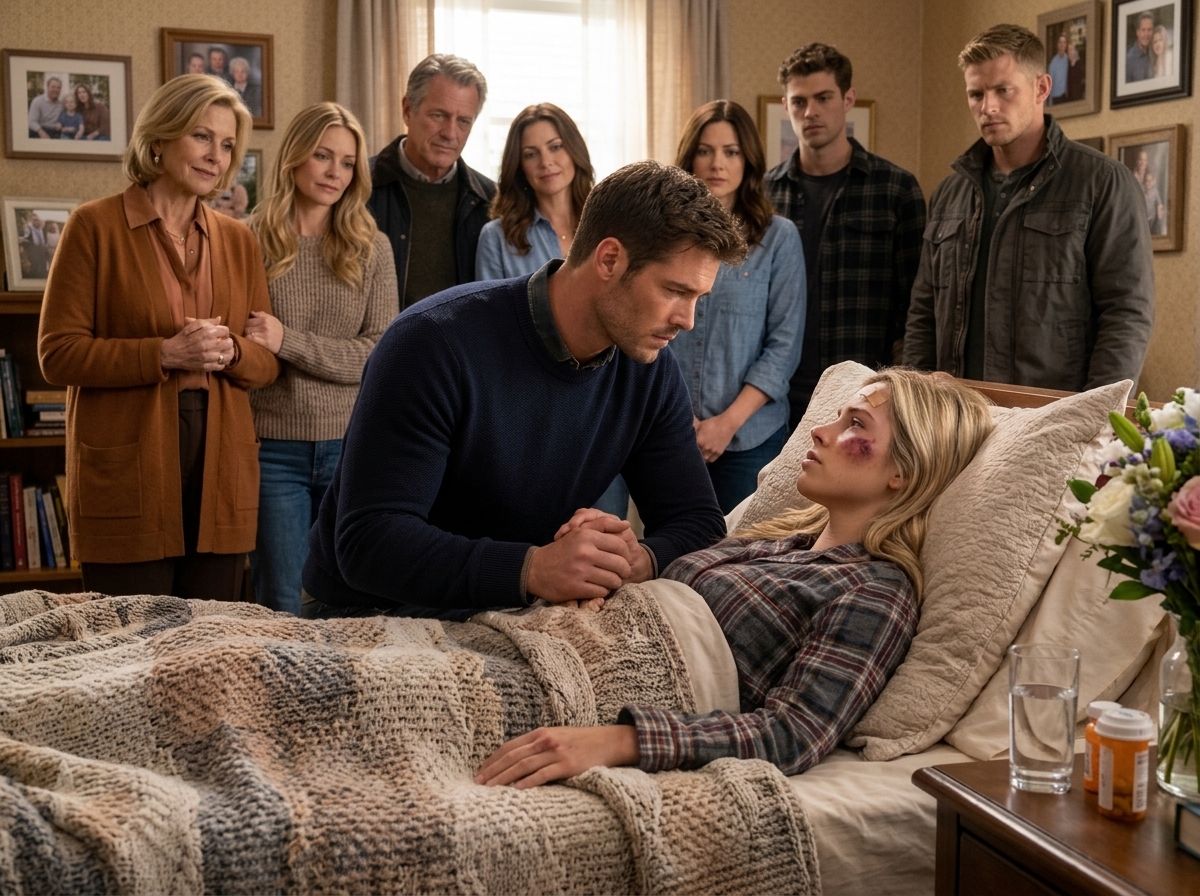
I stepped off a classified military transport and went straight to the ICU, where my wife lay with twenty-seven broken bones and a fractured skull. Outside her hospital room, her mother and six sisters were smiling like they were waiting for lunch. The detective assigned to her case leaned close and whispered, “Major, this family owns the whole county.” I looked through the glass at my wife’s battered, swollen face and answered, “Good. My authority reaches a lot farther than this county.”
My name is Grant Rowan.
For seven months, I’d been away on a classified Army mission, counting the days until I could get back to Evelyn. I’d imagined her waiting on our porch, pretending she hadn’t checked the driveway a hundred times.
Instead, my phone rang eleven hours before my plane was scheduled to land at Fort Liberty.
The nurse told me only one thing.
“Your wife is in intensive care. You need to come immediately.”
By the time I arrived at Hawthorne Regional, my boots were still covered in desert dust.
Dr. Walter Keene met me outside the secured ward.
“Your wife is alive,” he said carefully.
“What happened to her?”
“Twenty-seven fractures. Five ribs, both wrists, her left femur, and several bones in her face and skull. She also has internal bleeding and severe head trauma.”
The world around me seemed to shrink.
“How many people did this to her?”
“Her injuries suggest multiple attackers. It appears someone restrained her while another person caused most of the damage.”
“What weapon did they use?”
“Something heavy and made of metal. Possibly a fireplace tool or a framing hammer.”
Then I saw Evelyn.
Her face was so swollen I could barely recognize her. A section of her auburn hair had been shaved away, both wrists were secured in splints, and her damaged leg was held in traction.
I’d seen soldiers pulled from the wreckage of destroyed vehicles.
But nothing had prepared me to find my wife in that condition.
I gently placed my hand on her uninjured shoulder.
“Evelyn,” I whispered. “It’s Grant. I’m home.”
The ventilator was the only thing that answered.
Then I faced the hallway.
Margaret Shaw, Evelyn’s mother, sat beneath the bright fluorescent lights in a charcoal suit, pearls resting around her neck. All six of Evelyn’s sisters stood nearby: Meredith, Jocelyn, Paige, Laurel, Sabrina, and Faith.
The Shaw family controlled Shaw Aeronautics, a major defense contractor with political ties stretching across North Carolina.
But none of those women looked devastated.
Meredith was scrolling through her phone. Paige was laughing softly at something Sabrina had said. Margaret checked her watch.
Detective Harold Finch stood beside them.
I walked directly toward him.
“What happened at my house?”
“Burglary,” he said. “Your wife interrupted the intruders.”
“What was stolen?”
“Electronics. Some other valuables. Possibly cash.”
“How did they enter?”
“Through the back kitchen door.”
“Was there any sign of forced entry?”
He hesitated and briefly looked toward Margaret.
“We’re still investigating that.”
My stomach tightened.
“How long has her family been here?”
Finch lowered his voice. “They got here before the ambulance.”
I stared at him.
“How did they know?”
“I don’t know.”
He leaned closer.
“Major, you need to understand something. The Shaw family has enormous influence in this area. Police leadership, the district attorney, hospital administrators. Margaret practically funds half the county.”
“And?”
His eyes moved toward Evelyn’s room.
“Our hands are pretty much tied.”
I looked through the window at the narrow wound near Evelyn’s temple.
This wasn’t a random attack.
Someone had been deliberate.
Calculated.
Margaret approached me.
“Grant,” she said calmly, “our family will be handling Evelyn’s medical care from now on.”
“She’s my wife.”
“And you’re almost never here.”
Meredith stepped forward. “You’ve been gone seven months.”
“I was deployed.”
Margaret’s expression hardened. “Evelyn needed her family here with her.”
“She spent years trying to get away from this family.”
Silence followed.
I looked toward Faith.
She was the only sister who refused to meet my eyes.
She kept staring at the floor.
Her hands were shaking.
I stepped toward her.
“Faith, what happened in my house?”
Margaret instantly moved between us.
“You are not going to interrogate my daughter.”
I looked straight at her.
“Evelyn is your daughter, too.”
Margaret’s face went cold.
“She stopped being my daughter a long time ago.”
There it was.
Not quite a confession.
But close enough to make my blood run cold.
I leaned toward her.
“If Evelyn dies, there isn’t a corporation, political donor, courthouse, or security gate in this country that can protect the people responsible.”
Margaret gave a humorless laugh.
“Grant, you’re only one soldier.”
I glanced through the glass at my wife.
“No.”
Then I turned back and met Margaret’s eyes.
“I’m the husband none of you thought would make it home.”
They believed their money had already buried the truth.
But they had made two terrible mistakes.
Evelyn was still breathing.
And they’d let me come back.
Margaret’s smile vanished.
For a moment, no one spoke.
Then Meredith gave a sharp, dismissive laugh.
“Are you threatening us?”
I looked at her.
“No. I’m telling you that whatever happened to Evelyn is going to be investigated properly.”
Margaret folded her arms.
“You don’t get to march into our hospital and start issuing orders.”
“Our hospital?”
“My family has contributed millions to this institution.”
“Then I suggest you start remembering it’s a hospital, not one of your boardrooms.”
Her jaw tightened.
Behind her, Faith shifted uncomfortably.
I noticed something I hadn’t seen before.
There was a fresh cut across the knuckle of her right hand.
She caught me looking and immediately tucked both hands into her coat pockets.
Margaret noticed, too.
“Girls,” she said, “we’re leaving.”
“Not yet,” I answered.
Margaret turned.
“You have no authority to keep us here.”
“That’s true. But the detective might have a few questions.”
Finch looked as though he’d rather be anywhere else.
Margaret gave him a long, pointed stare.
“Detective, I believe we’ve already provided our statements.”
“Yes, ma’am.”
“Then there’s no reason for my daughters to remain.”
She walked away.
Five of the sisters followed immediately.
Faith lingered.
Just long enough to look over her shoulder.
Her lips moved.
I couldn’t hear the words.
But I understood the expression.
Fear.
Not the ordinary fear of someone whose sister was dying.
The fear of someone who knew exactly why.
I waited until the elevator doors closed.
Then I turned to Finch.
“How many interviews have you conducted?”
“Seven.”
“All separately?”
He hesitated.
“Initially, they were together.”
“And their statements?”
“Consistent.”
“Seven witnesses telling exactly the same story?”
His expression changed.
“They were pretty consistent, yes.”
“Detective, when seven people tell precisely the same story about something they supposedly didn’t witness, that doesn’t make me comfortable.”
He said nothing.
“Who processed the house?”
“County crime scene unit.”
“Who collected the physical evidence?”
“Same team.”
“Who authorized the burglary classification?”
Finch looked toward the empty elevator.
“Chief Daniel Mercer.”
I studied him.
“Did you believe it was a burglary?”
His eyes met mine.
For the first time, I saw something beneath his professional caution.
Shame.
“No, Major.”
“Then why is that what I’m being told?”
“Because the evidence didn’t fit the official version, and people above me decided the official version was the one we’d use.”
I felt my pulse slow.
That was how it happened when anger became something more useful.
I stopped thinking about Margaret’s face.
I started thinking about evidence.
“Tell me what didn’t fit.”
Finch glanced toward the nurses’ station.
“Not here.”
He handed me a business card.
On the back, he’d written a phone number.
“That’s my personal cell.”
“Are you willing to put what you know in writing?”
He swallowed.
“If I can be certain it won’t disappear into Mercer’s office.”
“I can’t promise you protection from every consequence.”
“I know.”
“But I can promise I’ll make sure the truth reaches someone outside this county.”
He nodded once.
Then he walked away.
I returned to Evelyn’s bedside.
Her breathing was controlled by the ventilator. Purple bruising covered one side of her face, and beneath the hospital sheets lay injuries that would take months, perhaps years, to heal.
I pulled a chair close.
“Sweetheart, I need you to do one thing for me.”
I brushed a loose strand of hair from her forehead.
“Stay.”
My voice cracked.
“Just stay.”
For seven months, I’d survived dangerous assignments by refusing to imagine the worst.
Now the worst was lying three feet away.
And I couldn’t protect her from pain.
I couldn’t even make her open her eyes.
I stayed beside her until Dr. Keene returned.
“Major Rowan, may I speak with you?”
We stepped into the corridor.
“There’s something I need to clarify about your wife’s injuries.”
“What?”
“The fractures aren’t all consistent with a single episode of violence.”
I stared at him.
“What does that mean?”
“Some injuries appear to have occurred earlier than others. There’s evidence of healing in two ribs and a fracture in her right hand.”
“How much earlier?”
“I can’t give you a precise timeline without further imaging and review. But we’re concerned she may have suffered injuries before the incident that brought her here.”
My chest tightened.
Evelyn had been hurt before.
And she’d never told me.
I remembered our last video call.
She’d been wearing a long-sleeved sweater despite the unusually warm weather.
I’d asked if she was feeling all right.
She’d smiled.
“Just tired, Grant. You worry too much.”
I had believed her.
“Doctor, has anyone documented those findings?”
“Yes.”
“Please make sure they’re preserved in her medical record.”
“They will be.”
He paused.
“There’s something else. Your mother-in-law contacted hospital administration this morning.”
“About what?”
“She requested that you be excluded from certain treatment discussions.”
I almost laughed.
“On what grounds?”
“She claimed your classified assignment made you emotionally unstable and unavailable to make decisions.”
I stared at him.
“Did anyone approve that?”
“No. You’re her spouse, and we have no legal basis to disregard you. I wanted you to know.”
“Thank you.”
Dr. Keene lowered his voice.
“Major, I’ve treated assault victims for twenty-six years. Your wife’s injuries trouble me.”
“They trouble me, too.”
“No. I mean the pattern.”
He took a careful breath.
“Someone spent time doing this.”
That sentence stayed with me long after he returned to the ward.
Someone spent time doing this.
Not a burglar surprised in a hallway.
Not a panicked intruder.
Someone who had wanted Evelyn to suffer.
My phone vibrated.
A message from an unfamiliar number.
Don’t trust the security footage. Ask about the fireplace.
I stared at the screen.
Then another message arrived.
And don’t let them take her home.
I called immediately.
No answer.
I tried again.
The phone was switched off.
But I didn’t need anyone to explain the reference to the fireplace.
Dr. Keene had mentioned a heavy metal weapon.
Possibly a fireplace tool.
Evelyn and I had a fireplace in our living room.
An old stone hearth she’d insisted on keeping when we renovated the house.
Beside it stood a black iron set of tools.
Poker.
Brush.
Shovel.
Tongs.
A wedding gift from Margaret Shaw.
I stood.
For the first time since entering the hospital, I knew exactly where I needed to go.
But I wasn’t going alone.
I called Finch.
“Detective, I need you to meet me at my house.”
“Major, Mercer ordered the scene released yesterday.”
“Then someone made a terrible mistake.”
“The cleaning crew’s already been scheduled.”
“What cleaning crew?”
There was a pause.
“Shaw Aeronautics contracted a private restoration company.”
“When?”
“Tomorrow morning.”
I checked the time.
It was almost midnight.
“Then we have a few hours.”
“Major, you can’t disturb a released crime scene and expect anything you find to be admissible.”
“I’m not touching anything. I’m asking you to document what you observe and help request an independent examination.”
He was quiet.
Then he said, “Give me twenty minutes.”
The house looked exactly as I’d remembered.
White siding.
Blue shutters.
Two rocking chairs on the porch.
Evelyn’s small ceramic flowerpots lined the front steps.
One had fallen over.
The dead stems spilled across the concrete.
I stood at the end of the driveway, staring at the place I’d spent seven months dreaming about.
Every window was dark.
Every familiar detail felt wrong.
Finch arrived in an unmarked sedan.
He carried a flashlight, a camera, and an expression that told me he’d already made a decision about his career.
“I requested emergency assistance from the state investigative bureau,” he said.
“Response?”
“They want an explanation for why the county’s burglary investigation needs outside supervision.”
“And?”
“I told them I suspected the evidence had been mishandled.”
“Good.”
He held up one hand.
“We can examine what remains visible, but I’m not collecting anything without proper authority.”
“Understood.”
We approached the back door.
The lock was intact.
No splintered wood.
No broken glass.
No pry marks.
Finch photographed it.
“The official report says the intruders entered here,” he muttered.
“Who reported that?”
“Margaret Shaw.”
I turned toward him.
“She wasn’t supposed to be here.”
“I know.”
“Then how did she know where the intruders entered?”
He didn’t answer.
Inside, the house smelled faintly of bleach.
That bothered me more than the overturned furniture.
Blood had been cleaned from the living room floor.
The cushions had been replaced.
Someone had swept broken glass from the hearth.
And the fireplace tools were gone.
All of them.
I stood staring at the empty iron stand.
Finch followed my gaze.
“What?”
“My wife kept four tools here.”
He photographed the stand.
“Could they have been taken as evidence?”
“Check the inventory.”
He pulled out his phone and opened a document.
His expression hardened.
“No fireplace tools listed.”
“Then someone removed them.”
I walked toward the kitchen, careful not to touch the disturbed surfaces.
One of Evelyn’s favorite coffee mugs sat upside down beside the sink.
A pale yellow mug with the words HOME IS WHERE WE FIND EACH OTHER printed across the side.
I’d bought it for her at a roadside shop in Tennessee.
Something about seeing that ordinary object nearly destroyed me.
I gripped the edge of the doorway.
Then I noticed the refrigerator.
A photograph was missing.
Not just any photograph.
Our wedding picture.
It had always hung beside the calendar.
Evelyn in a cream-colored dress.
Me in uniform.
Her father standing between us, one hand resting proudly on her shoulder.
Richard Shaw had died three years earlier.
He’d been the only member of her family who consistently treated our marriage with respect.
Margaret never forgave him for it.
I turned to Finch.
“Has anyone interviewed the family attorney?”
“Why?”
“Because Richard Shaw left Evelyn an inheritance Margaret wasn’t happy about.”
Finch frowned.
“What kind of inheritance?”
“Shares in Shaw Aeronautics.”
His flashlight lowered.
“How many?”
“Enough to give her a meaningful vote.”
I paused.
“Possibly enough to prevent Margaret from making certain decisions.”
Finch looked around the spotless room.
“That sounds like motive.”
“It sounds like something worth investigating.”
My phone rang.
The number was blocked.
I answered.
“Grant Rowan.”
A woman whispered, “You shouldn’t be there.”
“Who is this?”
“Leave the house.”
“Faith?”
A sharp breath.
“Please.”
“Tell me what happened.”
“I can’t.”
“Faith, your sister is fighting for her life.”
A faint sob came through the receiver.
“I know.”
“Then help her.”
There was silence.
Then she said something that made every muscle in my body tighten.
“Mom didn’t think you’d come home.”
The line disconnected.
I stood motionless.
Finch watched me.
“Who was that?”
“Faith.”
“What did she say?”
I repeated the words.
He took out his notebook.
This time, he wrote down every one.
We left the house without disturbing anything further.
At 2:17 in the morning, Finch called.
The state investigators had agreed to review his concerns and seek the necessary warrants.
By sunrise, the restoration company’s access had been suspended.
And by eight, Margaret Shaw knew someone had interfered with her plans.
She called me.
“Grant, what exactly do you think you’re doing?”
I sat beside Evelyn’s hospital bed.
“Having the evidence independently examined.”
“You have no idea what you’re dealing with.”
“Then explain it.”
“You are jeopardizing an important business transaction.”
I looked at Evelyn.
There it was.
Not concern for her daughter’s life.
Not grief.
A transaction.
“What does Shaw Aeronautics have to do with my wife being beaten nearly to death?”
Margaret went silent.
Then she said, “You should be very careful about the accusations you’re making.”
“I haven’t made one.”
“You’re implying—”
“I’m asking questions.”
“Questions have consequences.”
“So do answers.”
She hung up.
An hour later, my commanding officer called.
Colonel Nathan Brooks had known me for eleven years.
He didn’t waste time.
“Grant, I understand you’re dealing with a serious family emergency.”
“Yes, sir.”
“I’m sorry about Evelyn.”
“Thank you.”
“I also understand someone contacted the installation claiming you’ve been making threats against civilians.”
I closed my eyes.
“Margaret Shaw.”
“Her attorney, actually.”
“Of course.”
“I’ve reviewed the complaint. I need you to stay clear of anything that could be interpreted as using military authority in a private dispute.”
“Understood.”
Brooks paused.
“That doesn’t mean you have to stop seeking justice.”
“I know, sir.”
“And it doesn’t mean we’re ignoring the possibility of criminal conduct involving a defense contractor.”
I sat straighter.
“What have you heard?”
“Shaw Aeronautics is under contract review regarding irregular procurement disclosures. That’s all I’m authorized to tell you.”
He let the words settle.
“Don’t confuse your position as Evelyn’s husband with your position as an Army major. The first gives you every reason to fight for her. The second gives you responsibilities you can’t set aside.”
“I understand.”
“Good. Take your emergency leave. Let the investigators do their jobs.”
When the call ended, I understood something Margaret didn’t.
My rank wasn’t going to save Evelyn.
My rank couldn’t authorize an arrest or erase the Shaw family’s influence.
But my years of service had taught me to recognize compromised systems, document what could be proved, and build a case strong enough to survive pressure.
I didn’t need to outrank Margaret.
I needed the truth.
And I needed people willing to put their names beside it.
Three days later, the first real breakthrough came.
Finch met me in the hospital cafeteria.
He looked exhausted.
“State investigators found something.”
“What?”
“Your neighbor has security cameras.”
“Mrs. Hensley?”
He nodded.
“She’s eighty-four. Apparently, the county officers never asked her for footage.”
I stared.
“You’re kidding.”
“She was visiting her son when it happened. Her system uploads recordings automatically.”
“What did it show?”
Finch slid a photograph across the table.
A black SUV parked outside my house.
Its license plate was visible.
I recognized the vehicle.
Margaret’s personal SUV.
“Time stamp?” I asked.
“9:43 p.m. The night Evelyn was attacked.”
“Who was inside?”
“Margaret and three of her daughters.”
My hands curled into fists.
“Which three?”
“Meredith. Paige. Sabrina.”
I stared at the photograph.
“How long were they there?”
“Forty-seven minutes.”
“And Evelyn?”
“Her emergency call came at 10:39.”
I looked up.
“Twenty minutes after they left.”
“Approximately.”
“Where was she when the ambulance arrived?”
“Living room floor.”
“Who called for help?”
Finch hesitated.
“Faith Shaw.”
I went still.
“Faith wasn’t in the SUV?”
“No.”
“Then how did she know?”
“That’s what we’re trying to determine.”
He pulled out another photograph.
This one showed a dark sedan arriving at 10:31.
Faith’s car.
She’d been inside the house for approximately eight minutes before calling emergency services.
“Was she trying to help?”
“We don’t know yet.”
“What else?”
“The original county report lists no blood evidence on the fireplace stand.”
I leaned forward.
“But?”
“State technicians found traces in the lower joint. Someone cleaned the visible surfaces and missed a narrow seam.”
“Evelyn’s blood?”
“The preliminary testing is consistent. Confirmation is pending.”
I stared down at the photograph.
For the first time, the evidence was beginning to tell its own story.
Then Finch gave me the detail that changed everything.
“Your wife made a phone call at 9:17 that night.”
“To whom?”
“Her attorney.”
I frowned.
“Evelyn has an attorney?”
“Apparently, she hired one six weeks ago.”
“Why?”
Finch looked directly at me.
“She was preparing to challenge a proposed corporate sale.”
For several seconds, I couldn’t speak.
Evelyn had never liked the family business.
She’d inherited shares after her father’s death, but she’d always said she wanted as little involvement as possible.
Yet apparently, something had changed.
Something important enough that she’d hired an attorney without telling me.
“Who is the lawyer?”
“Rebecca Lawson. Raleigh.”
“Has she been contacted?”
“State investigators are speaking with her.”
“Can I talk to her?”
“That’s her decision.”
That afternoon, Rebecca Lawson called me herself.
Her voice was steady and professional.
“Major Rowan, I represent your wife in a corporate matter. I understand she’s still unconscious.”
“Yes.”
“I’m very sorry.”
“What was she working on?”
Rebecca paused.
“Some of what Evelyn shared with me is privileged. I can explain the public corporate context, and I’ll cooperate with investigators through the appropriate process.”
“Please.”
“Shaw Aeronautics has been negotiating a sale of one of its manufacturing divisions.”
“To whom?”
“A private investment group.”
“Why would Evelyn object?”
“She believed the proposed valuation concealed serious liabilities. She was also concerned that certain financial disclosures to federal contracting agencies were inaccurate.”
My throat tightened.
“Did she have evidence?”
“She believed she did.”
“Where is it?”
“That’s a question the investigators are now examining.”
I stared at the hospital window.
“Did Margaret know Evelyn was challenging the sale?”
“Yes.”
“How?”
“Your wife sent a formal objection through counsel two days before the attack.”
I shut my eyes.
Two days.
Margaret had received that objection.
And two days later, Evelyn was in intensive care.
Rebecca continued.
“Major, there’s another thing you need to understand. The voting agreement governing Richard Shaw’s shares requires Evelyn’s consent for certain transfers. Margaret can’t simply override it.”
“What if Evelyn is incapacitated?”
“The company may attempt to delay matters or seek court intervention, but incapacity doesn’t automatically transfer Evelyn’s voting rights to her mother.”
“Then Margaret’s plan wouldn’t work.”
“Not legally, no.”
I thought about the request to exclude me from medical decisions.
The attempt to remove Evelyn from the hospital.
The rushed cleaning of our house.
“Rebecca, what happens if Evelyn dies?”
Her voice became quieter.
“That depends on her estate documents and the company’s shareholder agreements. I won’t speculate about inheritance.”
I appreciated the answer.
It was the first one I’d heard in days that didn’t pretend uncertainty was certainty.
When we disconnected, I returned to Evelyn’s room.
Her condition remained critical but stable.
I sat beside her and took her hand.
“You were fighting them, weren’t you?”
The ventilator hissed.
“You knew what they were doing.”
I looked at her battered face.
“And you were trying to stop it.”
I felt an ache deeper than anger.
For seven months, I’d thought my greatest responsibility was getting home.
I’d never considered that Evelyn might have been fighting her own battle while I was away.
That evening, the ICU doors opened.
Faith Shaw stood in the doorway.
She looked terrible.
Her hair was tied into a messy knot. Dark circles shadowed her eyes, and the cut across her knuckle had begun to heal.
I stood.
She flinched.
“I’m not going to hurt you,” I said.
Tears filled her eyes.
“I know.”
“Then tell me the truth.”
She looked past me toward Evelyn.
“Can I see her?”
I stepped aside.
Faith approached the bed slowly.
When she saw her sister’s face, she covered her mouth.
“Oh, Evie.”
She started crying.
Not politely.
Not quietly.
Her shoulders shook as she gripped the bed rail.
“I’m sorry.”
I waited.
For several minutes, she couldn’t speak.
Then she turned toward me.
“Mom said Evelyn was destroying everything Dad built.”
“What did she mean?”
“She said the company was going to collapse if the sale didn’t happen.”
“And Evelyn refused to approve it?”
Faith nodded.
“She’d found something. Documents. Payments. Contracts that didn’t match the reports.”
“What happened the night she was attacked?”
Faith’s face went pale.
“Mom called a family meeting at your house.”
“Who came?”
“Mom, Meredith, Paige, and Sabrina.”
“Why not the others?”
“Jocelyn and Laurel were out of town. I refused to go.”
“Why?”
“Because I’d already heard what Mom wanted.”
My stomach tightened.
“What did she want?”
“She wanted Evelyn frightened enough to sign.”
I stared at her.
“Sign what?”
“An agreement withdrawing her objection. Mom said she only needed to teach Evelyn what happened when she turned against the family.”
Faith’s voice broke.
“I thought she’d scream at her. Threaten her. I didn’t think…”
She looked toward Evelyn.
“I didn’t think they’d do this.”
“How did you know she was hurt?”
“Meredith called me.”
“What did she say?”
“That Evelyn had fallen.”
I said nothing.
Faith wiped her cheeks.
“She told me to come over and help clean up before the police arrived.”
My pulse hammered.
“And when you got there?”
“Evelyn was on the floor.”
Faith began trembling.
“She was barely breathing. There was blood everywhere. Meredith kept saying it wasn’t supposed to go this far.”
“What did you do?”
“I called an ambulance.”
“Did they try to stop you?”
“Yes.”
“Who?”
“Mom.”
The room seemed to tilt.
Faith stared at the floor.
“She said we needed to get our stories straight first.”
For a moment, I couldn’t draw a full breath.
My wife had been dying on the floor.
And Margaret Shaw had wanted to rehearse a lie.
Faith continued.
“Mom said if I called the police before we agreed on what happened, I’d destroy the entire family.”
“Did you call the police?”
“I called 911. I told them Evelyn had been attacked.”
“Why did you tell the detective it was a burglary?”
Faith looked at me with absolute misery.
“Because by then, Mom had already spoken to Chief Mercer.”
I felt sick.
“Faith, you need to tell the state investigators everything.”
“I know.”
“Not just me.”
“I already contacted them.”
I stared at her.
“Before you came here?”
She nodded.
“They told me to come in tomorrow morning with an attorney.”
“Good.”
She reached into her purse.
Then stopped.
“I have something else.”
“What?”
She removed a small envelope.
Inside was a printed photograph of a black iron fireplace poker.
Its pointed end was bent.
There were dark stains along the shaft.
“Where did you get this?”
“Meredith sent it to me after the attack.”
“Why?”
“She wanted me to find out whether the stains could be removed without damaging the finish.”
I looked at her.
“Do you still have the original message?”
“Yes.”
“Don’t delete it. Give it to investigators with your phone.”
Faith nodded.
“Do you know where the poker is now?”
She looked toward the door.
“Mom’s lake house.”
I didn’t move.
I didn’t speak.
I simply stared at the photograph.
The weapon that might have shattered my wife’s bones was sitting in a house owned by the woman who’d called me one soldier.
Faith touched my arm.
“Grant, there’s something you need to know.”
I looked at her.
“Mom doesn’t think she did anything wrong.”
The words didn’t surprise me.
But the next ones did.
“She says Evelyn made her choose between her daughter and the company.”
Faith began crying again.
“And she chose the company.”
I walked her to the nurses’ station and asked security to make sure she could leave without interference.
Then I called Finch.
He answered on the second ring.
“Major?”
“Faith is cooperating.”
“I know. State investigators contacted me.”
“She has photographs and messages.”
“We’ll preserve them.”
“She says the weapon is at Margaret’s lake house.”
There was silence.
Then Finch said, “Don’t go there.”
“I wasn’t planning to.”
“Good. Let us get a warrant.”
“Detective?”
“Yes?”
“Make it count.”
“We intend to.”
Two days later, the state investigators searched Margaret’s lake house.
They recovered three fireplace tools wrapped in a contractor’s tarp and hidden inside a locked storage cabinet.
One was bent.
The investigators also seized cleaning supplies, electronic devices, business records, and financial documents pursuant to their warrants.
The medical examiners and forensic specialists began comparing the recovered objects with Evelyn’s injuries.
And for the first time, the Shaw family’s carefully arranged story began collapsing in public.
Meredith hired a criminal defense attorney.
Paige stopped answering investigators’ calls.
Sabrina attempted to leave the state but was located and served with a subpoena.
Margaret issued a statement through the family’s public relations firm.
The allegations being circulated are malicious and unfounded. Our family remains focused on Evelyn’s recovery during this difficult time.
I read the statement beside my wife’s bed.
Then I turned off my phone.
I was tired of hearing Margaret talk about family.
A family didn’t leave someone bleeding on a floor.
A family didn’t erase evidence.
A family didn’t choose stock prices over a daughter’s life.
On the sixth morning after my return, Evelyn moved.
It was almost nothing.
A slight pressure against my fingers.
I looked down.
“Evelyn?”
Her hand moved again.
I stood so quickly my chair scraped across the floor.
“Nurse!”
Within seconds, the room filled with medical staff.
Dr. Keene examined her pupils, checked her responses, and asked her to squeeze his hand.
She did.
Weakly.
But she did.
I had faced things in my military career that I still couldn’t discuss.
I’d endured sleepless nights, terrible losses, and the kind of fear that left a permanent mark.
Nothing had ever made my knees feel as weak as that small movement.
Dr. Keene looked at me.
“She’s responding purposefully. That’s encouraging.”
“Is she waking up?”
“She’s showing signs of improvement, but recovery from this kind of trauma is unpredictable. We need to proceed carefully.”
I nodded.
I would have accepted anything.
One movement.
One breath.
One more day.
Over the next several days, Evelyn gradually became more responsive.
Her doctors reduced her sedation.
She began opening her eyes.
Eventually, she was able to follow simple commands.
When the breathing tube was removed, her first attempts to speak were little more than hoarse whispers.
I leaned close.
“Don’t try to talk, sweetheart.”
She looked at me.
For several seconds, confusion clouded her face.
Then recognition appeared.
“Grant?”
My throat closed.
“Yeah.”
I touched her cheek as gently as I could.
“I’m here.”
Her eyes filled with tears.
“You came home.”
I tried to smile.
“Of course I did.”
She looked frightened.
Her gaze moved toward the door.
“Mom…”
“I know.”
Her breathing quickened.
I squeezed her hand.
“She’s not coming in here.”
“She…”
“You’re safe right now, Evelyn.”
Her lips trembled.
“Meredith…”
I called for the nurse.
Dr. Keene had warned me not to pressure her into recounting the attack while she was medically fragile.
So I didn’t.
I just stayed.
But when she finally drifted back to sleep, I stepped into the hallway and cried for the first time since arriving.
Not because I’d given up.
Because I’d spent so many days imagining I’d never hear her voice again.
The following afternoon, state investigator Laura Bennett arrived with a victim advocate.
She was in her forties, direct, and careful with her words.
“We’d like to speak with Evelyn when her physicians consider her ready.”
“She tried to tell me something.”
“What did she say?”
I explained.
Bennett listened without interrupting.
“Don’t question her further about the incident,” she said. “The last thing we want is to unintentionally influence her recollection.”
“I understand.”
She glanced toward the ICU.
“Major, we’ve developed substantial evidence. Your wife’s testimony matters, but the case won’t depend entirely on her memory.”
“Good.”
“There’s something else.”
She opened a folder.
“The financial investigation has uncovered communications between Margaret Shaw and Chief Mercer.”
“What kind of communications?”
“Records indicating Mercer received financial benefits connected to a consulting arrangement with a Shaw-affiliated company.”
I stared at her.
“Was he being paid to protect them?”
“That’s one of the questions investigators are examining.”
“And the burglary report?”
“We have evidence that Mercer intervened in how the case was classified.”
I thought of Finch standing helplessly in the hallway.
“Our hands are pretty much tied.
He hadn’t been imagining it.
The corruption was real.
“What’s happening to Mercer?”
“He’s been placed on administrative leave pending further proceedings.”
“And Margaret?”
Bennett closed the folder.
“We’re building the case. I know that’s difficult to hear.”
I looked toward Evelyn’s room.
“She’s been lying in there with twenty-seven broken bones.”
“I know.”
“Every day those people remain free feels wrong.”
Bennett’s expression softened slightly.
“I understand your anger. But if we rush and compromise the evidence, we risk losing the case. We’re not going to let that happen.”
I nodded.
That was a harder kind of patience than I’d ever learned in uniform.
Waiting while people did the right thing.
Trusting a process I couldn’t control.
And accepting that my anger didn’t make the evidence move faster.
Three days later, Evelyn was strong enough for a brief recorded interview.
She asked me to sit beside her.
Bennett agreed, provided I remained silent.
Evelyn’s voice was fragile.
But her words were clear.
“Mom came because I wouldn’t sign.”
Bennett nodded.
“What did she want you to sign?”
“A withdrawal of my objection to the sale. And a statement that the financial records I’d found were mistaken.”
“Did you agree?”
“No.”
“What happened next?”
Evelyn closed her eyes.
“She said I was humiliating the family.”
Her hand tightened around mine.
“Meredith took my phone. Paige blocked the hallway. Sabrina stood by the back door.”
“Did someone restrain you?”
Evelyn nodded.
“Meredith grabbed my arms.”
I felt my stomach twist.
Bennett continued gently.
“Who struck you?”
Evelyn began shaking.
I wanted to tell her to stop.
To spare her another second.
But she looked at me.
And I understood that she wanted to finish.
“Mom hit me first.”
The room went still.
“With what?”
“The fireplace poker.”
Evelyn swallowed.
“She hit my leg because I tried to run.”
Tears slid down her cheeks.
“Then Meredith and Paige held me down.”
I couldn’t move.
Couldn’t breathe.
My wife continued.
“Mom kept asking if I would sign.”
Bennett’s voice remained steady.
“What did you tell her?”
“I told her I wouldn’t help them steal from the company.”
Evelyn stared at the ceiling.
“She said I should have listened to my father when he told me not to marry a soldier.”
I felt her fingers tighten.
“But Dad never said that.”
A tear ran toward her ear.
“He loved you, Grant.”
I lowered my head.
“I know.”
Bennett allowed her a moment.
“Do you remember how the assault ended?”
Evelyn’s eyes filled with fear.
“Meredith said she’d stopped breathing.”
My heart seemed to stop.
“Mom told them to let go.”
She closed her eyes.
“I remember hearing Sabrina crying.”
A pause.
“Then Mom said they needed to make it look like someone broke in.”
No one spoke.
Finally, Bennett asked one last question.
“Why didn’t you tell your husband about the earlier injuries?”
Evelyn looked at me.
I felt the answer coming before she spoke.
“Because I thought I could fix it.”
She began crying.
“I didn’t want him to come home and lose everything he’d worked for.”
I leaned forward.
“Evelyn—”
Bennett gently raised her hand.
I fell silent.
Evelyn continued.
“Mom had been threatening me for months. She said if I exposed the contracts, she’d tell the Army Grant had leaked classified information to me.”
I stared at her.
“What?”
“She said she could ruin his career.”
Her voice broke.
“And I believed her.”
The interview ended shortly afterward.
Dr. Keene insisted she rest.
Once the investigators left, I stayed beside her.
For a long time, neither of us spoke.
Then Evelyn whispered, “I was scared.”
I leaned close.
“Of Margaret?”
She shook her head.
“Of what she’d do to you.”
I felt something inside me break.
“Evelyn, look at me.”
She did.
“You never had to protect my career at the cost of your life.”
Her tears started again.
“I thought if I could just get the evidence to the right people…”
“You were trying to do the right thing.”
“I should have told you.”
“Yes,” I whispered. “I wish you had.”
I swallowed.
“But I should have noticed how frightened you were.”
She shook her head.
“Grant…”
“I was so focused on getting home that I convinced myself everything here was fine.”
She squeezed my fingers.
“You couldn’t have known.”
“Maybe not.”
I kissed her hand.
“But we’re not going to carry this alone anymore.”
She closed her eyes.
“Promise?”
“I promise.”
The arrests began the following morning.
Margaret Shaw was taken into custody at her corporate headquarters.
Meredith was arrested at her attorney’s office.
Paige surrendered later that afternoon.
Sabrina was charged in connection with her role in the assault and the alleged effort to conceal evidence.
Additional charges followed as the investigation expanded.
Chief Mercer was arrested weeks later in connection with obstruction and corruption allegations.
The criminal cases remained separate from the ongoing examination of Shaw Aeronautics’ federal contracts.
No military officer appeared to seize control of the courthouse.
No secret commandos surrounded the Shaw estate.
There was no dramatic midnight raid ordered by me.
Instead, warrants were signed.
Evidence was cataloged.
Witnesses gave sworn statements.
Attorneys filed motions.
And the machinery Margaret believed she controlled began working without her permission.
The first time I saw her after the arrest was at a preliminary hearing.
She wore a dark blue suit.
Her hair was perfect.
Her pearls were still around her neck.
Even with restraints at her wrists, Margaret looked as though she expected the room to stand when she entered.
Her attorney whispered something to her.
She nodded.
Then she saw me.
For the first time since I’d returned home, her expression changed.
Not dramatically.
Just enough.
A flicker of uncertainty.
I sat in the second row beside Faith.
Evelyn was still hospitalized and unable to attend.
Margaret stared at us.
Faith lowered her eyes.
I didn’t.
The prosecutor presented evidence supporting the charges.
The neighbor’s security footage.
Phone records.
Forensic findings.
Faith’s preserved messages.
Evelyn’s recorded account.
And testimony concerning the attempted removal and destruction of evidence.
Margaret’s attorney argued that the accusations were unreliable, the family’s statements had been misunderstood, and no evidence established that Margaret intended to cause life-threatening harm.
The judge listened.
Then denied the defense request to dismiss the most serious charges at that stage.
Margaret turned toward me as officers prepared to escort her out.
“You’ve destroyed this family.”
I stood.
“No, Margaret.”
She stared.
“You did that when Evelyn said no.”
Her face hardened.
“Everything I did was for our family.”
I looked at the woman who’d raised seven daughters and apparently never understood the meaning of the word.
“Then you should have protected one.”
She was led away before she could answer.
For months afterward, Evelyn’s recovery consumed our lives.
There were surgeries.
Painful physical therapy sessions.
Headaches that lasted for hours.
Nights when she woke shaking because she dreamed she was still on the living room floor.
Some days she could stand with assistance.
Other days, even sitting upright exhausted her.
Her doctors warned that some injuries might leave permanent limitations.
I stopped measuring progress in distances and deadlines.
One day, success meant she could hold a spoon without help.
Another day, it meant walking six steps between parallel bars.
I learned how to support her injured leg.
How to help without making her feel helpless.
How to listen when she was angry.
Especially when she was angry.
One afternoon, she threw a folded towel onto the floor after failing to lift her left foot onto a rehabilitation step.
“I hate this!”
I crouched beside her.
“I know.”
“No, you don’t.”
She looked at me, furious and crying.
“You get to walk out of here whenever you want. I have to ask someone to help me get to the bathroom.”
I didn’t try to correct her.
Didn’t tell her to be grateful she was alive.
I just sat on the floor.
“You’re right.”
She stared at me.
“I don’t know exactly how it feels.”
Her shoulders sagged.
“But I’m here.”
She started crying harder.
“I used to run five miles before breakfast.”
“I remember.”
“I don’t even know if I’ll ever run again.”
I put my hand over hers.
“I don’t know either.”
She looked away.
“I hate not knowing.”
“So do I.”
We stayed there until she was ready to try again.
The physical therapist came back.
Evelyn gripped the bars.
Lifted her injured leg.
And stepped forward.
One step.
Then another.
I had never been prouder of anyone.
Not even myself.
By the following spring, the criminal proceedings had reached their decisive stage.
Paige and Sabrina entered negotiated guilty pleas and agreed to testify truthfully about the attack and subsequent concealment efforts.
Their testimony confirmed that Margaret had organized the confrontation, brought documents for Evelyn to sign, and directed her daughters to prevent Evelyn from leaving before she complied.
Meredith had helped restrain Evelyn and had participated directly in the assault.
Faith testified about the call she received afterward, what she saw when she arrived, and the attempt to delay emergency assistance.
The prosecution also presented corroborating physical and digital evidence.
Margaret maintained her innocence.
During the trial, her defense tried to portray Evelyn as a troubled daughter who had turned against the family business.
They suggested the injuries had resulted from a confrontation that escalated unexpectedly.
But the evidence told a different story.
It showed repeated threats.
Earlier violence.
A planned meeting.
A weapon.
An effort to force signatures.
And a deliberate attempt to conceal what happened afterward.
The most difficult day came when Evelyn testified.
She walked into the courtroom using a cane.
I stayed beside her until she reached the witness stand.
Her left leg still troubled her.
A faint scar ran along her hairline.
And sometimes, when she was tired, she struggled to find the words she wanted.
But she looked directly at the jury.
She told them about discovering financial irregularities in the proposed corporate transaction.
About refusing to withdraw her objection.
About months of threats.
And about the night her mother came to our home.
The defense attorney approached her carefully.
“Mrs. Rowan, isn’t it true you and your mother had disagreed for years?”
“Yes.”
“And isn’t it true you resented her control over the family company?”
“I disagreed with some of her decisions.”
“Would you describe your relationship as hostile?”
Evelyn thought for a moment.
“I’d describe it as frightening.”
The courtroom went quiet.
The attorney glanced at his notes.
“You understood that blocking the sale could cause serious financial harm to your family’s company?”
“Yes.”
“And you proceeded anyway?”
Evelyn nodded.
“Because I believed the financial information being used to justify it was false.”
The attorney continued.
“You were willing to put your family’s entire legacy at risk?”
Evelyn looked toward Margaret.
Then she answered.
“My father built that company with people who trusted him. I wasn’t willing to let my family use his name to deceive them.”
For the first time, Margaret looked away.
Evelyn continued.
“My mother kept telling me loyalty meant doing what she wanted.”
Her voice trembled, but she didn’t stop.
“I thought loyalty meant refusing to help someone do something wrong.”
I felt my eyes burn.
Evelyn looked back at the jury.
“I loved my mother. I spent most of my life wanting her to love me back.”
A tear slid down her cheek.
“But loving someone doesn’t mean giving them permission to hurt you.”
No one moved.
Then she said the sentence I would remember for the rest of my life.
“I survived what she did to me. But I shouldn’t have had to survive my own mother.”
The jury returned its verdict after two days of deliberation.
Margaret Shaw was found guilty of the principal assault charges and related offenses arising from the attempted coercion and concealment.
Meredith was also convicted.
Their sentences were substantial.
The court imposed prison terms reflecting the severity of Evelyn’s injuries and the deliberate nature of the attack.
Paige and Sabrina received lesser sentences under their plea agreements, though neither escaped criminal punishment.
Chief Mercer’s separate case resulted in a conviction for his role in obstructing the investigation.
Shaw Aeronautics underwent new management and a major independent review. The corporate inquiry uncovered misconduct that led to financial penalties, contract consequences, and further civil proceedings.
Evelyn worked with independent counsel to protect her ownership interests and ensure the company’s future decisions were subject to legitimate oversight.
She didn’t want revenge against the employees who’d spent their lives building aircraft components.
She wanted them to have a company worth working for.
And she wanted her father’s name to mean something better than it had under Margaret.
Several months after the sentencing, Faith came to our house.
It was the first time we’d invited any member of Evelyn’s family inside since the attack.
She stood awkwardly on the porch holding a small pot of white flowers.
Evelyn opened the door herself.
For a moment, neither sister spoke.
Then Faith began crying.
“I didn’t know if you’d want to see me.”
Evelyn looked at the flowers.
“Are those for me?”
Faith nodded.
“They’re the ones Dad used to plant by the back fence.”
Evelyn took the pot.
“Thank you.”
Faith swallowed.
“I should have told someone what Mom was doing. Before that night.”
Evelyn’s expression grew serious.
“Yes. You should have.”
Faith lowered her eyes.
“I was afraid of her.”
“So was I.”
“I keep thinking if I’d just—”
“Faith.”
Her sister looked up.
“You didn’t swing that poker.”
Faith wiped her eyes.
“But I stayed silent while she threatened you.”
Evelyn nodded slowly.
“And that hurt me.”
I watched Faith absorb those words.
There was no easy forgiveness.
No embrace that erased years of betrayal.
Finally, Evelyn stepped aside.
“Would you like some coffee?”
Faith looked surprised.
“Really?”
“Coffee isn’t forgiveness.”
A tiny smile appeared on Evelyn’s face.
“But it’s a beginning.”
Faith entered.
And for the first time in a long while, our house felt less like the place where something terrible had happened.
It felt like somewhere life might continue.
The following autumn, Evelyn asked me to take her back to the hospital.
I frowned.
“Why?”
“There’s someone I want to thank.”
We drove to Hawthorne Regional on a bright Saturday morning.
She walked through the entrance with her cane, wearing a simple blue dress and a light sweater.
Her auburn hair had grown long enough to cover most of the surgical scar.
We found Dr. Keene near the ICU.
When he saw Evelyn, he stopped.
Then a smile spread across his face.
“Mrs. Rowan.”
“Hello, Doctor.”
He looked at her cane.
Then at her face.
“You’re looking very well.”
“Some days are better than others.”
“I imagine.”
She took his hand.
“I wanted to thank you.”
“For what?”
“For keeping me alive long enough to decide what to do with the rest of my life.”
Dr. Keene’s eyes softened.
“You did the hard part.”
Evelyn smiled.
“I had help.”
Then she asked if we could visit the rehabilitation wing.
We spent nearly an hour speaking with patients and staff.
Before leaving, Evelyn asked the hospital administration about supporting a program for patients recovering from domestic violence and severe traumatic injuries.
She wanted practical help available.
Transportation.
Temporary housing referrals.
Counseling.
Legal resources.
Support for people who were afraid to return home.
The program eventually became one of the causes she cared about most.
She said she couldn’t change what happened to her.
But she could help make certain someone else wouldn’t face the aftermath alone.
That evening, we drove home as the sun dipped behind the trees.
The house looked different now.
We’d repainted the front door.
Replaced the damaged flooring.
Moved the furniture.
The fireplace tool stand was gone.
Instead, Evelyn had placed a tall vase of flowers beside the hearth.
Our wedding photograph was back on the refrigerator.
I still didn’t know who had removed it during the attempted cleanup.
And eventually, I realized I didn’t need to.
The important thing was that it had been returned to the place where it belonged.
Evelyn stood on the porch while I carried our bags inside.
When I came back, she was looking down the driveway.
I walked up beside her.
“What are you thinking about?”
She smiled faintly.
“The first day you came home.”
I swallowed.
“That wasn’t exactly the homecoming I’d planned.”
“No.”
She slipped her hand into mine.
“Do you remember what you said?”
“Which part?”
She looked at me.
“That your authority reached farther than this county.”
I gave a quiet laugh.
“I was angry.”
“You were.”
“And scared.”
She nodded.
“I know.”
I stared toward the road.
“The truth is, Evelyn, I didn’t have the power I wanted that day. I couldn’t make you better. I couldn’t arrest anyone. I couldn’t undo what happened.”
She leaned against me.
“But you stayed.”
I looked down at her.
“You fought for me,” she whispered. “Not by becoming someone bigger or more powerful than my family. You helped me get my voice back.”
I felt my throat tighten.
“You never lost who you were.”
“For a while, I thought I had.”
She looked toward the house.
“Mom spent my entire life making me believe I was only worth something if I did what she wanted.”
Her fingers tightened around mine.
“When I was lying in that hospital bed, I thought she’d taken everything.”
I kissed her forehead.
“She didn’t.”
“No.”
Evelyn smiled.
“She didn’t.”
We stood together as the last light faded from the sky.
A year earlier, I’d imagined coming home to find my wife waiting on that porch, pretending she hadn’t checked the driveway a hundred times.
I hadn’t known how much suffering stood between that dream and reality.
But now she was here.
Alive.
Healing.
Still stubborn enough to argue with me over the thermostat.
Still laughing at terrible jokes.
Still finding the courage to build a life that belonged entirely to her.
And as she turned toward the door, she stopped.
“Grant?”
“Yeah?”
“Welcome home.”
I smiled.
Then I followed her inside.
For most of my life, I’d believed coming home meant reaching a place where the people I loved were waiting.
Now I understood that sometimes home was something you had to rebuild after the people who should have protected it tried to destroy it.
Margaret Shaw had owned a corporation, influenced a county, and convinced herself that power could make the truth disappear.
But she had never owned Evelyn’s courage.
She had never owned our marriage.
And she had never understood the one thing that ultimately defeated her.
The truth didn’t need my rank to survive.
It only needed people brave enough to tell it.
And after everything we’d endured, Evelyn and I finally had what we’d spent so long fighting for.
Not revenge.
Not power.
Just the freedom to close our own front door, hold each other without fear, and know that nobody else would ever decide what our family was allowed to be.
THE END.