My family gathered around a $100,000 coffin they thought contained my remains, while my husband consoled his mistress and secretly calculated how he’d spend my military life insurance payout. They believed leaving me trapped in a remote cabin during a snowstorm had sealed my fate. But they had overlooked one crucial detail—I had spent years teaching Special Forces soldiers how to stay alive in conditions that would kill almost anyone else.
Dominic told me our getaway into the Montana mountains was meant to repair our marriage.
“We need to get away from everything,” he said. “No phones. No interruptions. Just the two of us.”
After months of feeling our marriage drift further apart, I desperately wanted to trust him. Spending our anniversary weekend alone in the wilderness seemed like our final opportunity to fix what had been breaking between us.
We traveled for hours on twisting mountain roads before arriving at a secluded cabin deep in the forest, surrounded by snow. No other homes were visible, and the closest town was several miles away.
I had barely stepped inside with my overnight bag when the door slammed behind me.
Then came a sound.
Metal grinding against metal.
A thick padlock clicked shut.
My blood turned cold.
“Dominic!” I yelled, slamming my body against the door. “What are you doing? Unlock this door!”
Silence.
I hurried to the window, its glass coated in frost, and scraped the ice away with my sleeve.
Dominic was standing outside.
And someone was with him.
Chloe.
The woman whose unmistakable bright red lipstick I’d discovered weeks ago on documents in his office. She wore an expensive white fur coat and rested against him comfortably, as though they’d been anticipating this moment all along.
Dominic grinned.
There was no remorse in his expression.
Only satisfaction.
He raised my military satellite phone, letting it swing from his finger. Slung across his shoulder were my insulated backpack, my winter survival jacket, and all the emergency supplies I’d carefully packed before leaving.
He’d taken everything that could keep me alive before we’d even reached the mountains.
“This was never about fixing our marriage!” he called over the roaring wind. “It was about what I’d get once you were gone!”
He started listing everything, smiling as he spoke.
“The insurance.”
“The pension.”
“The house.”
Then he laughed.
“You’re worth much more to me dead than you ever were alive.”
Chloe wrapped an arm around his waist.
“We should get going,” she remarked casually. “We still have a very expensive funeral to arrange.”
Dominic lifted his hand in a final goodbye.
“That blizzard will take care of you before morning.”
“Goodbye, Lieutenant.”
They got into the truck together.
Within moments, the sound of its engine disappeared into the storm, leaving only the fierce wind pounding against the cabin.
I sank slowly down the wall until I was sitting on the freezing wooden floor.
For one devastating moment, the betrayal cut deeper than the cold.
The man I’d trusted with my life had deliberately arranged for me to die.
I shut my eyes.
One measured breath.
Another.
Then a third.
My pulse began to settle.
My mind grew clear.
And when I opened my eyes, the frightened wife was no longer there.
The woman inside that frozen cabin was anything but defenseless.
I was the Army officer who had devoted years to training Special Forces soldiers to survive seemingly impossible situations with barely any resources.
Dominic thought the snow would kill me for him.
He thought being stranded alone could defeat years of training.
He thought fear would complete the murder his betrayal had set in motion.
He couldn’t have been more wrong.
Because the very first lesson I taught every soldier was this:
Survival doesn’t start when someone comes to save you.
It starts the instant everyone else believes you’re already dead.
And Dominic had just committed the greatest mistake of his life.
I got to my feet and began examining the cabin.
The first thing I checked was the temperature.
There was no electricity. No working heater. No fire burning in the stone fireplace.
Dominic had been thorough.
The second thing I checked was the door.
Solid wood. Reinforced hinges. A heavy exterior padlock.
Trying to break through it would waste energy I couldn’t afford to lose.
So I turned to the windows.
There were four.
Three faced the forest. The fourth overlooked the narrow road we’d traveled to reach the cabin.
Every window was secured with wooden shutters from the outside.
Dominic had planned this carefully.
He wanted the police to find a frozen body inside a locked cabin. A tragic accident. A wife who had wandered into the mountains, become trapped by a winter storm, and died before anyone realized she was missing.
But he’d forgotten that a building designed to keep people out wasn’t necessarily designed to keep someone inside.
I started with an inventory.
The cabin contained two wool blankets, a battered couch, a wooden dining table, several kitchen drawers, a small supply of firewood, and an old cast-iron stove.
In the kitchen, I found a half-empty box of matches.
I almost smiled.
Dominic had stolen my expensive survival equipment.
But he’d left me something far more important.
A way to make fire.
I gathered the blankets, pulled the couch cushions onto the floor, and closed the doors to the bedrooms. The fewer spaces I needed to keep warm, the better.
Then I examined the stove.
Its flue appeared intact. I checked for obvious blockages and made sure the draft was working before building a small fire.
Within minutes, flames began licking around the dry wood.
The warmth was modest, but it was enough to buy time.
And time was everything.
Outside, the storm intensified.
Snow struck the shutters with enough force to make the entire cabin shudder.
I sat close to the stove, wrapped both blankets around my shoulders, and studied my surroundings.
I needed three things.
A way out.
A way to communicate.
And proof.
Because surviving would only be the beginning.
Dominic hadn’t merely abandoned me.
He had tried to murder me.
And if I returned home without evidence, the man who had once promised to love me would claim the entire thing had been a misunderstanding.
He would tell everyone I was confused.
Traumatized.
Perhaps mentally unstable.
I knew him well enough to anticipate every lie.
That was when I remembered something I’d seen while unloading our bags.
A small black device mounted above the front entrance.
At the time, I had assumed it was an old security camera.
Now I looked toward the ceiling.
A thin cable ran along the wooden beam and disappeared through the wall.
My heart accelerated.
I followed the cable into a narrow utility closet beside the kitchen.
Inside sat a small recording unit.
Its indicator light was dark.
No power.
But when I removed its cover, I found a memory card still inserted.
I held it between two fingers.
Dominic had taken my satellite phone.
He had taken my survival gear.
But he hadn’t thought about the cabin’s security system.
If that camera had been recording when he locked me inside, it might have captured everything.
I slipped the memory card into the interior pocket of my sweater.
For the first time since the truck disappeared, I allowed myself a moment of hope.
Then the fire began to weaken.
I looked toward the woodpile.
Only a few pieces remained.
That changed my priorities.
I couldn’t stay there indefinitely.
I had to find a way out before the temperature dropped further.
The windows were my best option.
I chose the one overlooking the road.
Its wooden shutter was secured from the outside, but the interior frame was old and weathered.
Using a heavy kitchen utensil, I worked at the screws holding the window latch.
My fingers were stiff.
The first screw refused to move.
The second loosened.
I kept working.
After nearly an hour, I managed to remove the interior panel.
Cold air rushed through the opening.
I could see the shutter’s back surface.
And a narrow gap near the bottom.
I pushed.
Nothing.
I pushed harder.
The wood creaked.
Then I noticed the metal hinge screws had been driven into rotting timber.
I returned to the kitchen, found a sturdy iron fireplace tool, and used it as a lever.
The first hinge tore loose with a sharp crack.
I stopped immediately.
Listened.
Only wind.
I worked on the second.
The shutter finally swung outward.
A wall of snow waited beyond it.
I could have climbed through.
But stepping into that blizzard without proper clothing would have been suicide.
So I closed the opening as best I could and returned to the fire.
Survival required patience.
Sometimes the most courageous decision was refusing to move.
I spent the night conserving warmth, drinking melted snow after boiling it, and monitoring the weather through the narrow gap.
I did not sleep for more than a few minutes at a time.
Whenever exhaustion began pulling me under, I reminded myself of the expression on Dominic’s face.
That satisfied smile.
The casual way Chloe had mentioned my funeral.
They weren’t simply expecting me to die.
They were counting on it.
Shortly before sunrise, the wind finally weakened.
The forest grew quiet.
A gray light seeped through the broken shutter.
I examined the road.
Most of it was buried.
But I could still identify the line where the trees had been cleared.
I checked my clothing.
Thermal underwear. Jeans. A wool sweater. Hiking boots.
Not enough for prolonged exposure.
I cut a blanket into strips and used them to reinforce the insulation around my torso and legs. I wrapped extra fabric around my neck and improvised coverings for my hands.
Then I packed the remaining matches, a metal container, several scraps of food from the kitchen, and the precious memory card.
Before leaving, I wrote a message on the kitchen table using a black marker.
MY NAME IS LT. REBECCA HALE, U.S. ARMY.
MY HUSBAND, DOMINIC HALE, LOCKED ME INSIDE THIS CABIN DURING A BLIZZARD AND REMOVED MY EMERGENCY EQUIPMENT.
HE WAS ACCOMPANIED BY A WOMAN NAMED CHLOE.
I AM ATTEMPTING TO REACH HELP.
I included the date and approximate time.
Below it, I wrote the route I intended to follow.
If I failed, investigators needed to know where to look.
I stared at those words for a long moment.
Then I added one final sentence.
THIS WAS NOT AN ACCIDENT.
I climbed through the window into snow that reached nearly to my waist.
The cold struck like a physical blow.
I took one final look at the cabin.
Then I began moving toward the road.
Every step demanded effort.
The snow was uneven, with hidden drifts that swallowed my legs.
I avoided exposed slopes and stayed close to the tree line, where the wind had deposited less snow.
I knew approximately how far we’d driven after leaving the last maintained road.
That knowledge wasn’t comforting.
It meant help could be miles away.
But I also remembered a narrow access track we’d passed shortly before reaching the cabin.
There had been an old wooden sign.
MONTANA FOREST SERVICE.
If I could reach that track, I might find a maintenance shelter, a marked trail, or a road used by rangers.
I walked for nearly two hours before my right leg sank into a hidden depression.
Pain shot through my ankle.
I fell forward, burying both hands in the snow.
For several seconds, I couldn’t move.
The cold was stealing strength faster than I could replace it.
I rolled onto my back and stared up through the branches.
Snowflakes drifted across the gray sky.
And for one terrifying moment, I thought about how easy it would be to stop.
To close my eyes.
To surrender.
Then I heard Dominic’s voice again.
“You’re worth much more to me dead.”
I sat up.
“No,” I whispered.
The word disappeared into the trees.
I examined my ankle.
Painful, but I could bear weight.
I tightened my boot, adjusted my improvised wrappings, and continued.
Another hour passed.
Then I saw something through the branches.
A wooden post.
Half buried.
A faded green sign.
FOREST SERVICE ACCESS ROAD.
I almost cried.
But relief would have to wait.
I followed the access road downhill until I spotted a small maintenance structure beside a clearing.
It wasn’t occupied.
The door was locked.
But mounted beside it was an emergency information board protected by a clear plastic cover.
I brushed away the snow.
A map.
Trail distances.
Emergency contact instructions.
And a location identifier.
I memorized the number.
Then I noticed tire tracks.
Fresh ones.
Someone had driven through the clearing after the storm began weakening.
I followed those tracks until I reached a wider road.
Less than twenty minutes later, I heard an engine.
A white Forest Service truck appeared around the bend.
I stepped into the open and raised both arms.
The driver braked so hard the truck slid several feet.
A middle-aged man jumped out.
“Ma’am! What the hell are you doing out here?”
I tried to answer.
My lips barely moved.
He rushed toward me.
“Are you hurt?”
I managed three words.
“Call the police.”
Then my knees buckled.
When I opened my eyes again, I was lying beneath warm blankets in the back of an ambulance.
A paramedic was checking my pulse.
“You’re safe,” she said. “We’ve got you.”
I grabbed her wrist.
“My husband tried to kill me.”
Her expression changed.
She leaned closer.
“Can you tell me your name?”
“Lieutenant Rebecca Hale.”
“Okay, Rebecca. You’re going to the hospital.”
I tightened my grip.
“Don’t contact my husband.”
She nodded.
“I understand.”
“No,” I whispered. “You don’t.”
I forced myself to remain conscious.
“He thinks I’m dead.”
Three hours later, a detective entered my hospital room.
He was a broad-shouldered man in his late forties with tired eyes and a notebook tucked beneath one arm.
“Detective Daniel Mercer,” he introduced himself. “I’m with the county sheriff’s office.”
I sat upright despite the pain in my ankle.
“Did you find the cabin?”
“We did.”
“And the writing on the table?”
“Photographed and documented.”
He pulled up a chair.
“The door was padlocked from the outside. Your personal belongings were missing, and the window showed signs of someone forcing their way out.”
I nodded.
“There’s something else.”
I reached toward the plastic hospital bag containing my clothing.
Inside my sweater pocket was the memory card.
Mercer accepted it carefully.
“What is this?”
“Possibly a recording of the man who locked me inside.”
His eyes narrowed.
“Your husband?”
“And his girlfriend.”
He looked at the tiny card.
Then back at me.
“Lieutenant, I need you to tell me everything.”
So I did.
Every word Dominic had spoken.
Every item he’d stolen.
Every threat.
Every detail of Chloe’s white coat and the way she’d stood beside him.
Mercer took notes without interrupting.
When I finished, he closed his notebook.
“Where does your husband believe you are right now?”
“Dead,” I replied.
He sat silently for a moment.
Then he said, “We need to establish exactly what he did after leaving that cabin.”
The next two days changed everything I thought I knew about my marriage.
The security camera had captured most of the confrontation.
Its recording ended when the cabin lost power, but the footage showed Dominic securing the exterior lock, holding my satellite phone, and leaving with Chloe.
The audio was imperfect.
The wind drowned out several sentences.
But one statement was unmistakable.
“You’re worth much more to me dead than you ever were alive.”
Mercer played it twice.
Then he looked at me.
“That’s going to be difficult for him to explain.”
Investigators also discovered that Dominic had purchased the padlock three days before our trip.
A receipt connected him directly to it.
The cabin rental was under his name.
And Chloe’s vehicle had been recorded at a gas station near the highway shortly after the two of them left the mountains.
But what investigators uncovered next was worse.
Dominic had been planning my death for months.
A financial investigator working with Mercer discovered that my husband had accumulated enormous private debts.
He had borrowed money to support investments that collapsed.
He had spent thousands on Chloe.
Expensive hotels.
Jewelry.
Trips.
A car lease.
And he’d been using our joint accounts to cover expenses while convincing me our finances were secure.
The total exceeded $400,000.
I stared at the documents spread across my hospital bed.
“Why didn’t I see this?”
Mercer spoke gently.
“People who commit financial fraud against their spouses often go to great lengths to conceal it.”
I shook my head.
“I trained soldiers to recognize threats.”
“Your husband wasn’t supposed to be one.”
That was the first time I cried.
Not because I’d nearly died.
Not because I’d spent a night fighting hypothermia.
But because I remembered all the ordinary moments I’d mistaken for love.
Dominic bringing me coffee before an early morning briefing.
Dominic kissing my forehead when I came home exhausted.
Dominic telling me I worked too hard and deserved a vacation.
I had trusted him completely.
And he’d used that trust to choose the perfect place to kill me.
There was another detail.
Dominic had contacted an insurance representative two weeks before our anniversary trip to ask about the benefits payable after the death of a military spouse.
He had also searched online for information about missing-person investigations in wilderness areas.
And according to a message recovered from Chloe’s phone account, he’d told her something chilling.
By the time they figure out what happened, we’ll already be starting our new life.
The following afternoon, Mercer returned with another update.
“We’ve found your husband’s missing-person report.”
I looked up.
“He filed one?”
“Yesterday morning.”
“What did he say?”
Mercer opened his notebook.
“That you became angry during your anniversary vacation, insisted on spending time alone, and disappeared while he drove into town to purchase supplies.”
I laughed.
The sound startled both of us.
“He abandoned me inside a locked cabin.”
“I know.”
“And he told the police I wandered off?”
“He did.”
Mercer hesitated.
“There’s something else.”
I waited.
“He’s telling your family that you suffered a mental-health crisis. He’s claiming you threatened to leave him and disappear.”
My stomach twisted.
Of course.
Dominic wasn’t merely covering his tracks.
He was attacking my credibility.
He knew exactly how to make an independent woman appear unstable.
He knew how deeply my family worried about the pressure of military life.
He was using every concern they’d ever expressed against me.
“Have you told my parents I’m alive?” I asked.
“Not yet. We’ve kept knowledge of your survival tightly restricted while securing evidence. But that can’t continue without your agreement, and there are people who need to know.”
I looked toward the hospital window.
Outside, the afternoon sun had melted some of the snow along the pavement.
“I want my mother told immediately.”
Mercer nodded.
“And my commanding officer.”
“We can arrange that.”
I swallowed.
“But don’t tell Dominic until you’re ready to arrest him.”
Mercer held my gaze.
“We’re working on it.”
My mother arrived that evening.
She came through the hospital door with her coat still open and tears streaming down her face.
“Rebecca.”
I barely had time to stand before she wrapped her arms around me.
She held me so tightly my injured ankle protested.
But I didn’t care.
“My baby,” she whispered. “Oh, God. My baby.”
For several minutes, neither of us said anything.
Then she pulled back and searched my face.
“Dominic told us you were missing. He said you ran away.”
“I know.”
“He said you’d been struggling.”
“I know.”
Her expression hardened.
“What really happened?”
I told her.
By the time I finished, she was sitting beside my bed with both hands covering her mouth.
“He left you there?”
I nodded.
“In that storm?”
“Yes.”
She stared at me.
Then her grief transformed into something I’d rarely seen.
Pure anger.
“I welcomed that man into our family.”
“Mom—”
“I treated him like a son.”
Her voice cracked.
“He sat in my kitchen and cried about losing you.”
I closed my eyes.
Dominic had already begun performing the role of grieving husband.
And apparently, he was convincing.
My mother reached for my hand.
“What happens now?”
I looked at her.
“Now we make sure he never does this to anyone else.”
For several days, investigators continued building the case.
Mercer told me Dominic had begun calling attorneys about my finances.
He was asking questions about property ownership, survivor benefits, and how long it would take for someone missing in dangerous wilderness conditions to be legally declared dead.
The answer was not what he’d hoped.
Without proof of death, he couldn’t simply collect everything.
That didn’t stop him from planning how he would spend it.
Then a new development arrived.
Search teams had recovered a damaged piece of my equipment near an area of the mountain where the road crossed a steep ravine.
Dominic seized on the discovery.
He told our relatives that it confirmed his worst fears.
He told them I must have wandered into the storm.
He told them he blamed himself for not stopping me.
The equipment was eventually traced to the supplies he’d taken from the cabin, and investigators suspected he had discarded it deliberately.
But Dominic didn’t know they were studying the evidence.
He believed the investigation was moving exactly where he wanted.
Toward an accidental death.
Two weeks after my escape, my mother showed me a photograph someone had posted online.
Dominic and Chloe were standing outside an upscale jewelry store.
Chloe was smiling.
Her left hand rested against his chest.
On her finger was a diamond ring.
I stared at the picture.
“He bought her an engagement ring?”
My mother nodded.
“Apparently.”
I felt something shift inside me.
Not heartbreak.
That had already happened.
This was colder.
A final recognition of the man I’d married.
He hadn’t even waited for proof that I was dead.
He was already spending our future on another woman.
Meanwhile, the investigation uncovered a message Dominic had sent to Chloe before the trip.
Make sure the cabin is empty. I don’t want anyone showing up.
That message, combined with the purchase records, the video, and his false statements to police, gave prosecutors substantial grounds to move forward.
Still, Mercer wanted to understand one more thing.
Dominic had arranged what he was calling a private military memorial for me.
Despite there being no recovered body, he had ordered an extraordinarily expensive coffin and was insisting on a ceremony with full military imagery.
He told relatives it was his way of honoring my service while the search continued.
The coffin would be closed.
He claimed it would contain a few of my belongings, sealed inside as a symbolic farewell.
Yet in conversations with certain guests, he allowed them to believe that remains had been recovered and were inside.
He was manufacturing a funeral before anyone had legally established my death.
And the price?
Nearly $100,000 for the coffin and elaborate arrangements.
Money he didn’t have.
He’d secured the services through additional credit and promised payment once financial matters were settled.
When Mercer told me, I could barely believe it.
“He’s holding a funeral for a woman he knows he tried to kill.”
“Yes.”
“With an empty coffin.”
“That’s what the funeral director has confirmed.”
I sat back.
“Who does he think is paying for it?”
Mercer gave me a grim look.
“I suspect he believes you eventually will.”
There was a long silence.
Then I asked a question.
“When is the memorial?”
“Saturday.”
I glanced at the calendar.
Four days away.
“Is my family planning to attend?”
“Most of them. Your mother has told him she won’t, but he doesn’t know why.”
I thought about Dominic standing in front of our relatives.
Accepting sympathy.
Pretending to mourn.
Using my military career as a prop in a performance designed to disguise a murder.
I thought about Chloe wearing a diamond ring bought with money stolen from our marriage.
And I knew I couldn’t allow that ceremony to become the final version of my story.
“I want to be there.”
Mercer’s expression tightened.
“Rebecca, that’s not necessary.”
“I know.”
“The evidence is already strong.”
“I understand.”
“Confronting him could be dangerous.”
I looked him directly in the eye.
“I don’t want to confront him alone. I want him arrested safely. But I want my family to see that I’m alive.”
Mercer considered that.
Finally, he said, “We’ll discuss it with the prosecutor and arrange the appropriate security.”
On Saturday morning, I put on my dress uniform.
I hadn’t worn it since my last formal military ceremony.
My mother helped straighten the collar.
Her hands trembled slightly as she adjusted the fabric.
“You don’t have to do this,” she said.
“I know.”
She looked at my reflection.
“Are you afraid?”
I considered lying.
But my mother deserved better.
“Yes.”
“Of him?”
I shook my head.
“Of seeing the man I thought I loved.”
She rested her hands on my shoulders.
“Then remember something.”
“What?”
“You’re not walking into that room alone.”
I turned around and hugged her.
For a moment, I was no longer an officer.
I was simply her daughter.
Still alive.
Still breathing.
Still here.
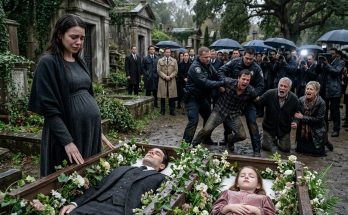
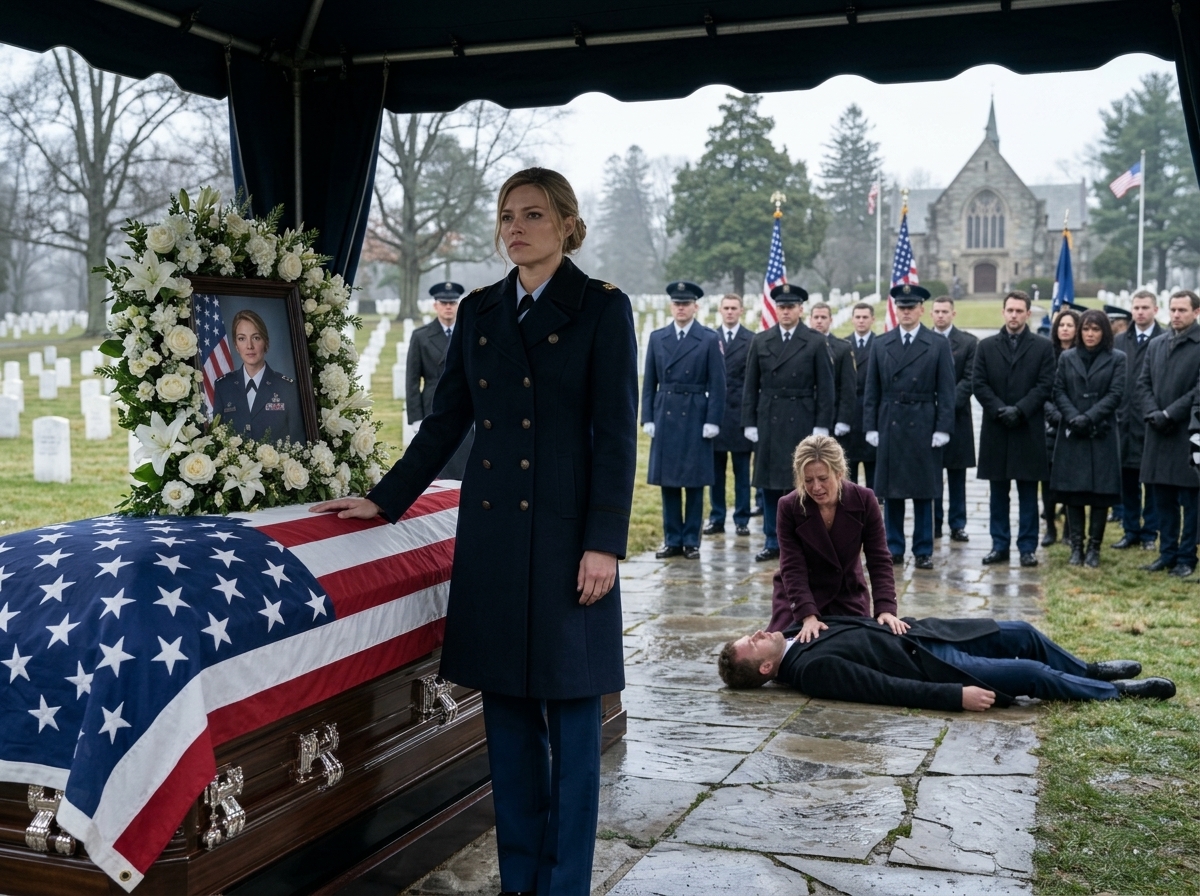
The memorial was being held in a grand historic chapel decorated with American flags and enormous arrangements of white flowers.
Dominic had spared no expense.
He’d invited distant relatives, family friends, former colleagues, and several military acquaintances.
A number of uniformed service members were present as private guests, though the Army had not authorized a military funeral or ceremonial honors.
A framed portrait of me stood beside the polished coffin.
In the photograph, I was smiling.
I remembered the day it had been taken.
Dominic had told me how proud he was of me.
Now the same image was being used to celebrate a death he had attempted to cause.
Mercer coordinated the operation with local officers and the prosecutor’s office.
Uniformed deputies waited outside.
Plainclothes investigators were positioned near the chapel entrances.
I had agreed not to approach Dominic until officers were ready to intervene.
The ceremony began shortly after eleven.
I waited in a side room, listening to the muffled sounds through a closed door.
Then I heard Dominic’s voice.
“Rebecca was an extraordinary woman.”
My jaw tightened.
“She gave everything to her country, her family, and the people she loved.”
A pause.
“I only wish I could have done more to save her.”
I heard quiet sobbing from the congregation.
Then Dominic continued.
“My wife was strong. Sometimes too strong. She carried burdens she never wanted to share.”
I recognized the implication immediately.
He was still trying to make me sound unstable.
Still rewriting the truth.
Still protecting himself.
“And although her final days were difficult,” he said, “I hope she’s finally found peace.”
My mother, who had entered separately, later told me she nearly stood up at that moment.
But she stayed seated.
She knew what was coming.
Dominic went on.
“I’ll carry her memory for the rest of my life.”
I glanced at Mercer.
He was standing beside the door with his phone in his hand.
An investigator inside had just confirmed Dominic and Chloe were both present.
Mercer nodded to me.
“We’re ready.”
My heartbeat thundered.
I stepped into the hallway.
The chapel doors stood ahead.
Through the narrow opening, I could see rows of mourners dressed in black.
White flowers surrounded the coffin.
American flags rose along the walls.
And near the front stood Dominic.
One hand pressed to his chest.
A handkerchief in the other.
Playing the grieving widower.
Chloe sat in the front row.
Her expensive purple dress shimmered beneath the chandeliers.
And on her finger was the diamond ring.
I drew one steady breath.
Then I pushed the doors open.
The hinges creaked.
Several people turned.
A woman in the rear pew gasped.
Then another.
Whispers spread across the chapel.
Dominic stopped speaking.
His gaze moved toward the back of the room.
For a moment, his expression remained confused.
Then he saw me.
His face went completely white.
The handkerchief fell from his fingers.
I walked slowly down the center aisle.
Every step echoed against the polished floor.
I could hear someone crying.
Someone else whispered my name.
But I kept my eyes on Dominic.
The man who had left me to die.
The man who had told everyone I’d disappeared.
The man standing beside a coffin he’d purchased to celebrate his own crime.
He staggered backward.
“Rebecca?”
I said nothing.
He stared at me as though he’d seen a ghost.
“No.”
His voice was barely audible.
“No, that’s impossible.”
I stopped beside the coffin.
My portrait stood only a few feet away.
I looked at it.
Then at him.
“Hello, Dominic.”
The entire chapel fell silent.
He swallowed.
“How—”
He stopped himself.
I watched the realization spread across his face.
He wasn’t wondering why I hadn’t contacted him.
He wasn’t asking whether I was injured.
He wasn’t expressing relief that his supposedly missing wife had returned.
He was trying to understand how his murder attempt had failed.
“How did you get out?” he whispered.
The words carried farther than he intended.
I tilted my head slightly.
“Out of what?”
His eyes widened.
I continued.
“Out of the cabin you locked from the outside?”
A collective gasp rippled through the crowd.
Dominic looked around desperately.
“Rebecca, honey, you’re confused.”
There it was.
Exactly as I’d predicted.
He took one cautious step toward me.
“You’ve been through something terrible. You need medical attention.”
“I’ve received it.”
“You’re not thinking clearly.”
“I’m thinking more clearly than I have in years.”
Chloe abruptly rose from her seat.
“Dominic,” she whispered.
He ignored her.
Instead, he reached for my arm.
I stepped away.
“Don’t touch me.”
His face twisted.
“Rebecca, you’re embarrassing yourself.”
I glanced toward the coffin.
“At my own funeral?”
Several people shifted uncomfortably.
A man near the front muttered, “What the hell is going on?”
Dominic began speaking faster.
“Everyone, please. My wife has obviously suffered a traumatic experience. I need to get her somewhere quiet.”
“No,” I said.
The single word stopped him.
“You don’t get to take me anywhere again.”
I turned toward the congregation.
“My name is Lieutenant Rebecca Hale.”
A few people straightened instinctively.
“Two weeks ago, my husband brought me to a remote cabin in the Montana mountains. He told me we were going there to repair our marriage.”
I looked back at Dominic.
“Instead, he locked me inside during a blizzard, stole my emergency equipment, and left me to die.”
Someone shouted, “That’s a lie!”
It was Dominic’s brother.
Before he could continue, Detective Mercer stepped into the aisle.
“I’m Detective Daniel Mercer with the county sheriff’s office.”
He displayed his identification.
“We’re conducting a criminal investigation. Please remain calm.”
Dominic looked toward the exits.
For the first time, genuine fear appeared in his eyes.
He took another step backward.
Then he turned.
Two investigators were already approaching from the side aisle.
“Dominic Hale,” Mercer said firmly, “you’re under arrest for attempted deliberate homicide and related offenses.”
Dominic froze.
“No.”
Mercer continued.
“Turn around and place your hands behind your back.”
“This is insane!”
“Do it now.”
Dominic looked at me.
His expression changed again.
Anger replaced fear.
“You planned this?”
I met his eyes.
“No, Dominic.”
I gestured toward the coffin.
“You planned this.”
He opened his mouth.
Nothing came out.
Then he shouted, “She’s lying! She went out into the storm! I tried to stop her!”
Mercer nodded toward another investigator.
“We have a video recording from the cabin.”
Dominic stopped moving.
Mercer continued.
“It shows you securing the exterior lock and leaving with her emergency supplies.”
The room erupted.
People stood.
Chairs scraped against the floor.
Someone began crying loudly.
Dominic shook his head.
“No. That camera wasn’t—”
He stopped.
Too late.
I watched his face as he realized what he’d almost admitted.
Mercer gave him a measured look.
“Wasn’t what, Mr. Hale?”
Dominic stared at him.
His mouth opened again.
Then his legs gave way.
He collapsed onto the marble floor.
Chloe screamed.
“Dominic!”
She rushed toward him, dropping to her knees beside his body.
Her hands pressed against his shoulders.
“Dominic! Wake up!”
She looked up at me with an expression of pure panic.
“You did this!”
I didn’t move.
A deputy checked Dominic’s condition while Mercer called for medical assistance.
Dominic was breathing.
Consciousness returned within seconds.
And when he opened his eyes, he found Chloe leaning over him, the police standing nearby, and his supposedly dead wife watching from beside her own coffin.
He began shaking.
Chloe was crying now.
Not elegant, carefully controlled tears.
Real sobs.
“Dominic,” she whispered, “you told me she couldn’t survive.”
The words rang through the chapel.
Then silence.
Chloe seemed to realize what she’d said.
She covered her mouth.
Mercer turned toward her.
“Ma’am, I need you to stand.”
She stared at him.
“I didn’t mean—”
“Please stand.”
Dominic struggled to sit upright.
“Chloe, don’t say another word.”
She looked at him.
Then at me.
Then back at the police.
And something in her expression changed.
For the first time, she understood that the man who had promised her wealth and freedom had placed her directly inside a murder investigation.
“He’s the one who planned it,” she blurted.
Dominic went rigid.
“Chloe!”
“He said it would look like an accident!”
A murmur swept through the room.
She began crying harder.
“He said nobody could survive that storm!”
Mercer instructed officers to separate them.
“Both of you need to stop talking. You’ll be advised of your rights before any questioning.”
Dominic began shouting as deputies restrained him.
“She’s making it up!”
Chloe shouted back.
“You told me the money would be ours!”
“I never said that!”
“You said we’d be rich!”
Their voices echoed beneath the high ceiling.
I listened for a few seconds.
Then I turned away.
I had imagined this moment so many times.
I thought watching Dominic lose everything would bring satisfaction.
Maybe even joy.
Instead, I felt exhausted.
And strangely empty.
The man I’d loved was gone.
In his place stood a desperate stranger fighting to escape the consequences of his own choices.
My mother approached from the front pew.
She was crying again.
But this time, she was smiling.
“Rebecca.”
I reached for her hand.
She squeezed it tightly.
Together, we watched the deputies lead Dominic toward the exit.
He turned once.
Our eyes met across the chapel.
“Rebecca,” he called.
I didn’t answer.
“Please.”
For a moment, I remembered our wedding.
The promises.
The laughter.
The way he’d held my hands and told me he’d always protect me.
Then I remembered the cold wooden floor of that cabin.
The padlock snapping shut.
The sound of his truck driving away.
I looked at him one last time.
“You left me there to die.”
His face crumpled.
“Rebecca, I—”
“No.”
I shook my head.
“You don’t get another goodbye.”
The deputies escorted him out.
Chloe followed separately, accompanied by investigators.
And the chapel doors closed behind them.
The silence that remained was unlike anything I’d ever experienced.
Hundreds of people had gathered to mourn my death.
Now they stood staring at me.
Alive.
Wounded.
But standing.
I looked toward the coffin.
Its polished wood reflected the chandeliers.
The American flag draped across it had been arranged with meticulous care.
A funeral director quietly approached and asked whether I wanted the ceremony stopped.
I glanced around the room.
My former colleagues.
My family.
People who had traveled enormous distances because they’d been told I was gone.
Then I stepped forward and placed one hand on the coffin.
“This ceremony was arranged under false pretenses,” I said quietly.
No one interrupted.
“But I know many of you came here because you cared about me.”
My voice trembled.
“I don’t know what Dominic told you. I don’t know what lies you were asked to believe.”
I looked toward the military personnel standing near the front.
“But I want you to know something.”
I took a breath.
“I survived.”
A woman in the second row began crying.
“I survived because of training. Because of discipline. Because somebody found me when I desperately needed help.”
I paused.
“And because I refused to let the person who betrayed me decide how my story ended.”
My mother covered her mouth.
I looked toward the portrait beside the flowers.
For years, I had been proud of my career.
Proud of the soldiers I’d trained.
Proud of the lessons I’d passed on.
But I’d never imagined that those lessons would one day save my own life from someone sleeping beside me.
I turned back to the congregation.
“Please don’t remember today as my funeral.”
I managed a small smile.
“Remember it as the day I came home.”
The first person to approach me was an older soldier I’d trained years earlier.
Sergeant First Class Michael Turner.
He stood silently in front of me, his eyes bright with tears.
Then he straightened and saluted.
“Welcome home, ma’am.”
My throat tightened.
I returned the salute.
“Thank you, Sergeant.”
Another soldier stepped forward.
Then another.
Soon the entire front row of service members had formed a quiet line.
Not for a funeral.
Not for a memorial.
But to welcome back someone they’d believed they had lost.
I finally broke down.
My mother held me as I cried.
And for the first time since the mountains, I let myself stop being strong.
In the months that followed, the criminal case moved forward.
Dominic’s financial records revealed more than reckless spending.
He had forged my signature on loan documents.
He had used my personal information to open credit accounts.
And he’d made detailed calculations about what he believed he could obtain after my death.
Investigators recovered additional messages between him and Chloe discussing the cabin, the storm forecast, and the timing of their trip.
Chloe eventually reached an agreement with prosecutors and provided a detailed account of their planning in exchange for consideration in her own case.
Her cooperation didn’t erase her involvement.
She still faced criminal consequences.
But her testimony helped establish what the evidence already strongly suggested.
My death hadn’t been an impulsive decision.
It had been a financial plan.
Dominic had chosen the weekend because the forecast predicted severe weather.
He had deliberately removed my equipment.
He had researched how long an exposed person could survive in extreme cold.
And he had prepared a narrative to explain my disappearance.
He hadn’t expected investigators to find me alive.
He certainly hadn’t expected the security camera to preserve evidence of his actions.
The memory card became one of the most important exhibits in the case.
At trial, prosecutors played the footage.
I sat in the courtroom and listened to Dominic’s voice filling the room.
“You’re worth much more to me dead than you ever were alive.”
I watched the jurors’ expressions change.
Some stared at the screen.
Others looked toward Dominic.
He sat beside his defense attorney wearing an expensive gray suit.
He seemed smaller than I remembered.
When it was my turn to testify, I described the cabin.
The cold.
The locked door.
The stove.
The damaged window.
The long walk through the snow.
The moment I collapsed and wondered whether I would ever see my mother again.
Dominic’s attorney tried to suggest I’d exaggerated my ordeal.
He asked whether my military training made me unusually capable of surviving wilderness conditions.
“Yes,” I answered.
“So you were never truly helpless?”
I looked directly at him.
“Training doesn’t make someone immune to hypothermia.”
He hesitated.
I continued.
“It gives you a better chance of recognizing danger and making decisions under pressure. It doesn’t make freezing temperatures harmless.”
The attorney shifted his papers.
“But you survived.”
“Yes.”
“Despite the conditions.”
“Yes.”
He leaned forward.
“Wouldn’t you agree, then, that the situation wasn’t necessarily fatal?”
I looked toward the jury.
“No.”
The attorney frowned.
I continued.
“Surviving an attempted murder doesn’t mean someone didn’t attempt to murder you.”
The courtroom went completely silent.
The attorney asked no further questions about my training.
After several weeks of testimony, the jury returned its verdict.
Guilty.
Dominic was convicted of attempted deliberate homicide and additional offenses connected to the scheme.
He received a lengthy prison sentence.
Chloe was sentenced separately for her role.
The financial proceedings took longer.
Our divorce became final.
The fraudulent debts were investigated and disputed.
The house was eventually sold as part of unwinding the financial damage Dominic had caused.
I didn’t recover everything.
Some money was gone forever.
Some property had to be surrendered.
Some friendships never fully recovered from the lies Dominic spread.
But the most important thing remained.
My life.
One year after the cabin, I returned to Montana.
Not to the place where Dominic had tried to kill me.
Not to prove anything.
I went because I wanted to see the mountains without fear.
My mother accompanied me.
We rented a small cabin near a maintained road, with working heat, reliable communication, and neighbors close enough to wave from their porches.
On our second morning, we sat outside with hot coffee as sunlight moved slowly across the snow-covered peaks.
For a long time, neither of us spoke.
Then my mother looked at me.
“Do you ever think about what would have happened if you hadn’t found those matches?”
I watched steam rise from my cup.
“Sometimes.”
“If the storm had lasted longer?”
“Yes.”
“If that Forest Service truck hadn’t come along?”
I turned toward her.
“Mom.”
She stopped.
I reached for her hand.
“I can’t spend the rest of my life living inside every terrible thing that might have happened.”
Tears filled her eyes.
“I know.”
I looked back toward the mountains.
“I spent enough time in that cabin.”
She nodded slowly.
Then she smiled.
“You’re right.”
Later that afternoon, I received an email from Sergeant Turner.
He was helping organize a military survival-training event and wanted to know whether I’d speak to a group of young soldiers about resilience.
At first, I hesitated.
For months, people had asked me to tell the story.
Reporters wanted interviews.
Producers wanted documentaries.
Strangers sent letters.
Everyone seemed fascinated by the woman who had walked out of a blizzard and appeared at her own funeral.
But the version they wanted was always the same.
A fearless soldier.
A brilliant escape.
A dramatic confrontation.
A villain brought to justice.
They wanted the story to sound like an action movie.
They rarely asked what it felt like to discover that the person who knew you best had been studying how to kill you.
They rarely asked how difficult it was to fall asleep afterward.
How often I woke to the imagined sound of a padlock.
How long it took before I could sit comfortably in a room with a closed door.
Surviving the mountains had taken less than two days.
Learning to feel safe again had taken much longer.
I stared at Turner’s email.
Then I began typing.
I’d be honored.
Three weeks later, I stood before a room filled with young soldiers.
Men and women at the beginning of their careers.
Some confident.
Some nervous.
All watching me with curiosity.
I could tell they’d heard the story.
One young private raised his hand before I had even finished introducing myself.
“Ma’am, is it true you escaped from a locked cabin during a blizzard?”
“Yes.”
“And walked for hours with almost no equipment?”
“Yes.”
He looked impressed.
“That’s incredible.”
I smiled faintly.
“It was frightening.”
He seemed surprised by the answer.
I walked toward the front of the room.
“There’s something I want all of you to understand.”
The room grew quiet.
“People think survival is about being fearless. It isn’t.”
I paused.
“I was afraid in that cabin. I was afraid when I climbed through the window. I was afraid every time I took another step through the snow.”
I looked around the room.
“Training doesn’t eliminate fear.”
A young woman near the center leaned forward.
“It teaches you how to act while you’re afraid.”
I let the words settle.
“And the most important decision I made wasn’t breaking out of that cabin.”
The private frowned.
“What was it, ma’am?”
I thought back to the freezing wooden floor.
The tears.
The betrayal.
The moment I’d closed my eyes and forced myself to breathe.
“Deciding that what happened to me wasn’t going to determine what I did next.”
No one spoke.
I continued.
“Your circumstances may be terrible. Your resources may be limited. The people you trusted may fail you.”
I looked directly at the young private.
“But until you’ve exhausted every reasonable option, your story isn’t finished.”
When the session ended, several soldiers approached to thank me.
One young woman waited until everyone else had left.
“Lieutenant Hale?”
I turned.
“Yes?”
She hesitated.
“My mother went through something terrible when I was little. Not like your situation, but she was hurt by someone she trusted.”
I listened.
“She survived,” the young woman continued. “But she always said she wasn’t strong enough.”
Her eyes filled.
“I wish she could have heard what you said today.”
I reached for her hand.
“Then tell her.”
She nodded.
“And tell her that surviving something terrible doesn’t mean she has to be strong every minute afterward.”
The young woman wiped her eyes.
“Thank you, ma’am.”
After she left, I stood alone in the classroom.
Through the window, I could see soldiers crossing the training grounds.
Laughing.
Talking.
Carrying equipment.
Beginning lives that would take them places they couldn’t yet imagine.
I thought about the old cabin.
About Dominic.
About the coffin with my photograph beside it.
For a long time, I’d believed the greatest victory was walking into that chapel and watching my husband realize he’d failed.
But standing there now, I understood something different.
That wasn’t the moment I reclaimed my life.
It was only the moment everyone else discovered I still had one.
I reclaimed it slowly.
When I slept through the night without waking in panic.
When I learned to trust my own judgment again.
When I stopped blaming myself for believing someone who had promised to love me.
When I walked into a room full of young soldiers and realized I had something worth teaching beyond how to survive the cold.
Dominic had wanted my life reduced to a financial calculation.
An insurance policy.
A pension.
A house.
A dollar amount he could collect.
He had spent months planning how to turn my death into his future.
And in the end, all his planning had accomplished was destroying his own.
I left the classroom and stepped into the afternoon sunlight.
My phone vibrated.
A message from my mother.
Dinner at six. Don’t be late. I made your favorite.
I smiled.
Then I typed back.
Wouldn’t miss it.
As I walked toward my car, I thought about the words I’d written on that frozen cabin table.
THIS WAS NOT AN ACCIDENT.
Those words had helped expose the truth.
But if I could have left one more message behind for the woman I’d been that night, it would have been something different.
Something simpler.
Something I hadn’t fully understood until much later.
You are going to have a life after this.
Dominic had stood outside that cabin believing the storm would erase me.
He had bought an expensive coffin, arranged a funeral, and invited hundreds of people to watch him mourn the woman he’d tried to murder.
But he had forgotten the one thing no insurance policy could measure.
My will to live.
And when I think about that coffin now, I no longer remember the polished wood or the white flowers.
I remember my mother’s arms around me.
The soldiers standing to welcome me home.
And the extraordinary feeling of walking out of a funeral that was never supposed to be mine.
Dominic had planned the ending of my story.
He just hadn’t understood that I was still the one writing it.
THE END.