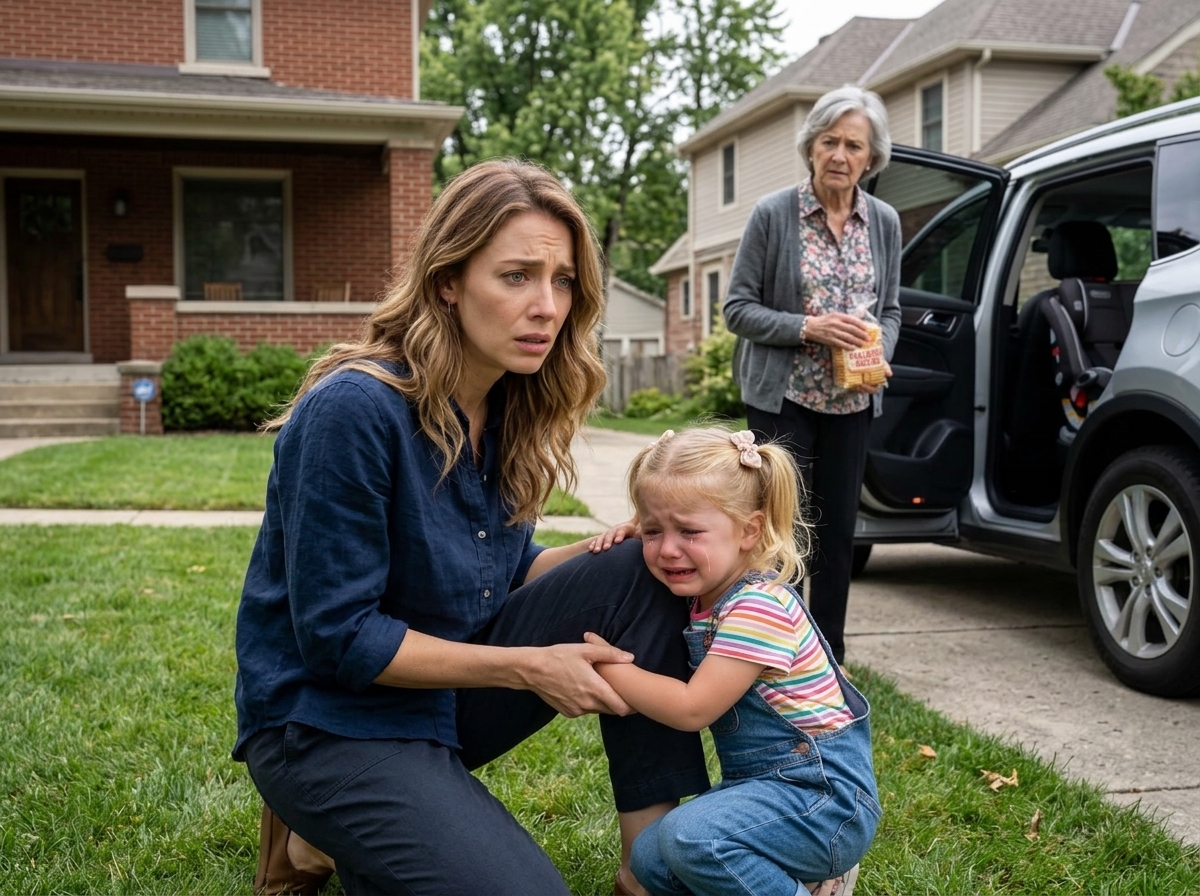
My daughter screamed and refused to get in my mother-in-law’s car, so I gave up and kept her home. Forty minutes later a state trooper called and asked, “Ma’am, who else knew your little girl was supposed to be in that car?”
Chapter 1: The Tuesday Tantrum
A visceral, ear-splitting shriek tore from my four-year-old’s throat, shattering the crisp September morning. It was the kind of guttural, desperate sound that makes the neighbors pause their lawnmowers and peer suspiciously through their plantation blinds.
My daughter, Nora, had both of her tiny hands wrapped like steel vises around the edge of our front doorframe. Her knuckles, usually a soft, rosy pink, had drained to a stark, bone-white from the sheer force of her grip. She wasn’t just crying; she was screaming with a primal terror that sent a cold shockwave straight down my spine.
“No, no, no, no! I don’t want to go! I don’t want to! Mommy, no !”
I stood there, paralyzed for a fraction of a second, clutching my travel mug of coffee. It was 8:15 on a Tuesday. Tuesdays were my marathons at the salon in Bowling Green, Kentucky . I am a hairstylist, and by 9:00, my hands would be deep in a complex color correction, followed by a meticulous 10:30 bob cut, and a highly anxious bride’s trial at noon. The schedule was relentless, and this Tuesday was supposed to run like clockwork, just like every Tuesday since January.
At the bottom of the porch steps stood my mother-in-law, Ruth Langford . She was parked beside her immaculate white Honda CRV, the rear passenger door swung wide open, revealing the empty, pink star-patterned car seat waiting inside. Ruth possessed the calm, unyielding pragmatism of a woman who had raised three rambunctious boys and fostered two more. She didn’t rattle.
She stood there holding a plastic bag of Nora’s favorite cheddar fish crackers, extending it gently, the way one might offer a peace offering to a cornered, shivering puppy.
“Come on, sweet pea,” Ruth coaxed, her voice an even, soothing melody. “The chickens are waiting for you. Mabel laid two massive eggs yesterday. Don’t you want to see?”
In response, Nora screamed louder, burying her face into the fabric of my scrubbed denim jeans, her tears soaking through to my knee.
My mind raced. Nora adored Tuesdays. She worshipped Ruth’s little farmhouse out in Morgantown , thirty-five minutes north on US 231. She spent the remaining six days of the week babbling about the tire swing, the dusty barn cats, and Mabel the Rhode Island Red. She had never, not in nine months, thrown so much as a whimper about going to Grandma Ruthie’s.
I knelt on the rough concrete of the porch, setting my coffee aside, and gently tried to pry her right hand off the painted wood of the doorframe. Instead of letting go, she abandoned the wood and latched onto my wrist. I gasped. I genuinely hadn’t known a four-year-old could summon that kind of crushing, desperate physical strength.
I looked up at Ruth, my eyes pleading for a maternal translation. Ruth just offered a subtle, soft shrug. Kids, the shrug said. They have their days.
“I’ll keep her home,” I sighed, running a trembling hand through my own hair. “I’ll call the salon and push my morning back. It’s fine.”
Ruth nodded, ever the pragmatist. She methodically tucked the bag of cheddar fish back into her oversized leather purse. “Feel better, sweet pea,” she murmured. She kissed her index and middle fingers, blowing the affectionate gesture toward the porch. Nora didn’t look up; she just pressed her face harder into my leg, shivering.
At exactly 8:31 AM, Ruth backed out of our driveway alone, the gravel crunching under the CRV’s tires, and disappeared down the sunlit street. I scooped my sobbing daughter into my arms, carried her inside, and locked the door behind us. I thought I had merely surrendered to a toddler’s inexplicable mood swing. I thought I was just being an accommodating mother.
Forty minutes later, at 9:11 AM, my cell phone vibrated on the kitchen counter. The caller ID displayed an unfamiliar Kentucky area code. I wiped my hands on a dish towel and swiped to answer.
“Is this Brooke Langford?” a deep, resonant voice asked over the crackle of a poor cellular connection.
“Yes, speaking.”
“Ma’am, this is Trooper Jordan Clements with the Kentucky State Police. I’m calling regarding your mother-in-law, Ruth Langford. She has been involved in a severe collision on US 231, just north of town.”
My hand instinctively flew to cover my mouth. The kitchen seemed to tilt on its axis. “Oh my god. Is she… what happened?”
“She is going to be okay,” the trooper assured me quickly, though his tone remained gravely professional. “She’s being transported to the hospital by ambulance right now.”
I exhaled a breath I didn’t know I was holding, my pulse hammering against my ribs. “Thank God.”
There was a heavy, static-filled pause on the line. It was the kind of deliberate silence a seasoned law enforcement officer uses when they are organizing their words for maximum impact. When he finally spoke again, his voice was slow, careful, and chillingly precise.
“Ma’am,” Trooper Clements asked, “who else knew your little girl was supposed to be in that car today?” Pages: 1 2 3