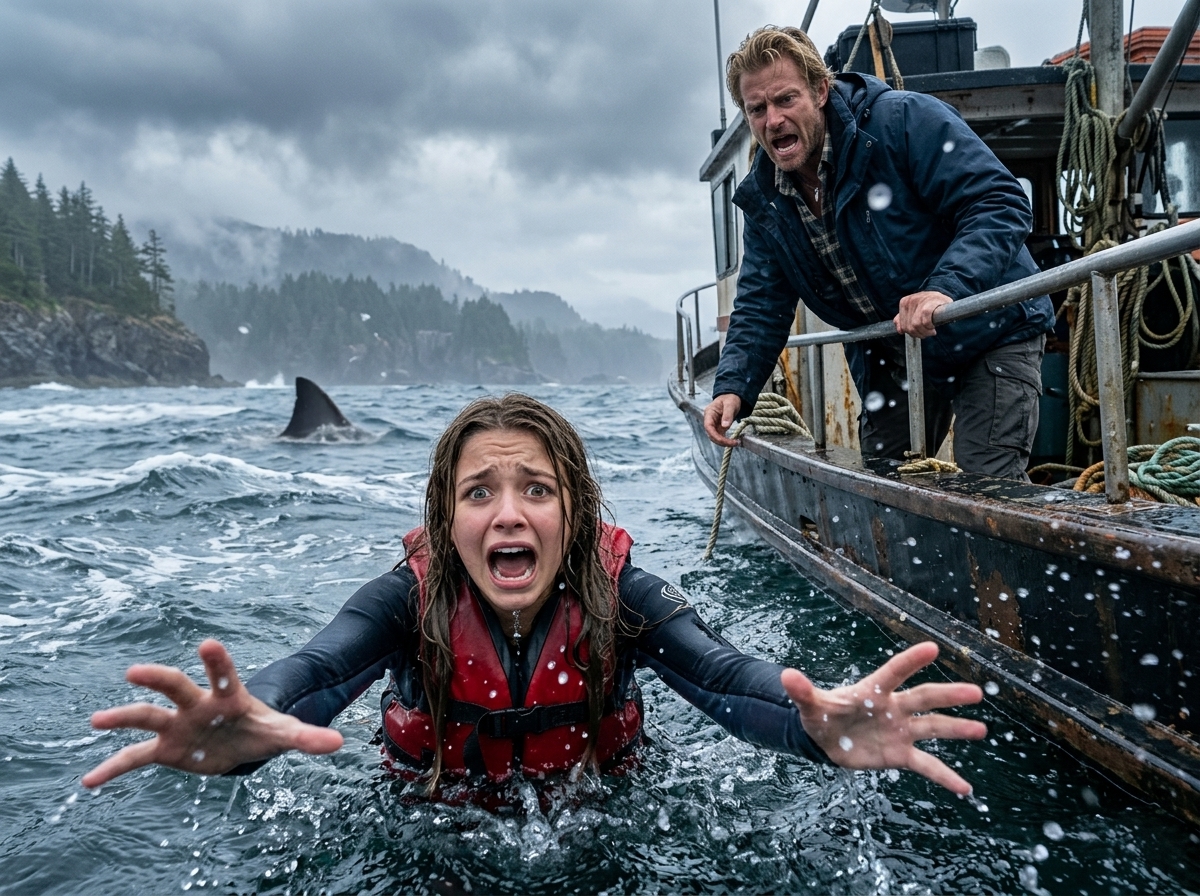
My brother took my 15-year-old daughter out fishing. Miles from shore, he pushed her off the boat and said: “Say hello to the sharks!” Then he drove away, leaving my daughter alone in the ocean. I didn’t know what he’d done, until I got one phone call. Hours later, my brother came home like nothing had happened. I was already waiting for him. He stopped when he saw me. I looked at him and said, “I’ve got something to show you…”
The Edge of the Water
Chapter 1: The Weight of Keys
The grandfather clock in the corner of my foyer ticked with a dry, mechanical persistence that felt like a needle tapping against bone. Seven thirty-six in the evening. Outside, the coastal fog of Cape Falcon had begun its nightly crawl across the lawn, pressing its damp, milky face against the living room windowpanes.
I did not turn on the lamps. I sat in the high-backed armchair positioned just beyond the throw of the hallway light, my hands resting flat against my thighs. My skin was cold, despite the thermostat humming at seventy degrees. On the low coffee table beside me lay my phone, its glass screen dark, reflecting only the pale rectangle of the ceiling fixture.
Then came the familiar rumble of an exhaust pipe loose from its bracket, the crunch of gravel under heavy tires, and the sudden cut of an engine.
A car door slammed. Heavy, unhurried boot-heels took the porch steps two at a time. Then came the rattle of brass.
He didn’t knock. He never knocked. Ryan Mercer treated my home the way he treated every corner of my life—as an annex of his own convenience, a sanctuary where consequences were quietly absorbed, scrubbed clean, and forgotten.
The brass deadbolt turned with a smooth, oiled click. The heavy oak door swung inward, bringing with it the sharp, briny smell of low tide, diesel exhaust, and stale sweat. Ryan stepped over the threshold, his shoulders loose, keys jingling on the brass carabiner hooked through his belt loop. He wore the same faded slate-gray fishing shirt he’d pulled on that morning, stained dark at the elbows with engine grease, his sun-bleached hair plastered to his forehead in wind-tangled spikes.
For three seconds, his eyes remained fixed on the hallway, anticipating the usual sounds of domestic rhythm—a pan rattling on the stove, the hum of the television, the scent of garlic and butter.
Then his gaze drifted into the dim alcove of the living room.
He stopped so abruptly that the keys in his hand chimed like small, frantic bells.
“Claire?” he said. His voice was casual, but the syllables were pitched half an octave too high.
I stayed motionless in the chair. In the dimness, my silence was not merely an absence of speech; it was a barricade.
Twelve hours earlier, I had entrusted him with the most precious piece of my soul. I had handed him my fifteen-year-old daughter, Lily Mercer , waving goodbye from the asphalt as his truck pulled out with a skiff trailing behind. I had spent fifteen years playing the role of the protective older sister—repairing his bruised credit, placating landlords, making excuses at holiday dinners when he arrived reeking of bourbon and grievance. I had convinced myself that his volatility was merely wounded pride, that beneath the defensive posturing was the sweet-faced younger brother who used to hold my sleeve when thunder rattled the roof of our childhood home.
Now, as I looked at the man standing in my entryway, I saw the truth. He stood alone. His hands were empty.
“Claire, why are you sitting in the dark?” Ryan took a tentative step forward, his brow furrowing into an expression of puzzled innocence. It was a mask I had seen him wear a thousand times—the wounded boy, unfairly suspected, bracing himself to be misunderstood. “You scared the hell out of me. Where’s the lights?”
I felt my jaw lock, the muscles aching with the effort of keeping my voice steady. “Where is she, Ryan?”
He did not flinch, but his eyes darted toward the empty kitchen behind me, measuring the space, calculating the odds of an ambush. That tiny, subtle flicker of calculation told me everything I needed to know. He was not a frantic uncle who had lost a child to an unforgiving ocean. He was an architect inspecting the foundation of a wall he had spent the last five hours building.
He doesn’t know, I realized with a shudder that traveled down the length of my spine. He has no idea that the sea gave back what he threw away.
Ryan forced an easy, exasperated chuckle, running a calloused palm through his hair. “Look, Claire, don’t start. If you’re going to jump down my throat the second I walk in, at least let me grab a glass of water. We had… well, it turned into a mess out there.”
“A mess?” I repeated, each letter tasting like copper.
“She had a meltdown,” he said smoothly, taking another step into the room, leaning his weight casually against the archway. “A complete teenage fit. But before you lose your mind on me, you need to hear what actually happened.”
I looked at his face, searching for a twitch of regret, a tremor of terror, anything that resembled humanity. There was only the greasy gleam of survival. And in that terrifying stillness, as the fog thickened against the glass, I knew the man who had walked into my home was not my brother. He was a predator waiting to see if his tracks had washed away in the rain.