PART 1
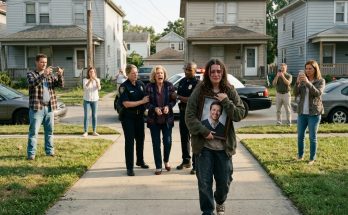
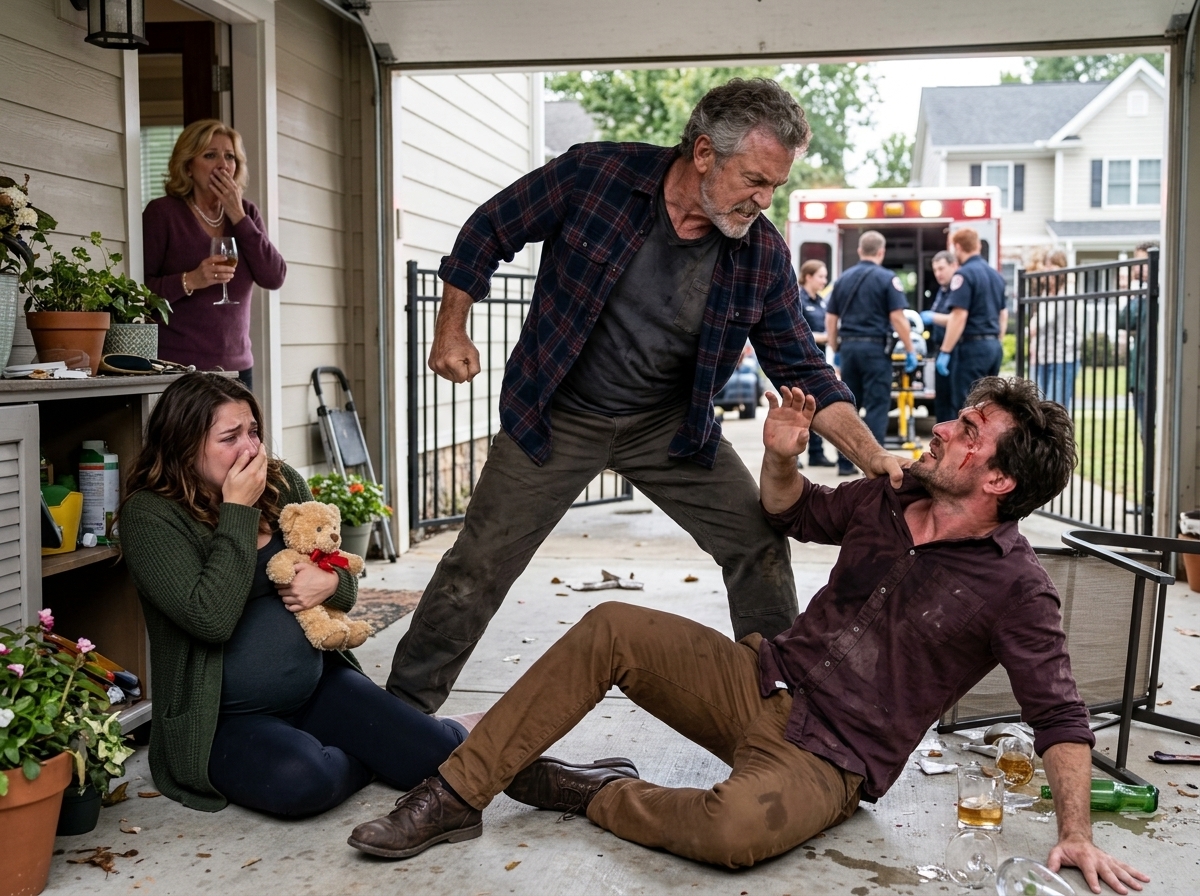
I came to visit my daughter eight months pregnant, carrying flowers and a stupid little teddy bear. Instead, I found her shaking beside the kitchen wall, whispering, “Dad, please don’t ask.”
The flowers slipped in my hand.
Emily was sitting on the floor in her own kitchen, one palm pressed under her ribs, her hair stuck to her wet cheek. The teddy bear’s blue ribbon suddenly looked obscene in my fist. Behind her, her husband, Mark, leaned against the doorway in a pressed shirt, smiling like I had interrupted a joke.
“She’s dramatic,” he said. “Pregnancy hormones.”
I looked at my daughter’s wrist. Purple fingerprints. Fresh ones.
“Emily,” I said softly. “Who did that?”
Her eyes flicked toward him.
Mark laughed. “Don’t start, old man. You show up twice a year with guilt gifts, and now you want to play hero?”
I set the flowers on the counter. Carefully. Slowly.
That made him smile wider.
He had always mistaken silence for weakness. Men like Mark did that. They saw my gray hair, my quiet voice, my cheap sedan, and decided I was harmless. He didn’t know that before retirement, I had spent thirty-one years building criminal cases for the district attorney’s office. He didn’t know I could read a room the way other men read a menu.
Broken mug in the sink. A dent in the drywall. Security camera unplugged but still warm. Emily’s phone on the table, screen cracked, one missed call from me every ten minutes for the last hour.
“Get out,” Mark said.
I looked at my daughter. “Pack a bag.”
“She’s not going anywhere.”
Emily flinched before he even moved.
That was the moment something inside me went cold.
Mark stepped toward me. “You deaf?”
“No,” I said. “I’m listening.”
“To what?”
“To how confident you are before your life changes.”
His smile faltered.
Then his mother’s voice came from the hallway. Linda, perfectly dressed, holding a glass of white wine at three in the afternoon. “Mark, don’t let him upset you. Emily knows better than to embarrass this family.”
Emily lowered her head.
I picked up the teddy bear, placed it gently in my daughter’s lap, and whispered, “Hold this. Don’t look away.”
Mark shoved my shoulder.
Three hours later, he was in the emergency room, screaming my name.
PART 2
The shove wasn’t hard enough to knock me down. It was meant to humiliate, not injure. Men like Mark always calibrate.
I let my back touch the refrigerator. I didn’t raise my hands. I didn’t say a word.
“That’s what I thought,” Mark said.
“Thank you,” I told him.
He blinked. “For what?”
I tapped the breast pocket of my jacket, where my phone had been recording since the moment I knocked on the front door. Thirty-one years of habit. You walk into a house where someone won’t answer the phone, you document.
“For saying it all out loud,” I said. “The threats. The shove. Your mother’s little speech about embarrassing the family. It uploads to the cloud every sixty seconds, by the way. So breaking my phone would just be one more charge.”
For the first time, Mark Whitmore looked unsure.
Linda set her wine glass down. “You can’t record people in their own home.”
“This state requires one party’s consent,” I said. “I’m the party. I consent.”
I crouched beside Emily. Up close, I could see what the doorway had hidden: the swelling along her jaw, the way she held her breath before every movement.
“Can you stand, sweetheart?”
She looked past me at Mark. Even now, she was asking his permission.
“Look at me, Em. Not him. Me.”
Slowly, her eyes came back to mine. She nodded.
Mark stepped into the doorway, filling it. “She walks out that door, she doesn’t come back.”
“That’s the first thing you’ve said today that I agree with.”
I don’t know if it was my voice or the phone in my pocket, but he moved. Not much. Just enough.
We walked out with nothing but her purse, her cracked phone, and the teddy bear she was clutching like a life preserver. The flowers stayed on the counter. Let them wilt there.
In the car, Emily finally broke. Not loud. Just a long, broken exhale, like she’d been holding one breath for two years.
“I’m sorry,” she whispered. “I’m so sorry, Dad.”
“You have nothing to be sorry for.”
“You don’t understand. He’s going to make this worse. He always makes it worse.”
I drove straight to St. Augustine Medical Center.
Dr. Priya Nair was the attending in the ER, a calm woman with tired eyes who took one look at Emily’s wrist and asked me to step out. I didn’t argue. I knew that protocol. I had written policy memos about that protocol.
Forty minutes later, she found me in the hallway.
“The baby’s heartbeat is strong,” she said first, because she was kind. “Emily has two cracked ribs.” She paused. “And the X-ray shows an old fracture in her left forearm. Healed, but badly. It was never set.”
The floor tilted.
Two years. My daughter had been married two years, and I had seen her six times. Holidays. One birthday. She’d worn long sleeves at Easter. I had noticed and said nothing, because she’d smiled and said she was cold.
A hospital social worker named Teresa Grant sat with Emily for an hour. When I was allowed back in, my daughter was lying on her side, one hand on her belly, the teddy bear tucked under her chin.
“They want me to make a statement,” she said.
“You don’t have to do anything tonight.”
“If I do, he’ll say I’m crazy. He’s been saying it for months. To his mother. To our friends. He’s been building it, Dad.” She laughed weakly. “Like a case.”
I knew exactly what she meant. And I hated how well she knew it.
At 6:12 p.m., almost exactly three hours after he shoved me, the automatic doors of the emergency department slid open.
Mark came in fast. Still in his pressed shirt. Face blotched red.
“Where is she?” he shouted at the front desk. “That’s my wife! That’s my child!”
The security guard, a big, soft-spoken man whose name tag read DESHAWN, stepped in front of him.
Mark saw me through the glass of the triage area. And he lost what little control he had left.
He shoved Deshawn aside and came at me.
I didn’t move. I didn’t need to. Deshawn caught him halfway across the waiting room, and Mark, who had never in his life been stopped by anyone, twisted, slipped on the polished floor, and went down hard on his own outstretched arm.
The sound made a nurse gasp.
Ten minutes later, Mark Whitmore was on a gurney in Bay 4 with a dislocated shoulder and a fractured wrist, screaming my name down the hallway.
“Daniel Brooks! He did this! Arrest him! He assaulted me!”
Two officers arrived. The younger one, Officer Luis Ramirez, took my statement in the hallway, glancing every few seconds toward the screaming.
“Sir, he’s claiming you attacked him.”
“The waiting room has four cameras,” I said. “I counted them on my way in. I never left this spot.”
Ramirez studied me. “You seem pretty calm about all this.”
“I am.”
“So what exactly happened here tonight?”
I smiled.
“That was only the beginning.”
He frowned, but before he could ask what I meant, Linda Whitmore swept through the doors. Beside her walked a tall man in a navy suit, carrying a leather briefcase.
My stomach dropped.
I knew that face. I had trained it. I had written its letters of recommendation.
Gavin Pryce. The best young prosecutor I had ever mentored.
And he was looking at me like an enemy.
PART 3
“Daniel.” Gavin extended his hand like we were meeting at a bar association dinner. “It’s been a while.”
I didn’t take it. “You represent the Whitmores now?”
“I represent Mark.” He lowered his voice. “And as a courtesy, because I respect you, I’m going to tell you how this goes. My client was injured tonight in a confrontation involving you. His mother witnessed you making threats in their home. Emily is emotionally fragile, and there’s documentation of that.”
“Documentation from who?”
He smiled, the way I had once taught him to smile at defense attorneys. Patient. Unbothered. “You know I can’t share that yet.”
“Gavin, she has two cracked ribs and an old broken arm nobody set.”
Something flickered across his face. Just for a second. Then it was gone.
“Then she should be very careful about what she says,” he said quietly, “because Mark is prepared to fight for custody of that baby. And judges don’t like mothers with psychiatric histories.”
He walked away before I could answer.
I stood in that hallway and realized something I should have understood hours earlier. Mark hadn’t panicked tonight. Mark had a plan. He’d been building it for months, exactly like Emily said.
And now he had a lawyer who knew every move I would make, because I had taught him.
I brought Emily home with me at midnight. My little two-bedroom house on Alder Street had been too quiet since Anne died. Emily’s mother had been gone four years now. After the funeral, I had buried myself in work, then in retirement, then in silence. I told myself Emily was grown, married, busy. I told myself she didn’t need me.
I had been wrong about almost everything.
She slept in her old room, under the faded glow-in-the-dark stars Anne had stuck to the ceiling when Emily was seven. I sat in the kitchen with a legal pad and did what I knew how to do.
I made a list.
Injuries, documented. Audio, preserved. Hospital footage, request immediately. Old fracture, find out where she was treated, if at all. Camera in kitchen, unplugged but warm. Who has the footage? Gavin, who is paying him? “Documentation” of mental instability, from where?
At seven a.m., I called Ray Kowalski.
Ray had been my investigator partner for nineteen years before his knees gave out. He answered on the second ring, the way he always had.
“Danny. It’s early, so somebody’s either dead or in trouble.”
“My daughter,” I said. And then, for the first time since I’d walked into that kitchen, my voice broke.
Ray was at my door in forty minutes with coffee and a box of donuts he wasn’t supposed to eat.
By noon, we had a plan. Ray would dig into Mark’s finances and history. I would get Emily in front of the right people. Not the patrol officers. The Domestic Violence Unit.
Detective Sandra Liu was in her forties, sharp-featured, and blunt in a way I appreciated. She interviewed Emily for two hours in my living room while I waited on the porch, because Emily asked me to.
When Liu came out, she sat on the step beside me.
“Your daughter’s a strong woman.”
“She shouldn’t have to be.”
“No.” Liu exhaled. “She told me things she’s never told anyone. He controls the money. Her phone. Who she talks to. He told her if she ever left, he’d make sure she never saw the baby. And she believed him, because his family knows every judge in this county.”
“Do they?”
Liu gave me a long look. “Enough of them.”
That evening, Emily sat across from me at the kitchen table, the teddy bear beside her coffee cup. She had named it already. Biscuit.
“Dad, can I ask you something?”
“Anything.”
“Why didn’t you hit him? Back in the kitchen. I saw your face. You wanted to.”
I thought about it honestly. “Because if I had, he’d have become the victim. And you’d have spent the next year visiting me in county jail instead of raising your baby.” I reached across the table and held her hand. “I’m done giving that man anything he can use.”
Her eyes filled. “He’s going to come after you.”
“Let him.”
Before bed, I did one more thing. Something old-fashioned and probably paranoid.
I bought a cheap prepaid phone at the pharmacy, turned on location sharing, silenced it, and carefully opened the back seam of Biscuit the bear. I tucked the phone deep into the stuffing beside a small battery pack, then stitched the seam closed with Anne’s old sewing kit.
I showed Emily.
“If you’re ever somewhere you can’t talk,” I told her, “if anyone takes your phone, you find this bear. You send me one word. Just Bear. And I will come.”
She laughed, a real laugh, the first in days. “You’re insane.”
“I’m prepared. There’s a difference.”
The next morning, Ray called before I’d finished my first cup of coffee.
“Danny. You sitting down?”
“Just tell me.”
“The trust Anne left Emily. The life insurance money. Three hundred eighty thousand dollars.” He paused. “It’s gone. All of it. Moved eight months ago into an LLC called Harbor Line Holdings.”
“Mark.”
“Mark’s name isn’t on it,” Ray said. “But the transfer documents were notarized by an attorney.”
I already knew. I think I’d known since the hospital.
“Gavin Pryce,” Ray said.
PART 4
I didn’t tell Emily right away. She was barely sleeping, barely eating. Dr. Nair had warned that stress this late in pregnancy was dangerous.
But secrets were what had nearly destroyed her. So that evening, I sat beside her on the couch and told her about the money.
She was quiet for a long time. Then she whispered, “I signed something.”
“When?”
“Last winter. He said it was for refinancing the house. He was in a hurry, and Gavin was there, and he was so nice to me, Dad. He asked about the baby. He brought a pen with his firm’s name on it.” Her voice cracked. “Mom’s money. That was Mom’s money.”
“You didn’t do anything wrong. They lied to you.”
“I let them.”
“No.” I took her face in my hands the way I used to when she was small and had nightmares. “Listen to me. When someone spends years teaching you that your judgment can’t be trusted, you stop trusting it. That’s not weakness. That’s the whole design.”
She cried against my shoulder for a long time. Biscuit sat in her lap, ribbon crooked.
Ray kept digging. That was his gift. He could follow a paper trail through a hurricane.
Three days later, he slid a folder across my kitchen table.
“Mark Whitmore was engaged before Emily. Woman named Rachel Dunn. Engagement ended five years ago. Two months after that, she filed for a protective order.”
“And?”
“And the file is sealed. Somebody worked very hard to make it disappear. Rachel moved to Ohio. Changed her number twice.”
“Can you find her?”
Ray grinned. “Danny. Who do you think you’re talking to?”
Rachel Dunn agreed to meet us at a diner outside Columbus. She was thirty-six, with short dark hair and a habit of sitting where she could see the door. I recognized that habit. Emily had it now too.
“I wasn’t going to come,” Rachel admitted, stirring her coffee without drinking it. “I’ve spent five years trying to forget that family.”
“Why did you come?” I asked.
“Because you said she’s pregnant.” Rachel’s jaw tightened. “I lost one. Did they tell you that? He pushed me down the back stairs at his mother’s house. Eleven weeks. Linda was standing in the kitchen. She heard everything. She told the paramedics I tripped.”
I closed my eyes.
“I filed for the order,” Rachel continued. “Then Mark’s family lawyer at the time called and offered a settlement. Sign an NDA, take the money, leave the state. Or fight a family that had half the courthouse at their Christmas party. I was twenty-nine and terrified. I took the money.” She looked at me with something like shame. “I’ve hated myself every day since.”
“You survived,” I said. “That’s not something to hate.”
She laughed bitterly. “That’s what my therapist says.”
“Would you testify?”
The question hung between us.
“The NDA—”
“NDAs can’t legally prevent you from testifying in a criminal case,” I said. “Not in this state. Not about a crime.”
Rachel stared at her coffee. Then she said something I wasn’t expecting.
“You should be asking about Linda. Not me.”
“Linda?”
“Everyone thinks Linda protects Mark because she’s his mother. That’s not it.” Rachel leaned forward. “I lived in that house for a year. Linda’s terrified of him. And before that, she was terrified of his father. Charles Whitmore used to say the exact same thing Mark says. ‘You know better than to embarrass this family.’ It was Charles’s line. Linda just learned to repeat it.”
I felt the room shift.
The phrase from the hallway. The wine at three in the afternoon. The perfectly pressed exterior.
Linda Whitmore wasn’t only an enabler.
She was what Emily would become in thirty years, if nobody stopped this.
We drove home through the night. Ray slept in the passenger seat. I watched the highway lines disappear under the headlights and thought about Anne, and about how many signs I had walked past because it was easier not to see them.
I pulled into my driveway at 6 a.m.
The front door was unlocked.
The house was silent.
“Emily?”
Her bedroom was empty. Bed made. Her overnight bag gone.
On the kitchen table, under Anne’s old sugar bowl, was a note in Emily’s handwriting.
Dad,
Gavin called. He said if I come home and drop everything, Mark won’t press charges against you. They have a witness who will say you attacked Mark first. You could go to prison. I can’t let you lose everything because of me.
I’m sorry. Please don’t come after me.
I love you.
— Em
My hands were shaking so badly I could barely hold the paper.
Then I noticed what was missing from the couch.
Biscuit was gone.
PART 5
Ray read the note twice. Then he said, very carefully, “Danny, she went voluntarily. She’s an adult. If you show up at that house, you’re handing Gavin his assault case on a silver platter.”
“I know.”
“Do you?”
I didn’t answer. I was already calling Detective Liu.
She arrived within the hour, read the note, and swore under her breath. “This is textbook. Isolation, threats against family, guilt. She’s protecting you.”
“Can you do a welfare check?”
“I can. And if she opens the door and says she’s fine, there’s nothing I can do.” Liu looked at me. “You know this.”
I did know this. I had watched it happen to a hundred families. I had always believed I understood it.
I hadn’t understood anything.
“Who’s the witness?” I asked. “Gavin told Emily he has a witness who’ll say I attacked Mark first. Linda?”
Liu checked her notes. “No. The defense filed a witness list this morning for the counter-complaint against you. Linda isn’t on it.” She turned the paper toward me. “Do you know a Jenna Cole?”
I sat down hard.
Jenna Cole had been Emily’s best friend since second grade. She’d slept over at our house a hundred times. She’d been Emily’s maid of honor. At Anne’s funeral, she had held Emily’s hand through the whole service.
“She wasn’t there,” I said. “Jenna wasn’t in that kitchen.”
“According to this statement, she was in the backyard and saw everything through the window.”
“There’s no window facing the kitchen from the backyard.”
Liu raised an eyebrow. “You sure?”
“I build cases for a living, Detective. I notice windows.”
Ray and I spent the afternoon at the county records office pulling property maps and building permits for the Whitmore house. I was right. The kitchen faced a solid wall and a side yard. Nobody could have seen anything from the backyard.
Jenna was lying. The question was why.
Ray found the answer by evening.
He spread credit card statements across my kitchen table. Not Mark’s personal cards. Harbor Line Holdings, the LLC that had swallowed Emily’s trust.
“Hotel in Savannah. Hotel in Charleston. Two nights at a spa resort in Asheville.” Ray tapped each line. “Every one of these trips, Mark told Emily he was at a real estate conference. And every one of these trips, Jenna Cole posted vacation photos on social media from the same cities.”
“Same dates?”
“Same dates. Same hotels in the background.”
I felt sick.
Mark hadn’t just stolen my daughter’s money. He had spent it on her best friend. And now that best friend was going to swear under oath that I was the violent one.
“Does Emily know?” Ray asked quietly.
“If she knew,” I said, “she would never have gone back.”
Liu’s welfare check came back exactly as she predicted. Emily opened the door, said she was fine, said she’d gone home voluntarily. Mark stood behind her the whole time. Liu noticed the new bruise on her upper arm, half-hidden under a cardigan. Emily said she’d bumped the doorframe.
“I gave her my card,” Liu told me on the phone. “I told her she could call any time, day or night. She took it. That’s something.”
It wasn’t enough.
That night, I couldn’t sleep. Around two in the morning, I drove past the Whitmore house. I didn’t stop. I didn’t get out. I just needed to see the light in the window.
There was a car parked at the curb across the street, engine off.
A woman sat behind the wheel, watching the same house.
I pulled up beside her and rolled down my window.
It was Linda Whitmore.
No wine glass. No pearls. Her face was bare, older than I’d ever seen it, and there was a dark mark beneath her left eye that makeup would have hidden by daylight.
We stared at each other.
“He did that?” I asked.
She didn’t answer the question. Instead, she said, in a voice so small I almost didn’t hear it:
“Mr. Brooks. I have something you need to see. But not here. He checks the cameras.”
“Where?”
“The church on Maple. Tomorrow. Seven a.m. Come alone.”
She started her car.
“Linda,” I said. “Why now?”
She looked at the house, at the one lit window upstairs.
“Because last night he told Emily that if she ever tries to leave again, she’ll fall down the stairs. Just like Rachel did.” Linda’s hands tightened on the steering wheel. “And I realized I’ve heard those exact words before. Thirty-four years ago. From his father.”
She drove away before I could say anything else.
PART 6
St. Mark’s Episcopal Church was nearly empty at seven a.m. Just an elderly caretaker vacuuming the aisle and Linda Whitmore in the last pew, her coat buttoned to her throat.
I sat beside her. Not too close.
For a long time, she said nothing. Then she reached into her purse and pulled out a small envelope.
Inside was a microSD card.
“The kitchen camera,” she said. “Mark unplugged it that afternoon, but not fast enough. The card records locally before it uploads. I took it out while you were taking Emily to the car.”
I stared at the tiny piece of plastic. “What’s on it?”
“Forty minutes before you arrived.” Her voice wavered. “Everything.”
“You kept it. You didn’t give it to Mark.”
“I told him I destroyed it.” She laughed, a hollow sound. “It’s the first time in my life I’ve ever lied to protect someone other than a Whitmore man.”
“Why didn’t you give it to the police?”
She turned to look at me, and her eyes were wet. “Because I was a coward, Mr. Brooks. I have been a coward for thirty-four years. When Charles broke my collarbone, I said I fell off a horse. When Mark was nine and Charles held his head under the pool water to ‘teach him to be a man,’ I went inside and made lemonade. When Mark pushed Rachel down the stairs, I told the paramedics she tripped.” Her voice cracked. “And when I watched him put his hands on your daughter, I said she knew better than to embarrass the family. Because those were the words that kept me alive.”
I didn’t know what to say. So I said the truth.
“You’re still alive. That means there’s still time to do something different.”
She pressed the envelope into my hand.
“There’s more,” she whispered. “I kept a box. Photographs. Medical bills. Things Charles did. Things Mark did. Twenty years of it. I never knew why I was keeping it.” She swallowed. “I think I was keeping it for today.”
Detective Liu watched the footage in her office with the door closed. I watched it with her, because I needed to.
I won’t describe it. I will only say that I had built cases for thirty-one years, seen photographs that would keep most people awake for a lifetime, and nothing had ever hurt like watching my daughter try to shield her belly with both arms while her husband stood over her.
When it ended, Liu sat back slowly.
“With this,” she said, “I don’t need Emily’s statement. I can arrest him today.”
“Do it.”
“There’s a problem.” She rubbed her temples. “Gavin Pryce is going to file a motion to suppress. He’ll argue the card was stolen property, removed from the home without the owner’s consent.”
“Linda co-owns that house,” I said. “I checked the deed. She has every legal right to remove property from her own home and hand it to anyone she wants.”
Liu stared at me. Then, for the first time since I’d met her, she smiled.
“You really are a pain, Mr. Brooks.”
“So I’ve been told.”
The arrest warrant went to Judge Harold Brennan that afternoon.
By evening, it hadn’t been signed.
Liu called me at eight. “Brennan’s sitting on it. Says he wants to review the chain of custody.”
“Brennan went to law school with Charles Whitmore,” I said. “He was a pallbearer at the funeral.”
Liu was silent.
“We go to another judge,” I said.
“It doesn’t work like that and you know it.”
I did know it. And I knew something else. Every hour that warrant sat on Brennan’s desk was an hour Gavin Pryce could use. An hour for someone to tip off Mark. An hour for Mark to start wondering where his mother went at seven in the morning.
I called Linda’s cell phone. It rang five times and went to voicemail.
I called again. Voicemail.
At 9:47 p.m., my phone buzzed with a text from a number I didn’t recognize.
He knows. He found the box. He’s taking her somewhere. I don’t know where. I’m sorry. — L
I was already grabbing my keys when the second phone in my pocket, the one I had connected to the burner inside Biscuit, lit up.
One word.
Bear.
PART 7
I have been afraid exactly three times in my life.
The first was the night Emily was born, when the doctors rushed Anne into surgery and I stood alone in a hallway, holding a baby I didn’t know how to hold.
The second was the morning Anne’s oncologist said the word months.
The third was now, standing in my driveway, staring at a blinking blue dot on a map, moving north out of the city at sixty-eight miles an hour.
I called Liu first.
“She sent the signal,” I said. “I’m tracking her location. They’re on Route 9, heading toward the lakes.”
“The Whitmores own a cabin on Lake Ashby,” Liu said instantly. “I’ll call county sheriff. Daniel, do not go up there alone.”
“I’m not alone. I have you on the phone.”
“Daniel—”
I hung up and called Ray. He picked up before the first ring finished.
“Bear?” he asked.
“Bear.”
“I’m putting my shoes on.”
Ray drove because my hands wouldn’t stop shaking. I sat in the passenger seat watching the blue dot, which had stopped moving at a dirt road off Lake Ashby Drive.
My phone buzzed again. Another message from the burner.
Contractions. 6 min apart. He won’t let me go to hospital. Says baby born here. Says you never see her.
I read it out loud. Ray pressed the accelerator harder.
“Talk to me, Danny,” he said. “You’re thinking something. I can see it.”
“I’m thinking about Mark.” I made myself breathe. “He’s not stupid. He knows we have the footage now. He knows his mother turned on him. He knows a warrant is coming. This isn’t a plan anymore. This is a man watching his whole life collapse.”
“Which means?”
“Which means he’s at his most dangerous right now. And the only thing he still thinks he controls is Emily.”
Ray was quiet for a moment. “So what do we do?”
“We take away his audience.”
Detective Liu called back ten minutes later. “Sheriff’s deputies are twenty minutes out. Hostage negotiator is forty. Daniel, how far are you?”
I looked at the map. “Six minutes.”
“You wait for the deputies. That’s an order.”
“I’m not a cop, Sandra. You can’t order me.”
“Then I’m begging you.”
The cabin sat at the end of a gravel road, lights burning in every window. Mark’s black SUV was parked crooked in the yard. Ray pulled in behind it and cut the engine.
Through the front window, I could see Mark pacing. He had his phone pressed to his ear, gesturing wildly.
“He’s calling someone,” Ray murmured.
“Gavin,” I said. “He’s calling his lawyer.”
And suddenly, I understood exactly what to do.
I took out my own phone, and I called Gavin Pryce.
He answered on the fourth ring. “Daniel, this isn’t a good time.”
“I know. You’re on the other line with Mark. He’s at the lake cabin with my daughter in active labor, and he won’t let her go to a hospital.”
Silence.
“Gavin, listen to me very carefully. In about fifteen minutes, there will be county deputies here. In forty, a hostage negotiator. If anything happens to my daughter or my granddaughter tonight, you notarized the documents that funded this. Every dollar Mark spent, every hotel, every lie, traces back to your signature. You can be a lawyer who made a mistake, or you can be an accessory. You choose in the next sixty seconds.”
“Daniel—”
“You used to tell me you went to law school because your father hit your mother and nobody stopped him.” My voice cracked. “Do you remember that, Gavin? You told me that the first day you worked for me.”
The line was silent for so long I thought he’d hung up.
Then, very quietly, Gavin said, “Tell me what you need.”
“Get back on the line with Mark. Tell him the warrant was signed. Tell him the best thing he can do for his case is walk out that front door with his hands visible and let Emily go to the hospital. Tell him any harm to her becomes a life sentence.”
“The warrant wasn’t signed.”
“It will be,” I said. “I promise you that.”
Through the window, I watched Mark switch phone calls. Watched him listen. Watched his shoulders drop, slowly, like a building settling into rubble.
Headlights appeared on the road behind us. Then more. Blue and red light washed across the trees.
The cabin door opened.
Mark Whitmore walked out onto the porch, his left arm still in a sling, his right hand raised. He didn’t look powerful anymore. He looked like what he had always been underneath: a frightened little boy who learned from his father that fear was something you made other people carry.
Two deputies moved in.
I didn’t wait to watch the cuffs. I ran past them, into the cabin, up the narrow stairs.
Emily was on the bed in the back room, gripping the headboard, sweat soaking her hair. Biscuit was tucked against her side, the seam I had stitched torn open.
“Dad,” she gasped. “Dad, you came.”
“I told you I would.”
Then her face twisted with pain, and she grabbed my hand so hard I felt the bones grind.
“Dad,” she whispered. “I think she’s coming right now.”
PART 8
Paramedics reached the cabin eleven minutes later. By then, my granddaughter had decided she wasn’t interested in waiting.
I had helped deliver exactly zero babies in my life. But a paramedic named Carla talked me through every step on speakerphone while Ray held a flashlight and kept saying, “You’re doing great, kid, you’re doing great,” to nobody in particular.
At 11:52 p.m., in a lakeside cabin that had held thirty-four years of a family’s secrets, Anne Grace Brooks came into the world screaming.
Emily had chosen the last name herself, in the ambulance. She didn’t hesitate.
“She’s not a Whitmore,” my daughter said, holding her baby against her chest. “She’s ours.”
I sat beside her in that ambulance with tears running down my face, and I didn’t care who saw.
Mark was booked at county jail at 2 a.m. on charges of aggravated domestic battery, unlawful restraint, and endangering the welfare of a child.
Judge Brennan, I was told, signed the original warrant at 1:15 a.m., after Detective Liu called him at home and informed him, very politely, that the suspect had already been arrested and that any further delay would be noted in her report.
I wished I could have seen his face.
The next few days passed in a blur of hospital visits, diapers, and paperwork. Emily and baby Anne were healthy. Linda came to the hospital on the second day. She stood in the doorway for a long time, holding a small bouquet of daisies, afraid to come in.
Emily looked at her. I saw a lifetime of hurt cross my daughter’s face.
Then Emily said, “You can hold her. If you want.”
Linda Whitmore sat down in the vinyl chair and held her granddaughter, and she cried harder than I have ever seen a grown woman cry. She kept whispering, “I’m sorry. I’m so sorry. I’m so sorry,” and I honestly don’t know if she was talking to Emily, or the baby, or to Rachel Dunn, or to herself at twenty-five.
Maybe all of them.
On the fourth day, Gavin Pryce came to my house.
He looked like he hadn’t slept. He sat on my porch steps without being invited, exactly where Detective Liu had once sat.
“I withdrew as Mark’s counsel,” he said. “And I went to the state bar this morning. I self-reported.”
I sat down beside him. “That took guts.”
“Don’t.” He shook his head. “Don’t be kind to me, Daniel. I don’t deserve it. I knew. Not everything, but enough. When I notarized those transfers, Emily looked confused, and I told myself it wasn’t my job to ask. Mark’s family was paying me triple my rate. I had law school debt, a mortgage, a kid in private school.” He laughed bitterly. “I became the exact kind of lawyer you trained me to fight.”
“So what now?”
He pulled a thick folder out of his briefcase and handed it to me.
“Everything. Every transfer, every email, every conversation I had with Mark about Harbor Line Holdings. I’ve already given copies to the DA. I’m cooperating fully.” He swallowed. “It probably ends my career.”
“Probably,” I agreed. “But it might save your soul.”
He looked at me for a long moment. “You really believe that?”
“I believe it’s never too late to stop being the person you’ve been.” I thought of Linda in the hospital chair. “I’ve seen it happen this week.”
But just when I thought the worst had passed, the courthouse reminded me that men like Mark don’t lose quietly.
Mark’s family had a new lawyer within forty-eight hours. Bradley Stroud, a defense attorney so expensive he billed in fifteen-minute increments for returning emails. He got Mark released on a $500,000 bond with an ankle monitor.
And on the sixth day after Anne was born, Stroud filed an emergency petition for temporary custody of the baby on Mark’s behalf.
The petition claimed Emily was mentally unstable. That she had a history of self-harm. That she had once told a close friend she “didn’t think she could be a mother.” That she had threatened to “disappear” with the baby.
Attached was a sworn affidavit, signed under penalty of perjury.
The signature at the bottom belonged to Jenna Cole.
Emily read it in my kitchen, holding Anne against her shoulder. She read it twice. Then she set it down very carefully, the same way I had once set flowers on a counter.
“She was my sister,” she said quietly. “For twenty-three years, she was my sister.”
And then Emily looked up at me with an expression I had never seen on her face before. Not fear. Not grief.
Fury.
“Dad,” she said. “I want to testify. All of it. I want to look Mark in the eye in that courtroom.”
PART 9
The criminal trial of The People v. Mark Charles Whitmore began on a cold Monday in early spring.
The custody petition had collapsed weeks earlier, the moment Detective Liu presented the family court judge with Harbor Line’s hotel receipts alongside Jenna’s vacation photos. Jenna’s affidavit stopped looking like testimony and started looking like what it was: a woman protecting her lover.
The family court judge referred Jenna to the district attorney for possible perjury charges. Jenna stopped answering her phone after that.
But the criminal trial was different. Bradley Stroud was not stupid, and he was not cheap.
Assistant District Attorney Marisol Vega led the prosecution. She was thirty-eight, precise, and so calm under pressure that she reminded me of Anne. On the first morning, she found me in the hallway.
“Mr. Brooks, I need you to understand something,” she said. “Stroud is going to come after you. He’s going to say you hated Mark from the start. That you manipulated Emily. That this entire case is a grudge.”
“Let him.”
“He’s going to use your absence, too.” She hesitated. “The twice-a-year visits.”
That one hurt. Because it was true.
“Then I’ll tell the truth,” I said. “I wasn’t there enough. That’s my failure. It doesn’t make his fists any less real.”
Vega nodded slowly. “That,” she said, “is exactly what the jury needs to hear.”
The first week went the way trials go. Evidence. Experts. Dr. Nair testified about the cracked ribs and the old untreated fracture. Deshawn, the security guard, testified that Mark had shoved him and charged across the waiting room, and that I had never moved from where I stood. The hospital footage played on a large screen, and three jurors leaned forward at the exact same moment.
Then Rachel Dunn took the stand.
She wore a navy blazer, and her hands shook only once, when she first saw Mark at the defense table. After that, she looked straight at the jury and told them about the back stairs. About the baby she lost. About the settlement and the silence.
Stroud tried to cross-examine her about the NDA.
“Ms. Dunn, you accepted money to remain silent. Isn’t it true you’re testifying now because you see another payday?”
Rachel looked at him for a long, quiet moment.
“Mr. Stroud, I would give back every single dollar to have my child,” she said. “I’m not here for money. I’m here because five years ago, I stayed quiet. And another woman almost paid for it.”
Two jurors were openly crying.
Then came Linda.
The courtroom went completely silent when she walked in. Mark stared at his mother like he had seen a ghost.
She didn’t look at him. Not once.
She testified for three hours. About the SD card. About Charles. About the box of photographs she’d hidden in a cedar chest for twenty years. Mark had found that box the night he took Emily to the lake, but he never knew Linda had made copies, sealed in an envelope in her safe deposit box at the bank.
When Vega asked why she was testifying against her own son, Linda finally turned toward the defense table.
“Because I loved him,” she said. “And because I failed him. I let him grow up thinking this was what love looked like. The kindest thing I can do for my son now is stop lying for him.”
Mark lowered his head.
Gavin Pryce testified on the second Thursday. He walked the jury through every transfer, every signature, every forged document. When Stroud tried to paint him as a disgruntled former employee, Gavin calmly responded, “Sir, I’m testifying against myself, too. I don’t think a man with a grudge does that.”
By the end of the second week, Vega believed the case was strong.
Then Stroud played his last card.
It was Emily’s turn to testify. She had prepared for weeks. She had practiced with Vega. She had practiced with a therapist. She had practiced alone in the bathroom mirror at two in the morning while Anne slept.
She told the story clearly, calmly, all of it. The control. The money. The bruises. The cabin.
Then Stroud stood for cross-examination, and his voice was gentle. Too gentle.
“Mrs. Whitmore—”
“Ms. Brooks,” Emily corrected him.
“Ms. Brooks. You returned to my client voluntarily. After the alleged assault in the kitchen, you left a note for your father saying, and I’m quoting, ‘Please don’t come after me.’ You went home. You told a police detective you were fine.” He turned toward the jury. “How can these jurors trust anything you say, when you yourself chose to go back?”
The courtroom held its breath.
I watched my daughter’s face. For a moment, I saw the frightened young woman on the kitchen floor. I saw her shrink.
And then she straightened her back.
“May I show the court something?” Emily asked the judge.
Vega looked startled. This wasn’t in the plan.
The judge hesitated, then nodded. “Approach, counsel.”
After a whispered conference at the bench, the judge allowed it.
Emily reached into her bag and pulled out a small, worn teddy bear with a crooked blue ribbon, its back seam stitched and restitched.
Biscuit.
“My father gave me this bear,” she said, her voice steady. “He hid a phone inside it, so I could call for help if I couldn’t speak. That’s how I sent him the message at the lake.”
She turned the bear over in her hands.
“But what my father didn’t know,” Emily continued, “is that this bear came with a little button in its paw. It’s for recording messages. Grandparents use it to record bedtime songs.” She looked directly at Mark. “The night before he took me to the lake, while he was telling me what would happen if I testified, I had this bear in my lap.”
She looked up at the judge.
“And I pressed the button.”
PART 10
The bear’s recording lasted exactly thirty seconds.
That was all the little sound chip could hold. Thirty seconds, crackly and small, played through the courtroom speakers while twelve jurors sat motionless.
Thirty seconds of Mark Whitmore’s voice, low and calm and terrible, explaining to his pregnant wife exactly what would happen to her if she testified. Exactly what he would tell the judge. Exactly how stairs could be dangerous in an old house.
When it ended, nobody in that courtroom moved.
Bradley Stroud sat down without asking another question.
The jury deliberated for less than four hours.
Guilty on aggravated domestic battery. Guilty on unlawful restraint. Guilty on endangering the welfare of a child. Guilty on witness intimidation. Guilty on felony theft and fraud in connection with Harbor Line Holdings.
When the foreman read the final count, Mark turned around in his chair and looked at me. Not at Emily. At me.
I didn’t smile this time. There was nothing left to smile about. There was only a sad, quiet certainty that justice, finally, had arrived for a man who had never once been told no.
Six weeks later, Judge Eleanor Marsh, not Brennan, sentenced Mark Whitmore to fourteen years in state prison, followed by ten years of probation and a permanent protective order covering Emily and Anne Grace. The court ordered full restitution of Emily’s trust, with interest.
On the courthouse steps, a reporter asked Emily how she felt.
She shifted Anne on her hip, looked out at the street, and said, “Free. For the first time in a long time, I feel free.”
The rest of the dominoes fell quietly.
Jenna Cole pleaded guilty to perjury and received probation and community service. She wrote Emily a long letter. Emily read it once, cried, and put it in a drawer. “Maybe someday,” she told me. “Not today.”
Gavin Pryce was suspended from practicing law for three years. He accepted it without appeal. Last I heard, he was volunteering at a legal aid clinic for domestic violence survivors, filing protective orders for free. He sends me a Christmas card every year. I send one back.
Judge Harold Brennan announced his early retirement two months after the trial, shortly after the state judicial conduct board opened an inquiry into his handling of the warrant.
Rachel Dunn moved back from Ohio. She and Emily meet for coffee every Thursday. They call it their survivors’ club. They laugh more than you’d expect.
And Linda.
Linda sold the big house where so many terrible things had happened. She bought a small condo near the river and started seeing a therapist twice a week. Every Sunday afternoon, with Emily’s permission, she visits Anne Grace for two hours. She reads to her. She sings off-key. She never brings wine.
Once, I found her sitting alone on my porch after a visit, staring at nothing.
“I keep waiting to feel like I deserve this,” she said.
I sat down beside her. “I don’t think it works like that. I think you just keep showing up. And one day you realize you’ve been showing up long enough that it counts.”
She thought about that for a long time. Then she nodded.
It’s been a year now.
Emily and Anne Grace live with me in the little house on Alder Street. Emily went back to school part-time to finish her nursing degree, the one she abandoned when Mark told her she wasn’t smart enough. She works weekends at the same domestic violence shelter that Teresa Grant, the hospital social worker, connected us with that first night.
Last month, Emily stood in front of a room of women at that shelter and told her story. I sat in the back row. Halfway through, a young woman near the front started crying quietly. Afterward, she came up to my daughter and asked, in a whisper I knew too well, “How did you know it was time to leave?”
Emily held her hand and said, “I didn’t. Somebody who loved me knocked on the door and refused to look away.”
I had to step outside for a minute after that.
I think a lot about that first afternoon. The flowers. The stupid little teddy bear. Mark sneering that I showed up twice a year with guilt gifts.
He was right about that. That’s the part I can’t forget.
I had told myself that love meant not interfering. That a grown daughter needed her space. That calling every few weeks was enough. I let silence grow between us because silence was easier than the hard questions. And while I was being polite, my child was learning to hide her bruises under long sleeves.
Here is what I know now, at sixty-six years old, after thirty-one years of building cases against monsters:
Self-respect isn’t something you’re born with. Sometimes it gets taken from you, piece by piece, by people who are supposed to love you. And sometimes it has to be handed back by someone who believes you deserve it, until you’re strong enough to hold it yourself.
Family isn’t the name on the mailbox or the money in the trust. It isn’t a reputation you protect by keeping quiet. Family is the person who shows up when you whisper, “Please don’t ask,” and asks anyway.
And love isn’t a gift you bring twice a year.
Love is showing up. Every day. Especially when it’s hard.
Tonight, I’m sitting in the rocking chair Anne bought when Emily was born, holding my granddaughter while her mother studies at the kitchen table. Anne Grace has her grandmother’s stubborn chin and her mother’s brave eyes.
On the crib railing beside us sits a small, battered teddy bear with a crooked blue ribbon. Its back seam has been stitched closed one final time. The phone is gone. The little recording chip in its paw now holds a different thirty seconds.
Emily recorded it last week. When you press the button, you hear her voice, soft and steady:
“Hi, baby girl. This is Mommy. Grandpa’s right here, and he’s never going anywhere. You are safe. You are loved. And you never, ever have to be quiet to be good.”
When the police asked me, that night in the emergency room, what had happened, I told them it was only the beginning.
I didn’t know then what I was beginning.Now I do.
It was the beginning of finally being her father.
THE END