The first page was the deed.
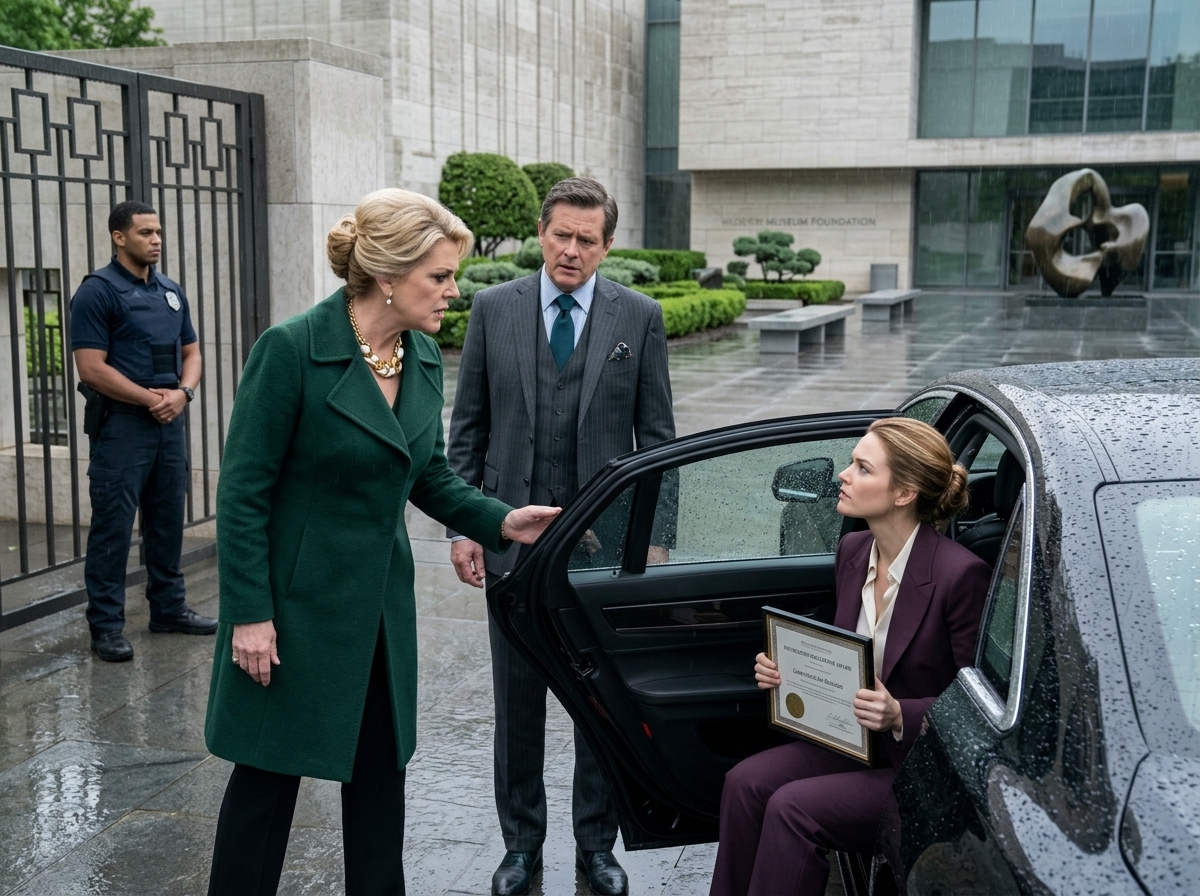
Linda leaned toward it so quickly that the security guard shifted between us.
I did not hand her the folder.
I simply turned it enough for her to read the owner line.
THE BENNETT FAMILY TRUST.
For a second, she looked as if the words were written in another language.
“That’s impossible.”
A dark SUV stopped behind her car.
Ethan climbed out wearing the navy office jacket I had bought him two Christmases earlier.
He took three steps toward us, then saw the house at the top of the drive.
Briar Ridge sat on a wooded rise beyond the gates, all pale stone, tall windows, and dark cedar beams.
It was not gaudy.
My grandmother would have hated gaudy.
It was quiet, private, and large enough that Linda’s insult about my “cheap little life” suddenly sounded ridiculous in the morning air.
Ethan stared at it.
Then he stared at me.
Linda recovered first.
She always did when there was an audience.
“Whatever game this is,” she said, “my son is entitled to half.”
I looked at Ethan.
“Is that what you told her?”
His jaw tightened.
The guard glanced at me.
“Ms.Bennett, your attorney is waiting at the main house.”
“Attorney?” Ethan said.
That one word changed his face more than the mansion had.
I closed the folder.
The deed was only the first page.
Behind it was the trust amendment Ethan had waived any claim to in our settlement.
Behind that was a letter dated six months before our divorce.
Linda reached for my sleeve.
The guard moved again, and she stopped.
“Claire,” Ethan said quietly.
“What letter?”
I opened the folder just enough for him to see the signature at the bottom.
His signature.
He went still.
Six months earlier, Linda had called us after midnight, sobbing about the mortgage on her condo.
She had fallen behind after refinancing twice, and the bank had sent a notice she claimed she did not understand.
Ethan had panicked.
I had contacted the administrator of my grandmother’s trust and arranged a short-term loan so Linda would not lose her home.
The trust had required paperwork.
Ethan signed it.
Linda signed it.
Both documents stated, in language even they could not twist, that the funds came from my family trust, that neither Ethan nor Linda acquired any ownership interest in trust property, and that Linda’s loan had to be repaid according to the schedule attached.
At the time, Ethan had barely read the pages.
“Just tell me where to sign,” he had said.
That habit had finally become expensive.
I got back into my car.
The guard looked at Linda.
“You’ll need to move your vehicle away from the entrance.”
“I’m going with her.”
“No, ma’am.”
“I am her family.”
“No,” I said through the open window.
“You’re not.”
The words were not cruel.
That surprised me.
They were simply accurate.
I drove through the gates.
In the mirror, I saw Ethan standing beside his mother as the iron bars closed between us.
My attorney, Naomi Chen, was waiting inside the library with two cups of coffee and a stack of documents on the walnut table.
She had handled the trust work after my grandmother died and had reviewed every page of my divorce settlement before I signed.
“You showed them the deed?” she asked.
“Just the first page.”
Naomi smiled faintly.
“Restraint.
I admire it.”
I sat across from her, suddenly more tired than triumphant.
People imagine revenge as a rush.
Mine felt nothing like that.
It felt like finally setting down a suitcase I had carried too long.
The Bennett Family Trust had existed since I was a teenager.
My grandparents built a small manufacturing company, sold it decades later, and placed much of what remained into a trust for their children and grandchildren.
I was never handed a fortune.
The trust paid for education, protected certain family properties, and made conservative investments.
My grandmother believed money should create choices, not noise.
Briar Ridge had been her last major purchase.
She bought the property when I was in college because she loved the trees and the view of the Cascades.
After my grandfather died, she stopped visiting often.
The house sat mostly unused except for family holidays and occasional charity events.
Eight months before my marriage ended, my grandmother died.
Her amended trust named me as the beneficiary with the right to occupy Briar Ridge and, once the administrative period closed, to direct the property’s future.
I had told Ethan that some family assets would eventually pass to me.
I had never told him what they were worth.
Not because I wanted to trap him.
Because my grandmother had taught me to watch what money did to people before telling them how much existed.
With Ethan, I had believed it did not matter.
We had built our life on our salaries.
We split bills.
We saved slowly.
I let him assume my family trust was a collection of old jewelry and minor investments because that was the part I used.
I wanted our marriage to be ours.
Then Linda began treating our joint savings like an extension of her checking account.
The trust loan had been the one exception.
I used it because losing a home is serious, and because despite everything, I did not want Ethan’s mother frightened and homeless.
Naomi slid a statement toward me.
Linda had made exactly two payments.
Then she stopped.
“Her cure period ends Friday,” Naomi said.
“The trustee sent three notices.
She ignored all three.”
I closed my eyes.
Of course she had.
“What happens if she doesn’t pay?”
“The trust follows the loan agreement.
Nothing more, nothing less.”
I nodded.
That mattered to me.
I did not want special punishment invented because she had humiliated me.
I wanted the rules she had signed to apply to her exactly as written.
My phone buzzed.
Ethan.
Then again.
Then Linda.
I turned it facedown.
Naomi tapped the divorce settlement.
“There’s another reason Ethan looked worried.”
I knew.
During mediation, his attorney had asked whether there were family assets.
My attorney disclosed that a trust existed.
Ethan’s side was given the chance to review the clause protecting both spouses’ separate inheritances and trust interests.
Ethan had insisted on moving quickly.
He wanted the Portland house.
I wanted a clean exit.
So the settlement stated that each of us released any claim to the other’s inherited, gifted, or trust-held assets, whether currently distributed or distributed later.
He had signed every page.
Linda had stood outside the glass conference room smiling.
Now she was outside another pane of glass, only this one was attached to a security gate she could not order open.
By noon, Ethan stopped calling and sent a text.
Can we talk without Mom?
I stared at the message for a long time.
Then I wrote: Tomorrow.
Naomi’s office.
Ten a.m.
He arrived alone.
That was unusual enough to make me notice.
He looked exhausted.
There were gray shadows under his eyes, and his wedding ring was gone.
Mine had been gone for months, but seeing his bare hand still landed somewhere tender.
He sat across from me and did not touch the coffee Naomi’s assistant brought in.
“So it’s really yours,” he said.
“The trust owns it.
I’m the beneficiary with exclusive occupancy rights.”
“And later?”
“Later is not your concern.”
He flinched.
For years, I had softened every sentence for him.
I had padded boundaries with apologies so they would not feel like boundaries.
I was done doing that.
Ethan looked at Naomi.
“Is there any chance the settlement can be reopened?”
She answered calmly.
“You had counsel.
The trust was disclosed.
The release was mutual.
If you believe your former attorney failed you, you should speak with independent counsel.
Claire is not discussing a new settlement.”
He looked back at me.
“I didn’t know the house was part of it.”
“You didn’t ask.”
“You made it sound small.”
“No. You decided it was small.”
He rubbed both hands over his face.
Then he said the sentence I had expected since the gate.
“Mom says you hid it on purpose.”
I almost laughed.
“Your mother also said I was temporary.”
“I know.”
“No, Ethan.
You heard her say it.
Knowing would have required you to do something.”
He looked down.
Silence used to make me rush in and rescue him.
This time I let it stay.
Finally he said, “I thought you’d cool off.”
That hurt more than I wanted it to.
Not because it surprised me.
Because it confirmed everything.
“You thought I would give up the promotion?”
“I thought we’d figure something out.”
“You mean I would.”
He did not answer.
Naomi slid a photocopy across the table.
The loan acknowledgment.
Ethan saw his own signature and closed his eyes.
“Mom’s condo,” he said.
“Yes.”
“She told me that was handled.”
“It was handled.
With a loan.
She stopped paying it.”
His head snapped up.
“She what?”
I watched the realization move through him.
Linda had not just allowed him to believe I was selfish.
She had allowed him to believe she had solved problems that I had quietly paid to solve.
“How much does she owe?” he asked.
Naomi gave him the current balance.
Ethan stared at the number.
“That can’t be right.”
“It includes the principal she stopped repaying.
The trust administrator has the complete ledger.”
“She said Claire only helped with a small gap.”
“I helped with the amount she requested,” I said.
“You signed the request.”
His face reddened.
For the first time, his anger was not pointed at me.
I did not enjoy that either.
This was not the scene I had fantasized about during sleepless nights.
There was no satisfaction in watching a man discover that the mother he had defended had been editing reality around him.
There was only sadness.
Then the office door opened.
Naomi’s assistant looked apologetic.
“Ms.Chen, there’s a woman at reception insisting she has a family emergency.”
We all knew who it was.
Linda entered before anyone invited her.
She carried a thick envelope and the fury of someone who believed volume could change a contract.
“You’re trying to take my home,” she said to me.
Naomi stood.
“Mrs.Hayes, this is a private meeting.”
“I’m his mother.”
“And Claire is my client.”
Linda slapped the envelope onto the table.
“These notices are harassment.”
Naomi opened the envelope, glanced at the contents, and placed them neatly back down.
“They are payment notices required by your loan agreement.”
Linda pointed at me.
“She can forgive the loan.”
“I can’t unilaterally rewrite the trust,” I said.
That was true.
“But you could ask.”
“I already asked the trustee for one extension last year.”
Ethan turned toward me.
“You did?”
Linda’s face changed.
There it was.
A tiny break in the performance.
I looked at him.
“She said you were stressed at work.
I didn’t want you carrying more.”
He stared at his mother.
“You told me Claire refused to help.”
Linda’s chin lifted.
“I was protecting you.”
“From what?”
“From knowing exactly what kind of woman you married.”
The room went silent.
I had heard versions of that insult for years.
This time Ethan heard it without translating.
Linda pushed on.
“She let us struggle while she sat on all this money.
She let me worry about my home.
She let you live in that ordinary little house while she had a mansion waiting.”
I almost admired the speed of the rewrite.
Naomi opened a file.
“Mrs.Hayes, the trust covered the amount you requested.
Claire also used marital funds for several of your expenses before that.
The issue today is not whether she helped you.
The records show she did.”
Linda looked at Ethan.
“Don’t listen to this.”
But he was looking at the ledger.
Page after page.
Roof repair.
Car payment.
Credit card transfer.
The emergency dental bill Linda later told friends she had paid herself.
Not all of it came from the trust.
Much of it came from the joint account Ethan and I had built paycheck by paycheck.
I had never shown him the total in one place.
Neither had Linda.
Ethan’s mouth tightened.
“Why didn’t you tell me?” he asked me.
“I did.
Each time.”
“No.
I mean the total.”
“Because every time I questioned one expense, you told me your mother needed us.”
He had no answer.
Linda did.
“She is turning you against me.”
I stood.
“No.
I’m leaving you both with the paperwork.”
That was the difference between me and Linda.
She needed Ethan to choose a side.
I no longer did.
The trust did not take Linda’s condo.
Two days before the deadline, she refinanced through another lender and repaid the overdue balance.
I later learned Ethan helped her organize the documents, but he did not ask me for money.
Briar Ridge remained behind its iron gates.
Linda tried twice to get herself added to the guest list by calling the property office and claiming there had been a mistake.
There had not been.
I gave security one instruction: she was not authorized to enter unless I personally approved it.
Months passed.
I started the Seattle job.
The first weeks were brutal in the best way.
New team, new expectations, long days, unfamiliar systems.
For the first time in years, when my phone rang during a meeting, I did not brace for Linda’s newest emergency.
I bought groceries without calculating what crisis might drain the account before Friday.
I slept through Sundays.
I learned the sound of rain on the roof of a house where nobody could walk in uninvited.
Ethan and I spoke only when necessary until, one afternoon, he asked to meet at a coffee shop halfway between Portland and Seattle.
He looked different.
Not transformed.
Not magically wiser.
Just quieter.
He told me he had started therapy.
He had also set boundaries with his mother after discovering she had hidden several unpaid bills from him.
I listened.
Then he said, “I’m sorry.”
There were years when those words would have been enough to keep me.
That day, they were enough only to hear.
“I kept waiting for you to understand what I needed without making you say it,” he continued.
“And whenever Mom got upset, I treated her discomfort like an emergency and yours like a personality flaw.”
I looked down at my coffee.
That was the most accurate thing he had ever said about our marriage.
“I should have defended you.”
“Yes.”
“I should have gone with you.”
I shook my head.
“You should have decided what you wanted before your mother decided for you.”
He swallowed.
“Was there ever a chance after that morning?”
I thought about Linda’s finger on my promotion folder.
About Ethan’s eyes fixed on his mug.
About the sentence that had ended seven years of trying.
Maybe you should go if you want it that badly.
“No,” I said.
“Not after you made me choose between my future and being your wife.”
He nodded slowly.
There was grief in his face then.
Real grief.
I felt it too.
Leaving had not erased the good years.
It had simply stopped the bad ones from demanding more.
When I drove home that evening, the gate opened before I reached it.
The guard lifted a hand.
“Welcome home, Ms.
Bennett.”
The words still did something to me.
Not because the house was expensive.
Not because Linda could not enter.
Not because Ethan had signed away a claim he never understood.
Because home had finally become a place where my life did not require someone else’s permission.
Inside, I placed the old leather folder in the library drawer.
The deed went at the bottom.
On top of it, I put my original promotion letter.
For months, I had thought the deed was the document that changed everything.
It wasn’t.
The promotion had.
The moment I chose not to make myself smaller so other people could remain comfortable, the gates had already begun to open. Read More